
Call Us
+86 136 6007 9809
Call Us
+86 136 6007 9809

Juxin Fasteners manufactures flanged threaded capacitor discharge (CD) weld studs for thin sheet metal assemblies, automotive components, electrical enclosures and industrial equipment.
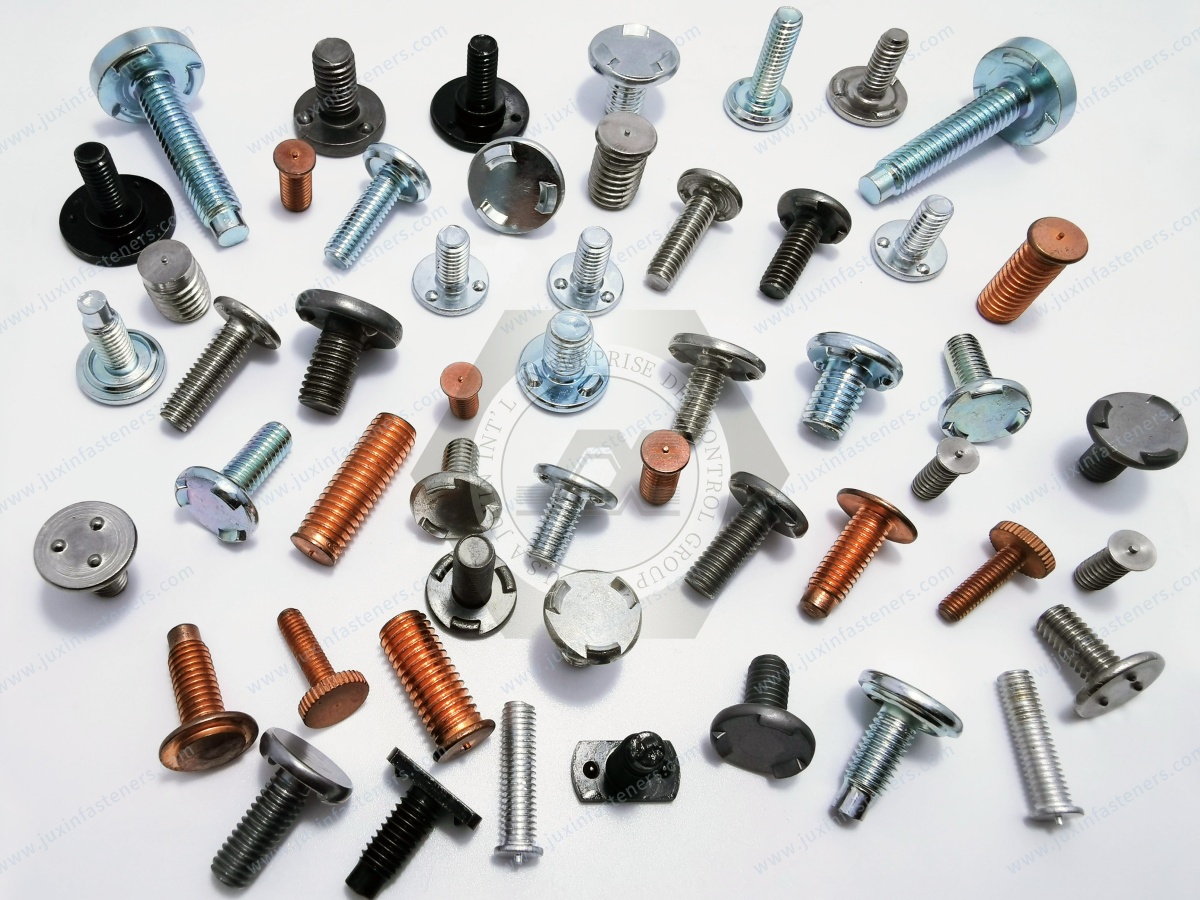
These externally threaded studs feature a circular welding flange and a calibrated ignition tip for capacitor discharge arc stud welding.
The process creates a permanent threaded mounting point without requiring a pre-drilled mounting hole.
Copper-flash-plated low-carbon steel is a key material option.
Stainless steel, aluminum and brass configurations can also be evaluated according to application requirements.
Standard references include ISO 13918 Type PT and legacy DIN 32501 specifications.
Metric threads include M3, M4, M5, M6, M8 and selected M10 designs. Inch options include #2-56 through 3/8-16, subject to drawing and manufacturing confirmation.
Juxin Fasteners supports custom OEM production, material selection, flange dimensions, ignition-tip geometry, thread specifications, surface finishes and engineering drawing evaluation.
Product Specification
Flanged Threaded CD Weld Studs – Inch & Metric
Juxin Fasteners manufactures flanged threaded capacitor discharge (CD) weld studs for automotive OEM assemblies, thin sheet metal fabrication, electrical equipment, industrial enclosures and precision manufacturing applications.
These externally threaded welding fasteners feature a circular flange and a small ignition tip on the welding face. The design is intended for capacitor discharge arc stud welding, providing a permanent threaded attachment point on compatible metal surfaces.
Our manufacturing capabilities support copper-plated low-carbon steel studs, stainless steel versions, aluminum alloys and customer-specified materials, including brass where technically suitable.
Standard metric and UNC inch threads, customized dimensions and drawing-based OEM production are available for engineering evaluation.
Product Specifications
Product Name: Flanged Threaded Capacitor Discharge Weld Studs
Alternative Names: Flanged CD Weld Studs, CD Threaded Studs, Tip-Ignition Threaded Weld Studs, Capacitor Discharge Welding Screws
Primary Material: Low-Carbon Steel
Primary Steel Finish: Copper Flash Plating
Additional Materials: Stainless Steel, Aluminum and Brass
Standard Reference: ISO 13918:2017, Type PT
Historical Standard Reference: DIN 32501
Welding Process: Capacitor Discharge Arc Stud Welding with Tip Ignition
Welding Methods: Contact and Gap CD Stud Welding, Subject to Equipment Compatibility
Head Configuration: Circular Welding Flange
Welding Feature: Calibrated Ignition Tip
Thread Configuration: External Machine Screw Thread
Thread Systems: ISO Metric, UNC and Selected UNF
Metric Thread Tolerance: According to the Approved Drawing and Applicable ISO Standard
Inch Thread Class: According to the Approved Drawing and Applicable ASME Standard
Flange Diameter: Standard or Customized
Stud Length: According to the Approved Drawing
Ignition-Tip Geometry: Controlled According to Welding Requirements
Manufacturing Service: OEM Custom Production
Applications: Automotive Components, Electrical Enclosures, Sheet Metal Assemblies and Industrial Equipment
What Are Flanged CD Weld Studs?
Flanged capacitor discharge weld studs are threaded metal fasteners designed for rapid attachment to compatible metal surfaces using stored electrical energy.
A capacitor discharge welding system releases a short pulse of energy through the stud and workpiece.
The ignition tip initiates the welding arc. Localized melting occurs at the interface, and the stud is brought into contact with the workpiece to complete the welded joint.
Once installed, the external threads provide a mounting point for nuts, brackets, electrical components and mechanical assemblies.
Unlike conventional bolted connections, the welding operation does not require a through-hole in the parent sheet.
This makes CD weld studs particularly useful where the reverse side of a metal panel must remain visually acceptable or inaccessible during assembly.
ISO 13918 Type PT and DIN 32501
ISO 13918:2017 specifies requirements for studs and ceramic ferrules used in arc stud welding.
Within this standard, Type PT identifies threaded studs intended for stud welding with tip ignition.
Type PT is the relevant standardized product designation for this externally threaded CD stud configuration.
DIN 32501 is a historical German standard reference commonly associated with capacitor discharge welding studs.
For new OEM projects, ISO 13918:2017 should be considered alongside the customer's engineering drawing and applicable welding specifications.
Compliance with a particular standard must be verified against the actual product dimensions, material properties and inspection requirements.
Why the Welding Flange Matters
The circular flange is a defining feature of this product.
Compared with the threaded shank, the flange provides a larger welding interface.
Its geometry helps establish the intended welding contact area and supports controlled joining to the parent material.
The flange also helps keep the arc concentrated around the welding interface rather than allowing it to migrate along the threaded shank.
Important flange design parameters include:
Flange Outside Diameter
Flange Thickness
Flange Flatness
Flange Concentricity
Welding Face Condition
Ignition-Tip Position
Flange-to-Shank Transition
The required dimensions depend on stud diameter, welding equipment and application requirements.
Calibrated Ignition Tip for CD Stud Welding
The ignition tip is a small projection located at the center of the welding face.
This feature is essential to the tip-ignition welding process.
When electrical energy is discharged, the ignition tip helps initiate the arc and controls the initial welding event.
Ignition-tip geometry can influence:
Arc Initiation
Arc Stability
Local Heat Generation
Welding Repeatability
Weld Interface Formation
Stud Positioning
Weld Quality Consistency
For high-volume production, ignition-tip height and diameter should be controlled according to the approved drawing and welding procedure.
Copper-Plated Low-Carbon Steel CD Weld Studs
Copper-flash-plated low-carbon steel is widely used for capacitor discharge threaded studs.
Low-carbon steel provides a weldable base material and an economical solution for repeat manufacturing.
The thin copper coating provides a controlled metallic surface and can improve electrical contact characteristics during welding.
However, copper flash plating should not be treated as equivalent to a dedicated high-corrosion-resistance coating.
Corrosion performance depends on coating thickness, exposure conditions and subsequent processing.
For automotive and electrical equipment applications, the final corrosion protection system should be specified separately when required.
Juxin Fasteners can evaluate customer requirements for copper plating, material chemistry, dimensional tolerances and welding performance.
Stainless Steel CD Weld Studs
Stainless steel threaded CD studs are suitable for applications requiring corrosion resistance and compatible welding characteristics.
Potential material options include A2-family stainless steels and other weldable stainless grades.
Material selection depends on environmental exposure, mechanical requirements and the parent metal.
Stainless steel studs may be considered for:
Outdoor Electrical Enclosures
Commercial Kitchen Equipment
Medical Equipment Housings
Industrial Control Cabinets
Stainless Steel Sheet Metal Assemblies
Food Processing Equipment
The appropriate alloy and welding procedure must be confirmed for the specific application.
Aluminum CD Weld Studs
Aluminum capacitor discharge studs provide a lightweight fastening solution for compatible aluminum components.
Potential applications include lightweight equipment housings, electronic enclosures and selected transportation components.
Aluminum alloy selection must account for weldability, electrical conductivity, mechanical properties and parent material compatibility.
Aluminum CD studs should not be assumed interchangeable with steel studs.
Brass CD Weld Studs
Brass configurations may be evaluated for specialized electrical and mechanical applications.
The brass alloy must be selected according to its welding suitability and the mating workpiece material.
Electrical conductivity alone does not establish weld compatibility.
Material and process qualification are necessary before production.
Metric Thread Sizes
Juxin Fasteners can evaluate the following metric threaded CD stud configurations:
M3 × 0.5
M4 × 0.7
M5 × 0.8
M6 × 1.0
M8 × 1.25
M10 × 1.5
Additional metric dimensions, including M2.5 and selected M12 designs, may be evaluated according to customer requirements.
Availability, stud length, flange dimensions and ignition-tip geometry must be confirmed for each specification.
UNC and UNF Inch Thread Sizes
Common inch-series threaded CD weld stud sizes include:
#2-56 UNC — 0.0860 in. Nominal Diameter (2.1844 mm)
#4-40 UNC — 0.1120 in. Nominal Diameter (2.8448 mm)
#6-32 UNC — 0.1380 in. Nominal Diameter (3.5052 mm)
#8-32 UNC — 0.1640 in. Nominal Diameter (4.1656 mm)
#10-24 UNC — 0.1900 in. Nominal Diameter (4.8260 mm)
#10-32 UNF — 0.1900 in. Nominal Diameter (4.8260 mm)
1/4-20 UNC — 0.2500 in. Nominal Diameter (6.3500 mm)
5/16-18 UNC — 0.3125 in. Nominal Diameter (7.9375 mm)
3/8-16 UNC — 0.3750 in. Nominal Diameter (9.5250 mm)
These are nominal thread designations, not guaranteed stock sizes or complete stud dimensions.
Metric and inch thread systems are not directly interchangeable.
For example, M6 × 1.0 and 1/4-20 UNC have different nominal diameters and thread pitches.
Custom inch-series designs can be evaluated against the applicable ASME thread requirements.
Capacitor Discharge Stud Welding Process
Capacitor discharge stud welding uses electrical energy stored in capacitors to produce a short-duration welding arc.
A typical process includes:
Clean and prepare the parent metal surface.
Install the appropriate stud in the welding gun.
Position the ignition tip against the intended weld location.
Set the welding parameters according to the qualified procedure.
Release the stored electrical energy.
Initiate the welding arc at the ignition tip.
Bring the stud and workpiece together to form the welded joint.
Allow the joint to solidify.
Inspect the finished weld according to the application requirements.
The actual sequence depends on whether contact or gap welding equipment is used.
Stud diameter, material, parent sheet thickness, surface condition and welding equipment all influence the required settings.
CD Welding vs. Resistance Projection Welding
Capacitor discharge stud welding and resistance projection welding are different joining processes.
CD stud welding uses a short-duration arc initiated at the stud tip.
Resistance projection welding uses electrical resistance heating and applied electrode force at engineered contact projections.
The equipment, joint design and process controls are not interchangeable.
Flanged CD weld studs should therefore be specified for the appropriate capacitor discharge welding process rather than treated as conventional ring projection weld studs.
Advantages for Thin Sheet Metal Assemblies
CD welding is particularly relevant to applications where controlled heat input is important.
Potential manufacturing benefits include:
Single-Sided Installation
No Pre-Drilled Mounting Hole
Reduced Secondary Fastening Operations
Permanent Threaded Attachment Points
Short Welding Cycle
Suitability for Thin Sheet Metal
Reduced Risk of Reverse-Side Marking
Improved Manufacturing Flexibility
Compatibility with Automated Stud Welding Equipment
Reduced Assembly Handling
The actual weld strength, deformation and reverse-side appearance depend on sheet thickness, material and qualified welding parameters.
No universal minimum sheet thickness or guaranteed mark-free result should be assumed.
Automotive OEM and Electric Vehicle Applications
Flanged threaded CD weld studs can provide mounting points on compatible automotive metal components.
Potential applications include:
Automotive Sheet Metal Brackets
Vehicle Interior Metal Assemblies
Body Equipment Mounting
Automotive Electrical Enclosures
Wiring Harness Support Brackets
Battery Pack Auxiliary Steel Brackets
Battery Management System Equipment Mounting
Electric Vehicle Power Distribution Enclosures
Thermal Management Equipment Supports
Automotive Accessory Brackets
For EV battery pack and BMS assemblies, stud selection must account for the enclosure material, electrical isolation, vibration, mechanical loading and corrosion requirements.
Steel CD studs should not be assumed suitable for direct welding to aluminum battery housings without specific qualification.
Electrical Enclosures and Power Distribution Equipment
Flanged threaded CD studs can provide attachment points for electrical equipment mounted inside fabricated metal enclosures.
Potential applications include:
Industrial Switchgear Cabinets
Electrical Distribution Panels
UPS Equipment Enclosures
Power Conversion Cabinets
Control Panel Structures
DC Power Distribution Equipment
Industrial Battery Storage Cabinets
Electrical Equipment Mounting Brackets
Where a stud is intended to provide an electrical grounding or bonding connection, the complete assembly must be evaluated for electrical continuity and applicable safety requirements.
Dedicated CD grounding stud designs may be preferable for specialized grounding applications.
AI Data Centers and Communication Equipment
Data center infrastructure requires large quantities of accurately fabricated metal equipment.
Potential applications include:
Server Cabinet Sheet Metal
Power Distribution Equipment Housings
Communication Equipment Cabinets
Cooling Equipment Metal Panels
Industrial Network Enclosures
Data Center Electrical Control Cabinets
Rack-Mounted Equipment Brackets
CD threaded studs may help simplify the installation of internal mounting components where the sheet material and assembly design are suitable.
HVAC and Thermal Management Equipment
Flanged CD weld studs can be used in compatible fabricated sheet metal assemblies for:
HVAC Equipment Cabinets
Ventilation System Housings
Air Handling Equipment
Industrial Cooling Equipment
Heat Exchanger Support Panels
Refrigeration Equipment Enclosures
Cooling System Brackets
The welding process should be validated to avoid unacceptable panel distortion or surface marking.
Medical and Laboratory Equipment
Potential applications include:
Medical Equipment Metal Enclosures
Diagnostic Equipment Cabinets
Laboratory Instrument Housings
Medical Electronics Support Structures
Stainless Steel Equipment Panels
Material selection and surface finish should be matched to cleaning requirements and the operating environment.
Commercial Kitchen and Food Processing Equipment
CD welding studs can provide threaded attachment points on compatible metal equipment.
Potential applications include:
Commercial Oven Housings
Industrial Kitchen Equipment
Stainless Steel Appliance Panels
Food Processing Machine Enclosures
Equipment Support Brackets
For hygienic applications, material selection, joint accessibility and cleanability require additional consideration.
Manufacturing and OEM Customization
Juxin Fasteners manufactures standard and custom threaded CD weld studs for OEM production.
Customization may include:
Metric Thread Specifications
UNC and UNF Threads
Stud Diameter
Stud Length
Flange Diameter
Flange Thickness
Ignition-Tip Diameter
Ignition-Tip Height
Material Grade
Copper Plating Requirements
Stainless Steel Alloy Selection
Aluminum Alloy Selection
Custom Surface Finish
Thread Tolerance
Special Dimensional Requirements
Customer-Specific Packaging
Prototype and Production Quantities
Manufacturing methods are selected according to the approved product geometry, material requirements and production volume.
Engineering Design Considerations
Successful CD stud welding requires the stud, parent material and welding equipment to be considered as a complete system.
Important design parameters include:
Parent Metal Grade
Parent Metal Thickness
Stud Material
Stud Diameter
Stud Length
Flange Geometry
Ignition-Tip Geometry
Surface Coating
Electrical Contact Conditions
Welding Energy
Welding Gun Setup
Stud Perpendicularity
Weld Strength Requirements
Reverse-Side Appearance
Corrosion Protection
Assembly Torque
Design engineers should confirm whether the application requires mechanical fastening only or an additional electrical function.
Quality Control and Weld Validation
For OEM production, inspection requirements may include:
Material Verification
Thread Gauge Inspection
Stud Length Measurement
Flange Diameter Inspection
Flange Thickness Inspection
Ignition-Tip Geometry Inspection
Surface Plating Inspection
Visual Defect Inspection
Dimensional Inspection Reports
Weld Bend Testing
Weld Tensile Testing
Weld Torque Testing
Customer-Specified Process Validation
Where required, material certificates, dimensional reports, PPAP documentation and other customer-specific records can be evaluated during quotation and production planning.
Weld testing should be performed using representative parent materials and the qualified welding procedure.
Frequently Asked Questions
What is a flanged CD weld stud?
A flanged CD weld stud is a welding fastener featuring a circular welding base and an ignition tip.
It is attached to compatible metal surfaces using capacitor discharge arc stud welding.
What does CD mean in stud welding?
CD stands for Capacitor Discharge.
The welding system stores electrical energy in capacitors and releases it rapidly to create a short-duration welding arc.
What is ISO 13918 Type PT?
Type PT identifies threaded studs intended for stud welding with tip ignition under ISO 13918.
Why are mild steel CD studs copper plated?
Copper flash plating provides a controlled metallic surface and can support electrical contact during welding.
Its corrosion protection is limited and depends on the coating specification.
Are CD weld studs suitable for thin sheet metal?
Yes. CD welding is widely used for thin metal sheets because of its short welding duration and relatively low total heat input.
Actual suitability must be verified for the workpiece.
Are inch and metric CD weld studs available?
Yes. Juxin Fasteners supports standard metric and inch-series thread configurations, as well as custom drawing-based designs.
Can stainless steel CD weld studs be supplied?
Yes. Stainless steel versions can be evaluated according to the required alloy, dimensions and welding application.
Can CD weld studs be used for electrical grounding?
They may form part of an electrical connection when the stud and complete assembly are designed and validated for that purpose.
Dedicated grounding stud configurations are available for specialized applications.
Are CD weld studs the same as projection weld studs?
No. CD welding uses an arc initiated at the ignition tip, while resistance projection welding relies on resistance heating and electrode pressure.
Can Juxin Fasteners manufacture custom CD weld studs?
Yes. Custom production can include special flange dimensions, ignition-tip geometry, thread sizes, materials, finishes and customer-specific requirements.
Request a Flanged CD Weld Stud OEM Quotation
Juxin Fasteners manufactures flanged threaded capacitor discharge weld studs for international OEM customers.
We support design engineers, manufacturing engineers, production managers,
purchasing teams and supplier development professionals requiring reliable threaded welding fasteners for industrial production.
Please provide the following information for engineering evaluation:
2D Engineering Drawing
3D CAD Model, If Available
Required Thread Size and Pitch
Stud Length
Flange Diameter and Thickness
Ignition-Tip Dimensions
Material Grade
Surface Finish
Parent Metal Material
Parent Metal Thickness
Welding Equipment or Process Requirements
Mechanical Load Requirements
Electrical Requirements, If Applicable
Inspection and Quality Documentation
Prototype Quantity
Production Order Quantity
Estimated Annual Demand
Our engineering sales team can review the specifications and prepare a manufacturing quotation based on your requirements.
Manufacturer: Juxin Fasteners
Website: www.juxinfasteners.com
Email: info@juxinfasteners.com
Flanged Threaded CD Weld Studs | Metric & Inch | Custom OEM Manufacturing
Product Packaging
Packaging Standard
At Juxin Fasteners, we apply standardized export packaging to ensure product protection, traceability, and compliance with international logistics requirements.
1. Standard Export Packaging
Unless otherwise specified, all products will be packed according to our factory standard export packaging, which includes:
Moisture-resistant inner protection
Poly bag or small box packing as required
Reinforced export cartons
Clear labeling with part number, specification, batch number, and quantity
Palletizing for sea or air shipment when necessary
Our standard packaging is designed to ensure safe transportation, efficient warehousing, and long-distance international shipping.
2. Customized Packaging Options
We also provide customized packaging solutions according to customer requirements, including but not limited to:
Private labeling
Customized barcodes
Specific carton dimensions
Retail packaging
Special pallet configuration
Customer-specific marking and identification
So that you know, customized packaging may involve additional costs and extended lead time depending on the complexity of the requirements.
3. Compliance & Quality Assurance
All packaging processes are controlled under our ISO 9001 quality management system to ensure consistency, traceability, and product integrity throughout the supply chain.
Product Pictures


Contact Us
Tel.:
+86 020 8621 0320
+86 020 3121 6067
E-mail:
Technical Support:
Navigation
SEND INQUIREY


