Call Us
+86 136 6007 9809
Call Us
+86 136 6007 9809

Automotive hydraulic and fluid systems depend on precisely matched tube fittings, threaded connectors, flare nuts and specialized fastening components to maintain reliable connections under pressure, vibration, thermal cycling and environmental exposure.
Applications range from hydraulic braking circuits and transmission fluid systems to power steering equipment, commercial vehicle hydraulics and selected thermal management assemblies.
Although these systems may use similar-looking metal connectors, their sealing principles, pressure requirements, materials and qualification procedures can differ significantly.
Product Specification
Automotive Tube Fittings & Hydraulic Connectors: Engineering Selection and OEM Sourcing
Automotive hydraulic and fluid systems depend on precisely matched tube fittings, threaded connectors, flare nuts and specialized fastening components to maintain reliable connections under pressure,
vibration, thermal cycling and environmental exposure.
Applications range from hydraulic braking circuits and transmission fluid systems to power steering equipment, commercial vehicle hydraulics and selected thermal management assemblies.
Although these systems may use similar-looking metal connectors, their sealing principles, pressure requirements, materials and qualification procedures can differ significantly.
For automotive OEMs and Tier 1 suppliers, choosing a tube fitting is not simply a matter of matching thread diameter.
The complete connection must be evaluated, including tube material, sealing geometry, assembly process, operating fluid, pressure cycles and installation conditions.
JUXIN FASTENERS supplies industrial fasteners and drawing-based custom metal components.
For automotive fluid connection projects, component drawings and technical specifications can be reviewed to determine whether the requested tube nuts,
adapters, threaded connectors or other precision metal parts fall within the applicable manufacturing and supply scope.
This engineering guide examines the differences between common tube connection systems,
identifies typical failure risks and explains the information needed for effective OEM sourcing and supplier qualification.
Automotive Fluid System Applications and Connection Requirements
Automotive fluid systems use different connection technologies according to their operating conditions.
| Automotive Application | Typical Connection Requirement | Main Engineering Concern |
|---|---|---|
| Hydraulic brake lines | Specified brake tube flare nuts and matching seats | Pressure integrity, fatigue and approved geometry |
| Transmission hydraulic circuits | Drawing-specified threaded connectors and adapters | Pressure pulsation, temperature and fluid compatibility |
| Power steering hydraulics | Application-specific hydraulic fittings | Dynamic pressure and vibration |
| Commercial vehicle hydraulic equipment | Compatible hydraulic tube fittings and adapters | Pressure rating, installation and maintenance |
| Coolant and thermal management lines | Fluid-compatible connectors and fastening hardware | Temperature, corrosion and sealing material compatibility |
| Fluid system mounting brackets | Bolts, lock nuts, studs and custom fasteners | Vibration resistance and bracket retention |
The connection method must be selected for the actual system. A fitting appropriate for an industrial hydraulic assembly is not automatically approved for an automotive brake circuit.
Brake-system components are safety-critical and require the vehicle or system manufacturer's specified design, validation and approval.
Understanding the Main Tube Fitting and Connector Designs
Several tube connection systems are used across automotive, commercial vehicle and industrial hydraulic equipment.
Their differences are especially important when developing replacement parts or qualifying alternative suppliers.
Automotive Brake Line Flare Nuts
Brake line flare nuts, also called brake tube nuts in some product catalogs, secure a formed brake tube flare against a compatible mating seat.
Common automotive brake tube connections may use different flare geometries, including ISO-style bubble flares and SAE-style inverted or double flares, depending on the vehicle design.
The tube nut provides mechanical retention and generates the force required to seat the formed tube end.
The sealing interface is primarily established by the correctly matched tube flare and mating seat—not simply by the external thread of the nut.
A brake tube nut with the correct thread diameter may still be unsuitable if its length, bearing surface, thread pitch or mating geometry differs from the original specification.
Engineering insight: Matching a brake line fitting by thread alone is insufficient.
The OEM must verify the complete connection geometry, including tube outside diameter, flare form, seat configuration, nut dimensions and tightening requirements.
DIN 2353 and ISO 8434-1 Bite-Type Tube Fittings
Bite-type compression fittings use a cutting ring or similar mechanical element to grip the outside of a suitable tube during assembly.
DIN 2353 is commonly associated with 24-degree cone compression fitting systems. ISO 8434-1 addresses 24-degree cone connectors for fluid power and general use.
These systems may be encountered in hydraulic equipment and commercial vehicle applications.
Important selection parameters include:
Tube outside diameter
Tube material and wall thickness
Fitting series and geometry
Cutting ring compatibility
Assembly procedure
Operating pressure
Pressure cycling and vibration
Surface finish and corrosion exposure
Not every fitting with a metric thread is compatible with a DIN 2353 or ISO 8434-1 connection.
The sealing geometry and complete fitting system must match.
JIC 37-Degree Flare Fittings
JIC-style 37-degree flare connections are widely used in hydraulic systems.
Relevant references include SAE J514 and ISO 8434-2 for applicable connector configurations.
These fittings use a specified 37-degree flare interface, typically combined with an appropriate straight thread for mechanical retention.
The flare geometry must not be confused with automotive 45-degree flare systems or other cone-seat designs.
A 37-degree connector and a 45-degree connector are not directly interchangeable simply because their threads appear to fit.
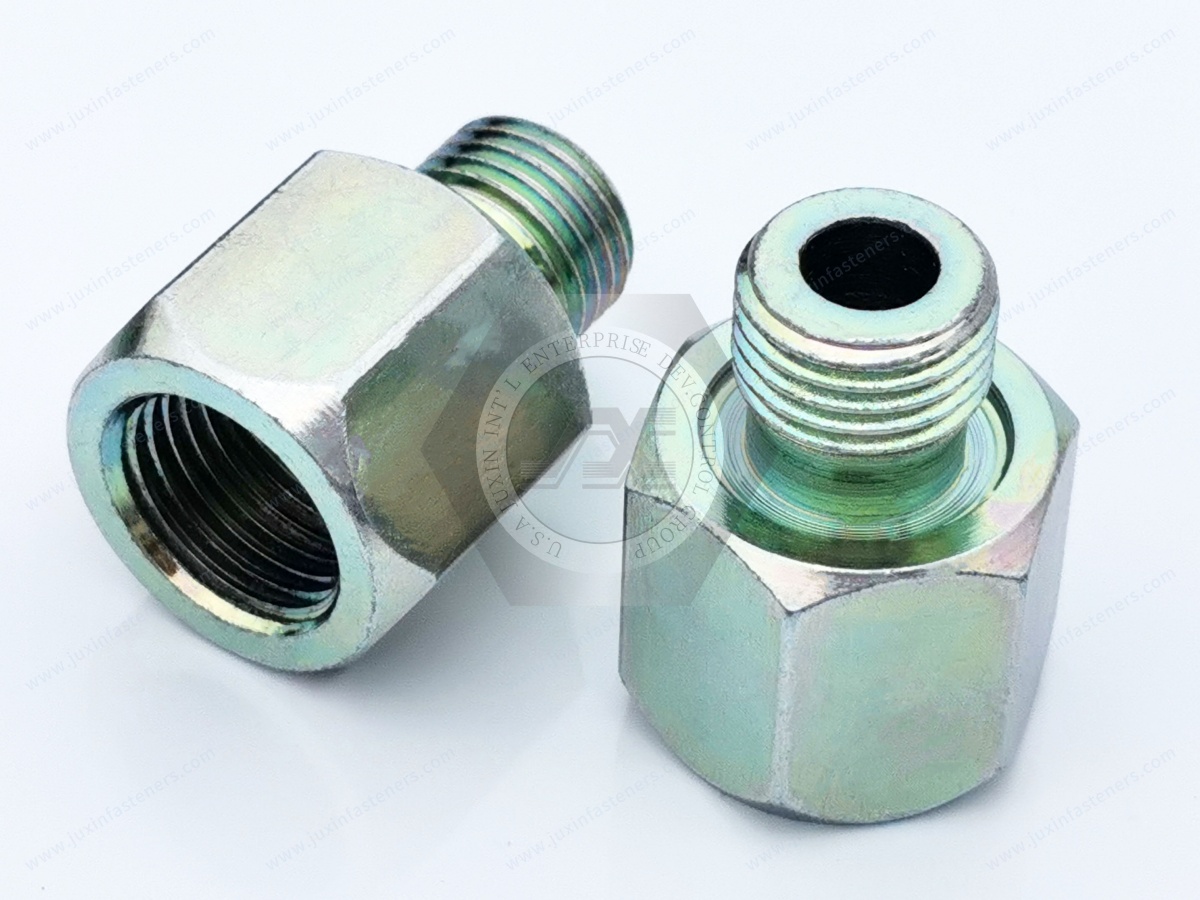
Custom Threaded Adapters and Precision Metal Connectors
Some OEM fluid systems require special connection geometries that are not covered by a standard catalog fitting.
Examples may include:
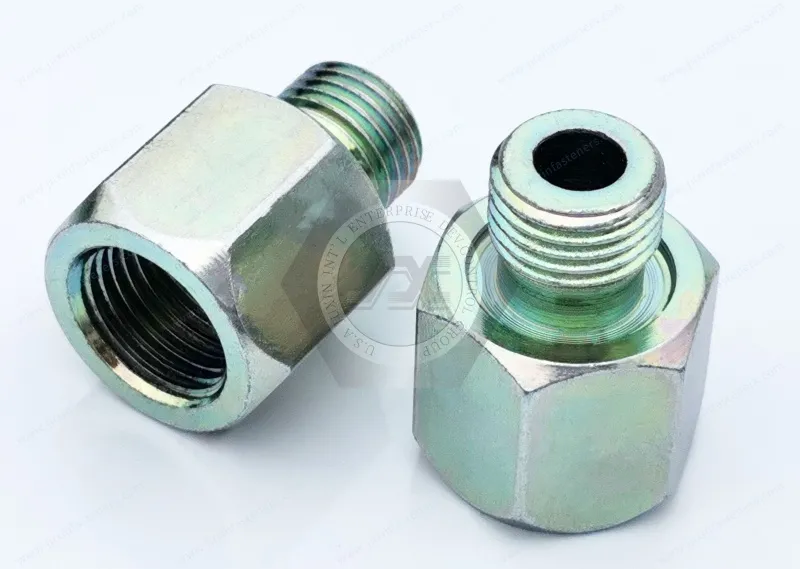
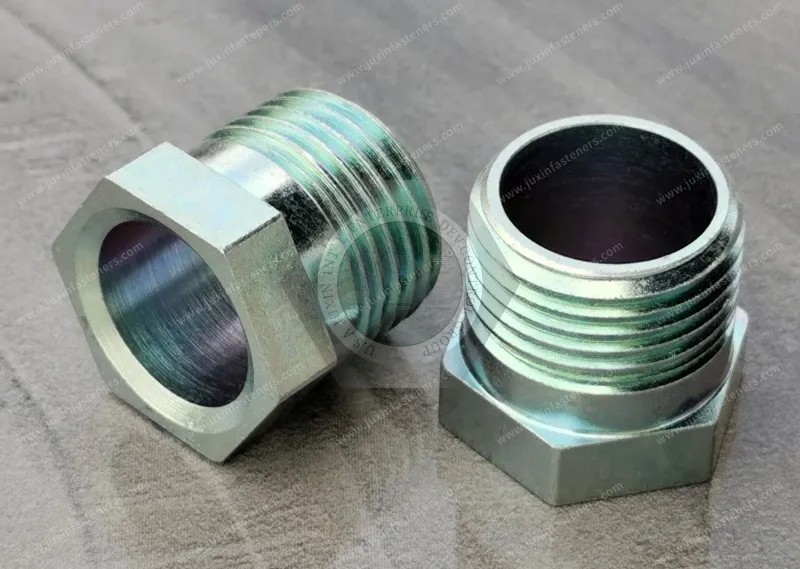
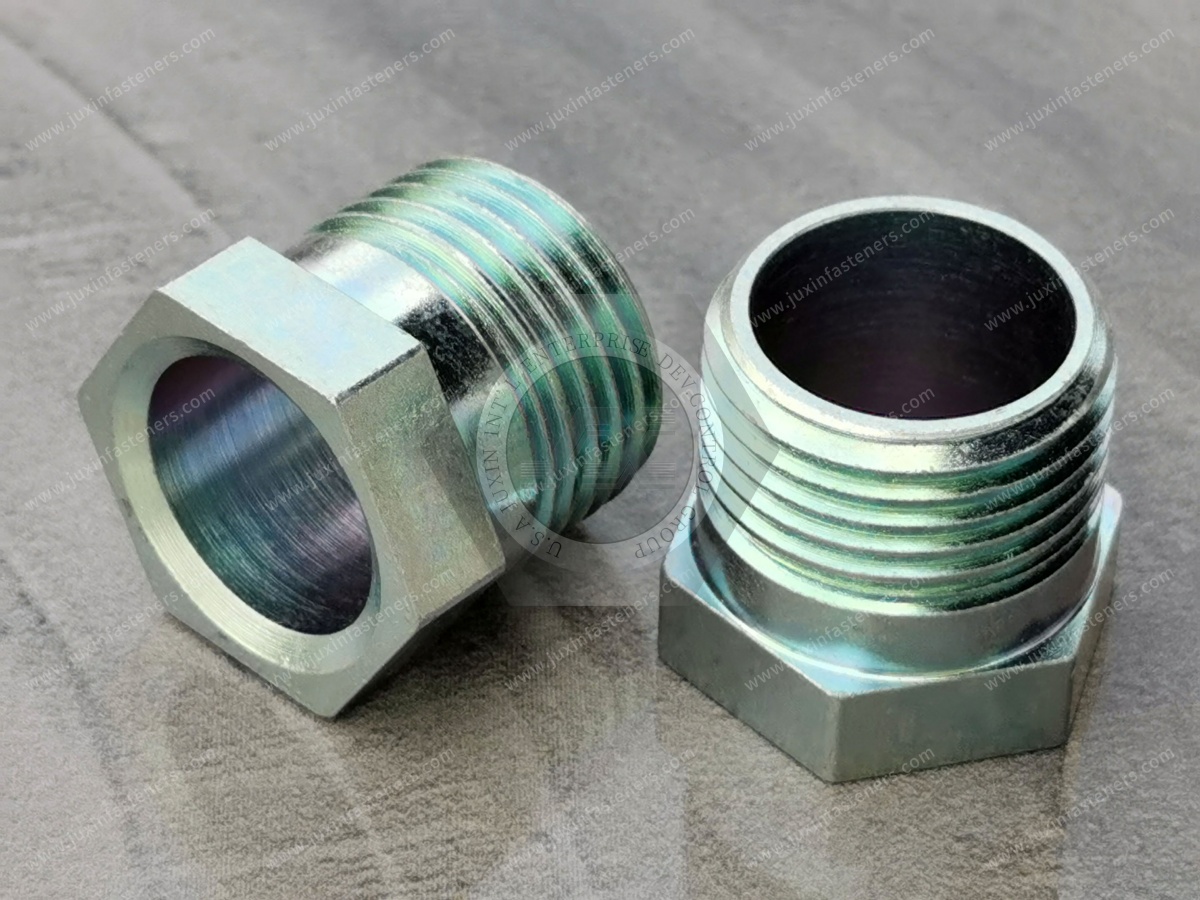
Nonstandard tube nuts
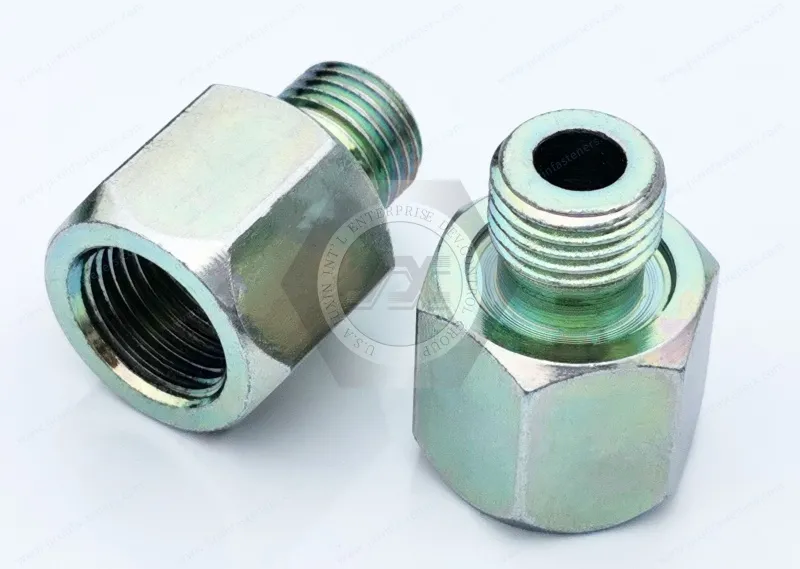
Special threaded adapters
Custom hexagonal connector bodies
Drawing-specific shoulders and seating surfaces
Precision machined metal connection components
Cold-formed blanks requiring secondary machining
Manufacturing feasibility depends on the component geometry, material, tolerance requirements, sealing surfaces, production quantity and inspection specifications.
Custom manufacturing capability should be confirmed against the submitted drawing rather than assumed from the general product category.
Why Tube Connection Sealing Geometry Matters More Than Thread Size
A threaded hydraulic connector typically performs at least two separate functions.
The thread provides mechanical engagement and assembly force.
The sealing interface prevents fluid leakage.
Depending on the design, sealing may occur through:
A formed tube flare against a mating seat
A metal cone and compatible mating surface
A cutting ring and tube interface
An elastomeric seal
A specified thread-sealing arrangement
These methods are not interchangeable.
For example, a connector using a straight thread with a separate sealing face cannot be treated as equivalent to a tapered pipe-thread connection.
Similarly, adding thread sealant to a flare fitting does not correct an incompatible or damaged flare seat.
Engineering insight: Thread engagement can be correct while the fluid connection remains unsafe or leaks.
When reviewing an alternative fitting, engineering teams should verify both the mechanical retention system and the intended sealing mechanism.
This distinction is especially important when evaluating parts supplied under different international thread systems.
Metric, UNF and Pipe Thread Compatibility
Automotive and hydraulic connector drawings may specify metric, Unified or pipe threads.
These systems require precise identification.
| Thread System | Typical Designation | Engineering Consideration |
|---|---|---|
| ISO metric | M10 × 1.0, for example | Metric diameter and pitch must match |
| Unified fine thread | 7/16-20 UNF, for example | Inch-series diameter and threads per inch |
| BSPP parallel pipe thread | G designation | Requires the correct specified sealing arrangement |
| BSPT tapered pipe thread | R designation | Tapered thread system with application-specific sealing |
| NPT tapered pipe thread | NPT designation | Different geometry from BSPT and other systems |
The examples above illustrate thread designation formats; they do not establish interchangeability or suitability for a particular vehicle.
BSPP and BSPT are not interchangeable merely because they belong to related pipe-thread families.
NPT and BSPT also differ in thread geometry.
When sourcing automotive tube fittings internationally, purchasing teams should provide the actual thread designation, applicable standard and mating component information.
Thread gauges and dimensional inspection may help identify an existing component, but they do not replace confirmation of the complete sealing design.
Pressure Pulsation, Fatigue and Leakage Risks
Hydraulic systems may experience pressure fluctuations during operation.
These pressure cycles can affect connectors, tubing and mating interfaces.
Potential failure mechanisms include:
Fatigue cracking
Tube flare damage
Joint relaxation
Seal degradation
Thread damage
Excessive assembly stress
Corrosion-assisted failure
A component's suitability depends on more than its nominal static pressure rating.
For pressure-containing connections, relevant qualification may include proof-pressure testing, burst-pressure testing,
pressure impulse testing and leakage evaluation, as required by the applicable system specification.
Test methods and acceptance criteria must be established for the actual connection design.
A burst-pressure result alone does not demonstrate resistance to long-term cyclic fatigue.
Likewise, a successful leak test at room temperature does not necessarily establish performance across the full operating temperature range.
Assembly Torque and Contact Stress
Incorrect tightening can damage a connection.
Insufficient tightening may fail to establish the intended sealing contact.
Excessive tightening may deform a tube flare, damage the sealing seat, overstress the threads or reduce reusability.
The appropriate tightening procedure depends on the fitting design and manufacturer specification.
Torque values should not be transferred between different connector systems without engineering confirmation.
Material Selection for Automotive Tube Fittings
Materials influence manufacturability, strength, corrosion behavior and compatibility with the operating environment.
Carbon Steel and Alloy Steel
Carbon steel and suitable alloy steels are commonly considered for machined or formed metal connection components.
Material selection depends on required mechanical properties, manufacturing process, surface treatment and customer drawing.
Free-machining grades may improve machining productivity, but their suitability must be evaluated against the component's strength, fatigue, forming and pressure-related requirements.
A material selected primarily for machining efficiency is not automatically appropriate for a safety-critical pressure connector.
Stainless Steel
Stainless steel may be considered where corrosion resistance is important.
However, the exact stainless steel grade and material product standard must be specified.
ISO 3506 covers mechanical properties of certain corrosion-resistant stainless steel fasteners; it should not be used as a universal material specification for all stainless steel hydraulic fittings.
For machined connector bodies, the applicable ASTM, EN or other material specification should match the actual product form and grade.
Stainless steel threaded connections may also require attention to galling, lubrication and tightening conditions.
Aluminum and Other Materials
Aluminum connector components may offer weight advantages in suitable applications.
Their suitability depends on pressure loading, fatigue performance, corrosion compatibility and the connection design.
Copper alloys and other materials may also be used in selected fluid systems, but material compatibility must be assessed for the intended fluid and operating environment.
No material should be selected solely on the basis of corrosion resistance or weight without considering the complete assembly.
Surface Treatments and Corrosion Protection
Automotive fluid connection components may be exposed to moisture, road salt, cleaning agents and temperature variation.
Potential surface treatments include suitable zinc-based coatings, zinc-nickel systems and other application-specific finishes.
The required coating should be defined by the OEM specification.
Important considerations include:
Corrosion exposure
Coating thickness
Thread fit after coating
Sealing surface requirements
Hydrogen embrittlement risk for susceptible high-strength steel parts
Coating compatibility with the operating environment
Assembly friction and tightening behavior
ASTM B117 may be used as a specified laboratory salt spray test method.
However, salt spray hours should not be presented as a direct prediction of real-world service life.
A coating that performs well in one test configuration may not provide equivalent protection on every connector geometry.
For fittings with precision metal-to-metal sealing surfaces, coating application and dimensional effects require particular attention.
Manufacturing Methods: Cold Forming and CNC Machining
Automotive connector components may be manufactured through different processes.
The optimal method depends on geometry, tolerance requirements and annual production volume.
Cold Forming
Cold forming may be suitable for certain tube nuts, hexagonal blanks and other relatively high-volume metal components.
Potential benefits include efficient material use and reduced machining requirements for suitable geometries.
However, complex internal passages, precision sealing seats or specialized features may require secondary machining.
CNC Machining
CNC machining can be suitable for lower-volume custom parts, complex geometries and components requiring accurately controlled machined features.
Critical characteristics may include:
Thread dimensions
Concentricity
Sealing seat angle
Surface finish
Bore geometry
Shoulder dimensions
Burr control
Combined Manufacturing
Some components may be produced using a formed blank followed by drilling, threading, turning or other finishing operations.
Engineering insight: The lowest unit machining cost does not always produce the lowest total assembly cost.
Production teams should also consider tool life, dimensional variation, inspection requirements, scrap rates, assembly compatibility and supply volume.
JUXIN FASTENERS can review drawing-based component requirements to determine suitable sourcing and manufacturing feasibility.
Production-Line Assembly and Quality Considerations
Manufacturing engineers and production managers often need to evaluate how a connector performs during repeated installation.
For high-volume automotive assembly, the following issues can influence production efficiency:
Thread Starting and Cross-Threading
Poor alignment, damaged lead-in geometry or inconsistent thread quality can increase cross-threading risk.
The mating component, installation angle and assembly equipment should be considered together.
Sealing Surface Protection
Precision seats can be damaged by handling, packaging or machining burrs.
Inspection and packaging requirements should reflect the importance of the sealing interface.
Automated Tightening
Automated assembly requires consistent component presentation and a validated tightening process.
Where torque monitoring is used, acceptance limits must be based on the approved joint design.
Rework and Serviceability
Some tube connection systems have specific requirements for reassembly, replacement of sealing elements or allowable reuse.
These requirements should follow the relevant connector manufacturer and OEM instructions.
A replacement part should not be qualified solely because it can be physically installed.
Engineering Validation and OEM Supplier Qualification
Automotive OEMs and Tier 1 suppliers may require formal evaluation of a new fitting or alternate component source.
The applicable process depends on the product and its safety classification.
A typical engineering and sourcing review may include:
| Qualification Area | Information to Confirm |
|---|---|
| Dimensional conformity | Drawing, tolerances, threads and sealing geometry |
| Material | Grade, specification and required documentation |
| Surface finish | Coating, thickness and critical surface restrictions |
| Assembly compatibility | Mating tube, seat, tooling and tightening procedure |
| Mechanical performance | Relevant strength and fatigue requirements |
| Fluid performance | Pressure, leakage and temperature requirements |
| Production consistency | Inspection plan and process capability requirements |
| Commercial supply | MOQ, forecast, packaging and delivery requirements |
For pressure-containing components, functional testing must be defined and approved by the responsible system manufacturer.
Material inspection documents, including EN 10204 documentation where applicable, should be specified and agreed during the sourcing process.
The availability of any particular certificate, test report or automotive approval should not be assumed without supplier confirmation.
Alternative Sourcing of Automotive Tube Nuts and Connectors
Purchasing managers and supplier development teams may need alternative suppliers for discontinued, costly or long-lead-time connector components.
A reliable alternative sourcing process should begin with the original engineering specification.
Recommended information includes:
OEM part number and drawing revision
Tube outside diameter and material
Thread designation and standard
Flare or sealing seat geometry
Material and surface treatment
Pressure and temperature requirements
Required inspection and functional tests
Annual usage and forecast
Packaging and traceability requirements
For a safety-critical component, dimensional similarity alone is not sufficient to approve an alternative source.
The OEM or designated engineering authority must evaluate and approve any required design or process changes.
Request an Automotive Tube Fitting or Custom Connector RFQ
JUXIN FASTENERS supplies industrial fastening components and supports drawing-based technical review for custom metal parts.
For automotive tube nuts, hydraulic connector components, special threaded adapters or related fastening hardware,
please submit your technical requirements for a manufacturing and sourcing feasibility assessment.
To support an efficient quotation, include:
2D technical drawing and available 3D model
Applicable product and thread standards
Material specification
Surface treatment and critical sealing surfaces
Mating tube or connector details
Pressure, temperature and fluid requirements
Required testing and documentation
Sample quantity, estimated annual demand and delivery expectations
For brake-system or other safety-critical pressure components, the requested scope and required qualification must be explicitly identified before any supply suitability can be determined.
Website: www.juxinfasteners.com
OEM Drawing Review & RFQ: info@juxinfasteners.com
Send your component drawings and sourcing requirements to discuss suitable manufacturing options and quotation feasibility.
Related JUXIN FASTENERS Engineering Solutions
Custom Cold-Headed Fasteners & Special Formed Parts for Industrial OEMs — drawing-based formed metal components and manufacturing considerations.
Precision Locknuts & Custom Machined Nuts for CNC Spindles and Rotary Systems — precision machined threaded components and dimensional requirements.
All-Metal Prevailing-Torque Lock Nuts for High-Vibration Industrial Assemblies — vibration-resistant mechanical fastening applications.
EV Battery Pack & Energy Storage Fastening Solutions for OEM Assemblies — fastening requirements for electric vehicle and energy storage equipment.
These related topics provide additional guidance on custom component sourcing, threaded fastener selection and industrial OEM qualification.
Product Packaging
Packaging Standard
At Juxin Fasteners, we apply standardized export packaging to ensure product protection, traceability, and compliance with international logistics requirements.
1. Standard Export Packaging
Unless otherwise specified, all products will be packed according to our factory standard export packaging, which includes:
Moisture-resistant inner protection
Poly bag or small box packing as required
Reinforced export cartons
Clear labeling with part number, specification, batch number, and quantity
Palletizing for sea or air shipment when necessary
Our standard packaging is designed to ensure safe transportation, efficient warehousing, and long-distance international shipping.
2. Customized Packaging Options
We also provide customized packaging solutions according to customer requirements, including but not limited to:
Private labeling
Customized barcodes
Specific carton dimensions
Retail packaging
Special pallet configuration
Customer-specific marking and identification
So that you know, customized packaging may involve additional costs and extended lead time depending on the complexity of the requirements.
3. Compliance & Quality Assurance
All packaging processes are controlled under our ISO 9001 quality management system to ensure consistency, traceability, and product integrity throughout the supply chain.
Product Pictures
Contact Us
Tel.:
+86 020 8621 0320
+86 020 3121 6067
E-mail:
Technical Support:
Navigation
SEND INQUIREY