Call Us
+86 136 6007 9809
Call Us
+86 136 6007 9809

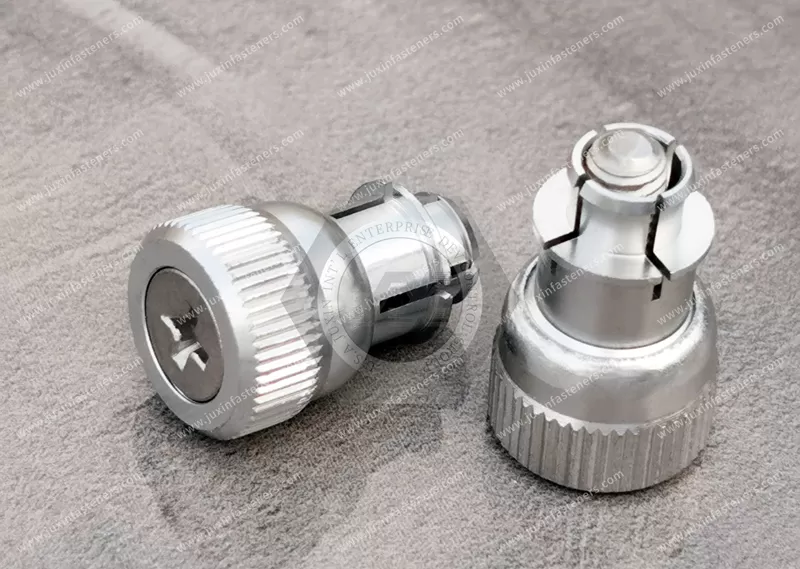
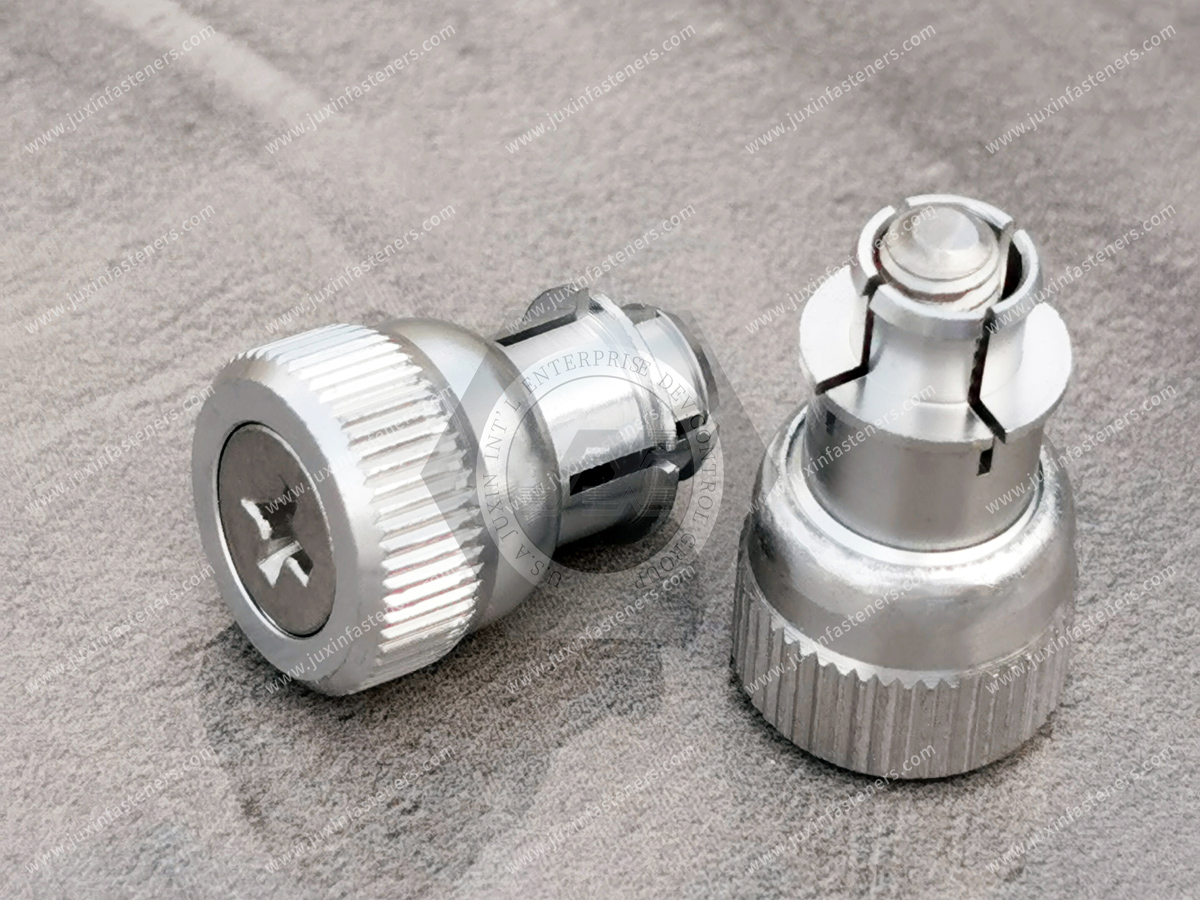
JUXIN FASTENERS supplies large-knob spring-loaded captive panel screws, Types JX-PF18, JX-PF28, and JX-PF38, for reusable fastening of industrial access panels, equipment covers, electronic enclosures, and OEM sheet-metal assemblies.
These captive panel fasteners incorporate a spring-loaded screw mechanism and an enlarged operating knob for convenient manual engagement and disengagement. Floating mounting configurations help compensate for mating-hole misalignment, reducing alignment difficulties during repeated panel assembly.
Available mounting styles include self-clinching, flaring, and floating configurations. A shoulder on the retaining component provides a positive installation stop to support consistent seating and assembly control.
The supplied material options include stainless steel, carbon steel, and aluminum, subject to component design and product configuration. Knob options include knurled or smooth metal caps, black metal caps, and customer-specified colored plastic caps.
These fasteners are suitable for industrial applications requiring retained screws, convenient maintenance access, repeatable panel installation, and controlled fastening performance. Custom dimensions and OEM configurations may be reviewed against customer drawings and the applicable technical specifications.
Product Specification
Large-Knob Spring-Loaded Captive Panel Screws for Industrial Access Panels and OEM Equipment
Product Overview
Large-knob spring-loaded captive panel screws are reusable fastening components designed to remain attached to an equipment panel when the threaded connection is disengaged.
JUXIN FASTENERS supplies the JX-PF18, JX-PF28, and JX-PF38 series for industrial assemblies requiring convenient manual operation, secure screw retention, and repeated access to enclosed components.
The enlarged operating knob provides an accessible gripping surface, while the spring-loaded screw mechanism supports controlled axial movement during engagement and disengagement.
Depending on the selected mounting configuration, the fastening system can also accommodate limited mating-hole misalignment.
This is particularly useful in removable equipment covers, industrial access panels, electronic enclosures, and modular sheet-metal assemblies where manufacturing tolerances may affect screw-to-hole alignment.
The available mounting configurations include self-clinching, flaring, and floating styles.
Product selection should be based on the required mounting method, panel material, thread configuration, available installation space, and intended operating conditions.
How Large-Knob Spring-Loaded Captive Screws Work
A captive panel screw combines a threaded fastening element with a retaining mechanism that prevents the screw from separating from the panel during normal service.
When the screw is loosened from its mating thread, the retaining component keeps the screw associated with the access panel.
The spring-loaded mechanism provides controlled axial movement and can help position the screw for subsequent engagement.
The enlarged knob allows the operator to grip and rotate the screw without relying exclusively on a separate installation tool, provided that the selected design is intended for hand operation.
This arrangement can simplify repeated panel opening and closing during inspection, adjustment, maintenance, and equipment servicing.
Unlike a loose machine screw, the captive screw remains attached to the panel when disengaged.
This reduces the need to handle and store separate screws during routine service operations.
However, the spring-loaded mechanism should not be assumed to provide a specified preload, vibration-locking function, or rated retention force without supporting product data.
Product Series and Technical Configuration
Product family: Large-knob spring-loaded captive panel screws
JUXIN series: JX-PF18, JX-PF28, and JX-PF38
Primary function: Reusable panel fastening with retained screw construction
Operating design: Spring-loaded captive screw with enlarged operating knob
Mounting configurations: Self-clinching, flaring, and floating styles
Alignment capability: Mating-hole misalignment compensation in applicable floating configurations
Retainer feature: Positive installation stop provided by the retainer shoulder
Material options: Stainless steel, carbon steel, and aluminum, subject to component configuration
Metal cap options: Knurled or unknurled finish
Additional cap options: Black metal cap or customer-specified colored plastic cap
Custom configurations: Subject to engineering review and manufacturing feasibility
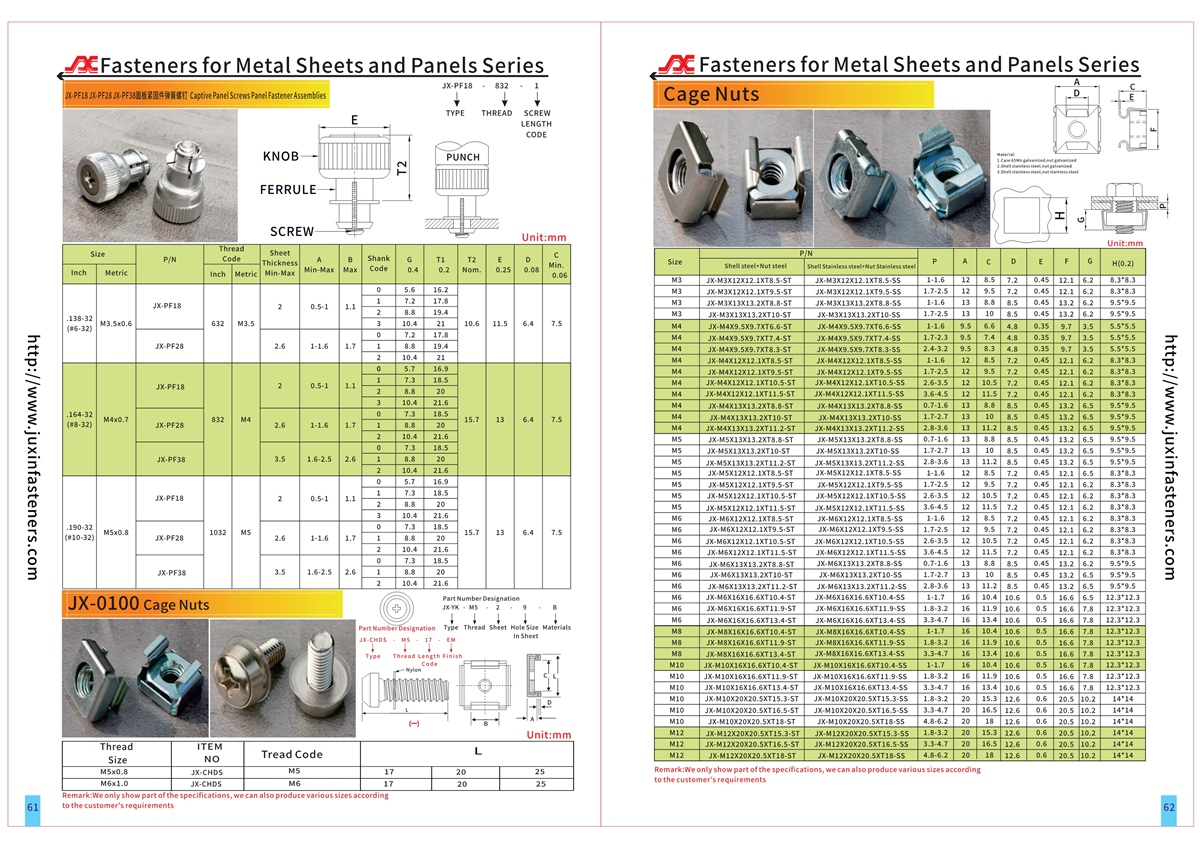
Technical reference: Applicable product specification PDF and CAD documentation, pages 61–62
The supplied information does not establish the exact dimensional differences among JX-PF18, JX-PF28, and JX-PF38.
Thread sizes, screw lengths, spring travel, floating allowance, mounting dimensions, and other critical specifications must be verified against the approved drawing for the selected model.
Spring-Loaded Screw Retention and Operating Principle
The spring-loaded mechanism is intended to support convenient screw engagement and disengagement while maintaining captive retention within the panel assembly.
During installation or closure, the screw is aligned with the corresponding threaded hole, nut, or receiving component.
The operator rotates the large knob to engage the screw thread and secure the panel.
When the screw is loosened, the captive retaining mechanism prevents the screw from becoming a loose component.
The spring provides controlled axial movement according to the specific product design.
This can make it easier to reposition the screw during repeated access operations.
For applications requiring frequent maintenance, captive retention can reduce handling time and the risk of misplaced fasteners.
The actual spring travel, spring force, and operating characteristics must be established from the product drawing or validated application data.
Floating Captive Screws for Mating-Hole Misalignment
One of the important engineering benefits identified in the supplied product information is the ability to compensate for mating-hole misalignment.
In floating configurations, the captive fastening arrangement permits limited movement of the screw relative to its nominal mounting position.
This movement can help the screw align with a receiving thread when the panel hole and mating component are not perfectly concentric.
Potential sources of misalignment include sheet-metal manufacturing tolerances, panel bending, assembly stack-up, coating thickness, and variation between mating components.
A floating captive screw may reduce the need for manual repositioning during assembly.
This can be particularly useful in equipment with multiple panel fastening points.
However, floating movement is not unlimited.
The allowable radial displacement and axial travel depend on the selected fastener configuration.
The floating allowance should not be used as a substitute for proper dimensional control of the equipment assembly.
Design engineers must verify that the permitted movement is sufficient for the expected tolerance stack-up without causing thread damage or interference.
A self-clinching or flaring captive screw should not automatically be assumed to provide the same floating capability as a dedicated floating configuration.
Self-Clinching Mounting Configuration
Self-clinching captive panel fasteners are installed into appropriately prepared sheet-metal mounting holes using controlled press force.
The mounting component incorporates retention geometry designed to engage the surrounding panel material.
During installation, suitable sheet material is displaced into the fastener retention features.
This creates mechanical retention between the mounting component and the panel.
The process requires compatible sheet material, correct mounting-hole preparation, and suitable installation tooling.
Panel hardness is particularly important because the material must deform sufficiently to achieve the intended mechanical interlock.
The original product information refers to installation in panels of any hardness.
For engineering accuracy, this statement should be understood as referring to the availability of different mounting solutions rather than universal compatibility of every self-clinching configuration with every panel material.
Self-clinching installation is not automatically suitable for hardened panels or materials that cannot provide the required deformation.
Final panel compatibility must be verified for the selected fastener and substrate combination.
Flaring Mounting Configuration
Flaring mounting uses controlled deformation of a designated retaining feature to secure the captive fastener assembly to the panel.
This method differs from conventional self-clinching installation.
Instead of relying exclusively on sheet-metal flow into a clinching undercut, a flaring configuration retains the component through deformation of the appropriate mounting feature.
Depending on the design, flaring installation may be considered where self-clinching installation is unsuitable or where panel material characteristics require an alternative retention method.
The required mounting-hole dimensions, panel thickness, tooling, and deformation geometry must be obtained from the applicable product drawing.
Incorrect flaring can result in insufficient retention, component distortion, or interference with screw movement.
The installation process should be validated using the actual panel material and production tooling.
Floating Mounting Configuration
Floating mounting is intended to provide controlled positional freedom for the captive screw.
This feature helps compensate for limited differences between the screw mounting position and the mating threaded hole.
Floating captive panel screws can be useful in assemblies where multiple fasteners must engage simultaneously or where manufacturing tolerances create small alignment variations.
The design engineer should verify the allowable floating movement, available screw travel, mounting clearance, and required thread engagement.
The mounting arrangement must retain the screw securely while allowing the specified movement.
Floating capability should not be confused with unrestricted movement or automatic correction of major panel misalignment.
Positive Installation Stop Provided by the Retainer Shoulder
The supplied product information identifies a shoulder on the retaining component that provides a positive stop during installation.
This feature helps define the intended installation position and can reduce the risk of uncontrolled insertion depth.
A positive installation stop is valuable in production environments because it provides a physical seating reference.
When combined with suitable tooling, it can support consistent mounting position and repeatable assembly results.
However, the shoulder does not eliminate the need to control installation force, panel preparation, or tooling alignment.
The final installed condition should be inspected against the approved product drawing.
Material Selection for Captive Panel Screws
The supplied product information identifies stainless steel, carbon steel, and aluminum as material options.
These materials may be used for different components within the captive screw assembly, depending on the selected configuration.
Stainless Steel
Stainless steel may be considered where corrosion resistance, appearance, or environmental durability is important.
The exact stainless steel grade must be specified according to the required mechanical properties and operating conditions.
A general stainless steel designation does not establish a particular ASTM, EN, or other material grade.
Carbon Steel
Carbon steel may be suitable for components requiring particular strength, machinability, or manufacturing characteristics.
Surface protection may be necessary depending on the operating environment.
The applicable steel grade, heat treatment, and coating requirements should be defined by the approved drawing or purchase specification.
Aluminum
Aluminum may be considered for selected knob or other component configurations where reduced weight and suitable machinability are beneficial.
Its mechanical properties, wear behavior, and compatibility with mating components must be evaluated.
Aluminum should not automatically be substituted for steel or stainless steel in load-bearing or retention-critical components.
Material Combination and Compatibility
A captive panel screw is an assembly rather than a single homogeneous part.
The screw, knob, retainer, and spring may require different materials according to their mechanical functions.
The supplied material list does not establish the material grade of every individual component.
Final material combinations should be confirmed during engineering review.
Knob and Cap Configuration Options
The supplied product information identifies several available knob or cap styles.
Knurled Metal Caps
Knurled surfaces provide a textured gripping area that can improve manual handling.
They may be useful where operators repeatedly open and close access panels.
Unknurled Metal Caps
Smooth metal caps provide an alternative appearance and surface texture.
They may be selected where a smooth operating surface is preferred or where equipment styling requires a less textured finish.
Black Metal Caps
Black metal caps may be considered for equipment requiring a dark external hardware appearance.
The coating or finishing process must be confirmed separately because the supplied information does not identify a specific black surface treatment.
Custom-Color Plastic Caps
Customer-specified colored plastic caps may support visual identification, equipment styling, or differentiation between access points.
Color selection should not be interpreted as an established safety identification system without appropriate application design.
The exact polymer material, color specification, temperature resistance, and chemical compatibility must be confirmed for the selected product.
Not every cap style should be assumed available for every JX-PF18, JX-PF28, or JX-PF38 configuration.
Metric and Inch Thread Selection
Captive panel screws may be specified using metric or Unified inch-thread systems according to the equipment design.
The supplied information does not provide a verified thread-size table for the JX-PF18, JX-PF28, and JX-PF38 series.
Therefore, specific metric or inch-thread sizes should be selected only from the approved technical drawing or confirmed product configuration.
For metric designs, thread specifications should be established according to the applicable ISO metric thread requirements.
For Unified-thread designs, the applicable ASME/ANSI thread designation should be identified.
Metric and Unified threads are not directly interchangeable.
Even when nominal diameters are similar, differences in thread pitch and profile may prevent correct engagement.
Design engineers should verify mating thread compatibility, usable engagement length, screw travel, and tightening requirements.
Industrial Applications and Engineering Solutions
Industrial Control Cabinets and Electrical Enclosures
Large-knob captive panel screws can be used in equipment covers and access panels that require repeated opening for inspection or maintenance.
The captive construction keeps screws attached to the panel during servicing.
This can reduce loose hardware handling around electrical and electronic components.
The enlarged knob may also improve accessibility where operators need to remove panels without specialized tools.
Final suitability depends on the enclosure design, mechanical retention requirements, and electrical safety considerations.
AI Data Center and Server Equipment
Data center infrastructure includes equipment housings, server chassis, power distribution assemblies, and serviceable electronic modules.
Spring-loaded captive panel screws may be suitable for selected covers and access points requiring frequent maintenance.
Floating configurations can be useful where multiple fastening points must align during panel installation.
The fastener should be evaluated for vibration, repeated operating cycles, available space, and the equipment's maintenance procedures.
No application-specific vibration rating or service-life performance is established by the supplied information.
Power Electronics and UPS Equipment
Power conversion systems, UPS enclosures, industrial power supplies, and electrical control equipment often contain removable panels and maintenance covers.
Large-knob captive screws can provide reusable fastening while retaining the screw within the panel.
The selection should consider operating temperature, electrical clearance, material compatibility, and maintenance access.
The fastener is a mechanical attachment component and should not automatically be assumed to provide electrical grounding or a safety interlock.
Industrial Automation and Machinery
Industrial machinery frequently requires removable guards, service panels, inspection covers, and adjustment access points.
Captive panel screws may simplify repeated removal and reinstallation of suitable non-safety-critical covers.
Floating configurations may reduce alignment difficulties when equipment panels contain multiple fastening points.
Production engineers should evaluate installation time, operator access, screw retention, and the risk of cross-threading.
Where a panel forms part of a machine safety guard, the complete guarding system must satisfy the applicable safety requirements independently of the fastener's general captive function.
Semiconductor and Precision Equipment
Precision manufacturing equipment may incorporate serviceable control housings, instrument panels, and internal access covers.
Captive panel fasteners can help prevent loose screws during maintenance.
The suitability of metal or plastic knob configurations depends on the environment, cleaning requirements, material compatibility, and equipment design.
Cleanroom suitability, particle-generation characteristics, and vacuum compatibility must be independently validated where required.
EV Electronics and Battery-Related Equipment
Electric vehicle electronic assemblies and battery-related equipment may include removable housings, control panels, and service access covers.
Large-knob captive screws can be evaluated for appropriate non-safety-critical fastening functions.
The selected material and mounting configuration should be reviewed for vibration, thermal cycling, corrosion exposure, and repeated maintenance operations.
Applications involving high-voltage access control or safety-critical retention require separate engineering approval and appropriate safeguards.
Medical and Laboratory Equipment Enclosures
Laboratory instruments and precision equipment may require frequent access to internal components for calibration, inspection, and maintenance.
Captive panel screws can reduce loose hardware handling and support repeated panel assembly.
However, material compatibility, cleaning resistance, and any applicable regulatory requirements must be evaluated separately.
No medical-device certification is implied by the product description.
Telecommunications and Network Equipment
Telecommunications cabinets, network enclosures, and communication equipment may use captive screws for removable access panels and modular housings.
The enlarged knob can support manual servicing where the equipment layout provides sufficient operating clearance.
Floating mounting may be useful where panel alignment varies slightly during installation.
Equipment-specific mechanical and environmental requirements must be verified before approval.
Captive Panel Screws Compared with Conventional Fasteners
Captive Panel Screws vs. Standard Machine Screws
A standard machine screw becomes a separate loose component when fully removed.
A captive panel screw remains attached to the panel through its retaining mechanism.
This can improve handling efficiency during repeated maintenance.
However, captive screws require appropriate mounting geometry and may involve additional installation considerations.
Spring-Loaded Captive Screws vs. Non-Spring-Loaded Captive Screws
Spring-loaded designs incorporate a spring mechanism that provides controlled axial movement.
Non-spring-loaded captive screws may rely on a different retention and positioning arrangement.
The preferred design depends on operating clearance, engagement requirements, service frequency, and assembly geometry.
Floating Captive Screws vs. Fixed-Mount Captive Screws
Floating designs permit limited positional movement to compensate for mating-hole misalignment.
Fixed-mount designs maintain a more constrained screw position.
Floating capability may simplify engagement in tolerance-sensitive assemblies, but it should not replace proper dimensional control.
Large-Knob Captive Screws vs. Tool-Driven Captive Screws
Large-knob designs provide an accessible gripping surface for manual operation.
Tool-driven designs may be preferable where the specified tightening torque cannot be achieved reliably by hand.
The correct selection depends on required clamping force, available operating space, access frequency, and service procedures.
Installation and Manufacturing Considerations
For manufacturing engineers and production managers, captive screw selection should account for both component performance and installation process requirements.
The mounting method influences hole preparation, tooling selection, installation force, and inspection procedures.
Self-clinching configurations require compatible sheet material and controlled press installation.
Flaring configurations require suitable deformation tooling and correct mounting geometry.
Floating configurations require verification of positional movement and retention.
The retainer shoulder provides a positive installation stop, but production tooling must still maintain proper alignment and avoid component damage.
A practical production validation process should evaluate mounting retention, screw movement, spring operation, knob accessibility, and engagement with the mating thread.
For repeat OEM production, dimensional inspection and functional checks can help maintain consistent assembly performance.
Production Efficiency and Total Installed Cost
Captive panel screws may offer operational advantages in equipment requiring frequent access.
By retaining screws within the panel, they can reduce time spent handling loose fasteners during maintenance.
Large operating knobs may improve manual accessibility where the design permits tool-free operation.
Floating mounting can reduce alignment difficulties in assemblies with multiple fastening locations.
However, total installed cost should also include mounting-hole preparation, installation tooling, component price, inspection time, and replacement requirements.
The preferred configuration should be selected according to production volume, service frequency, operating environment, and equipment design.
For purchasing and production teams, evaluating the complete assembly process provides a more useful comparison than comparing fastener unit prices alone.
Common Design and Installation Risks
Incorrect Mounting Hole Preparation
An improperly sized mounting hole may prevent reliable retention or cause installation damage.
Hole geometry must match the selected mounting style and approved drawing.
Incompatible Panel Hardness
Self-clinching retention depends on appropriate sheet material deformation.
Hard panels may require an alternative mounting method.
The correct installation style must be selected according to the actual substrate.
Insufficient Floating Clearance
A floating captive screw cannot compensate for unlimited misalignment.
The permitted movement must be sufficient for the expected assembly tolerance stack-up.
Incorrect Screw Engagement
Misalignment, insufficient thread engagement, or excessive tightening force can damage the screw or mating thread.
The complete fastening joint should be evaluated before production approval.
Insufficient Operating Clearance
Large knobs require adequate surrounding space for manual gripping and rotation.
Engineers should verify accessibility in the assembled equipment.
Incorrect Cap Material Selection
Plastic caps may have different temperature, chemical resistance, and wear characteristics from metal caps.
Material selection must reflect the actual operating environment.
Unverified Tightening Torque
The enlarged knob does not establish a specific tightening torque or clamping force.
Required joint preload and torque limits must be determined from the approved design and validated application requirements.
OEM Engineering Selection Checklist
Before specifying a JX-PF18, JX-PF28, or JX-PF38 captive panel screw, engineering teams should confirm the following.
Selected product model and drawing revision
Required metric or Unified thread specification
Screw length and usable thread engagement
Spring travel and operating characteristics
Panel material, thickness, and hardness
Self-clinching, flaring, or floating mounting method
Required floating allowance
Mounting-hole geometry and installation tooling
Knob diameter and available operating clearance
Metal or plastic cap configuration
Required material and surface finish
Expected tightening requirements
Environmental exposure and operating temperature
Maintenance frequency and expected operating cycles
Inspection and quality documentation requirements
Final selection should be supported by the approved product drawing and application validation.
OEM Purchasing and Supplier Qualification
JUXIN FASTENERS supports inquiries from OEM manufacturers, equipment builders, purchasing engineers, supplier development teams, procurement managers, and industrial supply chain organizations.
For accurate quotation, buyers should identify the required JX-PF18, JX-PF28, or JX-PF38 model and provide the corresponding technical drawing.
The purchasing specification should include thread requirements, mounting method, panel details, knob configuration, material requirements, and expected order quantity.
For customer-specific supply programs, buyers may also specify annual demand, delivery schedules, packaging requirements, labeling instructions, and drawing revision controls.
Any required dimensional inspection, material documentation, first-article reporting, or customer-specific qualification procedure should be identified during the RFQ stage.
Production feasibility, quality documentation, and commercial requirements should be agreed upon before order confirmation.
Custom Large-Knob Captive Panel Screw Solutions
Customer-specific captive screw configurations may be evaluated where standard product dimensions or knob designs do not satisfy the application.
Potential customization requirements include:
Thread specification and screw length
Spring travel and operating characteristics
Retainer and mounting geometry
Floating allowance
Knob diameter and surface texture
Knurled or smooth metal caps
Black metal cap finishes
Customer-specified plastic cap colors
Material selection
Surface treatment
Dimensional tolerances
Customer-specific inspection requirements
OEM packaging and labeling
Custom manufacturing feasibility depends on the required geometry, material combination, tooling, production volume, and engineering validation.
Customers are encouraged to provide 2D drawings, available 3D CAD models, and estimated annual purchasing quantities.
Frequently Asked Questions
What is a large-knob spring-loaded captive panel screw?
It is a reusable panel fastening component that combines a retained screw, spring-loaded axial movement, and an enlarged operating knob for convenient engagement and disengagement.
What is the main advantage of a floating captive panel screw?
A floating configuration allows limited positional movement to compensate for mating-hole misalignment, helping the screw engage the corresponding threaded component.
Can these captive screws be installed in panels of any hardness?
The product family includes different mounting styles that may support a range of panel materials. However, self-clinching, flaring, and floating configurations have different installation requirements. Compatibility must be confirmed for the selected mounting method and panel material.
What is the purpose of the retainer shoulder?
The shoulder provides a positive installation stop, helping establish the intended seating position during mounting.
Are knurled and smooth knobs available?
The supplied product information identifies knurled and unknurled metal caps as available options. The applicable configuration should be confirmed for the selected model.
Can the knob be supplied in black or a custom color?
The supplied options include black metal caps and customer-specified colored plastic caps. Material, finish, color, and availability must be confirmed during quotation.
Do spring-loaded captive screws prevent screws from being lost?
Their captive construction is intended to retain the screw within the panel during normal disengagement, reducing loose fastener handling. Actual retention performance depends on correct installation and the approved design.
Can these screws be tightened by hand?
Large knobs provide a convenient manual gripping surface. Whether hand tightening is sufficient depends on the required clamping force, operating conditions, and equipment design.
What is the difference between JX-PF18, JX-PF28, and JX-PF38?
All three are identified as large-knob spring-loaded captive panel screw series. Their exact dimensional and configuration differences must be confirmed using the corresponding technical drawings.
Can JUXIN FASTENERS review custom captive screw designs?
Customer-specific drawings and technical requirements may be submitted for engineering review. Manufacturing feasibility, material selection, tooling, and final specifications must be confirmed before quotation.
What should an OEM purchasing team include in an RFQ?
An effective RFQ should include the model, drawing, thread specification, mounting method, panel material, knob requirements, quantity, annual demand, quality documentation, and delivery expectations.
Related Captive Panel Fasteners and Sheet-Metal Hardware
For additional equipment fastening requirements, consider these related JUXIN FASTENERS product families:
Spring-Loaded Captive Panel Screws
Floating Captive Panel Screws
Self-Clinching Captive Panel Fasteners
Flare-Mounted Captive Screws
Low-Profile Captive Panel Screws
Self-Clinching Nuts and Standoffs
Precision Panel Fastening Components
These related product families provide different installation, retention, and operating characteristics.
The appropriate fastening solution should be selected according to panel design, installation requirements, mating-thread alignment, and expected maintenance frequency.
Contact JUXIN FASTENERS for OEM Captive Panel Screw RFQs
JUXIN FASTENERS supplies industrial fastening components for OEM manufacturers, equipment builders, purchasing teams, and international industrial supply chains.
For large-knob spring-loaded captive panel screws, Types JX-PF18, JX-PF28, and JX-PF38, our team can review technical drawings, mounting requirements, material specifications, and purchasing quantities.
We welcome inquiries involving standard configurations, custom knob designs, floating mounting solutions, repeat production orders, and project-specific panel fastening requirements.
To request an engineering review or commercial quotation, please provide your technical drawings, application requirements, estimated purchasing quantities, and delivery expectations.
Email: info@juxinfasteners.com
Website: www.juxinfasteners.com
Contact JUXIN FASTENERS to discuss spring-loaded captive panel screw selection, custom fastening requirements, and long-term OEM supply opportunities.
Product Packaging
JUXIN FASTENERS offers protective packaging arrangements for large-knob spring-loaded captive panel screws and other precision industrial fastening components.
Depending on product dimensions, knob materials, surface finishes, and shipment quantities, packaging may include suitable protective wrapping or separation, corrugated cartons, and palletized shipping arrangements.
Special consideration may be given to protecting knurled metal knobs, finished metal caps, plastic caps, and threaded components from handling damage during transportation.
For OEM and industrial supply programs, customer-specific packaging requirements may include part-number identification, carton labeling, lot identification, protective separation, and packing instructions.
Final packing quantities, carton dimensions, pallet configurations, and labeling requirements will be confirmed according to the approved purchase order and shipment specifications.
Product Pictures
Contact Us
Tel.:
+86 020 8621 0320
+86 020 3121 6067
E-mail:
Technical Support:
Navigation
SEND INQUIREY