Call Us
+86 136 6007 9809
Call Us
+86 136 6007 9809

120° Countersunk Closed-End Aluminum Blind Rivets
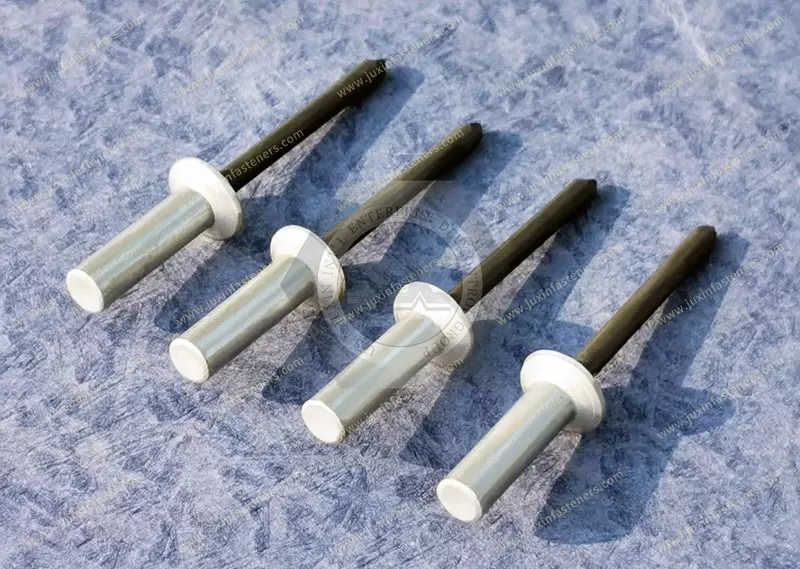
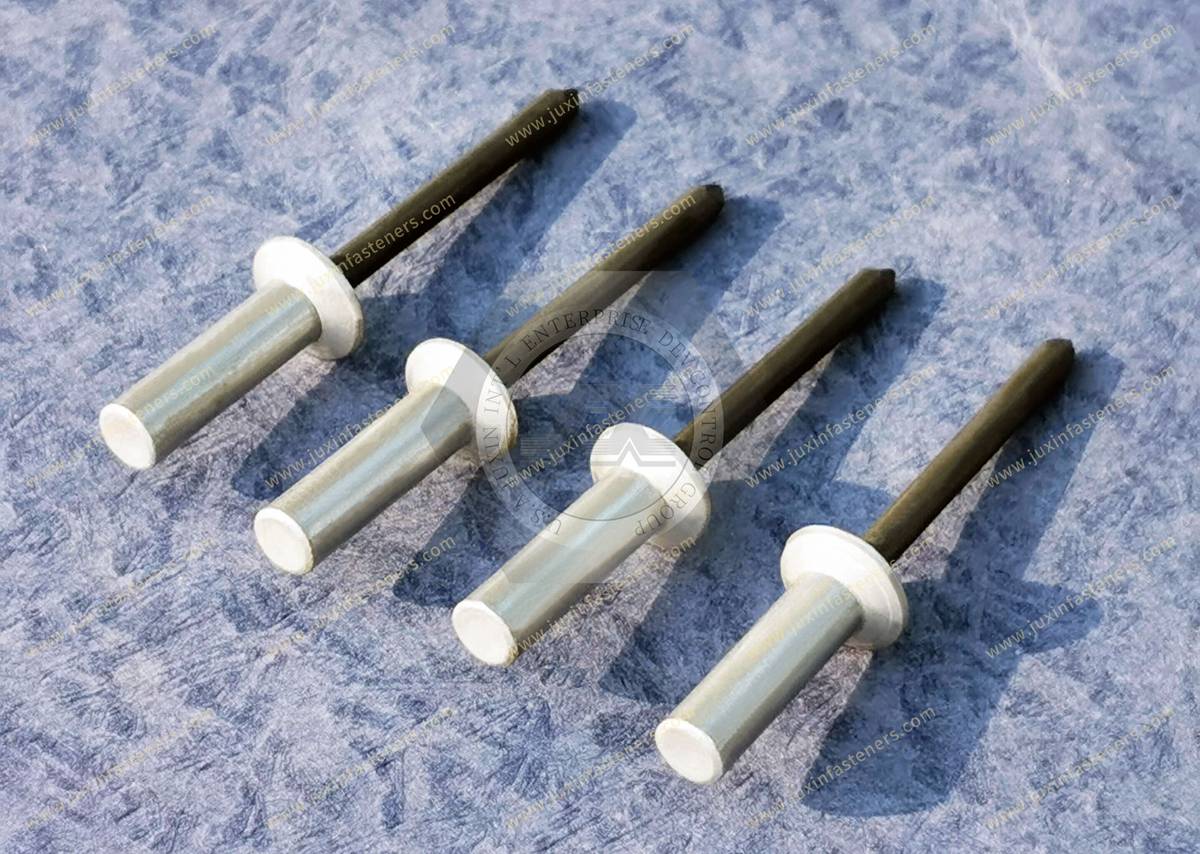
JUXIN FASTENERS supplies closed-end aluminum blind rivets with 120° countersunk heads and steel or aluminum mandrel configurations.
The closed cup-shaped rivet body helps restrict leakage through the mandrel passage, while the countersunk head provides reduced surface projection in correctly prepared holes.
For compatible sheet-metal enclosures, electrical equipment and noncritical EV battery enclosure assemblies.
Grip range, mechanical performance and complete joint sealing require engineering verification.
Product Specification
120° Countersunk Closed-End Aluminum Blind Rivets for OEM Sheet-Metal and Equipment Assemblies
Product Overview
JUXIN FASTENERS supplies 120° countersunk closed-end aluminum blind rivets for industrial sheet-metal fabrication, equipment enclosures, lightweight metal assemblies and OEM manufacturing applications.
The product is specified with an aluminum rivet body and two pull-mandrel material configurations:
Aluminum body with steel mandrel
Aluminum body with aluminum mandrel
Both configurations are identified in the original product information as closed-end blind rivets with 120° countersunk heads.
The closed-end construction uses a cup-shaped rivet body to restrict the passage of moisture, vapor and contaminants through the mandrel channel.
The 120° countersunk head is designed to fit a matching countersink, reducing head projection when the mounting hole and joint geometry are correctly prepared.
These characteristics can be useful in lightweight metal enclosures, electrical equipment housings and selected industrial assemblies where one-sided installation, surface clearance and leakage control are important.
Actual dimensions, grip ranges, material grades, mechanical performance and joint sealing must be confirmed against the approved engineering specification.
Product Identification and Material Configurations
| Item | Specification |
|---|---|
| Product Name | 120° Countersunk Closed-End Aluminum Blind Rivets |
| Product Type | Closed-End Break-Mandrel Blind Rivet |
| Rivet Body Material | Aluminum |
| Mandrel Option A | Steel |
| Mandrel Option B | Aluminum |
| Head Style | 120° Countersunk |
| Body Construction | Closed-End / Cup-Shaped |
| Installation | One-Sided Blind Riveting |
| Primary Features | Reduced Head Projection and Closed Mandrel Passage |
| Exact Aluminum Alloy | To be confirmed |
| Steel Mandrel Grade | To be confirmed |
| Surface Finish | To be confirmed |
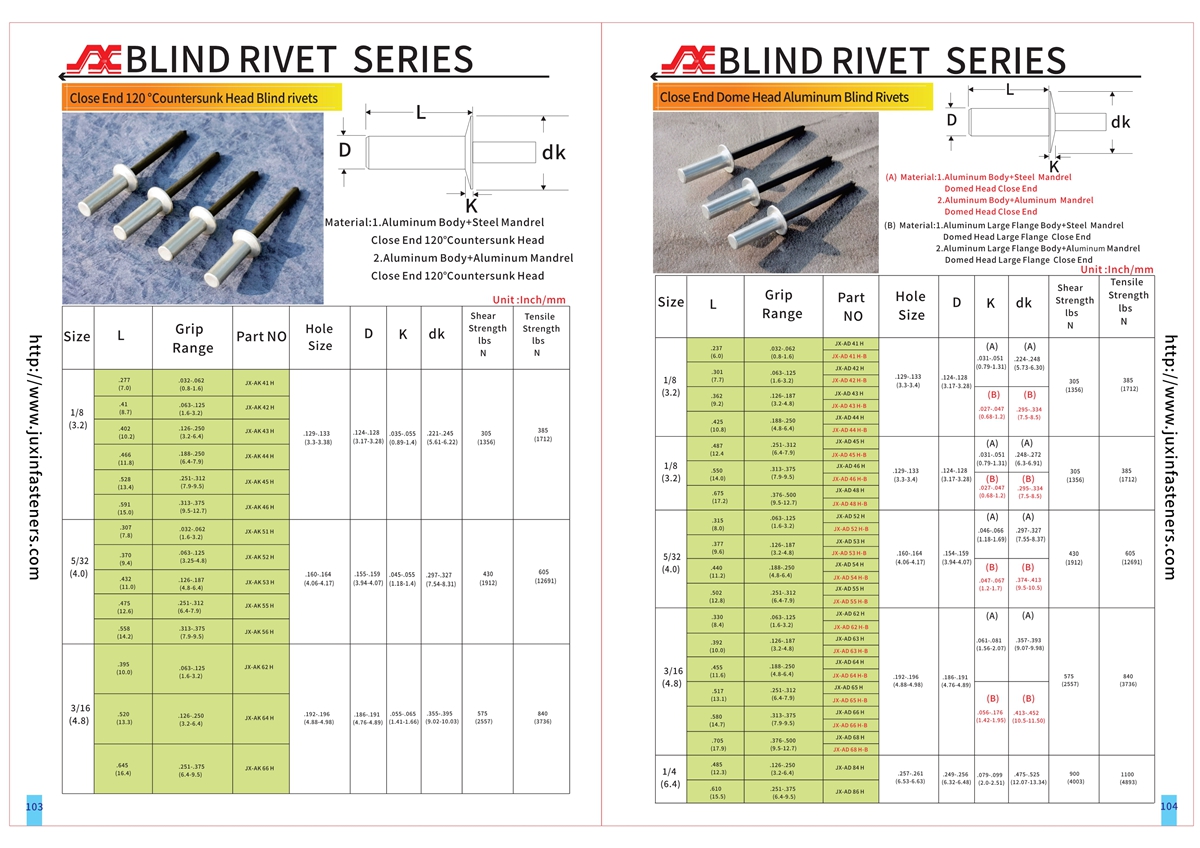
| Technical Reference | Original PDF/CAD, pages 103–104 |
Material Configuration A — Aluminum Body with Steel Mandrel
This configuration combines an aluminum rivet body with a steel pull mandrel.
The steel mandrel is used to develop the installation force required to deform the rivet body.
The actual setting force, mandrel break characteristics and mechanical performance depend on the approved rivet design.
The presence of a steel mandrel does not establish a particular shear strength, tensile strength or mandrel-locking mechanism.
Material Configuration B — Aluminum Body with Aluminum Mandrel
This configuration uses aluminum for both the rivet body and pull mandrel.
It may be considered where an aluminum/aluminum material combination is preferred for a particular assembly.
However, its mechanical performance and installation requirements must be evaluated independently from the aluminum/steel configuration.
The two material combinations should not be treated as automatically interchangeable.
Key Product Features
Aluminum closed-end rivet body
Steel or aluminum pull mandrel options
120° countersunk head geometry
One-sided installation
Closed cup-shaped construction
Reduced leakage path through the rivet body
Potential for reduced head projection
Suitable for engineering evaluation in lightweight sheet-metal assemblies
OEM drawing-based dimensional requirements
Product-specific mechanical and sealing performance
Dimensions and Technical Specifications
| Parameter | Engineering Requirement |
|---|---|
| Nominal Rivet Diameter | Refer to original PDF/CAD |
| Rivet Body Length | Refer to original PDF/CAD |
| Countersunk Head Diameter | Refer to original PDF/CAD |
| Head Height | Refer to original PDF/CAD |
| Countersunk Included Angle | 120° |
| Mandrel Diameter | According to selected configuration |
| Minimum Grip Thickness | According to approved specification |
| Maximum Grip Thickness | According to approved specification |
| Recommended Mounting-Hole Diameter | According to approved specification |
| Countersink Diameter and Depth | According to assembly drawing |
| Blind-Side Clearance | According to installed rivet geometry |
| Shear Strength | According to verified product data |
| Tensile Strength | According to verified product data |
| Mandrel Retention | According to verified product design |
| Sealing Performance | According to agreed test conditions |
| Corrosion Performance | According to material and environmental requirements |
Technical Documentation
Please refer to the original JUXIN product PDF/CAD specification, pages 103–104.
The approved technical documentation governs available sizes, grip ranges, tolerances, material grades and mechanical requirements.
Engineering Solution 1 — Closed-End Construction and Leakage Control
The principal difference between closed-end and conventional open-end blind rivets is the rivet-body construction.
A conventional open-end rivet may allow moisture or contaminants to pass through the mandrel channel.
A closed-end rivet uses a cup-shaped body that encloses the blind end of the fastener.
This construction helps restrict leakage through the rivet itself.
Potential applications include:
Electrical equipment housings
Industrial metal cabinets
Protective equipment covers
Automotive auxiliary enclosures
HVAC equipment panels
Outdoor equipment housings
Lightweight aluminum assemblies
However, a closed rivet body does not automatically establish a watertight or airtight joint.
Leakage can occur around the rivet head, mounting hole or mating surfaces.
Engineering Solution 2 — Rivet-Body Sealing vs. Complete Joint Sealing
Engineers should distinguish between the sealing function of the closed rivet body and the sealing performance of the complete assembly.
| Potential Leakage Path | Engineering Consideration |
|---|---|
| Through the Rivet Body | Restricted by closed-end construction |
| Beneath the Countersunk Head | Depends on seating and surface condition |
| Around the Mounting Hole | Depends on hole fit and installed joint |
| Between Joined Panels | Depends on mating surfaces and sealing design |
| Through a Cooling Channel | Requires a separately qualified fluid-boundary design |
Where a customer requires a specified leakage rate, pressure rating or ingress protection level, the complete assembly must be tested under defined conditions.
Closed-end construction alone is not evidence of compliance with those requirements.
Engineering Solution 3 — 120° Countersunk Head for Reduced Surface Projection
The 120° countersunk head is designed for a matching 120° recess.
Correct installation can reduce the projection of the fastener head above the accessible panel.
This may be useful where assemblies include:
Overlapping sheet-metal panels
Close-fitting equipment covers
Sliding or adjacent components
Limited head clearance
Smooth external panel surfaces
The head will not necessarily be perfectly flush in every assembly.
The result depends on:
Countersink angle
Countersink major diameter
Countersink depth
Head geometry
Panel thickness
Hole alignment
Installation conditions
A 120° countersunk rivet should not be substituted for a 90° or 100° countersunk rivet without engineering verification.
Engineering Solution 4 — Countersinking Thin Aluminum Panels
Countersinking reduces the material thickness supporting the fastener head.
For thin aluminum panels, excessive countersink depth can reduce local bearing support and increase the risk of deformation.
Before selecting this rivet, evaluate:
Original panel thickness
Remaining material beneath the countersink
Head diameter and height
Panel alloy and temper
Mounting-hole diameter
Joint loading
Edge distance
Rivet spacing
Where the remaining panel material is insufficient, a protruding-head rivet or a redesigned joint may be more appropriate.
Engineering Solution 5 — Aluminum/Steel vs. Aluminum/Aluminum Mandrels
The two material configurations should be compared using actual engineering data rather than general material assumptions.
| Selection Factor | Aluminum Body / Steel Mandrel | Aluminum Body / Aluminum Mandrel |
|---|---|---|
| Rivet Body | Aluminum | Aluminum |
| Pull Mandrel | Steel | Aluminum |
| Head Geometry | 120° Countersunk | 120° Countersunk |
| Closed-End Construction | Specified | Specified |
| Installed Weight | Depends on complete rivet geometry | Depends on complete rivet geometry |
| Setting Force | Requires verification | Requires verification |
| Shear and Tensile Performance | Requires verification | Requires verification |
| Corrosion Behavior | Depends on grades, coating and environment | Depends on grades and environment |
| Mandrel Retention | Requires verification | Requires verification |
A steel mandrel may provide different installation and mechanical characteristics, but a higher strength rating cannot be assumed without product-specific data.
Likewise, the aluminum/aluminum configuration should not automatically be considered equivalent in strength or installation behavior.
Engineering Solution 6 — Lightweight Design and Material Compatibility
Aluminum rivet bodies may be useful in lightweight industrial assemblies.
However, the mass of a complete rivet depends on:
Body alloy and geometry
Mandrel material
Mandrel dimensions
Rivet length
Head dimensions
Retained mandrel portion
For an accurate lightweighting comparison, engineers should compare complete installed fastener mass rather than simply comparing aluminum and steel material densities.
Where aluminum rivets are installed in aluminum panels, material compatibility may be favorable, but the actual alloy combinations and operating environment must still be assessed.
Engineering Solution 7 — Galvanic Corrosion and Environmental Exposure
Aluminum and steel can behave differently when exposed to moisture or other conductive environments.
For aluminum-body rivets with steel mandrels, engineers should evaluate:
Aluminum alloy
Steel mandrel grade
Mandrel surface coating
Retained mandrel exposure
Moisture and condensation
Contact with dissimilar materials
Installation damage
Service temperature
Closed-end construction may reduce some exposure pathways but does not eliminate every corrosion mechanism.
No particular salt spray performance or corrosion service life is claimed without supporting data.
Engineering Solution 8 — Grip Range and Installation
The combined thickness of the joined materials must remain within the specified grip range.
Important parameters include:
Rivet diameter
Rivet body length
Minimum grip thickness
Maximum grip thickness
Hole diameter
Countersink geometry
Blind-side clearance
Mandrel configuration
A compatible blind riveting tool and nosepiece are required.
Typical Installation Procedure
Confirm the rivet material configuration and dimensions.
Verify the total material stack-up.
Prepare the mounting hole according to the approved drawing.
Produce the matching 120° countersink.
Inspect hole diameter, countersink depth and burr condition.
Align the joined components.
Insert the closed-end rivet.
Seat the countersunk head.
Engage the mandrel using a compatible riveting tool.
Pull the mandrel to form the blind-side retaining portion.
Complete the setting operation.
Inspect head seating, blind-side formation and mandrel break condition.
Conduct leakage testing where specified.
Engineering Solution 9 — Mechanical Strength and Mandrel Retention
Shear strength, tensile strength and mandrel retention are separate technical characteristics.
The installed joint must be evaluated according to:
Rivet diameter
Material grades
Grip thickness
Hole geometry
Countersink dimensions
Blind-side formation
Retained mandrel condition
Panel stiffness
Vibration and fatigue
Environmental exposure
Certain proprietary closed-end rivet systems have verified mandrel-retention features.
However, those characteristics cannot be assigned to this JUXIN product without the applicable drawing or test evidence.
Engineering Solution 10 — Metric and Inch Diameter Reference
Common nominal blind rivet diameter references include:
| Metric Diameter | Approximate Inch Reference |
|---|---|
| 3.2 mm | 1/8 in |
| 4.0 mm | 5/32 in |
| 4.8 mm | 3/16 in |
| 6.4 mm | 1/4 in |
These are general nominal references, not a confirmed list of available sizes for this product.
Metric and inch-designated rivets must be verified for actual dimensions, grip range, hole requirements and countersunk geometry before substitution.
Special Engineering Application — How to Select Blind Rivets for EV Battery Pack Cooling Plate Fixing
EV Battery Thermal Management and Lightweight Assembly
Modern electric vehicle battery systems commonly incorporate aluminum housings, cooling plates, structural supports and thermal management components.
Battery cold plates transfer heat from battery modules to a liquid-cooling circuit.
The thermal management system must maintain suitable operating conditions while meeting vehicle requirements for mechanical integrity, durability and manufacturing efficiency.
Blind riveting may be considered for selected noncritical mounting brackets, auxiliary covers and positioning components where one-sided access is beneficial.
However, rivets should not be introduced into a coolant-carrying wall or fluid channel without a specifically engineered and validated joint design.
Structural Characteristics of EV Battery Enclosures
Depending on the vehicle and battery pack design, assemblies may include:
Aluminum battery housings
Stamped or formed aluminum cooling plates
Cooling channels and fluid manifolds
Mounting brackets
Reinforcement structures
Thermal interface materials
Electrical isolation components
Multiple mechanical fastening points
These components may experience vibration, thermal expansion, manufacturing variation and service loads.
The fastener must be selected according to the actual function of the joint.
EV Engineering Requirement 1 — Structural Load and Fatigue
Blind rivets used for approved auxiliary attachments must withstand the specified mechanical loads.
Relevant considerations include:
Static shear loads
Tensile loads
Vibration
Fatigue
Thermal cycling
Joint stiffness
Installation consistency
A closed-end aluminum blind rivet should not automatically be classified as an automotive structural rivet.
Its suitability must be demonstrated against the actual joint requirements.
EV Engineering Requirement 2 — Lightweight Construction
Reducing component mass is important in electric vehicle design.
Aluminum-body rivets may support lightweighting objectives in suitable assemblies.
However, a complete aluminum/steel rivet and a complete aluminum/aluminum rivet can have different masses and mechanical characteristics.
For OEM design decisions, compare:
Complete installed rivet mass
Required rivet quantity
Joint performance
Assembly process
Total system cost
The lightest individual fastener is not necessarily the best overall joint solution.
EV Engineering Requirement 3 — Aluminum Panel Compatibility
Aluminum battery housings and cooling-related brackets may require fasteners compatible with the selected aluminum alloys.
Engineers should evaluate:
Material combinations
Galvanic corrosion
Surface coatings
Hole preparation
Panel thickness
Countersink depth
Joint stiffness
Thermal expansion
For thin cooling plates, countersinking may remove material needed for structural support or fluid-channel integrity.
Therefore, the 120° countersunk design must be evaluated against the actual cooling plate geometry.
EV Engineering Requirement 4 — Cooling Circuit Leak Integrity
The closed-end rivet body helps restrict leakage through the mandrel passage.
However, this does not establish that a riveted cooling plate or battery enclosure is leak-tight.
The cooling circuit may require:
Fluid-channel isolation
Approved joining methods
Suitable sealing elements
Pressure and leakage testing
Thermal cycling validation
Production process controls
A rivet hole must not compromise the cooling channel.
Where a mechanical fastener is used near a fluid boundary, the design must provide appropriate separation from the coolant passage or use a separately qualified sealing arrangement.
EV Engineering Requirement 5 — One-Sided Installation and Production Efficiency
Blind rivets can be useful where rear-side tool access is limited.
Potential manufacturing benefits include:
One-sided setting
Repeatable assembly operations
Compatibility with selected sheet-metal joints
Reduced need for rear-side fastening access
Potential automation with suitable tooling
Actual productivity depends on the rivet, tooling, access conditions and assembly design.
EV Engineering Requirement 6 — Corrosion and Condensation
Even internal battery pack components may experience moisture-related risks.
Potential exposure can arise from:
Condensation
Temperature cycling
Environmental ingress
Manufacturing contamination
Coolant leakage
Service conditions
Material selection should not assume that an internal enclosure will remain permanently dry.
Corrosion requirements should be defined according to the vehicle manufacturer's actual operating and validation conditions.
EV Engineering Requirement 7 — Fastener Selection by Joint Function
| EV Assembly Function | Engineering Guidance |
|---|---|
| Noncritical cooling plate positioning bracket | Evaluate aluminum closed-end rivets if permitted by the design |
| Auxiliary aluminum enclosure cover | Evaluate grip range, countersink and joint loading |
| Protective sheet-metal shield | Verify vibration, clearance and panel thickness |
| Battery pack structural connection | Require separately qualified structural fastening |
| Coolant-carrying wall | Do not use an unqualified riveted penetration |
| Fluid manifold connection | Require validated mechanical and sealing design |
| Electrical isolation interface | Verify isolation and material compatibility |
| Serviceable component | Consider whether permanent riveting is appropriate |
EV Engineering Requirement 8 — OEM Validation and Quality Control
For an EV-related project, a suitable validation plan may include:
Confirm the function of the joint.
Review the 2D/3D assembly drawings.
Identify whether the joint intersects a fluid boundary.
Verify panel thickness and countersink geometry.
Select the material and mandrel configuration.
Confirm the grip range and mounting-hole dimensions.
Validate installation using production tooling.
Evaluate mechanical and vibration performance.
Evaluate corrosion and thermal cycling requirements.
Conduct leakage testing where applicable.
Define inspection and traceability requirements.
Obtain customer engineering approval before production release.
Automotive-specific documentation, including PPAP where required, should be discussed and agreed for each project rather than assumed to be available.
Industrial Applications & Engineering Fastening Solutions
Beyond EV battery assemblies, 120° countersunk closed-end aluminum blind rivets may be considered for a range of industrial applications.
1. AI Data Center Cabinets and Cooling Equipment
Potential applications include approved auxiliary aluminum panels, protective covers and equipment housings.
The closed-end design may help restrict leakage through the rivet body, while the countersunk head may reduce interference with adjacent components.
For liquid-cooling equipment, coolant containment and pressure integrity require separate validation.
2. Power Electronics and Electrical Equipment
Power conversion equipment, control cabinets and electrical housings may require low-profile mechanical connections.
Engineers should evaluate electrical bonding, insulation, corrosion, head clearance and serviceability.
3. Telecommunications Equipment
Outdoor and indoor telecommunications enclosures may use lightweight metal panels.
Closed-end rivets may be considered where reduced through-fastener moisture passage is desirable.
Complete enclosure ingress protection requires separate verification.
4. Automotive OEM and Tier-1 Manufacturing
Potential applications include noncritical sheet-metal covers, auxiliary brackets and lightweight equipment housings.
Vibration, fatigue, corrosion and customer-specific engineering requirements must be validated.
5. Motorcycle and Racing Vehicle Manufacturing
Aluminum closed-end countersunk rivets may be evaluated for suitable noncritical panels and protective covers.
Weight, vibration, fatigue and installation access should be considered.
6. Rail Transit Equipment
Rail equipment may include auxiliary aluminum panels and electrical enclosures.
Project-specific vibration, fatigue, fire and smoke, traceability and approval requirements must be evaluated.
7. Container Manufacturing
Auxiliary container compartments, lightweight covers and equipment housings may benefit from reduced head projection and closed-end construction.
Outdoor corrosion and structural loading require separate evaluation.
8. Energy Storage Systems
Energy storage cabinets may use aluminum auxiliary panels and protective covers.
Engineers should evaluate thermal movement, electrical isolation, corrosion and enclosure sealing requirements.
9. Semiconductor Equipment
Auxiliary cabinets and non-process-critical covers may require controlled head projection and one-sided fastening.
Cleanliness, installation debris and material compatibility should be evaluated.
No cleanroom or process-chamber qualification is implied.
10. Medical Equipment
Approved non-patient-contact instrument housings and auxiliary covers may use countersunk blind rivets where permanent fastening is acceptable.
Cleaning, corrosion, traceability and applicable regulatory requirements must be evaluated.
11. Food Processing Machinery
Non-product-contact guards and auxiliary equipment covers may be candidates for suitable aluminum closed-end rivets.
Hygienic design, cleaning compatibility and corrosion requirements must be reviewed.
No direct food-contact suitability is claimed.
12. Marine Equipment
Lightweight auxiliary housings and covers may require corrosion-resistant fastening solutions.
Aluminum alloy, steel mandrel exposure, galvanic compatibility and chloride conditions must be assessed.
Marine suitability is not automatic.
13. HVAC Equipment
HVAC housings and protective panels may require low-profile fasteners and controlled moisture pathways.
Condensation, vibration, corrosion and air leakage requirements should be evaluated.
14. Electronics and Electrical Appliances
Thin metal housings, equipment covers and protective panels may use countersunk closed-end rivets where appropriate.
Head clearance, installation consistency and maintenance access are important.
15. Outdoor Equipment and Leisure Products
Lightweight metal covers, accessory housings and auxiliary brackets may be considered.
Weather exposure, corrosion, vibration and joint loading require evaluation.
16. Aerospace Ground-Support Equipment
Nonflight-critical tooling covers, auxiliary cabinets and ground-support equipment may use approved mechanical fasteners.
No aircraft structural, flight-critical or aerospace-qualified application is claimed.
Production Engineering — Common Installation Problems
| Potential Problem | Engineering Check |
|---|---|
| Countersunk head projects above surface | Verify countersink depth and head dimensions |
| Excessive aluminum panel deformation | Check remaining thickness and installation |
| Incomplete blind-side formation | Verify grip range and setting process |
| Loose joint | Check hole fit and material stack-up |
| Mandrel break inconsistency | Confirm tooling and mandrel configuration |
| Unexpected corrosion | Review alloy, coating and environmental exposure |
| Leakage around fastener | Evaluate the complete joint and sealing design |
| Damage to cooling channel | Review fluid-boundary clearance and assembly drawing |
International Standards and Technical References
ISO 15974 is a relevant technical reference for closed-end blind rivets with countersunk heads and aluminum-alloy bodies with steel mandrels.
However, product conformity must be established using the applicable standard edition, actual material grades, dimensions and mechanical requirements.
The aluminum-body/aluminum-mandrel configuration requires separate standard applicability review.
ISO 15975 covers a protruding-head aluminum/aluminum closed-end configuration and should not automatically be cited as proof of conformity for a 120° countersunk product.
For EV battery assemblies, relevant vehicle and battery-pack requirements may include vibration, thermal cycling, corrosion and leakage evaluation.
SAE J3277 provides technical information concerning liquid leak-tightness evaluation for EV battery packs, but it does not establish certification of an individual JUXIN rivet.
The approved engineering drawing and customer specification remain the controlling technical references.
OEM Procurement and Supplier Development
For purchasing managers, supplier development engineers, manufacturing engineers and supply chain managers, technical qualification should distinguish between the two mandrel material configurations.
A complete sourcing evaluation should address:
Aluminum body alloy and temper
Steel or aluminum mandrel material
Rivet diameter and length
120° countersunk head dimensions
Grip range
Mounting-hole and countersink requirements
Mechanical performance
Mandrel retention
Corrosion requirements
Sealing requirements
Installation tooling
Drawing revision
Inspection and traceability
Packaging specifications
Expected annual demand
A visually similar closed-end rivet from another supplier is not automatically interchangeable.
Frequently Asked Questions
What is a 120° countersunk closed-end aluminum blind rivet?
It is a blind rivet with an aluminum closed-end body and a 120° countersunk head, designed for one-sided installation and reduced head projection.
What mandrel materials are available in the original product specification?
The original product information identifies steel and aluminum mandrel configurations.
What is the advantage of a closed-end rivet?
Its closed cup-shaped body helps restrict leakage through the mandrel passage.
Are closed-end blind rivets completely waterproof?
Not automatically. Complete joint sealing depends on hole geometry, installation and the assembly sealing design.
Can these rivets be used in EV battery enclosures?
They may be evaluated for suitable noncritical auxiliary assemblies, subject to OEM engineering approval.
Can a closed-end rivet be installed directly through a liquid-cooling channel?
Not without a specifically engineered and validated fluid-boundary design.
Is an aluminum/steel rivet stronger than an aluminum/aluminum rivet?
Not necessarily in every performance category. Actual strength depends on the complete product design and verified mechanical data.
Are aluminum/steel and aluminum/aluminum rivets interchangeable?
Not automatically. Dimensions, grip range, installation requirements and mechanical performance must be checked.
Can a 120° countersunk rivet replace a 90° or 100° countersunk rivet?
Only after confirming compatible head geometry and joint requirements.
Does this product comply with ISO 15974?
ISO 15974 is a relevant reference for the aluminum/steel configuration, but conformity for this JUXIN product has not been established from the available information.
Can JUXIN review custom closed-end blind rivet drawings?
Customer-specific drawings, material combinations, grip ranges and performance requirements can be submitted for engineering review and quotation.
Request an OEM 120° Countersunk Closed-End Aluminum Blind Rivet Quotation
JUXIN FASTENERS supplies industrial blind rivets for OEM manufacturing, sheet-metal fabrication and bulk purchasing projects.
For technical evaluation and quotation, please provide:
Rivet body diameter and length
120° countersunk head diameter and height
Aluminum body alloy and temper requirements
Steel or aluminum mandrel selection
Minimum and maximum material stack-up
Mounting-hole diameter and tolerance
Countersink diameter and depth
2D engineering drawings or 3D CAD files
Required shear and tensile performance
Mandrel retention requirements
Corrosion and environmental requirements
Sealing and leakage requirements
Installation tooling and inspection requirements
EV battery application details, if applicable
Packaging specifications
Expected order quantity and annual demand forecast
Target delivery schedule
Email: info@juxinfasteners.com
Website: https://www.juxinfasteners.com/
JUXIN FASTENERS — 120° Countersunk Closed-End Aluminum Blind Rivets and Custom OEM Fastening Solutions.
Product Packaging
Packaging Standard
At Juxin Fasteners, we apply standardized export packaging to ensure product protection, traceability, and compliance with international logistics requirements.
1. Standard Export Packaging
Unless otherwise specified, all products will be packed according to our factory standard export packaging, which includes:
Moisture-resistant inner protection
Poly bag or small box packing as required
Reinforced export cartons
Clear labeling with part number, specification, batch number, and quantity
Palletizing for sea or air shipment when necessary
Our standard packaging is designed to ensure safe transportation, efficient warehousing, and long-distance international shipping.
2. Customized Packaging Options
We also provide customized packaging solutions according to customer requirements, including but not limited to:
Private labeling
Customized barcodes
Specific carton dimensions
Retail packaging
Special pallet configuration
Customer-specific marking and identification
So that you know, customized packaging may involve additional costs and extended lead time depending on the complexity of the requirements.
3. Compliance & Quality Assurance
All packaging processes are controlled under our ISO 9001 quality management system to ensure consistency, traceability, and product integrity throughout the supply chain.
Product Pictures
Contact Us
Tel.:
+86 020 8621 0320
+86 020 3121 6067
E-mail:
Technical Support:
Navigation
SEND INQUIREY