
Call Us
+86 136 6007 9809
Call Us
+86 136 6007 9809

Aluminum Closed-End Dome Head Blind Rivets
JUXIN FASTENERS supplies aluminum closed-end blind rivets in standard dome head and large flange dome head configurations, with steel or aluminum pull mandrels.
The closed cup-shaped body helps restrict leakage through the mandrel passage, while the large flange option provides additional head-side bearing support for compatible thin panels.
Designed for one-sided installation in industrial sheet-metal assemblies. Actual grip ranges, strength, corrosion performance and complete joint sealing require specification verification.
Product Specification
Aluminum Closed-End Dome Head Blind Rivets — Standard and Large Flange Sealed-Body Fasteners
Product Overview
JUXIN FASTENERS supplies aluminum closed-end dome head blind rivets for OEM sheet-metal manufacturing, industrial equipment enclosures,
lightweight metal assemblies and applications requiring one-sided installation.
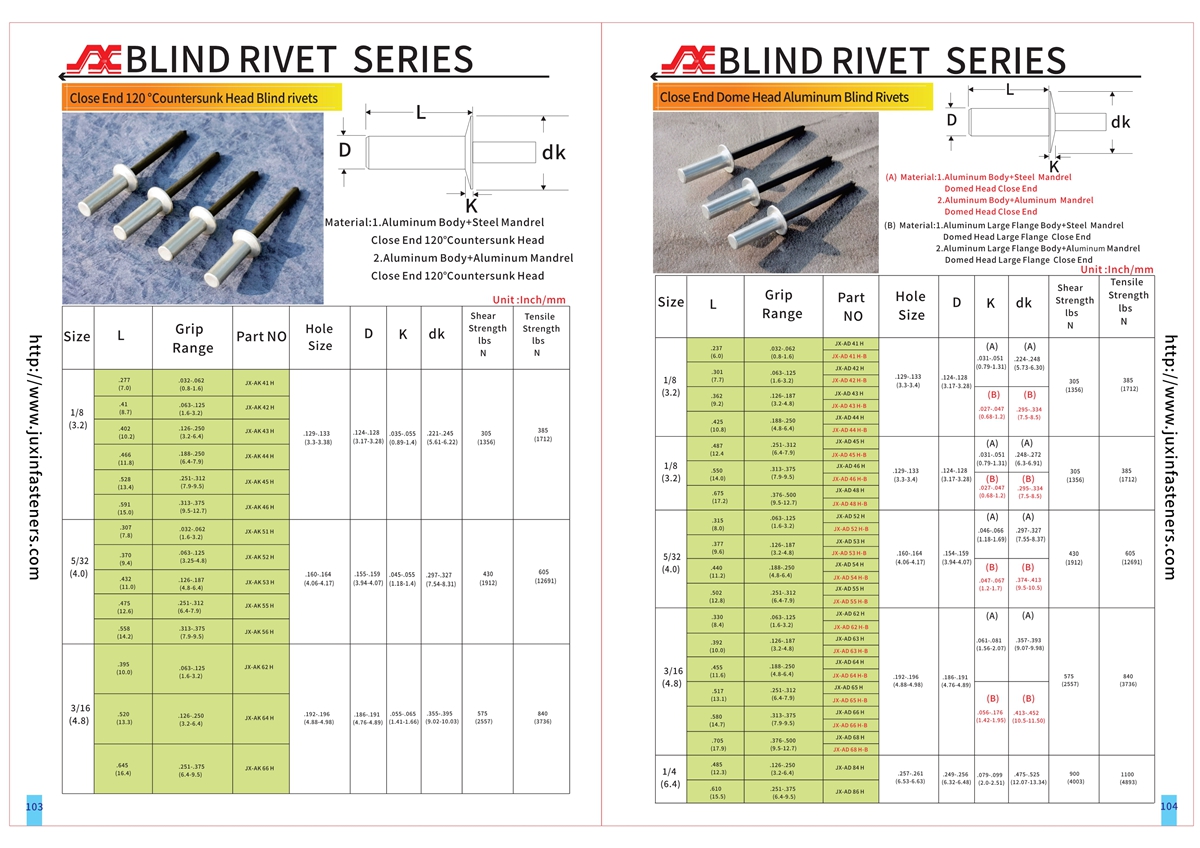
The product family includes standard dome head and large flange dome head configurations, each available in the original product information with either a steel or aluminum pull mandrel.
Unlike conventional open-end blind rivets, closed-end blind rivets use a cup-shaped rivet body that encloses the mandrel head and helps restrict the passage of liquids, vapor and contaminants through the fastener body.
The standard dome head provides a conventional accessible-side bearing surface.
The large flange version provides an enlarged head-side bearing area that may help reduce localized deformation or pull-through in compatible thin or relatively soft panels.
These are distinct engineering functions. A larger flange does not automatically improve the sealing performance or mechanical strength of the complete joint.
Product Configurations — Four Material and Head Options
| Configuration | Rivet Body | Pull Mandrel | Head Style |
|---|---|---|---|
| A1 | Aluminum | Steel | Standard Dome Head |
| A2 | Aluminum | Aluminum | Standard Dome Head |
| B1 | Aluminum | Steel | Large Flange Dome Head |
| B2 | Aluminum | Aluminum | Large Flange Dome Head |
All four configurations are described in the original JUXIN product information as closed-end blind rivets.
Actual available diameters, lengths, head dimensions and grip ranges must be confirmed from the approved technical specification.
Product Identification and Technical Characteristics
| Item | Specification |
|---|---|
| Product Family | Closed-End Blind Rivets |
| Rivet Body Material | Aluminum |
| Mandrel Materials | Steel or Aluminum |
| Head Styles | Standard Dome Head / Large Flange Dome Head |
| Rivet Body Construction | Closed-End / Cup-Shaped |
| Installation Method | One-Sided Blind Riveting |
| Primary Function | Permanent Mechanical Fastening |
| Sealing Feature | Closed Mandrel Passage |
| Large Flange Function | Increased Accessible-Side Bearing Area |
| Aluminum Alloy and Temper | To be confirmed |
| Steel Mandrel Grade | To be confirmed |
| Surface Finish | To be confirmed |
| Technical Reference | Original PDF/CAD, pages 103–104 |
Key Product Features
Aluminum closed-end rivet body
Steel or aluminum mandrel options
Standard dome head configuration
Large flange dome head configuration
One-sided installation
Closed cup-shaped body for restricting through-rivet leakage
Enlarged head-side bearing support in large flange versions
Potential suitability for lightweight sheet-metal assemblies
Drawing-based OEM specifications
Mechanical and sealing performance subject to verification
Dimensions and Technical Specifications
| Parameter | Engineering Requirement |
|---|---|
| Nominal Rivet Diameter (d) | Refer to original PDF/CAD |
| Rivet Body Length (L) | Refer to original PDF/CAD |
| Standard Dome Head Diameter | According to selected configuration |
| Large Flange Head Diameter | According to selected configuration |
| Head Height | According to approved drawing |
| Mandrel Diameter | According to selected configuration |
| Minimum Grip Thickness | According to selected rivet |
| Maximum Grip Thickness | According to selected rivet |
| Recommended Mounting-Hole Diameter | According to approved specification |
| Blind-Side Clearance | According to installed rivet geometry |
| Shear Strength | According to verified product data |
| Tensile Strength | According to verified product data |
| Mandrel Retention | According to verified product design |
| Sealing Performance | According to agreed test requirements |
| Corrosion Performance | According to material and environmental requirements |
Technical Documentation
Please refer to the original JUXIN PDF/CAD specification, pages 103–104.
The approved engineering drawing governs actual dimensions, tolerances, grip ranges, material requirements and mechanical characteristics.
Engineering Solution 1 — How Closed-End Blind Rivets Work
A closed-end blind rivet consists of a hollow rivet body with a closed blind end and a pull mandrel.
During installation, the mandrel is pulled through the rivet body, causing the body to deform and form the retaining portion on the inaccessible side of the assembly.
The mandrel then breaks at its designed location.
Because the rivet body has a closed end, the mandrel channel does not provide the same open passage as a conventional open-end blind rivet.
This construction helps restrict leakage through the rivet body.
However, the installed joint may still have leakage paths around the rivet head, mounting hole or mating surfaces.
Engineering Solution 2 — Standard Dome Head vs. Large Flange Dome Head
The two head styles address different bearing requirements.
Standard Dome Head
A standard dome head provides a conventional protruding bearing surface.
It may be suitable for general sheet-metal fastening where the head diameter provides adequate support.
Large Flange Dome Head
A large flange head provides a wider contact area on the accessible side.
It may be useful for compatible thin sheet metal, plastics and other materials where a conventional head could create excessive localized bearing stress.
| Engineering Factor | Standard Dome Head | Large Flange Dome Head |
|---|---|---|
| Head-Side Bearing Area | Conventional | Enlarged |
| Head Diameter | According to standard configuration | Larger than corresponding standard head |
| Thin Panel Support | Requires evaluation | May provide improved bearing support |
| Hole Coverage | Standard head coverage | Greater head-side coverage |
| Blind-Side Formation | Product-specific | Product-specific |
| Through-Rivet Leakage Control | Closed-end construction | Closed-end construction |
| Joint Strength | Requires verification | Requires verification |
The large flange version does not automatically provide a wider blind-side retaining area.
Head-side and blind-side bearing performance must be evaluated separately.
Engineering Solution 3 — Steel Mandrel vs. Aluminum Mandrel
Mandrel material affects installation behavior, fastener mass, corrosion considerations and potentially mechanical performance.
Aluminum Body with Steel Mandrel
The steel mandrel may provide different setting characteristics from an aluminum mandrel.
However, the actual setting force, shear strength, tensile strength and mandrel retention depend on the complete rivet design.
The steel component also introduces material and corrosion considerations.
Aluminum Body with Aluminum Mandrel
The aluminum/aluminum combination may be considered for assemblies where an all-aluminum material configuration is preferred.
Its installation characteristics and mechanical performance must be verified independently.
| Selection Factor | Aluminum / Steel | Aluminum / Aluminum |
|---|---|---|
| Rivet Body | Aluminum | Aluminum |
| Pull Mandrel | Steel | Aluminum |
| Complete Fastener Mass | Depends on geometry | Depends on geometry |
| Magnetic Characteristics | Steel mandrel may be magnetic | Depends on actual alloy and components |
| Installation Force | Requires verification | Requires verification |
| Mechanical Strength | Requires verification | Requires verification |
| Corrosion Behavior | Depends on material combination and environment | Depends on alloys and environment |
| Application Suitability | Drawing-controlled | Drawing-controlled |
Neither configuration should be described as universally stronger, corrosion-proof or interchangeable.
Engineering Solution 4 — Closed-End Sealing and Complete Joint Integrity
The closed-end rivet body helps block the direct leakage route through the mandrel passage.
This is different from guaranteeing a sealed assembly.
| Potential Leakage Location | Engineering Consideration |
|---|---|
| Through the Rivet Body | Restricted by closed-end construction |
| Under the Dome Head | Depends on seating, hole condition and interface |
| Around the Mounting Hole | Depends on hole geometry and installation |
| Between Joined Panels | Depends on mating surfaces and sealing design |
| Under Pressure | Requires defined leakage testing |
For a moisture-sensitive or pressure-related application, engineers should specify the complete joint's acceptance requirements.
These may include a test medium, pressure differential, exposure duration, leakage limit and environmental conditions.
An additional gasket, sealant or other sealing solution may be necessary.
Engineering Solution 5 — Large Flange Rivets for Thin and Soft Materials
Thin or soft panels may fail through localized deformation around the rivet head.
Potential problems include:
Head-side pull-through
Hole enlargement
Local panel crushing
Cracking
Permanent deformation
Joint loosening
The large flange head distributes contact forces across a wider area.
This may reduce localized bearing stress when the flange geometry is appropriate for the panel material.
However, the large flange does not eliminate the need to verify panel strength, grip range and blind-side retention.
For soft or composite materials, both sides of the joint should be evaluated.
Engineering Solution 6 — Mounting-Hole Dimensions and Tolerances
Correct mounting-hole geometry is essential to rivet performance.
Engineers should control:
Hole diameter
Hole roundness
Hole alignment
Burr condition
Panel thickness
Rivet body fit
Edge distance
Rivet spacing
A large flange may cover a larger area around the hole, but this does not mean that an oversized or irregular hole is mechanically acceptable.
Permitted hole dimensions must be established from the approved specification.
Engineering Solution 7 — Grip Range and Material Stack-Up
The combined thickness of the joined materials must fall within the rivet's specified grip range.
Before selecting a rivet, verify:
Minimum material stack-up
Maximum material stack-up
Rivet body diameter
Rivet body length
Mounting-hole diameter
Head style
Blind-side clearance
Required mechanical performance
The correct rivet must form an acceptable blind-side retaining portion at the intended grip thickness.
Engineering Solution 8 — Mandrel Retention and Joint Reliability
The original product description refers to retained mandrel stability.
Certain proprietary closed-end rivet systems provide verified mandrel retention.
However, closed-end construction alone should not be treated as proof of a particular mechanical locking mechanism.
Engineers should confirm:
Mandrel head geometry
Break location
Retained mandrel condition
Any mechanical locking feature
Vibration requirements
Installation consistency
Where loose mandrel fragments would create an equipment hazard, the required retention characteristics must be specified and validated.
Engineering Solution 9 — Corrosion and Material Compatibility
Aluminum rivet bodies can offer useful corrosion resistance in suitable environments.
However, the actual corrosion performance depends on:
Aluminum alloy
Steel mandrel grade and finish
Surface treatment
Mating panel materials
Moisture exposure
Condensation
Chloride exposure
Galvanic compatibility
Installation damage
For aluminum/steel configurations, the retained steel mandrel and its protective finish require particular consideration.
The closed rivet body may reduce some exposure routes but does not eliminate all corrosion risks.
No specific salt spray duration or outdoor service life is claimed without verified data.
Engineering Solution 10 — Installation Process
A compatible blind riveting tool and nosepiece are required.
Typical installation procedure:
Confirm the selected head style and mandrel material.
Verify the material stack-up and grip range.
Prepare the mounting holes according to the approved drawing.
Remove burrs and inspect the panel surfaces.
Align the joined components.
Insert the closed-end blind rivet.
Seat the dome head or large flange head against the accessible panel.
Engage the mandrel using the appropriate tool.
Pull the mandrel to form the blind-side retaining portion.
Complete the setting operation.
Inspect head seating, blind-side formation and mandrel break condition.
Conduct mechanical or leakage testing where required.
The installation process should be validated using representative production materials and tooling.
Engineering Solution 11 — Mechanical Strength and Failure Modes
Shear strength and tensile strength describe different loading conditions.
The complete installed joint may also be affected by:
Head-side pull-through
Blind-side pull-through
Panel bearing failure
Hole deformation
Vibration and fatigue
Rivet spacing
Edge distance
Grip thickness
Installation quality
Closed-end rivets should not automatically be described as stronger than conventional open-end rivets.
Actual performance must be established from product-specific mechanical data.
Metric and Inch Diameter Reference
Common nominal blind rivet diameter references include:
| Metric Diameter | Approximate Inch Reference |
|---|---|
| 3.2 mm | 1/8 in |
| 4.0 mm | 5/32 in |
| 4.8 mm | 3/16 in |
| 6.4 mm | 1/4 in |
These are general nominal references, not a confirmed list of available JUXIN sizes.
Metric and inch-designated rivets must be checked for actual dimensions, hole requirements and grip ranges before substitution.
Industrial Applications & Engineering Fastening Solutions
Aluminum closed-end dome head and large flange blind rivets may be considered for industrial assemblies requiring one-sided installation, closed-body construction and appropriate head-side bearing support.
The following examples describe potential engineering uses, not application-specific certifications.
1. AI Data Center Equipment — Electrical and Cooling Equipment Enclosures
AI data center infrastructure includes server cabinets, power distribution enclosures and cooling equipment housings.
Closed-end rivets may be considered for suitable auxiliary sheet-metal connections where limiting leakage through the fastener body is useful.
Large flange versions may provide additional bearing support for compatible thin panels.
Electrical bonding, corrosion, condensation and complete enclosure sealing must be evaluated.
Closed-end rivets are not automatically qualified for coolant pressure boundaries.
2. Electrical Power Equipment — Control Cabinets and Distribution Enclosures
Electrical equipment manufacturers use metal covers, control cabinets and protective housings.
Aluminum closed-end rivets may be evaluated for approved noncritical mechanical connections.
Engineers should consider head-side support, electrical continuity, grounding, insulation and moisture exposure.
3. Telecommunications Equipment — Outdoor and Indoor Cabinets
Telecommunications enclosures may require permanent fastening of auxiliary panels and protective covers.
Closed-end construction may help restrict moisture passage through the rivet body.
Outdoor installations require separate evaluation of corrosion and complete enclosure ingress protection.
4. EV Battery Enclosures — Noncritical Auxiliary Assemblies
Electric vehicle battery systems may use aluminum housings, protective covers and auxiliary mounting brackets.
Aluminum closed-end rivets may be considered for approved noncritical attachments where one-sided access is beneficial.
The engineer must evaluate:
Aluminum material compatibility
Grip range
Head-side bearing area
Vibration and fatigue
Thermal cycling
Corrosion
Electrical isolation
Installation quality
A closed-end rivet must not be treated as a qualified coolant seal or structural battery-pack fastener without specific engineering validation.
5. Energy Storage Systems — Protective Metal Panels
Energy storage equipment may use aluminum auxiliary covers, electrical cabinets and protective panels.
Closed-end rivets may be considered where a closed mandrel passage is desirable.
Thermal movement, electrical safety, corrosion and enclosure sealing requirements must be reviewed.
6. Automotive Manufacturing — Auxiliary Sheet-Metal and Trim Assemblies
Automotive OEM and Tier-1 manufacturers may use blind rivets for approved noncritical covers, brackets and sheet-metal components.
Standard dome heads may suit general fastening requirements.
Large flange versions may be useful where a thin accessible-side panel requires additional bearing support.
Vibration, fatigue, corrosion and customer-specific quality requirements must be validated.
7. Motorcycle Manufacturing — Protective Covers and Accessories
Motorcycle equipment may include aluminum covers, auxiliary brackets and protective panels.
Closed-end blind rivets may be considered for suitable noncritical connections.
Vibration, corrosion, impact and serviceability require evaluation.
8. Bicycle Manufacturing — Auxiliary Accessories
Bicycle accessories may include lightweight metal guards and protective covers.
Large flange closed-end rivets may be considered where thin panels require increased head-side support.
No suitability for frames, forks, brakes or other safety-critical components is implied.
9. Racing Vehicle Manufacturing — Noncritical Panels
Racing vehicle manufacturers may use lightweight auxiliary panels and equipment housings.
Closed-end rivets may be evaluated where material compatibility and one-sided installation are important.
Fatigue, vibration, weight and inspection requirements must be assessed.
10. Rail Transit Equipment — Interior and Auxiliary Enclosures
Rail transit equipment may include auxiliary electrical cabinets, equipment covers and interior metal panels.
Closed-end aluminum rivets may be considered for approved noncritical applications.
Project-specific fire and smoke, vibration, fatigue, traceability and approval requirements must be reviewed.
11. Container Manufacturing — Equipment Covers and Auxiliary Compartments
Container manufacturing may use auxiliary metal covers, equipment compartments and protective panels.
Closed-end rivets may help restrict moisture passage through the fastener body.
Large flange versions may provide additional support for compatible thin panels.
Outdoor corrosion and structural loading require separate evaluation.
12. HVAC Equipment Manufacturing — Sheet-Metal Housings
HVAC equipment includes protective covers, fan housings and auxiliary sheet-metal assemblies.
Closed-end rivets may be considered where condensation exposure or leakage control is relevant.
Large flange versions may be useful for relatively thin accessible-side panels.
Air leakage, vibration, corrosion and joint sealing must be assessed independently.
13. Semiconductor Equipment — Auxiliary Equipment Cabinets
Semiconductor equipment may use lightweight protective panels and non-process-critical electrical housings.
Closed-end rivets may be evaluated where reducing an open passage through the fastener body is useful.
Cleanliness, installation debris, material compatibility and serviceability require review.
No cleanroom or process-chamber qualification is implied.
14. Medical Equipment — Non-Patient-Contact Housings
Medical equipment may include aluminum instrument housings, auxiliary covers and equipment carts.
Closed-end rivets may be considered for approved non-patient-contact connections.
Cleaning exposure, corrosion, traceability and applicable regulatory requirements must be evaluated.
No medical-device certification or sterilization suitability is claimed.
15. Food Processing Machinery — Non-Product-Contact Guards
Food machinery may use lightweight protective panels and auxiliary equipment covers.
Large flange rivets may be considered where thin panels require wider head-side support.
Cleaning, corrosion, crevice formation and hygienic design must be reviewed.
No direct food-contact suitability is implied.
16. Marine Equipment — Auxiliary Housings
Marine equipment may use aluminum covers, protective panels and auxiliary housings.
Closed-end construction may help restrict leakage through the fastener body.
However, galvanic compatibility, steel mandrel corrosion and chloride exposure must be evaluated carefully.
Marine suitability is not automatic.
17. Electronics and Electrical Appliance Manufacturing
Electronics and appliance manufacturers may use lightweight metal housings, protective covers and decorative panels.
Closed-end rivets may be considered for permanent fastening where one-sided access is needed.
Large flange versions may be useful where head-side bearing support is important.
18. Outdoor Equipment and Fencing
Outdoor equipment may include metal panels, accessory housings and protective covers.
Closed-end rivets may be considered where moisture passage through the fastener body is a concern.
Outdoor corrosion, thermal expansion and joint loading require evaluation.
19. Leisure Equipment Manufacturing
Leisure equipment may use aluminum panels, protective guards and lightweight accessories.
Standard dome head or large flange closed-end rivets may be considered according to the material thickness and bearing requirements.
Impact, vibration, moisture and maintenance conditions must be assessed.
20. Aerospace Ground-Support Equipment
Ground-support equipment may use lightweight metal cabinets, tooling covers and nonflight-critical auxiliary panels.
Closed-end aluminum rivets may be considered only where the approved engineering specification permits them.
No aircraft structural, flight-critical or aerospace-qualified use is claimed.
Application Selection Matrix
| Engineering Requirement | Selection Consideration |
|---|---|
| General aluminum sheet-metal assembly | Evaluate standard dome head |
| Thin accessible-side panel | Evaluate large flange head |
| Steel mandrel required | Select and verify aluminum/steel configuration |
| Aluminum mandrel preferred | Select and verify aluminum/aluminum configuration |
| Moisture passage through fastener | Evaluate closed-end construction |
| Complete watertight joint | Require assembly sealing validation |
| Limited rear-side access | Evaluate one-sided blind riveting |
| Vibration exposure | Verify installed joint performance |
| Outdoor environment | Evaluate alloy, coating and corrosion |
| Safety-critical assembly | Require separate engineering qualification |
Production Engineering and Quality Control
For manufacturing engineers and production managers, repeatable installation requires control of the correct head style, mandrel material and grip range.
Important inspection characteristics include:
Rivet body diameter and length
Head diameter and height
Correct material configuration
Mounting-hole diameter
Grip thickness
Tool compatibility
Head seating
Blind-side formation
Mandrel break condition
Panel deformation
Surface finish
Sealing performance, where specified
A sealed-body fastener should not be approved for a leakage-critical application solely by visual inspection.
Common Installation Problems and Engineering Checks
| Potential Problem | Engineering Check |
|---|---|
| Loose joint | Verify grip range and hole fit |
| Incomplete blind-side formation | Check setting process and rivet length |
| Thin panel deformation | Review head diameter and panel stiffness |
| Head-side pull-through | Evaluate large flange option |
| Unexpected mandrel behavior | Confirm mandrel configuration and tooling |
| Leakage around head | Review complete joint sealing |
| Corrosion | Check material combination and environmental exposure |
| Inconsistent production results | Review tooling and inspection controls |
International Standards and Technical References
ISO 15973 is a relevant technical reference for closed-end blind rivets with protruding heads, aluminum-alloy bodies and steel mandrels.
ISO 15975 is a relevant technical reference for closed-end blind rivets with protruding heads, commercially pure aluminum bodies and aluminum-alloy mandrels.
These standards provide dimensional, mechanical and application requirements for their defined product configurations.
However, conformity for the actual JUXIN products has not been established from the available information.
Large flange head versions may have dimensions outside the standard protruding-head requirements and must be evaluated separately.
Other ISO, DIN, EN, ASTM or customer-specific requirements should be assessed against the actual drawing, material grades and mechanical data.
OEM Procurement and Supplier Development
For purchasing managers, supplier development engineers and supply chain managers, the four product configurations should be treated as separate technical choices.
A complete purchasing specification should identify:
Standard dome head or large flange dome head
Aluminum body alloy and temper
Steel or aluminum mandrel
Rivet diameter and length
Head diameter and height
Minimum and maximum grip range
Mounting-hole dimensions
Mechanical performance
Mandrel retention requirements
Corrosion requirements
Sealing requirements
Installation tooling
Inspection and traceability requirements
Packaging specifications
Expected annual demand
A visually similar closed-end rivet is not automatically interchangeable.
Frequently Asked Questions
What is an aluminum closed-end blind rivet?
It is a blind rivet with an aluminum body and a closed cup-shaped blind end that helps restrict leakage through the mandrel passage.
What head styles are included in this JUXIN product family?
The original product information identifies standard dome head and large flange dome head configurations.
What mandrel materials are available?
The original product information identifies steel and aluminum mandrel options.
What is the difference between a standard dome head and a large flange head?
A large flange provides a wider accessible-side bearing area, which may help support compatible thin or soft panels.
Are closed-end blind rivets waterproof?
Closed-end construction helps restrict leakage through the rivet body, but complete joint watertightness requires engineering validation.
Are aluminum closed-end rivets nonmagnetic?
Not necessarily. Aluminum is generally nonferromagnetic, but the steel mandrel configuration may contain magnetic material.
Are closed-end rivets stronger than open-end rivets?
Not automatically. Mechanical performance depends on the actual design, materials, dimensions and installation conditions.
Does the retained mandrel always remain mechanically locked?
Not necessarily. Mandrel retention characteristics must be confirmed for the selected product.
Do these rivets comply with ISO 15973 or ISO 15975?
These are relevant standards for certain standard-head material configurations, but actual product conformity must be verified.
Can large flange rivets be used in oversized holes?
Only where the mounting-hole geometry and complete joint performance meet verified requirements.
Can JUXIN review custom aluminum closed-end blind rivet specifications?
Customer-specific drawings, material combinations, head dimensions, grip ranges and technical requirements can be submitted for engineering review and quotation.
Request an OEM Aluminum Closed-End Dome Head Blind Rivet Quotation
JUXIN FASTENERS supplies industrial blind rivets for OEM manufacturing, sheet-metal fabrication and bulk purchasing projects.
For technical evaluation and quotation, please provide:
Required head style: standard dome or large flange
Rivet body diameter and length
Head diameter and height
Aluminum body alloy and temper requirements
Steel or aluminum mandrel selection
Minimum and maximum material stack-up
Mounting-hole diameter and tolerance
Required shear and tensile performance
Mandrel retention requirements
Sealing and environmental requirements
2D engineering drawings or 3D CAD files
Installation tooling requirements
Inspection and quality requirements
Packaging specifications
Expected order quantity and annual demand forecast
Target delivery schedule
Email: info@juxinfasteners.com
Website: https://www.juxinfasteners.com/
JUXIN FASTENERS — Aluminum Closed-End Dome Head and Large Flange Blind Rivets for Global OEM Applications.
Product Packaging
Packaging Standard
At Juxin Fasteners, we apply standardized export packaging to ensure product protection, traceability, and compliance with international logistics requirements.
1. Standard Export Packaging
Unless otherwise specified, all products will be packed according to our factory standard export packaging, which includes:
Moisture-resistant inner protection
Poly bag or small box packing as required
Reinforced export cartons
Clear labeling with part number, specification, batch number, and quantity
Palletizing for sea or air shipment when necessary
Our standard packaging is designed to ensure safe transportation, efficient warehousing, and long-distance international shipping.
2. Customized Packaging Options
We also provide customized packaging solutions according to customer requirements, including but not limited to:
Private labeling
Customized barcodes
Specific carton dimensions
Retail packaging
Special pallet configuration
Customer-specific marking and identification
So that you know, customized packaging may involve additional costs and extended lead time depending on the complexity of the requirements.
3. Compliance & Quality Assurance
All packaging processes are controlled under our ISO 9001 quality management system to ensure consistency, traceability, and product integrity throughout the supply chain.
Product Pictures

Contact Us
Tel.:
+86 020 8621 0320
+86 020 3121 6067
E-mail:
Technical Support:
Navigation
SEND INQUIREY


