
Call Us
+86 136 6007 9809
Call Us
+86 136 6007 9809

Juxin Fasteners manufactures custom zinc alloy expanding insert nuts for knock-down furniture, cabinetry, modular shelving and engineered panel connections.
These internally threaded inserts feature a hexagonal base and a longitudinally slotted expansion body.
They are designed to provide a threaded anchoring point in a compatible predrilled panel hole.
The actual expansion and retention mechanism must be confirmed from the approved component and assembly drawings.
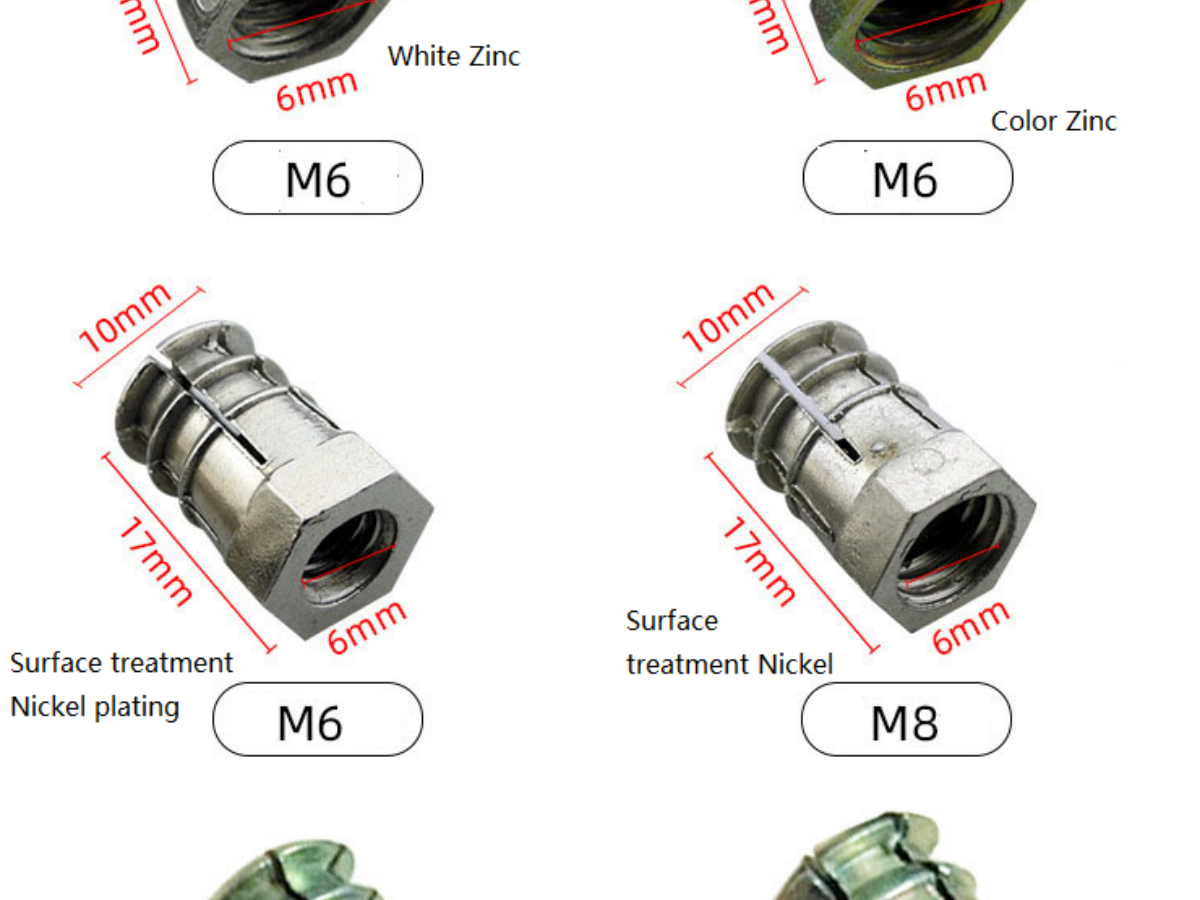
The specified sizes include M6 × Ø8 × 11.5 mm and M8 × Ø10 × 17 mm.
Zinc alloy is the primary material for this product page, with nickel or zinc surface finishes subject to alloy compatibility and project requirements.
Juxin Fasteners is an industrial fastener manufacturer supporting OEM/ODM, made-to-drawing manufacturing and industrial batch production.
The manufacturing process for each zinc alloy insert is selected according to material, slot geometry, thread requirements, dimensional tolerances and production volume.
Custom metric and Unified inch-thread designs can be evaluated for international OEM projects.
Product Specification
Zinc Alloy Expanding Insert Nuts for Furniture Connectors
Custom M6 and M8 Slotted Expansion Bushings for Knock-Down Furniture, Cabinetry and OEM Panel Assembly
Juxin Fasteners manufactures custom zinc alloy expanding insert nuts for furniture connector systems, cabinet manufacturing, modular furniture and engineered panel assemblies.
These internally threaded fastening components feature a hexagonal base and a longitudinally slotted expansion body.
They are intended to provide a female threaded anchoring point inside a compatible predrilled hole for connecting screws or furniture connector dowels.
The product is an individual expansion insert, not a complete cam-and-dowel furniture connector assembly.
Juxin Fasteners supports OEM/ODM manufacturing, made-to-drawing fasteners and industrial batch production based on customer engineering drawings,
material requirements, dimensional tolerances and manufacturing feasibility.
Product Specifications
| Parameter | Specification |
|---|---|
| Product Name | Zinc Alloy Expanding Insert Nuts |
| Alternative Names | Zinc Alloy Expansion Bushings; Furniture Expansion Nuts; Slotted Expanding Threaded Inserts |
| Primary Material | Zinc Alloy |
| Alloy Grade | Customer-Specified; Subject to Verification |
| Product Geometry | Hexagonal Base with Slotted Expansion Body |
| Internal Threads | M6 and M8 References |
| Nominal Dimensions | M6 × Ø8 × 11.5 mm; M8 × Ø10 × 17 mm |
| Surface Finish | Nickel or Zinc Finish, Subject to Process Review |
| Installation | Compatible Predrilled Hole |
| Applications | Furniture Connectors and Panel Assemblies |
| Manufacturing | Product-Specific Process Selection |
| Customization | OEM/ODM Made-to-Drawing Manufacturing |
Dimensions are nominal references supplied for this product family. Installation hole tolerances, internal thread depth, slot geometry and functional performance require confirmation from the approved drawing.
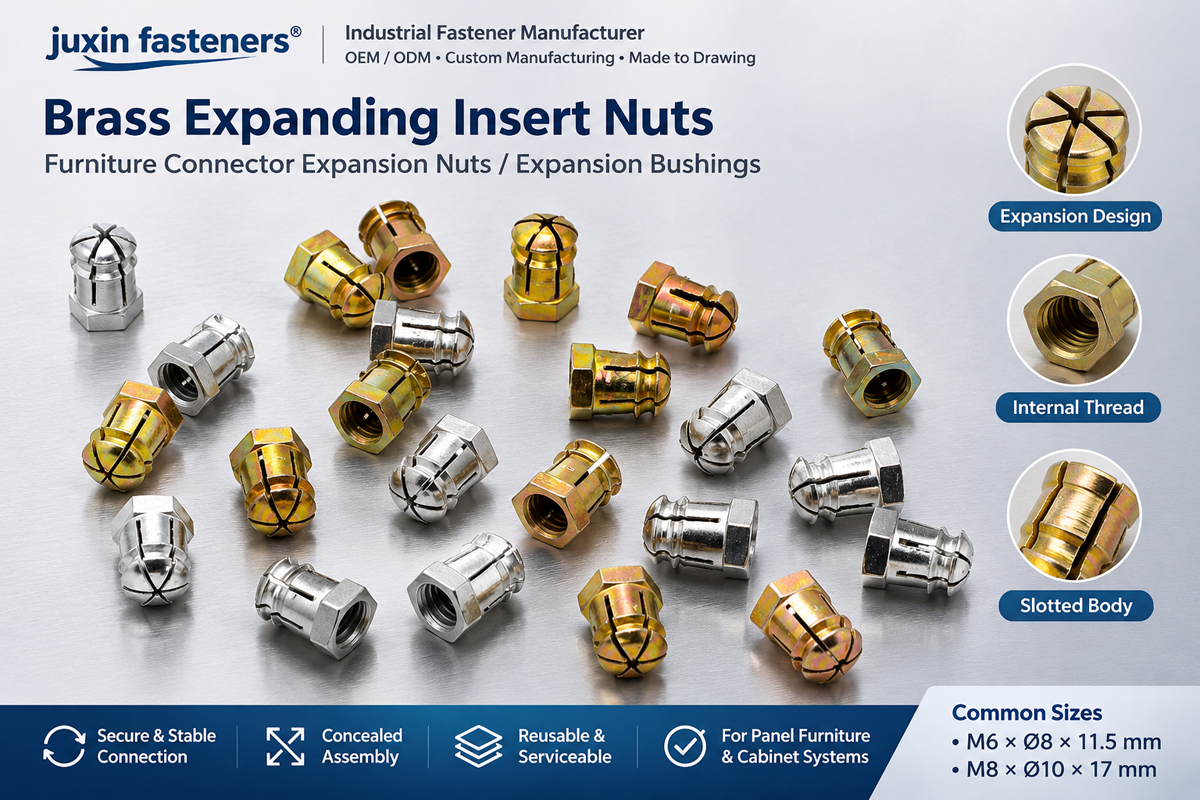
What Is a Zinc Alloy Expanding Insert Nut?
A zinc alloy expanding insert nut is a female threaded fastening component designed for installation into a suitable panel or substrate.
Its purpose is to provide an internal threaded connection without requiring a conventional nut on the opposite side of the panel.
The illustrated design includes:
An internally threaded base.
A hexagonal external section.
A cylindrical body.
Multiple longitudinal expansion slots.
Segmented end geometry.
The slotted structure is intended to participate in a mechanical retention mechanism.
However, the precise expansion method cannot be established from the external photograph alone.
How Does an Expanding Insert Work?
In a suitable furniture connector system, an expanding insert is installed into a prepared hole and engages the surrounding material through its designated retention mechanism.
Depending on the product design, expansion may be produced by a mating screw, an internal spreading element or another engineered mechanism.
The installed insert provides a threaded anchoring point for the connecting component.
The following requirements should be verified before assembly:
Installation hole diameter.
Hole depth.
Panel material.
Expansion mechanism.
Mating fastener.
Thread engagement.
Installation force or torque.
Required resistance to rotation and pull-out.
An internal plastic ball, spreading cone or other expansion component must not be assumed unless specified in the product drawing.
M6 and M8 Product Sizes
The supplied product range includes two nominal configurations.
| Internal Thread Reference | Nominal Outside Diameter | Nominal Length |
|---|---|---|
| M6 | 8 mm | 11.5 mm |
| M8 | 10 mm | 17 mm |
The nominal dimensions describe the supplied product references.
They do not independently establish the correct pilot hole diameter or recommended installation tolerance.
Metric Thread Requirements
For standard ISO metric coarse thread references:
| Thread | Nominal Diameter | Standard Coarse Pitch |
|---|---|---|
| M6×1.0 | 6 mm | 1.0 mm |
| M8×1.25 | 8 mm | 1.25 mm |
The actual thread pitch, tolerance and usable thread depth must be confirmed against the approved drawing.
Inch Dimension References
For North American engineering teams, the nominal metric dimensions can be converted to inches.
| Metric Dimension | Approximate Inch Equivalent |
|---|---|
| 8 mm | 0.315 in |
| 10 mm | 0.394 in |
| 11.5 mm | 0.453 in |
| 17 mm | 0.669 in |
These conversions are dimensional references only.
They do not establish interchangeability with inch-sized expansion inserts.
Custom UNC and UNF Thread Options
Custom zinc alloy inserts may be evaluated with Unified inch threads where the component geometry permits.
Potential engineering references include:
| Thread | Series | Nominal Diameter |
|---|---|---|
| #10-24 | UNC | 0.1900 in |
| #10-32 | UNF | 0.1900 in |
| 1/4-20 | UNC | 0.2500 in |
| 1/4-28 | UNF | 0.2500 in |
| 5/16-18 | UNC | 0.3125 in |
| 5/16-24 | UNF | 0.3125 in |
These are potential custom design references, not confirmed stock products.
The thread size must be reviewed together with the outside diameter, remaining wall thickness and expansion slot geometry.
Metric, UNC and UNF threads are not directly interchangeable.
The Role of Expansion Inserts in Furniture Connector Systems
Many knock-down furniture assemblies use connecting dowels, eccentric cams and threaded anchoring components.
An expansion insert may provide the female threaded connection for a suitable dowel or connecting bolt.
The cam component, where used, engages the connector dowel to draw the panels together.
These components perform different functions and must be selected as a compatible system.
The expansion insert should not be described as the cam lock itself.
Why Use Zinc Alloy for Furniture Inserts?
Zinc alloys are widely used in furniture hardware because suitable grades can be manufactured into complex components with consistent dimensions.
Depending on the design and manufacturing method, zinc alloys may offer advantages for production of shaped hardware components.
However, performance depends on the selected alloy and product geometry.
Important considerations include:
Mechanical strength.
Ductility.
Casting characteristics.
Dimensional stability.
Thread performance.
Corrosion resistance.
Surface finishing compatibility.
Manufacturing cost.
A zinc alloy component should not be assumed to have the same expansion behavior as a brass component.
Zinc Alloy Grade Selection
The designation zinc alloy does not identify a specific material grade.
For an OEM project, the drawing should specify the required alloy composition or applicable material designation.
Different zinc alloy grades may have different mechanical and manufacturing properties.
Material selection should account for the intended expansion mechanism and the stresses experienced by the slotted segments.
Zinc Alloy vs. Brass Expanding Insert Nuts
Zinc alloy and brass expansion inserts may perform similar functions, but they are not automatically interchangeable.
| Selection Factor | Zinc Alloy Insert | Brass Insert |
|---|---|---|
| Material Family | Zinc-Based Alloy | Copper-Zinc Alloy |
| Manufacturing Route | Depends on Alloy and Geometry | Depends on Grade and Geometry |
| Expansion Behavior | Requires Design Validation | Requires Design Validation |
| Corrosion Performance | Depends on Alloy and Finish | Depends on Grade and Finish |
| Thread Strength | Design-Specific | Design-Specific |
| Typical Selection Basis | OEM Design and Manufacturing Requirements | OEM Design and Manufacturing Requirements |
Neither material should be described as universally stronger or more durable.
The correct selection depends on the application, dimensions, manufacturing feasibility and validated joint performance.
Nickel and Zinc Surface Finishes
The supplied product information identifies nickel and zinc finishes.
Surface treatment selection should consider:
Base alloy compatibility.
Coating adhesion.
Coating thickness.
Thread tolerance.
Surface appearance.
Corrosion requirements.
Expansion slot functionality.
Environmental exposure.
Not every finishing process is suitable for every zinc alloy or component geometry.
Any specified coating must be reviewed for compatibility with the selected alloy and manufacturing route.
Pilot Hole Selection
Pilot hole diameter is a critical design parameter.
An oversized hole may reduce insert retention.
An undersized hole may increase installation force or damage the surrounding panel.
The correct hole specification depends on the actual insert dimensions, expansion mechanism and substrate.
The nominal outside diameter must not automatically be used as the recommended drilling diameter.
Panel Materials
Expansion inserts may be evaluated for suitable engineered furniture panels, including:
Particleboard.
MDF.
Plywood.
Selected solid wood components.
Other engineered panel substrates.
Performance varies with panel density, thickness, moisture condition and hole preparation.
Each application should be evaluated using representative panel materials.
Panel Thickness and Edge Distance
The available panel thickness must accommodate the insert and its installation geometry.
Insufficient material thickness may cause interference or damage.
A hole positioned too close to a panel edge may increase splitting risk.
The required edge distance should be established through engineering design and testing.
Preventing Insert Rotation
During assembly, the insert must resist the rotational forces generated by the mating fastener.
The hexagonal base and expansion geometry may influence retention, depending on how they engage the installation hole.
Actual anti-rotation performance must be verified for the complete assembly.
Preventing Pull-Out
Pull-out resistance depends on:
Insert geometry.
Expansion mechanism.
Panel material.
Installation hole dimensions.
Installation method.
Applied loading.
Environmental conditions.
No universal pull-out rating is claimed.
Functional testing should be specified where retention strength is critical.
Knock-Down Furniture Applications
Zinc alloy expanding insert nuts may be used in compatible furniture connector systems for:
Wardrobes.
Cabinets.
Bookcases.
Shelving units.
Desks.
Tables.
Storage furniture.
Modular furniture.
The insert must be matched to the connector dowel, panel material and installation method.
Cabinet Manufacturing
Cabinet manufacturers may use threaded expansion inserts where a concealed or compact connection is required.
Relevant design considerations include drilling accuracy, panel density, installation access and assembly consistency.
Office Furniture
Modular office furniture may require removable threaded connections for installation, transport or reconfiguration.
Expansion inserts can be evaluated for compatible connector systems.
Repeated assembly performance must be validated for the actual design.
Flat-Pack Furniture Production
Flat-pack furniture production benefits from consistent component dimensions and predictable assembly processes.
A suitable expansion insert may provide a repeatable anchoring point for furniture connectors.
Manufacturing engineers should evaluate:
Hole drilling accuracy.
Insert orientation.
Installation force.
Connector alignment.
Screw engagement.
Assembly cycle requirements.
Rework procedures.
Functional inspection.
Modular Retail Displays
Selected retail displays, interior fixtures and modular panel assemblies may use similar threaded connector systems.
The insert must be qualified for the intended substrate and mechanical loading.
Designing for Repeated Assembly
Furniture connector systems may allow disassembly and reassembly.
However, repeated use of the overall connector does not automatically establish that the expansion insert itself can be removed and reinstalled repeatedly.
The retention mechanism may remain permanently engaged in the panel.
The OEM should distinguish between removing the mating connector and removing the expansion insert.
Zinc Alloy Manufacturing Considerations
Juxin Fasteners is an industrial fastener manufacturer with capabilities that include cold heading, cold forming, CNC machining and product-specific secondary operations.
For zinc alloy expansion inserts, the manufacturing route must be selected according to the alloy, product geometry and production requirements.
Depending on feasibility, a zinc alloy component may require a casting-based process, machining or other appropriate operations.
Cold heading and cold forming should not be assumed suitable for every zinc alloy design.
If casting is required, the actual production route and manufacturing arrangements must be confirmed during project review.
Slot Geometry and Manufacturing Feasibility
The slotted expansion section is a critical functional feature.
Engineering review should consider:
Slot number.
Slot width.
Slot length.
Remaining wall thickness.
Segment symmetry.
Material ductility.
Internal clearance.
Expansion travel.
Risk of cracking.
A design suitable for brass may require modification before being manufactured in zinc alloy.
Internal Thread Quality
Thread requirements should be specified according to the mating connector.
Inspection may include:
Thread size.
Thread pitch.
Thread tolerance.
Usable thread depth.
Entry condition.
Burr control.
Functional thread engagement.
OEM/ODM Custom Manufacturing
Juxin Fasteners supports customer-specific expansion insert designs based on 2D drawings, 3D CAD models and technical specifications.
Potential customization includes:
Internal thread designation.
Outside diameter.
Overall length.
Hexagonal base geometry.
Expansion slot configuration.
Internal clearance.
Material grade.
Surface treatment.
Dimensional tolerances.
Functional requirements.
Packaging.
All custom requirements are subject to engineering and manufacturing feasibility review.
Quality Control and Functional Testing
Depending on the approved specification, quality requirements may include:
Material verification.
Dimensional inspection.
Thread gauging.
Slot geometry inspection.
Surface finish inspection.
Coating verification.
Functional assembly testing.
Pull-out testing.
Rotational resistance testing.
Batch acceptance criteria.
Functional test methods and acceptance limits should be agreed upon with the OEM customer.
Common Engineering Risks
Expansion Segment Cracking
Excessive deformation or unsuitable material properties may damage the slotted segments.
Insufficient Retention
Incorrect hole dimensions or inadequate expansion may reduce resistance to pull-out.
Insert Rotation
The insert may rotate when the mating fastener is tightened.
Panel Splitting
Excessive installation force or insufficient edge distance may damage the panel.
Thread Stripping
Incorrect thread engagement or excessive tightening torque may damage the internal thread.
Coating Interference
Excessive coating thickness or unsuitable finishing may affect thread fit or expansion behavior.
These risks should be addressed during engineering validation.
Production and Assembly Considerations
Production managers and manufacturing engineers should evaluate the complete installation process rather than the insert alone.
Important factors include:
Panel drilling process.
Hole tolerance control.
Insert handling.
Installation orientation.
Installation force.
Mating fastener compatibility.
Assembly inspection.
Defect prevention.
Rework requirements.
Batch consistency.
Purchasing and Supplier Development
OEM purchasing teams should consider:
Product drawing accuracy.
Zinc alloy grade.
Manufacturing feasibility.
Tooling requirements.
Sample evaluation.
Dimensional inspection.
Functional testing.
MOQ.
Production volume.
Lead time.
Packaging.
Long-term supply planning.
MOQ, tooling cost and production lead time are determined during quotation based on the approved design and order requirements.
Relevant International Engineering Standards
Depending on the final product design, relevant references may include:
ISO 261: ISO metric screw-thread general plan.
ISO 724: Basic dimensions of ISO metric screw threads.
ISO 965 Series: ISO metric screw-thread tolerances.
ASME B1.1: Unified inch screw threads.
ISO 9227: Salt spray corrosion testing, where specified.
Material and coating standards should be selected only after the zinc alloy grade and finishing process have been confirmed.
Thread standards alone do not establish the mechanical performance of an expanding furniture insert.
Frequently Asked Questions
What is a zinc alloy expanding insert nut?
It is an internally threaded component designed to provide a threaded anchoring point inside a compatible panel hole using a mechanical retention or expansion mechanism.
Is this a complete three-part furniture connector?
No. It is an individual insert component that may be used within a compatible furniture connector system.
What sizes are specified?
M6 × Ø8 × 11.5 mm and M8 × Ø10 × 17 mm.
Is zinc alloy the same as brass?
No. Zinc alloy and brass have different compositions, mechanical properties and manufacturing considerations.
Can zinc alloy replace brass in the same insert design?
Not automatically. Material substitution requires engineering review and functional validation.
Can these inserts be used in MDF and particleboard?
They may be suitable for certain engineered wood panels, but installation and retention performance must be verified for the intended substrate.
What is the recommended pilot hole diameter?
The correct pilot hole depends on the insert geometry, expansion mechanism and panel material. It must be established from the approved installation specification.
Do all expanding inserts contain an internal ball?
No. Expansion mechanisms vary by design.
Can the furniture connection be disassembled?
The mating connector may be removable, depending on the system. This does not necessarily mean the insert itself can be removed and reused.
Are custom inch threads available?
Custom Unified thread designs can be evaluated according to geometry and manufacturing feasibility.
Are M6 and 1/4-20 UNC interchangeable?
No. They are different thread systems.
Can Juxin Fasteners manufacture custom zinc alloy inserts?
Juxin Fasteners supports OEM/ODM manufacturing projects and engineering feasibility assessment for custom fastener designs.
The production route for a particular zinc alloy component must be confirmed.
Request a Quote — Zinc Alloy Expanding Insert Nuts
Juxin Fasteners is an industrial fastener manufacturer specializing in standard and custom-engineered fastening components for international OEM, Tier-1 and Tier-2 manufacturing programs.
Our manufacturing capabilities include cold heading, cold forming, CNC machining and product-specific secondary operations.
Each manufacturing route is selected according to product geometry, material, tolerance and production requirements.
We support custom furniture fastener development, made-to-drawing manufacturing, precision threaded components and industrial batch production.
Recommended RFQ Information
2D engineering drawing or 3D CAD model.
Internal thread size and tolerance.
Outside diameter.
Overall length.
Hexagonal base dimensions.
Expansion slot geometry.
Expansion mechanism details.
Zinc alloy grade.
Surface finish.
Panel material and thickness.
Installation hole dimensions.
Mating screw or connector dowel.
Required pull-out resistance.
Required rotational resistance.
Functional testing requirements.
Initial order quantity.
Estimated annual demand.
Packaging requirements.
Required delivery schedule.
Please send your engineering drawings, samples or technical specifications for manufacturing feasibility review and quotation.
Juxin Fasteners
Industrial Fastener Manufacturer | Zinc Alloy Expanding Insert Nuts | OEM Furniture Hardware Manufacturing | Custom Engineered Fasteners
Website: https://www.juxinfasteners.com/
Email: info@juxinfasteners.com
Product Packaging
Packaging Standard
At Juxin Fasteners, we apply standardized export packaging to ensure product protection, traceability, and compliance with international logistics requirements.
1. Standard Export Packaging
Unless otherwise specified, all products will be packed according to our factory standard export packaging, which includes:
Moisture-resistant inner protection
Poly bag or small box packing as required
Reinforced export cartons
Clear labeling with part number, specification, batch number, and quantity
Palletizing for sea or air shipment when necessary
Our standard packaging is designed to ensure safe transportation, efficient warehousing, and long-distance international shipping.
2. Customized Packaging Options
We also provide customized packaging solutions according to customer requirements, including but not limited to:
Private labeling
Customized barcodes
Specific carton dimensions
Retail packaging
Special pallet configuration
Customer-specific marking and identification
So that you know, customized packaging may involve additional costs and extended lead time depending on the complexity of the requirements.
3. Compliance & Quality Assurance
All packaging processes are controlled under our ISO 9001 quality management system to ensure consistency, traceability, and product integrity throughout the supply chain.
Product Pictures


Contact Us
Tel.:
+86 020 8621 0320
+86 020 3121 6067
E-mail:
Technical Support:
Navigation
SEND INQUIREY


