Call Us
+86 136 6007 9809
Call Us
+86 136 6007 9809

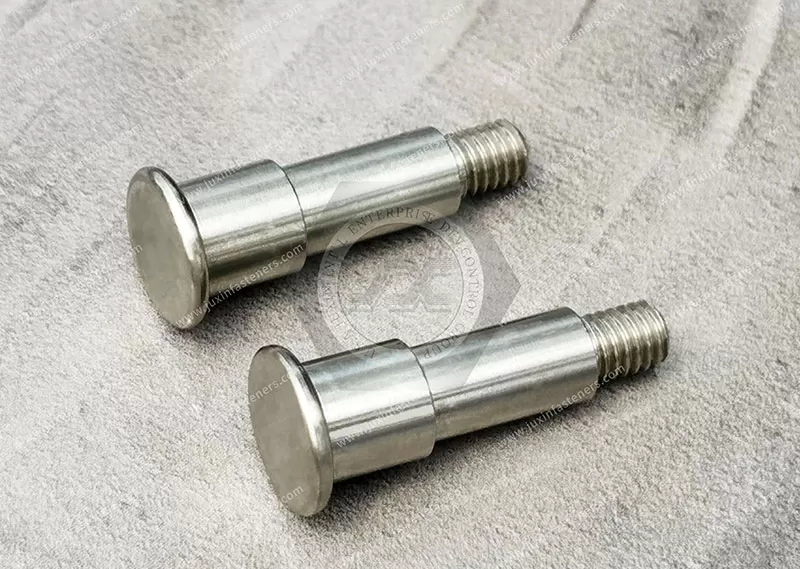
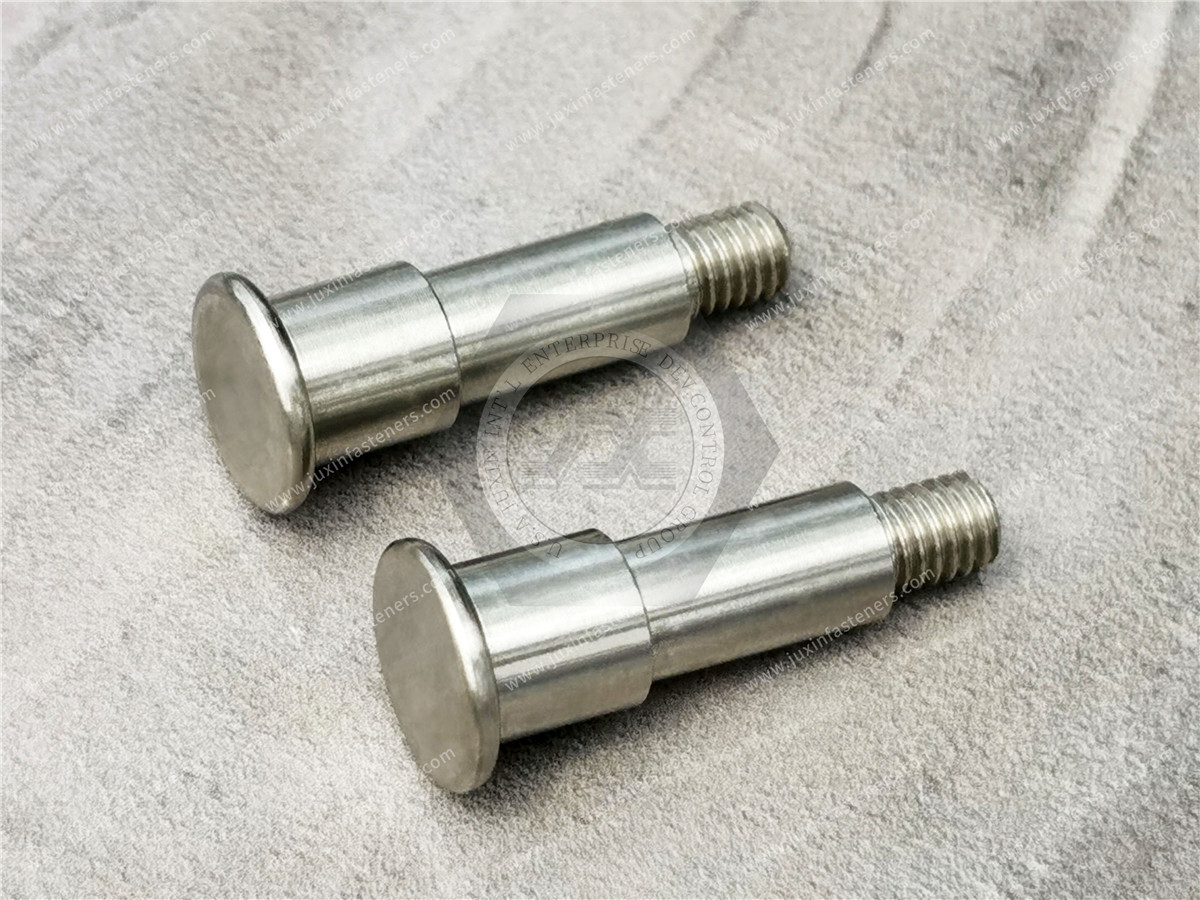
JUXIN FASTENERS supplies custom stainless steel threaded shoulder rivets featuring a manufactured head, stepped shank and external threaded section.
Original listed thread sizes include M5, M6, #10-32 and 1/4"-20. Depending on the approved design, these components may function as threaded pivot pins,
shoulder studs or specialized retaining fasteners in automotive linkages, industrial machinery, appliance hinges and articulated equipment assemblies.
Explore shoulder dimensions, thread engagement, bearing clearance, material selection, installation methods and OEM quality requirements.
Custom production inquiries are evaluated against customer engineering drawings.
Product Specification
Custom Stainless Steel Threaded Shoulder Rivets for OEM Pivot and Linkage Assemblies
JUXIN FASTENERS supplies custom stainless steel threaded shoulder rivets for industrial OEM manufacturing and specialized mechanical assemblies.
These precision fastening components combine a manufactured head, stepped cylindrical shoulder and externally threaded section in a single part.
Depending on the engineering design, the shoulder may function as a bearing surface, spacer or locating feature,
while the threaded section provides an attachment point for a mating nut or internally threaded component.
This combination is particularly useful in applications requiring controlled positioning, mechanical retention and rotational or sliding movement.
In the American and European industrial fastening markets, related products may be described as threaded shoulder rivets, threaded shoulder pins, custom shoulder studs or stepped threaded fasteners.
The correct technical designation depends on the actual geometry and installation method.
JUXIN FASTENERS supports drawing-based technical inquiries for custom threaded shoulder fastening components used by OEM manufacturers,
Tier-1 and Tier-2 suppliers, mechanical design engineers, production managers and industrial procurement teams.
Product Overview and Technical Specifications
Product Name: Custom Stainless Steel Threaded Shoulder Rivets
Original Product Name: Step Threaded Rivets
Related Industry Names: Threaded Shoulder Rivets, Threaded Shoulder Pins, Custom Shoulder Studs, Stepped Threaded Fasteners
Material: Stainless Steel
Head Configuration: Manufactured Round-Style Head, subject to drawing confirmation
Shank Configuration: Stepped Cylindrical Shoulder
Thread Configuration: External Thread
Original Listed Thread Sizes:
M5
M6
#10-32
1/4"-20
Manufacturing Basis: Customer Engineering Drawing
Typical Engineering Functions:
Mechanical Retention
Pivot Support
Component Positioning
Controlled Spacing
Threaded Attachment
The original product information does not specify the stainless steel grade, shoulder dimensions, overall length, thread length, thread tolerance class or mechanical performance.
These details must be confirmed against the approved customer drawing.
What Are Threaded Shoulder Rivets?
Threaded shoulder rivets are specialized fasteners combining a shoulder section with an external thread.
Unlike conventional straight-shank solid rivets, they incorporate multiple functional regions.
A typical design may include:
A manufactured retaining head.
A precision cylindrical shoulder.
A transition between different diameters.
An externally threaded end.
Customer-defined dimensional tolerances.
The shoulder can establish a controlled bearing or locating surface.
The threaded section can engage a mating nut or internally threaded component.
Depending on the joint design, the finished assembly may provide permanent retention, serviceable attachment or controlled mechanical movement.
The actual fastening function must be established from the engineering drawing.
Threaded Shoulder Rivets vs. Conventional Shoulder Rivets
A conventional shoulder rivet generally has a manufactured head, a shoulder and a smaller riveting section.
During installation, the smaller section may be mechanically formed to create a second retaining head.
A threaded shoulder rivet instead includes an external thread that may provide the retaining connection.
This distinction affects:
Installation equipment.
Joint assembly sequence.
Serviceability.
Retention method.
Axial clamping.
Rotational clearance.
Quality inspection.
A threaded shoulder rivet should not automatically be installed by upsetting the threaded end.
Doing so may damage the threads and prevent proper engagement.
Threaded Shoulder Rivets vs. Shoulder Screws
Shoulder screws, also known as shoulder bolts or stripper bolts, have an unthreaded cylindrical shoulder between the head and threaded portion.
They are commonly used in applications requiring controlled spacing, alignment or movement.
Standard shoulder screws often include a hex socket, slotted drive or another torque-transmitting head feature.
The featured JUXIN product has a different visible head configuration.
It is therefore more appropriate to describe it as a custom threaded shoulder rivet or threaded shoulder pin unless the approved drawing identifies it as a shoulder screw.
Threaded Shoulder Rivets vs. Pivot Pins
Pivot pins are used to support rotating or articulated components.
Some pivot pins use retaining rings, cotter pins or other locking features.
A threaded shoulder pin uses an external thread as part of the retention or attachment system.
The correct design depends on the required loading, clearance, maintenance access and assembly method.
Engineering Benefits of a Threaded Shoulder Design
Defined Bearing Surface
The cylindrical shoulder can provide a controlled contact surface for a moving component.
Controlled Axial Positioning
The shoulder length can help establish component spacing and alignment.
Threaded Retention
The external thread provides an attachment feature for compatible mating hardware.
Integrated Component Geometry
Combining the head, shoulder and threaded section may reduce the need for separate spacers or locating components in certain designs.
Custom Dimensional Control
The component can be specified according to the actual OEM assembly requirements.
Potential Serviceability
Depending on the joint design and locking method, a threaded connection may allow disassembly.
Serviceability must not be assumed for every custom application.
Available Metric and Inch Thread Specifications
The original product information identifies four thread sizes.
M5 Metric Thread
M5 identifies a nominal metric thread diameter of 5 mm.
M5 × 0.8 is a common coarse-pitch configuration.
The actual thread pitch must be verified from the customer drawing.
M6 Metric Thread
M6 identifies a nominal metric thread diameter of 6 mm.
M6 × 1.0 is a common coarse-pitch configuration.
The actual pitch and tolerance class require drawing confirmation.
#10-32 UNF Thread
#10-32 identifies a Unified inch-series thread with 32 threads per inch.
It is commonly designated #10-32 UNF.
1/4"-20 UNC Thread
1/4"-20 identifies a nominal quarter-inch thread with 20 threads per inch.
It is commonly designated 1/4"-20 UNC.
Metric and Inch Thread Compatibility
Metric and Unified inch-series threads use different dimensional systems.
M5 and #10-32 are not directly interchangeable.
M6 and 1/4"-20 are not directly interchangeable.
Even where nominal diameters appear similar, thread pitch, profile and tolerance differences can prevent correct engagement.
The mating thread must match the approved specification.
Critical Engineering Dimensions
1. Manufactured Head Diameter
Head diameter influences the retaining surface and assembly clearance.
2. Head Height
Head height affects the installed envelope and surrounding component clearance.
3. Shoulder Diameter
Shoulder diameter influences fit, bearing contact and alignment.
4. Shoulder Length
Shoulder length establishes the available bearing or spacing region.
5. Thread Diameter
Thread diameter must match the mating component.
6. Thread Pitch
Thread pitch determines compatibility with the mating nut or tapped component.
7. Thread Length
Thread length must provide adequate engagement without interfering with the intended joint movement.
8. Overall Length
Overall length must be compatible with the complete assembly.
9. Shoulder-to-Thread Transition
The transition geometry may influence seating, local stress concentration and manufacturing feasibility.
10. Concentricity
Concentricity between the shoulder and threaded section can influence assembly alignment.
11. Surface Finish
Surface condition may affect bearing performance, corrosion resistance and thread engagement.
12. Dimensional Tolerances
Critical tolerances should follow the approved customer drawing.
Shoulder Diameter and Pivot Joint Clearance
In articulated assemblies, the shoulder diameter is an important functional dimension.
The mating component may rotate around the shoulder or move along a defined bearing surface.
Insufficient Radial Clearance
An excessively tight fit may increase friction, restrict movement or cause binding.
Excessive Radial Clearance
An excessively loose fit may contribute to vibration, noise, positional variation or accelerated wear.
Engineering Considerations
The required clearance depends on:
Shoulder diameter.
Mating bore diameter.
Bushing material.
Surface finish.
Operating load.
Temperature.
Lubrication.
Wear requirements.
Manufacturing tolerances.
No universal clearance should be applied without engineering validation.
Shoulder Length and Axial Positioning
Shoulder length can determine the spacing between connected components.
If the shoulder is too short, tightening the threaded connection may clamp a moving component and restrict rotation.
If the shoulder is too long, the assembly may have excessive axial movement.
The correct design must account for:
Component thickness.
Washer thickness.
Bushing length.
Shoulder length.
Mating component geometry.
Thread engagement.
Required axial clearance.
A complete tolerance stack-up should be evaluated for precision assemblies.
Thread Engagement and Retention Engineering
The external thread provides a potential retaining or attachment function.
The correct thread engagement depends on:
Thread size.
Thread pitch.
Mating material.
Engagement length.
Applied loading.
Assembly torque, where applicable.
Locking method.
Vibration exposure.
Serviceability requirements.
Threaded Joint Preload
If the component is installed using a nut, the tightening process may create axial preload.
However, the intended preload must not interfere with the movement of a pivoting component.
Vibration Resistance
Applications exposed to vibration may require a suitable locking method.
Potential solutions depend on the assembly design and may include compatible prevailing-torque nuts, mechanical locking features or other customer-approved retention methods.
No locking method should be selected without reviewing the joint requirements.
Stainless Steel Material Selection
The original product information identifies stainless steel.
The specific grade is not confirmed.
Material selection should consider:
Mechanical strength.
Hardness.
Ductility.
Machinability.
Formability.
Corrosion resistance.
Fatigue behavior.
Thread performance.
Bearing wear.
Surface condition.
304 Stainless Steel
304 stainless steel is widely used in industrial equipment.
It may be considered where its mechanical and corrosion properties are appropriate.
However, the featured product must not be described as confirmed 304 stainless steel without material documentation.
316 Stainless Steel
316 stainless steel may be considered for certain environments requiring additional corrosion resistance.
Availability and suitability for a particular custom design must be verified.
303 Stainless Steel
303 stainless steel is commonly used for precision-machined components.
Its suitability depends on the required mechanical properties, corrosion environment and manufacturing process.
No particular grade should be substituted without customer approval.
Thread Galling
Stainless steel threaded components may be susceptible to galling under certain assembly conditions.
Relevant factors include:
Material grade.
Surface finish.
Mating material.
Thread condition.
Lubrication.
Assembly speed.
Applied load.
Appropriate material combinations and installation practices should be evaluated.
Industrial Applications and Engineering Solutions
1. Automotive Linkage and Pivot Assemblies
Automotive manufacturers may require custom shoulder fasteners for articulated mechanical assemblies.
Potential applications include:
Selected linkage pivots.
Mechanical levers.
Interior adjustment mechanisms.
Auxiliary bracket assemblies.
Non-safety-critical moving components.
Engineering Challenge
The connection must provide retention while maintaining the specified movement and alignment.
Engineering Solution
A threaded shoulder rivet may combine a defined bearing shoulder with threaded retention.
Important considerations include:
Shoulder diameter.
Axial clearance.
Thread engagement.
Vibration exposure.
Corrosion resistance.
Wear.
Assembly inspection.
Safety-critical automotive applications require dedicated validation and customer approval.
2. Industrial Machinery and Automation Equipment
Industrial equipment manufacturers may use custom threaded shoulder components in moving mechanisms.
Potential applications include:
Mechanical linkages.
Lever assemblies.
Actuator connections.
Positioning mechanisms.
Equipment pivots.
Guide components.
Engineering Challenge
The joint may require accurate alignment and controlled motion under repeated loading.
Engineering Solution
A precision shoulder can provide a defined bearing or locating surface.
The threaded section may simplify attachment where compatible with the assembly design.
Engineers should evaluate loading, bearing clearance, thread engagement and durability.
3. Commercial Appliance and Equipment Hinges
Appliance manufacturers may require custom pivot fasteners for hinged or articulated components.
Potential applications include:
Equipment hinges.
Access panels.
Mechanical linkages.
Adjustable brackets.
Moving appliance components.
Engineering Challenge
The connection must maintain alignment while permitting the intended movement.
Engineering Solution
A threaded shoulder fastener may provide controlled spacing and retention.
The design must account for repeated motion, wear and maintenance requirements.
4. Agricultural and Outdoor Equipment
Agricultural machinery may contain articulated components exposed to vibration, moisture and contaminants.
Potential applications include:
Equipment control linkages.
Mechanical levers.
Adjustable brackets.
Selected pivoting assemblies.
Engineering Challenge
The joint may experience cyclic loading, contamination and environmental exposure.
Engineering Solution
A custom shoulder fastener can be evaluated according to the required mechanical loading and operating environment.
Important factors include:
Material grade.
Bearing surface.
Corrosion resistance.
Thread retention.
Lubrication.
Wear.
Serviceability.
5. Electrical Equipment and Industrial Enclosures
Electrical equipment manufacturers may require specialized fastening components for mechanical positioning and moving hardware.
Potential applications include:
Mechanical support brackets.
Instrument mounting hardware.
Enclosure accessories.
Equipment positioning mechanisms.
Engineering Challenge
The component may require precise spacing and restricted installation clearances.
Engineering Solution
A custom shoulder length and threaded section can be evaluated against the equipment drawing.
Electrical clearances and material conductivity must be considered separately.
Stainless steel fasteners should not be assumed to provide electrical insulation.
6. Furniture and Commercial Hardware
Selected furniture and commercial hardware assemblies may use pivoting or adjustable mechanical connections.
Potential applications include:
Hinged components.
Mechanical adjustment hardware.
Folding mechanisms.
Equipment support joints.
Engineering Challenge
The connection may require controlled movement and compact geometry.
Engineering Solution
A threaded shoulder component can be evaluated where its bearing and retention functions match the intended design.
The required load capacity and durability must be verified.
7. Industrial Control and Mechanical Actuator Assemblies
Mechanical control systems may require pivoting components with defined spacing and alignment.
Potential applications include:
Control levers.
Actuator linkages.
Mechanical transmission components.
Positioning hardware.
Engineering Challenge
The assembly may require repeatable motion and dimensional accuracy.
Engineering Solution
A precision shoulder can provide a controlled interface for the moving component.
The threaded end may provide a convenient attachment feature when compatible with the mechanism.
Manufacturing Considerations for Custom Threaded Shoulder Rivets
Depending on the approved geometry, custom threaded shoulder components may require one or more manufacturing processes.
Potential processes include:
Cold heading.
Precision turning.
Thread rolling.
Thread cutting.
Shoulder forming.
Deburring.
Surface finishing.
Dimensional inspection.
The actual manufacturing method depends on:
Material grade.
Part geometry.
Thread specification.
Dimensional tolerances.
Surface requirements.
Production volume.
Tooling feasibility.
A particular manufacturing process should not be assumed without engineering review.
Installation Methods and Assembly Engineering
The original product description refers to press riveting, orbital riveting, spin riveting and other forming methods.
However, this threaded design must be evaluated separately.
Threaded Assembly
If the external thread provides retention, the fastener may be installed using a compatible nut or internally threaded component.
The installation process should establish:
Thread engagement.
Required tightening method.
Joint clearance.
Locking method.
Final alignment.
Retention performance.
Mechanical Riveting
If the engineering drawing includes a separate deformable riveting section, a forming operation may be required.
The process must not damage the functional external thread.
Press-Fit Installation
If a section of the component is intended to be press-fitted, the required interference and receiving material must be specified.
Orbital or Spin Forming
These processes may be suitable for certain custom components with a dedicated forming feature.
They should not be applied directly to the external thread unless the approved design explicitly requires such deformation.
Production Cycle Time
The original product description refers to approximately 0.3 seconds for certain high-speed processes and 5–8 seconds for some rotating or orbital riveting operations.
These values are historical process examples and do not establish guaranteed cycle times for this threaded product.
Actual assembly cycle time must be confirmed through production trials.
Common Engineering Problems and Prevention
1. Pivot Joint Binding
Possible causes:
Incorrect shoulder length.
Excessive axial clamping.
Insufficient bearing clearance.
Assembly misalignment.
Review shoulder geometry and the complete tolerance stack-up.
2. Excessive Joint Looseness
Possible causes:
Oversized mating bore.
Incorrect shoulder diameter.
Excessive axial clearance.
Inadequate retention.
Review dimensional specifications and assembly acceptance criteria.
3. Thread Damage
Possible causes:
Cross-threading.
Incorrect mating thread.
Excessive assembly force.
Improper installation tooling.
Verify thread compatibility and installation controls.
4. Stainless Steel Thread Galling
Possible causes:
Incompatible mating materials.
High friction.
Inadequate lubrication.
Excessive tightening conditions.
Review material selection and assembly practices.
5. Premature Bearing Wear
Possible causes:
Unsuitable shoulder clearance.
Excessive loading.
Surface damage.
Contamination.
Inadequate lubrication where required.
Review the complete bearing interface.
6. Corrosion at the Joint
Possible causes:
Unsuitable stainless steel grade.
Dissimilar-metal contact.
Aggressive environmental exposure.
Surface contamination.
Review material selection and service conditions.
7. Inconsistent Assembly Performance
Possible causes:
Dimensional variation.
Thread tolerance variation.
Inconsistent mating components.
Installation process variation.
Establish appropriate incoming inspection and assembly controls.
Quality Inspection for Custom Threaded Shoulder Rivets
Quality requirements should follow the approved customer engineering drawing.
Dimensional Inspection
Potential inspection characteristics include:
Head diameter.
Head height.
Shoulder diameter.
Shoulder length.
Thread diameter.
Thread pitch.
Thread length.
Overall length.
Transition geometry.
Concentricity.
Surface condition.
Critical dimensional tolerances.
Thread Inspection
Thread verification may require suitable thread gauges and dimensional checks according to the specified metric or Unified thread standard.
Material Verification
Confirm the specified stainless steel grade and material condition.
Visual Inspection
Check for:
Burrs.
Cracks.
Surface damage.
Damaged threads.
Head deformation.
Irregular shoulder geometry.
Other defects affecting fit or function.
Functional Validation
Depending on the application, customer-defined tests may include:
Thread engagement.
Joint retention.
Rotational resistance.
Bearing clearance.
Wear performance.
Vibration exposure.
Corrosion performance.
Fatigue durability.
These are potential validation requirements, not claims that every test is routinely performed for each product.
OEM and Tier-1/Tier-2 Supply Chain Requirements
Industrial OEM customers may require:
Approved engineering drawings.
Material specifications.
Dimensional inspection reports.
First article inspection.
Process control plans.
Material traceability.
Engineering change control.
Production consistency.
Customer-defined quality documentation.
Repeat-order supply planning.
Automotive programs may additionally specify PPAP or other customer-specific approval requirements.
Any certification or approval must be supported by appropriate documentation.
Production Engineering and High-Volume Assembly
For production managers, custom threaded shoulder fasteners can influence the complete assembly process.
Important considerations include:
Part feeding and orientation.
Thread protection during handling.
Fixture alignment.
Shoulder dimensional consistency.
Mating thread compatibility.
Assembly force or torque.
Joint clearance.
Retention verification.
Inspection time.
Scrap and rework.
Production throughput.
Repeat-order consistency.
A correctly designed fastening component should be evaluated together with the mating hardware and production equipment.
Custom Stainless Steel Threaded Shoulder Rivets to Drawing
JUXIN FASTENERS supports technical inquiries for custom threaded shoulder rivets, stepped threaded pins and specialized OEM fastening components.
Custom requirements may include:
Head diameter and height.
Shoulder diameter.
Shoulder length.
Thread diameter.
Thread pitch.
Thread length.
Overall length.
Transition radii.
Stainless steel grade.
Material condition.
Surface finish.
Dimensional tolerances.
Bearing clearance.
Retention requirements.
Production quantity.
Manufacturing feasibility and pricing depend on the actual engineering drawing and production specifications.
Metric and Inch Thread Reference
Original listed metric thread sizes:
M5
M6
Original listed Unified inch thread sizes:
#10-32
1/4"-20
For nominal diameter reference only:
M5 = 5.00 mm ≈ 0.197 in
M6 = 6.00 mm ≈ 0.236 in
#10 nominal major diameter ≈ 4.83 mm
1/4" nominal major diameter = 6.35 mm
These values are dimensional references, not statements of thread interchangeability.
M5 and #10-32 use different thread specifications.
M6 and 1/4"-20 use different thread specifications.
Actual thread fit must follow the approved drawing and mating hardware requirements.
Frequently Asked Engineering Questions
What is a threaded shoulder rivet?
A threaded shoulder rivet is a specialized fastener combining a manufactured head, cylindrical shoulder and external threaded section.
What is the difference between a shoulder rivet and a threaded shoulder rivet?
A conventional shoulder rivet may use a deformable tail for retention.
A threaded shoulder rivet incorporates an external thread that may provide the retaining connection.
Are threaded shoulder rivets the same as shoulder screws?
They are related fastener designs, but the head geometry, installation method and dimensional requirements may differ.
Can threaded shoulder rivets be used in rotating joints?
Yes, when the shoulder, mating bore, axial clearance and retention method are designed for controlled movement.
What thread sizes are listed for this product?
The original product information lists M5, M6, #10-32 and 1/4"-20.
Are M5 and #10-32 interchangeable?
No. They use different thread specifications.
Are M6 and 1/4"-20 interchangeable?
No. Their nominal diameters and thread pitches differ.
What stainless steel grade is used?
The original information specifies stainless steel without identifying the exact grade.
Can these components be installed using orbital riveting?
Only if the actual design includes a suitable forming feature and the process has been validated.
The external threaded section must not be unintentionally damaged.
Can threaded shoulder rivets replace conventional pivot pins?
They may be considered for certain applications, but substitution requires engineering review of geometry, retention, loading and serviceability.
Can custom shoulder dimensions be manufactured?
Custom dimensions can be evaluated according to customer drawings and production requirements.
What information is needed for an OEM quotation?
A dimensioned drawing, material grade, thread specification, shoulder dimensions, tolerances,
assembly requirements and estimated production volume provide a useful basis for technical review.
Request a Custom Threaded Shoulder Rivet RFQ
JUXIN FASTENERS supports engineering inquiries for stainless steel threaded shoulder rivets and custom stepped threaded fastening components.
For a new OEM program or an existing production component, please provide:
2D engineering drawing or 3D CAD file.
Required stainless steel grade.
Manufactured head dimensions.
Shoulder diameter and length.
Thread size and pitch.
Thread length.
Thread tolerance class.
Overall length.
Critical dimensional tolerances.
Surface finish requirements.
Mating component dimensions.
Intended installation method.
Required bearing clearance.
Required retention or mechanical performance.
Environmental and corrosion requirements.
Quality and inspection specifications.
Prototype or initial production quantity.
Estimated annual production demand.
Target project schedule.
Our team can review the supplied technical requirements and discuss the next steps for engineering clarification and quotation.
JUXIN FASTENERS
Website: https://www.juxinfasteners.com/
Email: info@juxinfasteners.com
Submit Your Engineering Drawings for a Custom Threaded Shoulder Rivet RFQ.
Product Packaging
Packaging Standard
At Juxin Fasteners, we apply standardized export packaging to ensure product protection, traceability, and compliance with international logistics requirements.
1. Standard Export Packaging
Unless otherwise specified, all products will be packed according to our factory standard export packaging, which includes:
Moisture-resistant inner protection
Poly bag or small box packing as required
Reinforced export cartons
Clear labeling with part number, specification, batch number, and quantity
Palletizing for sea or air shipment when necessary
Our standard packaging is designed to ensure safe transportation, efficient warehousing, and long-distance international shipping.
2. Customized Packaging Options
We also provide customized packaging solutions according to customer requirements, including but not limited to:
Private labeling
Customized barcodes
Specific carton dimensions
Retail packaging
Special pallet configuration
Customer-specific marking and identification
So that you know, customized packaging may involve additional costs and extended lead time depending on the complexity of the requirements.
3. Compliance & Quality Assurance
All packaging processes are controlled under our ISO 9001 quality management system to ensure consistency, traceability, and product integrity throughout the supply chain.
Product Pictures
Contact Us
Tel.:
+86 020 8621 0320
+86 020 3121 6067
E-mail:
Technical Support:
Navigation
SEND INQUIREY