Call Us
+86 136 6007 9809
Call Us
+86 136 6007 9809

JUXIN FASTENERS supplies custom steel and brass low-profile binding barrels and screws for industrial OEM assemblies.
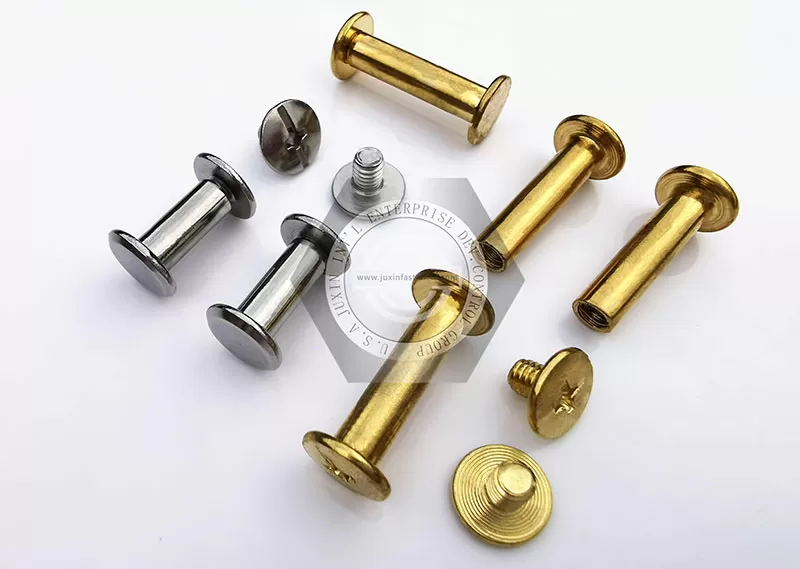
Also known as Chicago screws, binding posts, sex bolts and mating fasteners, these two-piece fastening systems combine a female barrel with a compatible male screw.
Low-profile heads provide a compact, unobtrusive appearance in suitable assemblies. Material options and finishes are subject to the approved drawing;
the pictured gold- and silver-colored components do not independently establish their base metals or coatings.
Explore barrel length, screw length, internal threads, mating compatibility, assembly thickness, corrosion protection, industrial applications and drawing-based OEM RFQs.
Product Specification
Steel and Brass Low-Profile Binding Barrels and Screws for Custom OEM Assemblies
JUXIN FASTENERS supplies custom low-profile binding barrels and screws for industrial equipment, commercial hardware,
fabricated metal assemblies and other OEM manufacturing applications.
Also known as Chicago screws, binding posts, sex bolts or mating fasteners,
these two-piece fastening systems typically combine an internally threaded female barrel with a compatible externally threaded male screw.
Their low-profile heads offer a compact fastening solution where conventional nuts and bolts may create excessive head projection or an undesirable external appearance.
The featured product family is associated with steel and brass fastening components.
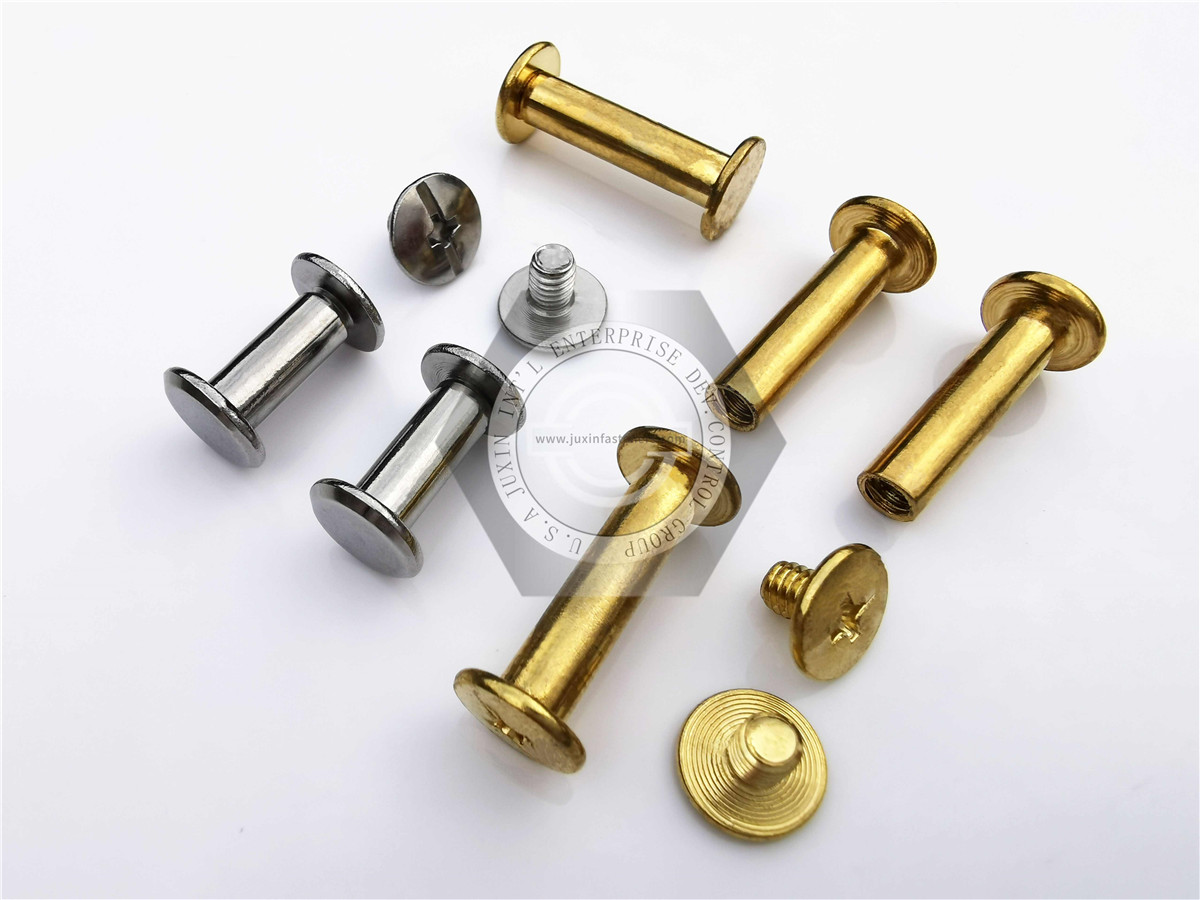
The existing product photograph shows several gold- and silver-colored fasteners, including headed barrels and mating components.
Exact material grades, surface treatments, head styles, internal threads and dimensional specifications must be confirmed from customer engineering drawings.
JUXIN FASTENERS supports drawing-based custom fastener inquiries for OEM manufacturers, mechanical engineers, production managers,
procurement teams and industrial supply chain professionals.
Product Overview and Technical Specifications
Product Name: Steel and Brass Low-Profile Binding Barrels and Screws
Original Product Name: Steel and Brass Tubular Threaded Rivets
Related Industry Names:
Low-Profile Binding Barrels and Screws
Chicago Screws
Binding Posts and Screws
Male and Female Fasteners
Sex Bolts
Barrel Bolts
Mating Fasteners
Threaded Binding Posts
Original Product Materials:
Carbon Steel
Brass
The original text also references copper and stainless steel. These materials must be evaluated separately rather than assumed to be interchangeable.
Product Configuration: Female Binding Barrel and Mating Male Screw
Head Design: Low-Profile, subject to approved drawing
Thread System: Customer-Specified Metric or Unified Inch Thread
Manufacturing Basis: Custom Engineering Drawings
Potential Supply Configurations:
Female Binding Barrel
Male Binding Screw
Matched Barrel and Screw Assembly
Supply as complete matched sets or individual components must be confirmed during quotation.
What Are Low-Profile Binding Barrels and Screws?
Low-profile binding barrels and screws are fastening components designed to join materials through a male-and-female threaded connection.
The female component generally consists of a cylindrical barrel with an internal thread and an enlarged head.
The male component consists of a compatible screw with an external thread.
During installation, the female barrel is inserted through aligned holes in the assembly.
The male screw engages the internal thread to secure the components.
Depending on the design, the connection may be removable for maintenance or replacement.
Why Choose a Low-Profile Head?
A low-profile head reduces the amount of fastener material projecting above the assembly surface.
Potential engineering advantages include:
Compact head geometry.
Reduced interference with adjacent components.
Clean external appearance.
Suitability for selected limited-clearance assemblies.
Potential access from both sides of the joint.
Compatibility with custom barrel lengths and screw dimensions.
Low-profile does not necessarily mean completely flush.
A truly flush installation may require a countersunk head and correctly prepared countersunk hole.
Low-Profile Binding Barrels vs. Conventional Nuts and Bolts
Conventional nuts and bolts use separate externally threaded and internally threaded components.
Binding barrel assemblies provide a different geometry.
The female barrel passes through the workpiece hole, and the male screw engages inside the barrel.
This arrangement can be useful when the designer requires a controlled external appearance or a particular relationship between the fastening components and the workpiece.
However, binding barrels should not automatically replace conventional bolts in highly loaded or safety-critical joints.
Mechanical suitability must be established from the actual design requirements.
Binding Barrels vs. Tubular Rivets
Although the original product was named Steel and Brass Tubular Threaded Rivets, binding barrels and conventional tubular rivets operate differently.
A conventional tubular rivet generally forms a permanent connection through deformation of its hollow tail.
A threaded binding barrel normally connects to a mating screw.
This difference affects installation, removal, inspection and joint performance.
For industrial search terminology, Binding Barrels and Screws is the preferred primary name for this product family.
Binding Barrels vs. Blind Rivet Nuts
A blind rivet nut is installed into a workpiece by deforming part of the rivet nut body.
A binding barrel is normally part of a mating fastener assembly.
The two systems are not directly interchangeable.
The correct choice depends on:
Installation access.
Workpiece thickness.
Hole geometry.
Retention requirements.
Mechanical loading.
Maintenance needs.
Production equipment.
Steel Binding Barrels and Screws
Carbon steel may be selected for applications requiring suitable mechanical properties and economical high-volume production.
Potential surface treatments include zinc plating, black oxide and other customer-specified finishes.
The actual coating must be confirmed from the engineering specification.
Engineering Considerations
Material strength.
Thread performance.
Corrosion exposure.
Surface treatment.
Assembly torque.
Head geometry.
Manufacturing tolerances.
Production volume.
Zinc-plated steel may offer corrosion protection for suitable environments.
Black oxide generally provides limited corrosion protection unless used with an appropriate supplementary treatment.
Neither finish should be assumed suitable for every wet or chemically aggressive environment.
Brass Binding Barrels and Screws
Brass is commonly used for binding posts and Chicago screws in commercial hardware and decorative fastening applications.
Potential advantages include:
Corrosion resistance in suitable environments.
Good machinability.
Electrical conductivity.
Decorative appearance.
Compatibility with selected architectural and commercial hardware designs.
Engineering Considerations
Brass alloy.
Thread strength.
Mechanical loading.
Surface finish.
Contact with dissimilar metals.
Environmental exposure.
Dimensional tolerances.
Brass should not automatically be substituted for carbon steel in a mechanically loaded joint.
The correct material must be selected according to the required performance.
Stainless Steel and Other Material Options
The supplied source text also includes product-family descriptions for 18-8 and 316 stainless steel.
These are relevant industry material options, but they do not establish that the photographed components are made from those grades.
18-8 Stainless Steel
18-8 stainless steel is widely used in corrosion-resistant industrial fasteners.
316 Stainless Steel
316 stainless steel may be appropriate for selected applications involving more demanding corrosion exposure.
Copper
Copper was mentioned in the original description, but its suitability and availability for the featured binding barrel design require confirmation.
For custom OEM projects, material availability should be evaluated against the engineering drawing, order quantity and required manufacturing process.
Critical Engineering Dimensions
1. Barrel Length
Barrel length influences the thickness of the assembly that can be accommodated.
It must be coordinated with the mating screw length and required thread engagement.
2. Barrel Outside Diameter
The barrel diameter must be compatible with the receiving hole.
Incorrect clearance may cause installation difficulties or unwanted movement.
3. Barrel Internal Thread
The internal thread must match the mating male screw.
4. Screw Thread Diameter and Pitch
Thread size and pitch determine the compatibility of the mating components.
5. Screw Length
Screw length must be selected according to the barrel configuration and assembly thickness.
6. Head Diameter
Head diameter influences the available retaining surface.
7. Head Height
Head height determines how far the fastener projects from the workpiece surface.
8. Internal Thread Depth
Thread depth affects available engagement and screw compatibility.
9. Head Drive Configuration
Potential configurations include:
Smooth No-Drive Head
Slotted Head
Phillips Head
Combination Slotted/Phillips Head
Hex Socket Head
Customer-Specific Drive Features
The exact drive styles available for the featured product must be confirmed.
10. Surface Finish
The surface finish should meet the specified appearance, corrosion and assembly requirements.
11. Dimensional Tolerances
All critical dimensions must follow the approved customer engineering drawing.
Barrel Length and Material Thickness Selection
A correctly selected binding barrel must fit the intended assembly thickness.
The designer should evaluate:
Total material stack thickness.
Barrel length.
Screw length.
Internal thread depth.
Thread engagement.
Head seating.
Required clamping condition.
Washer or spacer thickness.
If the barrel is too long, the assembly may not clamp as intended.
If the barrel is too short, thread engagement or component fit may be inadequate.
Barrel length and screw length are commonly measured from under the head in relevant American industrial catalogs.
However, the drawing must define the measurement convention for each custom component.
Open-End vs. Closed-End Binding Barrels
Open-End Binding Barrels
An open-end barrel may contain a through-threaded hole.
This configuration can provide additional thread engagement options in certain assemblies.
Closed-End Binding Barrels
A closed-end barrel contains a blind internal thread.
The available engagement depth must be coordinated with the screw length.
The featured product photograph does not establish which configurations are supplied.
Thread Compatibility and International Standards
Custom binding barrels and screws may use metric or Unified inch-series threads.
Relevant systems include:
ISO Metric Threads
UNC Unified Coarse Threads
UNF Unified Fine Threads
The internal and external threads must match.
For example, an M5 metric thread cannot be assumed compatible with a #10 Unified thread.
Likewise, M6 and 1/4"-20 UNC are not directly interchangeable.
The approved drawing should specify the nominal diameter, pitch and thread tolerance requirements.
Industrial Applications and Engineering Solutions
1. Industrial Equipment Panels
Industrial equipment manufacturers may require compact fastening systems for selected panels and covers.
Engineering Challenge
A conventional nut and bolt may create excessive head projection or require more assembly space.
Potential Solution
A low-profile binding barrel and screw assembly can be evaluated where both-side access and the required mechanical performance are available.
Important considerations include:
Panel thickness.
Hole diameter.
Head clearance.
Thread engagement.
Retention requirements.
Service access.
2. Electrical Equipment and Enclosures
Potential applications include mechanical enclosure hardware, support brackets and equipment accessories.
Engineering Challenge
Compact equipment may require precise fastening dimensions and controlled external profiles.
Potential Solution
A custom binding barrel may provide a compact threaded connection.
Electrical conductivity, grounding, insulation and clearance requirements must be evaluated separately.
Steel and brass are electrically conductive materials.
3. Commercial and Architectural Hardware
Binding posts and Chicago screws are established products in architectural and commercial hardware.
Potential applications include:
Door accessories.
Decorative metal panels.
Interior hardware.
Partition hardware.
Commercial fixtures.
Engineering Challenge
The fastener must provide the required retention while meeting appearance and installation requirements.
Potential Solution
A low-profile steel or brass binding barrel may offer a suitable combination of head geometry and threaded connection.
Material and finish should be selected according to the service environment.
4. Furniture and Cabinet Hardware
Potential applications include:
Furniture panels.
Cabinet components.
Commercial furniture.
Modular assemblies.
Decorative hardware.
Engineering Challenge
The assembly may require compact fasteners and controlled appearance.
Potential Solution
A matched binding barrel and screw can be evaluated according to panel thickness, hole dimensions and mechanical requirements.
5. Display Fixtures and Signage
Potential applications include:
Display panels.
Exhibition fixtures.
Signage hardware.
Retail display assemblies.
Commercial presentation equipment.
Engineering Challenge
Visible fasteners may need a low-profile, consistent finish.
Potential Solution
A custom binding barrel and screw assembly can provide a compact fastening arrangement.
Head appearance, material and finish should follow the approved design.
6. Appliance and Consumer Equipment Manufacturing
Potential applications include selected mechanical covers, brackets and accessory assemblies.
Engineering Challenge
The assembly may require compact hardware compatible with production tooling.
Potential Solution
Custom binding barrels can be evaluated according to the actual dimensions, assembly access and performance requirements.
7. Industrial Machinery
Potential applications include machine covers, mechanical brackets and non-critical equipment hardware.
Engineering Challenge
Standard catalog fasteners may not match the required head height, barrel diameter or assembly thickness.
Potential Solution
A custom low-profile binding assembly can be manufactured to a customer-specific drawing, subject to feasibility.
8. Bookbinding and Presentation Hardware
Chicago screws are widely used in certain bookbinding and presentation products.
Potential applications include:
Sample books.
Presentation folders.
Albums.
Catalog assemblies.
Display books.
These are established applications of the binding post family.
The featured industrial components are not automatically interchangeable with standard bookbinding hardware.
9. Leather Goods and Accessories
Brass and steel binding posts are also used in selected leather goods and accessory assemblies.
The appropriate dimensions, finishes and mechanical properties depend on the actual application.
JUXIN FASTENERS focuses on industrial OEM production and drawing-based bulk supply rather than individual consumer replacement orders.
Manufacturing Considerations
Depending on the design, binding barrels and screws may require:
Cold heading.
Precision turning.
Drilling.
Internal threading.
External thread forming.
Head forming.
Deburring.
Surface finishing.
Dimensional inspection.
The manufacturing method depends on:
Material.
Head geometry.
Barrel dimensions.
Thread requirements.
Tolerances.
Surface treatment.
Production quantity.
Not every custom design is suitable for every manufacturing process.
Assembly and Installation
Step 1: Verify the Components
Confirm the female barrel and mating male screw use compatible thread specifications.
Step 2: Check the Assembly Thickness
Verify the material stack thickness against the barrel and screw dimensions.
Step 3: Prepare the Receiving Holes
Confirm hole diameter, alignment and burr condition.
Step 4: Insert the Female Barrel
Position the barrel through the aligned holes.
Step 5: Engage the Male Screw
Thread the compatible screw into the female barrel.
Step 6: Tighten According to the Approved Process
Use the specified tool, tightening method and any required locking feature.
Step 7: Inspect the Finished Assembly
Verify head seating, retention, alignment and appearance.
The actual assembly process must follow the approved engineering drawing.
Common Engineering Problems and Solutions
Incorrect Barrel Length
May cause inadequate clamping or poor fit.
Review the assembly stack-up and mating screw length.
Cross-Threading
May damage the internal or external thread.
Verify thread compatibility and assembly alignment.
Insufficient Thread Engagement
May reduce the reliability of the connection.
Review thread depth and screw length.
Joint Loosening
May occur under vibration or repeated loading.
Evaluate the required locking method and assembly procedure.
Head Deformation
May result from excessive installation loading or unsuitable material properties.
Review head geometry and tightening requirements.
Corrosion
May occur if the material or finish is unsuitable for the operating environment.
Select materials and surface treatments according to the customer specification.
Galvanic Interaction
May occur when dissimilar metals are exposed to a conductive environment.
Review the complete material combination.
Quality Inspection for Custom Binding Barrels and Screws
Potential dimensional inspection characteristics include:
Barrel length.
Barrel outside diameter.
Head diameter.
Head height.
Internal thread size.
Internal thread depth.
Male screw diameter.
Male screw length.
External thread specification.
Surface finish.
Concentricity.
Critical tolerances.
Material Verification
Confirm the specified steel or brass grade.
Thread Inspection
Verify internal and external threads using suitable inspection methods and gauges.
Visual Inspection
Check for:
Burrs.
Cracks.
Damaged threads.
Head deformation.
Surface damage.
Coating defects.
Other conditions affecting assembly.
Functional Validation
Depending on the customer requirements, validation may include:
Mating screw engagement.
Thread stripping resistance.
Joint retention.
Assembly fit.
Vibration performance.
Corrosion exposure.
Repeated assembly performance.
These are potential customer-defined requirements, not claims that every test is routinely performed for the featured products.
Production Engineering and OEM Supply
For production managers, custom binding barrels and screws can influence total assembly cost.
Relevant factors include:
Material availability.
Dimensional repeatability.
Component feeding.
Part orientation.
Mating screw compatibility.
Installation tooling.
Assembly time.
Inspection requirements.
Scrap and rework.
Production scheduling.
Repeat-order consistency.
Where the application permits, a properly specified binding post assembly may simplify the external fastening arrangement.
Actual production efficiency must be validated for the customer's equipment and assembly process.
Custom Binding Barrels and Screws to Engineering Drawings
JUXIN FASTENERS supports inquiries for custom steel and brass binding barrels, Chicago screws and related mating fasteners.
Custom requirements may include:
Barrel length.
Barrel outside diameter.
Internal thread size.
Internal thread depth.
Male screw dimensions.
Head diameter.
Head height.
Head profile.
Drive style.
Steel or brass material grade.
Surface finish.
Dimensional tolerances.
Required mechanical performance.
Production quantity.
Manufacturing feasibility and pricing depend on the approved engineering requirements.
Frequently Asked Engineering Questions
What are low-profile binding barrels and screws?
They are male-and-female fastening components designed to provide a compact threaded connection with relatively thin heads.
Are binding barrels and Chicago screws the same?
Chicago screws are a common type of binding post and screw assembly. Terminology may vary by manufacturer and product configuration.
What are sex bolts?
Sex bolts are mating male-and-female fasteners, often featuring a female barrel and compatible male screw.
Are these conventional tubular rivets?
Not necessarily. Threaded binding barrels use a mating screw, while conventional tubular rivets are generally secured by deforming the rivet tail.
What materials are available?
The original product is identified as steel and brass. Exact material grades and other material options require confirmation.
Can the heads be completely flush?
A low-profile head reduces projection, but a completely flush installation may require a suitable countersunk design.
Can binding barrels be removed after installation?
Many threaded binding post assemblies can be disassembled, depending on the locking method and service conditions.
What is the difference between open-end and closed-end barrels?
Open-end barrels may provide a through-threaded configuration, while closed-end barrels have a blind internal thread.
Can binding barrels be used in industrial equipment?
Yes, where the geometry, mechanical loading, installation access and retention requirements are compatible with the fastening system.
Can metric and inch threads be mixed?
No. The male and female components must use compatible thread specifications.
Can JUXIN FASTENERS supply custom head and barrel dimensions?
Customer-specific dimensions can be evaluated according to engineering drawings and production requirements.
What information is needed for an OEM quotation?
A dimensioned drawing, material grade, barrel length, head dimensions, thread specification, mating screw details and estimated annual production quantity provide a useful basis for review.
Request a Custom Low-Profile Binding Barrels and Screws RFQ
JUXIN FASTENERS supports drawing-based inquiries for steel and brass low-profile binding barrels, Chicago screws, mating fasteners and specialized OEM threaded hardware.
For a new product development program or existing production component, please provide:
2D engineering drawing or 3D CAD file.
Required steel or brass material grade.
Barrel outside diameter.
Barrel length.
Internal thread size and pitch.
Internal thread depth.
Male screw dimensions.
Head diameter and height.
Head profile and drive style.
Surface finish requirements.
Assembly thickness.
Receiving-hole dimensions.
Critical dimensional tolerances.
Mechanical performance requirements.
Installation method.
Quality and inspection requirements.
Prototype or initial production quantity.
Estimated annual production demand.
Target project schedule.
Our team can review the supplied technical requirements and discuss the next steps for engineering clarification and quotation.
JUXIN FASTENERS
Website: https://www.juxinfasteners.com/
Email: info@juxinfasteners.com
Submit Your Engineering Drawings for a Custom Binding Barrels and Screws RFQ.
Product Packaging
Packaging Standard
At Juxin Fasteners, we apply standardized export packaging to ensure product protection, traceability, and compliance with international logistics requirements.
1. Standard Export Packaging
Unless otherwise specified, all products will be packed according to our factory standard export packaging, which includes:
Moisture-resistant inner protection
Poly bag or small box packing as required
Reinforced export cartons
Clear labeling with part number, specification, batch number, and quantity
Palletizing for sea or air shipment when necessary
Our standard packaging is designed to ensure safe transportation, efficient warehousing, and long-distance international shipping.
2. Customized Packaging Options
We also provide customized packaging solutions according to customer requirements, including but not limited to:
Private labeling
Customized barcodes
Specific carton dimensions
Retail packaging
Special pallet configuration
Customer-specific marking and identification
So that you know, customized packaging may involve additional costs and extended lead time depending on the complexity of the requirements.
3. Compliance & Quality Assurance
All packaging processes are controlled under our ISO 9001 quality management system to ensure consistency, traceability, and product integrity throughout the supply chain.
Product Pictures
Contact Us
Tel.:
+86 020 8621 0320
+86 020 3121 6067
E-mail:
Technical Support:
Navigation
SEND INQUIREY