
Call Us
+86 136 6007 9809
Call Us
+86 136 6007 9809

Nov. 18, 2026
All-Metal Prevailing-Torque Lock Nuts for Industrial Machinery
In the realm of heavy mechanical engineering—spanning agricultural combines, mining crushers, railway rolling stock, and industrial stamping presses—threaded fasteners are subjected to relentless dynamic forces. Shock loads, severe thermal cycling, and continuous high-frequency transverse vibration constantly work to overcome the friction holding a bolted joint together. Once the preload (clamping force) is lost, the nut backs off, leading to rapid joint fatigue, component detachment, and ultimately, catastrophic equipment failure.
To combat this loosening, engineers specify lock nuts. While numerous locking designs exist, the two most common industrial solutions for demanding environments are Nylon Insert Lock Nuts (e.g., DIN 985) and All-Metal Prevailing-Torque Lock Nuts (e.g., DIN 980 / ISO 7042). As an expert Industrial Fastener Manufacturer, Juxin Fasteners produces both varieties in high-volume industrial batches. However, understanding the strict engineering limitations, specific locking mechanics, and reusability constraints of each mechanism is critical for OEM design engineers to ensure equipment safety and longevity.
The Heat and Vibration Challenge in Heavy Industry
Consider the exhaust manifold, turbocharger assembly, or hydraulic drive systems of a heavy-duty diesel tractor. The localized temperature in these areas frequently exceeds 300^°C (570^°F), while the massive engine block and uneven terrain generate severe, multi-axis high-frequency vibration.
If a design engineer mistakenly specifies a standard nylon insert lock nut for these high-temperature mounting studs, the locking performance may deteriorate outside the approved service range. The polyamide (nylon) locking ring utilized in these nuts has a temperature capability that depends on polymer grade, exposure duration, and the applicable product specification. Excessive temperature can reduce the polymer element's ability to maintain the specified prevailing torque. The engine vibration will then rapidly back the nut off the stud. In this high-heat, high-vibration environment, an all-metal prevailing-torque lock nut is one candidate that should be evaluated against the required operating conditions.
Fastener Geometry and Locking Mechanisms
Understanding *how* these nuts grip the bolt is essential for proper specification and installation.
* Nylon Insert Lock Nuts (DIN 985, DIN 982): These feature a captive, undersized nylon collar housed securely in the top portion of the nut. As the bolt threads pass through the metal portion of the nut and enter the nylon, they physically cut threads into the softer polymer. The elastic memory of the nylon exerts a continuous, radial compressive force against the bolt threads. This creates significant friction (prevailing torque) that resists rotational loosening.
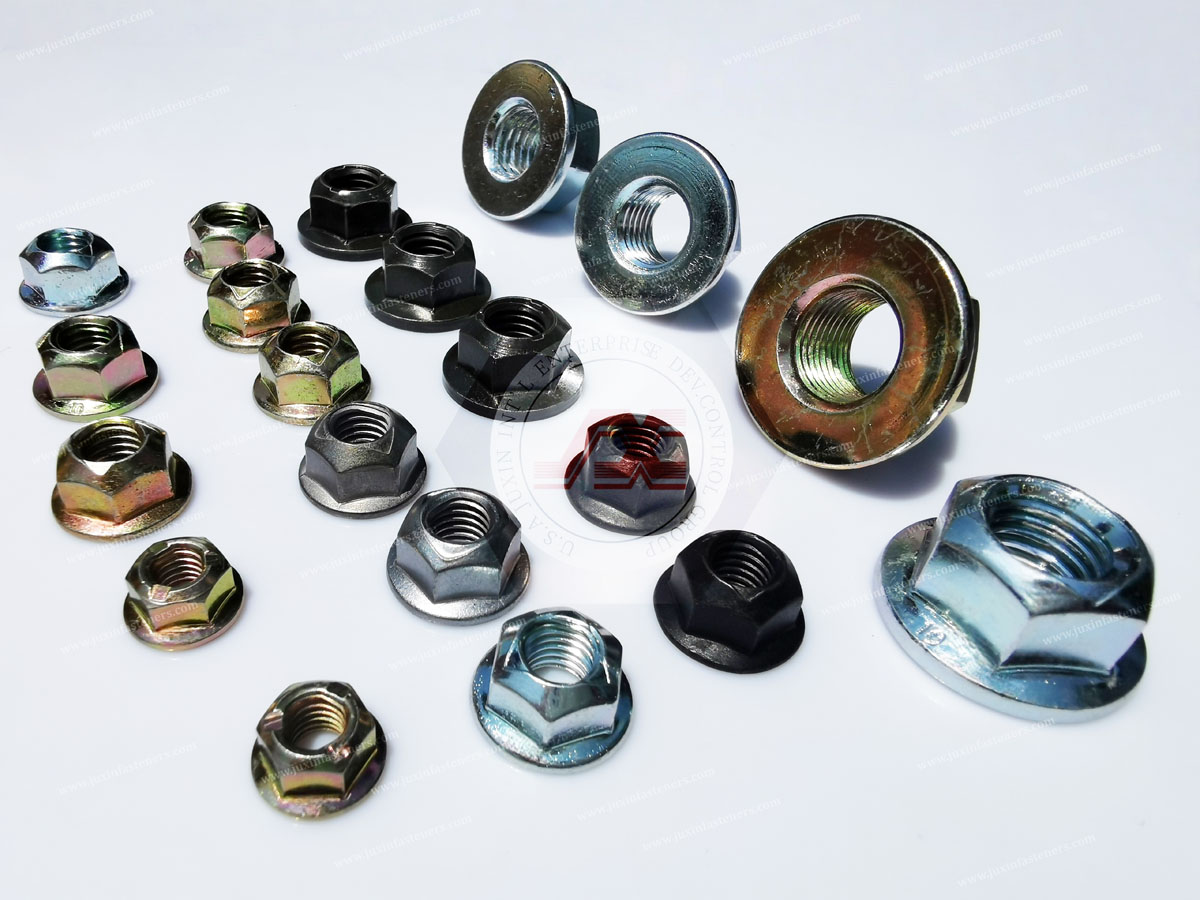
* All-Metal Prevailing-Torque Lock Nuts (DIN 980, ISO 7042): These rely entirely on metal-to-metal friction. During the manufacturing process, the top threads of the nut are intentionally and mechanically deformed. Common methods include pinching the top of the nut into an elliptical shape or deflecting the top threads downward. As the bolt forces its way through this distorted section, the hardened steel of the nut acts as a stiff, radial spring, clamping down fiercely on the bolt threads.
* Fuji-Style / Flange Lock Nuts: A popular variation of the all-metal design that may combine a flange bearing surface with a separate metal locking feature, depending on the exact design. Fuji-style or spring-stop descriptions must be checked against the supplied drawing; a flange alone does not create prevailing torque.
Engineering Comparisons and Decision Frameworks
When selecting between nylon inserts and all-metal designs, OEM engineers must evaluate three primary constraints:
Temperature Ceilings:
* Nylon Inserts: Check the manufacturer's specified temperature range and the polymer insert material; there is no single universal service limit for every nylon-insert nut.
* All-Metal: Performance is limited only by the metallurgy of the nut, the bolt, and any applied surface coatings. Do not infer high-temperature suitability from an all-metal locking feature alone. Material strength, relaxation, coating, mating bolt, and the required joint preload must all be evaluated at operating temperature.
Chemical and Environmental Exposure:
* Nylon Inserts: The polyamide ring is susceptible to degradation from aggressive agricultural chemicals, certain harsh hydraulic fluids, strong acids, and extended UV exposure.
* All-Metal: Do not contain a polymer locking element, but remain subject to corrosion, thermal relaxation, and metal-to-metal wear. The environmental resistance is dictated entirely by the base metal (e.g., stainless steel) or the applied plating (e.g., Zinc-Nickel or Zinc Flake coatings).
Galling Risks (Particularly in Stainless Steel Applications):
* When using stainless steel bolts and nuts together, the friction generated during installation creates immense localized heat, causing the threads to cold-weld (gall) and seize permanently. All-metal stainless lock nuts present a massive galling risk because the deliberate thread deformation generates extreme friction during installation. Engineering teams should evaluate approved lubricants, surface treatments, and compatible material combinations when specifying all-metal stainless lock nuts. Nylon inserts present a significantly lower galling risk on stainless hardware because the polymer acts somewhat as a lubricant.
Clarifying "Locking": Anti-Rotation vs. Preload Retention
A critical engineering misconception is that prevailing-torque lock nuts guarantee joint clamping force (preload). They do not.
A prevailing-torque lock nut provides *anti-rotation*. If the bolted joint experiences severe transverse vibration or thermal expansion that causes the bolt to stretch or the host material to compress, the joint will still lose its clamping force (preload). However, unlike a standard hex nut which will rapidly spin off the bolt and fall onto the factory floor under vibration, the prevailing-torque lock nut will stay locked in its current position on the bolt threads. The resistance to further rotation may remain, but retention is not guaranteed in every service condition. To maintain actual preload under vibration, engineers must look to tension-control mechanisms like Belleville conical washers or Nord-Lock style wedge-locking washers.
ISO 2320 Standards and Reusability Limits
During routine machinery maintenance, mechanics often remove and reinstall the same lock nuts to save time and costs. Engineers must account for the degradation of prevailing torque over multiple cycles, which is governed by international standards like ISO 2320.
* Every time an all-metal lock nut is installed and removed, the harder bolt slightly stretches and re-forms the deliberately deformed section of the nut.
* Repeated installation can change prevailing torque; evaluate the relevant standard test sequence and the actual fastener/bolt pairing instead of assuming a fixed percentage loss.
* For critical aerospace, railway, or heavy lifting applications, replacement policy should follow the OEM maintenance instruction, safety assessment, and applicable product specification. While ISO 2320 allows for some reusability testing, safety factors often dictate replacement after initial removal.
Manufacturing Processes and Quality Inspection
As an OEM/ODM Fastener Manufacturer, Juxin Fasteners utilizes advanced multi-process manufacturing to produce high-reliability all-metal lock nuts:
* Cold Forming: The nut body, threads, and locking feature require an appropriate controlled manufacturing sequence; internal threads are not necessarily cold-formed.
* Precision Deflection: Specialized stamping presses apply precisely calculated pressure to the top of the nut to create the necessary elliptical or downward deformation. If deformed too much, the nut will gall, require excessive installation torque, and potentially destroy the bolt threads. If deformed too little, it will fail ISO 2320 prevailing torque minimums and vibrate loose.
* Transverse-Vibration Validation: Although dimensional and prevailing-torque requirements can be specified and inspected, OEMs must validate the final joint design. This is often done using the Junker vibration test (DIN 65151), which subjects the bolted joint to severe transverse displacement to measure the rate of preload loss over time, proving the efficacy of the lock nut in a simulated real-world environment.
How Prevailing Torque Differs From Tightening Torque
Prevailing torque is the rotational resistance produced by the locking feature before the nut seats against the joint. Tightening torque includes this resistance plus the torque used to generate bolt tension through thread and bearing friction. A torque wrench reading therefore cannot be translated directly into clamp load without accounting for the locking feature and friction conditions. For automated assembly, the program may need a run-down window, seating detection, and a separately established tightening strategy.
The bolt grade, thread finish, lubrication, coating, and installation speed can change measured torque. A nut tested on one reference bolt may behave differently with another production bolt. For this reason, acceptance criteria should identify the mating thread specification and test method, not merely an isolated torque value.
Choosing a Locking Mechanism by Application
A nylon-insert design may be appropriate where temperature and chemical exposure remain within its qualified range and repeated service is anticipated under the OEM procedure. All-metal designs avoid polymer-specific limitations but can require higher run-down torque and may increase galling risk, especially with stainless combinations. Distorted-thread, top-lock, and other all-metal configurations do not necessarily have identical prevailing-torque characteristics. Compare the actual product drawing, not just a broad commercial name.
A flanged lock nut changes the bearing interface, but flange diameter and surface finish also affect friction and local contact stress. On painted, coated, or soft substrates, embedment and coating creep can reduce clamp load even when the locking feature continues to resist rotation. For critical assemblies, joint stiffness, bolt stretch, thermal expansion, and service loads must be assessed together.
Validation Under Transverse Vibration
The commonly cited Junker-type transverse vibration test evaluates loss of preload under imposed lateral displacement. It does not mean a nut that passes one test will be immune to loosening in every machine. Test fixture stiffness, initial preload, displacement amplitude, number of cycles, and surface conditions affect results. Where relevant, the OEM should define a representative test protocol and acceptance criteria for retained preload, nut rotation, and joint damage.
ISO 2320 addresses prevailing-torque-type steel nuts within its defined scope and test conditions; it is not a universal design approval for every material, flange style, or operating temperature. Confirm the applicable product standard and edition before placing an ISO designation on a drawing or certificate.
Maintenance and Traceability
Service instructions should state whether a removed nut may be reused, whether lubricant is permitted, and what to inspect on the mating bolt. Thread damage, corrosion, galling, and loss of locking resistance are reasons for rejection regardless of nominal reuse count. For batch purchasing, define material and property class, thread tolerance, finish, prevailing-torque test requirements, packaging, and lot identification so production and maintenance receive consistent components.
OEM Purchasing and Batch Manufacturing Considerations
When requesting a drawing-based RFQ for custom lock nuts or inquiring about standard DIN/ISO components, OEM procurement teams must specify:
* Required locking torque range (specifying First On / First Off / Fifth Off prevailing torques if deviating from standard ISO 2320).
* Surface finish requirements (e.g., Zinc Flake coating for 1,000-hour salt spray resistance without the risk of hydrogen embrittlement found in electroplating high-strength fasteners).
* Any required dry-film lubrication to prevent galling on high-speed automated assembly lines.
To discuss your heavy-duty fastening challenges, custom locking requirements, and Industrial Batch Production, contact Juxin Fasteners at info@juxinfasteners.com.
 MORE NEWS
Nov. 18, 2026
Contact Us
Tel.:
+86 020 8621 0320
+86 020 3121 6067
E-mail:
Technical Support:
Navigation
SEND INQUIREY