
Call Us
+86 136 6007 9809
Call Us
+86 136 6007 9809

Nov. 18, 2026
DIN 929 Hex Weld Nuts for Automotive and Industrial Assemblies
In heavy-duty automotive and industrial manufacturing, structural integrity is non-negotiable. When assembling vehicle frames, Body-in-White (BIW) structures, heavy machinery chassis, and industrial enclosures, engineers must establish permanent, high-strength threaded mounting points on structural steel components. These mounting points must withstand immense torque during final assembly and resist dynamic vibration and shear forces throughout the product's lifespan.
The industry standard solution for this requirement is the DIN 929 Hex Weld Nut. Designed specifically for resistance projection welding, these fasteners fuse metallurgically with the host metal, creating a joint that often exceeds the strength of the mating bolt itself. As an Industrial Fastener Manufacturer, Juxin Fasteners specializes in producing high-precision DIN 929 weld nuts for global OEMs, ensuring consistent quality and weldability for automated, high-throughput assembly lines.
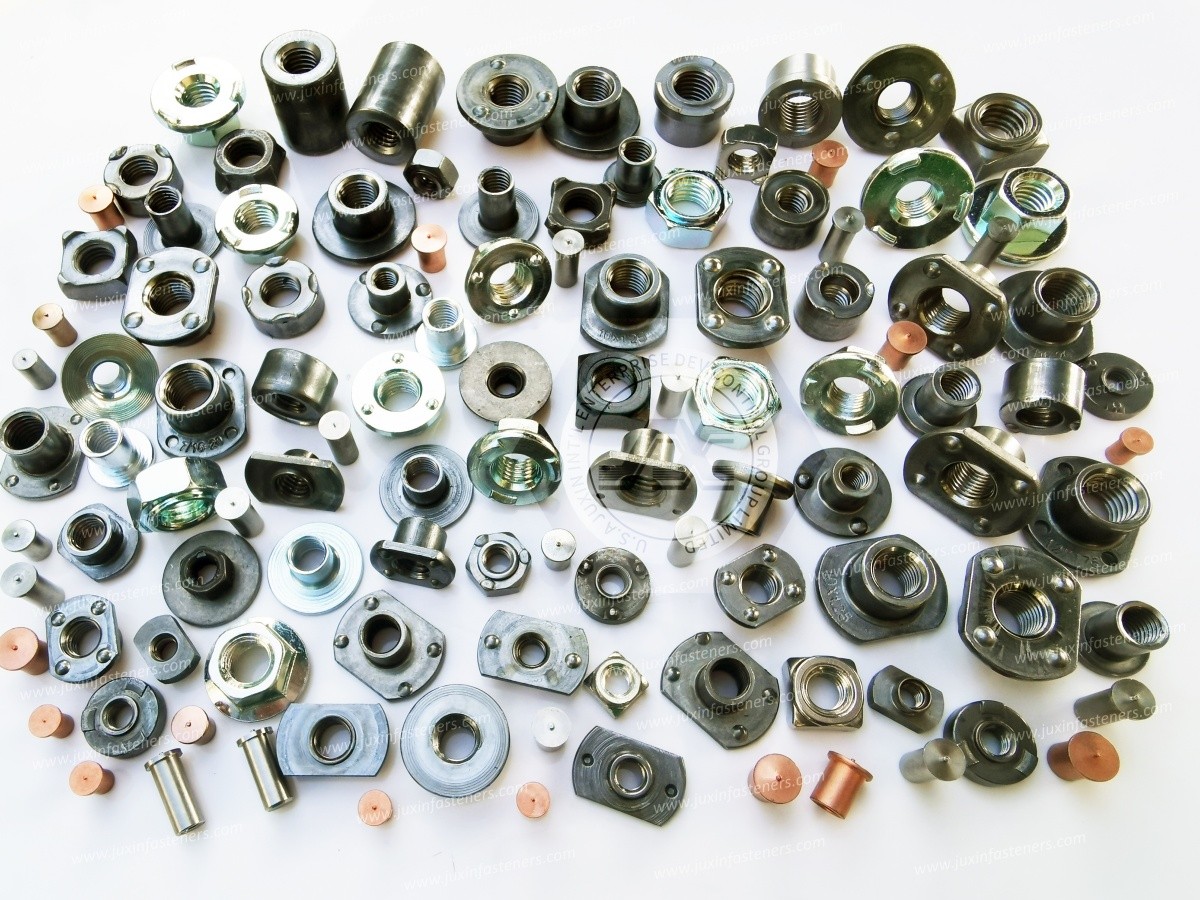
The Mechanics of Projection Resistance Welding
Unlike standard hex nuts, DIN 929 hex weld nuts feature distinct geometric modifications engineered specifically for the resistance welding process:
Weld Projections: The welding face of the nut features weld projections with geometry defined by the applicable DIN 929 edition and the approved product drawing. These are not random bumps; their volume and geometry are strictly defined by the DIN 929 standard to provide the exact amount of material needed for the weld nugget.
Location and Hole Fit: The nut must be accurately positioned relative to the sheet opening by its approved geometry and the welding fixture. Do not assume a particular pilot feature without checking the selected DIN 929 drawing and variant.
The welding process itself relies on electrical resistance and immense pressure. During automated assembly, copper electrodes clamp the nut against the steel sheet. A massive electrical current is discharged through the electrodes. Because the designated weld projections represent the points of contact with the smallest surface area, they present the highest electrical resistance in the circuit.
This resistance causes the projections to rapidly heat and melt within milliseconds. Simultaneously, the electrodes apply forging pressure, forcing the nut flush against the sheet metal. The molten material from the projections fuses with the molten surface of the sheet, cooling rapidly to create a permanent, unified metallurgical structure.
Engineering Advantages in Automotive and Industrial Assembly
* Exceptional Shear and Pull-Out Strength: Because the nut is welded directly to the host material, the resulting joint provides superior resistance to push-off and torque-out forces compared to mechanical fasteners like clinch nuts or rivet nuts, which rely on mechanical displacement or deformation.
* Automated Alignment and Feeding: Correct fixture design and verified nut geometry help align the internal thread with the sheet opening, facilitating rapid robotic bolt insertion down the line. Furthermore, the hexagonal shape allows for easy orientation in automated vibratory bowl feeders.
* Thread Protection: Thread condition after welding should be verified; spatter, electrode alignment, and distortion can affect bolt assembly even when the supplied nut passed thread gaging.
Material Limitations: The Mixed-Material Challenge in EVs
While DIN 929 weld nuts are indispensable for steel structures, the rapid evolution of automotive engineering—specifically the rise of Electric Vehicles (EVs)—introduces complex mixed-material challenges. Many modern EV battery trays and structural components are manufactured from extruded or cast aluminum alloys to significantly reduce vehicle weight and improve range. Meanwhile, internal cross-members or suspension mounts may remain Advanced High-Strength Steel (AHSS).
Conventional resistance projection welding of a steel nut directly to aluminum sheet is challenging and should not be assumed qualified. The drastically different melting points (aluminum melts around 660^°C, while steel melts around 1500^°C), differing electrical conductivities, and the inevitable formation of brittle intermetallic phases can make process development and joint qualification difficult; specialized dissimilar-metal joining approaches exist but require separate validation.
When engineers must place a heavy-duty steel thread into an aluminum enclosure, they must specify mechanical fastening alternatives, such as custom self-clinching nuts, blind rivet nuts, or rely on specialized joining technologies like Friction Stir Welding (FSW) combined with mechanical fasteners. Juxin Fasteners provides both precision DIN 929 weld nuts for traditional steel applications and comprehensive mechanical fastening alternatives for modern aluminum structures.
Material Selection and Weldability Considerations
For successful projection welding, the metallurgy of the weld nut must be carefully controlled and matched to the host material:
* Low-Carbon Steel (e.g., C1010 / C1015): The standard and most common material for DIN 929. High carbon content must be avoided. The rapid heating and quenching cycle inherent in resistance welding causes high-carbon steel to form brittle martensite in the Heat-Affected Zone (HAZ), leading to weak welds that can shatter under stress or vibration.
* Stainless Steel (A2 / 304 or A4 / 316): Available for applications requiring superior corrosion resistance (such as food processing equipment or exterior architectural structures), provided the host material is also a compatible stainless steel. Welding stainless steel requires higher electrode pressure and adjusted current settings compared to carbon steel.
* Surface Finishes and Coatings: Standard DIN 929 weld nuts are typically supplied in a plain finish or lightly oiled. Heavy zinc plating (electrogalvanizing) can complicate the welding process. The zinc coating can contaminate the weld nugget, cause erratic electrical arcing, and emit toxic zinc oxide fumes. While welding zinc-plated nuts is possible with adjusted parameters and proper ventilation, many manufacturers prefer plain nuts or utilize specialized weldable primers or a light copper flash if pre-weld corrosion protection is necessary during transit and storage.
Manufacturing Precision and Quality Control
The reliability of a projection weld is entirely dependent on the dimensional consistency of the weld nut, specifically the weld projections. If one projection is significantly taller or shorter than the others, the electrical current will distribute unevenly during the weld cycle. The taller projection will take the brunt of the current, potentially vaporizing, while the shorter projection may not melt sufficiently. This results in a "cold weld" on one side and excessive spatter on the other, ultimately leading to a structurally compromised joint that may fail under load.
As an OEM/ODM Fastener Manufacturer, Juxin Fasteners utilizes suitable forming and secondary manufacturing processes to stamp the required body and projection features using an appropriate manufacturing route, subject to drawing approval. Projection consistency must be controlled and verified through agreed inspection methods during Industrial Batch Production.
Our rigorous quality assurance protocols for weld nuts include:
* Projection Inspection: The inspection plan should define the critical projection dimensions and acceptable variation; optical inspection or other methods may be used where available and agreed.
* Thread Gaging: Ensuring internal threads meet strict ISO 6H or specified UNC/UNF tolerances, both before and simulating conditions after the welding process.
* Joint Qualification: Push-off, torque, and destructive weld tests should be planned on representative welded assemblies by the responsible welding operation. Test methods and minimum acceptance loads must be agreed with the OEM; fastener dimensions alone cannot establish weld strength.
What Must Be Verified Against DIN 929
DIN 929 identifies a specific family of hexagon weld nuts; it should not be treated as a generic label for every projection nut. The applicable standard edition, thread size, dimensions, welding face geometry, and material requirements should be checked against the customer drawing. DIN 928 square weld nuts have different geometry and must not be substituted merely because both products use projection welding. Likewise, a custom hex weld nut with modified projections or locating features may require its own controlled drawing rather than a blanket DIN 929 conformity statement.
For international programs, a metric designation such as M8 identifies a different thread system from an inch-series 5/16-18 UNC thread. Approximate dimensional similarity does not make the parts interchangeable. If an American OEM requests an inch-thread weld nut, the geometry and thread standard must be separately specified and validated.
Weld Schedule Development Is an Assembly Responsibility
The fastener manufacturer controls supplied nut features; the welding plant must qualify the actual joining process. Current, weld time, electrode force, electrode face condition, fixture alignment, and the electrical characteristics of the coated sheet all interact. Increasing current alone cannot correct poor contact geometry or incorrect pressure. Excessive heat may cause expulsion or thread distortion, while insufficient energy can leave weak or incomplete bonds.
A practical qualification matrix includes the thinnest and thickest approved panels, relevant material grades and coatings, representative nut lots, and electrode-wear conditions. Record weld settings and test outcomes so production can distinguish a component variation from a machine or tooling problem. Thread gaging after welding is important because a nut that passed incoming inspection may still be damaged during the joining operation.
Corrosion Protection and Downstream Assembly
The welded joint can become a corrosion initiation site, especially where coatings are disrupted by heat. The finishing sequence matters: an uncoated nut welded before a body coating or paint process is different from a plated nut welded to a coated panel. Evaluate the complete process route, including cleaning, e-coat or paint coverage, trapped moisture, and contact with dissimilar metals. A coating specification on the loose nut does not by itself demonstrate corrosion resistance of the finished welded assembly.
Failure Analysis and Production Feedback
When a weld nut rotates, detaches, or rejects a bolt, collect evidence before changing the nut drawing. Check the weld fracture surface, projection collapse pattern, electrode marks, sheet coating, and thread condition. Record whether failure occurs during installation torque, axial loading, or service vibration. This structured feedback helps engineering, welding production, and purchasing decide whether the remedy is a geometry change, process adjustment, fixture repair, or an alternate fastening method.
OEM RFQ and Procurement
When sourcing DIN 929 hex weld nuts for automated assembly lines, procurement teams must provide:
* Required thread size and pitch (e.g., M6, M8, M10).
* Material specifications (Low-carbon steel grade or specific stainless alloy).
* Host material thickness and grade (to ensure compatibility with the standard pilot height and projection volume).
* Estimated Annual Usage (EAU) to optimize batch production scheduling and pricing.
* Any specific packaging requirements for automated vibratory bowl feeding systems.
For reliable, high-volume production of DIN 929 hex weld nuts and Custom Engineered Fastening Solutions, contact Juxin Fasteners at info@juxinfasteners.com to discuss your specific OEM manufacturing requirements.
 MORE NEWS
Nov. 18, 2026
Contact Us
Tel.:
+86 020 8621 0320
+86 020 3121 6067
E-mail:
Technical Support:
Navigation
SEND INQUIREY