
Call Us
+86 136 6007 9809
Call Us
+86 136 6007 9809

Nov. 18, 2026
Cold Heading and CNC Machining for Custom Fasteners
In the complex landscape of industrial manufacturing, engineering and procurement teams often encounter a false dichotomy when sourcing custom fasteners. For highly specialized, non-standard components, they are typically forced to choose between designing exclusively for high-volume cold heading (which struggles with complex secondary geometries and tight-tolerance milling) or relying entirely on CNC machining from bar stock (which incurs massive raw material waste and prohibitive unit costs at scale).
At Juxin Fasteners, we recognize that Cold Heading, Cold Forming, and CNC Machining are complementary, not competing, manufacturing processes. As an expert Industrial Fastener Manufacturer, we evaluate these complementary capabilities and combine them when a specific component benefits from the sequence. This Multi-Process Fastener Manufacturing approach delivers Custom Engineered Fastening Solutions that optimize both mechanical performance and total manufacturing cost for our global OEM partners.
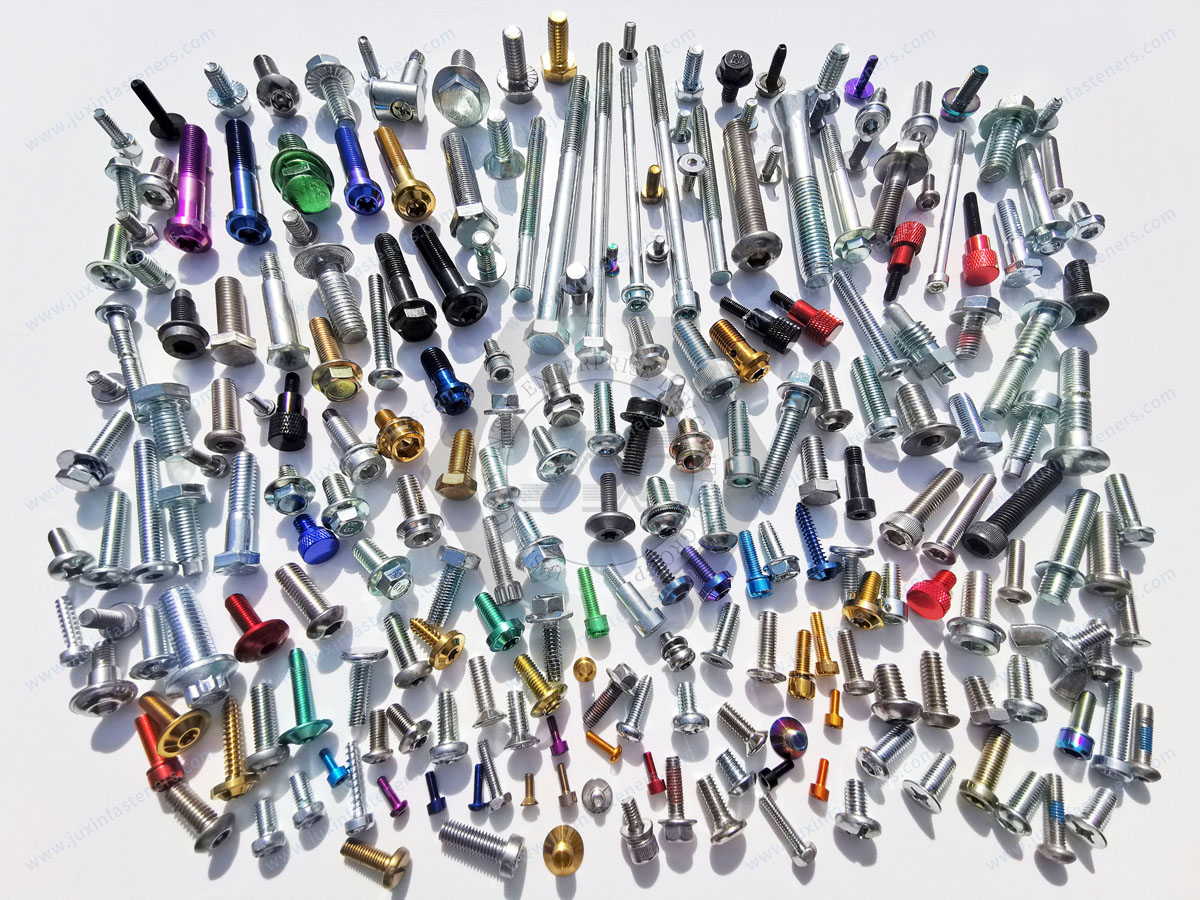
The Limitations of Single-Process Manufacturing
To truly understand the value of integration, one must first recognize the stark limitations and economic realities of relying on a single manufacturing method for complex custom fasteners.
* 100% CNC Machining (Turning from Bar Stock): CNC machining is excellent for achieving extreme tolerances (e.g., tight dimensional tolerances where the equipment and process are suitable) and executing complex internal geometries, sharp corners, and deep cross-holes. However, turning a fastener entirely from hexagonal or round bar stock means cutting away (removing) material as chips; the amount depends strongly on the starting stock and geometry. Furthermore, cutting through the metal severs its natural, continuous grain structure, which changes grain continuity but does not by itself establish inferior fatigue or shear performance. It is also a significantly slower, sequential process, making high-volume Industrial Batch Production prohibitively expensive.
* 100% Cold Heading: Cold heading is incredibly fast, highly material-efficient (often reducing chip generation relative to machining from bar), and capable of beneficial material flow and work hardening in suitable designs, subject to material and heat-treatment requirements. However, the cold heading process has geometric limitations. It cannot produce sharp internal corners, deep or small-diameter cross-drilled holes, precise O-ring grooves, or extreme micro-tolerances required for precision alignments.
The Power of Process Integration: The Multi-Process Approach
By combining these distinct manufacturing methods, Juxin Fasteners provides OEMs with optimal component design flexibility and unprecedented cost-efficiency.
Phase 1: Cold Heading (Net-Shape Blank Formation)
For the bulk body of the custom fastener, a suitable cold-heading route can be selected. Metal wire is sheared to length and forced into a series of progressive dies at room temperature. This displaces the metal rather than cutting it, forming the primary head, shank, and any large flanges or shoulders.
* Mechanical Advantage: The severe cold working process strain-hardens the material, changing its mechanical properties; any strength or fatigue benefit must be established for the specific design in the critical areas under the head and at thread transitions.
* Economic Advantage: It achieves a near-net shape in milliseconds with potentially improved material utilization, driving down the base piece-part cost significantly, particularly when utilizing expensive specialty alloys.
Phase 2: CNC Machining (Precision Secondary Operations)
Once the cold-formed blank is produced, it may proceed to appropriate CNC secondary operations. Here, we execute the high-precision secondary operations that the cold headers physically cannot achieve.
* Complex Features: We can add precision O-ring grooves for sealing applications, cross-drill cotter pin or safety wire holes, mill flat wrench faces, or cut complex internal undercuts.
* Micro-Tolerances: We finish critical bearing diameters, pilot rings, or sealing surfaces to strict GD&T tolerances, supporting the required alignment in the final OEM assembly.
Material Selection and Work-Hardening Considerations
When designing for multi-process manufacturing, material selection is critical because the initial cold heading phase fundamentally alters the metal's machinability for the subsequent CNC phase.
* Carbon Steels and Alloy Steels (e.g., 10B21, 4140, 4340): Formability and machinability depend on grade, condition, reduction, and tooling; each candidate requires a feasibility review, making them ideal for high-strength automotive, structural, and heavy machinery applications.
* Stainless Steels (304 / 316 / A2 / A4): These austenitic alloys work-harden significantly during cold heading. The severe deformation required to form a large head makes the adjacent shank much harder and substantially tougher to machine. The machining plan may require suitable tooling, adjusted feeds and speeds, and appropriate coolant strategies to machine these work-hardened blanks efficiently without experiencing excessive tool wear or compromising the surface finish.
Collaborative Engineering: Value Analysis and Design for Manufacturability (DFM)
Juxin Fasteners acts as a true OEM/ODM Fastener Manufacturer, partnering directly with OEM engineering teams during the design phase to drive value engineering.
Often, a customer will submit a 2D drawing of a complex fastener that they are currently having 100% CNC machined by a local machine shop, resulting in high unit costs. Our engineering team conducts a rigorous Design for Manufacturability (DFM) audit to determine if the part can be redesigned for multi-process manufacturing.
By suggesting slight, non-critical adjustments to the drawing—such as increasing an internal corner radius, altering an external chamfer, or changing a sharp step to a gradual taper to accommodate cold-forming dies—we can shift the bulk of the production to cold heading, followed by rapid CNC finishing. The business case should be calculated from material use, cycle times, tooling amortization, inspection, and expected production volume; savings and mechanical performance cannot be guaranteed without a part-specific comparison.
Quality Control in Multi-Process Manufacturing
Transferring parts between entirely different manufacturing modalities requires rigorous, integrated quality control tracking:
* First Article Inspection (FAI): Conducted and documented after both the cold heading setup and the CNC setup to verify all GD&T specifications are met before the batch runs.
* In-Process Monitoring: Utilizing optical comparators and digital gaging at the CNC stations to ensure the cold-headed blanks are indexing and chucking correctly, accounting for the slight dimensional variations inherent in formed blanks compared to pristine bar stock.
When CNC-Only Production Is the Better Choice
Not every custom fastener should begin as a cold-headed blank. Low annual volume, frequent engineering changes, difficult-to-form alloys, unusual length-to-diameter ratios, or complex internal passages can make CNC-only production the more rational option. Machining may also shorten prototype lead time because it avoids a dedicated forming die. The decision should be based on an actual quotation comparison rather than an assumption that one process is always cheaper.
How to Calculate the Break-Even Volume
Compare the total landed manufacturing cost of each route. A simple model is total cost equals one-time tooling and setup charges plus unit conversion cost multiplied by the expected quantity, with inspection, scrap, finishing, packaging, and logistics added where applicable. Cold heading may carry greater upfront tooling expense but lower recurring conversion cost. CNC may require less dedicated tooling but more machining time or material removal. The break-even quantity is the point where the total costs cross; it varies by part and can shift if the drawing changes.
Consider release quantities as well as annual volume. A forecast of 100,000 pieces is not equivalent to a firm order for 100,000 pieces if releases are uncertain or the design is still evolving. Inventory exposure, minimum economic batch size, and tooling ownership should be agreed during sourcing.
Feature-by-Feature Process Planning
A useful DFM review maps each drawing feature to a proposed operation. A large head, shoulder, or flange might be suitable for forming; a critical pilot diameter might need finishing; an off-axis hole may require drilling; and a thread may be rolled, tapped, or cut depending on whether it is external or internal. The sequence must also consider workholding. A formed blank that lacks a stable datum can be difficult to locate repeatably for a precision CNC feature.
Tolerance stack-up between forming and machining is another concern. If a critical dimension references a surface that changes during a later operation, the manufacturing plan must establish a consistent datum scheme. Surface coatings and heat treatment can further change dimensions, so the final inspection state should be specified on the drawing.
Quality Gates Across Multiple Operations
A hybrid process adds transfer points where defects can escape or accumulate. Inspection should cover incoming material, formed-blank geometry, critical post-machining dimensions, thread condition, heat-treatment requirements where applicable, and finished coating. The control plan should identify what is checked at each stage, the sample frequency, the response to an out-of-control condition, and the traceability link between batches.
A prototype approval is not automatically a production approval when the process route changes. For example, a machined sample can verify fit but may not represent a later cold-formed component's hardness or residual stress. The customer should identify which mechanical or assembly tests need to be repeated before production release.
Designing for Manufacturability Without Losing Function
Engineering changes should target noncritical features first: corner radii, chamfers, unnecessary cosmetic surfaces, and tolerances that do not control fit. Any proposed revision to a load-bearing shoulder, thread engagement length, under-head fillet, or sealing interface requires functional review. The final decision belongs to the drawing owner. Juxin Fasteners can discuss feasible manufacturing routes from 2D and 3D drawings, but no unapproved geometry change should be introduced into production.
OEM RFQ and Production Planning
To leverage our multi-process capabilities for your next Industrial Batch Production run, please provide:
* Fully toleranced 2D engineering drawings (identifying critical vs. non-critical dimensions to aid in DFM).
* 3D CAD models (STEP or IGES).
* Exact material specifications and desired heat treatments/surface finishes.
* Estimated Annual Usage (EAU). *Note: Multi-process manufacturing is typically most cost-effective for medium to high-volume production runs (with the break-even quantity determined by tooling cost, geometry, cycle time, and forecast demand) where the initial tooling investment for cold heading dies can be rapidly amortized over the run.*
To request a manufacturing feasibility audit and discover how multi-process integration can optimize your component costs, submit your drawings to Juxin Fasteners at info@juxinfasteners.com.
 MORE NEWS
Nov. 18, 2026
Contact Us
Tel.:
+86 020 8621 0320
+86 020 3121 6067
E-mail:
Technical Support:
Navigation
SEND INQUIREY