Call Us
+86 136 6007 9809
Call Us
+86 136 6007 9809

Nov. 20, 2026
Industrial machinery skids, rotating pumps, storage racks, street-side ATM safes, outdoor electrical pedestals, and safety guardrails all transfer operational forces into a single unforgiving substrate: concrete. Unlike ductile structural steel, concrete is brittle, variable in aggregate composition, weak in tension, and prone to hairline cracking over time from drying shrinkage, floor settlement, heavy forklift traffic, or seismic motion. When an anchor bolt is selected without accounting for cracked concrete, edge distance, vibration, or borehole cleaning, the base connection can slip, split the concrete slab, or pull out under load.
This engineering guide compares the primary concrete anchor architectures, explains substrate and installation failure modes, contrasts real-world ATM floor anchoring against outdoor guardrail anchoring, and defines the regulatory boundary between general mechanical fixation and code-governed structural safety connections.
Mandatory Engineering and Capability Notice: Anchor load capacities are never universal properties of a steel bolt or stud; they depend on the complete qualified anchor system, verified concrete compressive strength, cracked versus uncracked condition, effective embedment depth, edge and spacing geometry, and installation workmanship. Juxin Fasteners does not publish generic anchor load tables or claim third-party structural anchor approvals (such as ETA or ICC-ES) unless independently verified for a specific qualified project. All structural load calculations and building-code selections must be verified by a licensed structural engineer.
Comparing Five Concrete Anchor Architectures
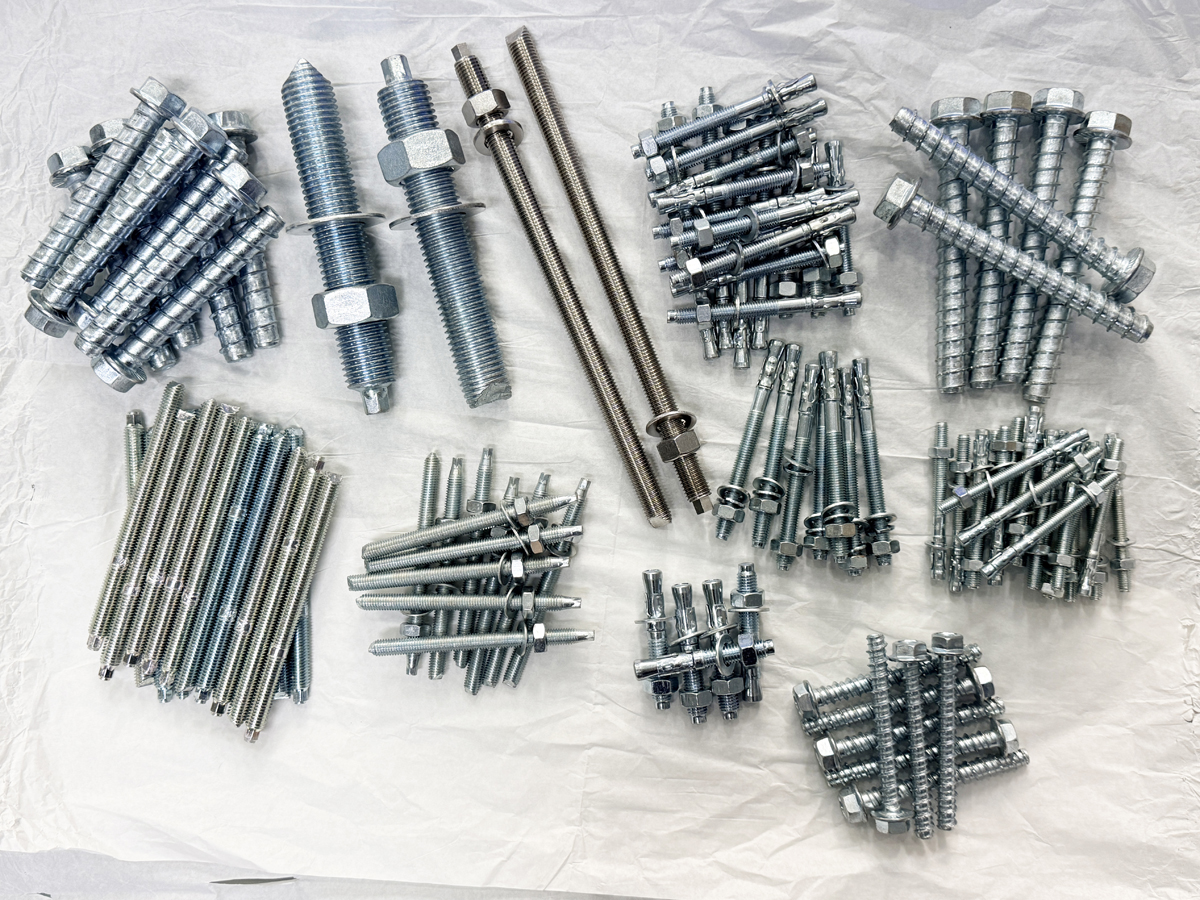
Concrete anchors transfer tension and shear loads into the slab via cast-in mechanical bearing, post-installed friction expansion, thread-cutting mechanical interlock, or chemical resin bonding.
| Anchor Architecture | Load Transfer Mechanism | Installation Expansion Stress | Edge & Spacing Sensitivity | Hole-Cleaning Sensitivity | Typical Industrial Application Context |
|---|---|---|---|---|---|
| Cast-In-Place Anchor Bolts (L-Bolts, J-Bolts, Headed Anchor Rods) | Mechanical bearing of bent hook or forged head cast into wet concrete before curing | Zero post-install expansion | Governed by foundation reinforcement and code edge rules | Not applicable (cast prior to pour) | Permanent heavy industrial machinery foundations, large outdoor electrical/equipment pads with finalized bolt patterns |
| Sleeve & Drop-In Mechanical Expansion Anchors | Expanding sleeve or internal plug presses outward against borehole wall by friction | Moderate to High | Moderate to High (risks splitting near slab edges) | Moderate (bottom debris blocks full depth) | Light-to-medium interior equipment guards, floor cable-tray stanchions, stationary brackets |
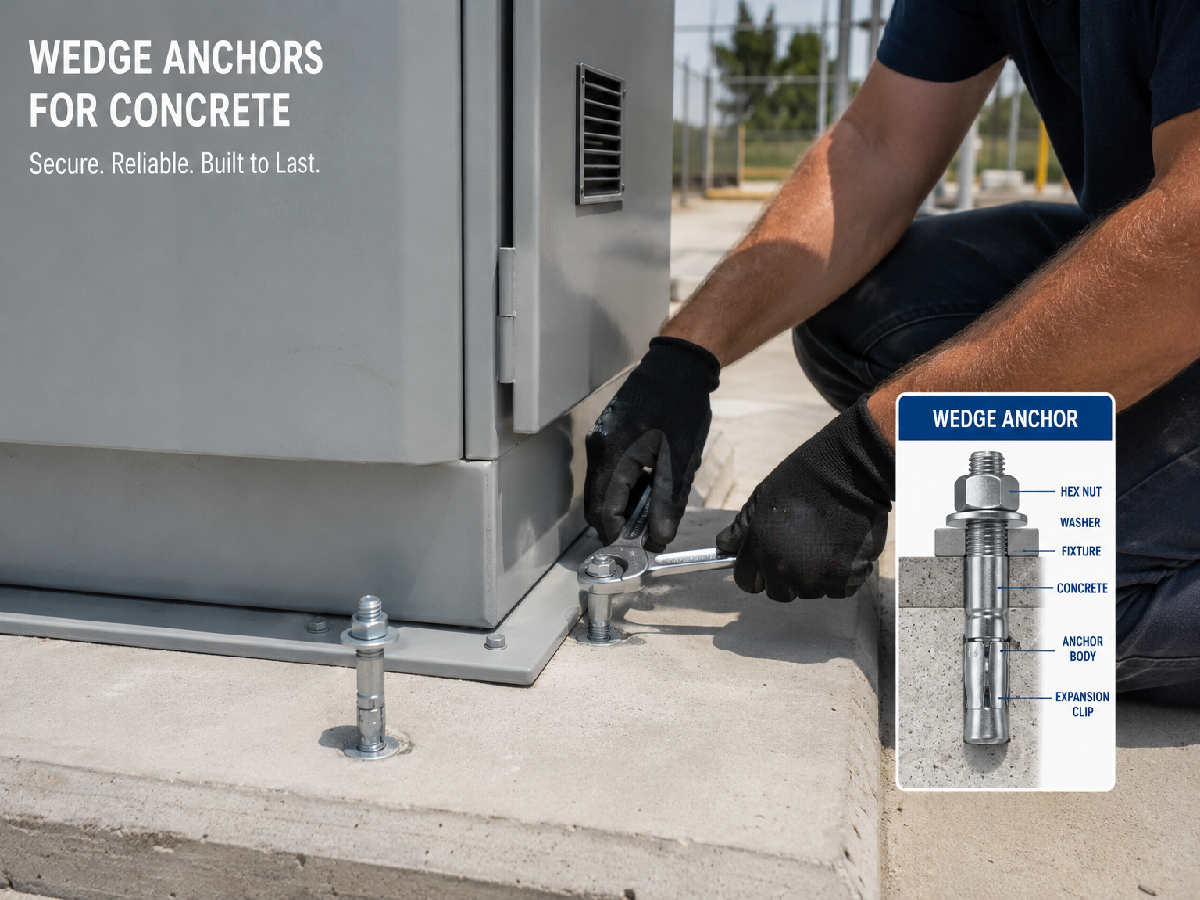
| Torque-Controlled Wedge Anchors | Nut tightening draws tapered cone upward, wedging expansion clip into concrete | High localized radial stress | Product- and approval-dependent; verify edge distance and spacing | Moderate (dust reduces clip bite) | Heavy stationary machinery baseplates, conveyor columns, solid-concrete interior racks |
| Concrete Screw Anchors (Threaded Anchors) | Hardened external threads tap directly into concrete hole wall for mechanical interlock | Very Low | Product- and approval-dependent; verify permitted edge distances and spacing | Moderate (exact drill diameter and dust clearing required) | Removable industrial brackets, reconfigurable plant fixtures, modular frames |
| Chemical / Adhesive Anchors (Threaded Anchor Rod + Resin) | Epoxy, vinylester, or hybrid resin bonds threaded rod to concrete pore walls | Zero expansion stress | Product- and design-dependent; low installation expansion does not eliminate edge-distance requirements | Critical: inadequate cleaning can significantly reduce bond strength; follow the qualified system instructions | High-vibration pump skids, close-to-edge baseplates, deep embedments, outdoor equipment pads |
Concrete Substrate Realities: Cracked Concrete, Breakout Cones, Edges, and Spacing
Cracked vs. Uncracked Concrete
Industrial floor slabs and exterior concrete pads routinely develop fine hairline cracks from drying shrinkage, thermal gradients, wheel loads, or flexural tension. If a crack opens across an anchor borehole, the hole diameter increases slightly. Standard friction-based expansion or wedge anchors not specifically designed and qualified for cracked concrete can lose radial gripping force and slip abruptly. Anchors intended for cracked concrete—such as follow-up expansion wedge anchors, undercut anchors, or appropriately qualified adhesive systems—are engineered to sustain load even when a crack intersects the anchor axis. Unless structural analysis demonstrates that a concrete zone remains strictly in compression throughout service life, engineers generally design assuming cracked concrete conditions.
Concrete Breakout Geometry, Edge Distance, and Spacing
Under tension, an anchor mobilizes a surrounding volume of concrete governed by its effective embedment depth—modeled in standards such as ACI 318 (Chapter 17) and EN 1992-4 using Concrete Capacity Design (CCD) projected breakout geometry. Placing an anchor too close to a slab edge, or clustering multiple anchors tightly inside a small machinery baseplate, truncates or overlaps these concrete tension zones. The result is a steep drop in concrete breakout capacity and an elevated risk of splitting the concrete pad corner during tightening—especially with high-expansion wedge anchors. Where tight edge distances or compact bolt clusters are unavoidable, low-expansion concrete screw or adhesive systems may reduce installation-induced splitting forces, but they do not eliminate concrete breakout, splitting, edge-distance, spacing, or qualification requirements.
Primary Tension and Shear Failure Modes
Baseplate connections can fail through the steel element or the surrounding concrete:
Tension Failure Modes: Ductile steel rod yielding/fracture, anchor pull-out (slippage within the hole), concrete breakout (extracting a cone/prism of concrete), bond failure (for adhesive systems), and concrete splitting.
Shear Failure Modes: Steel shear rupture at the baseplate plane, concrete edge breakout (when shear acts toward a nearby free edge), and concrete pryout (short, stiff anchors levering out concrete behind the shaft).
Four Field Installation Controls That Govern Real Performance
Even an accurately engineered anchor specification fails when field installation cuts corners:
1. Effective Embedment Depth: Concrete breakout resistance is strongly governed by effective embedment depth. Drilling short to bypass rebar—or failing to seat an anchor to its specified embedment mark—severely reduces load capacity.
2. Carbide Drill Bit Wear: Hammer-drill bits wear narrower across dozens of holes. A worn undersized bit can prevent insertion or damage concrete screw threads, while an oversized wobble-drilled hole undermines wedge-anchor friction grip.
3. Thorough Hole Cleaning: Drilling dust acts as a dry bond-breaker. For mechanical anchors, packed bottom dust prevents full depth seating. For chemical adhesive anchors, failing to perform the manufacturer's specified compressed-air blowing and wire-brushing sequence leaves a dust film that can drastically reduce pull-out capacity.
4. Calibrated Setting Torque: Torque-controlled expansion anchors require the specified installation torque to set the wedge mechanism properly without over-stressing concrete. On cured adhesive anchors, excessive torque from an uncalibrated impact wrench can fracture the resin bond before equipment even starts running.
Contrasting Real-World Applications: ATM Floor Anchoring vs. Outdoor Guardrail Anchoring
Comparing two demanding industrial anchoring applications highlights why one anchor type never fits all projects:
ATM Anti-Theft Floor Anchoring
Heavy ATM safes and retail kiosks are anchored to interior vestibule slabs or exterior concrete pads to resist prying, tipping, and physical pull-out theft attempts. Baseplate anchor holes inside an ATM safe footprint are often tightly spaced and restricted in tool access. Depending on the qualified design, suitable mechanical or adhesive anchor systems may be evaluated for pry resistance, cracked-concrete performance, restricted access, and compact baseplate geometry, while keeping anchor selection separate from exterior cabinet corrosion screws and internal wire-routing clips.
Outdoor Guardrail Structural Anchoring
Exterior pedestrian barriers, rooftop fall-protection posts, and roadside industrial guardrails present a completely different engineering profile: outdoor coastal or winter de-icing salt corrosion combined with narrow concrete curb edge distances and life-safety impact loads. Carbon steel anchors corrode rapidly at the wet concrete-air interface, risking hidden cross-section loss or rust-expansion spalling of the concrete curb. Outdoor guardrail anchoring may call for 316 / A4 stainless steel, suitably protected carbon steel, or another project-qualified corrosion-resistant system. Adhesive and mechanical anchor alternatives must be evaluated for concrete edge distance, sustained load, cracked-concrete qualification, installation conditions, and structural design; the completed connection must conform to local structural building codes and third-party qualified anchor assessments.
Distinguishing General Mechanical Fixation from Code-Regulated Structural Connections
Engineering and purchasing teams must separate two clear compliance tiers:
General Non-Structural Mechanical Fixation: Securing appropriately assessed minor auxiliary brackets or equipment features where failure has no structural or life-safety consequence; the classification depends on actual project conditions and applicable codes. Selection centers on corrosion protection, vibration retention, and installation practicality.
Potentially Code-Regulated Structural and Life-Safety Connections: Anchoring guardrails, heavy machinery, tall racking, wind- or seismic-loaded equipment, overhead loads, or security-critical safes, subject to actual use, jurisdiction, and project design. These installations are governed by regional structural codes—such as ACI 318 (Chapter 17) in North America and EN 1992-4 in Europe—which may require appropriately qualified anchor systems, documented evaluation evidence (such as ICC-ES reports or ETA, where applicable), installation inspection, and review by a qualified design professional.
Direct Engineering Q&A
When should engineers choose a chemical adhesive anchor over a torque-controlled wedge anchor?
Adhesive anchors may be considered when installation expansion must be limited or deeper embedment is needed. They are not automatically preferable near edges or under vibration: the engineer must compare qualified tension/shear capacities, concrete breakout, sustained-load and temperature limits, seismic/cracked-concrete approval, edge distances, hole cleaning, cure conditions, and installation inspection.
Can standard zinc-plated anchor bolts be used for outdoor concrete equipment pads?
Standard thin electroplated zinc degrades quickly at outdoor concrete-to-baseplate interfaces where rainwater and de-icing salts collect. Outdoor equipment bases generally evaluate hot-dip galvanized steel, zinc-flake coated alloy steel, or 316 (A4) stainless steel anchor hardware depending on coastal chloride exposure and structural grade requirements.
Juxin Fasteners Manufacturing Review for Base-Connection Hardware
As an industrial fastener manufacturer, Juxin Fasteners evaluates standard and custom made-to-drawing metallic base-connection hardware for OEM equipment builders and industrial supply programs. Examples include threaded rods, J-bolts and L-bolts, expansion components, heavy hex nuts, washers, and precision leveling studs, subject to drawing review and manufacturing feasibility. Depending on part diameter, length, alloy, and batch volume, manufacturing feasibility is evaluated across cold heading, cold forming, thread rolling, CNC machining, and applicable coordinated heat treatment and corrosion-resistant finishing. Every component is manufactured strictly to customer 2D/3D engineering drawings and agreed inspection criteria; any third-party structural approval (ETA/ICC-ES) or load qualification required by project codes must be verified independently for the complete anchoring system.
Submit Your Base-Connection & Anchor Hardware RFQ
Send your drawing package to info@juxinfasteners.com, or submit your drawings through our website. Please include:
2D engineering drawings (PDF) with dimensions, thread class, and critical tolerances, plus 3D CAD models (STEP/IGES)
Material grade (e.g., ASTM/ISO carbon or alloy steel, 304/316 stainless steel) and surface finish requirements
Application context (interior machinery base, ATM baseplate, outdoor equipment pad, or code-governed assembly)
Required inspection documentation, sample quantities, and Estimated Annual Usage (EAU)
Contact Us
Tel.:
+86 020 8621 0320
+86 020 3121 6067
E-mail:
Technical Support:
Navigation
SEND INQUIREY