Call Us
+86 136 6007 9809
Call Us
+86 136 6007 9809

Nov. 20, 2026
Across industrial pumps, HVAC blower decks, automotive chassis brackets, railway rolling stock, and sheet-metal equipment cabinets, a loose bolt or stripped thread can shut down a production line or trigger expensive field recalls. Yet assembly teams routinely apply the wrong corrective action—adding a split spring washer to stop transverse vibration, or increasing tightening torque to fix a joint that is actually stripping or spinning inside thin sheet metal.
Effective troubleshooting requires separating five fundamentally different failure mechanisms, understanding the real operating boundaries of locking hardware under standards like ISO 2320, and recognizing a core engineering reality: no mechanical locking fastener is permanently vibration-proof across every load spectrum, thermal cycle, and reuse count. As an industrial fastener manufacturer, Juxin Fasteners helps OEM design engineers, production managers, and quality teams pair the right standard or made-to-drawing fastener architecture with validated assembly controls.
Separating Five Distinct Industrial Fastener Failure Mechanisms
Each joint failure mechanism has a distinct physical root cause and demands a different engineering solution:
1. Rotational Self-Loosening Under Transverse Vibration
Axial vibration along the bolt axis rarely causes a well-preloaded bolt to back off on its own. Rotational self-loosening is driven primarily by transverse (shear) cyclic sliding perpendicular to the bolt axis. When alternating transverse loads overcome static friction between the clamped plates, micro-slip occurs across the mating thread flanks and under the bolt head. During each micro-slip event, the thread helix angle generates an untightening torque that rotates the nut incrementally loose until preload collapses.
2. Non-Rotational Preload Loss
A joint can lose clamp load completely without any nut rotation. Localized crushing of surface roughness, thick paint/powder coatings, gaskets, or soft aluminum faces (surface embedment) slightly shortens the clamped stack. On short-grip bolts with high stiffness, even microscopic settling can remove a large fraction of bolt stretch. Differential thermal expansion (steel bolts clamping aluminum housings) and polymer creep similarly erode preload over time.
3. Thread Stripping and Cross-Threading
Thread stripping occurs when axial clamping tension exceeds the shear strength of the external bolt threads or the internal female threads. Common causes include insufficient thread engagement in cast aluminum or thin sheet metal, mismatched nut property classes, uncalibrated impact guns exceeding yield torque, and angled starting (cross-threading) on automated lines.
4. Thread Galling (Cold Welding)
In austenitic stainless steel (304/316) and aluminum assemblies, high sliding contact pressure and frictional heat shear away the thin protective oxide layer, allowing bare metal asperities to cold-weld instantaneously mid-tightening. The nut seizes onto the shank, often twisting the bolt in half during assembly or future maintenance.
5. Blind Rivet Nut or Threaded Insert Rotation (Spin-Out)
In thin sheet-metal enclosures and hollow tubular frames, loosening frequently happens when the threaded anchor itself spins inside the panel hole. Round smooth or lightly knurled blind rivet nuts rely solely on friction against the sheet wall; high installation torque, painted surfaces, or slightly corroded mating bolts can break that friction grip, leaving the insert spinning freely so the bolt can neither tighten nor be extracted.
Evaluating Locking Hardware, Washers, and Anti-Rotation Solutions
| Hardware Type (Reference Standards) | Functional Mechanism | Verified Operating & Reuse Boundaries | Engineering Role & Limitations |
|---|---|---|---|
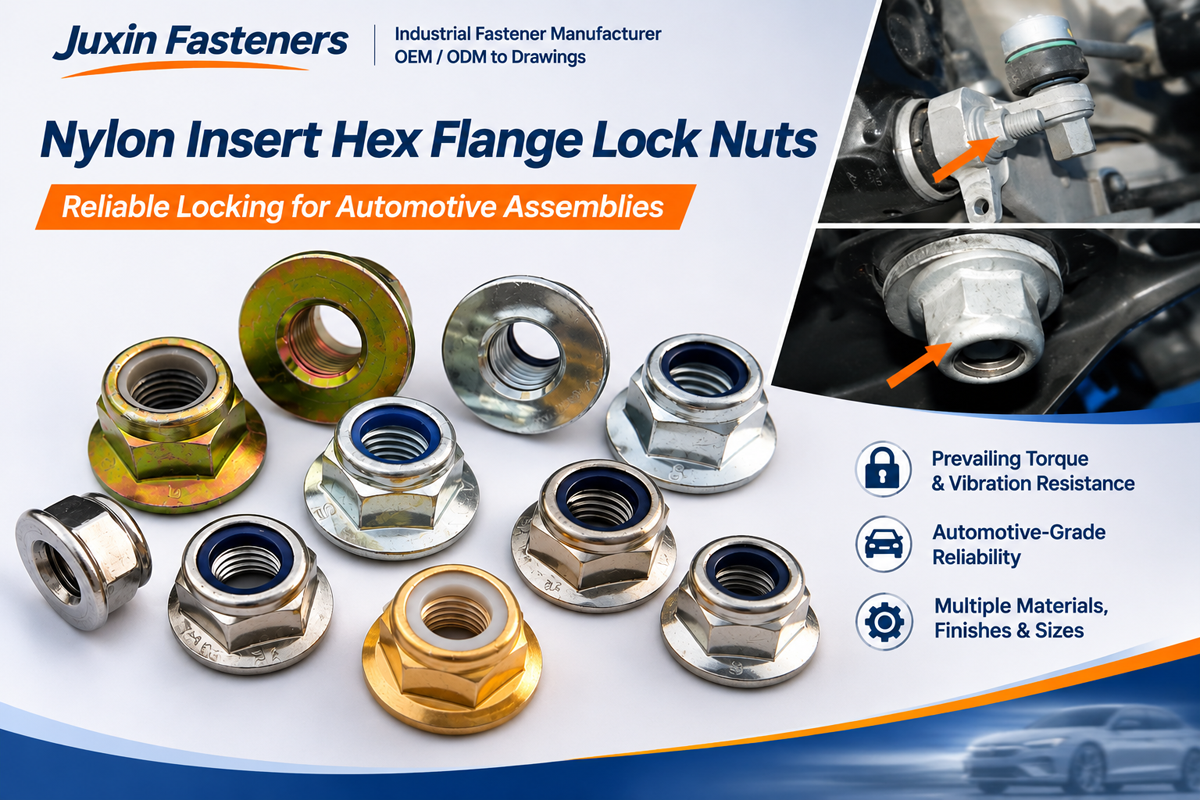
| Nylon-Insert Lock Nuts (ISO 10511 / DIN 985 / DIN 982) | Polymer insert elastically/plastically deforms around male threads to create prevailing torque | ISO 2320 functional testing is at +10 to +35°C; its stated typical application range for non-metallic insert nuts is −50 to +120°C, not a guaranteed service rating; performance decreases with reuse | Helps prevent complete nut loss under moderate vibration; does not stop initial preload settling; unsuitable for high-heat zones |
| All-Metal Prevailing-Torque Lock Nuts (ISO 7042 / DIN 980 / DIN 6927) | Controlled thread or body distortion generates metallic interference friction | ISO 2320 states a typical application range of −50 to +150°C for conforming all-metal nuts; higher-temperature applications need separate product-specific validation | Effective in high-heat automotive, industrial, and rail zones; increases thread-flank wear and requires lubrication/coating review to avoid galling |
| Flat Washers (ISO 7089 / ISO 7090; check washer hardness grade) | Expands bearing area and spans slotted or oversized holes | Depends on material, dimensions, and specified washer hardness; match the washer to the joint and bolt class | Not a locking element. Reduces surface embedment and non-rotational preload loss on soft or coated joints |
| Helical Split Spring Lock Washers (DIN 127 withdrawn / ASME B18.21.1) | Helical split ring intended to apply spring force | Flattens completely well below standard structural bolt preload | Not a reliable universal anti-loosening solution. Offers no dependable resistance to transverse vibration loosening |
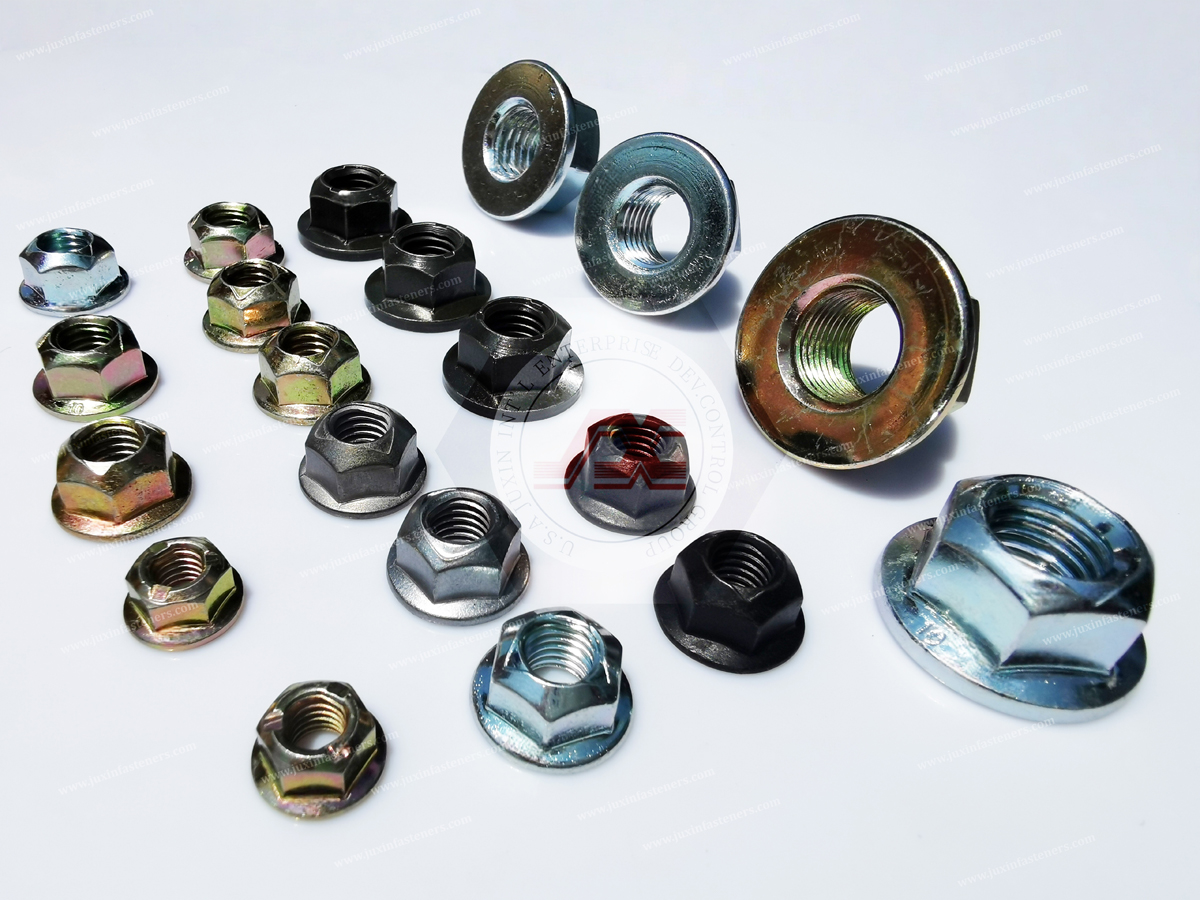
| Hex Flange Bolts and Nuts (ISO 4162 / DIN 6921 / DIN 6923) | Integrated wide bearing flange (plain or serrated) | Plain flange preserves coatings; serrated flange requires uncoated steel validation | Wide flange reduces bearing stress and embedment; serrations provide modest friction bite on bare steel but damage paint and soft aluminum |
| Anti-Rotation Sheet Hardware (Hex/Square Rivet Nuts, Self-Clinching Nuts, D-Flats) | Positive geometric interlocking prevents anchor body rotation | Requires accurate hex/square hole tolerances or matched sheet hardness (for clinching) | Directly solves blind-side spin-out in thin sheet-metal cabinets, HVAC panels, and brackets |
Why Standard Split Spring Lock Washers Are Not a Reliable Anti-Loosening Solution
Standard helical split spring lock washers (historically designated DIN 127 in Europe and covered under ASME B18.21.1 in North America) remain one of the most misunderstood components in industrial assembly. Transverse vibration testing (such as Junker-type rigs) and aerospace/industrial fastener research (including NASA RP-1228) demonstrate that a split spring washer compresses completely flat at a small fraction of normal working preload for Class 8.8 or 10.9 bolts. Once flattened, it offers no effective spring reserve against embedment and no reliable resistance to transverse slip—and its split edges can create uneven head seating.
Recognizing these engineering limitations, DIN formally withdrew DIN 127 as a recognized locking standard, and ASME B18.21.1 explicitly notes that the word "lock" in spring lock washer is a generic historical term rather than a guarantee of permanent fixity. For vibration-critical assemblies, engineers should rely on adequate preload, favorable grip-to-diameter ratio, qualified prevailing-torque lock nuts (ISO 7042 / ISO 10511), mechanical wedge-locking washers where appropriate, or validated threadlocking adhesives rather than standard split lock washers.
Understanding ISO 2320:2015 Prevailing-Torque and Reuse Boundaries
Engineers specifying prevailing-torque steel lock nuts should understand what ISO 2320:2015 actually verifies. ISO 2320 defines functional testing at ambient temperatures (+10 to +35°C), including first-installation and first-removal prevailing-torque limits; a fifth-removal test applies for initial type testing or disputes unless otherwise agreed. Crucially, ISO 2320 explicitly cautions that prevailing-torque performance declines with every reuse, and the user must evaluate the consequences before reusing any lock nut. ISO 2320 describes typical application ranges of −50 to +120°C for conforming non-metallic insert nuts and −50 to +150°C for conforming all-metal nuts; these ranges are not universal product-specific service ratings.
Preventing Thread Stripping, Galling, and Sheet-Metal Rotation
Thread Engagement Length and Substrate Strength
To prevent stripping expensive housings, bolted joints are generally proportioned so that under extreme overload the replaceable bolt yields before the internal female thread shears. As broad engineering starting guidelines (always requiring joint-specific calculation and testing based on thread tolerance class 6g/6H, pitch, and alloy temper):
Matching steel bolt into steel block or ISO 898-2 nut: roughly 0.8 to 1.0 times nominal bolt diameter.
Steel bolt into cast iron or medium-strength steel: roughly 1.2 to 1.5 times nominal diameter.
Steel bolt into aluminum alloys or brass: commonly 1.5 to 2.5 times nominal diameter, or reinforced with solid/wire thread inserts.
Thin sheet metal below roughly 3 mm: direct tapping seldom yields reliable engagement; transition to hex/square blind rivet nuts, self-clinching nuts (verified for sheet-to-fastener hardness differential), or projection weld nuts.
Controlling Torque Repeatability and Stainless Galling
Uncalibrated impact tools create extreme clamp-load scatter—stripping one joint while under-tightening the next. Repeatable assembly requires controlled electric or shut-off pneumatic drivers, consistent thread lubrication states (since wet vs. dry friction dramatically alters achieved preload at identical torque), multi-pass cross-pattern tightening on gasketed flanges, and pilot-point tips to prevent cross-threading. On stainless steel fasteners, lowering driver RPM, using smooth cold-rolled threads, and evaluating OEM-approved anti-galling coatings or lubricants significantly reduces cold-welding seizures.
Industrial Application Scenarios
Railway Equipment (Bounded Engineering Example): Rolling-stock subassemblies and trackside equipment can experience shock, vibration, and project-specific thermal or fire-safety requirements. Polymer inserts should not be excluded automatically; the applicable OEM specifications, location, operating temperatures, and qualification evidence govern the choice. Railway OEMs evaluate all-metal prevailing-torque lock nuts (ISO 7042 / DIN 980 / DIN 6927) or mechanical wedge-locking systems validated to project-specific railway standards—with project-defined installation, inspection, and reuse controls rather than assuming permanent vibration immunity.
Industrial Pumps and HVAC Blowers: Continuous rotational vibration and gasket settling erode clamp load on motor mounts and casing flanges. Combining adequate bolt preload with plain flange bolts or hardened load-spreading washers, qualified lock nuts, and cross-pattern torque sequencing maintains joint stability across long duty cycles.
Sheet-Metal Electrical Cabinets and Automotive Brackets: Replacing tapped thin-sheet holes and round rivet nuts with hexagonal/square-body blind rivet nuts, self-clinching fasteners, or custom D-flat anti-rotation studs substantially reduces spin-out and thread stripping during factory assembly and field maintenance.
Direct Engineering Q&A
Can a prevailing-torque lock nut prevent preload loss caused by paint crushing or gasket settling?
No. Prevailing-torque nuts resist free spinning off the bolt if preload drops, helping prevent catastrophic part separation, but they cannot stop non-rotational embedment. Preventing preload loss requires wide bearing surfaces (plain flange heads or hardened flat washers), controlled coating thickness, and adequate bolt grip length.
How do you stop blind rivet nuts from spinning inside thin painted steel cabinets?
Switch from round knurled rivet nuts to hexagonal or square-body blind rivet nuts installed into accurately punched or laser-cut matching holes, verify exact grip range including coating thickness, and calibrate the pull-setting stroke so the backside bulge seats fully without damaging internal threads.
Juxin Fasteners Manufacturing Support and OEM RFQ
As an industrial fastener manufacturer, Juxin Fasteners produces standard prevailing-torque lock nuts, flange bolts, blind rivet nuts, self-clinching fasteners, and custom made-to-drawing anti-rotation components for industrial batch production. Process selection—spanning cold heading, cold forming, CNC machining, thread rolling, and coordinated heat treatment or surface finishing—is evaluated per engineering drawing and production volume.
To discuss a joint-loosening, rotation, or thread-stripping issue with our engineering team, email info@juxinfasteners.com, or submit your drawings through our website with:
2D drawings (PDF) and 3D CAD models (STEP/IGES) of the fastener and joint interface
Specific failure mode observed (transverse loosening, embedment, spin-out, stripping, or galling)
Substrate materials, sheet thickness, operating temperature range, vibration profile, and reuse requirements
Current installation driver, target torque/preload method, sample needs, and Estimated Annual Usage (EAU)
Contact Us
Tel.:
+86 020 8621 0320
+86 020 3121 6067
E-mail:
Technical Support:
Navigation
SEND INQUIREY