
Call Us
+86 136 6007 9809
Call Us
+86 136 6007 9809

Sep. 11, 2026
Modern vehicle assembly uses a wide range of polymer fastening components for interior trim, exterior panels, wiring harnesses, and other vehicle assemblies.
Compared with conventional metal fasteners, automotive plastic fasteners offer different design options for retention, positioning, routing, and component attachment, depending on the application.
For engineers and procurement teams, selecting a plastic fastener is not simply a matter of matching the product name.
The component must be evaluated against the mounting interface, panel geometry, material requirements, installation method, environmental conditions, and intended function.
JUXIN FASTENERS manufactures customer-specific automotive plastic fasteners, clips, and retainers according to approved drawings, material requirements, and application conditions.
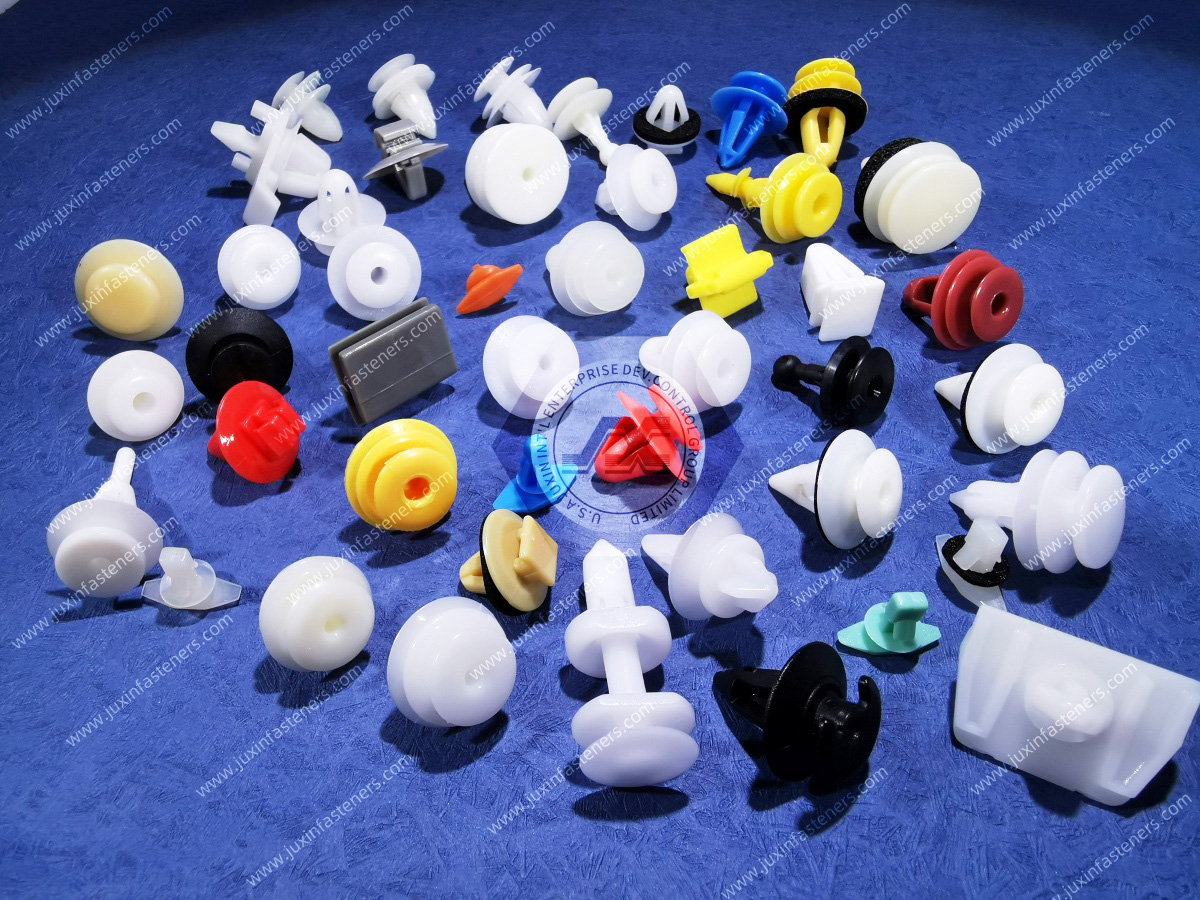
Automotive assemblies contain numerous fastening points across body, trim, electrical, and interior systems.
Plastic fastening components can provide application-specific ways to retain or position panels, trim pieces, wiring, and other components while supporting the assembly method selected by the vehicle manufacturer.
Unlike universal fastening products, automotive plastic fasteners are often closely related to the geometry of the components they connect.
The mounting hole, panel thickness, mating component, retention geometry, and installation direction can all influence whether a particular design is suitable.
Plastic fasteners may also be considered where factors such as weight, corrosion considerations, electrical isolation, flexibility, or assembly access are relevant to the application.
The actual requirements depend on the vehicle system and approved engineering design.
JUXIN FASTENERS manufactures customer-specific components according to the customer's specified design and application requirements.
Automotive plastic fasteners cover a broad range of product designs.
Understanding the basic categories helps engineering and procurement teams identify the appropriate component type before reviewing detailed geometry and specifications.
Push-type retainers generally use a pin, leg, or expandable retention structure to engage a mounting hole.
They are commonly used for applications where a panel or trim component needs to be retained through a prepared mounting interface.
The exact retention mechanism, installation force, panel thickness range, and hole requirements depend on the specific design.
Trim and moulding clips are used to attach or retain decorative and protective vehicle components, including certain exterior mouldings, trim pieces, and related body components.
Their geometry is normally matched to the profile of the mating trim and the vehicle panel. A clip designed for one moulding profile should not automatically be considered interchangeable with another design.
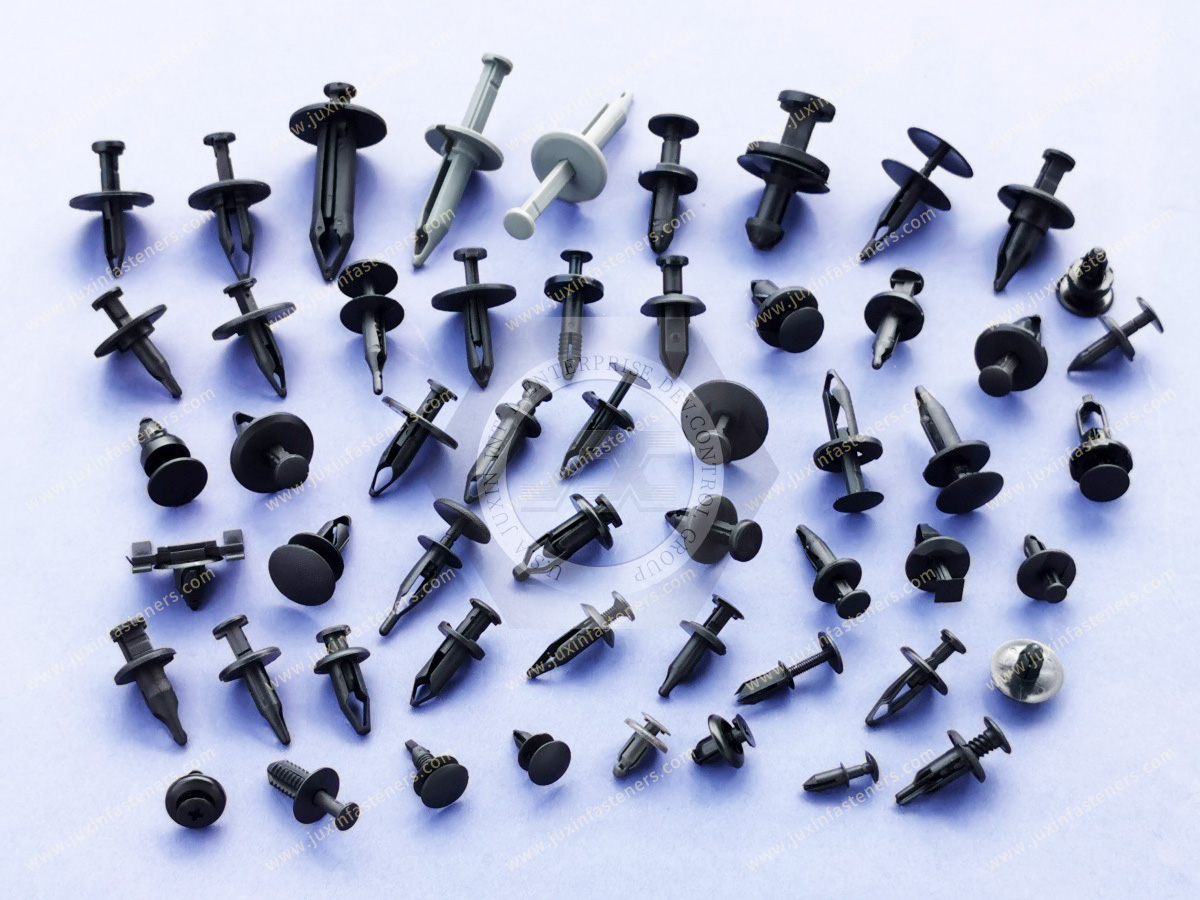
Screw grommets and related plastic retainers provide a receiving interface for a metal screw or similar threaded fastener.
They may be used where a plastic receiving component is incorporated into a panel or assembly rather than relying directly on a metal threaded hole.
The appropriate design depends on the mounting-hole geometry, screw specification, panel characteristics, and required retention method.
Fir tree clips typically use a series of flexible ribs or similar retention features to engage a mounting hole or substrate.
They are used in various automotive applications where the clip geometry is designed to match the relevant hole and panel conditions.
The actual retention performance depends on the clip geometry, material, hole dimensions, substrate, and application requirements.
Edge clips are designed to engage the edge or flange of a panel or substrate.
Depending on the design, they may allow components such as trim, wiring, or other vehicle hardware to be positioned relative to a panel edge.
Because edge geometry varies between applications, the clip must be matched to the relevant panel thickness, edge profile, and mating component.
Wire harness and cable clips are used to route and retain electrical wiring or cables at specified locations within a vehicle assembly.
Their design may include features for attachment to a panel, bracket, hole, edge, or other mounting structure. Selection depends on cable dimensions, mounting interface, installation direction, and routing requirements.
Material selection is an important part of automotive plastic fastener design because different polymers have different mechanical, dimensional, environmental, and processing characteristics.
Depending on the application, customer specifications may identify a particular polymer family or grade. Common engineering thermoplastics considered for plastic fastening components include:
Nylon / PA: May be considered for applications requiring a combination of mechanical properties and flexibility, depending on the selected grade and application conditions.
POM / Acetal: May be considered where dimensional stability, rigidity, or other application-specific characteristics are relevant.
Polypropylene / PP: May be considered for applications where its particular flexibility and chemical characteristics are compatible with the intended use.
Other engineering polymers may also be specified depending on the customer's design requirements.
Material selection may consider:
Mechanical requirements
Flexibility and retention behavior
Dimensional stability
Moisture exposure
Temperature conditions
Chemical or environmental exposure
Assembly method
Mating materials
Production requirements
The final material and grade should be established from the customer's approved engineering specifications rather than selected solely from the general product category.
JUXIN FASTENERS manufactures components using materials specified in the approved customer data package.
The required fastening approach can vary significantly depending on where the component is used within the vehicle.
Interior applications may include door trim, instrument panels, dashboards, console components, seat-related trim, and other interior panels.
Engineering considerations can include panel thickness, mounting-hole geometry, retention requirements, installation direction, serviceability, and the interaction between adjacent components.
Exterior body applications may require plastic clips or retainers designed around specific panel, trim, or bracket interfaces.
The selection process may consider the mounting geometry, substrate, environmental conditions, installation method, and required retention or positioning function.
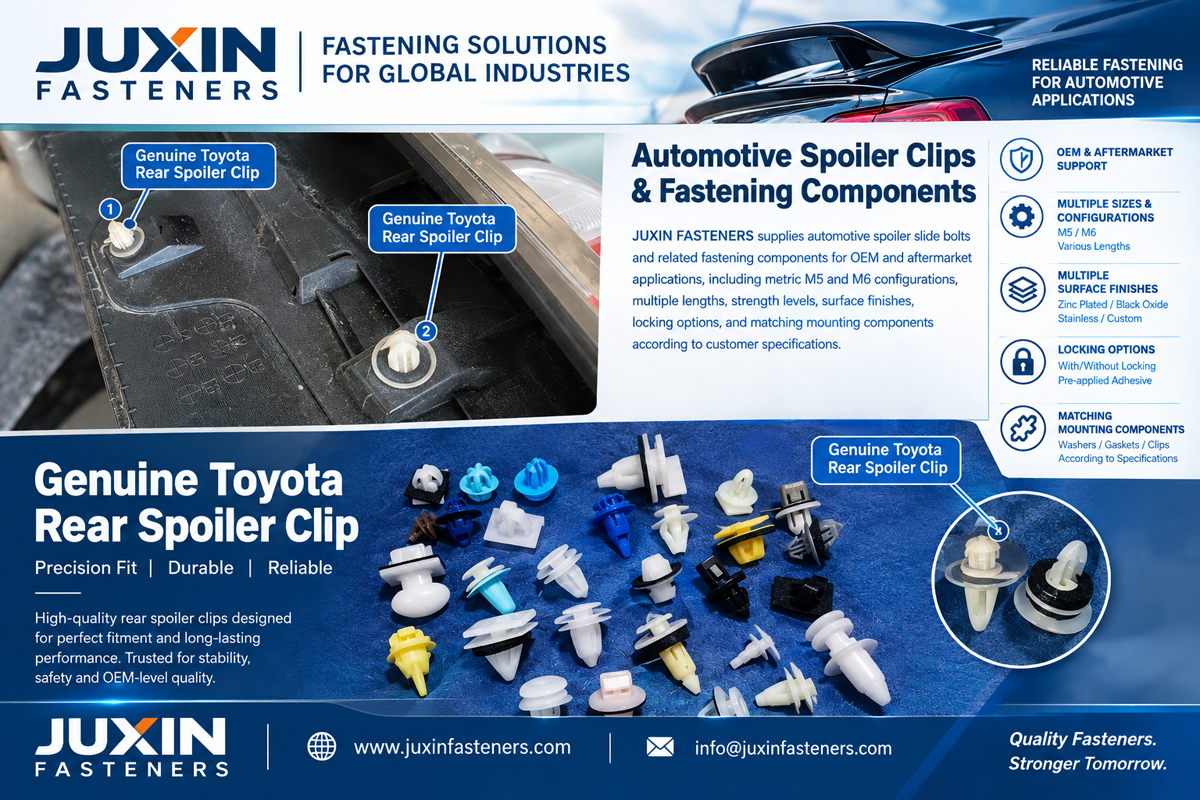
Rear spoiler assemblies can combine plastic and metal fastening components.
Depending on the vehicle design, a Rear Spoiler Clip may be used for locating, retaining, positioning, spacing, or supporting a fastening interface.
Other fastening components, such as a Spoiler Bolt or Slide Bolt, may work together with the plastic component as part of the overall rear spoiler mounting arrangement.
The exact configuration depends on the vehicle assembly design.
This application is covered in greater detail in the dedicated JUXIN FASTENERS articles on rear spoiler fastening components and Rear Spoiler Clips.
Plastic clips can also be used to position and retain wiring harnesses and cables.
For these applications, engineers may need to consider cable diameter, routing path, attachment point, installation direction, and clearance from surrounding components.
Product names provide only a starting point. The suitability of an automotive plastic fastener depends on the relationship between the fastener and its mating components.
Key parameters may include:
Mounting-hole geometry: The diameter, shape, tolerance, and location of the relevant mounting interface.
Panel thickness: The thickness and construction of the substrate receiving or supporting the fastener.
Mating component geometry: The shape, clearance, and engagement conditions of the components being connected.
Retention or positioning function: Whether the component is primarily used for locating, retaining, spacing, routing, or another defined function.
Installation direction: The direction and sequence in which the fastener is installed during assembly.
Material requirements: The polymer family or specific grade defined by the customer.
Environmental conditions: Temperature, moisture, chemical exposure, and other conditions relevant to the application.
Service requirements: Where applicable, requirements related to inspection, removal, replacement, or service access.
These factors should be evaluated together rather than selecting a component based only on appearance or nominal product terminology.
Plastic fastening components can be considered as part of vehicle lightweighting strategies because polymer components may have lower density than comparable metal components.
However, weight reduction should not be evaluated independently from the fastening function.
The appropriate material and design must still satisfy the specific retention, positioning, assembly, environmental, and dimensional requirements of the application.
For OEM sourcing teams, the practical objective is not simply to replace a metal fastener with a plastic component.
The correct approach is to evaluate whether a polymer fastening design is technically appropriate for the intended joint or mounting interface.
Plastic components may also influence packaging and logistics considerations because component weight, packaging configuration, and shipment volume can differ from metal alternatives.
Actual logistics benefits depend on the specific component and supply arrangement.
Automotive plastic fasteners are often application-specific components rather than universal products.
A catalog part may provide a useful reference, but its geometry may not match the mounting-hole dimensions, panel thickness, mating component, installation sequence, or retention requirements of a particular vehicle assembly.
For customer-specific projects, JUXIN FASTENERS manufactures automotive plastic fasteners, clips, and retainers according to approved drawings, material requirements, and application conditions.
The development and production requirements may include:
Engineering drawings
3D CAD data
Mounting interfaces
Material specifications
Assembly requirements
Application conditions
Production quantities
Packaging requirements
The final component specification is established according to the customer's approved design and intended application.
For a custom automotive plastic fastener project, providing clear technical information at the beginning of the sourcing process can help suppliers evaluate the component accurately.
Depending on the project, useful information may include:
Customer engineering drawing or 3D CAD data
Mounting-hole dimensions and relevant geometric requirements
Panel thickness and substrate material
Mating component information
Required retention, positioning, spacing, or routing function
Polymer family or material grade
Installation direction and assembly method
Environmental and temperature requirements
Target production quantities
Packaging requirements
If a physical sample is available, it may also help clarify the component geometry and mating relationship. Final production requirements should be based on the customer's approved technical documentation.
One important point in automotive plastic fastener sourcing is that similar-looking components are not necessarily interchangeable.
A Rear Spoiler Clip may visually resemble a general automotive retainer or trim clip, but the actual geometry, mating interface, retention mechanism, and installation requirements may be different.
The same principle applies across automotive applications.
A push-type retainer designed for one panel thickness or hole geometry should not automatically be substituted for another product simply because the external appearance is similar.
For engineers and procurement teams, the relevant question is not only:
“What type of clip is this?”
It is also:
“What mounting interface and assembly function is this clip designed to match?”
This distinction is important when evaluating catalog alternatives, replacement components, and customer-specific OEM designs.
JUXIN FASTENERS supplies customer-specific fastening components for OEM and industrial applications.
For automotive plastic fasteners, the component specification can be established according to the customer's approved drawing, material requirements, mating geometry, assembly conditions, and intended application.
This approach allows procurement and engineering teams to evaluate the actual component requirements rather than relying only on generic product names.
For projects involving automotive plastic clips, retainers, grommets, wire routing components, or other application-specific plastic fastening parts, customers can provide the relevant technical documentation for review.
What are automotive plastic fasteners?
Automotive plastic fasteners are polymer components such as clips, retainers, grommets, and routing attachments used to retain, position, space, or attach vehicle components according to the requirements of a specific assembly.
What are the primary categories of automotive plastic fasteners?
Common categories include push-type retainers, trim and moulding clips, screw grommets, fir tree clips, edge clips, and wire harness or cable clips.
The exact design and terminology can vary by application and supplier.
What materials are used for automotive plastic fasteners?
Depending on the application, customers may specify materials such as Nylon / PA, POM / Acetal, PP, or other engineering polymers.
The appropriate material and grade depend on the mechanical, dimensional, environmental, assembly, and production requirements.
Why is material selection important for plastic retainers?
Material selection can influence properties such as flexibility, dimensional stability, retention behavior, and environmental performance.
The appropriate material should be selected according to the specific application and approved engineering requirements.
Are automotive plastic fasteners interchangeable?
Not necessarily. Two components with similar names or appearances may have different mounting-hole requirements, panel thickness ranges, mating geometries, retention mechanisms, or installation methods.
What should be provided when sourcing custom automotive plastic fasteners?
OEM buyers should provide available engineering drawings or CAD data, mounting-interface information, panel thickness,
material requirements, mating component information, application conditions, and target quantities. The exact information required depends on the project.
Can JUXIN FASTENERS manufacture custom automotive plastic clips?
Yes. JUXIN FASTENERS manufactures customer-specific automotive plastic fasteners, clips, and retainers according to approved drawings, material requirements, and application conditions.
For a custom automotive plastic fastener project, JUXIN FASTENERS can review the customer's engineering drawings, CAD data, material requirements, mounting interfaces, application conditions, and production requirements.
Send the relevant technical information to info@juxinfasteners.com or visit www.juxinfasteners.com to discuss customer-specific automotive plastic fastener requirements.
Contact Us
Tel.:
+86 020 8621 0320
+86 020 3121 6067
E-mail:
Technical Support:
Navigation
SEND INQUIREY


