Call Us
+86 136 6007 9809
Call Us
+86 136 6007 9809

Nov. 19, 2026
Electrical Cabinet and Power Distribution Fastening Solutions for OEM Enclosures
Industrial control panels, low- and medium-voltage switchgear, power distribution boards, uninterruptible power supply (UPS) cabinets, power conversion inverters, and energy storage enclosures place simultaneous mechanical, thermal, and electrical safety demands on every fastener in the bill of materials. Sheet-metal enclosures must securely support heavy transformers, DIN-rail contactors, busbar assemblies, and hinged doors while allowing fast assembly on automated fabrication lines and safe field maintenance over decades of continuous service.
As a custom electrical enclosure fastener manufacturer, Juxin Fasteners partners with switchgear OEMs, panel builders, and sheet-metal fabricators worldwide. Our multi-process manufacturing capabilities—integrating cold heading, cold forming, CNC machining, and product-specific secondary operations—support both standard DIN/ISO hardware and made-to-drawing custom fasteners tailored for industrial batch production.
Sheet-Metal Threading Decisions: Self-Clinching, Weld Hardware, and Blind Rivet Nuts
Electrical cabinet fabrication relies heavily on 1.2 mm to 3.0 mm cold-rolled steel, galvanized steel, stainless steel, and aluminum sheet. Choosing between self-clinching nuts or weld nuts for electrical cabinets—or migrating to post-coat blind rivet nuts—directly affects welding distortion, paint-line masking labor, and rework rates.
| Engineering Factor | Hex / Square Blind Rivet Nuts | DIN 928 / DIN 929 Projection Weld Nuts | ISO 13918 Capacitor Discharge (CD) Weld Studs | Self-Clinching Nuts & Standoffs |
|---|---|---|---|---|
| Best Cabinet Application | Post-coat mounting, tubular frames, field-serviceable switchgear doors | High-load mounting plates, transformer brackets, heavy door hinges | Seamless exterior panels, internal DIN rails, PE grounding posts | Internal power-conversion chassis, PCB & relay mounting sub-plates |
| Installation Timing | After powder coating or plating (may reduce thread masking requirements) | Before coating (requires thread plugging/masking prior to paint) | Before coating (grounding studs require masking before paint) | Before coating or into pre-galvanized/aluminum sub-plates |
| Anti-Rotation Resistance | Very high when matched to punched hex or square holes | Depends on validated weld quality, geometry and substrate | Depends on validated weld quality and substrate | High in properly matched ductile sheet metal |
| Back-Side Appearance & Access | Blind-side installation; flange sits on front face | Requires two-sided welding electrode access; leaves weld marks | One-sided welding; minimal reverse-side heat marking on thin sheet | Requires two-sided parallel press access; flush reverse side |
| Thermal Distortion & Spatter | No welding heat; panel deformation is possible | Weld heat and spatter require process controls | Localized heat and reverse-side marking depend on sheet and settings | No welding heat; local sheet deformation is intentional |
| Typical OEM Production Bottleneck | Hole punching accuracy (hex/square die maintenance) | Weld-nut thread re-tapping after spatter or paint overspray | Surface oil/coating removal required prior to CD stud welding | Host sheet hardness must remain well below fastener hardness |
Preventing Rivet Nut Spin-Out in Electrical Switchgear and Control Panels
Round knurled blind rivet nuts are widely used in general fabrication, yet they frequently fail inside electrical enclosures when technicians over-torque mounting bolts or remove seized screws years later. Once a round rivet nut loses friction against a thin painted panel and begins spinning freely, the technician can neither tighten nor extract the bolt without cutting the hardware—risking metal shavings inside live switchgear.
Hex Body Rivet Nuts for Electrical Switchgear and Square Body Designs
To solve this failure mode, switchgear OEMs increasingly specify hex-body rivet nuts for electrical switchgear or square-body rivet nuts for enclosure designs. By matching a full-hex or half-hex fastener shank to a laser-cut or turret-punched hexagonal hole, rotational resistance shifts from surface friction to positive mechanical interference. Preventing rivet nut spin-out in thin steel panels depends on three practical controls: maintaining tight hex hole tolerances without oversized clearance, selecting the exact grip range for the total panel thickness (including paint buildup), and calibrating pull-to-stroke or pull-to-force installation tools so the backside upset bulge forms completely without stripping the internal threads.
Rivet Nuts Installed After Cabinet Powder Coating
Installing rivet nuts after powder coating can reduce the need for thread masking and post-coating thread cleaning. Installation can still chip or crack the coating around the hole. If the damage exposes the underlying metal, it can increase the risk of localized corrosion in humid or salt-laden service. Verify coating integrity around the hole after installation on representative coated panels.
Projection Weld Nuts and Capacitor Discharge Weld Studs
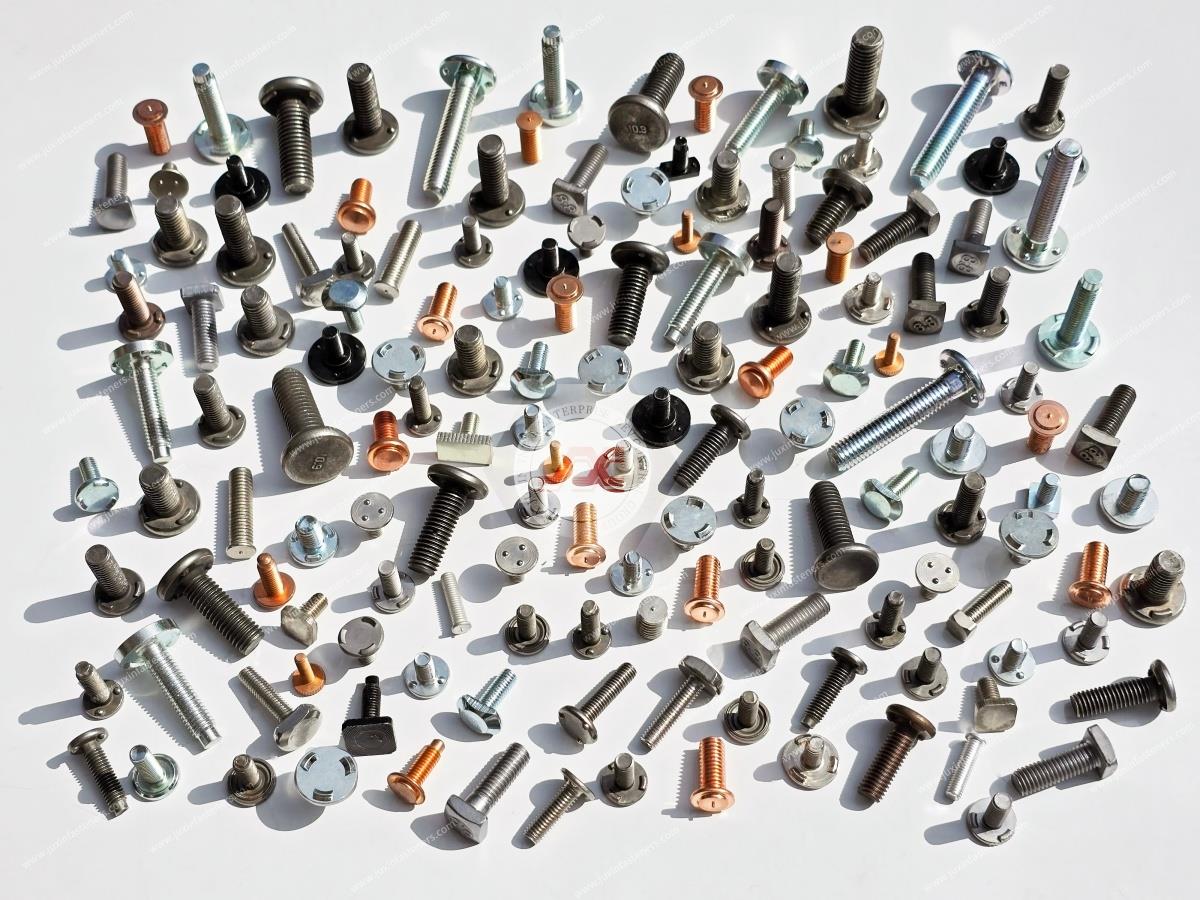
When high structural clamp loads or permanent bare-metal electrical paths are required prior to finishing, welded fastening hardware remains a mainstay of electrical cabinet manufacturing.
DIN 928 Square Weld Nuts and DIN 929 Hex Weld Nuts
DIN 928 square weld nuts for control cabinet assemblies feature four corner weld projections that self-center into precision pilot holes or flat sheet surfaces, delivering balanced weld fusion for heavy internal mounting brackets and door hinges. DIN 929 hex weld nuts for OEM switchgear designs use three projections for stable three-point seating even on slightly uneven sheet metal, offering compact wrench-free threaded anchors inside tight corners. Production engineers must control welding current, electrode force, and projection height consistency to avoid weld spatter fouling the internal metric threads—an area where consistent cold-formed projection geometry makes a measurable difference on automated welding cells.
ISO 13918 Capacitor Discharge Weld Studs
For external enclosure doors and thin stainless steel control panels where reverse-side weld burn-through is unacceptable, capacitor discharge welding can attach an ISO 13918 threaded stud to one face of the sheet in milliseconds. The rapid discharge melts only a thin surface zone, potentially preserving exterior appearance while providing internal mounting studs, subject to process qualification for mounting wire ducts, nameplates, or internal cover plates.
Internal Chassis Hardware: Self-Clinching Standoffs and Captive Panel Screws
Inside power conversion cabinets, frequency drives, and UPS modules, sub-assemblies require precise spacing and safe service access.
Self-Clinching Standoffs for Power Conversion Chassis
Self-clinching standoffs for power conversion chassis elevate control boards, IGBT driver assemblies, and busbar supports above grounded steel sub-plates. By installing threaded or thru-hole standoffs flush into thin SECC or aluminum sub-plates, OEMs maintain uniform mechanical spacing and repeatable assembly geometry across high-volume batch runs.
Captive Panel Screws for Power Distribution Boards
Dead-front inner shields, breaker inspection plates, and fuse-access doors require captive panel screws for power distribution boards. When a maintenance electrician opens an inner barrier, a loose screw dropping onto energized busbars or switchgear contacts creates an immediate arc-flash hazard. Captive screw assemblies—retaining the screw within the cover panel via flare-in, press-in, or spring-loaded ferrules—help prevent hardware loss and accelerate scheduled maintenance inspections.
Critical Engineering Boundaries: Mechanical Fastening vs. Protective Earthing vs. Electrical Insulation
Electrical cabinet designers and purchasing engineers must maintain strict technical boundaries between three distinct functions: mechanical clamping, protective earthing (PE) / electrical bonding, and electrical insulation.
Protective Earthing Studs vs. Mechanical Fasteners
Standard painted mounting brackets, powder-coated enclosure doors, and generic mechanical bolts do not automatically provide compliant protective earthing. Protective earthing studs differ from mechanical fasteners in installation preparation and verification. PE studs (often copper-plated steel or A4/316 stainless steel ISO 13918 weld studs) must maintain low-resistance electrical continuity to bare chassis metal, frequently paired with serrated contact washers or star lock washers engineered to bite through oxide layers and maintain clamping pressure. Grounding continuity must always be verified by the OEM on the finished cabinet according to applicable IEC or UL panel standards.
Copper Busbar Fastening Hardware: Stainless vs. Coated Steel
Joining copper or aluminum busbars inside power distribution equipment introduces thermal expansion cycling and electrical contact-resistance requirements. When comparing stainless steel and coated steel fasteners for copper busbars, engineers must balance corrosion resistance, magnetic hysteresis heating, and clamp-load retention. Austenitic stainless steel (A2-70 / A4-80) is largely non-magnetic—minimizing eddy-current heating near high-current AC busbars—but has lower yield strength than Class 8.8 or 10.9 alloy steel and is prone to thread galling if assembled dry at high speed. High-strength coated steel bolts (Class 8.8 or 10.9) paired with hardened conical spring washers (Belleville washers) maintain high contact pressure across copper thermal expansion cycles, reducing contact resistance drift over time. In all cases, final busbar joint temperature-rise testing must be performed by the switchgear OEM.
Nylon Insulating Washers and Polymer Hardware Limits
Nylon insulating washers for switchgear assemblies, plastic cable clips, and polymer shoulder bushings are valuable for isolating dissimilar metals, spacing low-voltage signal leads, and routing internal wire harnesses cleanly away from sharp cabinet edges. However, engineers must recognize a critical safety boundary: a nonmetallic fastener or nylon washer does not independently certify compliance with electrical safety standards. Final dielectric strength, creepage and clearance distances, thermal aging, and flammability / glow-wire performance (such as UL 94 or IEC 60335 / IEC 61439 system requirements) depend on the complete cabinet geometry, voltage rating, and OEM end-product testing—not on a raw polymer datasheet alone.
Manufacturing Capabilities and Quality Verification for Electrical OEMs
Electrical cabinet OEMs typically require dozens of coordinated fastener SKUs per enclosure platform—spanning weld nuts, blind rivet nuts, self-clinching standoffs, captive screws, flange bolts, and insulating spacers. Sourcing through a multi-process industrial fastener manufacturer simplifies tolerance alignment and batch consistency.
At Juxin Fasteners, manufacturing routes are evaluated per drawing rather than forced into a single process:
Cold Heading and Cold Forming provide high dimensional repeatability and projection uniformity for batch runs of DIN 928/929 weld nuts, flange bolts, weld studs, and rivet nut bodies.
CNC Machining produces custom captive screw ferrules, stepped standoffs, precision busbar spacers, and non-standard electrical hardware with tight concentricity or fine thread requirements.
Product-Specific Secondary Operations—including thread rolling, heat treatment for high-strength steel hardware, zinc or zinc-nickel plating, stainless passivation, and tapping—are coordinated according to the customer's engineering drawing and application requirements.
Before approving mass production for electrical cabinet programs, OEM quality and manufacturing teams should confirm:
Dimensional and Thread Gauge Inspection: Verify hex/square body flats, grip-range barrel lengths, weld projection heights, and GO/NO-GO thread acceptance on First Article samples.
Torque-to-Turn and Pull-Out Testing: Test blind rivet nuts and self-clinching hardware in actual production-thickness painted or bare cabinet steel coupons.
Coating and Corrosion Verification: Specify exact plating type, coating thickness range, and required corrosion-test expectations on the RFQ drawing rather than generic "zinc plated" callouts.
Initiate Your Electrical Cabinet Fastener RFQ
Juxin Fasteners supports global switchgear, control panel, UPS, and power distribution OEMs with standard and made-to-drawing industrial batch manufacturing. Send your technical specifications to info@juxinfasteners.com including:
2D engineering drawings (PDF) and 3D CAD models (STEP/IGES)
Fastener standard (DIN/ISO/ASME) or custom dimensions and critical tolerances
Material grade, property class, and coating/surface finish requirements
Host cabinet sheet material, thickness range, and pre-coat vs. post-coat installation sequence
Operating environment (indoor control room vs. coastal/outdoor switchgear) and Estimated Annual Usage (EAU)
Contact Us
Tel.:
+86 020 8621 0320
+86 020 3121 6067
E-mail:
Technical Support:
Navigation
SEND INQUIREY