
Call Us
+86 136 6007 9809
Call Us
+86 136 6007 9809

Oct. 07, 2026
Food-processing equipment, commercial food-service machinery and agricultural equipment create very different fastening environments,
but they share several recurring joint-design challenges:
Vibration and cyclic loading
Repeated maintenance
Moisture and contamination
Temperature variation
Corrosion exposure
Stainless-steel mating components
Slotted or oversized mounting holes
Limited assembly space
Washer management
Thread galling
Equipment-specific cleaning requirements
Selecting the correct nut therefore requires more than choosing a thread size and material.
JUXIN FASTENERS supplies locking fastener solutions including:
All-metal prevailing-torque lock nuts
All-metal flange lock nuts
Fuji-style all-metal flange lock nuts
Nylon-insert lock nuts
DIN 985 nylon-insert lock nuts
Stainless steel lock nuts
Carbon-steel lock nuts
Aluminum nylon-insert lock nuts
Titanium nylon-insert lock nuts
Drawing-based locking nuts
Custom machined and special fastening components
These products can support applications across:
Food-processing machinery
Commercial food-service equipment
Commercial ovens
Refrigeration equipment
Agricultural machinery
Conveyors
Pumps
Motors
HVAC equipment
Packaging machinery
Industrial equipment
Electrical equipment
Rail-related assemblies
Automotive equipment
The key engineering question is not simply:
“Which lock nut is strongest?”
A better question is:
“Which locking architecture is appropriate for this joint, temperature, environment, mating bolt and maintenance requirement?”
A lock nut is only one part of a bolted joint.
The assembled joint can also depend on:
Bolt material
Bolt strength
Thread fit
Tightening torque
Clamp load
Joint stiffness
Bearing surface
Flange geometry
Washer selection
Surface coating
Lubrication
Temperature
Vibration direction
Service frequency
This means that replacing one nut with another based only on thread size can change assembly behavior.
An M8 nylon-insert lock nut, M8 all-metal prevailing-torque nut and M8 flange lock nut do not perform the same engineering function.
This is one of the most important distinctions in industrial nut selection.
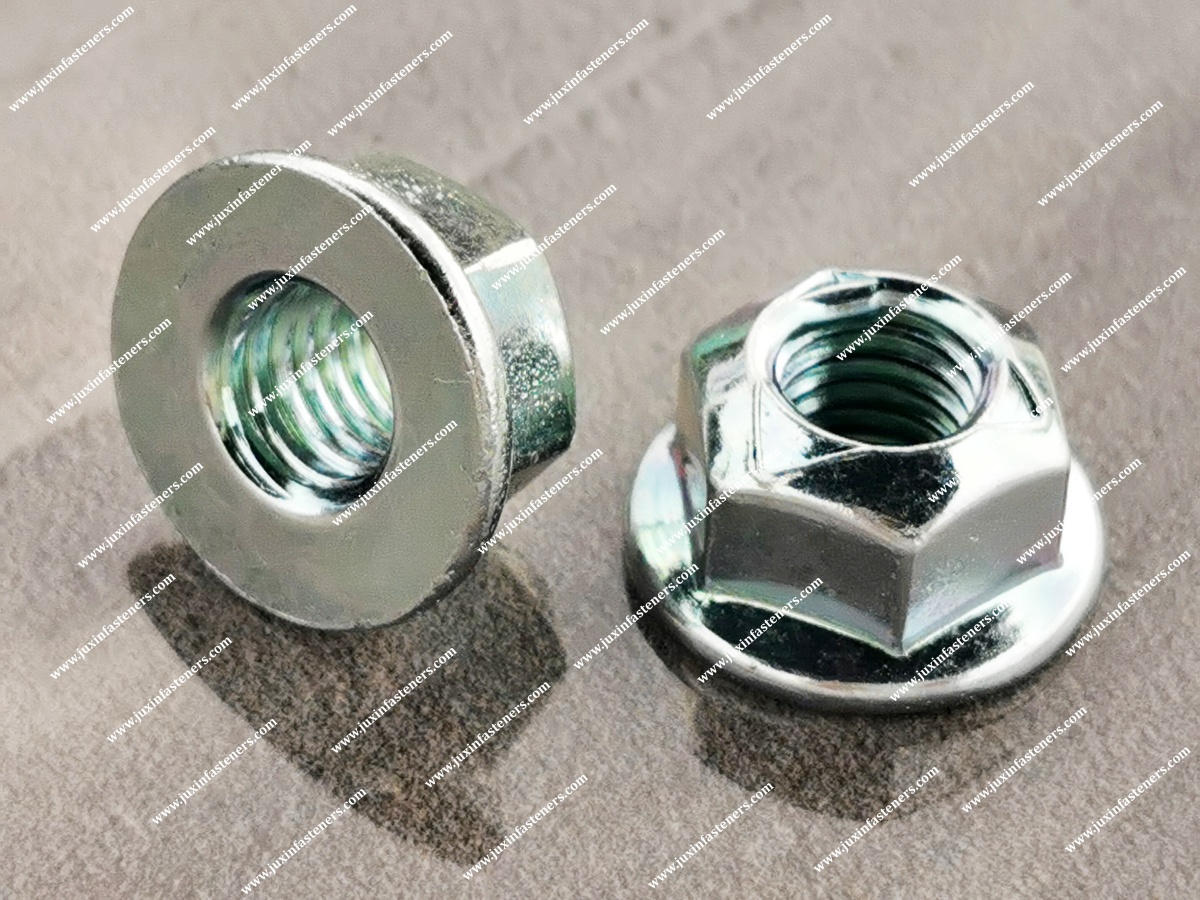
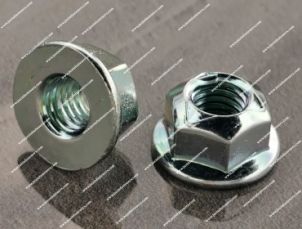
A flange nut has an integrated flange that increases the bearing area beneath the nut.
A lock nut includes a feature intended to resist free rotation or loosening.
A nut can therefore be:
Flanged but not prevailing-torque
Prevailing-torque but not flanged
Flanged and prevailing-torque
Serrated-flange
Non-serrated flange
These terms should not be treated as interchangeable.
For procurement teams, an RFQ that says only:
“M8 flange lock nut”
may still be incomplete.
The flange beneath a nut can provide a broader bearing interface than a conventional hex nut.
Depending on the joint design, this can help:
Distribute bearing pressure
Simplify the washer stack
Increase contact area
Support assembly on larger clearance holes
Improve production handling
But the flange should not automatically be described as replacing every washer in every joint.
A separate washer may still be required where the design needs:
A specific bearing diameter
Surface protection
Electrical isolation
Controlled friction
A hardened bearing surface
Coverage of a large slot
Special load distribution
The complete joint geometry determines whether the integrated flange is sufficient.
This matters especially with slotted holes.
A flange can bridge some clearance around a hole, but whether it safely covers a slot depends on:
Flange diameter
Slot width
Slot length
Material thickness
Bearing stress
Joint load
Installation torque
Therefore:
Do not remove a washer from an existing assembly simply because the replacement nut has a flange.
The bearing interface should be reviewed first.
Nylon-insert lock nuts use a polymer insert that interferes with the mating bolt thread.
JUXIN FASTENERS supplies DIN 985 nylon-insert lock nuts and related configurations in materials including stainless steel, aluminum and titanium for appropriate applications.
Typical industrial applications can include:
Equipment covers
Brackets
Light machinery
Food-service equipment
Electrical assemblies
HVAC equipment
General industrial machinery
Their advantages can include:
Prevailing torque after initial thread engagement
Familiar assembly method
Widely recognized industrial architecture
No separate locking washer required for the locking function
However, nylon-insert nuts are not the correct answer for every environment.
The polymer insert is the feature that creates the prevailing-torque behavior.
Its performance can be affected by:
Temperature
Exposure duration
Thermal cycling
Chemical exposure
Aging
Mating-thread condition
Therefore, a nylon-insert lock nut should not be selected for a high-temperature application simply because the metallic nut body can tolerate the temperature.
The limiting component may be the polymer insert.
Consider a stainless steel nylon-insert nut.
The stainless nut body may remain mechanically suitable at a temperature where the polymer locking element is no longer appropriate for the required performance.
Therefore:
Material selection must consider the complete lock nut, not only the metal body.
This distinction is especially important around:
Commercial ovens
Heating equipment
Exhaust-adjacent machinery
High-temperature process equipment
Where temperature exceeds the suitable range of the polymer locking element, an all-metal locking architecture may be more appropriate.
All-metal prevailing-torque nuts create resistance to free rotation using a metallic locking feature rather than a polymer insert.
Potential applications include:
Agricultural machinery
Motors
Pumps
Conveyor systems
Industrial machinery
Commercial food equipment
Equipment exposed to elevated temperatures
Applications where polymer locking elements are undesirable
JUXIN FASTENERS supplies all-metal lock nut configurations, including flange-style designs.
But:
All-metal does not mean vibration-proof.
The nut still operates as part of the complete bolted joint.
Prevailing torque is the resistance encountered when rotating the locking nut on the mating thread before or apart from the final bearing condition.
Clamp load is the axial force generated in the assembled joint.
They are related to assembly torque but they are not the same quantity.
The installer must overcome:
Thread friction
Bearing friction
Prevailing torque from the locking feature
Torque required to develop the desired joint preload
Therefore, changing from a free-running nut to a prevailing-torque lock nut can change the assembly torque budget.
If an assembly originally used a conventional free-running nut and is changed to an all-metal prevailing-torque lock nut,
using exactly the same tightening torque without review can produce a different clamp load.
Why?
Because some applied torque is now consumed by the locking feature.
This becomes important in automated assembly where torque values are programmed into production tools.
A locking-nut substitution should therefore consider the complete tightening strategy.
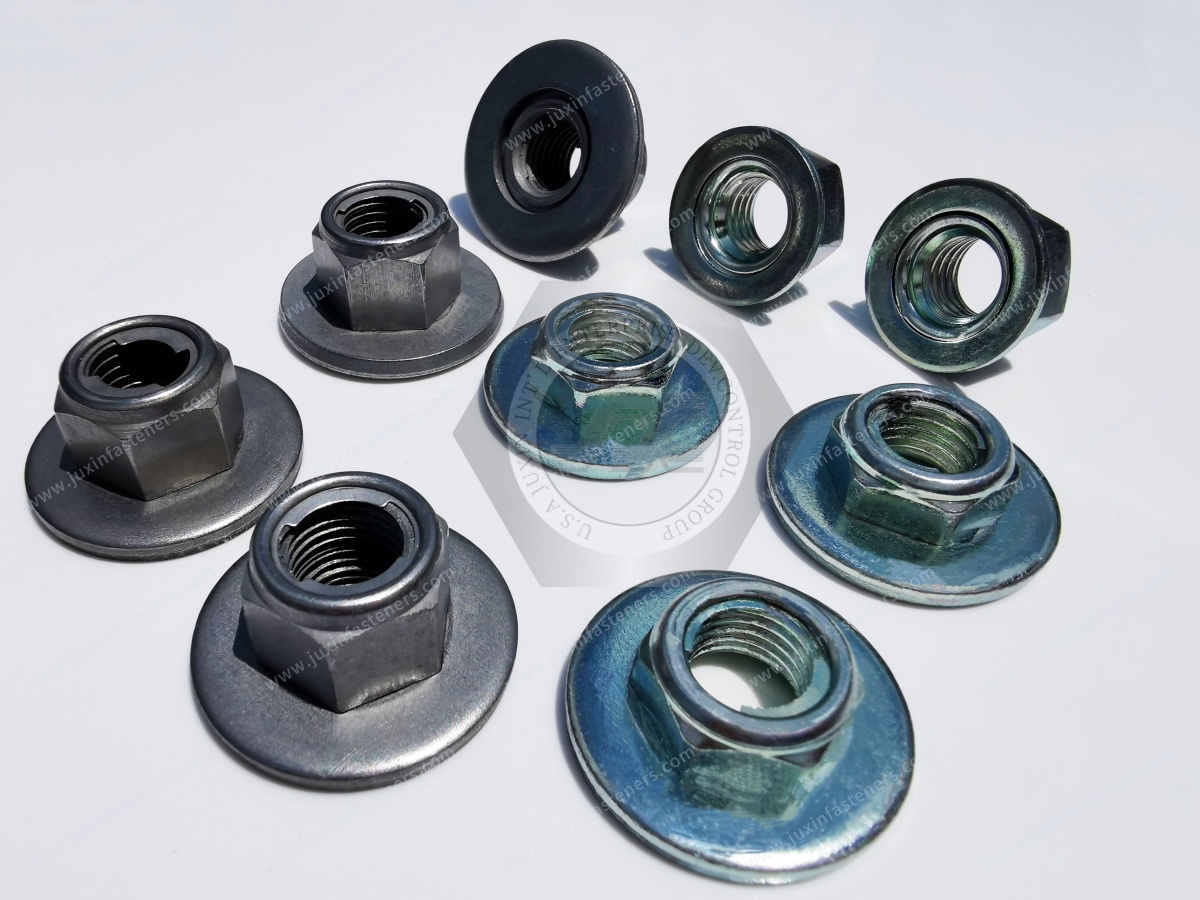
An all-metal flange lock nut combines:
A prevailing-torque locking mechanism
An integrated flange bearing surface
This architecture can be useful where designers want both:
Locking behavior
Increased bearing area
Potential applications include:
Machinery brackets
Motor mounts
Conveyor equipment
Agricultural machinery
Equipment frames
Industrial enclosures
The flange geometry and locking feature should still be specified independently.
JUXIN FASTENERS also supplies Fuji-style all-metal flange lock nuts using a spring-stop or tab-style locking architecture for appropriate applications.
These can be relevant where OEM drawings specify features such as:
All-metal locking
Flanged bearing surface
Non-serrated flange
Specific locking-tab geometry
Stainless steel construction
Metric thread
A Fuji-style nut should not be substituted automatically for another prevailing-torque design simply because the thread size matches.
The locking geometry, flange geometry and assembly behavior should be compared.
Procurement teams sometimes assume serrations are always desirable because they appear to provide additional locking.
That is not necessarily true.
A non-serrated flange may be selected where the designer wants to avoid aggressive marking of the mating surface or where joint friction must be managed differently.
This can matter with:
Painted surfaces
Coated brackets
Stainless surfaces
Soft materials
Components requiring repeatable positioning
The presence or absence of flange serrations should therefore follow the drawing.
Serrated flange nuts use teeth or serrations on the bearing surface.
The serrations interact with the mating surface and can increase resistance to rotation in suitable joints.
However, they can also:
Mark the mating surface
Damage coatings
Change bearing friction
Affect electrical contact
Complicate reuse
Interact differently with soft substrates
A serrated flange nut should not automatically be specified because an application contains vibration.
A serrated flange acts primarily at the bearing interface.
A prevailing-torque feature acts primarily through the threaded engagement.
These are different mechanisms.
That distinction matters when evaluating:
Surface coating
Joint reuse
Installation torque
Mating material
Locking strategy
Food-processing machinery can include:
Conveyors
Mixers
Filling equipment
Packaging systems
Cutting equipment
Sorting equipment
Pumps
Motors
Guards
Structural frames
Fasteners in different machine zones can experience very different environments.
Some may be exposed to:
Water
Humidity
Food residue
Cleaning chemicals
Repeated washing
Others may remain inside protected machinery compartments.
Therefore:
“Food machinery fastener” is not a complete material specification.
Commercial food-service equipment can include:
Ovens
Cooking equipment
Refrigeration systems
Food preparation equipment
Stainless housings
Internal mechanical assemblies
Heating and ventilation components
Different locations inside the same machine can require different locking solutions.
For example:
High-temperature zone → evaluate all-metal locking
Moderate-temperature service panel → nylon-insert may be appropriate
Stainless wet area → corrosion and galling become important
Motor mount → vibration and preload become important
The equipment name alone does not determine the nut.
Instead of specifying one lock nut for the entire machine, engineers can divide equipment into fastening zones:
Consider whether polymer locking elements are suitable.
Evaluate corrosion and cleaning chemistry.
Evaluate preload, joint stiffness and locking architecture.
Consider reassembly, prevailing-torque behavior and replacement strategy.
Consider flange serration and surface marking.
This approach is more useful than writing one generic fastener specification for the complete machine.
Agricultural equipment can expose fasteners to:
Vibration
Shock
Mud
Water
Fertilizer
Dust
Outdoor humidity
Temperature changes
Repeated maintenance
Potential applications include:
Conveyor systems
Sorting machinery
Brackets
Guards
Motor mounts
Equipment frames
Adjustment mechanisms
But “agricultural machinery” still does not define one universal lock nut.
A fastener on an interior control enclosure has different requirements from one near a vibrating mechanical drive.
A common mistake is to assume that vibration directly rotates a nut loose.
Bolted-joint self-loosening can be influenced by relative movement within the joint,
especially transverse movement under certain conditions.
The locking method should therefore be considered together with:
Preload
Joint stiffness
External loading
Bearing surfaces
Bolt length
Joint geometry
A lock nut can add resistance to rotation.
It does not replace correct joint design.
Transverse vibration testing is commonly used to evaluate bolted-joint loosening behavior.
Standards and test methods may be specified by the customer depending on the application.
A vibration test can help compare fastening systems under defined test conditions.
However:
Passing one vibration test does not prove that a lock nut is universally vibration-proof in every machine.
The real application can differ in:
Joint stiffness
Bolt size
Clamp length
Surface
Preload
Loading direction
Loading amplitude
Test requirements should therefore be defined by the OEM where necessary.
A useful engineering comparison is:
| Selection Factor | Nylon-Insert Lock Nut | All-Metal Prevailing-Torque Lock Nut |
|---|---|---|
| Locking element | Polymer insert | Metallic feature |
| Elevated temperature | Polymer limits must be considered | Often considered where polymer is unsuitable |
| Prevailing torque | Yes | Yes |
| Surface marking | Normally not from serration unless separately designed | Depends on flange/bearing design |
| Reuse | Must be evaluated | Must be evaluated |
| Corrosion | Depends on nut material and finish | Depends on nut material and finish |
| Stainless options | Available for appropriate designs | Available for appropriate designs |
| Application | General machinery and equipment | Machinery requiring all-metal locking architecture |
The correct choice depends on the application.
Another common sourcing mistake is to assume that a lock nut can be reused indefinitely.
Prevailing-torque behavior can change after repeated installation and removal.
The amount of change depends on:
Locking mechanism
Nut material
Bolt material
Surface finish
Thread condition
Lubrication
Installation history
Where repeated reuse is important, the OEM should define the acceptable prevailing-torque requirement and service strategy.
Instead of asking:
“Is this lock nut reusable?”
A better engineering question is:
“What prevailing-torque performance is required after the specified number of installation/removal cycles?”
That creates a measurable requirement.
Stainless steel is widely considered for food equipment because of corrosion resistance and equipment material compatibility.
JUXIN FASTENERS supplies stainless locking fasteners for appropriate industrial applications.
Possible stainless selections can include 304/316-family materials depending on the drawing and project requirement.
However:
Stainless steel is not universally immune to corrosion.
Performance depends on:
Alloy
Surface condition
Chloride exposure
Cleaning chemicals
Temperature
Crevices
Contact with dissimilar metals
The actual environment should determine material selection.
The decision between 304 and 316-family stainless steels should not be based simply on whether the machine handles food.
316-family stainless can provide improved resistance in some chloride-containing environments.
But 316 is not automatically required for every food machine.
The correct choice depends on:
Chemical exposure
Chloride level
Cleaning process
Temperature
Cost
Existing equipment material
Procurement should follow the engineering specification rather than replacing one stainless grade with another based only on perceived quality.
Food-processing environments may use:
Alkaline cleaners
Acidic cleaners
Chlorinated products
Detergents
Sanitizing chemicals
Compatibility depends on the actual:
Chemical
Concentration
Temperature
Exposure time
Frequency
Therefore, JUXIN FASTENERS should not claim that one stainless lock nut is resistant to every commercial cleaning agent.
If chemical exposure is important, include the cleaning environment in the RFQ.
Two customers can both say:
“This is a washdown application.”
One may use room-temperature water.
Another may use hot water plus aggressive cleaning chemicals.
Those are different corrosion environments.
A better RFQ includes:
Cleaning Chemical + Concentration + Temperature + Frequency + Exposure Location
This gives the fastener supplier useful engineering information.
Stainless threaded joints can experience galling.
Galling is influenced by:
Mating materials
Surface finish
Thread fit
Installation speed
Load
Lubrication
Surface treatment
It can become particularly important with prevailing-torque nuts because the locking feature adds friction during assembly.
Therefore:
Stainless + prevailing torque requires attention to the complete thread pair and assembly process.
A free-running stainless nut encounters relatively low resistance before seating.
A prevailing-torque stainless nut intentionally adds resistance before seating.
That additional friction can change the tribological conditions at the mating threads.
For high-volume automated assembly, engineers should evaluate:
Mating bolt
Installation speed
Lubrication policy
Thread condition
Tool settings
rather than treating galling as only a material issue.
Carbon-steel locking nuts can be appropriate for many agricultural and industrial applications.
Material and strength requirements should follow:
Mating bolt
Joint load
OEM drawing
Applicable specification
Surface finish should then be selected for the actual corrosion environment.
A generic description such as “high-strength carbon steel” is not sufficient for an engineering RFQ.
Depending on the product and customer requirement, protective finishes may be specified for carbon-steel lock nuts.
The specification should identify:
Coating type
Coating thickness where required
Passivation/topcoat where applicable
Corrosion test requirement
Appearance
Friction requirement where relevant
Coating is not purely cosmetic.
It can affect tightening behavior.
Changing the finish of a nut can change friction.
That means a coating substitution can change the relationship between:
Applied Torque → Friction → Bolt Tension → Clamp Load
Therefore, changing from one coating system to another should not automatically be treated as a cosmetic substitution.
This becomes particularly important in controlled-torque assembly.
ASTM B117 may be specified as a salt-spray test method for certain coated components.
But a useful specification should include:
Test duration
White corrosion acceptance where relevant
Red corrosion acceptance where relevant
Evaluation criteria
Salt-spray hours should not be presented as a direct prediction of years of field service.
A flange increases the contact area beneath the nut.
This can be useful on:
Clearance holes
Sheet-metal brackets
Equipment frames
Slotted adjustment brackets
But flange diameter should be evaluated against the actual joint geometry.
A larger flange is not automatically better.
Potential constraints include:
Nearby bends
Adjacent components
Limited wrench clearance
Edge distance
Slot geometry
Slotted holes are common where equipment requires:
Adjustment
Alignment
Tensioning
Manufacturing tolerance
When using a flange nut over a slot, engineers should evaluate:
Slot width
Flange diameter
Bearing overlap
Material thickness
Clamp load
Surface hardness
If the flange does not provide adequate bearing coverage, a separate washer or different joint architecture may still be required.
A flange can distribute bearing pressure over a larger area, but it does not strengthen the sheet itself.
Thin sheet can still experience:
Local deformation
Bearing damage
Hole elongation
Surface indentation
If the substrate is thin, the complete load path should be evaluated.
Can be appropriate where:
Surface marking should be minimized
Coating damage is undesirable
Controlled bearing behavior is required
The locking mechanism is elsewhere in the nut
May be considered where interaction with the mating surface is intentional.
But engineers should consider:
Surface damage
Coating removal
Reuse
Friction variability
The drawing should explicitly identify whether serrations are required.
A stainless lock nut does not make a machine hygienic.
Hygienic equipment design can also depend on:
Joint geometry
Crevices
Surface finish
Drainage
Cleanability
Material selection
Fastener placement
Fastener selection should support the equipment design rather than be presented as a standalone sanitation solution.
Agricultural equipment can encounter:
Water
Mud
Fertilizer
Chemicals
Organic contamination
Outdoor weather
A laboratory salt-spray test may provide comparative coating information, but actual field corrosion depends on the service environment.
Material and finish should be selected from the real exposure.
A standard nut with washer can remain appropriate for many joints.
A lock nut may be preferred when the joint requires additional resistance to free rotation.
A flange nut may be preferred when integrated bearing area is useful.
These are different decisions.
The designer should not assume that one component replaces the complete function of:
Nut + Washer + Locking Feature
unless the replacement has been evaluated for all three functions.
Liquid or pre-applied threadlocking systems can provide another approach to resisting thread movement.
The correct choice can depend on:
Assembly process
Serviceability
Temperature
Contamination
Cure requirements
Maintenance
Production volume
A mechanical lock nut may be attractive where the OEM wants the locking function integrated into the hardware.
But threadlocker and prevailing-torque nuts should not automatically be treated as equivalent.
Double-nut arrangements are used in some mechanical assemblies.
However, they increase:
Part count
Thread length requirement
Assembly operations
Space requirement
A prevailing-torque lock nut can simplify some architectures, but suitability depends on the actual joint.
Positive mechanical locking systems such as castle nuts with cotter pins serve a different function and may be required in certain safety-critical mechanical joints.
A prevailing-torque nut should not automatically replace a positive locking system specified by the equipment designer.
Follow the controlled engineering drawing.
Design engineers should begin with:
1. What is the joint doing?
Structural clamp, bracket mounting, motor mount, cover, adjustment point or rotating equipment?
2. What loading occurs?
Static, vibration, shock or cyclic?
3. What is the operating temperature?
Especially important for polymer locking elements.
4. What is the environment?
Dry, humid, outdoor, washdown, chemical cleaning or high temperature?
5. What is the mating bolt?
Material, thread, strength and coating.
6. Is a flange required?
Why?
7. Serrated or non-serrated?
What happens to the mating surface?
8. Is repeated disassembly required?
Define service-cycle expectations.
9. Is stainless required?
Evaluate corrosion and galling together.
10. How is tightening controlled?
Manual, torque wrench or automated driver?
This process produces a much better specification than simply selecting “M8 stainless lock nut.”
For accurate review and quotation, provide:
Nut type
Thread size
Thread pitch
Metric or inch thread
Nylon-insert or all-metal
Flange or non-flange
Serrated or non-serrated flange
Nut material
Mating bolt material
Mating bolt strength/property requirement
Surface finish
Operating temperature
Corrosion environment
Cleaning chemicals where relevant
Vibration requirement where specified
Prevailing-torque requirement where specified
Reuse-cycle requirement where specified
Flange diameter where controlled
Applicable drawing
Applicable standard where required
Prototype quantity
Annual quantity
Packaging requirement
For existing OEM parts, send the controlled 2D drawing whenever possible.
Do not compare only:
M6 + stainless + lock nut + price.
Compare:
Locking architecture
Thread
Nut dimensions
Flange geometry
Serration
Material
Surface finish
Prevailing-torque requirement
Mating bolt
Temperature requirement
Corrosion requirement
Assembly behavior
Reuse requirement
Drawing revision
Sample approval
Production consistency
Two M6 lock nuts can look similar and still behave differently in assembly.
A lock nut cannot be fully evaluated in isolation.
Prevailing torque occurs between the nut and the mating bolt.
Therefore, when an OEM has a controlled locking requirement, useful information includes:
Bolt thread
Bolt material
Bolt finish
Bolt hardness/strength where relevant
This is particularly important when qualifying an alternate lock nut supplier.
For existing food machinery or agricultural equipment projects, a practical second-source qualification process can follow:
Existing Part Review → Nut & Mating Bolt Review → Drawing Confirmation → Material & Finish Review → Sample → Assembly Evaluation
→ Required Torque/Performance Validation → Golden Sample Approval → Production
If the OEM specifies vibration, corrosion, reuse or prevailing-torque testing, the test requirement and acceptance criteria should be provided before validation.
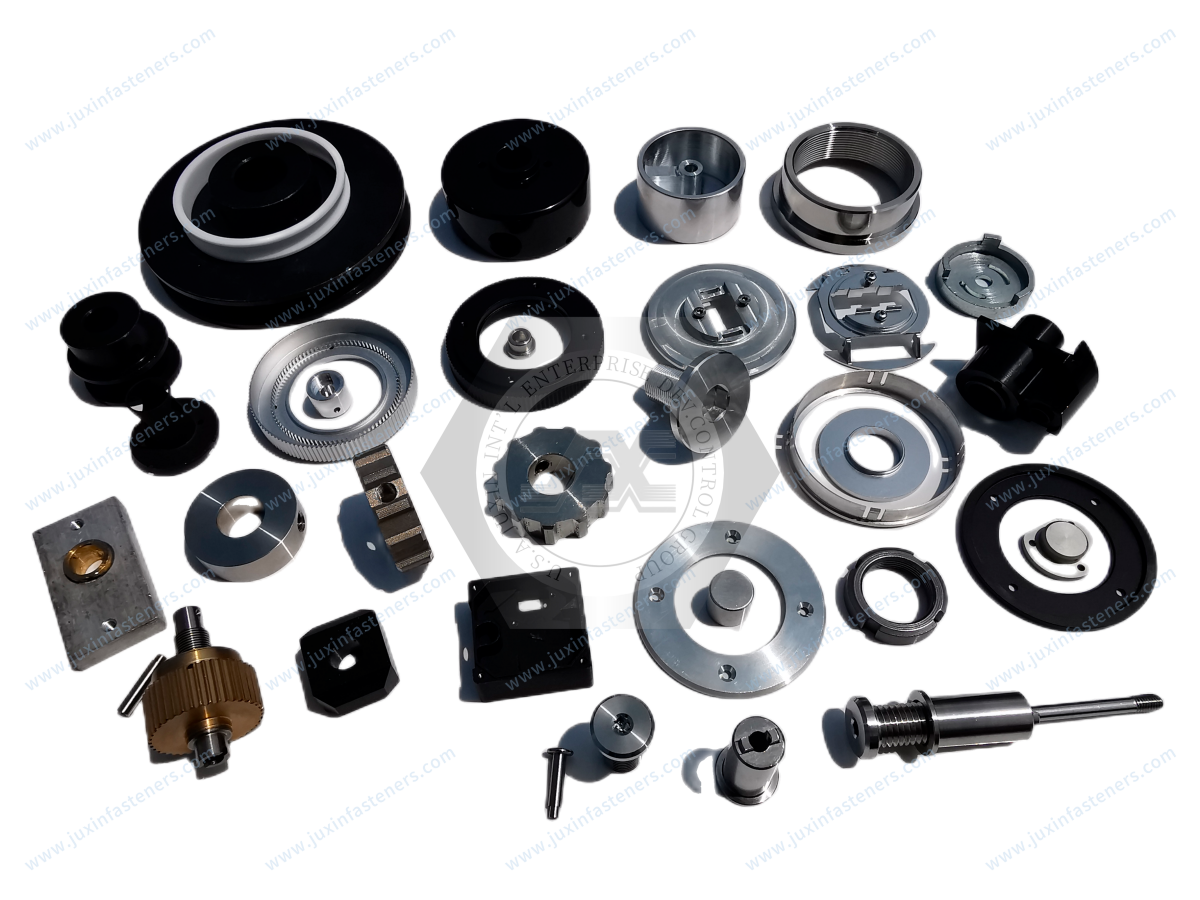
Standard lock nuts cover many industrial applications.
Drawing-based components may be required for:
Special flange diameter
Special nut height
Special locking geometry
Non-serrated flange requirement
Customer-specific tab geometry
Special thread
Special material
Special finish
Restricted assembly envelope
JUXIN FASTENERS supports drawing-based review for custom locking nuts and industrial fastening components.
Feasibility should be confirmed against the complete application requirement.
For drawing-based or OEM-specific lock nut projects, a practical development path can follow:
Joint Requirement → Locking Method Selection → Drawing & Mating Bolt Review → Material & Finish Confirmation → Prototype / Sample
→ Assembly Evaluation → Required Prevailing-Torque / Performance Validation → Golden Sample Approval → Production
This helps prevent a common sourcing problem:
A replacement nut matches the dimensions but behaves differently on the customer's actual bolt.
Depending on the specific product, customer requirements may reference standards such as:
DIN 985 for certain nylon-insert lock nut configurations
DIN 980 / applicable ISO specifications for certain all-metal prevailing-torque nuts
ISO 3506 series where applicable to specified stainless fastener mechanical properties
ISO 898 series where applicable to specified carbon/alloy steel nut mechanical properties
ASTM B117 where salt-spray testing is specified
ASME/ANSI thread requirements for inch-series applications
Standards should be applied only where they genuinely correspond to the product and drawing.
JUXIN FASTENERS does not treat a generic lock nut as automatically compliant with every ISO, DIN, ASME, BS or EN requirement.
For OEM projects, the controlled drawing and purchase specification remain the primary references.
This page should connect to the wider JUXIN FASTENERS locking and machinery fastening architecture.
Related solutions include:
All-Metal Prevailing-Torque Lock Nuts for High-Vibration Industrial Assemblies — detailed product-selection guide for metallic prevailing-torque locking
DIN 985 Nylon-Insert Lock Nuts — polymer-insert locking architecture for suitable industrial applications
Fuji-Style All-Metal Flange Lock Nuts — all-metal flange locking architecture for OEM applications
Blind Rivet Nuts for Sheet Metal Enclosures & One-Sided Assembly — permanent female threads for blind-side sheet-metal installation
Projection Weld Nuts for Automotive Chassis & Sheet Metal Assemblies — welded threaded attachment for fabricated structures
Fastening Solutions for Medical Device Housings & Laboratory Equipment — stainless, self-clinching, PCB and plastic fastening architecture
Self-Clinching Fasteners for Telecom Cabinets & AI Data Center Enclosures — thin-sheet permanent fastening solutions
The internal selection path should help engineers move by function:
Need prevailing torque without polymer → All-Metal Lock Nut
Need nylon-insert prevailing torque → DIN 985 / Nylon-Insert Lock Nut
Need locking + integrated flange → Flange Lock Nut / Fuji-Style Lock Nut
Need permanent thread in thin sheet → Self-Clinching Nut
Need blind-side permanent female thread → Rivet Nut
Need welded female thread → Weld Nut
This keeps product functions clear and reduces incorrect substitutions.
If you are sourcing locking fasteners for:
Food-processing machinery
Commercial food-service equipment
Commercial ovens
Refrigeration systems
Agricultural machinery
Conveyors
Motors
Pumps
Packaging equipment
HVAC equipment
Industrial machinery
send us:
Drawing + Nut Type + Thread + Material + Mating Bolt + Finish + Operating Temperature + Environment + Quantity
For washdown applications, include the cleaning environment where relevant.
For vibration-sensitive applications, include the joint and test requirements rather than simply specifying “vibration-proof.”
For stainless prevailing-torque assemblies, include the mating bolt material and finish so the complete thread pair can be reviewed.
JUXIN FASTENERS can review:
All-metal prevailing-torque lock nuts
All-metal flange lock nuts
Fuji-style all-metal flange lock nuts
DIN 985 nylon-insert lock nuts
Stainless steel locking nuts
Carbon-steel locking nuts
Aluminum and titanium nylon-insert lock nut requirements
Drawing-based custom locking components
The goal is not to choose the most aggressive locking feature.
The goal is to select a locking architecture that fits the joint, environment, temperature, mating bolt, manufacturing process and service requirement.
JUXIN FASTENERS
Website: www.juxinfasteners.com
Engineering & RFQ: info@juxinfasteners.com
 MORE NEWS
Contact Us
Tel.:
+86 020 8621 0320
+86 020 3121 6067
E-mail:
Technical Support:
Navigation
SEND INQUIREY