
Call Us
+86 136 6007 9809
Call Us
+86 136 6007 9809

JUXIN FASTENERS supplies stainless steel nylon-insert flange locknuts with an integral bearing flange and a non-metallic prevailing-torque insert.
Catalog sizes include metric M5–M20, with custom UNC/UNF designs available for review.
Material options include 304, 316 and 316L stainless steel, subject to grade and performance verification. Designed for suitable machinery,
automotive equipment, HVAC assemblies and industrial enclosures requiring corrosion resistance and controlled resistance to loosening.
Product Specification
Stainless Steel Nylon-Insert Flange Locknuts – DIN 6926
A2 / A4 Stainless Steel Prevailing-Torque Flange Nuts for Industrial OEM Assemblies
JUXIN FASTENERS supplies stainless steel nylon-insert flange locknuts for industrial manufacturers requiring corrosion resistance,
controlled resistance to threaded loosening and an integrated load-distributing flange.
These locknuts combine a hexagonal stainless steel nut body, a non-serrated circular flange and a retained nylon locking insert.
The nylon ring engages the mating bolt threads and generates prevailing torque, while the flange provides a wider bearing surface than an ordinary hex nut.
In American industrial markets, the primary product name is Stainless Steel Nylon-Insert Flange Locknuts.
Other recognized terms include Stainless Steel Nylon-Insert Flange Nuts, DIN 6926 Flange Locknuts, Stainless Steel Flanged Nyloc Nuts and Non-Serrated Nylon-Insert Flange Locknuts.
The original JUXIN FASTENERS catalog lists metric M5–M20. Custom UNC and UNF inch-thread versions can be reviewed for OEM production.
Product Specifications
| Parameter | Specification |
|---|---|
| Product Name | Stainless Steel Nylon-Insert Flange Locknuts |
| Alternative Names | Nylon-Insert Flange Nuts, Flanged Nyloc Nuts, Prevailing-Torque Flange Nuts |
| Product Type | Hexagonal Flange Locknut with Non-Metallic Insert |
| Main Material | Stainless Steel |
| Listed Material Options | SUS304, SUS316, SUS316L |
| Stainless Steel Designations | A2 and A4, Subject to Material Verification |
| Requested Mechanical Classes | A2-70, A4-80, Subject to Verification |
| Locking Element | Nylon / Polyamide Insert |
| Locking Mechanism | Non-Metallic Insert Prevailing Torque |
| Flange | Integrated, Non-Serrated Bearing Flange |
| Surface Finish | Natural Stainless Steel |
| European Product Reference | DIN 6926 |
| Metric Dimensional Reference | ISO 7043:2012 |
| Metric Fine-Thread Reference | ISO 12125:2012 |
| Stainless Steel Mechanical Reference | ISO 3506-2:2020 |
| Functional Testing Reference | ISO 2320 Principles, Where Applicable |
| American Inch-Series Reference | ASME B18.16.6, Subject to Material and Design Qualification |
| Metric Catalog Sizes | M5, M6, M8, M10, M12, M14, M16, M20 |
| Inch-Thread Options | UNC / UNF, Subject to Engineering Review |
| Customization | Material, Thread, Flange, Insert, Finish and Packaging |
| Typical Customers | OEMs, Tier-1/Tier-2 Manufacturers, Engineering and Procurement Teams |
What Are Stainless Steel Nylon-Insert Flange Locknuts?
A stainless steel nylon-insert flange locknut is an internally threaded prevailing-torque fastener with a non-metallic locking insert and an enlarged bearing flange.
Unlike a standard stainless steel hex nut, it generates resistance to rotation when the mating bolt engages the nylon insert.
The locking insert deforms locally around the bolt thread profile, creating interference and friction.
The flange provides a larger contact area against the clamped component and may eliminate the need for a separate flat washer where the joint design permits.
Key Engineering Benefits
Resistance to unintentional threaded loosening.
Stainless steel corrosion resistance.
Integrated flange bearing surface.
Reduced washer handling in suitable assemblies.
Compact locking and bearing arrangement.
Non-serrated bearing surface.
Metric and customer-specific inch-thread configurations.
Multiple stainless steel material options.
Potential for repeatable industrial assembly processes.
Important Engineering Limitation
The nylon insert resists nut rotation but does not guarantee clamp-load retention under all vibration, impact or thermal conditions.
The complete bolted joint must be evaluated for its intended service environment.
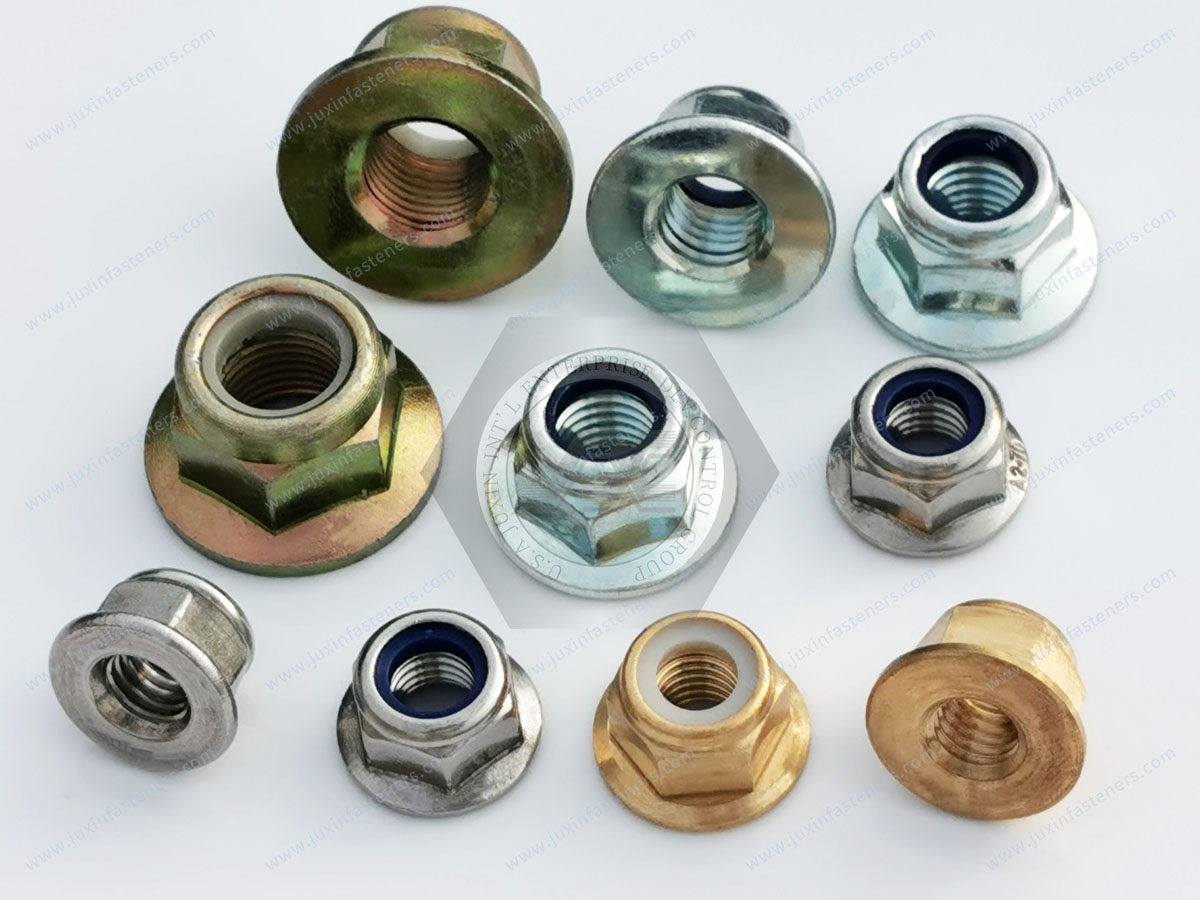
DIN 6926 – Stainless Steel Nylon-Insert Flange Nuts
DIN 6926 is a recognized European reference for prevailing-torque hexagon flange nuts with non-metallic inserts.
It is commonly used in industrial catalogs for stainless steel flange locknuts.
The product geometry generally includes:
Hexagonal wrenching body.
Integrated circular flange.
Internal metric thread.
Retained nylon locking ring.
Non-serrated bearing surface.
DIN 6926 and ISO 7043
ISO 7043:2012 covers prevailing-torque hexagon nuts with flange and non-metallic insert, style 2, in nominal metric sizes M5–M20.
However, the mechanical property classes identified by ISO 7043 are associated with its steel nut requirements.
For stainless steel versions, the material and mechanical properties require separate verification under the applicable stainless steel fastener specification.
Engineering Recommendation
For OEM purchasing, specify the exact DIN 6926 or ISO 7043 dimensional requirements together with the stainless steel grade,
required mechanical properties and prevailing-torque acceptance criteria.
ISO 3506-2 – Stainless Steel Nut Mechanical Properties
ISO 3506-2:2020 specifies mechanical and physical properties of corrosion-resistant stainless steel nuts.
It provides a technical basis for evaluating stainless steel grades and property classes.
The standard does not independently establish the prevailing-torque performance of the nylon locking insert.
Important Distinction
Stainless steel mechanical strength and nylon-insert locking performance are separate engineering requirements.
Both must be verified where required by the application.
Stainless Steel Material Selection
304 Stainless Steel / A2 Family
304 stainless steel is widely used in general industrial equipment requiring good atmospheric corrosion resistance.
Typical applications include:
Machinery housings.
Equipment brackets.
Electrical enclosures.
Industrial fixtures.
General mechanical assemblies.
In American industrial catalogs, 18-8 stainless steel is a common commercial description for certain austenitic stainless steel fasteners.
However, the designation 18-8 does not independently prove a specific ISO mechanical property class.
316 Stainless Steel / A4 Family
316 stainless steel contains molybdenum and may provide improved resistance to certain chloride-containing environments compared with 304.
It may be considered for:
Coastal equipment.
Selected outdoor machinery.
Chemical processing accessories.
HVAC equipment exposed to corrosive environments.
Industrial equipment requiring additional corrosion resistance.
316L Stainless Steel
316L is a low-carbon version of 316 stainless steel.
It may be selected where its specific material characteristics are required.
Material Qualification
The availability of SUS304, SUS316 and SUS316L does not mean every material option automatically meets A2-70 or A4-80 mechanical requirements.
The actual material and property class must be verified.
A2-70 and A4-80 – Understanding the Difference
A2 and A4 identify stainless steel grade families.
The numbers 70 and 80 indicate mechanical property classes with specified strength requirements under the applicable standard.
A2-70
A common designation for stainless steel fasteners with A2 material characteristics and class 70 mechanical properties.
A4-80
A designation for A4 stainless steel fasteners meeting class 80 mechanical requirements.
Engineering Warning
A4-80 is not automatically achieved by manufacturing a nut from 316 stainless steel.
The required mechanical properties must be confirmed by appropriate manufacturing controls and testing.
Metric Stainless Steel Nylon-Insert Flange Locknut Sizes
The original JUXIN FASTENERS product information lists the following sizes.
| Metric Thread | Nominal Diameter | Standard Coarse Pitch |
|---|---|---|
| M5 × 0.8 | 5 mm | 0.8 mm |
| M6 × 1.0 | 6 mm | 1.0 mm |
| M8 × 1.25 | 8 mm | 1.25 mm |
| M10 × 1.5 | 10 mm | 1.5 mm |
| M12 × 1.75 | 12 mm | 1.75 mm |
| M14 × 2.0 | 14 mm | 2.0 mm |
| M16 × 2.0 | 16 mm | 2.0 mm |
| M20 × 2.5 | 20 mm | 2.5 mm |
These are standard ISO metric coarse-thread references.
Actual thread tolerance, flange dimensions, nut height and material requirements must be confirmed for each part.
Metric Fine-Thread Stainless Steel Flange Locknuts
Metric fine-thread versions may be considered for suitable OEM applications.
Recognized engineering thread references include:
| Nominal Diameter | Example Fine-Thread Designations |
|---|---|
| M8 | M8 × 1.0 |
| M10 | M10 × 1.25; M10 × 1.0 |
| M12 | M12 × 1.5; M12 × 1.25 |
| M14 | M14 × 1.5 |
| M16 | M16 × 1.5 |
| M20 | M20 × 1.5 |
ISO 12125 provides a relevant dimensional reference for metric fine-thread prevailing-torque flange nuts with non-metallic inserts.
Important
These fine-thread sizes are engineering references and do not establish confirmed stock availability.
American Inch-Thread Stainless Steel Nylon-Insert Flange Locknuts
American OEM customers may require Unified inch threads.
The following sizes are relevant for engineering inquiries and custom product evaluation.
UNC – Unified National Coarse
| Thread | Nominal Diameter | Threads per Inch |
|---|---|---|
| 1/4"-20 UNC | 0.250 in | 20 |
| 5/16"-18 UNC | 0.3125 in | 18 |
| 3/8"-16 UNC | 0.375 in | 16 |
| 7/16"-14 UNC | 0.4375 in | 14 |
| 1/2"-13 UNC | 0.500 in | 13 |
| 9/16"-12 UNC | 0.5625 in | 12 |
| 5/8"-11 UNC | 0.625 in | 11 |
| 3/4"-10 UNC | 0.750 in | 10 |
UNF – Unified National Fine
| Thread | Nominal Diameter | Threads per Inch |
|---|---|---|
| 1/4"-28 UNF | 0.250 in | 28 |
| 5/16"-24 UNF | 0.3125 in | 24 |
| 3/8"-24 UNF | 0.375 in | 24 |
| 7/16"-20 UNF | 0.4375 in | 20 |
| 1/2"-20 UNF | 0.500 in | 20 |
| 9/16"-18 UNF | 0.5625 in | 18 |
| 5/8"-18 UNF | 0.625 in | 18 |
| 3/4"-16 UNF | 0.750 in | 16 |
American Standard Reference
ASME B18.16.6 provides requirements for certain inch-series prevailing-torque locknut designs, including nylon-insert flange configurations.
However, the standard's listed N2, N5 and N8 grades are carbon steel classifications.
They should not be applied automatically to stainless steel products.
Inch-Thread Availability Notice
The original JUXIN FASTENERS product information confirms metric sizes only.
The UNC and UNF specifications above are engineering references for custom RFQs, not a statement that every inch-thread size is stocked.
Metric and Inch Threads Are Not Interchangeable
ISO metric and Unified inch threads differ in nominal dimensions and pitch.
Examples:
M6 × 1.0 is not interchangeable with 1/4"-20 UNC.
M8 × 1.25 is not interchangeable with 5/16"-18 UNC.
M10 × 1.5 is not interchangeable with 3/8"-16 UNC.
M12 × 1.75 is not interchangeable with 1/2"-13 UNC.
Thread compatibility must be verified before assembly.
How the Nylon Insert Provides Locking Resistance
The locking insert is positioned near the top of the nut.
As the mating bolt engages the insert, the nylon deforms around the bolt threads.
This creates frictional interference that resists rotation.
Installation Sequence
The metallic internal thread engages the mating bolt.
The bolt reaches the nylon insert.
The insert deforms locally around the external threads.
Prevailing torque develops.
The nut continues toward the joint surface.
The flange contacts the mounting surface.
Clamp force develops as tightening continues.
Prevailing Torque vs. Clamp Load
Prevailing torque is the resistance generated by the locking feature.
Clamp load is the force holding the joint components together.
These are not the same measurement.
A locknut may maintain rotational resistance without guaranteeing that the original clamp force is fully retained.
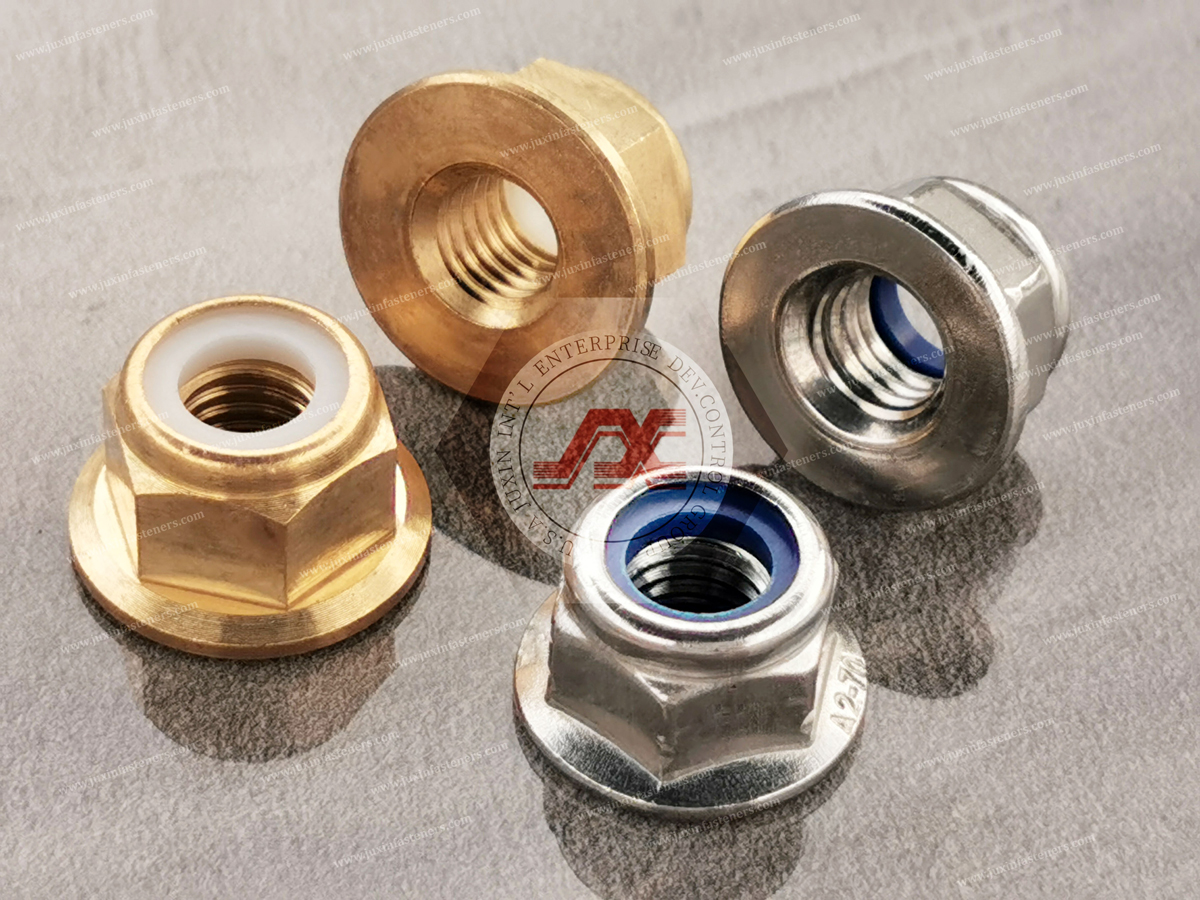
Why Use an Integrated Flange?
The flange provides a larger bearing surface than a comparable ordinary hex nut.
Potential benefits include:
More distributed bearing pressure.
Reduced need for a separate flat washer.
Lower assembly part count.
Convenient installation.
Coverage around suitable clearance holes.
Engineering Limitation
A flange does not automatically make a nut suitable for every oversized, slotted or irregularly shaped hole.
The mounting surface, hole geometry and bearing stress must be evaluated.
Non-Serrated Flange Design
A smooth flange may be useful where surface marking from serrations is undesirable.
However, the actual surface condition and clamp load determine whether marking occurs.
Stainless Steel Nylon-Insert Flange Locknuts vs. Standard Stainless Steel Nuts
| Feature | Nylon-Insert Flange Locknut | Standard Stainless Steel Hex Nut |
|---|---|---|
| Nylon Locking Insert | Yes | No |
| Prevailing-Torque Locking | Yes | Not Inherently |
| Integral Flange | Yes | Not Normally |
| Corrosion Resistance | Depends on Stainless Grade | Depends on Stainless Grade |
| Temperature Limit | Influenced by Nylon Insert | Depends on Metal and Joint Design |
| Reuse | Requires Locking Performance Evaluation | Depends on Thread and Joint Condition |
| Installation Torque | Includes Prevailing Torque | No Nylon-Insert Prevailing Torque |
Important Distinction
The nylon insert does not make the entire nut electrically insulating.
The stainless steel body remains electrically conductive.
Does the Nylon Insert Prevent Galvanic Corrosion?
Not automatically.
The nylon insert is located in the locking region of the nut and does not generally isolate the metallic flange from the mounting surface.
Galvanic corrosion risk depends on:
Mating materials.
Electrical contact.
Moisture.
Electrolyte exposure.
Relative material areas.
Protective treatments.
Electrical isolation must be designed and validated separately.
Temperature Limitations of Nylon-Insert Locknuts
The temperature capability of a nylon-insert locknut depends on the insert material and functional requirements.
ISO 2320 identifies approximately −50°C to +120°C for conforming non-metallic-insert steel locknuts within its scope.
This is a useful engineering reference, but it is not a verified service-temperature guarantee for every stainless steel nylon-insert locknut.
High-Temperature Risks
Elevated temperatures may affect:
Nylon stiffness.
Elastic recovery.
Insert retention.
Prevailing torque.
Repeated-use performance.
Low-Temperature Risks
Low temperatures may change insert behavior and affect locking performance.
Engineering Recommendation
For applications near temperature limits, request the insert material specification and appropriate functional testing.
Stainless Steel Thread Galling
Austenitic stainless steel fasteners can experience thread galling.
Galling is a form of adhesive wear that can occur when mating metallic threads slide under load.
Potential contributing factors include:
High thread friction.
Excessive installation speed.
Damaged threads.
Poor surface finish.
Inappropriate lubrication.
Similar stainless steel mating materials.
Recommended Engineering Controls
Verify thread fit.
Use an appropriate mating bolt.
Review installation speed.
Consider approved lubrication where permitted.
Validate installation torque.
Inspect for thread damage.
Important
The nylon insert does not eliminate galling risk in the metallic threaded region.
Corrosion Resistance of Stainless Steel Flange Locknuts
Stainless steel provides corrosion resistance through its passive surface film.
Actual performance depends on:
Stainless steel grade.
Chloride exposure.
Temperature.
Surface condition.
Chemical environment.
Crevice geometry.
Mating materials.
Cleaning procedures.
304 vs. 316
316 stainless steel may provide improved resistance to certain chloride-containing environments compared with 304.
However, neither material is universally resistant to all corrosive conditions.
Magnetic Properties
Austenitic stainless steel is generally non-ferromagnetic in the annealed condition.
Cold working may cause some magnetic response.
Therefore, 18-8 or 304 stainless steel fasteners may be mildly magnetic.
Engineering Limitation
Where magnetic properties are critical, the finished fastener must be evaluated.
Are Stainless Steel Nylon-Insert Flange Locknuts Reusable?
Some nylon-insert locknuts can be reused under controlled conditions.
However, the prevailing-torque capability may decrease with repeated installation and removal.
Reuse Evaluation
Remaining prevailing-off torque.
Nylon insert condition.
Thread damage.
Temperature history.
Corrosion.
Application safety requirements.
Customer maintenance instructions.
Engineering Recommendation
For safety-critical or difficult-to-access joints, replacement after removal may be appropriate.
Do not assume unlimited reuse.
Vibration Resistance and Joint Reliability
Nylon-insert flange locknuts can provide useful resistance to unintentional nut rotation.
However, joint reliability depends on:
Initial clamp load.
Bolt strength.
Joint stiffness.
Surface settlement.
Transverse loading.
Temperature.
Thread friction.
Prevailing torque.
Installation procedure.
Important Limitation
A prevailing-torque locking feature does not guarantee resistance to every vibration condition.
Critical joints may require additional testing.
Industrial Applications and Engineering Solutions
1. Automotive Manufacturing
Potential applications:
Production fixtures.
Inspection equipment.
Mechanical brackets.
Non-critical equipment assemblies.
Automotive manufacturing machinery.
Engineering Value
Stainless steel nylon-insert flange locknuts may provide corrosion resistance and rotational locking performance in suitable automotive manufacturing applications.
Safety-critical vehicle joints require specific qualification.
2. Electric Vehicle Manufacturing
Potential applications:
EV production equipment.
Mechanical support brackets.
Assembly tooling.
Auxiliary manufacturing machinery.
Engineering Considerations
Evaluate vibration, temperature, corrosion and mechanical loading.
3. EV Battery Pack Manufacturing
Potential applications:
Battery assembly fixtures.
Inspection tooling.
Auxiliary production equipment.
Selected non-electrical mechanical attachments.
Engineering Limitation
These locknuts are not automatically approved for high-voltage electrical connections, battery cell retention or crash-critical structures.
4. Rail Transit Equipment
Potential applications:
Maintenance equipment.
Mechanical housings.
Auxiliary brackets.
Selected non-critical equipment assemblies.
Engineering Limitation
Rail applications may require specific vibration, fire, material and safety qualification.
5. Aerospace Ground Support Equipment
Potential applications:
Ground support machinery.
Maintenance fixtures.
Inspection equipment.
Workshop accessories.
Engineering Limitation
Commercial stainless steel locknuts are not automatically approved for flight-critical aerospace assemblies.
6. Electrical Cabinets
Potential applications:
Mechanical mounting brackets.
Cabinet accessories.
Equipment supports.
Enclosure assemblies.
Engineering Value
The integrated flange may reduce separate washer handling in suitable assemblies.
Important
The stainless steel body remains electrically conductive.
7. HVAC Equipment
Potential applications:
Fan equipment brackets.
Mechanical supports.
Motor mounting accessories.
Equipment housings.
Engineering Considerations
Evaluate vibration, humidity, corrosion exposure and operating temperature.
8. Medical Equipment
Potential applications:
Non-patient-contact equipment housings.
Laboratory equipment.
Mechanical support brackets.
External accessories.
Engineering Limitation
Cleaning compatibility, contamination requirements and applicable regulations must be evaluated.
These locknuts are not automatically suitable for MRI or patient-contact applications.
9. Construction Equipment
Potential applications:
Machinery brackets.
Equipment housings.
Non-critical accessory connections.
Industrial maintenance equipment.
Structural applications require appropriate engineering validation.
10. Industrial Machinery
Potential applications:
Motor mounting accessories.
Mechanical brackets.
Machine housings.
Auxiliary equipment assemblies.
Engineering Value
The combination of prevailing torque and flange support can simplify suitable bolted assemblies.
11. Robotics and Automation
Potential applications:
Robot peripheral equipment.
Automation fixtures.
Sensor support brackets.
Equipment housings.
Auxiliary mounting assemblies.
Engineering Considerations
Evaluate vibration, dynamic loading, installation torque and maintenance requirements.
12. Sheet Metal Fabrication
Potential applications:
Equipment enclosures.
Metal housings.
Mechanical brackets.
Cabinet accessories.
Support assemblies.
Engineering Considerations
The flange provides a wider bearing surface but does not automatically prevent deformation of thin sheet metal.
Verify material thickness, hole geometry and bearing stress.
13. Telecommunications Equipment
Potential applications include mechanical mounting accessories, cabinet brackets and equipment supports.
14. AI Data Center Infrastructure
Potential applications include mechanical equipment supports, cabinet assemblies and maintenance equipment.
Electrical bonding and grounding requirements must be assessed separately.
15. Semiconductor Equipment
Potential applications include peripheral machinery, fixtures and selected equipment housings.
Cleanroom contamination and material compatibility requirements must be evaluated.
16. Energy Storage Systems
Potential applications include auxiliary mechanical equipment, manufacturing fixtures and non-critical support assemblies.
High-voltage electrical connections require separate engineering qualification.
17. Power Distribution Equipment
Potential applications include mechanical cabinet assemblies, equipment supports and mounting accessories.
18. Industrial Manufacturing Equipment
Potential applications include machinery housings, mechanical brackets, motor accessories and production equipment.
Production Manager Considerations
For production managers, stainless steel nylon-insert flange locknuts can combine corrosion resistance, locking performance and bearing support in one component.
Important Evaluation Factors
Assembly cycle time.
Reduced washer handling.
Prevailing-torque consistency.
Automated installation compatibility.
Installation speed.
Stainless steel galling risk.
Thread engagement.
Nylon insert retention.
Surface cleanliness.
Quality inspection.
Production lead time.
Repeat-order consistency.
Quality Control and Inspection
Material Verification
Stainless steel grade.
Chemical composition where required.
Material certification.
Mechanical property class.
Lot traceability.
Dimensional Inspection
Thread diameter.
Thread pitch.
Across-flats dimension.
Nut height.
Flange diameter.
Flange thickness.
Bearing surface geometry.
Insert position.
Thread Inspection
Thread tolerance.
Functional thread fit.
Mating bolt compatibility.
Thread surface condition.
Prevailing-Torque Evaluation
Prevailing-on torque.
Prevailing-off torque.
Reuse-cycle performance where specified.
Temperature influence where required.
Customer-specific acceptance criteria.
Mechanical Verification
Proof load where applicable.
Thread strength.
Flange integrity.
Relevant mechanical properties.
Surface Inspection
Burrs.
Cracks.
Surface defects.
Corrosion.
Insert contamination.
Insert damage.
Appearance consistency.
Common Engineering Problems and Solutions
Problem 1: Insufficient Locking Torque
Possible causes include insert damage, incorrect geometry or repeated reuse.
Solution: Verify prevailing torque against the agreed requirements.
Problem 2: Excessive Installation Torque
Possible causes include thread galling, incorrect thread fit or excessive insert interference.
Solution: Inspect mating threads and review the installation process.
Problem 3: Nylon Insert Damage
Possible causes include excessive heat or unsuitable assembly conditions.
Solution: Review insert material and service temperature.
Problem 4: Loss of Locking Performance After Reuse
Cause: Reduced insert interference or material deterioration.
Solution: Apply validated reuse or replacement criteria.
Problem 5: Stainless Steel Thread Galling
Possible causes include high friction, damaged threads or excessive installation speed.
Solution: Review thread fit, mating material and approved assembly procedures.
Problem 6: Flange Surface Damage
Possible causes include unsuitable bearing conditions or excessive loading.
Solution: Review flange geometry and joint material.
Problem 7: Corrosion
Possible cause: Unsuitable stainless steel grade or aggressive exposure.
Solution: Verify material selection and environmental compatibility.
Problem 8: Incorrect Metric or Inch Thread
Cause: Incomplete thread identification.
Solution: Verify the full thread designation.
Problem 9: Incorrect Stainless Steel Property Class
Cause: Assuming that 304, 316, A2-70 and A4-80 are interchangeable designations.
Solution: Specify material grade and mechanical property class separately.
Problem 10: Vibration-Related Joint Failure
Possible causes include insufficient clamp load, joint movement or unsuitable fastening design.
Solution: Validate the complete joint and installation procedure.
OEM Procurement and Engineering Checklist
For accurate quotation, please specify:
Product name or part number.
2D engineering drawing.
3D CAD model, if available.
DIN 6926, ISO 7043 or customer specification.
Metric or inch thread.
Nominal diameter.
Thread pitch or threads per inch.
Thread tolerance.
Stainless steel material grade.
Required mechanical property class.
Nylon insert material.
Flange diameter.
Nut height.
Across-flats dimension.
Bearing surface requirements.
Surface finish.
Corrosion environment.
Prevailing-torque requirements.
Operating temperature range.
Reuse requirements.
Inspection and certification requirements.
Initial purchasing quantity.
Estimated annual purchasing volume.
Packaging requirements.
Delivery schedule.
Custom Stainless Steel Nylon-Insert Flange Locknuts for OEM Manufacturing
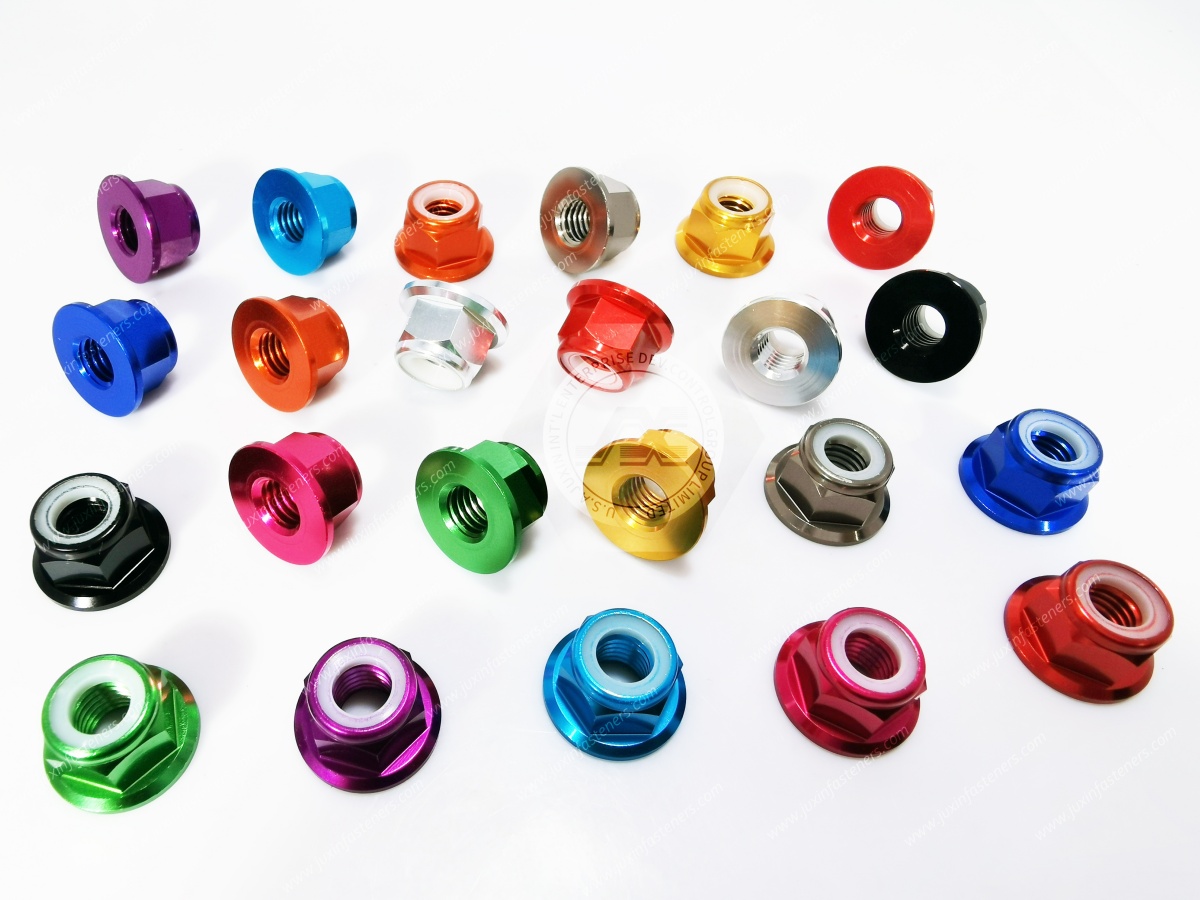
JUXIN FASTENERS can review customer-specific requirements for:
DIN 6926-style designs.
ISO 7043 metric coarse-thread dimensions.
ISO 12125 metric fine-thread dimensions.
UNC and UNF inch threads.
Custom flange dimensions.
Special nut heights.
304 stainless steel.
316 stainless steel.
316L stainless steel.
Customer-specified mechanical properties.
Alternative insert materials.
Natural stainless steel finishes.
Special surface treatments.
Drawing-specific tolerances.
OEM packaging.
Production-volume supply.
All custom configurations are subject to engineering and manufacturing feasibility review.
Frequently Asked Questions
What are stainless steel DIN 6926 nuts called in the United States?
Stainless Steel Nylon-Insert Flange Locknuts and Stainless Steel Nylon-Insert Flange Nuts are common American product names.
What is DIN 6926?
DIN 6926 is a recognized dimensional reference for hexagonal flange locknuts with non-metallic locking inserts.
What is the difference between DIN 6926 and ISO 7043?
Both are relevant references for nylon-insert flange locknut geometry, but the applicable edition, dimensions, materials and performance requirements must be verified.
What is the difference between A2 and A4 stainless steel?
A2 and A4 identify different stainless steel grade families. A4 materials generally provide improved resistance to certain chloride-containing environments.
Is 304 stainless steel automatically A2-70?
No. The required mechanical property class must be verified.
Is 316 stainless steel automatically A4-80?
No. A4-80 requires the applicable mechanical properties to be demonstrated.
What metric sizes does JUXIN FASTENERS list?
M5, M6, M8, M10, M12, M14, M16 and M20.
Can JUXIN FASTENERS supply inch-thread versions?
Customer-specific UNC and UNF designs can be reviewed for manufacturing feasibility.
Are metric and inch threads interchangeable?
No.
Do nylon-insert flange locknuts require washers?
An integrated flange may eliminate a separate flat washer where the joint design permits.
Are stainless steel nylon-insert flange locknuts reusable?
Reuse may be possible, but the remaining prevailing-torque performance must satisfy the applicable requirements.
Can nylon-insert flange locknuts be used above 120°C?
Conventional nylon-insert designs should not be assumed suitable above their validated temperature limits. Special materials and testing may be required.
Do nylon inserts electrically insulate the joint?
No. The metallic nut body remains electrically conductive.
Do nylon inserts eliminate stainless steel thread galling?
No. Galling may still occur in the metallic threaded region.
Are stainless steel nylon-insert flange locknuts suitable for vibration?
They provide prevailing-torque resistance to rotation, but the complete joint must be validated for the actual vibration environment.
Are they suitable for automotive and EV equipment?
They may be suitable for selected mechanical assemblies and production equipment, subject to the relevant engineering and qualification requirements.
Related Industrial Fastening Solutions
JUXIN FASTENERS also supplies:
Carbon Steel Nylon-Insert Flange Locknuts.
Stainless Steel Nylon-Insert Hex Locknuts.
All-Metal Prevailing-Torque Locknuts.
Serrated Flange Nuts.
Non-Serrated Hex Flange Nuts.
Distorted-Thread Flange Locknuts.
Stainless Steel Hex Nuts.
Weld Nuts and Weld Studs.
Self-Clinching Fasteners.
Blind Rivet Nuts.
Threaded Inserts for Plastics.
Custom CNC Machining Parts.
Internal links should be added only to verified live product pages.
Request a Stainless Steel Nylon-Insert Flange Locknut OEM RFQ
JUXIN FASTENERS supports international OEM manufacturers, Tier-1 and Tier-2 suppliers, mechanical engineers, structural engineers, design engineers, manufacturing engineers, production managers, purchasing engineers and global supply chain teams.
For accurate technical evaluation and quotation, please provide your 2D/3D drawings, stainless steel grade, required mechanical property class, metric or inch-thread specifications, flange dimensions, nylon insert requirements, prevailing-torque criteria, initial purchasing quantity and estimated annual purchasing volume.
Our technical sales team can review material selection, thread compatibility, manufacturing feasibility, inspection criteria and production-volume quotations.
JUXIN FASTENERS
Website: https://www.juxinfasteners.com/
Email: info@juxinfasteners.com
Send Your 2D/3D Drawings and OEM Purchasing Requirements for a Stainless Steel Nylon-Insert Flange Locknut RFQ.
Product Packaging
Packaging Standard
At Juxin Fasteners, we apply standardized export packaging to ensure product protection, traceability, and compliance with international logistics requirements.
1. Standard Export Packaging
Unless otherwise specified, all products will be packed according to our factory standard export packaging, which includes:
Moisture-resistant inner protection
Poly bag or small box packing as required
Reinforced export cartons
Clear labeling with part number, specification, batch number, and quantity
Palletizing for sea or air shipment when necessary
Our standard packaging is designed to ensure safe transportation, efficient warehousing, and long-distance international shipping.
2. Customized Packaging Options
We also provide customized packaging solutions according to customer requirements, including but not limited to:
Private labeling
Customized barcodes
Specific carton dimensions
Retail packaging
Special pallet configuration
Customer-specific marking and identification
So that you know, customized packaging may involve additional costs and extended lead time depending on the complexity of the requirements.
3. Compliance & Quality Assurance
All packaging processes are controlled under our ISO 9001 quality management system to ensure consistency, traceability, and product integrity throughout the supply chain.
Product Pictures


Contact Us
Tel.:
+86 020 8621 0320
+86 020 3121 6067
E-mail:
Technical Support:
Navigation
SEND INQUIREY


