Call Us
+86 136 6007 9809
Call Us
+86 136 6007 9809

Construction machinery, excavators, wheel loaders, mining equipment, agricultural tractors, forestry machines, material-handling vehicles,
and other off-highway equipment operate under mechanical and environmental conditions far more severe than those encountered by typical indoor industrial machinery.
Product Specification
Construction machinery, excavators, wheel loaders, mining equipment, agricultural tractors, forestry machines, material-handling vehicles,
and other off-highway equipment operate under mechanical and environmental conditions far more severe than those encountered by typical indoor industrial machinery.
Shock from uneven terrain, diesel-engine vibration, chassis movement, abrasive dust, mud, water, hydraulic fluids, temperature cycling, outdoor UV exposure,
and repeated maintenance can all affect small fastening and wire-management components.
Primary structural joints in heavy equipment normally depend on appropriately engineered metallic fastening systems.
Plastic fasteners perform a different but important role in secondary systems where engineers require combinations of:
wire harness retention;
cable protection;
electrical isolation;
panel attachment;
edge protection;
lightweight component mounting;
non-marring contact;
tool-free assembly;
service access.
Juxin Fasteners supplies standard and drawing-specific plastic fasteners and cable-management hardware for heavy equipment, construction machinery,
agricultural equipment, mining machinery, commercial vehicles, and industrial equipment OEMs.
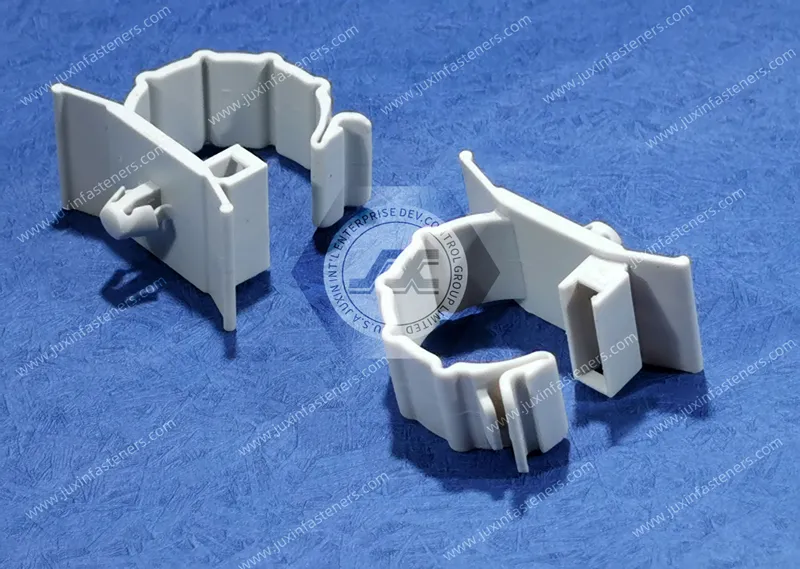
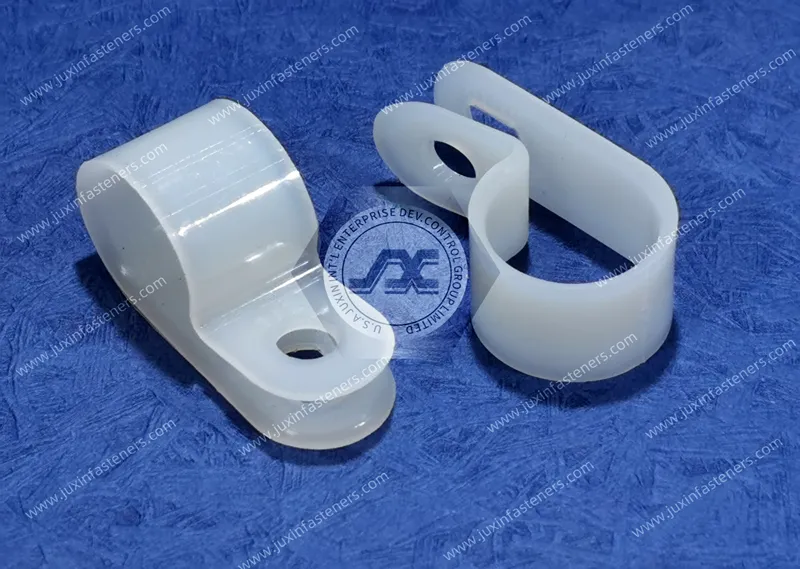
Product families include heavy-duty nylon cable clamps, P-clips, adjustable cable clamps, cable clips, cable tie mounts,
nylon snap bushings, strain relief grommets, plastic push rivets, panel fasteners, nylon machine screws, washers, spacers, standoffs, and custom molded plastic fasteners.
For severe-duty machinery, component selection should not begin with the question:
“Which plastic clip fits this cable?”
A more reliable engineering sequence is:
Application Zone → Mechanical Load → Vibration / Shock → Temperature → Chemical Exposure → Cable or Panel Interface → Material → Retention Geometry → Serviceability → Validation
Plastic hardware is most valuable where its properties solve a specific secondary-system problem rather than replace structural metal hardware.
Typical application zones include:
operator cabs;
dashboards and instrument panels;
engine compartments;
chassis wiring;
lighting harnesses;
sensors and cameras;
hydraulic monitoring systems;
control enclosures;
cooling packages;
access panels;
protective covers.
Each zone creates a different combination of mechanical, thermal, chemical, and environmental requirements.
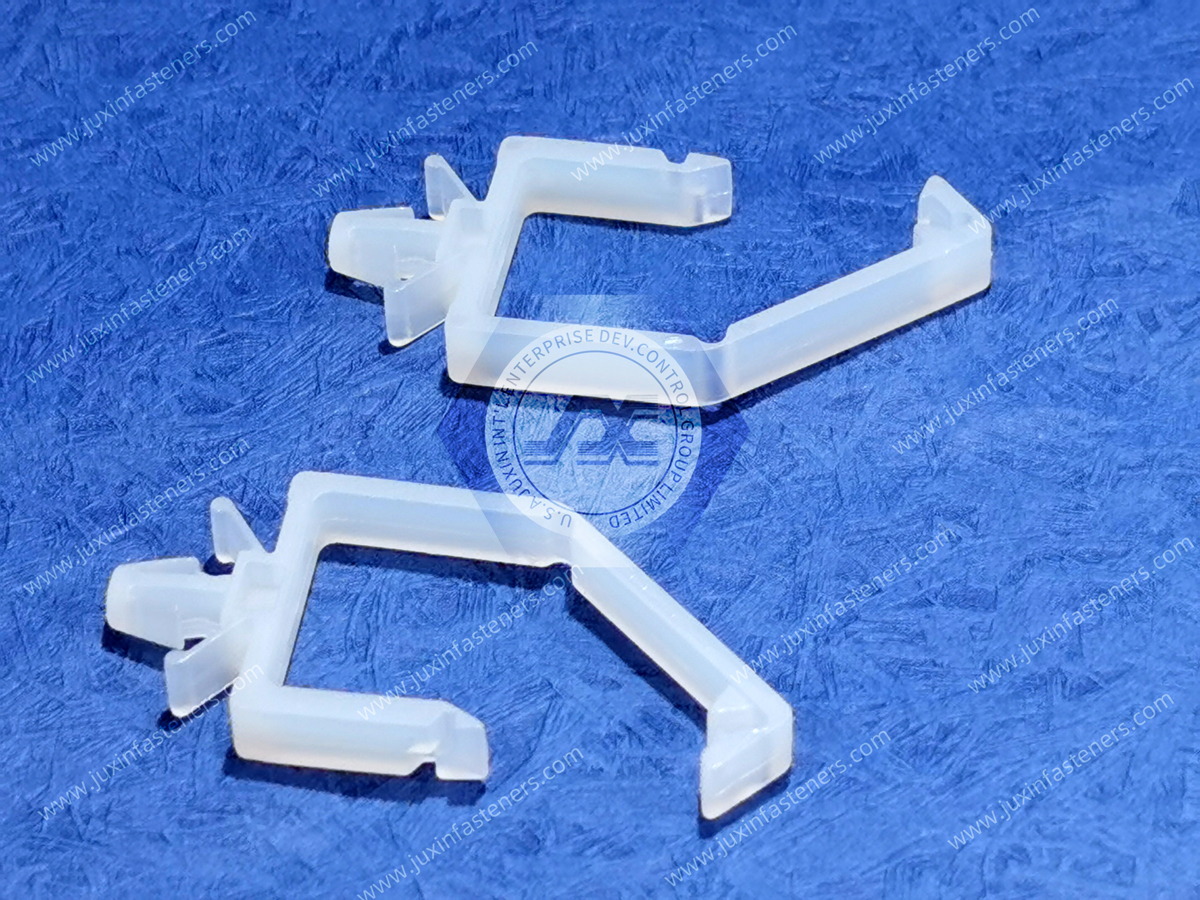
Engine compartments can expose cable-management hardware to a demanding combination of:
continuous vibration;
local heat;
oil mist;
diesel-related contaminants;
dust;
repeated thermal cycling.
Potential hardware includes:
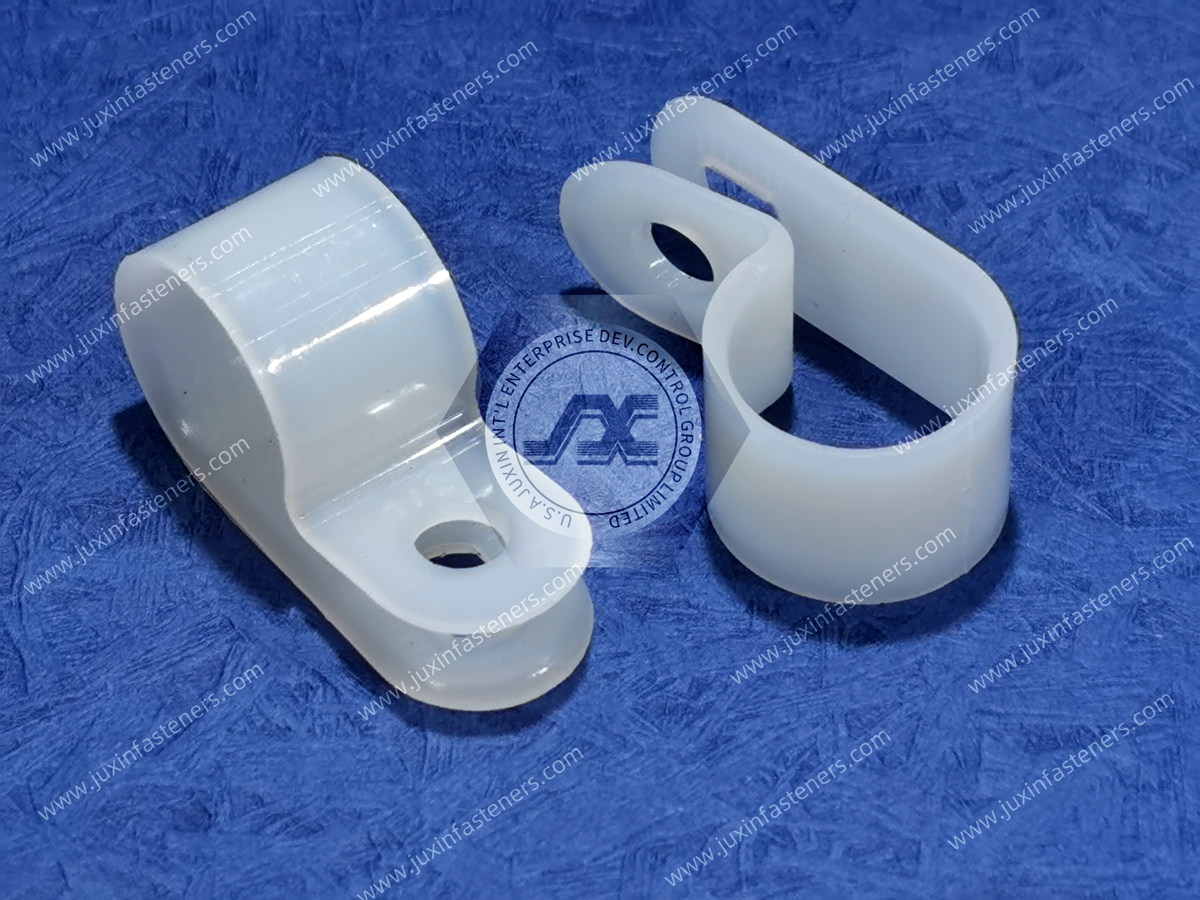
Heavy-Duty Nylon Cable Clamps & P-Clips;
adjustable cable clamps;
wire harness clips;
cable tie mounts;
snap bushings.
The most important design objective is not simply holding the wire bundle in place.
The routing system must prevent the harness from contacting:
sharp bracket edges;
moving linkages;
hot surfaces;
rotating components;
hydraulic lines where unwanted rubbing can occur.
A cable does not need to become completely detached for a failure to develop.
Even small repetitive movement between a harness and a nearby bracket can gradually damage insulation.
The engineering chain can be:
Small Relative Movement → Repeated Rubbing → Jacket Wear → Conductor Exposure → Electrical Failure
Therefore, cable-management hardware should be selected according to both retention force and movement control.
Wiring routed along a machine chassis may experience:
vibration;
frame flex;
stone impact;
water;
mud;
debris;
temperature changes.
A rigid routing strategy that ignores chassis movement can transfer unnecessary stress into the harness or its connectors.
The correct clamp arrangement may need to control the cable without completely preventing required movement.
This creates an important design distinction:
Cable Retention ≠ Cable Immobilization
In some locations, a harness needs positive retention.
In others, the system needs controlled movement to accommodate:
chassis flex;
thermal expansion;
assembly tolerances;
service movement.
The required behavior should be defined before selecting the clamp geometry.
Operator environments contain:
displays;
switches;
instrument clusters;
HVAC controls;
cameras;
communication equipment;
interior trim.
Potential plastic fastening products include:
nylon machine screws;
finishing washers;
push rivets;
removable panel fasteners;
spacers;
snap-in retainers.
Plastic components can be useful where engineers need:
electrical isolation;
lightweight retention;
non-marring contact;
clean appearance;
rapid installation;
removable service panels.
For visible surfaces, engineers may also need to consider:
head profile;
color;
flange diameter;
panel thickness;
removal method.
Modern construction and agricultural equipment increasingly uses:
proximity sensors;
cameras;
work lights;
positioning systems;
telematics;
machine-control electronics.
These systems create additional wiring routes around:
booms;
cabs;
frames;
guards;
lighting structures.
Cable clips and clamps should prevent excessive movement without crushing cable jackets or placing excessive load on connectors.
For moving structures, engineers should also consider the difference between:
Static Harness Retention
and
Dynamic Harness Guidance
A clip suitable for a stationary chassis harness may not be appropriate near an articulated or repeatedly moving assembly.
Electrical cables frequently pass through punched, drilled, or laser-cut holes in:
cab structures;
brackets;
control boxes;
guards;
sheet-metal panels.
Direct contact between cable insulation and an unfinished metal edge creates a potential chafing point.
Nylon snap bushings and strain relief grommets can provide a protective interface between the cable and the metal panel.
Important dimensions include:
mounting-hole diameter;
panel thickness;
internal bore diameter;
cable OD;
flange diameter;
retention geometry.
A replacement bushing should therefore be cross-referenced using the complete panel interface rather than outside diameter alone.
Radiator assemblies, fan shrouds, airflow guides, and protective covers may experience:
vibration;
thermal expansion;
fan-induced airflow;
maintenance removal.
Potential hardware includes:
plastic push rivets;
panel fasteners;
nylon screws;
washers;
custom molded retainers.
The required component depends on whether the joint is intended for:
permanent retention;
occasional service;
frequent removal.
Using a single-use push fastener in a frequently serviced location can increase replacement frequency and maintenance cost.
There is no universal “heavy-equipment nylon.”
The correct resin depends on the actual combination of:
Temperature + Impact + Vibration + Chemical Exposure + UV + Load + Service Life
PA66 is widely used for industrial plastic fasteners and cable-management components because it can provide a useful balance of:
strength;
toughness;
wear resistance;
fatigue resistance;
electrical insulation;
moldability.
Potential applications include:
cable clamps;
clips;
bushings;
push rivets;
washers;
spacers;
machine screws.
However, standard PA66 should not automatically be assumed suitable for every off-highway location.
Where low-temperature impact or severe mechanical shock is important, an impact-modified polyamide grade may be considered.
This can be particularly relevant for components with:
snap arms;
locking fingers;
flexible tabs;
push-in retention features.
Material qualification should still be based on the actual resin grade and application conditions.
Hardware located near:
engines;
exhaust-adjacent zones;
hydraulic systems;
cooling packages;
electrical power equipment
may experience higher local temperatures than the general machine environment.
Heat-stabilized grades may therefore be appropriate for selected applications.
The design temperature should be based on local component temperature, not simply the published ambient operating temperature of the machine.
Exterior clips, cable retainers, and panel hardware may remain exposed to sunlight for long periods.
For these applications, UV resistance should be specified where necessary rather than assuming that every black nylon component automatically provides adequate long-term outdoor performance.
POM may be considered for selected components requiring:
low friction;
dimensional stability;
low moisture absorption;
repeated mechanical movement.
Other engineering polymers may be evaluated where chemical, thermal, or dimensional requirements exceed the capability of standard nylon.
Material availability and suitability should be confirmed against the actual project specification.
Heavy equipment often exposes one small component to several stress mechanisms simultaneously.
For example, an engine-bay cable clamp may experience:
mechanical vibration;
elevated temperature;
oil contamination;
moisture;
sustained clamp stress.
Testing only one variable may therefore provide an incomplete picture.
A useful qualification principle is:
Real Risk = Combined Environment, Not Individual Property
A polymer with adequate room-temperature tensile strength may still perform poorly when continuously loaded at elevated temperature after chemical exposure.
Shock and vibration are often grouped together, but they create different failure mechanisms.
A short-duration, high-energy event can cause:
snap fracture;
barb failure;
clip disengagement;
cable displacement.
Repeated lower-amplitude loading can cause:
fatigue;
fretting;
progressive wear;
mounting-hole movement;
harness chafing.
A component that survives a single high-impact event may still fail after prolonged vibration.
Therefore:
Impact Strength ≠ Vibration Fatigue Resistance
Both should be considered when the application requires them.
Construction, mining, forestry, and agricultural equipment may operate in cold climates.
As temperature falls, some polymers become less flexible.
This matters particularly for:
push rivets;
snap clips;
P-clips;
bushings;
locking tabs.
A component that installs easily at room temperature may require greater insertion force or become more vulnerable to fracture at low temperature.
For cold-environment projects, engineers should define:
minimum assembly temperature;
minimum service temperature;
whether the component is installed or serviced outdoors.
At elevated temperatures, the concern may shift from brittle fracture toward:
reduced stiffness;
creep;
stress relaxation;
loss of clamp force;
dimensional change.
This produces an important engineering distinction:
Cold Risk → Impact / Snap Fracture
Heat Risk → Creep / Retention Loss
A severe-duty plastic component may therefore need to perform across both ends of the temperature range.
A cable clamp can appear secure immediately after installation but gradually lose holding force if the polymer remains highly stressed for long periods.
Creep risk generally increases with:
mechanical stress;
temperature;
time.
For cable-management hardware, designers should avoid unnecessarily compressing the bundle simply to obtain greater retention.
The target should be:
Enough Retention to Control Movement Without Excessive Continuous Polymer or Cable Stress
Two harnesses with the same outside diameter may require different clamps.
Why?
Because the cable bundle may differ in:
jacket hardness;
compressibility;
mass;
routing orientation;
vibration exposure;
connector sensitivity.
Therefore, a better selection model is:
Bundle OD + Bundle Construction + Weight + Orientation + Vibration + Required Movement
rather than:
Bundle OD Alone
This is particularly useful when cross-referencing heavy-duty wire routing clamps.
Push-in clips and snap components depend on the mounting interface.
Critical variables may include:
hole diameter;
hole shape;
panel thickness;
edge condition;
insertion direction;
backside clearance.
A clip can be dimensionally correct yet perform poorly if the mounting hole differs from the geometry for which the locking feature was designed.
For second-source qualification:
Clip Geometry + Host Hole Geometry = Retention System
Heavy equipment may expose plastic hardware to:
hydraulic oil;
lubricants;
diesel-related contaminants;
coolant;
cleaning chemicals;
road salt;
fertilizers;
agricultural chemicals;
mud and water.
Not every component sees every fluid.
Therefore, chemical resistance should be specified according to the real application zone instead of applying an unnecessarily broad chemical requirement to the entire machine.
This can improve both engineering accuracy and sourcing efficiency.
Construction and agricultural machines are frequently cleaned aggressively.
Even when the polymer itself tolerates water, high-pressure cleaning can create mechanical loading on:
exposed cable clips;
harnesses;
panel retainers.
Engineers should therefore consider:
clip orientation;
exposed edges;
harness support spacing;
possibility of direct spray impact.
Water resistance alone does not guarantee that the installed retention system is appropriate for pressure-wash exposure.
| Application Zone | Primary Risk | Potential Plastic Hardware |
|---|---|---|
| Engine-Bay Harness | Heat / Vibration / Fluids | Heavy-Duty P-Clips / Cable Clamps |
| Chassis Harness | Shock / Flex / Chafing | Cable Clips / Tie Mounts |
| Cab Electronics | Isolation / Serviceability | Nylon Screws / Panel Fasteners |
| Sensor Wiring | Movement / Connector Load | Adjustable Cable Clamps |
| Sheet-Metal Pass-Through | Edge Chafing | Snap Bushings / Grommets |
| Lighting Harness | Outdoor Exposure / Vibration | Cable Clips / Clamps |
| Cooling Package | Heat / Vibration | Push Rivets / Panel Retainers |
| Interior Trim | Appearance / Removal | Finishing Washers / Push Fasteners |
| Custom Mounting Point | Non-Standard Geometry | Custom Molded Plastic Fasteners |
This matrix is an initial selection guide.
Final qualification should consider actual geometry, temperature, vibration, mechanical loading, chemical exposure, environmental conditions, and service requirements.
Possible causes:
low-temperature installation;
excessive insertion force;
incompatible mounting hole;
unsuitable material condition.
Possible causes:
oversized loop;
incorrect bundle size;
insufficient retention;
vibration-induced movement.
Possible causes:
relative movement;
sharp edge;
incorrect clamp geometry;
insufficient support spacing.
Possible causes:
oversized panel hole;
incorrect panel thickness;
locking feature mismatch;
repeated removal of a non-serviceable fastener.
Possible causes:
panel too thick;
hole too small;
incorrect cutout geometry;
insufficient backside clearance.
Possible causes:
local temperature higher than design assumption;
sustained mechanical stress;
creep;
inappropriate resin grade.
Possible causes:
UV exposure;
thermal aging;
unsuitable material grade;
environmental aging.
Understanding the failure mechanism makes second-source qualification more reliable than comparing appearance alone.
OEMs and Tier suppliers may seek alternative sources because of:
supplier consolidation;
cost reduction;
regional supply strategy;
obsolete components;
long lead times;
capacity limitations;
platform redesign;
supply continuity requirements.
For plastic hardware, a replacement should not be approved simply because the two parts look alike.
Second-source review should consider:
Geometry + Material + Mounting Interface + Mechanical Function + Environment + Serviceability
Two cable clips can have almost identical external dimensions while differing in:
resin grade;
material stiffness;
snap-arm thickness;
barb geometry;
moisture condition;
molding tolerance.
These differences can affect:
insertion force;
extraction force;
fatigue behavior;
low-temperature performance;
long-term retention.
Therefore, second-source approval should verify both:
Dimensional Equivalence
and
Functional Equivalence
Provide where available:
OEM part number;
supplier part number;
2D drawing;
3D CAD model;
physical sample.
Examples:
engine bay;
chassis;
operator cab;
sensor system;
lighting system;
cooling package;
control enclosure.
Provide:
cable or bundle diameter;
mounting-hole diameter;
panel thickness;
thread size;
critical dimensions;
available installation space.
Specify where relevant:
vibration;
shock;
articulation;
cable movement;
service cycles.
Provide:
minimum operating temperature;
maximum local operating temperature;
assembly temperature where relevant.
Identify expected exposure to:
UV;
water;
mud;
dust;
hydraulic oil;
fuel-related contaminants;
coolant;
cleaning chemicals;
road salt;
agricultural chemicals.
Determine whether the component is:
permanent;
occasionally removable;
repeatedly serviceable.
Validate:
fit;
insertion;
retention;
cable clearance;
panel engagement;
removal method.
Where required, OEM validation may include:
vibration testing;
shock testing;
thermal cycling;
low-temperature evaluation;
chemical exposure;
UV weathering;
insertion and extraction force testing.
After engineering approval, procurement can define:
prototype quantity;
production quantity;
annual usage;
packaging;
inspection requirements;
documentation;
delivery schedule.
For faster technical review, provide the following information.
Application
excavator;
loader;
tractor;
mining equipment;
forestry equipment;
material-handling vehicle;
other off-highway equipment.
Application Zone
engine bay;
chassis;
cab;
lighting;
sensor system;
cooling system;
electrical enclosure.
Existing Part
OEM part number;
drawing;
CAD model;
physical sample.
Dimensions
cable OD;
bundle OD;
mounting-hole diameter;
panel thickness;
thread size;
critical dimensions.
Mechanical Conditions
vibration;
shock;
articulation;
required retention;
service cycles.
Temperature
minimum temperature;
maximum local temperature;
installation temperature where relevant.
Environment
UV;
water;
mud;
dust;
hydraulic oil;
coolant;
fuel-related exposure;
cleaning chemicals;
salt;
other project-specific fluids.
Material
PA66;
heat-stabilized nylon;
impact-modified nylon;
UV-stabilized polymer;
POM;
customer-specified material.
Procurement
sample quantity;
prototype quantity;
production quantity;
estimated annual usage;
packaging requirements;
required documentation;
target delivery schedule.
Related Juxin Fasteners product and engineering pages include:
Heavy-Duty Nylon Cable Clamps & P-Clips for robust harness retention;
Adjustable Cable Clamps for application-specific cable routing;
Nylon Cable Clips for wire and harness positioning;
Cable Tie Mounts for organized chassis wiring;
Nylon Snap Bushings & Strain Relief Grommets for sheet-metal edge protection;
Nylon Machine Screws for electrically isolated fastening;
Plastic Push Rivets and Panel Fasteners for covers and trim;
Custom Molded Plastic Fasteners for proprietary equipment interfaces.
These pages should create a clear internal conversion path:
Heavy Equipment Application → Failure Risk → Engineering Requirement → Product Family → Drawing / Sample → Qualification → RFQ
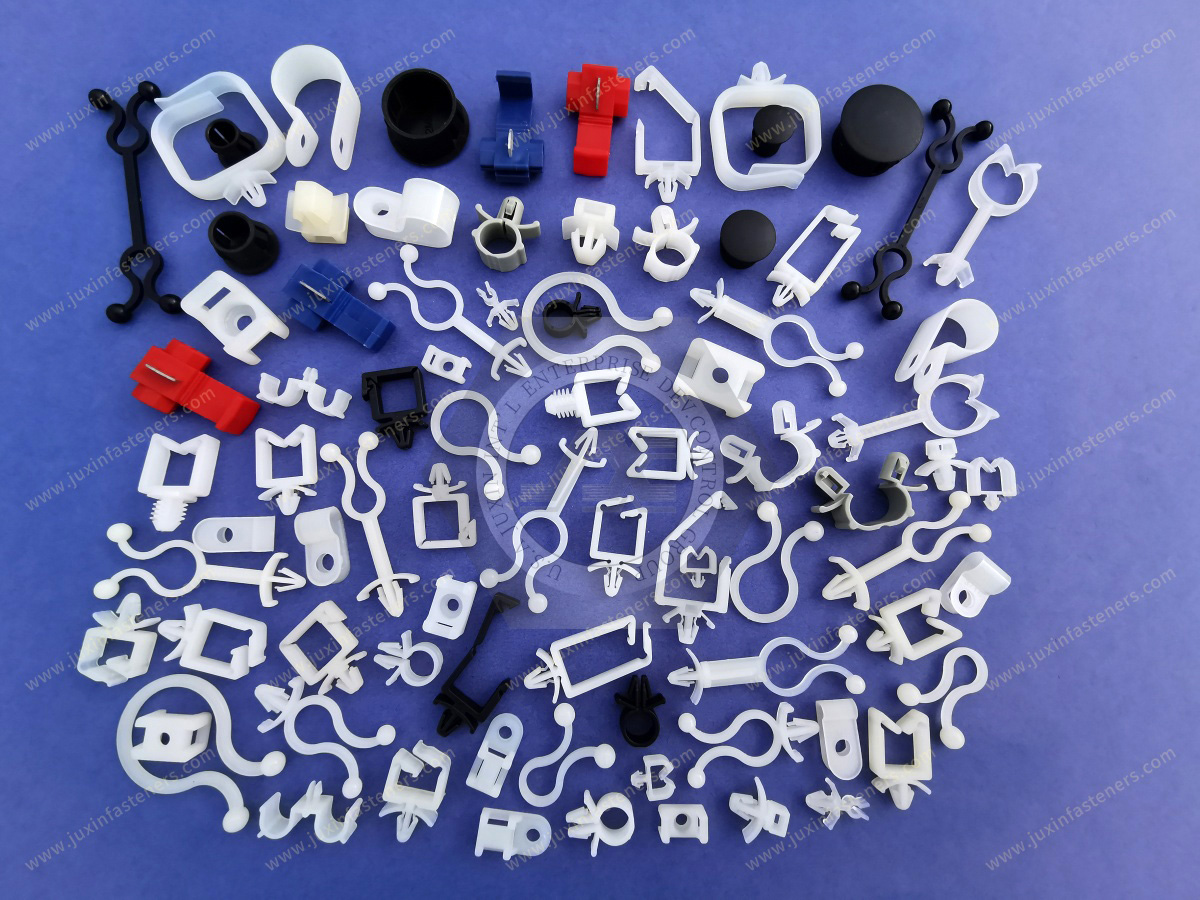
Heavy-equipment platforms may contain hundreds of small hardware items distributed across multiple assemblies.
Instead of sourcing each component independently, procurement and engineering teams can group plastic hardware into functional families.
P-clips;
cable clamps;
cable clips;
tie mounts.
snap bushings;
strain relief grommets.
push rivets;
removable panel fasteners.
nylon screws;
washers;
spacers;
standoffs.
drawing-specific clips;
proprietary retainers;
custom molded components.
This approach can support:
BOM simplification;
supplier consolidation;
common-component strategies;
reduced qualification workload;
better second-source coverage.
Standard catalog hardware does not solve every off-highway application.
Custom or drawing-specific plastic components may be required for:
proprietary mounting holes;
unusual cable bundle sizes;
constrained installation areas;
special panel thicknesses;
combined retaining functions;
legacy replacement components.
Juxin Fasteners can support drawing-based sourcing for selected:
cable clips;
clamps;
bushings;
panel fasteners;
screws;
washers;
spacers;
standoffs;
custom molded plastic components.
Project support can include:
drawing review;
CAD review;
physical sample comparison;
dimensional cross-referencing;
material discussion;
DFM review;
sample evaluation;
second-source development.
Material grades, testing, certifications, and customer-specific documentation should be confirmed according to the individual project.
Juxin Fasteners supports heavy equipment manufacturers, construction machinery OEMs, agricultural equipment manufacturers,
mining machinery suppliers, commercial vehicle manufacturers, Tier suppliers, procurement teams,
and supplier-development engineers requiring standard or drawing-specific plastic fastening and wire-management components.
Our recommended sourcing workflow is:
Existing Part / Drawing / Sample → Application Zone → Mechanical Function → Vibration & Shock → Temperature
→ Environmental Exposure → Material → Mounting Interface → Serviceability → Sample Validation → Second-Source Qualification → Production RFQ
This process can support:
new equipment development;
harness-routing optimization;
obsolete-part replacement;
second-source qualification;
supplier consolidation;
common-platform component strategies;
custom plastic hardware development.
Send us your existing part number, 2D drawing, 3D CAD model, physical sample, cable or bundle diameter,
mounting-hole dimensions, panel thickness, local operating temperature, vibration and shock conditions,
environmental exposure, material requirement, serviceability requirement, sample quantity, production quantity, and estimated annual usage for engineering review and RFQ evaluation.
Email: info@juxinfasteners.com
Website: www.juxinfasteners.com
Product Packaging
Packaging Standard
At Juxin Fasteners, we apply standardized export packaging to ensure product protection, traceability, and compliance with international logistics requirements.
1. Standard Export Packaging
Unless otherwise specified, all products will be packed according to our factory standard export packaging, which includes:
Moisture-resistant inner protection
Poly bag or small box packing as required
Reinforced export cartons
Clear labeling with part number, specification, batch number, and quantity
Palletizing for sea or air shipment when necessary
Our standard packaging is designed to ensure safe transportation, efficient warehousing, and long-distance international shipping.
2. Customized Packaging Options
We also provide customized packaging solutions according to customer requirements, including but not limited to:
Private labeling
Customized barcodes
Specific carton dimensions
Retail packaging
Special pallet configuration
Customer-specific marking and identification
So that you know, customized packaging may involve additional costs and extended lead time depending on the complexity of the requirements.
3. Compliance & Quality Assurance
All packaging processes are controlled under our ISO 9001 quality management system to ensure consistency, traceability, and product integrity throughout the supply chain.
Product Pictures
Contact Us
Tel.:
+86 020 8621 0320
+86 020 3121 6067
E-mail:
Technical Support:
Navigation
SEND INQUIREY