Call Us
+86 136 6007 9809
Call Us
+86 136 6007 9809

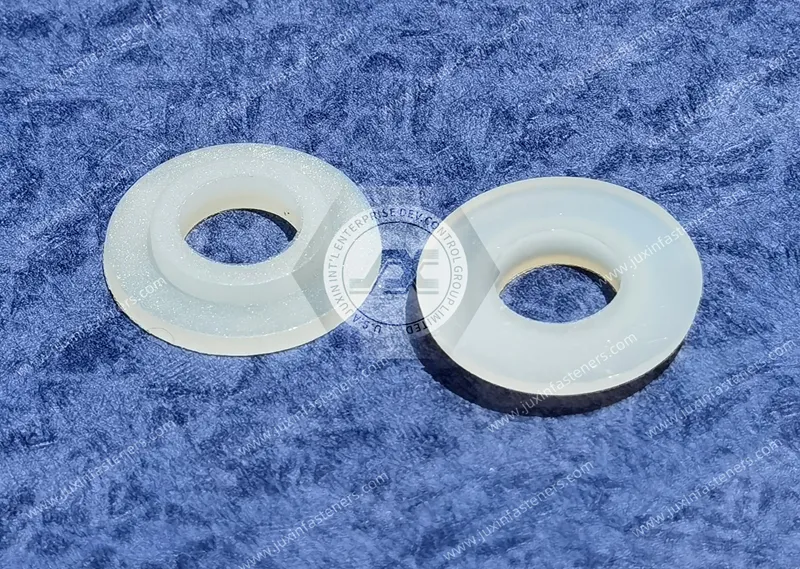
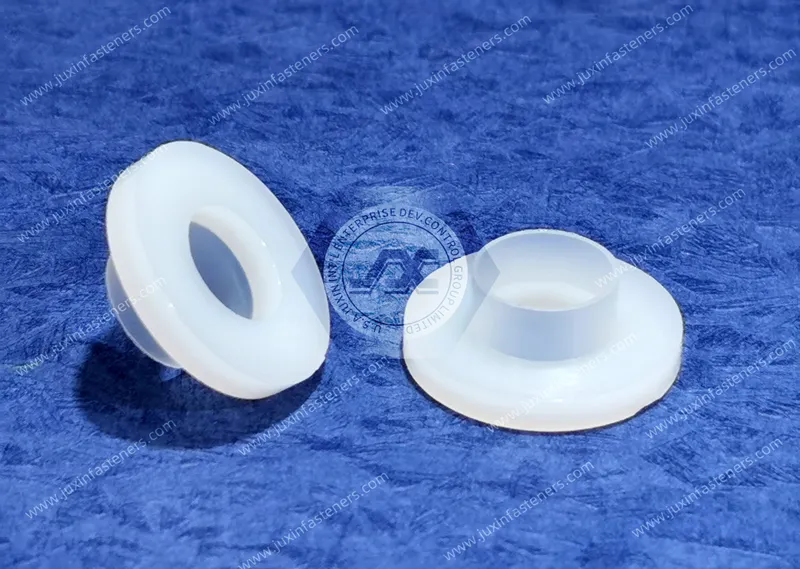
Insulating shoulder washers, nylon shoulder washers, top-hat washers, and plastic bushing washers provide a practical method of separating a metal screw, bolt, stud,
or other fastener from the conductive edge and surface of a mounting hole.
Unlike a conventional flat washer, which primarily creates a bearing interface beneath a fastener head or nut,
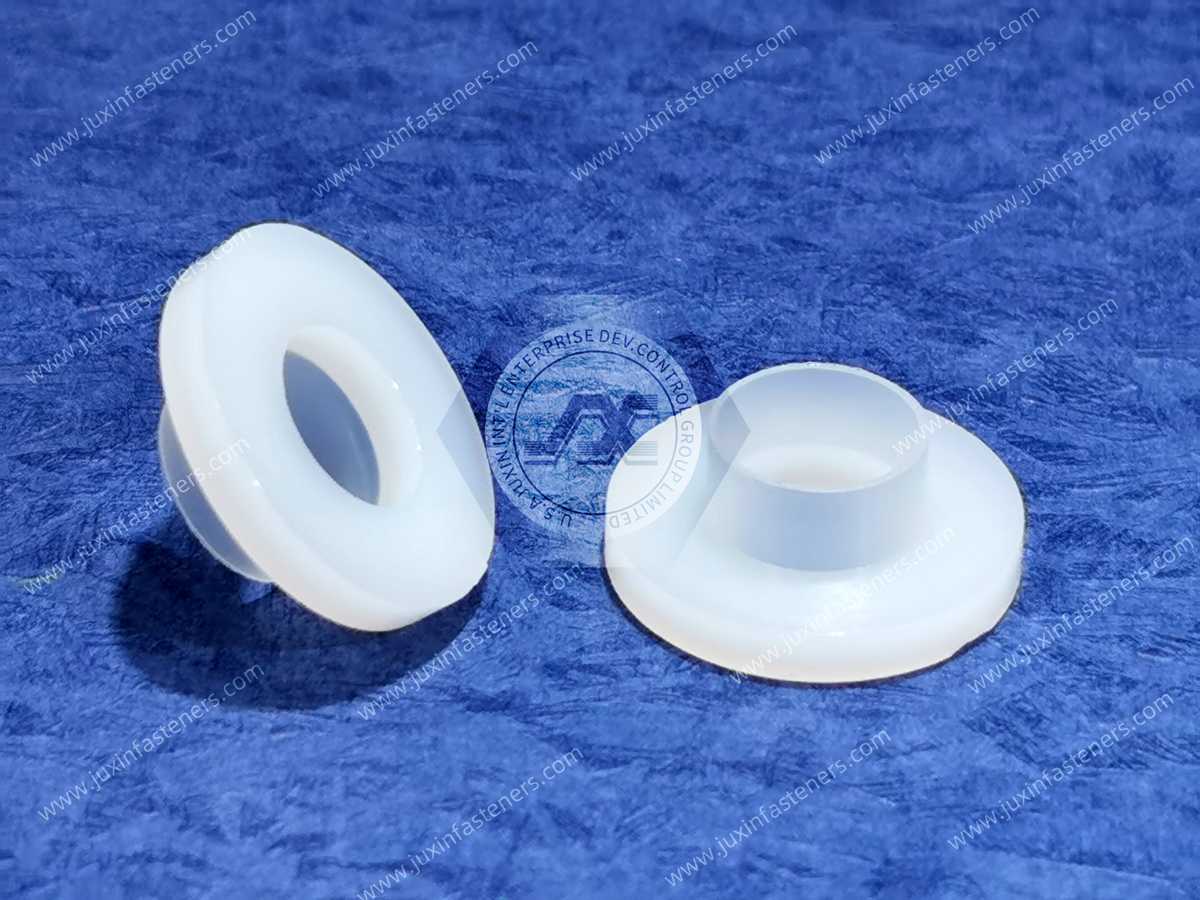
a shoulder washer incorporates a cylindrical sleeve or barrel extending from the flange.
Product Specification
Insulating shoulder washers, nylon shoulder washers, top-hat washers, and plastic bushing washers provide a practical method of separating a metal screw,
bolt, stud, or other fastener from the conductive edge and surface of a mounting hole.
Unlike a conventional flat washer, which primarily creates a bearing interface beneath a fastener head or nut,
a shoulder washer incorporates a cylindrical sleeve or barrel extending from the flange. This geometry can provide two distinct functions within one molded component:
Axial separation at the flange + Radial separation through the mounting hole
This makes insulating shoulder washers useful in electrical equipment, switchgear, power distribution systems, power electronics, industrial automation,
electronic assemblies, AI data center power infrastructure, renewable energy equipment, battery energy storage systems, medical equipment,
semiconductor equipment, telecommunications infrastructure, and other assemblies where a metallic fastener should not directly contact an adjacent conductive panel or component.
However, a plastic shoulder washer should not be treated as a universal electrical insulation solution simply because it is manufactured from a non-metallic material.
Reliable application design requires engineers to evaluate the complete interface:
Fastener + Washer ID + Barrel OD + Shoulder Length + Panel Hole + Stack Thickness + Material + Clamp Load + Temperature + Electrical Environment
Juxin Fasteners supplies standard and custom insulating shoulder washers, nylon bushing washers, flat plastic washers, nylon machine screws,
spacers, standoffs, and drawing-based custom molded plastic fasteners for industrial OEM applications.
Engineering and sourcing evaluation can begin from an existing manufacturer part number, OEM part number, 2D drawing,
3D CAD model, physical sample, screw size, panel-hole dimensions, assembly stack-up, or application requirements.
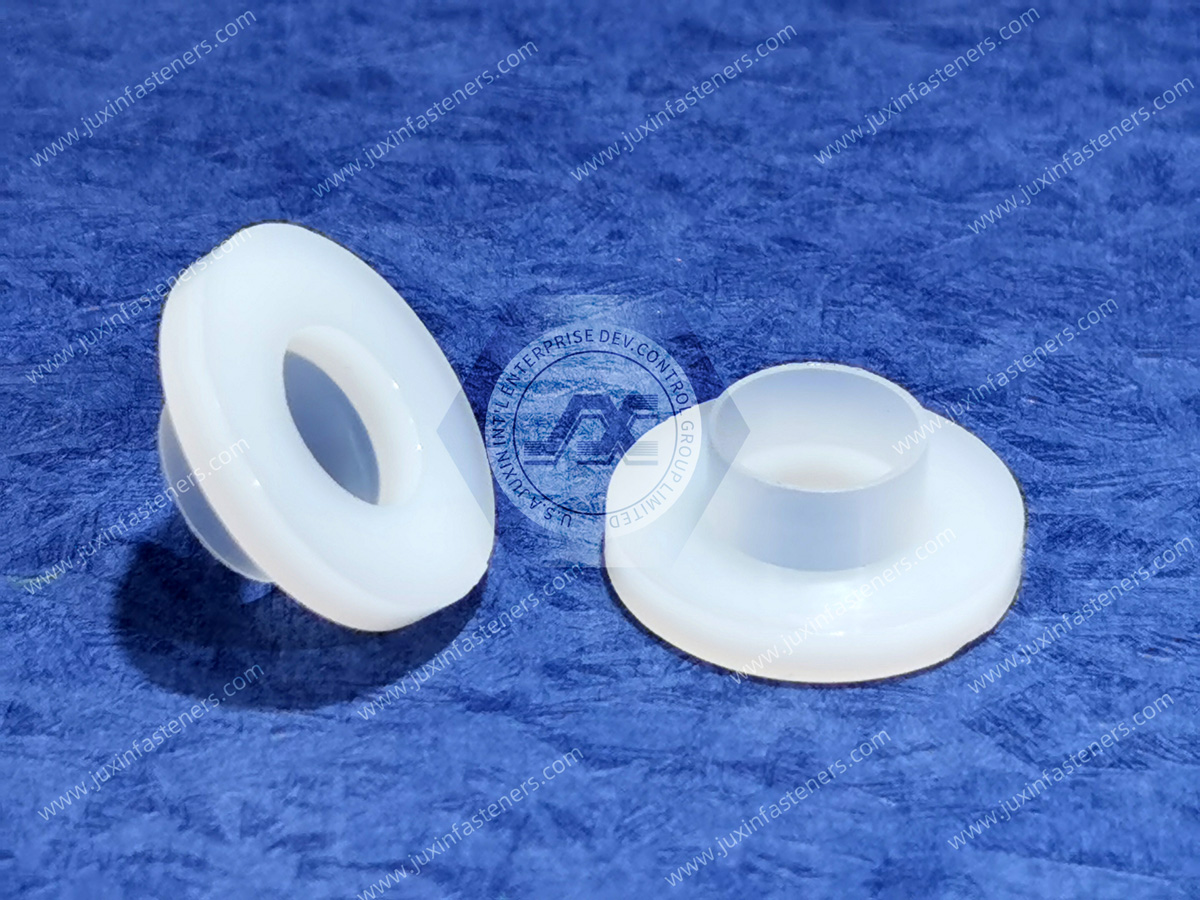
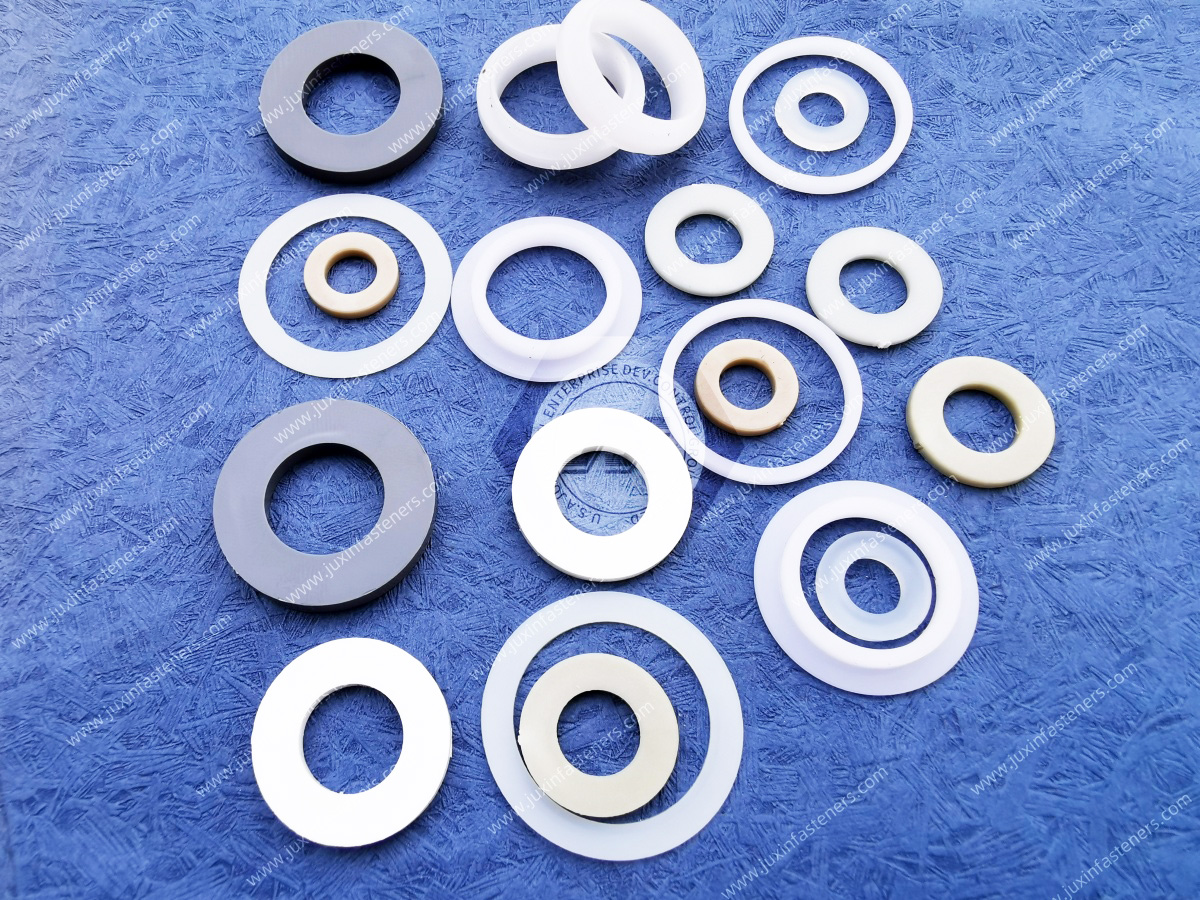
An insulating shoulder washer is a molded washer incorporating an integral cylindrical projection around its central hole.
Depending on regional terminology and application, similar components may be described as:
insulating shoulder washers;
nylon shoulder washers;
plastic shoulder washers;
top hat washers;
top-hat bushings;
insulating bushing washers;
nylon bushing washers;
screw isolation washers;
electrical insulating washers.
These names can overlap in industrial sourcing, but dimensional geometry remains more important than terminology.
A typical shoulder washer contains four critical dimensional features:
Inner Diameter (ID) — clearance around the screw, bolt, stud, or mounting feature;
Barrel Outer Diameter (OD) — interface with the panel or component mounting hole;
Shoulder / Barrel Length — depth of the cylindrical isolation section;
Flange Diameter and Thickness — bearing and separation surface around the mounting hole.
Two shoulder washers described by the same nominal screw size may therefore be functionally different.
A conventional nylon flat washer provides separation primarily beneath the fastener head or nut.
It does not normally prevent the screw shank from contacting the edge of a metal mounting hole.
A shoulder washer adds an integral barrel around the screw shank.
Conceptually:
Flat Washer:
Fastener Head → Washer → Panel
Shoulder Washer:
Fastener Head → Flange → Panel Surface
Fastener Shank → Insulating Barrel → Panel Hole
This difference is important when the design requires both surface separation and hole-edge separation.
See our Nylon Flat Washers solutions for applications requiring primarily bearing-area separation without an integral hole-lining shoulder.
In many electrical and mechanical assemblies, the fastener head is not the only potential metal-to-metal contact location.
The screw shank can move laterally within a clearance hole and contact the conductive edge of the panel.
A shoulder washer reduces this risk by inserting a polymer barrier between the fastener shank and mounting-hole wall.
This means that engineers should not evaluate only:
Washer flange diameter
They must also evaluate:
Fastener Shank → Washer ID → Barrel Wall → Panel Hole
The barrel is therefore a functional isolation feature rather than simply an extension of the washer.
Shoulder washers are particularly useful because one component can address two geometric directions.
The flange separates the underside of a screw head, bolt head, nut, or other component from the adjacent conductive surface.
The cylindrical shoulder separates the fastener shank from the wall of the mounting hole.
This distinction is useful in equipment where both contact paths matter.
However:
Axial + radial polymer separation does not automatically mean complete equipment-level electrical isolation.
The entire assembly must still satisfy the electrical requirements of the application.
Standard nylon shoulder washers commonly combine:
circular flange;
cylindrical barrel;
central clearance hole;
one-piece molded construction.
They can be used with appropriate metric or Unified fastener systems depending on the required dimensions.
Typical applications can include:
electrical equipment;
electronic enclosures;
mounting panels;
control equipment;
power electronics;
instrument assemblies;
industrial machinery.
Selection should be based on actual dimensions rather than nominal screw designation alone.
The term top hat washer generally describes the recognizable flange-and-barrel profile.
Viewed in cross section, the component resembles a small top hat.
Procurement teams may therefore encounter searches such as:
M4 top hat washer;
M5 nylon top hat washer;
plastic top hat bush;
insulating top hat washer.
However, “M4” or “M5” alone does not fully define the component.
A correct cross-reference still requires:
washer ID;
barrel OD;
barrel length;
flange OD;
flange thickness;
material.
Therefore:
Same nominal screw size ≠ same shoulder washer.
Extended-barrel designs can be used where the insulating sleeve must pass through a thicker component or deeper stack.
Potential applications include:
thicker mounting plates;
busbar supports;
heat-sink assemblies;
power electronics;
multi-layer mounting structures.
The barrel length must be coordinated with the complete stack geometry.
A longer shoulder is not automatically better because excessive projection can interfere with:
mating washers;
nuts;
threaded inserts;
adjacent components;
required clamping.
Shorter shoulders can be appropriate where only a thin conductive sheet or mounting plate requires radial separation.
The shoulder still needs sufficient engagement to maintain the intended separation after assembly.
If the shoulder is too short relative to the stack, a portion of the conductive hole edge may remain exposed to the fastener.
Some plastic insulating bushings incorporate retaining features that allow the component to remain positioned in a panel before the screw or bolt is installed.
This can improve assembly efficiency in:
vertical panels;
automated equipment;
difficult-access locations;
high-volume assembly lines.
These components should not automatically be treated as dimensionally interchangeable with conventional loose shoulder washers.
Retention geometry introduces additional requirements for:
panel thickness;
hole diameter;
insertion force;
removal method.
One important design decision is whether the assembly uses one shoulder washer or a pair.
A single shoulder washer may provide under-head and through-hole separation from one side of the panel.
The opposite side of the assembly must still be reviewed for potential conductive contact.
Some assemblies use shoulder washers from opposite sides of a panel or component.
This can create a more comprehensive polymer interface around the fastener path.
However, the two barrels must be dimensioned so they do not interfere with one another or prevent the joint from achieving the intended clamp condition.
This leads to an important design principle:
Washer selection must be based on the complete stack-up—not on screw diameter alone.
The shoulder washer inner diameter must allow the intended screw or bolt to pass through without excessive interference.
If the ID is too small:
assembly force increases;
the screw can bind;
the washer barrel can deform;
automated assembly can become unreliable.
If the ID is unnecessarily large:
lateral fastener movement increases;
centering control decreases;
available barrel wall thickness can decrease.
Therefore:
Screw nominal diameter ≠ shoulder washer ID.
The required ID is a clearance dimension determined by the fastener geometry and assembly requirement.
The barrel OD must be compatible with the panel-hole diameter.
If the barrel OD is too large:
insertion can be difficult;
the shoulder can buckle or shave;
the panel hole can damage the polymer.
If the barrel OD is too small:
radial movement increases;
centering becomes less controlled;
the fastener can shift laterally within the assembly.
The correct fit depends on whether the design requires:
free insertion;
controlled location;
light interference;
snap retention.
The insulating barrel wall is the material remaining between:
Fastener Clearance ID ↔ Barrel OD
This dimension can affect:
mechanical robustness;
molding feasibility;
resistance to assembly damage;
available separation distance.
A shoulder washer should therefore not be evaluated only by ID and flange dimensions.
For tight electrical and mechanical packaging, the barrel wall itself becomes a critical design feature.
Gemini's original concept that shoulder length should simply equal or exceed panel thickness is too general for industrial design.
The correct shoulder length depends on the assembly architecture.
Relevant dimensions may include:
panel thickness;
PCB thickness;
heat-sink thickness;
busbar thickness;
additional washers;
opposing shoulder washer geometry;
compression after tightening.
If the shoulder is too short, the fastener may contact an exposed conductive edge.
If the shoulder is too long, it may bottom against another component before the intended clamping surfaces are fully seated.
Therefore:
Shoulder length should be engineered from the complete dimensional stack.
The flange provides a bearing interface between the fastener and the mounted component.
A larger flange can distribute compressive load over a wider area.
However, flange size is limited by:
nearby components;
edge distance;
PCB traces;
busbars;
enclosure geometry;
installation access.
The flange should therefore be sized as part of the assembly rather than selected independently.
Flange thickness contributes directly to the assembled stack height.
Under tightening load, polymer flange thickness can also change due to:
immediate elastic compression;
long-term creep;
temperature;
material condition.
Applications requiring tightly controlled stack dimensions should evaluate the washer in the assembled state rather than relying only on free-state dimensions.
PA66 is widely used for molded plastic hardware because suitable grades can provide a useful combination of:
mechanical strength;
toughness;
wear resistance;
moldability;
electrical properties;
corrosion-free polymer construction.
However:
PA66 is a material family, not a complete electrical or mechanical specification.
Performance depends on the actual grade, geometry, moisture condition, temperature, additives, and application.
For critical electrical equipment, the specified resin and required material documentation should be confirmed during project review.
Polyamides absorb moisture from the environment.
This can influence:
dimensions;
stiffness;
toughness;
compressive behavior;
long-term creep.
For broad-clearance mechanical applications, small dimensional changes may not be significant.
For tightly controlled shoulder-to-hole interfaces, however, moisture-conditioned dimensions should be considered during validation.
Therefore:
Dry molded dimensions ≠ necessarily final in-service dimensions.
POM can be considered in selected applications requiring characteristics such as:
lower moisture absorption;
dimensional stability;
low friction;
repeated assembly.
However, POM should not automatically be treated as a superior replacement for PA66.
Material selection should consider:
mechanical load;
temperature;
electrical requirements;
chemical exposure;
dimensional stability;
equipment-level compliance.
See our PA66 vs POM Fasteners engineering guide for additional material-selection considerations.
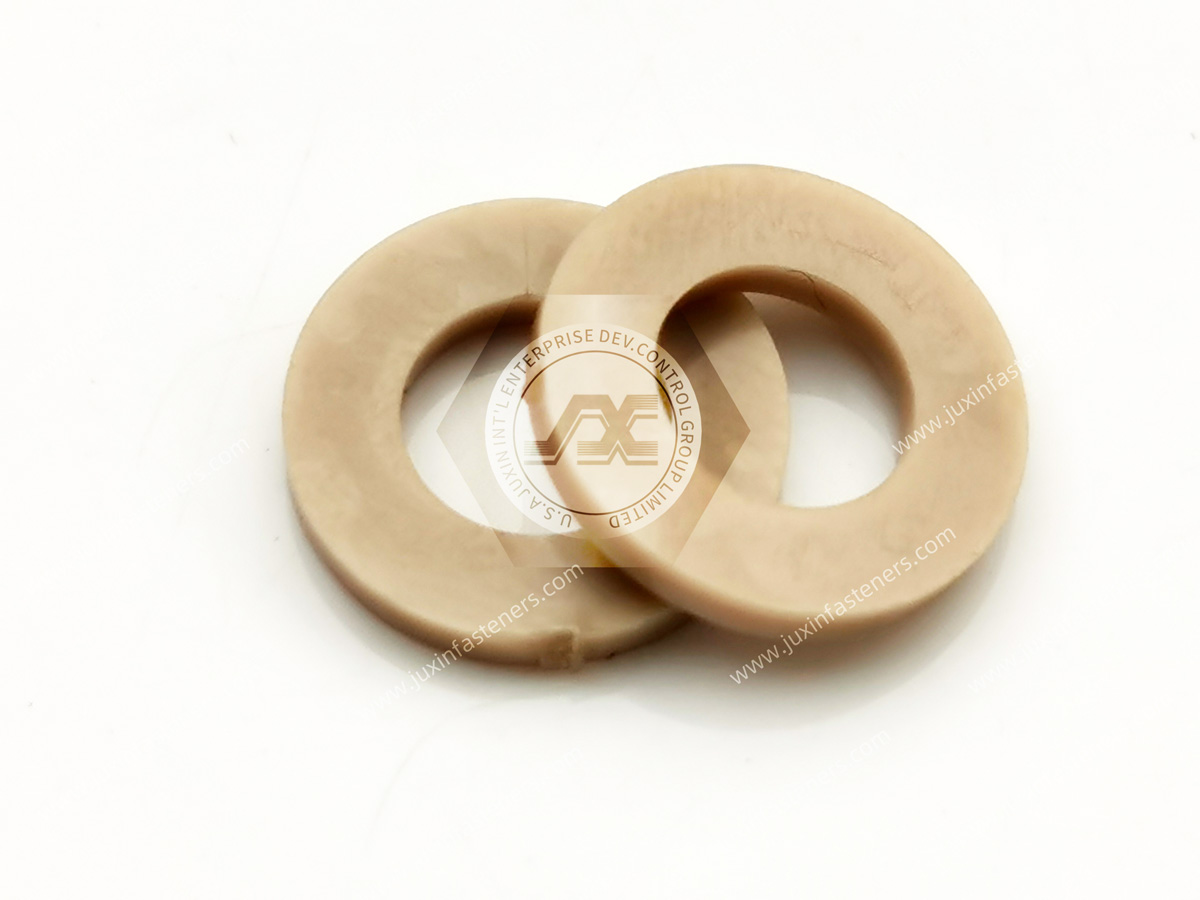
Specialty polymers may be considered where an application has specific requirements involving:
chemical exposure;
friction;
temperature;
other project-defined conditions.
However, specialty materials should not be specified solely from a generic material name.
Mechanical strength, creep, molding geometry, dimensional stability, cost, and availability must also be evaluated.
Material availability should be confirmed for the specific project.
Glass-filled or other reinforced polymer grades can provide increased stiffness in suitable applications.
However, greater stiffness does not automatically make a material better for an insulating shoulder washer.
Potential trade-offs can include:
reduced ductility;
altered surface behavior;
different creep performance;
molding considerations;
changed electrical characteristics depending on formulation.
The complete application must be reviewed before substituting reinforced materials.
A shoulder washer can create a useful non-metallic barrier around selected portions of a metallic fastener.
However, it does not by itself guarantee complete electrical isolation.
Electrical performance depends on factors including:
material dielectric properties;
polymer grade;
wall thickness;
voltage;
creepage path;
clearance distance;
contamination;
humidity;
temperature;
adjacent conductive geometry.
Therefore:
Insulating shoulder washer ≠ complete electrical insulation system.
Electrical engineers should evaluate the washer as one component within the complete insulation architecture.
These terms should not be used interchangeably.
Clearance generally refers to the shortest distance through air between conductive parts.
Creepage generally refers to the shortest path along an insulating surface between conductive parts.
A shoulder washer can influence local geometry, but required values depend on the applicable equipment standard, voltage, material group, pollution environment, and system architecture.
Therefore, a supplier should not claim that a generic shoulder washer automatically “meets creepage and clearance requirements” without knowing the equipment design.
Shoulder washers can be useful for separating dissimilar metals at selected contact interfaces.
Examples can include a steel or stainless fastener passing through an aluminum panel.
By interrupting direct metal-to-metal contact at the washer and hole interface, the polymer component can form part of a galvanic separation strategy.
However:
Shoulder washer ≠ complete galvanic corrosion prevention system.
Moisture, exposed metal interfaces, coatings, electrical continuity elsewhere, and environmental conditions must also be considered.
A shoulder washer located beneath a fastener head or nut experiences compressive stress.
Engineering thermoplastics can exhibit time-dependent deformation under sustained load.
Over time, excessive local compression can contribute to:
flange thinning;
clamp-load reduction;
stack-height change;
loss of joint stability.
Risk generally increases with:
higher compressive stress;
higher temperature;
longer service time;
unfavorable material condition.
Therefore:
Room-temperature tightening condition ≠ guaranteed long-term clamp condition.
See our Polymer Creep & Stress Relaxation in Plastic Fasteners guide for additional design considerations.
A metal screw can withstand far greater tightening torque than a plastic shoulder washer may tolerate beneath its head.
Therefore, the allowable assembly torque cannot be determined from the bolt strength alone.
The design must consider:
washer material;
flange area;
flange thickness;
panel material;
clamp load;
temperature;
long-term creep.
Excessive tightening can cause:
flange crushing;
barrel distortion;
extrusion;
cracking;
reduced electrical separation.
Polymer shoulder washers, steel screws, stainless steel fasteners, aluminum panels, copper busbars, PCBs, and heat sinks can all respond differently to temperature changes.
Thermal cycling can alter:
clamp load;
hole fit;
barrel contact;
stack height;
component position.
This is particularly relevant to:
power electronics;
switchgear;
energy storage;
renewable energy;
industrial automation;
AI data center power equipment.
Assemblies exposed to substantial thermal cycling should be validated across the intended operating range.
Shoulder washers can be used in selected electrical equipment for:
fastener separation;
panel-hole lining;
mounting hardware isolation;
component positioning.
The final insulation design must still be evaluated against the applicable equipment requirements.
Potential application areas include mounting interfaces around:
power modules;
control assemblies;
heat sinks;
busbar supports;
enclosure hardware.
Power-electronics applications can involve substantial temperature cycling, making both electrical geometry and polymer creep important.
Modern AI data centers use increasingly dense power-distribution, conversion, cooling, control, and monitoring equipment.
Plastic insulating hardware can be used in selected:
power distribution units;
UPS systems;
power conversion equipment;
control cabinets;
monitoring assemblies;
rack-level electrical equipment.
The shoulder washer should be specified according to the actual voltage, temperature, mechanical stack, and equipment architecture rather than simply as “data center grade.”
BESS equipment can require non-metallic hardware around:
control electronics;
battery-management systems;
power-distribution assemblies;
monitoring components;
enclosure interfaces.
Relevant engineering considerations include:
thermal cycling;
vibration;
electrical separation;
material aging;
long-term clamp stability.
Solar, wind, inverter, and energy-conversion equipment may use shoulder washers in selected electrical and mechanical mounting interfaces.
Outdoor or semi-outdoor equipment additionally requires consideration of:
temperature cycling;
humidity;
material aging;
environmental exposure.
Control cabinets, drives, sensors, power supplies, and automation equipment can use insulating washers and bushings to separate selected mounting hardware from conductive structures.
Mechanical vibration should also be considered where equipment is installed near machinery.
Semiconductor manufacturing equipment may require specialized material controls beyond ordinary industrial plastic hardware.
Project-specific requirements can involve:
cleanliness;
outgassing;
chemical compatibility;
particle control;
temperature.
Standard PA66 shoulder washers should not automatically be represented as suitable for cleanroom, vacuum, or chemically aggressive semiconductor processes without project-specific validation.
Selected medical equipment assemblies may use polymer shoulder washers for mechanical separation and electrical-interface design.
However, medical applications may introduce additional requirements relating to:
cleaning;
sterilization;
material documentation;
regulatory requirements.
These must be defined by the customer.
Possible causes include:
washer ID too small;
incorrect screw size;
screw-thread interference with the barrel;
washer deformation;
dimensional change.
Possible causes include:
barrel OD too large;
panel hole undersized;
burrs;
coating thickness;
incorrect part.
Possible causes include:
panel hole too large;
barrel OD too small;
incorrect cross-reference.
Possible causes include:
excessive interference;
sharp hole edges;
damaged panel hole;
brittle material condition;
misalignment.
Possible causes include:
excessive torque;
insufficient bearing area;
unsuitable material;
elevated temperature.
Possible contributors include:
polymer creep;
temperature;
moisture;
excessive initial compression.
Possible causes include:
insufficient shoulder length;
excessive ID clearance;
barrel damage;
incorrect stack-up;
washer displacement.
The washer should not automatically be assumed defective.
The complete assembly should be checked for:
alternate conductive paths;
insufficient clearance;
insufficient creepage;
contamination;
incorrect geometry;
damaged insulation;
inappropriate material.
Failure analysis should examine:
Fastener + Washer + Panel Hole + Stack-Up + Material + Clamp Load + Electrical Architecture + Environment
A sourcing request may state:
“We need a nylon shoulder washer for an M5 screw.”
That does not fully define the component.
Two M5-compatible shoulder washers can have different:
IDs;
barrel ODs;
shoulder lengths;
flange diameters;
flange thicknesses;
materials.
Therefore:
Same screw compatibility ≠ dimensional interchangeability.
This is particularly important for shoulder washers because the component interfaces with both the fastener and the panel hole.
For practical second-source qualification, procurement and engineering teams should verify at minimum:
ID + Barrel OD + Shoulder Length + Flange OD + Flange Thickness
This simple five-dimension rule prevents many incorrect cross-references.
Additional material and performance requirements can then be added according to the application.
Provide:
manufacturer;
manufacturer part number;
OEM part number;
drawing;
CAD model;
physical sample;
photographs.
Confirm:
screw or bolt size;
shank diameter;
thread system;
head or nut geometry.
Specify:
ID;
barrel OD;
shoulder length;
flange OD;
flange thickness.
Provide:
panel-hole diameter;
panel thickness;
panel material;
coating thickness where relevant;
burr condition where applicable.
Include:
PCB;
busbar;
heat sink;
mounting plate;
additional washers;
spacers;
opposing shoulder washer;
nut or threaded insert.
Where applicable, provide:
system voltage;
insulation objective;
applicable equipment requirements;
required creepage and clearance determined by the customer's design team.
Specify:
operating temperature;
humidity;
chemical exposure;
vibration;
indoor / outdoor use.
Verify:
screw clearance;
hole fit;
shoulder engagement;
flange seating;
assembly stack.
Where required, evaluate:
tightening behavior;
compression;
thermal cycling;
vibration;
electrical performance within the final assembly.
After engineering approval, proceed to:
quotation;
inspection requirements;
material documentation;
packaging;
lot traceability;
production planning.
Standard nylon shoulder washers cover many common mounting interfaces, but proprietary electrical and mechanical assemblies frequently require drawing-specific geometry.
Custom requirements can include:
special ID;
custom barrel OD;
extended shoulder length;
reduced shoulder length;
oversized flange;
thin flange;
stepped barrel;
proprietary retaining geometry;
specified polymer;
custom color.
Juxin Fasteners can support drawing-based custom plastic component sourcing through:
2D drawing review;
3D CAD review;
physical sample comparison;
dimensional analysis;
material evaluation;
DFM discussion;
tooling evaluation;
sample validation;
production sourcing.
See our Custom Molded Plastic Fasteners solutions for proprietary OEM plastic hardware.
For faster engineering review and quotation, provide as much of the following information as possible.
manufacturer;
manufacturer part number;
OEM part number;
drawing;
CAD model;
physical sample;
photographs.
screw / bolt size;
shank diameter;
metric or Unified system;
fastener material.
inner diameter;
barrel outer diameter;
shoulder length;
flange outer diameter;
flange thickness.
mounting-hole diameter;
panel thickness;
panel material;
surface coating.
total stack geometry;
PCB thickness;
busbar thickness;
heat-sink thickness;
additional washers;
spacer dimensions;
opposing shoulder washer where applicable.
required clamp condition;
tightening torque if specified;
vibration;
thermal cycling;
electrical isolation objective;
galvanic separation objective.
minimum operating temperature;
maximum operating temperature;
humidity;
chemical exposure;
indoor / outdoor use;
special cleanliness requirements.
PA66;
POM;
other specified polymer;
color;
project-specific material requirements.
sample quantity;
production quantity;
expected annual usage;
delivery schedule;
RoHS declaration;
REACH declaration;
material documentation;
lot traceability;
inspection requirements.
The more complete the stack-up information, the more accurately a replacement or custom shoulder washer can be evaluated.
Related Juxin Fasteners product and engineering solutions include:
Nylon Flat Washers for bearing-area separation without an integral shoulder;
Nylon Machine Screws for non-metallic threaded fastening;
Plastic Spacers and Standoffs for controlled component spacing;
PA66 vs POM Fasteners for engineering polymer selection;
Polymer Creep & Stress Relaxation in Plastic Fasteners for long-term clamp behavior;
Custom Molded Plastic Fasteners for proprietary OEM plastic components.
These products should not be treated as interchangeable simply because they are all manufactured from engineering polymers.
Each performs a different mechanical or electrical-interface function.
Juxin Fasteners supports electrical equipment manufacturers, power electronics OEMs, industrial automation companies,
data center equipment manufacturers, renewable energy companies, BESS manufacturers, electronics companies,
medical equipment manufacturers, semiconductor equipment manufacturers, contract manufacturers, procurement teams,
and supplier-development organizations requiring standard or custom plastic hardware.
For insulating shoulder washer projects, the sourcing pathway can begin with:
Existing Part / Drawing / Sample → Fastener Review → Five Critical Washer Dimensions → Panel Hole & Stack-Up Review
→ Material & Environment Review → Candidate Part → Physical Sample → Assembly Validation → Second-Source Qualification → Production RFQ
This process can support:
new equipment development;
electrical mounting interfaces;
panel-hole isolation;
galvanic separation;
power electronics assemblies;
existing component replacement;
supplier consolidation;
second-source qualification;
obsolete component replacement;
custom shoulder washer development.
Send us your existing supplier part number, OEM part number, 2D drawing, 3D CAD model, physical sample, fastener size,
washer dimensions, panel-hole diameter, stack-up, material requirement, operating environment, documentation requirements, and expected annual volume for technical review.
Email: info@juxinfasteners.com
Website: www.juxinfasteners.com
Product Packaging
Packaging Standard
At Juxin Fasteners, we apply standardized export packaging to ensure product protection, traceability, and compliance with international logistics requirements.
1. Standard Export Packaging
Unless otherwise specified, all products will be packed according to our factory standard export packaging, which includes:
Moisture-resistant inner protection
Poly bag or small box packing as required
Reinforced export cartons
Clear labeling with part number, specification, batch number, and quantity
Palletizing for sea or air shipment when necessary
Our standard packaging is designed to ensure safe transportation, efficient warehousing, and long-distance international shipping.
2. Customized Packaging Options
We also provide customized packaging solutions according to customer requirements, including but not limited to:
Private labeling
Customized barcodes
Specific carton dimensions
Retail packaging
Special pallet configuration
Customer-specific marking and identification
So that you know, customized packaging may involve additional costs and extended lead time depending on the complexity of the requirements.
3. Compliance & Quality Assurance
All packaging processes are controlled under our ISO 9001 quality management system to ensure consistency, traceability, and product integrity throughout the supply chain.
Product Pictures
Contact Us
Tel.:
+86 020 8621 0320
+86 020 3121 6067
E-mail:
Technical Support:
Navigation
SEND INQUIREY