Call Us
+86 136 6007 9809
Call Us
+86 136 6007 9809

Plastic finishing washers, nylon cup washers, countersunk screw washers, and decorative trim washers provide a controlled interface between
a screw head and the surface of a panel, enclosure, cover, housing, or other mounted component.
Product Specification
Plastic finishing washers, nylon cup washers, countersunk screw washers, and decorative trim washers provide a controlled interface between
a screw head and the surface of a panel, enclosure, cover, housing, or other mounted component.
They are particularly useful when a conventional countersunk, oval-head,
or other compatible screw head would otherwise apply concentrated pressure directly against a painted, coated, polymer, composite, thin-sheet, or cosmetically important surface.
Instead of allowing the screw head to bear directly against the panel, the finishing washer creates an intermediate molded interface.
Depending on its geometry, this can help distribute the applied load over a wider area, protect the surrounding surface, improve screw-head seating, and create a more controlled finished appearance.
Plastic finishing washers are therefore used not only as decorative components but also as functional fastening interfaces in electrical and electronic equipment,
appliances, industrial enclosures, medical equipment, instrumentation, office equipment, automotive interiors, lighting equipment, HVAC systems, vending equipment, commercial furniture, and other OEM assemblies.
However, selecting a finishing washer by screw diameter alone is not sufficient.
The functional interface must be evaluated as:
Screw Size + Screw Head Geometry + Washer Seat Geometry + Washer OD + Panel Material + Surface Finish + Clamp Load + Required Appearance
Juxin Fasteners supplies standard and custom plastic finishing washers, nylon cup washers, flat plastic washers, insulating shoulder washers, nylon screws,
nuts, spacers, standoffs, and drawing-based custom molded plastic fasteners for industrial OEM applications.
Engineering and sourcing evaluation can begin from an existing manufacturer part number, OEM part number, physical sample, 2D drawing,
3D CAD model, screw specification, washer dimensions, panel material, or finished assembly requirement.
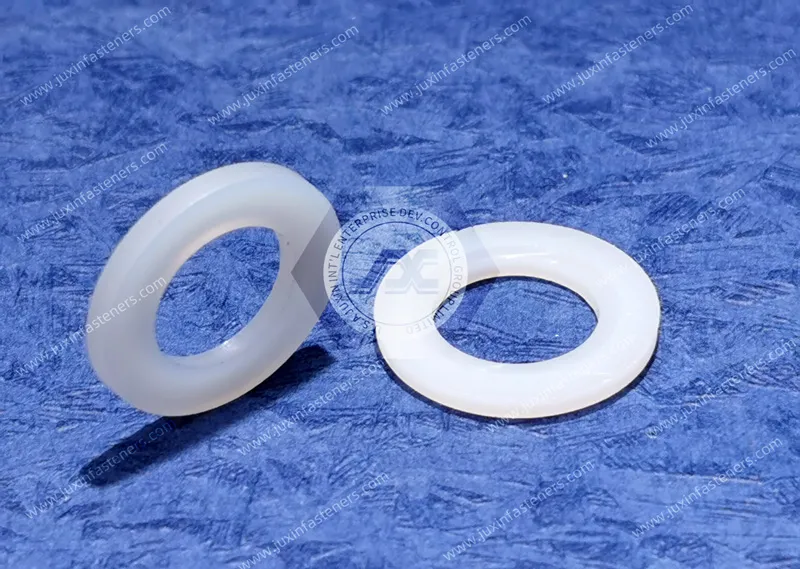
A plastic finishing washer is a molded fastening component designed to fit beneath or around a compatible screw head while providing a larger and more controlled interface with the mounted surface.
Depending on geometry and market terminology, similar components may be described as:
plastic finishing washers;
nylon finishing washers;
plastic cup washers;
nylon cup washers;
countersunk plastic washers;
countersunk screw washers;
trim washers;
screw finishing washers;
decorative plastic washers.
These terms frequently overlap in industrial sourcing.
However:
Product name ≠ complete dimensional specification.
Two products both described as “M4 nylon finishing washers” can differ substantially in screw-head seat, recess depth, through-hole diameter, outside diameter, height, flange thickness, and material.
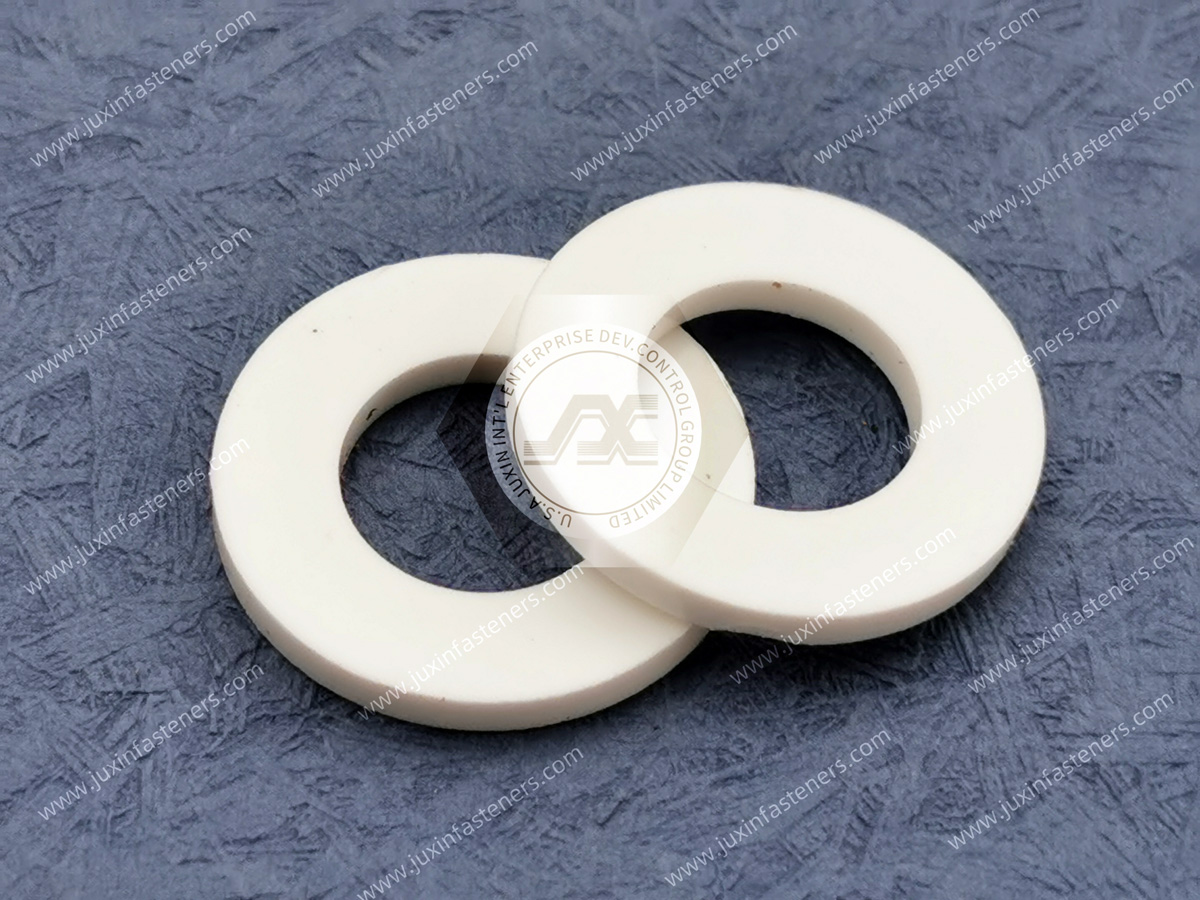
A conventional flat washer primarily provides a flat bearing surface beneath a fastener head or nut.
A finishing washer has a formed or recessed upper geometry designed to interact with the screw head.
Conceptually:
Flat Washer:
Screw Head → Flat Washer → Panel
Finishing / Cup Washer:
Screw Head → Formed Washer Seat → Washer Bearing Surface → Panel
This difference changes both the appearance and load-transfer behavior of the assembly.
See our Nylon Flat Washers solutions for applications requiring a conventional flat bearing interface.
These two components should not be confused.
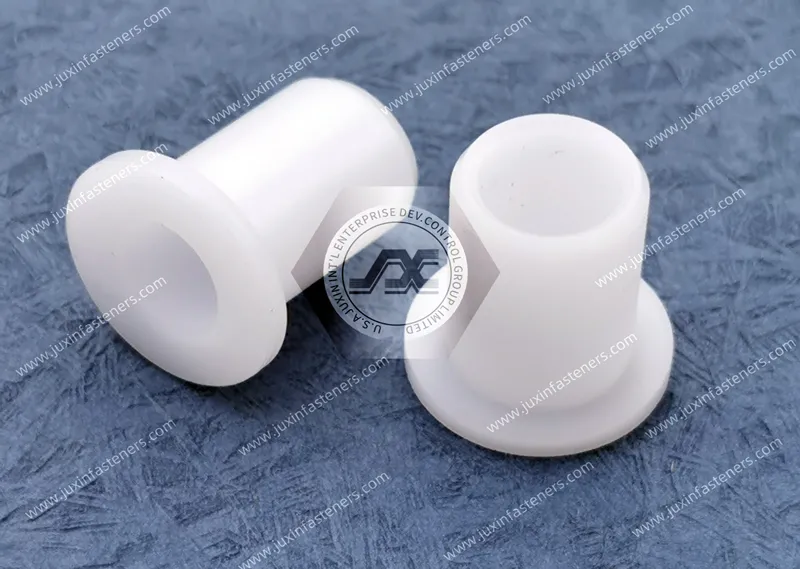
An insulating shoulder washer incorporates a barrel extending into the mounting hole and is selected primarily where radial separation around the screw shank is required.
A finishing washer is primarily concerned with the interface beneath or around the screw head.
Therefore:
Shoulder Washer = Hole Isolation + Under-Head Separation
Finishing Washer = Screw-Head Interface + Surface Protection + Finished Appearance
Some applications may require both functions, but they should not automatically be treated as interchangeable parts.
See our Insulating Shoulder Washers engineering guide for mounting-hole isolation applications.
A countersunk screw converts tightening force through an inclined head surface.
When that head bears directly against a sensitive panel, the local contact condition can create:
concentrated compressive stress;
radial wedging force;
coating damage;
indentation;
cracking around the hole;
localized deformation.
A correctly selected finishing washer provides an intermediate geometry between the screw head and the panel.
Instead of requiring the panel itself to form the complete countersunk bearing surface, the washer can accept the screw-head contact and transfer the load into a broader footprint.
This is particularly useful where the substrate is:
plastic;
composite;
thin sheet metal;
painted metal;
coated metal;
laminated material;
cosmetically visible equipment housing.
Cup washers generally incorporate a recessed or concave upper surface.
The geometry may be designed to accept a particular screw-head family.
Potential compatible screw styles can include selected:
flat countersunk heads;
oval countersunk heads;
raised countersunk heads;
other drawing-defined screw heads.
However, compatibility should be verified from actual dimensions.
A washer should not be selected simply because both the screw and washer are described as “countersunk.”
Countersunk screw heads are manufactured in different geometries according to fastener type and applicable standards.
The included head angle may vary.
For example, depending on the screw system and specification, engineers may encounter different countersunk geometries rather than one universal angle.
Therefore:
Countersunk screw ≠ universal head angle.
When specifying a finishing washer, engineering teams should verify:
screw standard or drawing;
head diameter;
included head angle;
head height;
washer recess geometry.
Where a precise mating relationship is required, the actual fastener drawing and washer drawing should be compared.
Consider two screws carrying the same nominal thread designation.
They may still have different:
head styles;
head diameters;
head heights;
countersunk angles;
drive recesses.
The corresponding finishing washer may therefore require different internal geometry.
This leads to one of the most important sourcing rules for this product family:
Same thread size ≠ same screw head ≠ same finishing washer.
Procurement teams performing second-source qualification should therefore cross-reference the complete screw-head interface rather than searching only by M3, M4, M5, or another nominal thread size.
Standard plastic cup washers generally combine:
central through-hole;
recessed upper seat;
outer bearing flange;
molded one-piece construction.
They can provide:
improved screw-head presentation;
controlled seating;
wider bearing area;
protection of the surrounding panel.
Dimensions must still be matched to the actual screw and application.
Many finishing washers use a relatively flat lower bearing surface.
This allows the washer to distribute the applied load over a broader panel area while the upper recess receives the screw head.
This architecture can be useful on:
thin metal covers;
polymer housings;
equipment panels;
decorative surfaces;
access covers.
The lower bearing geometry should be evaluated against the actual panel surface.
Some finishing washers use a deeper cup or raised profile.
These designs may conceal more of the screw head or accommodate a different head geometry.
A deeper cup can alter:
overall assembly height;
head exposure;
tool access;
load path.
Therefore, cup depth should be treated as a functional dimension rather than only a cosmetic feature.
Visible equipment surfaces may require finishing washers in a particular color.
Potential requirements can include:
black;
white;
natural nylon;
gray;
other project-specific colors.
However, color matching in engineering polymers should be specified realistically.
Appearance can be influenced by:
base resin;
pigment;
surface texture;
molding conditions;
lighting;
adjacent panel material.
For OEM projects requiring controlled appearance, the customer should provide a target color specification or approved physical reference where appropriate.
The washer surface may be:
smooth;
matte;
textured;
drawing-defined.
This can affect how visible the fastener appears on the finished product.
For consumer-facing or commercial equipment, appearance requirements should therefore be included in the sourcing specification rather than assumed from dimensions alone.
A plastic finishing washer can reduce direct contact between a hard metallic screw head and the panel surface.
This can help reduce the risk of:
paint scratching;
coating damage;
localized indentation;
visible witness marks.
However:
Plastic finishing washer ≠ guaranteed damage-free surface.
Surface response still depends on:
tightening torque;
panel hardness;
coating thickness;
washer geometry;
contamination;
washer material.
Critical cosmetic surfaces should be validated with the actual production panel and fastener.
One important mechanical advantage of a finishing washer is its ability to increase the effective bearing area beneath the screw assembly.
In general:
Larger Effective Bearing Area → Lower Average Bearing Pressure for the Same Applied Load
This does not mean that every larger washer is automatically better.
Excessive outside diameter can interfere with:
adjacent features;
panel edges;
embossed surfaces;
labels;
other fasteners;
enclosure geometry.
The correct OD is therefore determined by both load distribution and available packaging space.
Polymer panels can be particularly sensitive to concentrated fastener loads.
Potential failure modes include:
indentation;
creep;
cracking;
whitening;
hole deformation.
A finishing washer can help distribute the load, but the complete joint must still be designed for the panel material.
The washer does not compensate for excessive installation torque.
Some equipment housings use materials with relatively low tolerance for concentrated wedge loading.
Examples can include selected:
acrylic components;
rigid polymer panels;
composite sheets;
laminated panels.
A finishing washer may help reduce localized stress, but the actual material behavior should be validated experimentally where cracking would create a significant product risk.
Visible sheet-metal panels often rely on paint, powder coating, or another surface finish for both appearance and environmental protection.
Direct metallic screw-head contact can damage the coating during tightening.
A polymer finishing washer can create a softer interface between the screw head and coating.
However, assembly torque must still be controlled.
Excessive compression can cause the washer itself to deform and transfer damaging pressure into the coating.
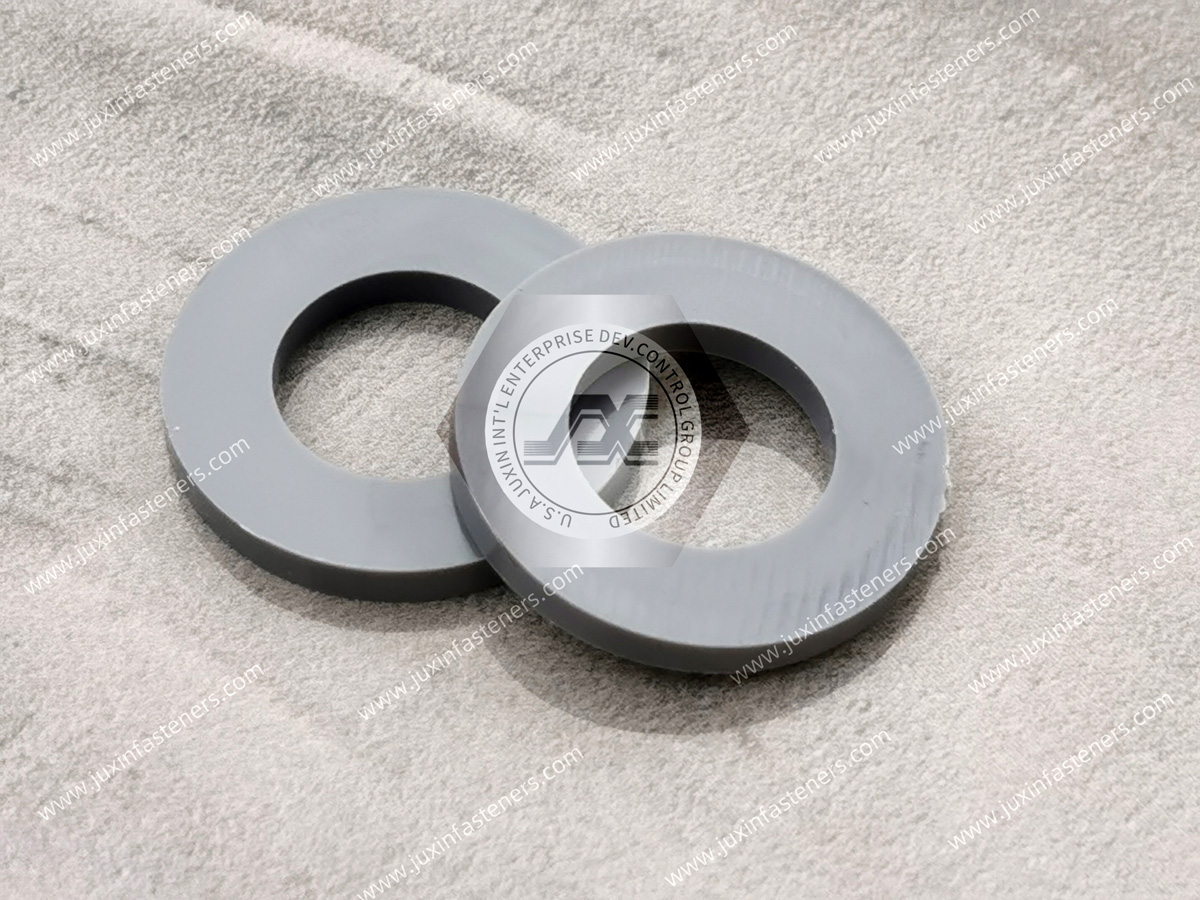
PA66 is commonly used for molded plastic washers because suitable grades can provide a useful combination of:
mechanical strength;
toughness;
wear resistance;
moldability;
electrical properties;
corrosion-free polymer construction.
However:
PA66 is a material family, not a complete product specification.
Actual washer performance depends on:
resin grade;
geometry;
moisture condition;
temperature;
clamp load;
service environment.
Polyamide absorbs moisture from the environment.
This can change:
stiffness;
toughness;
dimensions;
compressive behavior;
long-term creep.
A dry nylon finishing washer and a moisture-conditioned washer may therefore not behave identically under tightening load.
Applications with tightly controlled cosmetic height or clamp stack should consider expected service conditions during validation.
POM may be considered in selected applications where properties such as:
low moisture absorption;
dimensional stability;
low friction;
surface hardness;
are important.
However:
POM is not automatically superior to PA66.
Material selection should consider the complete application, including:
temperature;
load;
impact;
appearance;
environment;
chemical exposure;
long-term behavior.
Finishing washers exposed directly to outdoor conditions may require enhanced weathering performance.
Applications can include:
outdoor electrical enclosures;
lighting equipment;
marine equipment;
renewable-energy equipment;
exterior commercial equipment.
Where UV exposure is relevant, the project should specify the required weathering performance rather than assuming that standard indoor-grade nylon is suitable for prolonged outdoor use.
A finishing washer is located directly within the clamped joint.
As tightening force increases, the polymer washer experiences compressive stress.
Excessive load can produce:
permanent deformation;
cup collapse;
flange distortion;
reduced aesthetic quality;
panel damage;
long-term clamp loss.
Therefore:
Metal screw torque capability ≠ allowable finishing-washer assembly torque.
The installation limit must be determined from the complete joint.
Engineering polymers can exhibit time-dependent deformation under sustained compression.
A finishing washer that appears correctly seated immediately after assembly may gradually change thickness under sustained load.
This can affect:
screw preload;
washer profile;
panel retention;
visible screw position.
Risk can increase with:
high compressive stress;
elevated temperature;
long service time.
See our Polymer Creep & Stress Relaxation in Plastic Fasteners engineering guide for additional information.
One failure mode occurs when excessive tightening force pushes the screw head too deeply into the washer recess.
Potential consequences include:
distorted cup geometry;
split washer;
reduced bearing area;
visible cosmetic damage.
This is why screw-head diameter and washer seat dimensions must be considered together.
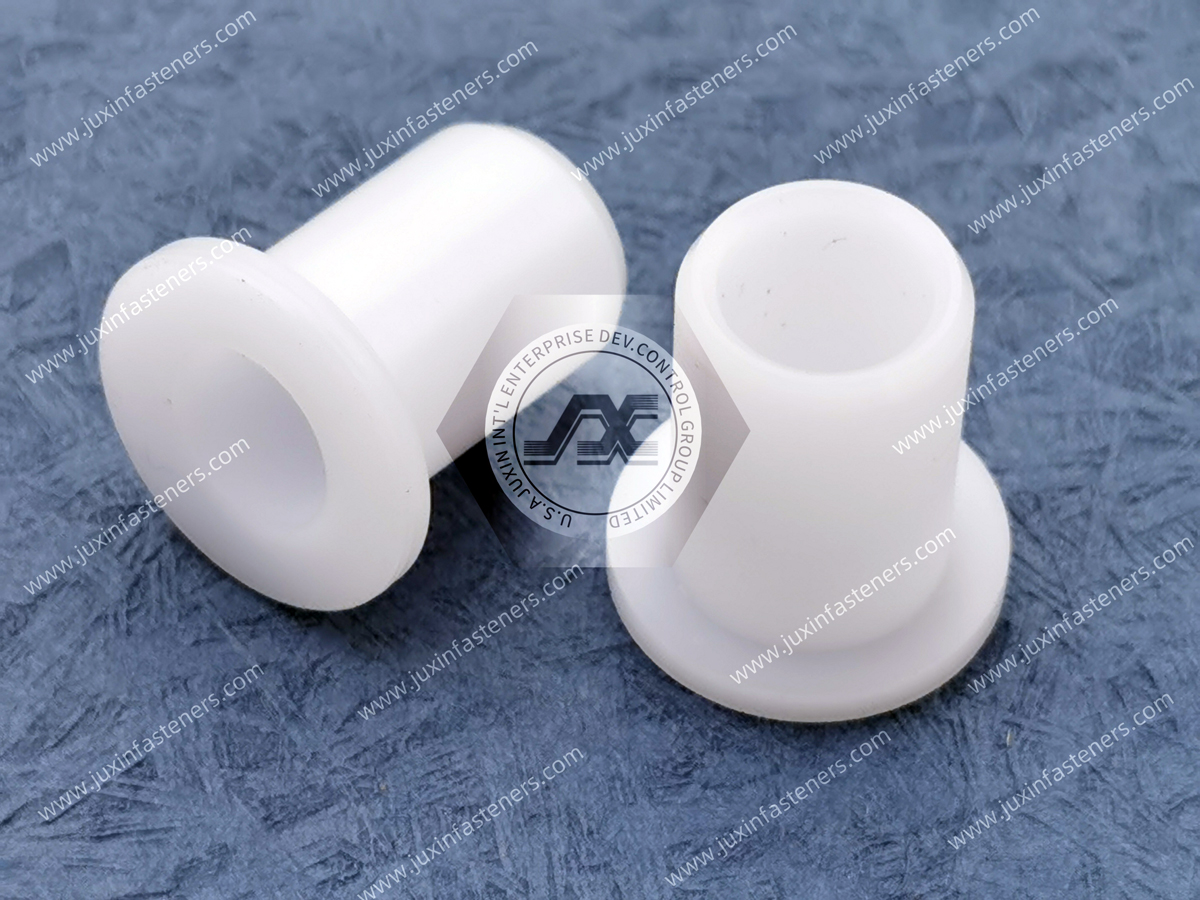
The central hole must provide appropriate clearance for the screw shank or threaded portion.
If the hole is too small:
the screw can bind;
the washer can rotate during tightening;
installation becomes inconsistent.
If the hole is unnecessarily large:
washer centering may become less controlled;
the screw head may not seat concentrically.
Therefore:
Thread designation ≠ washer through-hole dimension.
Actual fastener geometry should be reviewed.
Visible fasteners often have an aesthetic requirement beyond pure mechanical retention.
If the washer and screw head are not concentric, the finished assembly can appear misaligned even when mechanically functional.
Concentricity can be influenced by:
screw-to-hole clearance;
washer ID;
washer seat geometry;
panel hole;
installation method.
This makes dimensional control particularly important for visible equipment surfaces.
A finishing washer can surround a significant portion of the screw head.
The design must therefore preserve adequate access to the screw drive.
Relevant drive systems can include:
Phillips;
Pozidriv;
Torx;
hex socket;
slotted;
other project-specific drives.
A washer that visually covers too much of the head can interfere with installation or service tooling.
A plastic finishing washer can interrupt direct contact between the underside of a metal screw head and a conductive panel.
This can be useful in selected electrical and corrosion-management designs.
However:
Finishing washer ≠ complete electrical isolation.
The screw shank may still contact the mounting hole.
If radial screw-shank isolation is required, an Insulating Shoulder Washer or other appropriate bushing architecture may be necessary.
Likewise:
Plastic finishing washer ≠ complete galvanic corrosion prevention.
The full metallic interface and environmental exposure must be reviewed.
Plastic finishing washers can be used on visible:
covers;
control panels;
access panels;
housings;
internal assemblies.
Design priorities can include:
appearance;
coating protection;
repeatable assembly;
panel retention.
Potential applications include:
instrument covers;
electronic housings;
control equipment;
power equipment enclosures;
rack-mounted equipment.
Where electrical isolation is required, engineers must determine whether a finishing washer alone is sufficient for the intended interface.
Finishing washers can help protect:
powder-coated panels;
painted covers;
thin sheet-metal access panels.
They may also improve visual consistency where fasteners remain visible after assembly.
Medical and laboratory equipment often places high importance on:
clean appearance;
controlled panel surfaces;
service access;
equipment finish.
Project-specific material, cleaning, sterilization, and regulatory requirements must be confirmed before material selection.
Visible fasteners on precision instruments may require both repeatable service access and controlled appearance.
Potential applications include:
front panels;
rear covers;
adjustment access panels;
instrument housings.
Selected automotive interior and trim assemblies may use polymer washers where visible fastener interfaces require:
trim protection;
appearance control;
vibration resistance.
Automotive projects must still be evaluated according to project-specific temperature, vibration, material, and validation requirements.
Potential applications include:
fixture housings;
access covers;
control enclosures;
decorative assemblies.
Outdoor lighting additionally requires material evaluation for UV exposure and environmental aging.
Control panels, service covers, and visible enclosure surfaces may use finishing washers to distribute fastener loads and protect coatings.
Vibration and repeated maintenance should be considered where access panels are frequently removed.
Outdoor and marine environments introduce additional considerations involving:
UV exposure;
moisture;
temperature cycling;
corrosion of adjacent metals.
Polymer material selection should therefore be based on the actual environment.
Possible causes include:
incorrect screw-head geometry;
incompatible washer recess;
incorrect head diameter;
washer deformation;
misalignment.
Possible causes include:
excessive torque;
incorrect screw-head geometry;
insufficient washer wall thickness;
brittle material condition.
Possible causes include:
excessive clamp load;
high temperature;
insufficient bearing area;
unsuitable material.
Possible causes include:
excessive tightening torque;
insufficient washer OD;
contaminated interface;
very soft panel material;
inappropriate washer geometry.
Possible causes include:
cup depth too shallow;
incompatible head geometry;
excessive washer thickness.
Possible causes include:
cup depth too great;
excessive torque;
oversized recess;
polymer deformation.
Possible causes include:
screw binding in the through-hole;
high screw-head friction;
insufficient panel friction;
dimensional mismatch.
Possible causes include:
excessive washer ID clearance;
oversized panel hole;
incompatible screw head;
poor installation alignment.
Possible contributors include:
polymer creep;
elevated temperature;
excessive initial compression;
panel creep.
Failure analysis should therefore examine:
Screw + Washer + Panel + Torque + Material + Environment
rather than evaluating the washer alone.
A sourcing request may initially state:
“We need an M4 nylon cup washer.”
That is not enough to establish interchangeability.
Two M4-compatible finishing washers can differ in:
through-hole diameter;
screw-head seat geometry;
recess depth;
outside diameter;
total height;
flange thickness;
material;
color;
surface finish.
Therefore:
Same nominal screw size ≠ same finishing washer.
For OEM second-source projects, both the mechanical interface and visible appearance may need qualification.
For practical engineering and procurement review, Juxin Fasteners recommends verifying at least:
ID + OD + Total Height + Recess Diameter + Recess Depth + Screw-Head Geometry
Where the washer has a more complex profile, the customer drawing should govern.
For visible components, also verify:
Material + Color + Surface Finish
This provides a much stronger second-source comparison than nominal screw size alone.
Provide:
manufacturer;
manufacturer part number;
OEM part number;
drawing;
CAD model;
physical sample;
photographs.
Confirm:
thread size;
screw standard or drawing;
head style;
head diameter;
head height;
head angle where relevant;
drive type.
Specify:
through-hole ID;
outside diameter;
total height;
recess diameter;
recess depth;
lower bearing geometry.
Provide:
panel material;
panel thickness;
hole diameter;
coating;
surface-finish requirements.
Specify:
tightening method;
installation torque if controlled;
required clamp condition;
vibration;
service frequency.
Where applicable, specify:
color;
surface texture;
visible head height;
acceptable screw exposure;
approved appearance sample.
Provide:
minimum temperature;
maximum temperature;
humidity;
UV exposure;
chemical exposure;
indoor / outdoor use.
Check:
screw-head seating;
concentricity;
panel contact;
appearance;
installation behavior.
Where required, evaluate:
tightening behavior;
panel indentation;
vibration;
repeated service;
thermal cycling;
long-term compression.
After approval, proceed to:
quotation;
material requirements;
inspection plan;
packaging;
lot traceability;
production planning.
Standard finishing washers cover many common screw and panel interfaces, but proprietary equipment frequently requires drawing-specific geometry.
Custom requirements can include:
special ID;
custom OD;
custom cup depth;
dedicated screw-head seat;
low-profile design;
oversized bearing flange;
proprietary decorative profile;
custom surface texture;
specified polymer;
custom color.
Juxin Fasteners can support drawing-based custom plastic washer sourcing through:
2D drawing review;
3D CAD review;
physical sample comparison;
dimensional analysis;
material evaluation;
DFM discussion;
tooling evaluation;
sample validation;
production sourcing.
See our Custom Molded Plastic Fasteners solutions for proprietary OEM plastic hardware.
For faster engineering review and quotation, provide as much of the following information as possible.
manufacturer;
manufacturer part number;
OEM part number;
drawing;
CAD model;
physical sample;
photographs.
metric or Unified thread;
nominal size;
head style;
head diameter;
head height;
countersunk angle where applicable;
drive type.
ID;
OD;
total height;
recess diameter;
recess depth;
flange / bearing thickness;
other drawing-defined dimensions.
material;
thickness;
mounting-hole diameter;
coating;
surface finish.
installation torque if specified;
clamp requirement;
vibration;
service frequency;
repeated removal requirement.
color;
surface texture;
visible screw-head requirement;
approved appearance sample where applicable.
minimum temperature;
maximum temperature;
humidity;
UV exposure;
chemical exposure;
indoor / outdoor application.
PA66;
POM;
other specified polymer;
color;
project-specific resin requirements.
sample quantity;
production quantity;
expected annual usage;
delivery schedule;
RoHS declaration;
REACH declaration;
material documentation;
lot traceability;
inspection requirements.
Providing the screw-head geometry together with the washer dimensions and panel information significantly improves second-source evaluation accuracy.
Related Juxin Fasteners product and engineering solutions include:
Nylon Flat Washers for conventional bearing-area distribution;
Insulating Shoulder Washers for under-head and mounting-hole separation;
Nylon Machine Screws for non-metallic threaded fastening;
Nylon Thumb Screws for tool-free manual access;
Polymer Creep & Stress Relaxation in Plastic Fasteners for long-term clamp-load analysis;
Custom Molded Plastic Fasteners for proprietary OEM components.
Each product family performs a different mechanical function and should be selected according to the actual fastener interface, panel material, load, environment, and service requirements.
Juxin Fasteners supports appliance manufacturers, electrical and electronic equipment OEMs, industrial enclosure manufacturers,
medical equipment companies, instrumentation manufacturers, automotive component suppliers, lighting companies,
HVAC manufacturers, contract manufacturers, procurement teams, and supplier-development organizations requiring standard or custom plastic fastening components.
For plastic finishing washer projects, the sourcing pathway can begin with:
Existing Part / Drawing / Sample → Screw Head Review → Washer Geometry Review → Panel & Surface Review
→ Material / Torque / Environment Review → Candidate Washer → Physical Sample → Assembly & Appearance Validation → Second-Source Qualification → Production RFQ
This process can support:
new product development;
visible-panel fastening;
countersunk screw interfaces;
coated-panel protection;
plastic enclosure assembly;
existing component replacement;
supplier consolidation;
second-source qualification;
obsolete component replacement;
custom finishing washer development.
Send us your existing supplier part number, OEM part number, 2D drawing, 3D CAD model, physical sample, screw specification,
screw-head geometry, washer dimensions, panel material, surface requirements, operating environment, documentation requirements, and expected annual volume for technical review.
Email: info@juxinfasteners.com
Website: www.juxinfasteners.com
Product Packaging
Packaging Standard
At Juxin Fasteners, we apply standardized export packaging to ensure product protection, traceability, and compliance with international logistics requirements.
1. Standard Export Packaging
Unless otherwise specified, all products will be packed according to our factory standard export packaging, which includes:
Moisture-resistant inner protection
Poly bag or small box packing as required
Reinforced export cartons
Clear labeling with part number, specification, batch number, and quantity
Palletizing for sea or air shipment when necessary
Our standard packaging is designed to ensure safe transportation, efficient warehousing, and long-distance international shipping.
2. Customized Packaging Options
We also provide customized packaging solutions according to customer requirements, including but not limited to:
Private labeling
Customized barcodes
Specific carton dimensions
Retail packaging
Special pallet configuration
Customer-specific marking and identification
So that you know, customized packaging may involve additional costs and extended lead time depending on the complexity of the requirements.
3. Compliance & Quality Assurance
All packaging processes are controlled under our ISO 9001 quality management system to ensure consistency, traceability, and product integrity throughout the supply chain.
Product Pictures
Contact Us
Tel.:
+86 020 8621 0320
+86 020 3121 6067
E-mail:
Technical Support:
Navigation
SEND INQUIREY