Call Us
+86 136 6007 9809
Call Us
+86 136 6007 9809

Removable plastic rivets and reusable panel fasteners provide a practical fastening solution for assemblies that require periodic inspection,
maintenance, component replacement, cleaning, or access behind covers and trim panels.
Product Specification
Removable plastic rivets and reusable panel fasteners provide a practical fastening solution for assemblies that require periodic inspection,
maintenance, component replacement, cleaning, or access behind covers and trim panels.
Unlike permanent or difficult-to-remove retention systems, appropriately designed removable plastic rivets allow a panel to be secured during normal operation and later released using a defined removal method.
Common applications include automotive trim, commercial vehicle interiors, industrial enclosures, electrical equipment, appliances,
HVAC systems, medical equipment housings, electronics, vending equipment, office equipment, agricultural machinery, and service-access panels.
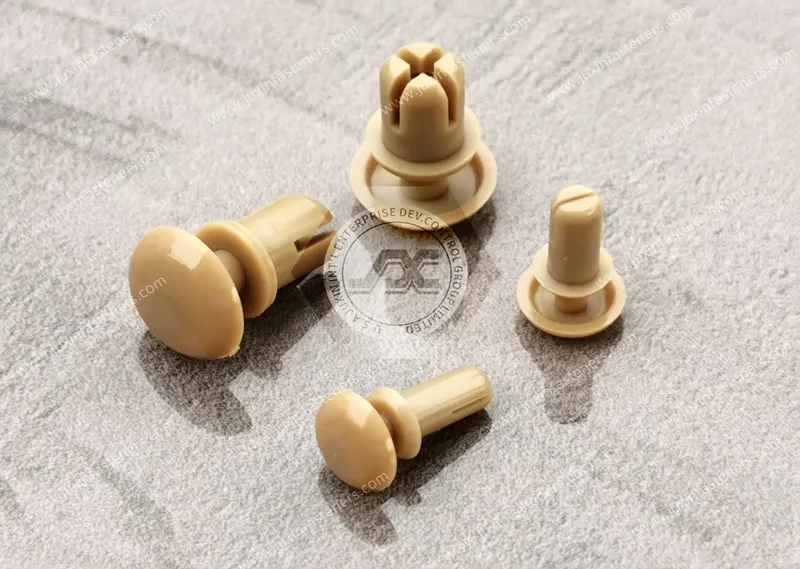
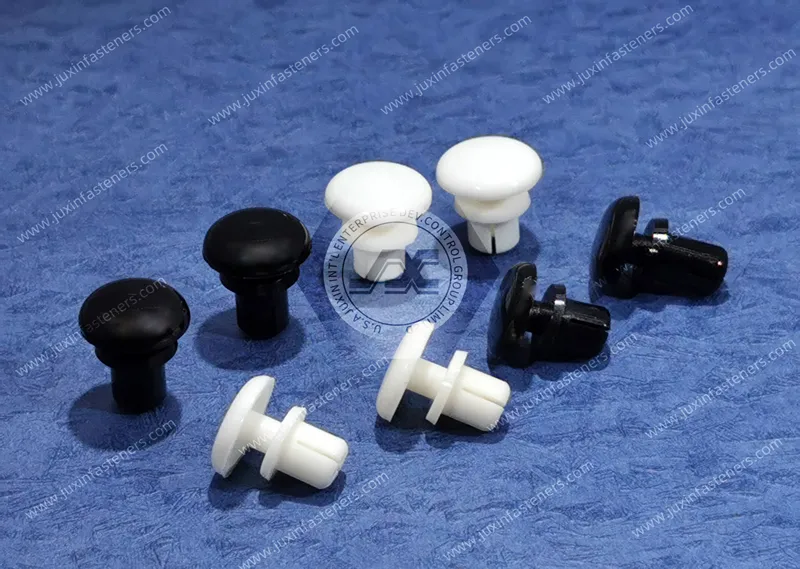
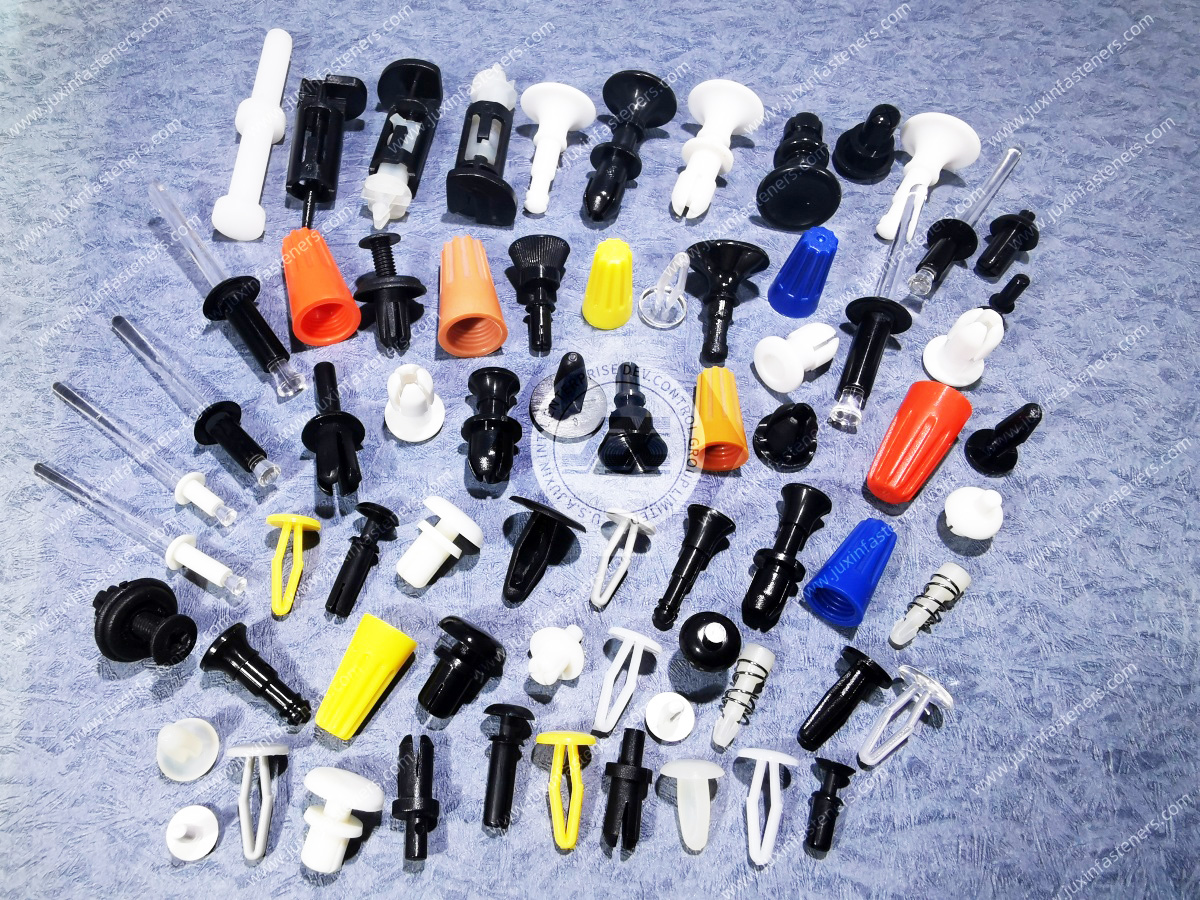
Two-piece push-pin plastic rivets are among the most widely used designs. A typical assembly consists of a molded rivet body and a separate center pin.
During installation, movement of the center pin changes the geometry of the rivet body, expanding or locking the retaining legs against the panel interface.
For removable designs, the center pin can subsequently be moved to a release position according to the fastener geometry, reducing retention sufficiently for removal.
However:
Removable ≠ unlimited reuse.
Repeated insertion and removal can affect the retaining legs, pin interface, head, panel hole, and resulting retention force.
Reusability should therefore be validated according to the actual fastener design and required service cycle.
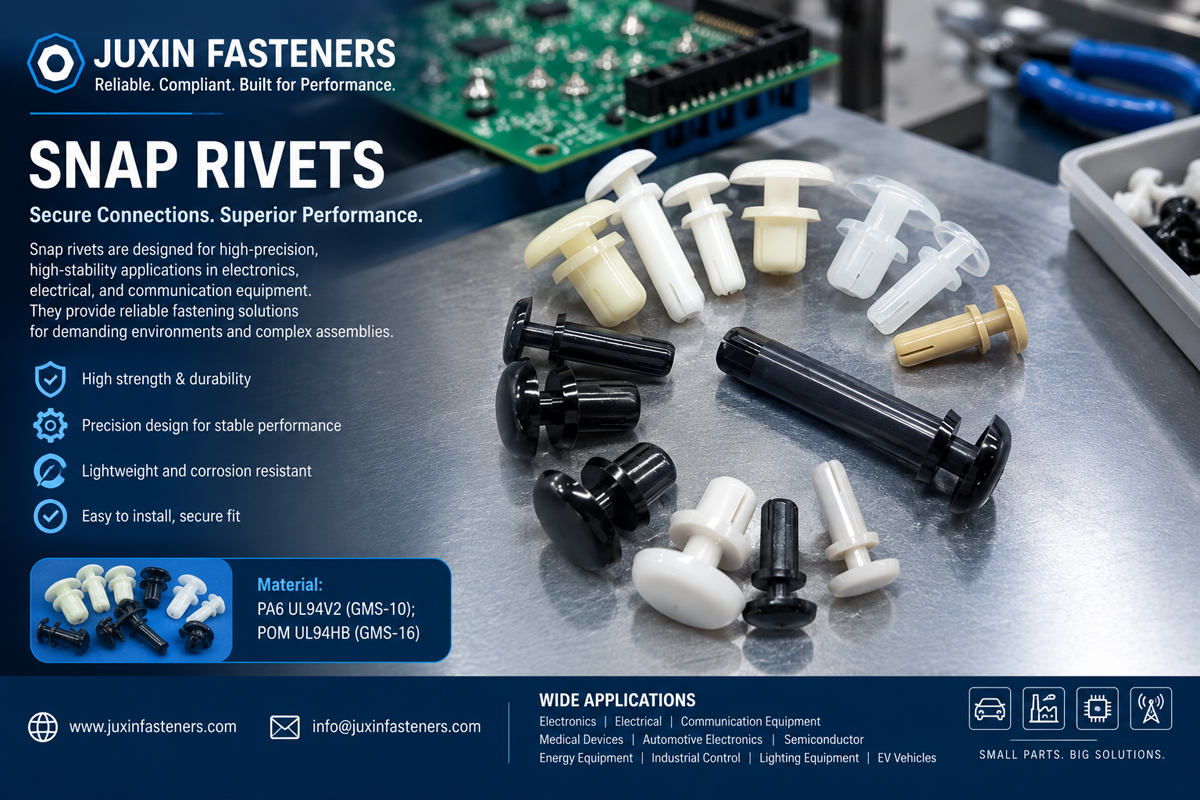
Juxin Fasteners supplies standard and custom removable plastic rivets, reusable nylon push rivets, panel fasteners,
plastic trim clips, push-pin retainers, and drawing-based molded plastic fastening components for OEM and industrial applications.
Engineering and sourcing evaluation can begin from an existing manufacturer part number,
OEM part number, physical sample, 2D drawing, 3D CAD model, panel dimensions, or application requirement.
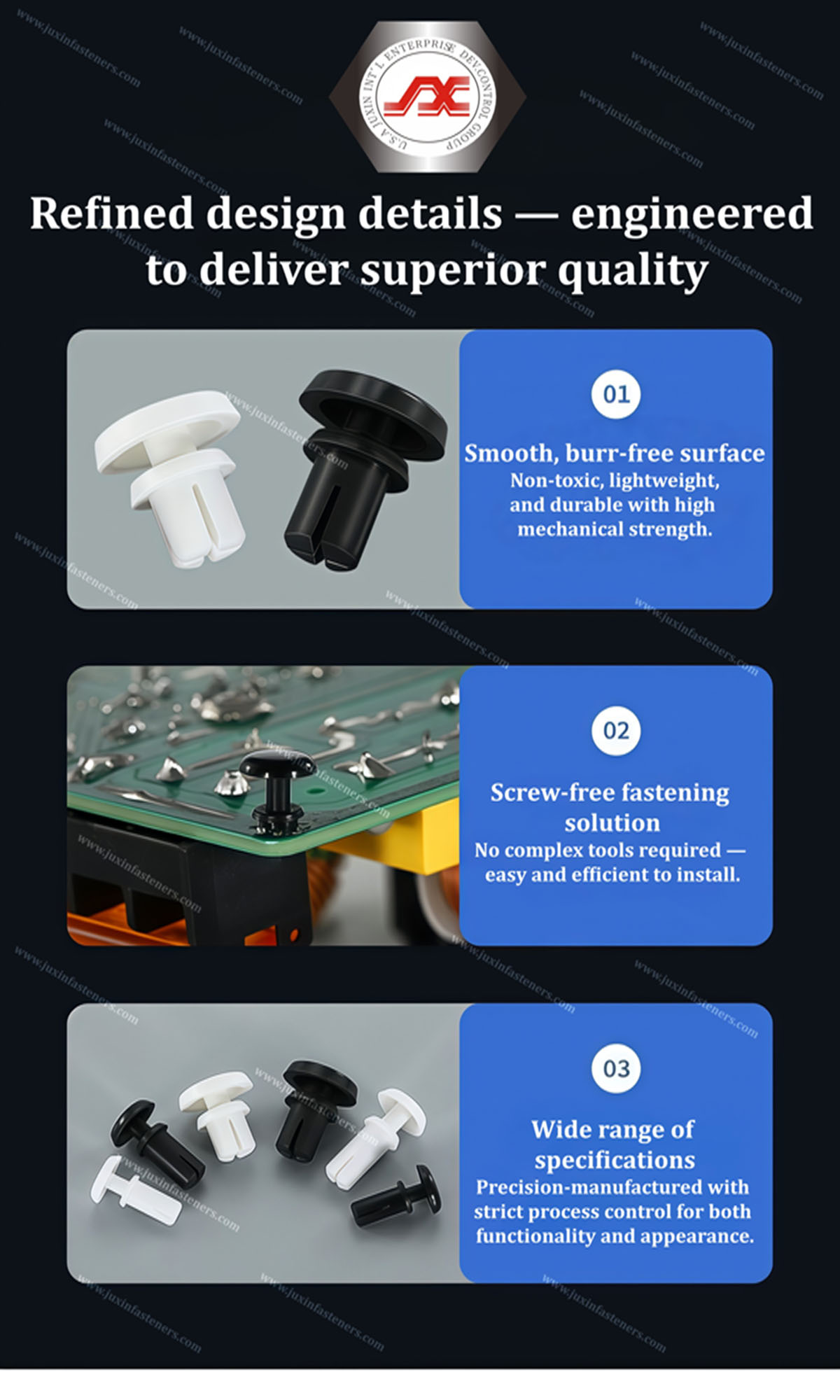
The operating principle depends on the fastener geometry, but many removable plastic rivets use a two-component architecture:
Rivet Body + Center Pin
The body provides the panel interface and retaining features.
The center pin controls the locking condition.
During installation, the pin can force the body legs outward or prevent them from collapsing inward.
During removal, moving the pin to its specified release position allows the body to relax or collapse sufficiently for extraction.
This creates an important engineering distinction:
Installation mechanism ≠ removal mechanism.
A fastener that pushes into place does not necessarily release simply by pulling in the opposite direction.
The correct service method should therefore be defined during component selection.
Two-piece push-pin rivets typically consist of:
molded rivet body;
expandable or flexible retaining legs;
separate center pin;
external head or flange.
Depending on the design, the center pin may be:
pushed flush during installation;
raised during removal;
pushed through to a release position;
actuated using a specific tool or head feature.
These fasteners are commonly used where assembly speed and later service access are both important.
Applications can include:
automotive interior trim;
access covers;
equipment housings;
electrical enclosures;
appliance panels;
HVAC covers;
lightweight machine guards.
Reusable nylon push rivets are designed to permit controlled release without intentionally destroying the fastener during normal removal.
The actual number of practical service cycles depends on:
fastener geometry;
polymer;
panel hole condition;
insertion force;
removal method;
temperature;
aging;
technician handling.
Therefore, a supplier should not claim a universal reuse-cycle number unless that specific design has been validated accordingly.
Some removable panel fasteners use flexible molded legs or locking features rather than a conventional drive-pin architecture.
They may be used for:
trim panels;
access covers;
interior panels;
electronics housings;
equipment covers.
These should be evaluated separately from two-piece push rivets because their installation, retention, and removal mechanisms can differ significantly.
Some serviceable plastic fasteners use a screw-type or threaded center element.
These designs can provide controlled engagement and release while retaining the advantages of a lightweight polymer body.
However, they should not automatically be treated as interchangeable with standard push-pin rivets.
Quarter-turn fasteners can also provide rapid service access, but they represent a different fastening architecture.
Where a project requires quarter-turn actuation, positive indexing, or frequent equipment access,
the design should be evaluated as a dedicated panel-fastening system rather than simply classified as another removable push rivet.
Some reusable or removable fasteners can be installed from one side of the assembly.
This is useful where rear-side access is unavailable.
Potential applications include:
closed cavities;
trim panels;
enclosure walls;
equipment housings.
However:
Blind installation ≠ automatically removable from the same side without constraints.
Service access and removal method should be evaluated before design release.
The correct choice depends on the expected product lifecycle.
A standard push rivet may be appropriate where:
assembly is permanent;
service access is unlikely;
replacement fasteners are acceptable during repair.
A removable plastic rivet may be preferable where:
inspection is required;
filters or internal components require access;
covers are removed during scheduled maintenance;
field service is expected;
non-destructive panel removal is desirable.
The engineering question should therefore not simply be:
“Which rivet has higher retention?”
A better question is:
“What combination of installation speed, retention, removal method, service frequency, panel protection, and lifecycle cost does the assembly require?”
The mounting hole is one of the most important dimensions in a removable rivet assembly.
If the hole is too small, potential consequences include:
excessive insertion force;
incomplete seating;
body deformation;
difficult pin actuation;
damage during removal.
If the hole is too large, potential consequences include:
reduced radial engagement;
lower pull-out retention;
lateral movement;
vibration rattle;
poor panel alignment.
Therefore:
Nominal rivet size ≠ complete hole specification.
Engineering drawings should identify the recommended mounting-hole diameter and tolerance for the actual fastener.
A removable rivet normally secures two or more layers.
The combined retained thickness can include:
trim panel;
cover;
enclosure wall;
bracket;
liner;
insulation layer;
decorative panel.
This total stack must be compatible with the fastener's grip range.
Possible consequences include:
axial looseness;
panel rattle;
insufficient clamping;
visible gaps.
Possible consequences include:
incomplete leg expansion;
center pin not seating correctly;
excessive installation force;
reduced retention;
fastener damage.
Therefore:
Hole diameter + total grip thickness must be evaluated together.
Matching only one dimension is not sufficient for second-source qualification.
The same plastic rivet can behave differently in:
sheet steel;
aluminum;
molded plastic;
composite panels;
painted metal;
coated sheet;
soft trim materials.
Panel edge condition and stiffness can affect:
insertion force;
pull-out force;
hole wear;
rattle;
service life.
A replacement fastener should therefore be evaluated in the actual or representative panel material whenever retention is important.
A drawing may specify the correct nominal hole diameter while the actual production interface still creates problems.
Relevant manufacturing factors include:
stamping burrs;
laser-cut edge condition;
paint thickness;
powder coating;
plating;
molded hole variation;
hole roundness.
For removable fasteners, these factors can affect both installation and subsequent extraction.
This leads to an important sourcing principle:
Drawing dimensions alone may not fully represent the production interface.
Physical assembly validation is especially useful when replacing an existing fastener.
The rivet head performs several functions.
It can influence:
bearing area;
panel appearance;
accessibility;
removal-tool engagement;
flushness;
surface protection.
Design engineers should consider whether the application requires:
low-profile head;
larger flange;
recessed pin;
raised pin;
tool-access feature;
cosmetic surface.
For visible automotive or appliance applications, appearance may be nearly as important as retention.
One of the most common mistakes in reusable fastener selection is evaluating installation while ignoring removal.
A fastener may install easily but become difficult to service because nearby geometry blocks access to the center pin.
Design teams should consider:
finger clearance;
pry-tool clearance;
screwdriver access where applicable;
adjacent ribs;
panel recesses;
painted surfaces;
nearby cables or electronics.
Serviceability should be designed before production, not discovered during maintenance.
Where the surrounding panel is painted, coated, textured, or decorative, removal-tool geometry can matter.
A poorly controlled removal process can:
scratch paint;
dent soft panels;
mark trim surfaces;
damage the rivet head.
For cosmetic surfaces, engineers may need to evaluate:
head clearance;
extraction-tool geometry;
protective service tools;
technician instructions.
PA66 is widely used for many molded plastic fasteners because suitable grades can provide a useful balance of:
strength;
stiffness;
toughness;
fatigue performance;
molded feature definition;
snap-fit capability.
However:
“PA66” alone is not a complete material specification.
Performance can vary according to:
resin grade;
moisture condition;
additives;
impact modification;
heat stabilization;
geometry;
operating temperature.
Where material performance is critical, the required resin characteristics should be defined as part of the engineering specification.
Polyamides absorb moisture from their environment.
This can influence:
stiffness;
toughness;
dimensions;
leg flexibility;
insertion force;
removal force;
retention behavior.
Moisture conditioning can improve toughness in some applications, but it should not simply be described as universally improving removable-rivet performance.
Instead:
Dry-state fit ≠ conditioned in-service fit.
For tight-tolerance or demanding applications, the expected operating environment should be considered during validation.
Impact-modified nylon grades may be considered where improved toughness is required, particularly in applications involving:
repeated handling;
low-temperature service;
impact exposure;
flexible retaining features.
However, material selection involves trade-offs.
Changing resin formulation can also change:
stiffness;
dimensional behavior;
retention force;
thermal performance.
The correct grade should therefore be selected against the complete application requirement.
Temperature can affect both the rivet and the surrounding panel.
At elevated temperatures, polymer stiffness and long-term retention can change.
At low temperatures, some materials can become less tolerant of high local strain.
For applications involving:
automotive interiors;
commercial vehicles;
outdoor machinery;
HVAC equipment;
electrical enclosures;
the service temperature range should be included in component qualification.
Plastic retaining features can experience time-dependent mechanical behavior.
If a retaining leg remains continuously deflected, stress relaxation can reduce its restoring force over time.
Potential influences include:
material;
temperature;
moisture;
geometry;
continuous strain;
service duration.
Therefore:
Initial pull-out force ≠ guaranteed lifetime pull-out force.
For applications where long-term retention is critical, aging and environmental conditions should be considered.
See our engineering guide on Polymer Creep & Stress Relaxation in Plastic Fasteners for additional design considerations.
The word “reusable” requires careful engineering interpretation.
A reusable rivet is generally designed so that normal removal does not intentionally destroy the fastener.
It does not mean the component will maintain identical performance through unlimited service cycles.
Repeated use can cause:
retaining-leg wear;
center-pin wear;
surface abrasion;
permanent deformation;
reduced retention;
panel-hole wear.
The appropriate validation question is:
How many service cycles does this particular assembly require?
An appliance filter access panel removed several times during its life has a different requirement from an automotive trim panel intended to be removed only during occasional repair.
In vibration-sensitive equipment, the center pin must remain in its intended locking position.
Possible concerns include:
pin migration;
gradual loosening;
panel rattle;
loss of expansion;
complete fastener release.
Applications involving:
commercial vehicles;
agricultural equipment;
machinery;
HVAC equipment;
mobile equipment;
may require representative vibration evaluation.
Successful static retention ≠ proven vibration retention.
Plastic fasteners are non-metallic and can be useful where designers want to avoid a direct conductive fastening path or metal-to-metal contact at selected interfaces.
They can also avoid fastener corrosion associated with metallic rivets in appropriate environments.
However:
Plastic fastener ≠ complete electrical insulation system.
Electrical safety depends on the complete equipment architecture, including:
voltage;
creepage;
clearance;
material properties;
geometry;
contamination;
applicable equipment requirements.
Similarly, using a plastic fastener does not automatically eliminate every galvanic corrosion mechanism elsewhere in the assembly.
When specifying removable plastic rivets, engineers should evaluate at least the following parameters.
Confirm nominal diameter and tolerance.
Calculate the complete retained panel stack.
Identify metal, plastic, composite, trim, or other substrates.
Determine whether the fastener primarily provides:
positioning;
light panel retention;
anti-rattle retention;
structural support.
Do not use a lightweight plastic trim rivet as a structural fastener unless the application has been specifically engineered and validated for that purpose.
Determine whether assembly is:
manual;
tool-assisted;
automated.
Define how service technicians will release the fastener.
Estimate realistic lifecycle access frequency.
Identify stationary versus vibration-intensive equipment.
Specify relevant thermal, humidity, chemical, UV, or other environmental conditions.
For visible surfaces, define:
head diameter;
head height;
color;
texture;
flushness.
These two product families can overlap in panel-retention applications but should not automatically be substituted.
Better suited where controlled release and service access are design priorities.
Their multiple flexible ribs can provide strong engagement across certain hole and panel conditions.
However, some fir-tree designs can experience increased extraction force or barb wear during repeated removal.
Therefore:
High pull-out retention and easy repeated removal are different design objectives.
See our Fir Tree Fasteners solutions for applications where ribbed blind-hole retention is the primary requirement.
Where service frequency is high or controlled tightening is required, engineers may also consider a threaded fastening system.
Potential advantages:
rapid installation;
limited tooling;
low component count;
convenient panel access.
Potential advantages:
controlled threaded engagement;
familiar removal process;
suitability for applications designed around threaded joints.
The appropriate choice depends on:
required retention;
assembly speed;
service frequency;
mating interface;
space;
cost.
Removable plastic rivets may be used for:
interior trim;
dashboard panels;
console components;
trunk liners;
access covers;
lightweight under-panel components.
Important considerations include:
appearance;
vibration;
temperature;
rattle prevention;
service removal;
panel-hole wear.
Applications can include:
cabin trim;
electrical access covers;
interior panels;
maintenance covers;
lightweight service panels.
Vibration and repeated field maintenance can make removal behavior especially important.
Removable plastic panel fasteners may support:
access covers;
internal barriers;
lightweight service panels;
fan or filter covers.
Where an enclosure requires a specified ingress-protection level, the complete closure system must be evaluated separately.
Panel retention ≠ environmental sealing.
Potential applications include:
service covers;
internal liners;
control housings;
lightweight trim;
filter-access panels.
Assembly speed and service access can both influence fastener selection.
Plastic removable fasteners may be considered for selected:
equipment covers;
electronics housings;
internal access panels;
lightweight service components.
Material, cleaning, regulatory, and equipment-specific requirements must be defined by the project.
Applications can include:
filter covers;
control access panels;
internal airflow components;
lightweight covers.
Temperature, vibration, condensation, and service frequency should be considered.
These systems can require frequent access for:
servicing;
cleaning;
electronic replacement;
internal inspection.
Reusable panel fasteners can reduce replacement-hardware requirements where the application is appropriately designed.
Potential applications include:
cab trim;
electrical covers;
lightweight access panels;
equipment housings.
Higher vibration, contamination, and outdoor exposure may require additional validation.
Understanding failure modes is essential when evaluating a new design or alternative source.
Possible causes:
oversized hole;
panel wear;
incorrect body diameter;
insufficient radial engagement.
Possible causes:
undersized hole;
excessive panel thickness;
coating buildup;
burrs;
geometry mismatch.
Possible causes:
incorrect grip range;
rivet body not fully inserted;
interference;
damaged fastener.
Possible causes:
insufficient clamping;
excessive hole size;
incorrect grip range;
panel stack variation.
Possible causes:
incorrect removal method;
excessive tool force;
aged polymer;
unsuitable temperature;
non-removable fastener design.
Possible causes:
leg wear;
permanent deformation;
pin wear;
panel-hole wear;
stress relaxation.
Possible causes:
inadequate locking geometry;
worn components;
unsuitable application conditions;
excessive vibration.
Failure analysis should therefore evaluate:
Fastener + Panel Hole + Grip Stack + Material + Environment + Installation + Service Method
rather than judging the fastener in isolation.
Removable plastic rivets are frequently cross-referenced from an existing OEM or manufacturer part number.
This creates a significant sourcing risk.
Two rivets can look nearly identical in a photograph while differing in:
body diameter;
hole requirement;
grip range;
head diameter;
head height;
center-pin travel;
leg geometry;
retention force;
material;
removal method.
Therefore:
Visual similarity ≠ functional interchangeability.
A reliable second-source program should compare the complete mechanical interface.
Provide one or more of the following:
existing manufacturer part number;
OEM part number;
2D drawing;
3D CAD;
physical sample;
clear photographs.
Confirm:
mounting-hole diameter;
hole tolerance;
panel material;
individual panel thicknesses;
total grip thickness;
coatings or finishes.
Identify:
expected pull-out resistance;
anti-rattle requirement;
vibration environment;
panel loading.
Specify:
removal method;
expected access frequency;
required reuse cycles;
technician access;
cosmetic-surface requirements.
Provide:
operating temperature;
humidity;
chemical exposure;
UV exposure where applicable;
vibration.
Test samples in the actual production assembly or a representative fixture.
Review:
insertion force;
pin actuation;
head seating;
panel retention;
rattle;
removal;
reinstallability.
Where reuse is important, perform the required number of realistic installation and removal cycles and re-evaluate retention.
After engineering approval, proceed with:
commercial quotation;
inspection requirements;
material documentation;
packaging;
production quantities;
supply planning.
Standard components cover many panel-fastening applications, but custom geometry may be required for proprietary assemblies.
Custom development may involve:
special head diameter;
low-profile head;
dedicated pin geometry;
non-standard grip range;
custom panel hole;
specialized removal feature;
custom color;
specified polymer;
proprietary OEM geometry.
Juxin Fasteners can support drawing-based custom plastic fastener sourcing through:
2D drawing review;
3D CAD review;
sample evaluation;
dimensional comparison;
DFM discussion;
material selection according to project requirements;
tooling evaluation;
prototype or sample validation;
production sourcing.
See our Custom Molded Plastic Fasteners solutions for proprietary panel-fastening requirements.
For faster technical review and quotation, provide the following information where available.
manufacturer;
part number;
OEM number;
drawing;
sample;
photographs.
body diameter;
head diameter;
head height;
overall length;
center-pin configuration.
mounting-hole diameter;
hole tolerance;
panel material;
individual panel thicknesses;
total grip thickness;
coating or finish.
required retention;
vibration;
service frequency;
required reuse cycles;
removal method.
operating temperature;
humidity;
UV exposure;
chemicals;
indoor or outdoor use.
PA66 or specified polymer;
color;
flame-retardant requirement if applicable;
other material requirements.
sample quantity;
annual usage;
production quantity;
required delivery schedule;
RoHS declaration;
REACH declaration;
material documentation;
lot traceability;
inspection requirements.
This information allows engineering and procurement teams to evaluate the fastener as a functional assembly component rather than selecting a replacement based only on appearance.
Related Juxin Fasteners product and engineering solutions include:
Plastic Push Rivets for rapid panel assembly;
Nylon Push Rivets for lightweight fastening;
Fir Tree Fasteners for ribbed blind-hole retention;
Ratchet Rivets for adjustable panel-stack fastening;
Screw Grommets for removable screw-and-grommet panel systems;
Panel Fasteners for enclosure and equipment assembly;
Nylon Machine Screws for threaded removable joints;
Custom Molded Plastic Fasteners for proprietary OEM interfaces;
Polymer Creep & Stress Relaxation in Plastic Fasteners for long-term retention engineering.
These product families solve different mechanical problems and should be selected according to the actual mounting interface and lifecycle requirement.
Juxin Fasteners supports OEM engineering teams, product designers, maintenance engineering teams, procurement departments,
supplier-development engineers, strategic sourcing teams, and contract manufacturers requiring standard or custom removable plastic fastening components.
For removable plastic rivet and reusable panel fastener projects, the sourcing path can begin with:
Existing Part / Drawing / Sample → Panel Hole & Grip Review → Retention & Removal Review → Material & Environment Review
→ Candidate Fastener → Sample Validation → Service-Cycle Validation → Second-Source Qualification → Production RFQ
This process can support:
new product development;
reusable panel fastening;
automotive trim and interior applications;
service-access optimization;
replacement fastener sourcing;
second-source qualification;
obsolete component replacement;
supplier consolidation;
custom molded fastener development.
Send us your existing supplier part number, OEM part number, drawing, CAD model, physical sample, panel-hole dimensions,
grip thickness, material requirement, operating environment, expected service cycles, documentation requirements, and annual volume for technical review.
Email: info@juxinfasteners.com
Website: www.juxinfasteners.com
Product Packaging
Packaging Standard
At Juxin Fasteners, we apply standardized export packaging to ensure product protection, traceability, and compliance with international logistics requirements.
1. Standard Export Packaging
Unless otherwise specified, all products will be packed according to our factory standard export packaging, which includes:
Moisture-resistant inner protection
Poly bag or small box packing as required
Reinforced export cartons
Clear labeling with part number, specification, batch number, and quantity
Palletizing for sea or air shipment when necessary
Our standard packaging is designed to ensure safe transportation, efficient warehousing, and long-distance international shipping.
2. Customized Packaging Options
We also provide customized packaging solutions according to customer requirements, including but not limited to:
Private labeling
Customized barcodes
Specific carton dimensions
Retail packaging
Special pallet configuration
Customer-specific marking and identification
So that you know, customized packaging may involve additional costs and extended lead time depending on the complexity of the requirements.
3. Compliance & Quality Assurance
All packaging processes are controlled under our ISO 9001 quality management system to ensure consistency, traceability, and product integrity throughout the supply chain.
Product Pictures

Contact Us
Tel.:
+86 020 8621 0320
+86 020 3121 6067
E-mail:
Technical Support:
Navigation
SEND INQUIREY