Call Us
+86 136 6007 9809
Call Us
+86 136 6007 9809

Nylon machine screws and plastic threaded fasteners are widely used in industrial assemblies where electrical isolation, corrosion resistance,
lightweight construction, controlled surface contact, and non-metallic fastening are more important than the maximum clamp load available from steel fasteners.
Product Specification
Nylon machine screws and plastic threaded fasteners are widely used in industrial assemblies where electrical isolation, corrosion resistance,
lightweight construction, controlled surface contact, and non-metallic fastening are more important than the maximum clamp load available from steel fasteners.
Applications range from printed circuit boards, electrical enclosures, switchgear and semiconductor equipment to industrial automation systems, power electronics,
telecommunications infrastructure, medical equipment, renewable-energy systems, battery energy storage equipment, instrumentation, and high-density computing hardware.
Unlike carbon steel or stainless steel screws, however, polymer fasteners cannot be selected by thread size alone.
A nylon screw is a viscoelastic engineering component. Its mechanical behavior depends on material grade, temperature,
moisture condition, thread geometry, engagement length, tightening method, joint stiffness, and duration of applied load.
This leads to one of the most important design principles for plastic threaded joints:
Same Thread Size ≠ Same Mechanical Performance
Juxin Fasteners supplies standard and drawing-based nylon machine screws, nylon bolts, plastic nuts, plastic washers, spacers, standoffs, set screws,
and other engineered plastic fastening components for industrial OEM applications.
Engineering and sourcing review can begin from an existing manufacturer part number, OEM part number, 2D drawing,
3D CAD model, physical sample, thread specification, material requirement, or complete application conditions.
Metal screws remain the preferred solution when maximum tensile strength, high preload, or structural joint capacity dominates the design.
Plastic machine screws solve a different group of engineering problems.
Typical reasons for specifying nylon screws include:
electrical isolation;
galvanic separation;
corrosion resistance;
low component weight;
protection of sensitive surfaces;
reduced risk of scratching;
non-magnetic fastening requirements;
reduced metal content around electronic assemblies;
controlled fastening of plastics and circuit boards;
chemical resistance where a suitable polymer is selected.
The engineering question should therefore not be:
“Can a nylon screw replace this steel screw?”
It should be:
“What mechanical, electrical, thermal, environmental, and assembly functions must this fastener perform?”
That distinction prevents inappropriate one-for-one substitutions.
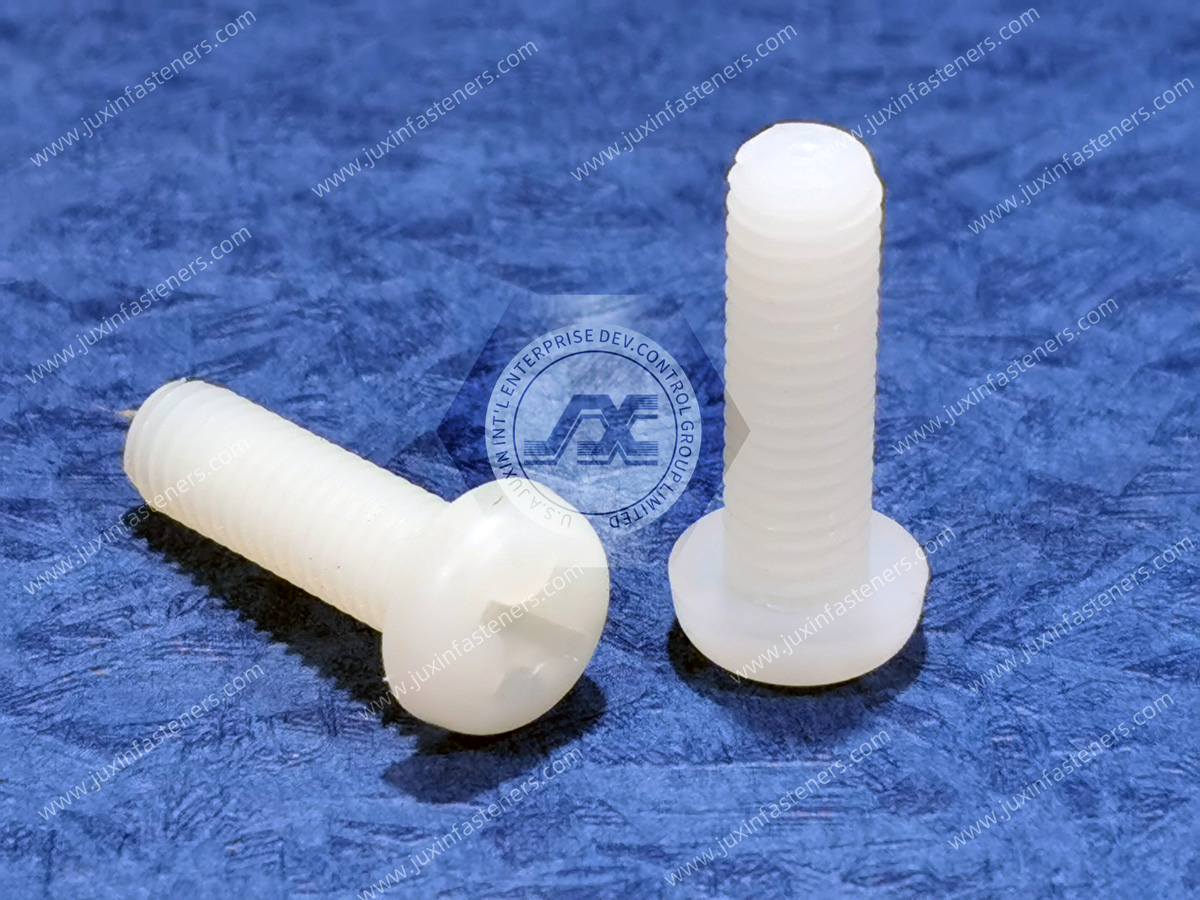
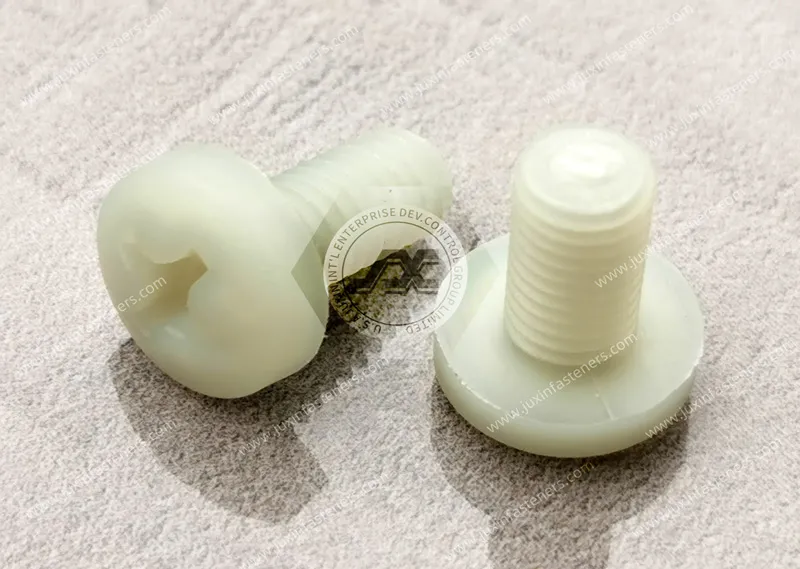
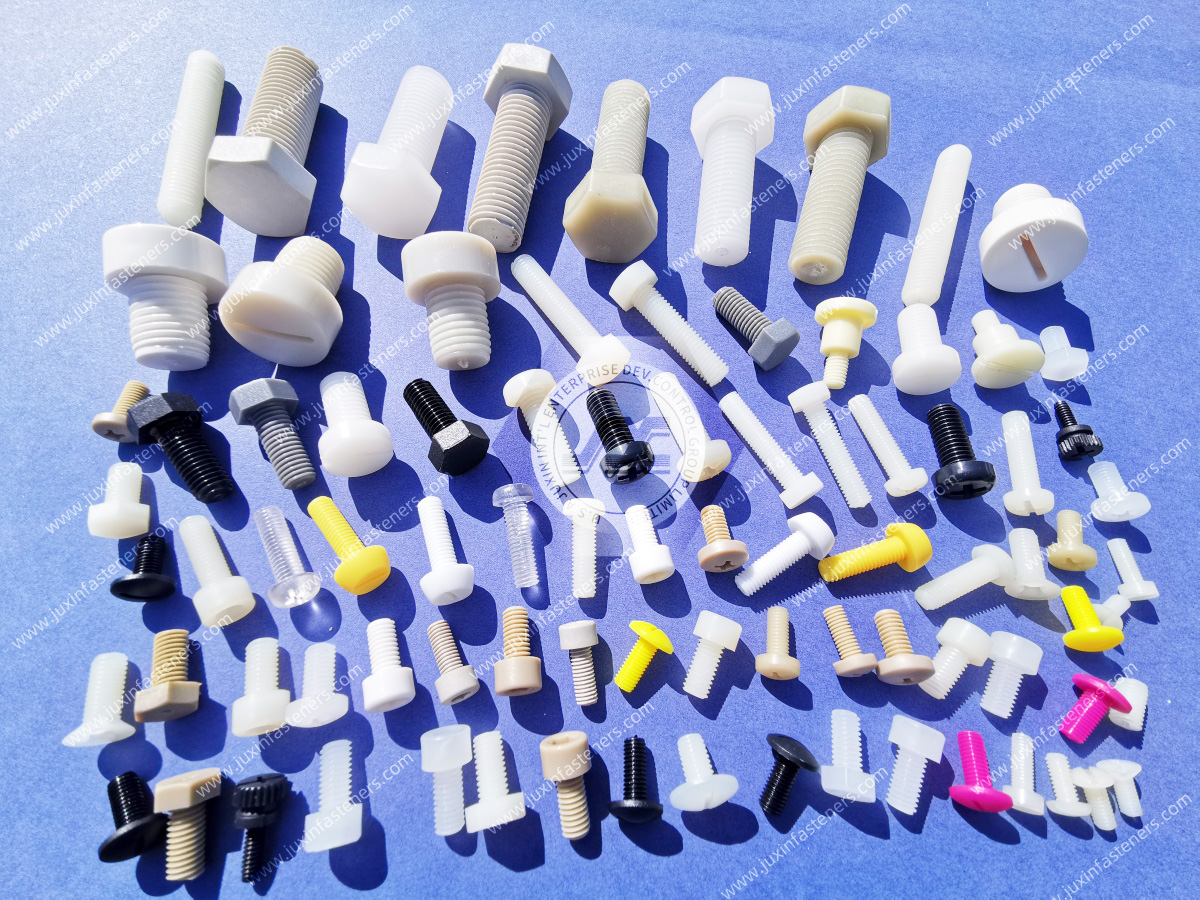
Pan head plastic machine screws provide a relatively broad under-head bearing surface combined with a compact head profile.
They are commonly used for:
electronic assemblies;
PCB mounting;
plastic housings;
electrical equipment;
instrumentation;
light-duty panel fastening.
The larger bearing area can help distribute installation load over softer substrates compared with smaller head profiles.
However, the actual bearing pressure must still be evaluated against the substrate material and installation torque.
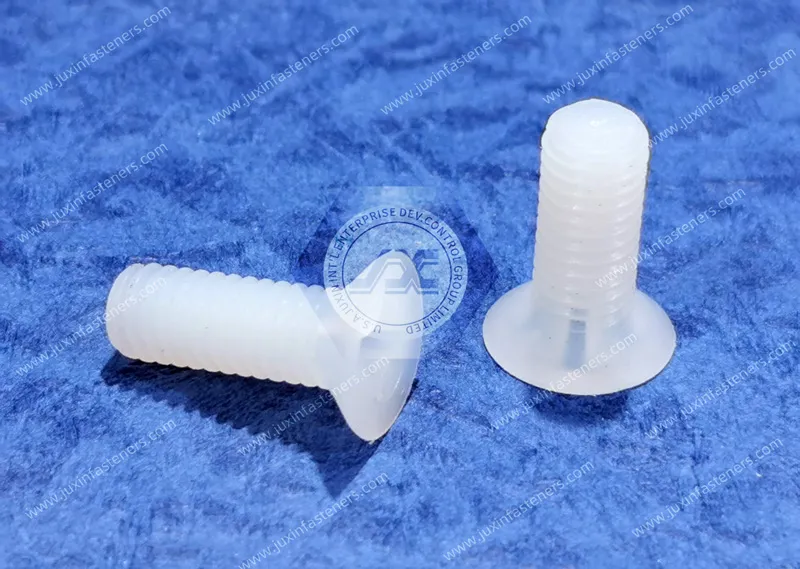
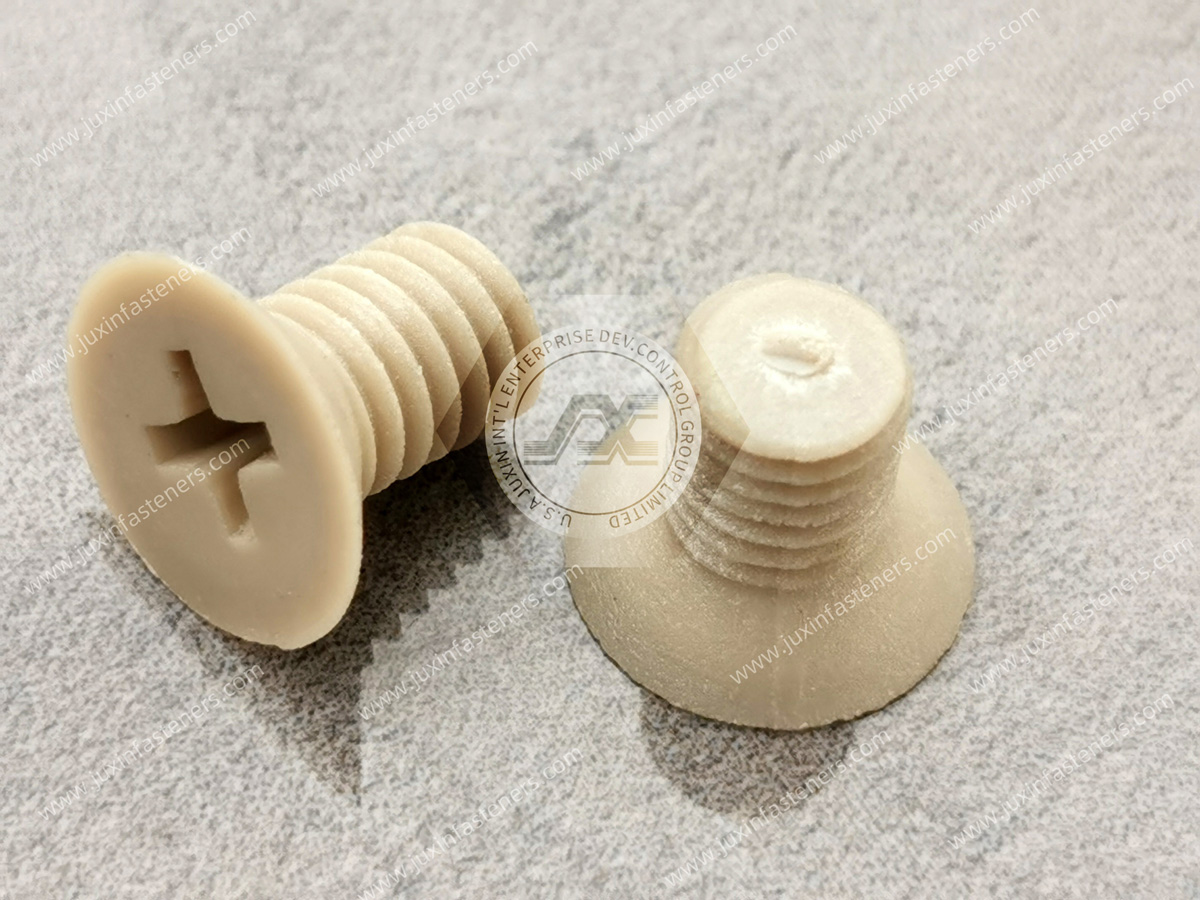
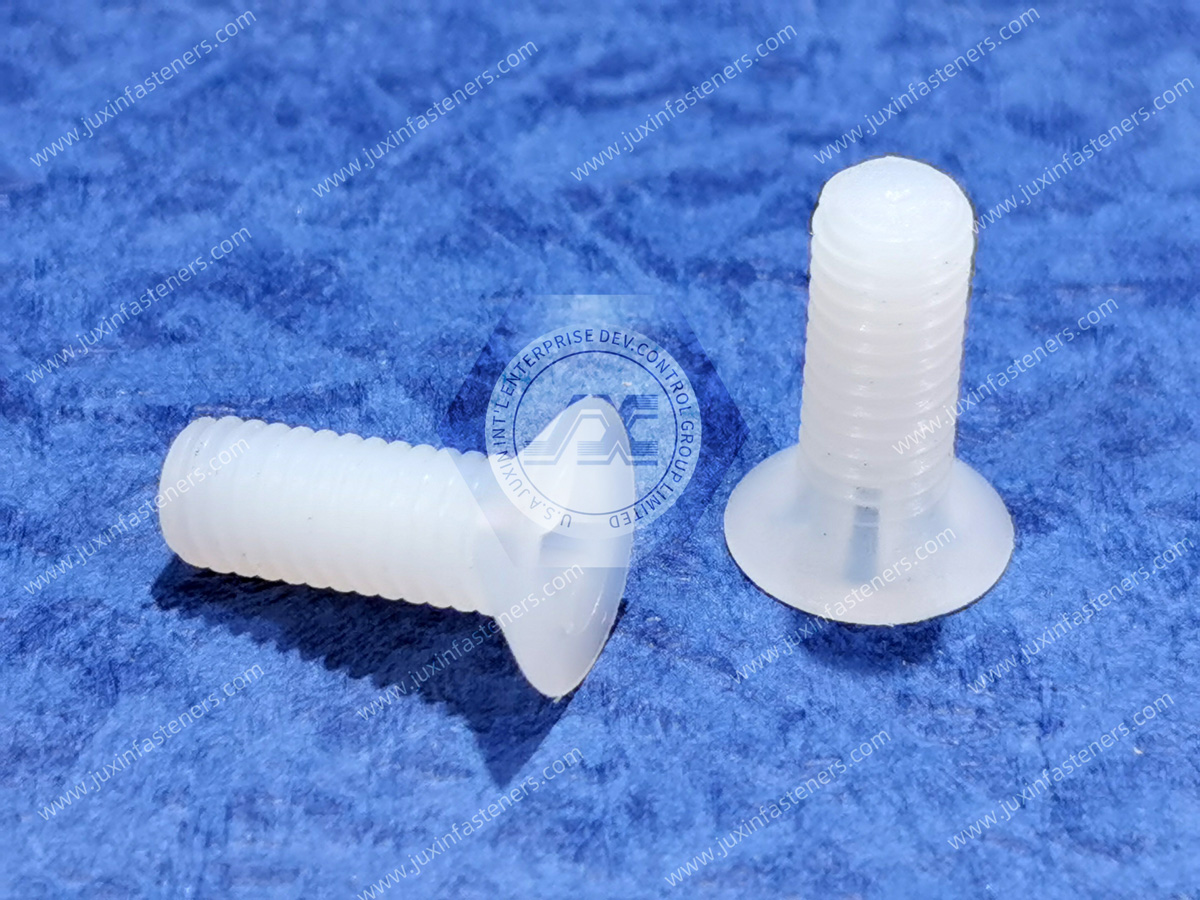
Countersunk nylon screws are used where the fastener head must sit flush or below the surrounding surface.
Applications can include:
enclosure panels;
equipment covers;
instrumentation;
electrical assemblies;
low-profile mounting interfaces.
The screw head angle must correspond to the mating countersink geometry.
Depending on the fastener system, applications may use metric or inch-series countersunk geometries.
The actual drawing should control the head angle rather than assuming that all countersunk screws use the same profile.
This is particularly important during second-source qualification.
Same Thread + Same Length + Different Head Angle = Potentially Incompatible Fastener
Cheese-head and fillister-style plastic machine screws can provide additional head height and drive engagement for equipment assemblies where vertical clearance permits.
They can be useful in:
electrical hardware;
instrumentation;
electronics;
machinery;
equipment housings.
Head diameter, head height, drive geometry, and bearing surface should all be verified against the original drawing.
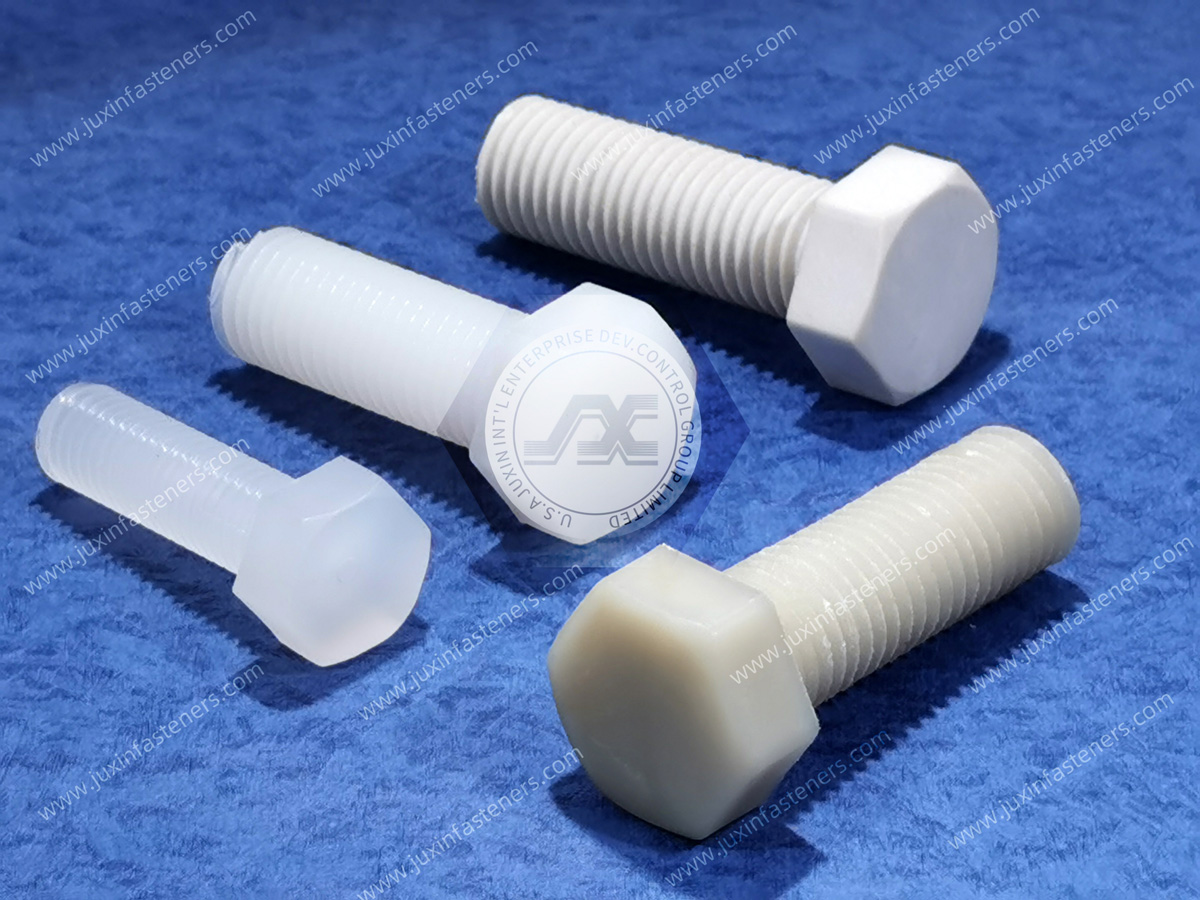
Plastic hex-head bolts allow installation with standard wrenching interfaces while providing the electrical and corrosion advantages of polymer hardware.
They may be selected for:
electrical equipment;
light-duty mechanical assemblies;
enclosures;
chemical-processing hardware;
equipment requiring non-metallic fastening.
A hexagonal head does not mean that a plastic bolt can accept the same installation torque as a metal bolt of equivalent nominal thread size.
Material limits still control the joint.
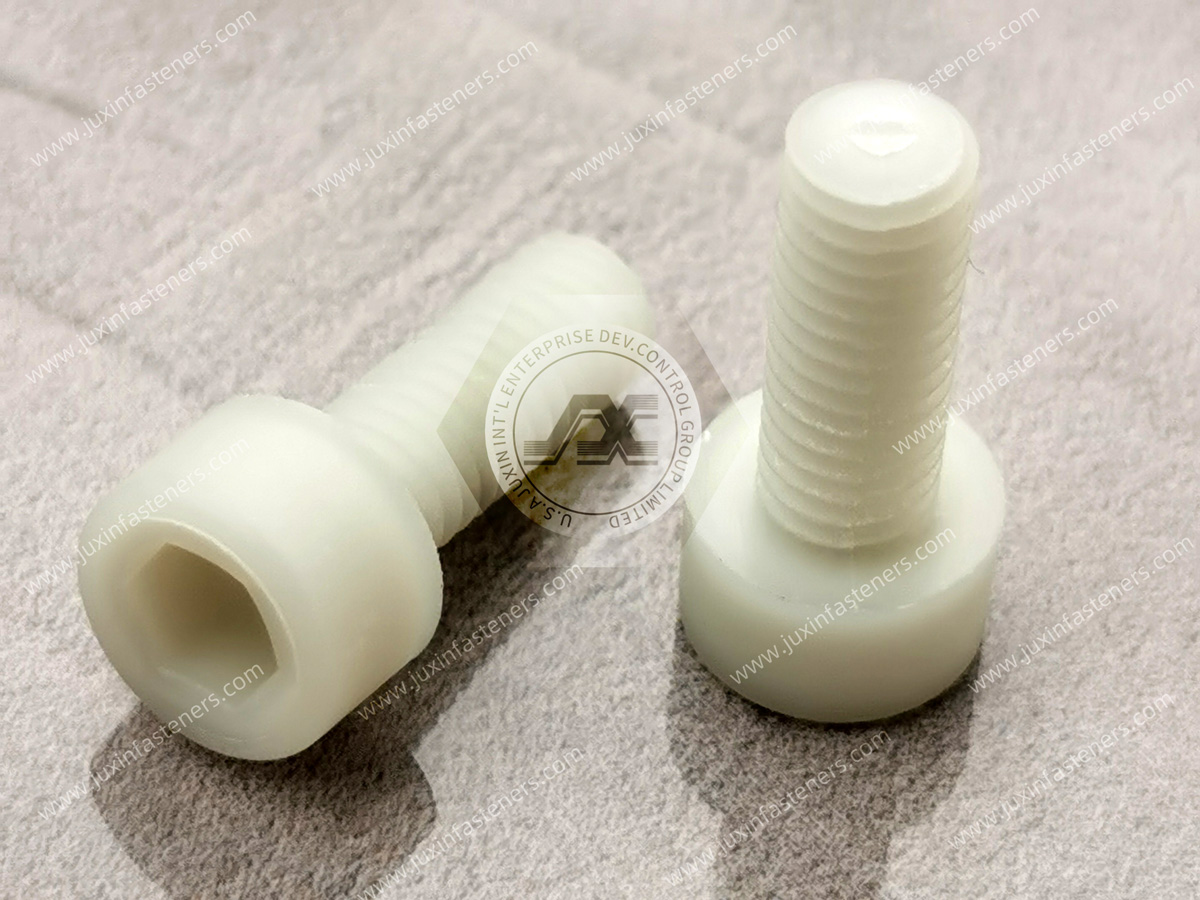
Internal-drive plastic screws can be useful where external head clearance is restricted.
However, socket geometry removes material from the screw head.
For molded polymer fasteners, drive recess depth, wall thickness, material toughness, and applied installation torque must therefore be considered together.
Excessive torque can cause:
drive rounding;
head splitting;
torsional failure;
thread damage.
Plastic machine screws can be produced with common metric and inch-series machine thread forms depending on the product and project.
Typical engineering references can include applicable ISO metric screw thread systems and ASME Unified Inch screw thread systems.
However, the nominal thread designation alone does not establish complete interchangeability.
Engineers and procurement teams should confirm:
nominal diameter;
thread pitch or threads per inch;
thread form;
effective thread length;
overall length;
head geometry;
drive style;
mating-thread material;
required fit.
For replacement sourcing:
M4 Is Not a Complete Specification
and
#8-32 Is Not a Complete Specification
The complete interface must be evaluated.
PA66 is one of the most common engineering polymers used for nylon machine screws and related fastening components.
Depending on grade and condition, PA66 can provide a useful balance of:
mechanical strength;
toughness;
fatigue resistance;
electrical insulation;
wear resistance;
corrosion resistance;
moldability.
It is suitable for many industrial and electronic fastening applications.
However:
PA66 Is a Material Family, Not a Complete Material Specification
Mechanical performance depends on the actual resin formulation, moisture condition, temperature, geometry, and manufacturing process.
POM may be considered where dimensional stability and relatively low moisture absorption are important.
Potential applications can include:
precision equipment;
instrumentation;
repeated threaded adjustment;
mechanisms requiring dimensional consistency.
Material suitability must still be evaluated against the operating environment and mechanical load.
PVDF may be evaluated for project-specific applications requiring enhanced chemical resistance or specialized environmental performance.
Applications can include selected:
chemical-processing equipment;
fluid-handling equipment;
specialized electrical assemblies.
PVDF should be treated as an application-specific material selection rather than a universal replacement for PA66.
PEEK may be considered for specialized projects involving demanding temperature, chemical, or engineering requirements.
Potential applications can include:
semiconductor equipment;
specialized industrial equipment;
high-temperature assemblies;
advanced electronic systems.
PEEK fastening projects should be reviewed according to the actual drawing, load, environment, quantity, and material requirements.
Glass reinforcement can increase stiffness and improve certain mechanical properties of nylon.
However, reinforced nylon is not automatically the best choice.
Glass-filled materials can change:
elongation;
impact behavior;
surface characteristics;
electrical properties;
molding behavior;
thread response.
They can also be more aggressive toward sensitive mating surfaces than unfilled nylon.
Material selection therefore requires a trade-off analysis rather than simply choosing the polymer with the highest published tensile strength.
PA66 is hygroscopic.
It absorbs moisture from the surrounding environment, and this changes its mechanical and dimensional behavior.
Compared with dry-as-molded material, conditioned nylon can exhibit changes in:
stiffness;
toughness;
dimensions;
tensile behavior;
thread fit;
torque response.
This matters because a screw that performs one way immediately after molding may behave differently after reaching moisture equilibrium in service.
For precision assemblies, engineers should consider whether validation is being performed in:
dry-as-molded condition;
conditioned condition;
representative operating humidity.
This is particularly relevant for tight thread fits and dimension-sensitive assemblies.
One of the most important engineering mistakes in plastic fastening is assuming that a given installation torque creates a predictable clamp load in the same way across different materials.
Torque is consumed by multiple interfaces:
Input Torque → Thread Friction + Under-Head Friction + Fastener Tension
For plastic fasteners, the relationship is influenced by:
polymer material;
moisture condition;
mating material;
surface condition;
thread geometry;
head geometry;
temperature;
installation speed.
Therefore:
Torque Value ≠ Guaranteed Clamp Load
A torque value validated for one nylon screw assembly should not automatically be transferred to another assembly simply because the nominal thread size is identical.
A universal statement such as:
“M4 nylon screws should always be tightened to X torque”
can be misleading.
Two M4 plastic screws may differ in:
resin;
head design;
thread geometry;
length;
mating material;
temperature;
moisture condition.
The safe installation torque can therefore differ.
For engineering qualification, torque should be validated using the actual fastener and mating assembly.
Excessive installation torque can produce several different failures.
The external polymer threads deform or shear before sufficient preload is achieved.
Where the mating component is also polymer, the internal thread may strip first.
The screw can fail at the transition between the head and shank when excessive torque is transmitted through the head.
Phillips, slotted, hex socket, or other drive features can deform before the thread itself fails.
Even when the screw survives, excessive tightening can damage:
PCBs;
plastic housings;
thin panels;
brittle substrates.
The complete joint therefore determines the torque limit—not the screw alone.
A common engineering shortcut is to specify thread engagement as a fixed multiple of nominal screw diameter.
This can be useful as an initial design concept in some metallic joints, but it should not be treated as a universal requirement for polymer fasteners.
Required thread engagement depends on:
screw material;
mating-thread material;
nominal diameter;
pitch;
load;
temperature;
expected service life;
repeated assembly requirements.
For example:
Nylon Screw → Steel Thread
behaves differently from:
Nylon Screw → Nylon Nut
and differently again from:
Nylon Screw → Molded Plastic Boss
Thread engagement should therefore be validated for the actual assembly.
Plastic fasteners are viscoelastic.
Under sustained mechanical loading, their deformation and internal stress can change with time.
Two mechanisms are especially important.
Under approximately constant load, strain can gradually increase over time.
Under approximately constant deformation, internal stress can gradually decrease.
In a clamped joint, this can lead to reduction in preload.
The rate depends strongly on:
polymer type;
temperature;
initial stress;
time;
moisture;
joint geometry.
For detailed engineering analysis, see our Managing Polymer Creep & Stress Relaxation in Plastic Fasteners guide.
A common reaction to preload loss is to tighten the plastic screw more aggressively during assembly.
That can make the problem worse.
Higher initial stress can increase the risk of:
thread deformation;
local yielding;
creep;
head damage;
substrate crushing.
The correct engineering response is to redesign the joint where necessary rather than simply increasing torque.
A Nylon Flat Washer can increase the bearing area beneath the fastener head.
This can help reduce localized surface pressure on:
plastic housings;
circuit boards;
painted surfaces;
composite components.
The washer itself, however, is also a polymer component and can experience compressive creep.
Therefore the complete stack should be considered.
Where a metal screw must pass through a conductive panel while remaining electrically isolated, an Insulating Shoulder Washer may provide axial and radial separation around the fastener.
This is a different engineering function from replacing the metal screw with a nylon screw.
The designer should choose the architecture based on:
mechanical load;
electrical requirement;
available space;
service environment.
Engineering polymers generally respond to temperature changes differently from steel, stainless steel, aluminum, FR-4 circuit boards, and other assembly materials.
Temperature cycling can therefore change:
joint compression;
thread fit;
bearing pressure;
alignment.
Applications involving large temperature excursions should evaluate the complete material stack.
One of the major reasons for specifying nylon machine screws is electrical isolation.
Plastic screws can help prevent direct conductive contact between components.
Potential applications include:
PCB mounting;
busbar-adjacent hardware;
electrical enclosures;
power electronics;
switchgear;
instrumentation.
However:
Non-Conductive Fastener ≠ Complete Electrical Safety Compliance
The equipment designer must still evaluate applicable:
creepage;
clearance;
insulation;
grounding;
voltage;
temperature;
contamination;
regulatory requirements.
The fastener is only one part of the electrical insulation system.
When dissimilar metals are electrically connected in the presence of an electrolyte, galvanic corrosion can become an engineering concern.
A non-conductive polymer fastener or insulating component can help break the direct conductive path in suitable assemblies.
Applications can include interfaces involving:
aluminum;
stainless steel;
coated metals;
electronic chassis.
However, galvanic corrosion control depends on the complete joint architecture and environmental exposure.
Plastic threaded fasteners do not rust in the same way as carbon steel.
This can make them useful in:
humid equipment;
selected chemical environments;
outdoor systems;
electrical equipment.
But “corrosion resistant” should not be interpreted as “chemically resistant to everything.”
Polymer compatibility must be evaluated against the actual:
chemicals;
cleaners;
oils;
fuels;
solvents;
temperature.
Plastic fasteners can provide useful damping characteristics, but polymer material alone does not guarantee resistance to loosening.
Vibration performance depends on:
preload;
joint stiffness;
thread geometry;
mating material;
temperature;
dynamic loading.
Where vibration is significant, the joint should be validated under representative conditions.
Some equipment requires screws to be removed and reinstalled repeatedly during:
maintenance;
calibration;
inspection;
component replacement.
Repeated cycling can change:
thread geometry;
drive condition;
installation torque;
retention.
Service-cycle requirements should therefore be included during fastener selection.
Nylon machine screws are frequently considered for:
circuit board mounting;
electronic housings;
sensor modules;
control boards;
low-load electronic assemblies.
They can be combined with:
Nylon Hex Nuts;
Nylon Flat Washers;
Plastic Spacers and Standoffs;
Snap-Fit Circuit Board Supports.
The correct solution depends on whether the PCB requires threaded retention, snap-fit assembly, fixed spacing, or serviceability.

Potential applications include:
insulating covers;
terminal barriers;
control assemblies;
low-load mounting interfaces;
electrical enclosures.
Engineers should define:
electrical function;
temperature;
required clamp load;
material;
flammability requirement where applicable.
AI data centers and high-performance computing infrastructure increasingly contain dense power-distribution, cooling-control, monitoring, networking, and electronic subsystems.
Plastic threaded fasteners may be evaluated for selected applications requiring:
electrical isolation;
lightweight mounting;
PCB retention;
sensor mounting;
non-corrosive hardware;
non-metallic spacing systems.
Potential equipment includes:
rack-level electronics;
power distribution units;
control modules;
monitoring systems;
cooling-control hardware.
Material and mechanical requirements must be evaluated according to the actual operating environment rather than assuming all data-center applications require the same polymer.
Inverters, converters, UPS equipment, rectifiers, power supplies, and industrial drives combine electrical isolation requirements with elevated operating temperatures.
For these applications, engineers should evaluate:
continuous temperature;
thermal cycling;
clamp-load requirement;
creepage and clearance architecture;
polymer grade.
Semiconductor manufacturing equipment can require plastic fasteners for selected electrically isolated, corrosion-resistant, precision, or non-metallic assemblies.
Depending on the process environment, project-specific materials such as POM, PVDF, or PEEK may require evaluation.
Material selection must be based on actual application requirements and drawing specifications.
Battery energy storage systems, solar power electronics, energy-conversion equipment, and associated control systems contain numerous electronic and electrical subassemblies.
Potential plastic fastener applications include:
monitoring electronics;
sensor assemblies;
control boards;
insulating covers;
low-load enclosure hardware.
Outdoor or elevated-temperature applications require additional environmental review.
Telecommunications equipment can use nylon machine screws in:
electronic modules;
control equipment;
communication hardware;
rack systems;
power distribution assemblies.
Requirements can include electrical isolation, low weight, corrosion resistance, and maintenance accessibility.
Plastic threaded fasteners may be used in selected medical, laboratory, and analytical equipment assemblies.
Project-specific requirements may involve:
material compatibility;
electrical isolation;
chemical exposure;
cleaning agents;
repeated servicing.
Regulatory and material requirements must be defined by the equipment manufacturer.
Automation systems contain:
sensors;
controllers;
electronic modules;
instrumentation;
cable-management hardware.
Nylon screws may provide electrically isolated mounting for selected low-load assemblies.
For high-vibration applications, actual joint performance should be validated.
Possible causes:
excessive torque;
insufficient thread engagement;
incompatible mating thread;
damaged threads;
temperature or material condition.
Possible causes:
excessive installation torque;
restricted head geometry;
drive misalignment;
unsuitable material or design.
Possible causes:
polymer stress relaxation;
creep;
temperature;
joint-stack compression;
insufficient initial joint design.
Possible causes:
incorrect thread pitch;
dimensional mismatch;
damaged mating thread;
moisture-related dimensional change;
cross-threading.
Possible causes:
excessive tightening;
insufficient bearing area;
poor boss design;
countersink mismatch;
brittle substrate.
Failure diagnosis should evaluate:
Fastener + Mating Thread + Joint Stack + Torque + Material + Environment
rather than treating the screw as an isolated component.
Procurement teams frequently begin with:
“We need an M4 nylon screw.”
That is not enough information to establish interchangeability.
Two M4 nylon screws can differ in:
pitch;
head style;
head diameter;
head height;
drive;
length;
threaded length;
material;
color;
dimensional tolerance.
Therefore:
Same Thread Size ≠ Same Part
For second-source qualification, the complete interface should be reviewed.
For practical sourcing review, verify:
Thread system
Nominal diameter
Pitch / TPI
Length
Head geometry
Drive style
Material
Application environment
For critical assemblies, also review:
installation torque;
required clamp load;
operating temperature;
moisture;
chemical exposure;
vibration;
service life.
Provide:
manufacturer;
manufacturer part number;
OEM part number;
drawing;
physical sample;
photographs.
Confirm:
metric or unified thread;
nominal diameter;
pitch / TPI;
thread length;
mating-thread material.
Confirm:
head style;
head diameter;
head height;
drive type;
countersink geometry where applicable.
Specify:
PA66;
POM;
PVDF;
PEEK;
reinforced material where applicable;
project-specific resin requirements.
Provide:
required clamp function;
installation torque;
tensile load;
shear load;
vibration;
repeated service cycles.
Provide:
operating temperature;
humidity;
chemicals;
UV exposure where applicable;
electrical requirements.
Verify:
thread fit;
installation feel;
head seating;
torque behavior;
mating-component compatibility.
Where required, evaluate:
torque-to-failure;
pull-out;
tensile loading;
thermal cycling;
vibration;
long-term joint retention.
Compare the candidate part against the approved reference for:
dimensions;
material;
installation;
functional performance.
After technical approval, proceed with:
production quantity;
annual usage;
quality requirements;
packaging;
traceability;
delivery schedule.
Standard nylon machine screws cover many common requirements.
However, OEM assemblies may require:
special head profiles;
non-standard lengths;
reduced head diameters;
special shoulders;
custom thread lengths;
captive features;
proprietary geometry;
specialized polymer materials.
Juxin Fasteners can support drawing-based plastic fastener projects through:
2D drawing review;
3D CAD review;
physical sample comparison;
material evaluation;
dimensional review;
DFM discussion;
sample validation;
production sourcing.
See our Custom Molded Plastic Fasteners solutions for drawing-specific polymer components.
For faster engineering review and quotation, provide as much of the following information as possible.
thread system;
nominal diameter;
pitch / TPI;
overall length;
threaded length;
head style;
head diameter;
head height;
drive type.
metal thread;
plastic nut;
molded plastic boss;
insert;
other interface.
PA66;
POM;
PVDF;
PEEK;
other specified polymer;
reinforced or unfilled grade;
color where required.
installation torque;
required clamp load;
tensile load;
shear load;
vibration;
service cycles.
minimum temperature;
maximum temperature;
humidity;
chemical exposure;
UV exposure;
electrical requirements.
RoHS;
REACH;
material documentation;
dimensional inspection;
lot traceability;
other project-specific requirements.
sample quantity;
production quantity;
estimated annual usage;
delivery schedule;
packaging requirement;
existing supplier part number.
Providing the actual drawing and operating conditions significantly improves engineering review and second-source accuracy.
Related Juxin Fasteners engineering and product solutions include:
Nylon Hex Nuts for matched non-metallic threaded assemblies;
Nylon Flat Washers for increased bearing area and surface protection;
Insulating Shoulder Washers for axial and radial isolation around metallic fasteners;
Plastic Spacers and Standoffs for controlled component separation;
Plastic Set Screws & Insulating Grub Screws for non-marring positioning and adjustment;
Managing Polymer Creep & Stress Relaxation in Plastic Fasteners for long-term joint design;
Custom Molded Plastic Fasteners for drawing-specific OEM components.
These components should be selected as part of the complete assembly architecture rather than as independent catalog items.
Juxin Fasteners supports electronics manufacturers, electrical-equipment OEMs, switchgear companies, industrial automation manufacturers,
semiconductor-equipment companies, power-electronics manufacturers, AI data center and HPC infrastructure suppliers,
telecommunications-equipment companies, energy-storage manufacturers, renewable-energy equipment manufacturers, medical-equipment companies,
automotive electronics suppliers, robotics companies, instrumentation manufacturers, contract manufacturers, procurement teams,
and supplier-development organizations requiring standard or custom plastic threaded fasteners.
For nylon machine screw projects, the sourcing pathway can begin with:
Existing Part / Drawing / Sample → Thread & Geometry Review → Material & Environment Review → Torque & Load Review
→ Candidate Fastener → Physical Sample → Assembly Validation → Second-Source Qualification → Production RFQ
This process can support:
new product development;
metal-to-plastic fastener conversion;
electrical isolation requirements;
corrosion-control projects;
weight reduction;
existing component replacement;
supplier consolidation;
second-source qualification;
obsolete component replacement;
custom plastic fastener development.
Send us your existing manufacturer part number, OEM part number, 2D drawing, 3D CAD model, physical sample, thread specification,
mating material, operating temperature, torque requirement, electrical requirement, polymer specification, compliance requirements, and expected annual volume for technical review.
Email: info@juxinfasteners.com
Website: www.juxinfasteners.com
Product Packaging
Packaging Standard
At Juxin Fasteners, we apply standardized export packaging to ensure product protection, traceability, and compliance with international logistics requirements.
1. Standard Export Packaging
Unless otherwise specified, all products will be packed according to our factory standard export packaging, which includes:
Moisture-resistant inner protection
Poly bag or small box packing as required
Reinforced export cartons
Clear labeling with part number, specification, batch number, and quantity
Palletizing for sea or air shipment when necessary
Our standard packaging is designed to ensure safe transportation, efficient warehousing, and long-distance international shipping.
2. Customized Packaging Options
We also provide customized packaging solutions according to customer requirements, including but not limited to:
Private labeling
Customized barcodes
Specific carton dimensions
Retail packaging
Special pallet configuration
Customer-specific marking and identification
So that you know, customized packaging may involve additional costs and extended lead time depending on the complexity of the requirements.
3. Compliance & Quality Assurance
All packaging processes are controlled under our ISO 9001 quality management system to ensure consistency, traceability, and product integrity throughout the supply chain.
Product Pictures
Contact Us
Tel.:
+86 020 8621 0320
+86 020 3121 6067
E-mail:
Technical Support:
Navigation
SEND INQUIREY