Call Us
+86 136 6007 9809
Call Us
+86 136 6007 9809

Industrial OEMs designing electronic enclosures, control panels, electrical equipment, instrumentation, machinery,
and PCB assemblies often require more than a screw and nut to create a reliable fastening system.
Product Specification
Industrial OEMs designing electronic enclosures, control panels, electrical equipment, instrumentation, machinery,
and PCB assemblies often require more than a screw and nut to create a reliable fastening system.
Managing bearing pressure, protecting finished surfaces, maintaining electrical separation, establishing PCB clearance, controlling component height,
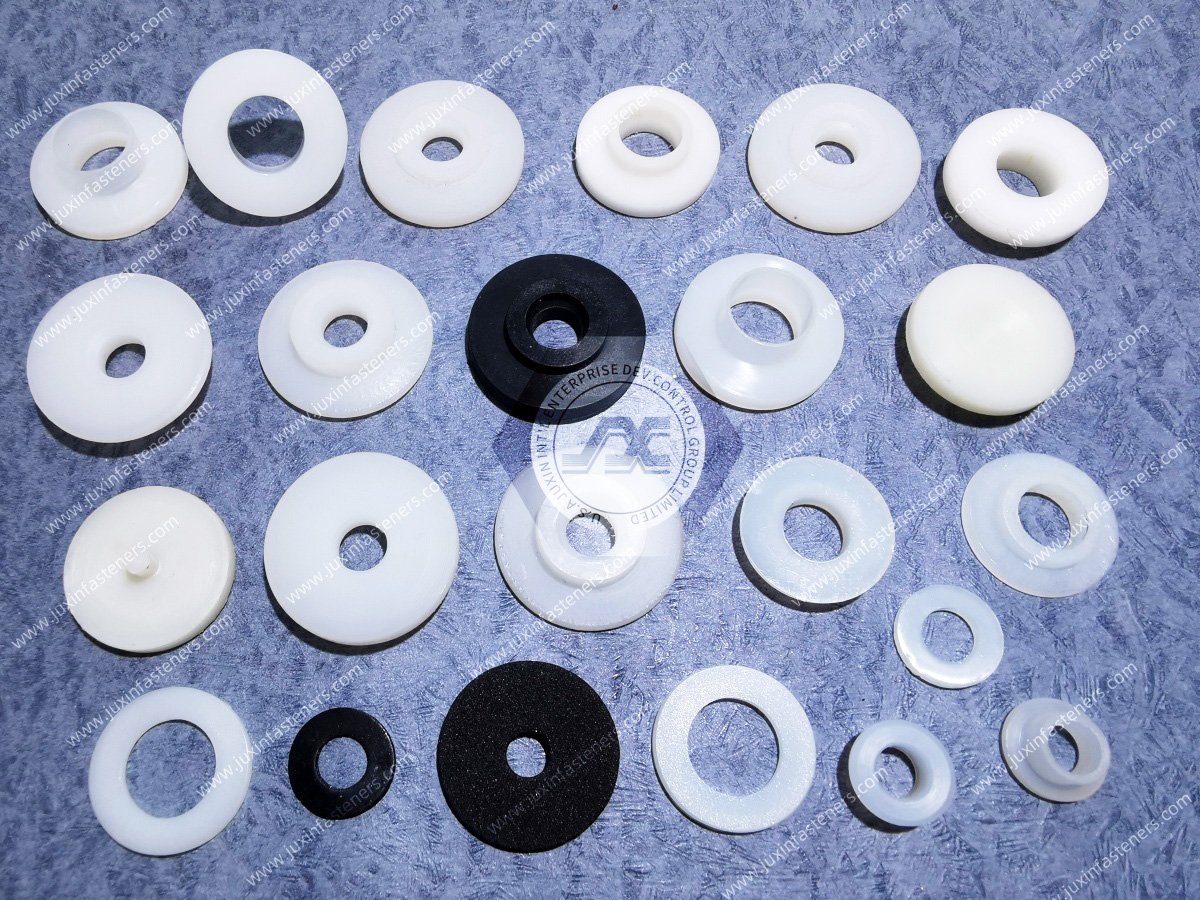
and accommodating dimensional stack-ups can require specialized plastic washers, nylon flat washers, shoulder washers, plastic spacers, insulating spacers, and PCB standoffs.
These components can provide useful mechanical or electrical functions without adding another metallic interface to the assembly.
However, they should not be treated as generic accessories. The correct material, inner diameter (ID), outer diameter (OD), thickness, length,
thread configuration, bearing area, and environmental resistance all depend on the actual joint design.
For example, a flat nylon washer and a shoulder washer may both be described as "insulating washers," but they perform different geometric functions.
A spacer and a PCB standoff may both establish separation, but one may be intended primarily for dimensional spacing while the other provides an integrated threaded mounting interface.
JUXIN FASTENERS provides industrial fastening and custom component solutions for OEM applications.
Product selection can be evaluated against technical drawings, CAD data, material requirements, application conditions, quantity, and multi-SKU sourcing requirements.
This guide explains how engineers and procurement teams can select and source plastic washers, nylon spacers, shoulder washers,
PCB standoffs, and related polymer hardware as part of a complete OEM fastening architecture.
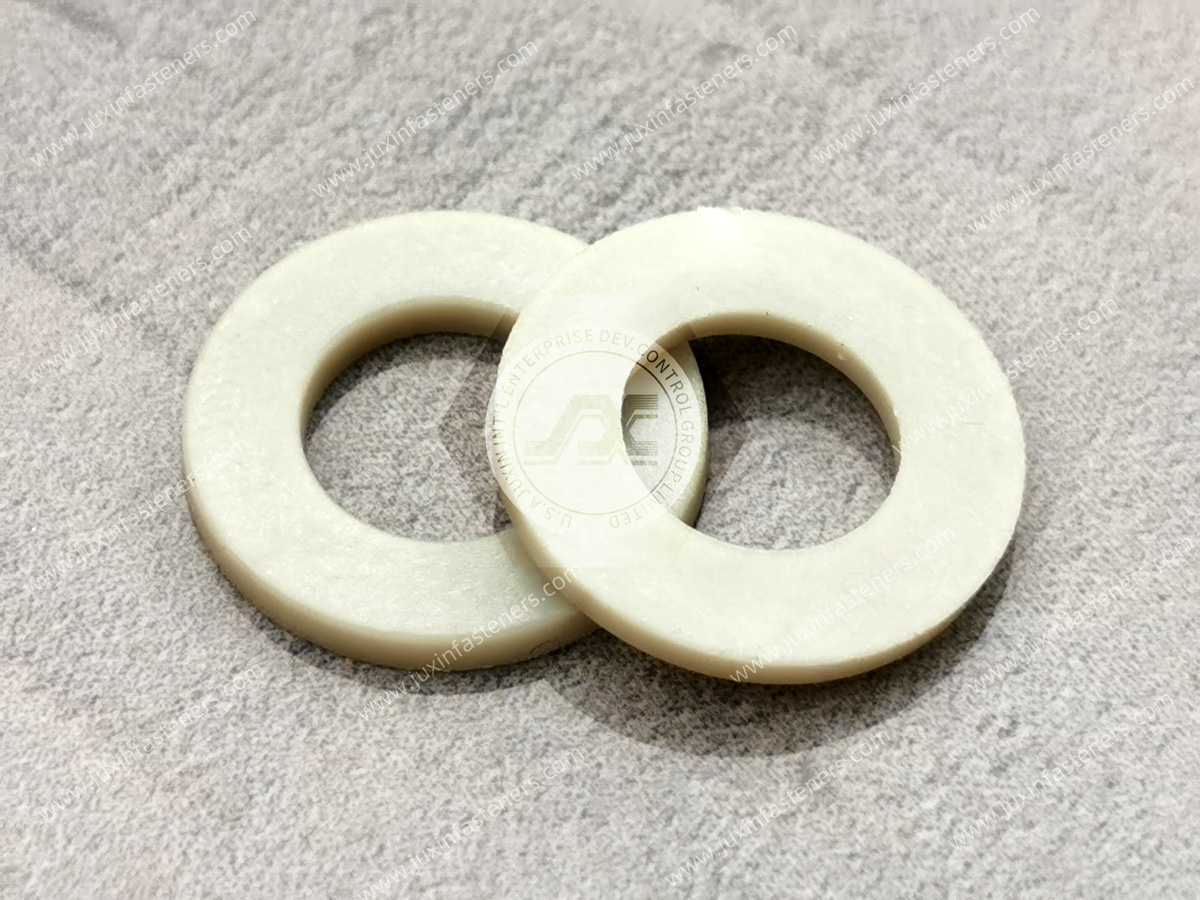
Design engineers and sourcing teams may consider plastic washers, insulating spacers, shoulder washers, and PCB standoffs when an assembly requires one or more of the following functions:
Load distribution: A flat washer can increase the bearing area between a fastener and the surrounding substrate, depending on the washer geometry and material.
Surface protection: A polymer washer may be considered where direct contact between a fastener and a finished, coated, painted, plastic, or composite surface needs to be controlled.
Electrical separation: A suitable polymer component can provide electrical isolation between a fastener and a conductive structure when the material and geometry are appropriate for the application.
PCB clearance: Standoffs and spacers can maintain a defined mechanical separation between a printed circuit board and an enclosure, chassis, or secondary board.
Dimensional positioning: Precision spacers can establish a controlled distance between two components or surfaces.
Shoulder isolation: A shoulder washer can isolate both the radial surface of a fastener shank and the axial bearing surface where the geometry is designed for that purpose.
The appropriate component depends on the required function. A washer should not automatically be substituted for a spacer, and a spacer should not automatically be treated as a PCB standoff.
The value of polymer spacing hardware comes from the engineering function it performs inside the assembly.
A screw or nut applies force over a relatively concentrated bearing area.
When that bearing area is too small for the surrounding substrate, the local stress can become significant. This can be particularly relevant for plastic housings, composite panels, coated sheet metal, painted surfaces, and other finished components.
A nylon flat washer or plastic washer increases the contact area and can distribute the applied load over a wider region.
However, washer diameter alone does not determine performance. Engineers should consider:
fastener preload
washer OD
washer ID
washer thickness
washer material
substrate material
substrate thickness
surface condition
temperature
long-term loading
A larger washer can change bearing pressure, but the surrounding substrate still needs to be capable of carrying the applied load.
Polymer components can exhibit time-dependent deformation when subjected to sustained mechanical loading.
For a washer or spacer under continuous compression, this can affect:
thickness
contact pressure
dimensional position
joint preload
long-term alignment
The magnitude of this behavior depends strongly on polymer family, specific grade, temperature, stress level, geometry, conditioning, and duration.
Therefore, an engineer should not select a polymer washer simply because its short-term compressive strength appears sufficient.
For long-duration applications, the complete load and environmental condition should be evaluated.
Electrical assemblies require careful distinction between clearance and creepage.
Clearance refers to the shortest distance through air between conductive parts.
Creepage refers to the shortest distance along an insulating surface between conductive parts.
A PCB standoff or insulating spacer can contribute to the physical geometry of an assembly, but simply installing a plastic component does not automatically establish compliance with a particular electrical safety requirement.
The required distances depend on the relevant equipment design, working voltage, pollution conditions, insulation system, material characteristics, and applicable safety standard.
For this reason, engineers should specify the required electrical geometry rather than simply requesting "an insulating spacer."
Plastic washers and PCB standoffs are normally part of a larger fastening architecture.
A complete OEM assembly may combine:
plastic screws
nylon bolts
plastic nuts
nylon lock nuts
nylon flat washers
shoulder washers
plastic spacers
PCB standoffs
threaded inserts
cable clamps
plastic clips
custom polymer components
A shoulder washer can be used where the screw needs radial separation from a conductive clearance hole.
The shoulder or barrel section occupies the clearance-hole interface, while the washer flange can also provide an insulating bearing surface.
This is different from a simple flat washer.
The actual geometry should be selected according to:
screw shank diameter
hole diameter
washer ID
shoulder OD
shoulder length
flange OD
substrate thickness
required isolation distance
A PCB assembly may use threaded or unthreaded standoffs to maintain a controlled mechanical separation between the circuit board and supporting structure.
A typical arrangement may include:
plastic screw → PCB → standoff → support structure
or:
metal screw → PCB → insulating standoff → enclosure
The material and thread configuration depend on the electrical, mechanical, temperature, and assembly requirements.
A spacer can establish a defined distance between components while washers distribute bearing loads at the interfaces.
This arrangement can be useful in:
control panels
electrical cabinets
instrumentation
industrial equipment
sheet-metal assemblies
electronics
communication equipment
The exact stack-up should be evaluated as one assembly rather than as independent catalog components.
The polymer family affects stiffness, dimensional stability, moisture behavior, chemical resistance, temperature capability, friction, and long-term deformation.
| Polymer Family | Typical Examples | General Characteristics | Potential Industrial Applications | Engineering Considerations |
|---|---|---|---|---|
| Nylon / Polyamide | PA6, PA66 | Widely used engineering polymer with useful strength-to-weight characteristics and electrical non-conductivity | PCB hardware, electrical enclosures, control equipment, appliances, machinery | Moisture absorption can affect dimensions and mechanical behavior; evaluate conditioning and environment |
| POM / Acetal | Homopolymer or copolymer grades | Good rigidity, low friction and useful dimensional behavior for many precision applications | Precision spacers, washers, alignment components, mechanical equipment | Evaluate long-term load, temperature and contact compatibility |
| PP | Polypropylene grades | Low density and useful chemical resistance in selected applications | Electrical components, equipment housings, lightweight assemblies | Lower stiffness than some engineering polymers may affect load-bearing applications |
| PC | Polycarbonate grades | Good impact resistance and useful dimensional performance in selected applications | Electronics, instrumentation, housings and industrial components | Chemical compatibility, temperature and stress-cracking conditions require evaluation |
| PVDF | PVDF grades | Strong chemical resistance in selected demanding environments | Chemical equipment, semiconductor-related equipment and specialized industrial assemblies | Select against actual chemical and thermal exposure |
| PEEK | PEEK grades | High-performance engineering polymer with strong thermal and mechanical characteristics | Specialized high-temperature equipment, electronics and demanding industrial applications | Material cost and application-specific processing requirements can be significant |
These material families should be treated as a selection framework rather than a universal ranking.
The correct polymer depends on the function of the component and the actual application environment.
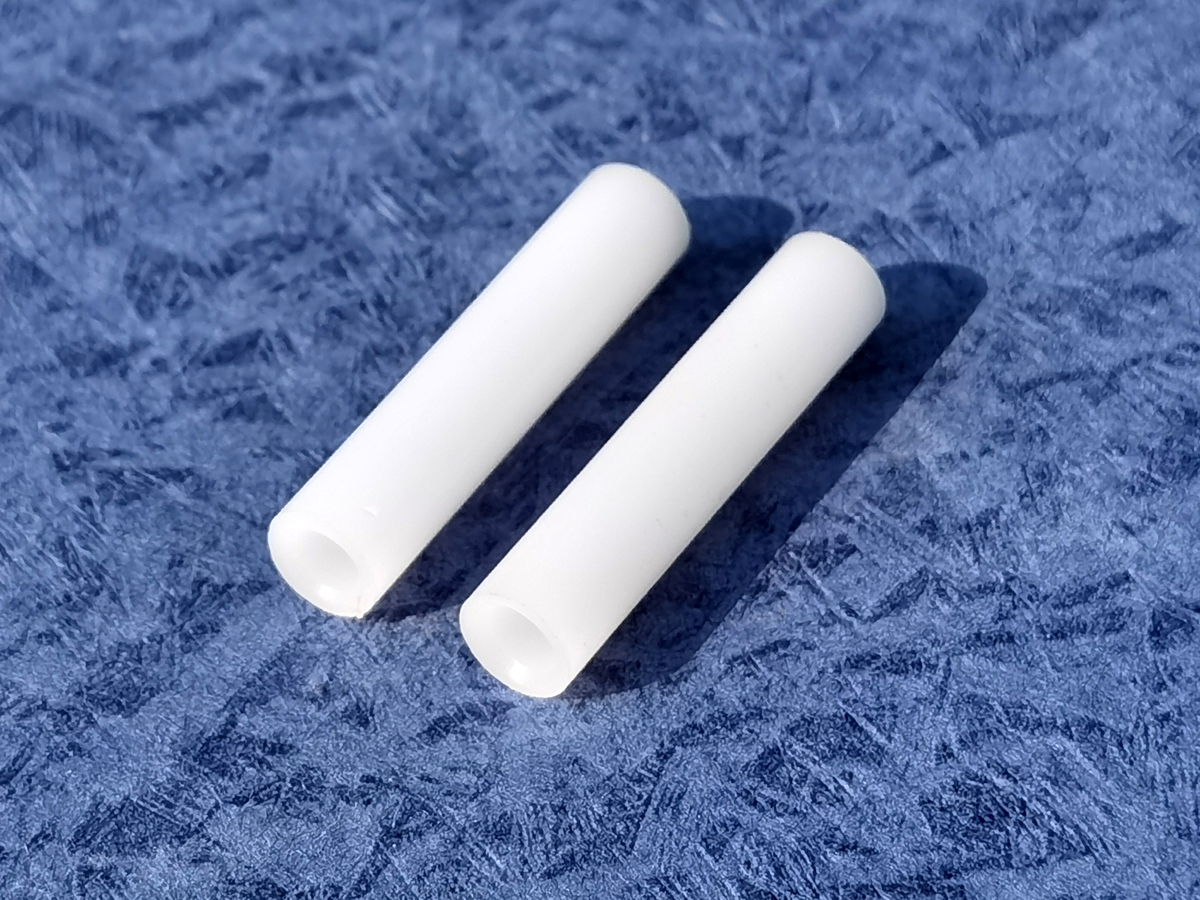
A spacer is often specified when the primary engineering requirement is to maintain a defined distance between two components.
Important dimensions may include:
inside diameter
outside diameter
overall length
wall thickness
end-face geometry
concentricity where relevant
material
tolerance
For example, a spacer between an enclosure and a PCB may need to maintain a specific board height. A spacer between two mechanical components may control axial positioning.
This means that spacer length is often a critical-to-function dimension, not merely a cosmetic dimension.
If a drawing specifies a narrow spacer-length tolerance, procurement should not substitute a nominally similar catalog part without engineering approval.
Different production routes may be appropriate depending on the part geometry, volume, tolerance requirements, and material.
Standard plastic washers, spacers, and standoffs can be suitable when:
dimensions already match the assembly
the material is acceptable
required tolerances are achievable
production volume supports the selected manufacturing route
no special geometry is required
A custom component may be required when the design contains:
non-standard ID or OD
unusual thickness
custom spacer length
special shoulder geometry
custom flange dimensions
special mounting features
non-standard thread configuration
application-specific tolerances
The appropriate production route depends on the component design, material, volume, tolerance requirements, and agreed manufacturing process.
For OEM programs, a controlled technical drawing is generally the most reliable starting point for determining the appropriate manufacturing approach.
A common sourcing mistake is to request:
"Nylon washer for an M6 screw."
That information may be insufficient.
An M6 screw can be used with washers having very different:
inner diameters
outer diameters
thicknesses
material grades
hardness characteristics
bearing areas
The engineer should instead define:
Mating fastener → required clearance → ID → OD → thickness → material → load → environment
This creates a more useful engineering specification.
For a shoulder washer, the same principle becomes even more important because the radial and axial dimensions interact with the enclosure or panel hole.
A complete RFQ gives engineering and procurement teams a common technical reference.
Identify the required component:
nylon flat washer
plastic flat washer
insulating washer
shoulder washer
plastic spacer
nylon spacer
PCB standoff
threaded standoff
unthreaded standoff
custom polymer spacer
custom insulating component
Specify the relevant dimensions:
ID
OD
thickness
overall length
shoulder diameter
shoulder length
flange diameter
thread size
thread pitch
across-flats dimension for hexagonal components
dimensional tolerances
Do not assume that a nominal fastener size defines all washer or spacer dimensions.
Provide a controlled 2D technical drawing for dimensional requirements.
A 3D CAD model can supplement the drawing and help review:
assembly fit
interference
clearance
component positioning
stack-up
enclosure geometry
Where there is a conflict, the customer's controlled drawing should define the applicable dimensional requirements.
Identify the polymer family and, where necessary, the specific grade.
Potential materials may include:
PA6
PA66
reinforced polyamide
POM
PP
PC
PVDF
PEEK
If the material has not yet been selected, provide the functional requirements so material suitability can be evaluated rather than assuming that all nylon or plastic materials behave equivalently.
Include:
expected compressive load
fastener preload
bearing requirements
dimensional stability requirements
assembly cycles
long-term loading
temperature exposure
vibration where relevant
Where electrical isolation is important, identify the actual design requirement.
Depending on the application, this may include:
isolation between fastener and chassis
required clearance
required creepage
dielectric requirements
working voltage
applicable safety standards
surrounding insulation system
"Insulating" should not be used as a substitute for the actual electrical design specification.
Identify relevant exposure to:
humidity
water
chemicals
oils
cleaning agents
UV
temperature cycling
outdoor conditions
Material selection should be based on the actual environment.
Procurement teams should also specify:
annual volume
initial order quantity
forecast
delivery requirements
packaging
labeling
multiple-SKU requirements
inspection documentation
quality requirements
For customers sourcing several plastic hardware families, multi-SKU consolidation can make supplier coordination more structured.
See the JUXIN FASTENERS Multi-SKU BOM Consolidation Guide for the broader sourcing approach.
A supplier comparison should go beyond unit price.
Can the supplier correctly interpret:
ID
OD
thickness
length
thread
material
tolerance
application requirements?
Can the supplier coordinate related components such as:
washers
spacers
standoffs
screws
nuts
threaded inserts
clips
cable clamps?
This can matter when an OEM wants to reduce the number of separate suppliers across a plastic hardware BOM.
Can the supplier identify missing or ambiguous information before quotation?
For example:
A drawing may specify an M6 screw but fail to define the required washer OD.
That missing dimension can materially change the component's bearing function.
Procurement should confirm that the quoted polymer matches the approved material requirement.
"Plastic," "nylon," and "engineering polymer" are broad categories rather than complete material specifications.
The supplier should understand:
critical dimensions
inspection criteria
appearance requirements
material requirements
packaging
identification
change-control expectations
For production programs, procurement should evaluate:
production planning
lead-time expectations
SKU management
packaging
communication
quality response
engineering change coordination
This gives procurement a more useful supplier-qualification framework than simply comparing initial quotations.
Different components have different critical dimensions.
| Component | Common Critical Dimensions | Primary Function |
|---|---|---|
| Flat Washer | ID, OD, thickness | Bearing area and surface separation |
| Shoulder Washer | ID, shoulder OD, shoulder length, flange OD, thickness | Radial and axial isolation |
| Spacer | ID, OD, length | Controlled mechanical separation |
| PCB Standoff | Thread, height, mounting geometry, body diameter | PCB positioning and support |
| Threaded Standoff | Thread size, thread length, height, body geometry | Mechanical support and threaded connection |
| Custom Insulating Component | Application-specific geometry and tolerances | Electrical and/or mechanical separation |
The most important dimension is therefore not always the thread.
For a spacer, length may be the dominant functional dimension.
For a washer, OD-to-ID relationship may determine the available bearing area.
For a shoulder washer, shoulder diameter and length can determine whether the component actually isolates the screw from the surrounding hole.

Electrical cabinets and control panels frequently contain conductive sheet-metal structures, electrical components, terminal assemblies, PCBs, cable systems, and mounting hardware.
Plastic washers and shoulder washers may be considered for:
electrical isolation
surface protection
load distribution
mounting hardware separation
enclosure assemblies
control equipment
instrumentation
A shoulder washer can be particularly useful when the screw must pass through a conductive panel without making direct contact with the panel around the screw shank.
The correct geometry should be designed around the actual panel thickness, hole diameter, screw size, and required electrical separation.
Electronic assemblies often require controlled spacing between:
PCB and enclosure
PCB and chassis
PCB and PCB
electronic module and support bracket
sensor and mounting structure
PCB standoffs and plastic spacers can establish these physical relationships.
Typical applications include:
PCB assemblies
control boards
sensors
instrumentation
electronic housings
industrial controllers
communication equipment
power electronics
The required standoff height should be based on the actual component stack-up.
For example, if a PCB contains components extending below its surface, the nominal board-to-chassis distance may not be sufficient by itself. Engineers should consider the complete assembly envelope.
Communications equipment may combine PCBs, metal frames, antennas, cables, brackets, and electronic modules.
Polymer washers, spacers, standoffs and clips may be evaluated for:
PCB positioning
electrical separation
cable routing
enclosure mounting
component clearance
weight-sensitive assemblies
Applications can include:
communication equipment
base stations
antenna systems
RF-related equipment
network hardware
electronic enclosures
The polymer should be selected according to the actual environmental and mechanical requirements rather than assuming that one nylon grade is suitable for every communications application.
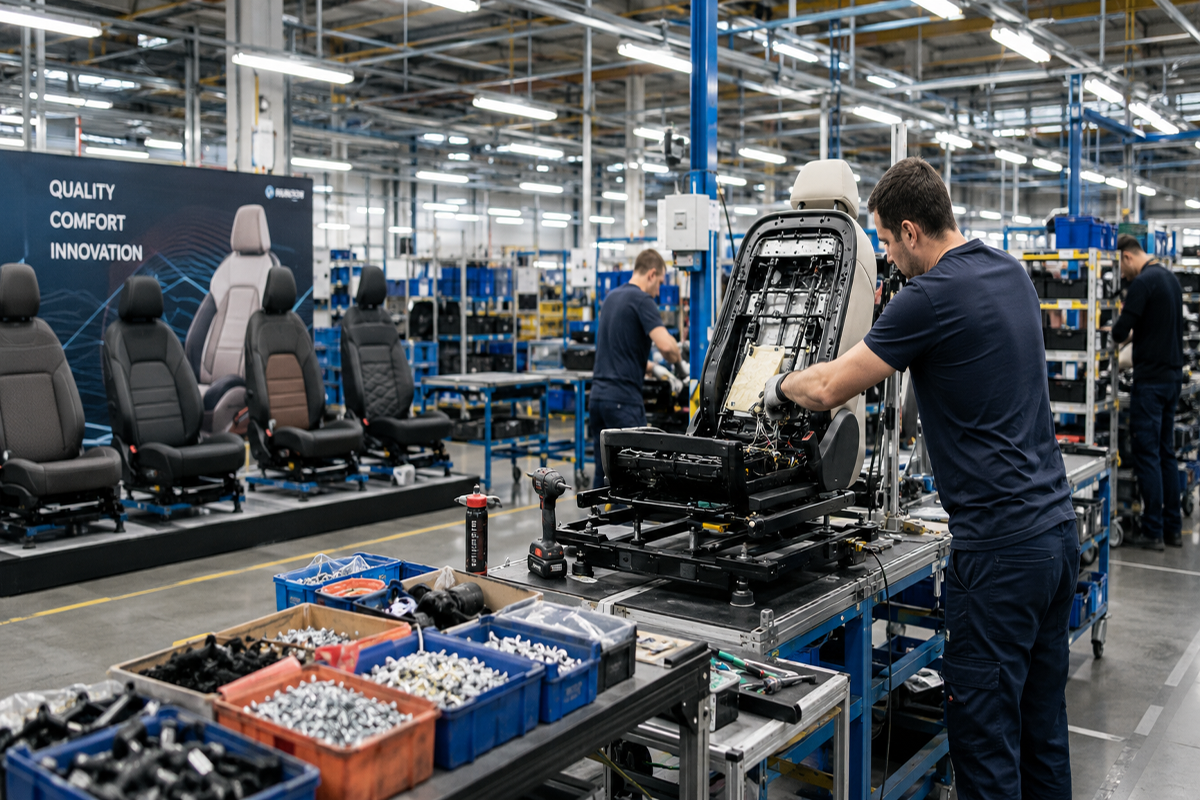
Automotive and EV systems contain combinations of metal, plastic, composite, electrical and electronic components.
Plastic spacing hardware may be considered for:
electronic housings
sensors
control modules
cable systems
secondary brackets
electrical assemblies
selected battery-related components
Depending on the installation location, engineers may need to evaluate:
temperature
vibration
moisture
chemical exposure
dimensional stability
electrical separation
long-term loading
The actual component location and function should determine the material and geometry.
HVAC systems, machinery, automation equipment, robotics, and sheet-metal assemblies can use plastic washers and spacers for:
load distribution
surface protection
electrical separation
component positioning
enclosure mounting
clearance control
Applications may include:
HVAC control panels
electrical cabinets
automation equipment
robotics
industrial machinery
sheet-metal fabrication
instrumentation
sensors
For highly loaded structural joints, polymer spacing hardware should be evaluated against the complete joint load path rather than selected only for its non-metallic properties.
A shoulder washer is useful when a flat washer is not sufficient because the fastener needs radial separation from the surrounding mounting hole.
A typical shoulder washer includes:
a central opening for the fastener
a raised cylindrical shoulder
a flange or washer section
The shoulder occupies the clearance hole and can separate the screw shank from the conductive or sensitive surrounding material.
This creates two distinct functions:
Radial isolation: the shoulder separates the fastener shank from the hole wall.
Axial bearing: the flange provides separation between the fastener head and the surrounding surface.
This is why a shoulder washer should not simply be treated as a thicker flat washer.
A washer primarily manages the interface around a fastener.
A spacer primarily establishes a defined distance between two components.
A simplified decision rule is:
Need more bearing area? → Consider a washer.
Need controlled separation? → Consider a spacer.
Need PCB mounting height? → Consider a standoff.
Need radial and axial screw isolation? → Consider a shoulder washer.
Need a durable threaded interface integrated into plastic? → Consider a threaded insert.
These functions can also be combined in one assembly.
If the requirement is not simply spacing but a durable threaded interface inside a plastic housing, a threaded insert for plastic may be more appropriate than a standalone plastic spacer or nut.
Threaded inserts can be considered where the design requires:
repeated assembly
stronger internal threads
improved thread durability
a metal mating thread within a polymer component
integration into a plastic housing
Depending on the insert and housing design, installation methods may include heat-staking, ultrasonic installation, press-in installation, or other application-specific methods.
For a deeper discussion of threaded interfaces in plastic housings, see the JUXIN FASTENERS guide Threaded Inserts for Plastic: Industrial Design Guide.
"Insulating spacer" describes a product category, but it does not completely describe an electrical requirement.
An engineer should ask:
What exactly must be electrically separated?
For example:
screw from chassis
PCB from enclosure
conductive bracket from PCB
two conductive components
mounting hardware from a live assembly
Then define:
voltage → required clearance → required creepage → material → geometry → temperature → environment
This produces a much stronger specification than simply writing "nylon insulating spacer."
It also gives suppliers enough information to identify whether a standard component is appropriate or whether a custom component should be considered.
For many OEM products, spacing components are only one part of a larger plastic hardware program.
A BOM may contain:
nylon screws
plastic bolts
plastic nuts
nylon lock nuts
flat washers
shoulder washers
spacers
PCB standoffs
threaded inserts
cable clamps
plastic clips
custom polymer components
Procurement teams can group these components by:
function → material → dimensional family → application → quality requirement → annual demand
This can make it easier to identify opportunities for multi-SKU sourcing and reduce unnecessary supplier fragmentation.
For a broader sourcing strategy, see the JUXIN FASTENERS Custom Plastic & Nylon Fastener Sourcing Guide.
Before approving a supplier, procurement and engineering teams can ask:
Can the supplier review controlled 2D drawings?
Can the supplier work with 3D CAD data where required?
Can the supplier identify missing ID, OD, thickness or length requirements?
Can the supplier support the specified polymer family and grade?
Can the supplier coordinate washers, spacers, standoffs and related plastic fasteners?
Can the supplier identify critical-to-function dimensions?
Can the supplier provide samples when engineering validation requires them?
Can the supplier work to agreed inspection requirements?
Can the supplier manage multiple plastic hardware SKUs?
Can the supplier support engineering changes through controlled communication?
These questions move the sourcing process from simple product purchasing toward OEM supplier qualification.
Quality requirements should be connected to the function of the component.
Typical inspection points may include:
ID
OD
thickness
length
thread dimensions where applicable
shoulder diameter
shoulder length
flange geometry
material
color
surface appearance
burrs or other production-related defects
assembly fit
For PCB standoffs, thread fit and standoff height may be particularly important.
For shoulder washers, the shoulder dimensions can be critical because even a small mismatch can affect radial isolation or panel fit.
For spacers, length tolerance may directly affect the assembly stack-up.
Customers should identify critical-to-function dimensions and acceptance criteria in the technical documentation.
Applicable ISO, DIN, ASME/ANSI, EN, BS, SAE, ASTM, or customer-specific requirements should be referenced where relevant to the particular product.
A standard reference does not automatically define every performance characteristic of a custom polymer component.
Standard products may be suitable when:
dimensions already match
material is acceptable
tolerance is sufficient
no special geometry is required
application conditions are within the component's intended range
Custom components may be more appropriate when the assembly requires:
non-standard dimensions
special shoulder geometry
custom spacer length
unusual ID/OD combinations
integrated mounting features
specific polymer requirements
application-specific tolerances
For custom components, the most useful starting point is usually a controlled drawing showing the complete geometry and critical requirements.
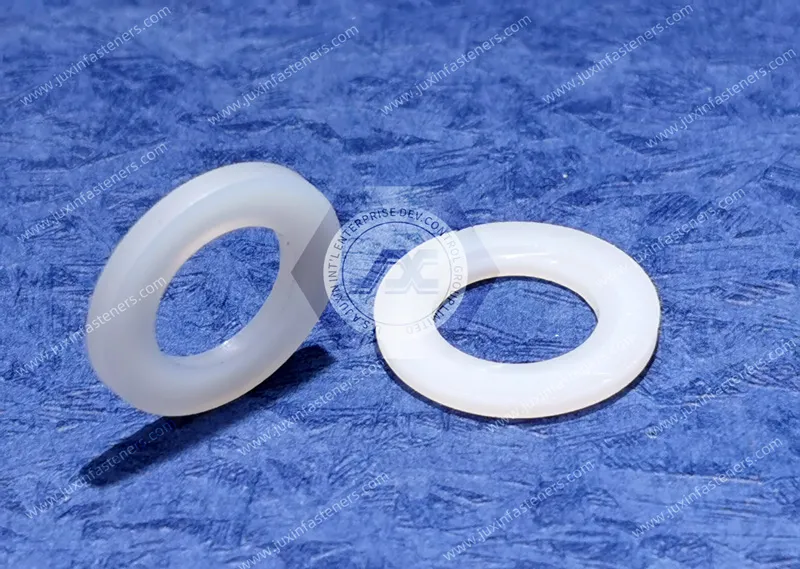
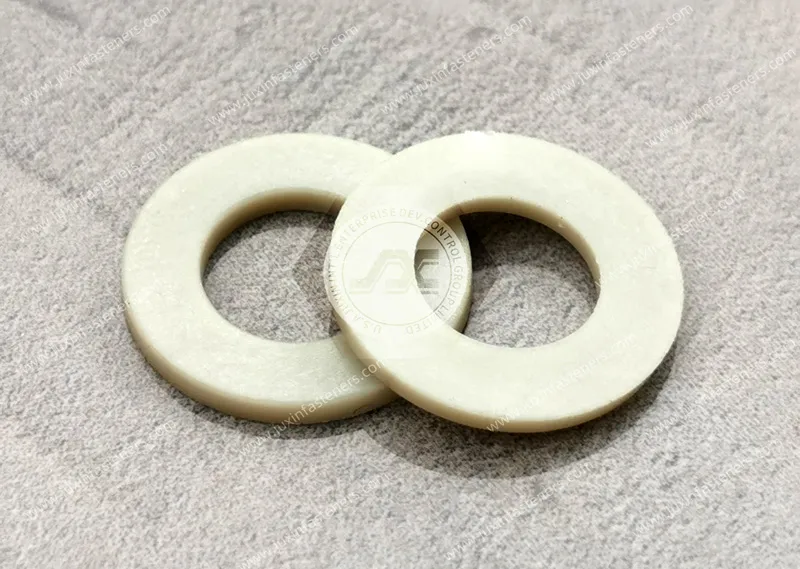
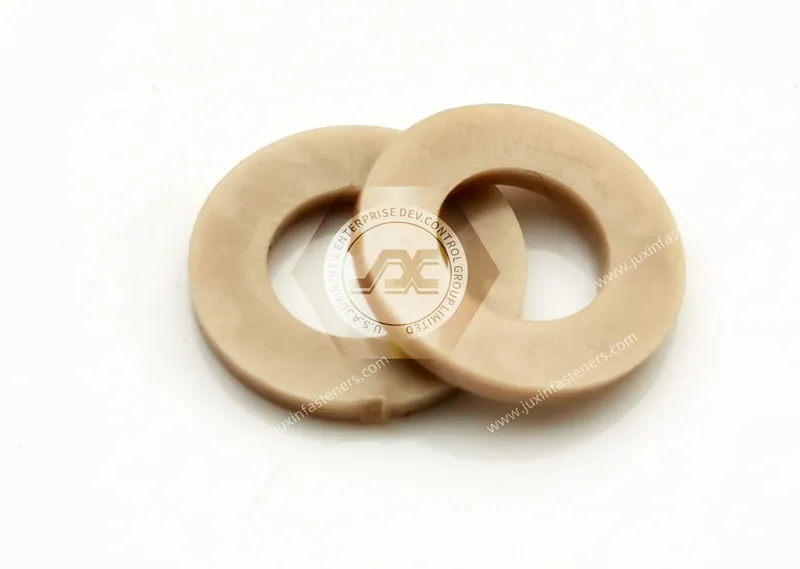
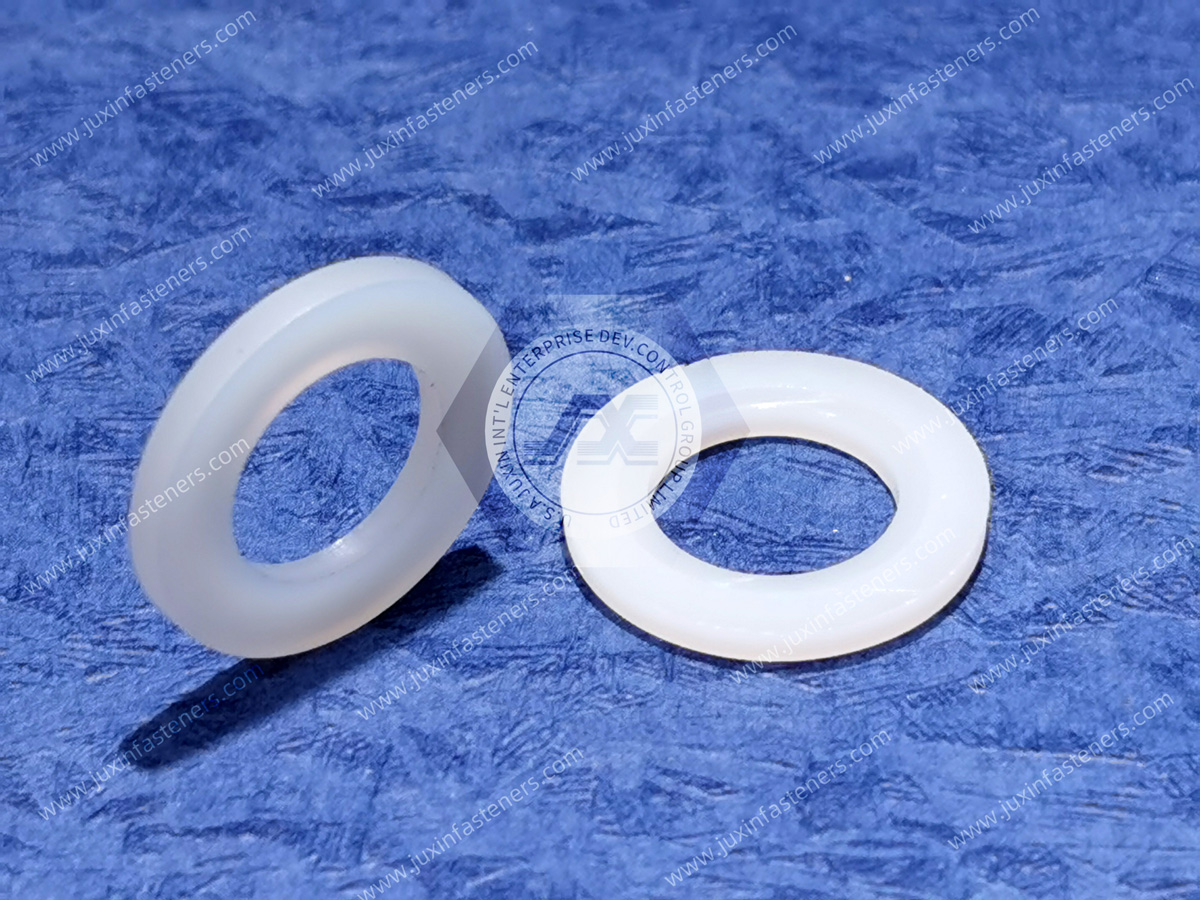
Nylon flat washers can provide a non-metallic bearing interface, electrical non-conductivity, and load distribution across a wider area.
They may also reduce direct metallic interaction between the fastener and surrounding components.
Their mechanical suitability depends on the washer geometry, polymer grade, preload, temperature, substrate and long-term loading.
A flat washer primarily provides a bearing surface and can distribute load.
A shoulder washer includes a raised shoulder that can provide radial separation between a fastener shank and the surrounding mounting hole, in addition to its axial bearing function.
A spacer primarily establishes a defined distance between components.
A PCB standoff is generally designed specifically to support and position a circuit board and may include threaded or unthreaded mounting features.
The answer depends on the polymer family, specific grade, geometry, load and operating environment.
Standard nylon may require additional evaluation as temperature and sustained loading increase. Higher-performance polymers may be considered for applications with more demanding thermal requirements.
No. A polymer washer can provide electrical separation, but compliance depends on the complete insulation system, geometry, voltage, environment,
applicable standard and equipment design. Required clearance and creepage distances should be defined by the engineering specification.
The shoulder portion occupies the clearance hole and separates the screw shank from the hole wall, while the flange can separate the screw head or bearing surface from the panel.
The shoulder diameter, length and flange dimensions must match the actual panel and screw geometry.
A spacer should generally be considered when the primary requirement is controlled distance between two components.
A washer is more commonly used to manage the bearing interface around a fastener. The two components can also be used together.
Provide the controlled 2D drawing, 3D CAD where available, ID, OD, thickness or length, material and grade, tolerances, color, application environment,
mechanical and electrical requirements, annual quantity, packaging requirements, and applicable quality requirements.
Selecting the correct plastic washers, nylon flat washers, shoulder washers, plastic spacers, insulating spacers, and PCB standoffs requires more than matching a nominal fastener size.
The engineering decision should connect:
function → geometry → material → load → electrical requirement → environmental conditions → dimensional stack-up → complementary hardware → quality requirements → supply program
For OEM applications, procurement teams can also evaluate the complete plastic hardware family, including plastic screws, nylon bolts, plastic nuts, nylon lock nuts, washers, spacers, PCB standoffs, threaded inserts, clips, cable clamps, and custom polymer components.
JUXIN FASTENERS can review your technical requirements based on the available drawing, CAD data, material specification, application information, quantity, and sourcing requirements.
Send your 2D drawing, 3D CAD file, required ID/OD/length or thickness, material requirements, annual volume, and relevant application conditions to:
Start with the engineering function and critical dimensions. Then select the material, product architecture, quality requirements, and sourcing path around the actual OEM application.
Product Packaging
Packaging Standard
At Juxin Fasteners, we apply standardized export packaging to ensure product protection, traceability, and compliance with international logistics requirements.
1. Standard Export Packaging
Unless otherwise specified, all products will be packed according to our factory standard export packaging, which includes:
Moisture-resistant inner protection
Poly bag or small box packing as required
Reinforced export cartons
Clear labeling with part number, specification, batch number, and quantity
Palletizing for sea or air shipment when necessary
Our standard packaging is designed to ensure safe transportation, efficient warehousing, and long-distance international shipping.
2. Customized Packaging Options
We also provide customized packaging solutions according to customer requirements, including but not limited to:
Private labeling
Customized barcodes
Specific carton dimensions
Retail packaging
Special pallet configuration
Customer-specific marking and identification
So that you know, customized packaging may involve additional costs and extended lead time depending on the complexity of the requirements.
3. Compliance & Quality Assurance
All packaging processes are controlled under our ISO 9001 quality management system to ensure consistency, traceability, and product integrity throughout the supply chain.
Product Pictures
Contact Us
Tel.:
+86 020 8621 0320
+86 020 3121 6067
E-mail:
Technical Support:
Navigation
SEND INQUIREY