
Call Us
+86 136 6007 9809
Call Us
+86 136 6007 9809

Jan. 21, 2024
Automotive nylon rivets and plastic push rivets provide lightweight mechanical attachment for selected vehicle panels, electronic assemblies,
cable-management systems, trim components, covers and other light-load applications.
In electric vehicles, plastic fasteners can also be useful where engineers need combinations of:
Low component mass
Electrical insulation
Corrosion-free polymer construction
Controlled panel retention
Rapid installation
Reduced risk of scratching finished surfaces
Compatibility with plastic or thin-panel assemblies
But selecting a plastic rivet is not as simple as specifying “nylon,” matching the visible head diameter or finding a fastener that fits into the hole.
Installed performance depends on the interaction between:
Polymer type and grade
Panel material
Panel stack thickness
Hole diameter
Hole tolerance
Retention geometry
Installation method
Required removal force
Temperature
Moisture
Creep
Chemical exposure
Vibration
Thermal cycling
Expected service life
The most important engineering principle is:
Plastic Fastener Performance = Polymer + Geometry + Joint + Environment
JUXIN FASTENERS supplies nylon snap rivets, plastic push rivets, plastic blind rivets and other drawing-based plastic fastening components for suitable automotive,
EV, electronics, electrical equipment and industrial applications.
Automotive nylon rivets are polymer fastening components designed to mechanically retain two or more suitable components through a prepared hole or corresponding assembly geometry.
Depending on the rivet design, installation may involve:
Pushing the fastener into the hole
Expanding a retention feature
Snapping two components together
Activating a center pin
Blind-side expansion
Another design-specific locking action
Unlike a conventional metal screw and nut, many plastic rivets are designed for rapid installation without creating a conventional threaded joint.
This makes them useful for high-volume light-load assembly where the joint requirements match the fastener design.
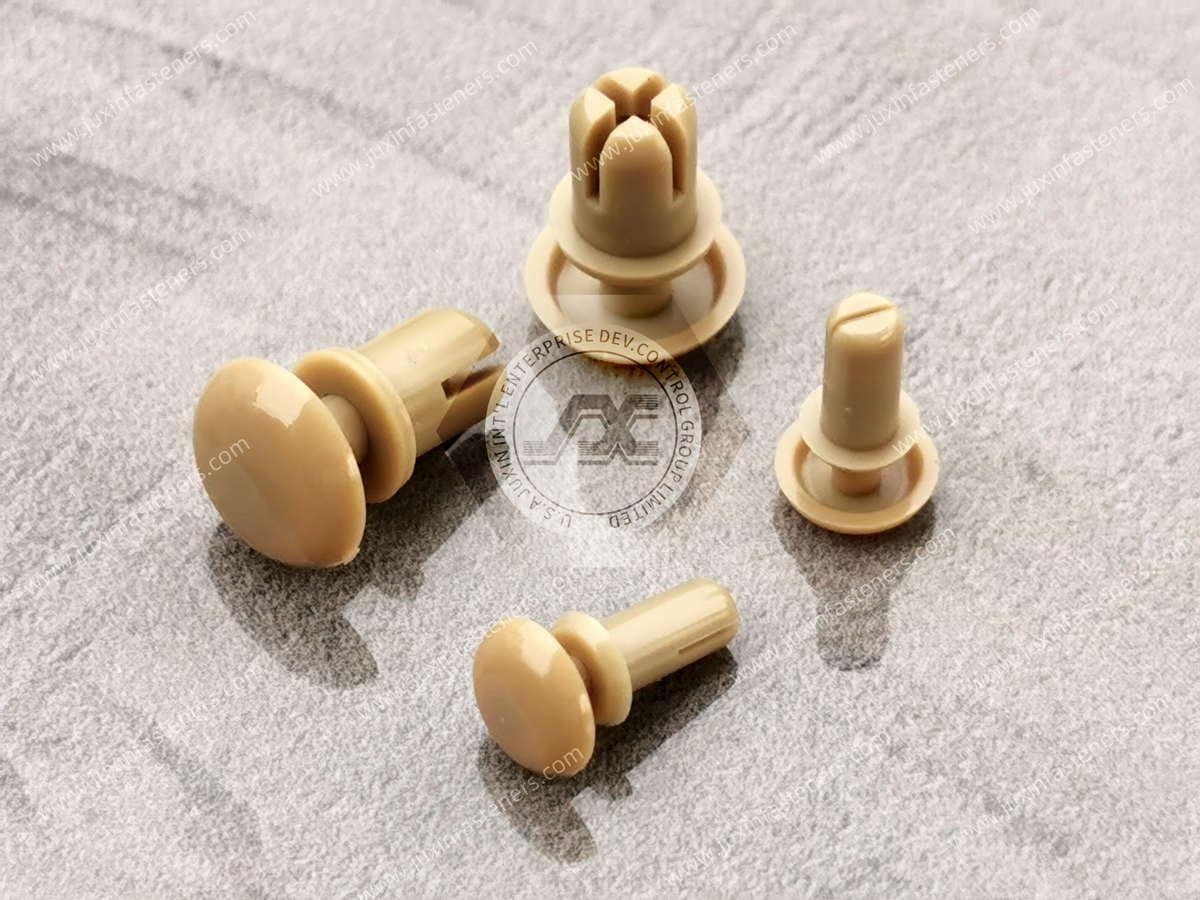
These terms are sometimes used loosely in sourcing, but they should not automatically be treated as interchangeable.
Snap rivets typically use mating or expanding geometry to retain panels after insertion.
They can be useful for:
Electronics
Plastic panels
Covers
Light sheet assemblies
Equipment housings
Push rivets are designed for insertion into a prepared hole using a pushing action.
Depending on design, retention can be created by flexible legs, barbs, an expanding pin or another geometry.
Plastic blind rivets are designed for applications where installation can be completed from the accessible side of the assembly.
The exact installation principle depends on the rivet design.
Other plastic fasteners may use:
Fir-tree geometry
Arrowhead geometry
Ratchet features
Snap-fit legs
Push-in retention
These should be selected according to the actual panel and removal requirements rather than grouped under a single generic “plastic rivet” specification.
Depending on the vehicle design and load requirements, suitable applications can include:
Battery-system insulation covers
Cable-protection covers
Wire-harness management
Plastic brackets
BMS enclosure components
Electronic equipment covers
Interior trim panels
Door trim
Lightweight access covers
Sensor covers
Plastic shields
Non-structural protective panels
Electronic housings
The important qualifier is:
Suitable light-load and secondary applications.
Plastic rivets should not automatically be substituted for structural metal fasteners in load-bearing or safety-critical vehicle connections.
Generic nylon or plastic rivets should not automatically be used for:
Primary crash structures
Suspension load paths
Steering assemblies
Brake-system structural joints
Seat-belt anchorage
Primary battery structural joints
High-load chassis connections
High-temperature locations outside the polymer's validated capability
These applications require their own engineering and OEM specifications.
Low mass and electrical insulation do not override structural requirements.
“Nylon” is not a complete engineering specification.
Two fasteners described as nylon can behave differently because of differences in:
Polymer family
Resin grade
Reinforcement
Additives
Moisture conditioning
Manufacturing process
Geometry
Depending on the product and application, JUXIN FASTENERS can evaluate suitable engineering polymers such as:
PA6
PA66
POM
PP
PC
PVDF
PEEK
Not every polymer is appropriate for every rivet geometry or application.
Material selection should follow the functional requirement.
PA66 and PA6 are widely used engineering nylons, but their properties are not identical.
Relevant selection factors can include:
Mechanical behavior
Moisture absorption
Temperature
Creep
Impact requirement
Chemical environment
Dimensional stability
Manufacturing geometry
A procurement specification that says only “nylon” may therefore be incomplete.
Where the material is functionally important, the actual polymer grade should be controlled.
Nylon is hygroscopic.
This means it can absorb moisture from the environment.
Moisture can influence properties such as:
Stiffness
Toughness
Dimensions
Retention behavior
Installation feel
Therefore:
Dry Nylon Properties ≠ Conditioned Nylon Properties
For automotive qualification, the expected moisture condition should be considered when retention and dimensional behavior are important.
This is one reason a sample tested immediately after production may not behave exactly like a component after environmental conditioning.
A polymer datasheet may contain temperature-related values, but these should not automatically be interpreted as the allowable continuous service temperature of the finished fastener under load.
Actual performance depends on:
Polymer grade
Applied load
Exposure duration
Geometry
Moisture
Chemicals
Thermal cycling
Required retention
Therefore:
Datasheet Temperature ≠ Finished Fastener Allowable Service Temperature Under Load
For higher-temperature EV environments, the complete operating condition should be defined before material selection.
Polymers can deform gradually under sustained stress.
This time-dependent behavior is known as creep.
For a plastic rivet, creep can influence:
Retention force
Clamp condition
Panel movement
Long-term geometry
Joint stability
Creep generally becomes more important when:
Temperature increases
Sustained stress increases
Exposure time increases
Therefore:
Initial Retention ≠ Long-Term Retention
A plastic fastener that performs well immediately after assembly may require additional validation for long-duration service.
Polymer fasteners can provide electrically insulating material characteristics that are useful in suitable EV and electronic assemblies.
Potential applications include:
Insulation covers
Cable-management components
Electronic housings
PCB-related structures
Non-conductive mounting points
However:
Non-Conductive Fastener ≠ High-Voltage System Compliance
Electrical safety depends on the complete system, including:
Creepage
Clearance
Voltage
Insulation architecture
Material properties
Contamination
Temperature
Moisture
Applicable electrical requirements
A nylon rivet should therefore not be represented as independently making an EV battery system electrically safe.
This distinction matters to both engineers and procurement teams.
A polymer fastener can be one element of an insulation strategy.
It does not establish:
System voltage rating
Dielectric compliance
Creepage compliance
Clearance compliance
Flammability compliance
Battery safety certification
Those requirements belong to the complete assembly and applicable project specification.
Where flammability is important, the polymer grade and finished product requirements should be specified carefully.
UL 94 classifications such as V-0, V-1 or V-2 relate to defined test methods and specimen conditions.
A material-family name such as PA66 does not automatically establish a specific finished-fastener flammability classification.
Therefore:
PA66 ≠ Automatically UL 94 V-0
JUXIN FASTENERS can evaluate specified polymer and flammability requirements for suitable products,
but the requirement should be confirmed against the actual fastener design, material grade and customer specification.
For suitable snap-rivet applications, JUXIN FASTENERS has product options such as:
JX-R6080B-V0
JX-R6060B-V0
JX-R5865B-V0
where the applicable material and product specification should be confirmed for the project.
For plastic blind rivets, engineers should not assume that the same flammability performance available in one snap-rivet design automatically transfers to another rivet architecture.
Product-specific validation matters.
Outdoor suitability involves more than polymer type.
Where long-term outdoor exposure matters, engineers may need to consider:
UV
Water exposure
Temperature
Weathering
Chemicals
Mechanical stress
A plastic fastener should not automatically be described as suitable for long-term outdoor use simply because it does not rust.
Likewise, an F1 suitability claim should only be made where the actual material/product requirement is supported.
A polymer rivet itself does not undergo red rust like carbon steel.
But the complete joint may still include:
Metal panels
Metal brackets
Conductive components
Coatings
Environmental contaminants
Therefore:
Non-Metallic Fastener ≠ Corrosion-Proof Assembly
The entire joint environment still matters.
Statements such as “chemical resistant nylon” are too broad for engineering selection.
Chemical compatibility depends on:
Chemical identity
Concentration
Temperature
Exposure duration
Mechanical stress
Polymer grade
Automotive exposure can potentially involve:
Cleaning agents
Oils
Greases
Coolants
Road contaminants
Other application-specific fluids
A polymer should be evaluated against the actual chemical environment.
Plastic rivet performance can change significantly with hole size.
The hole influences:
Insertion force
Retention force
Expansion
Panel movement
Removal force
Installation consistency
An oversized hole may reduce retention.
An undersized hole can:
Increase installation force
Damage the fastener
Stress the panel
Prevent correct seating
Therefore:
Same Rivet + Different Hole ≠ Same Retention
The mating hole should be treated as part of the fastening system.
Prototype assemblies may work even when hole dimensions vary.
High-volume production is different.
Variation can come from:
Molded plastic components
Stamped panels
Drilled holes
Tool wear
Coating thickness
Assembly tolerances
The plastic fastener should tolerate the expected production variation while still providing acceptable insertion and retention behavior.
This should be considered during qualification rather than after launch.
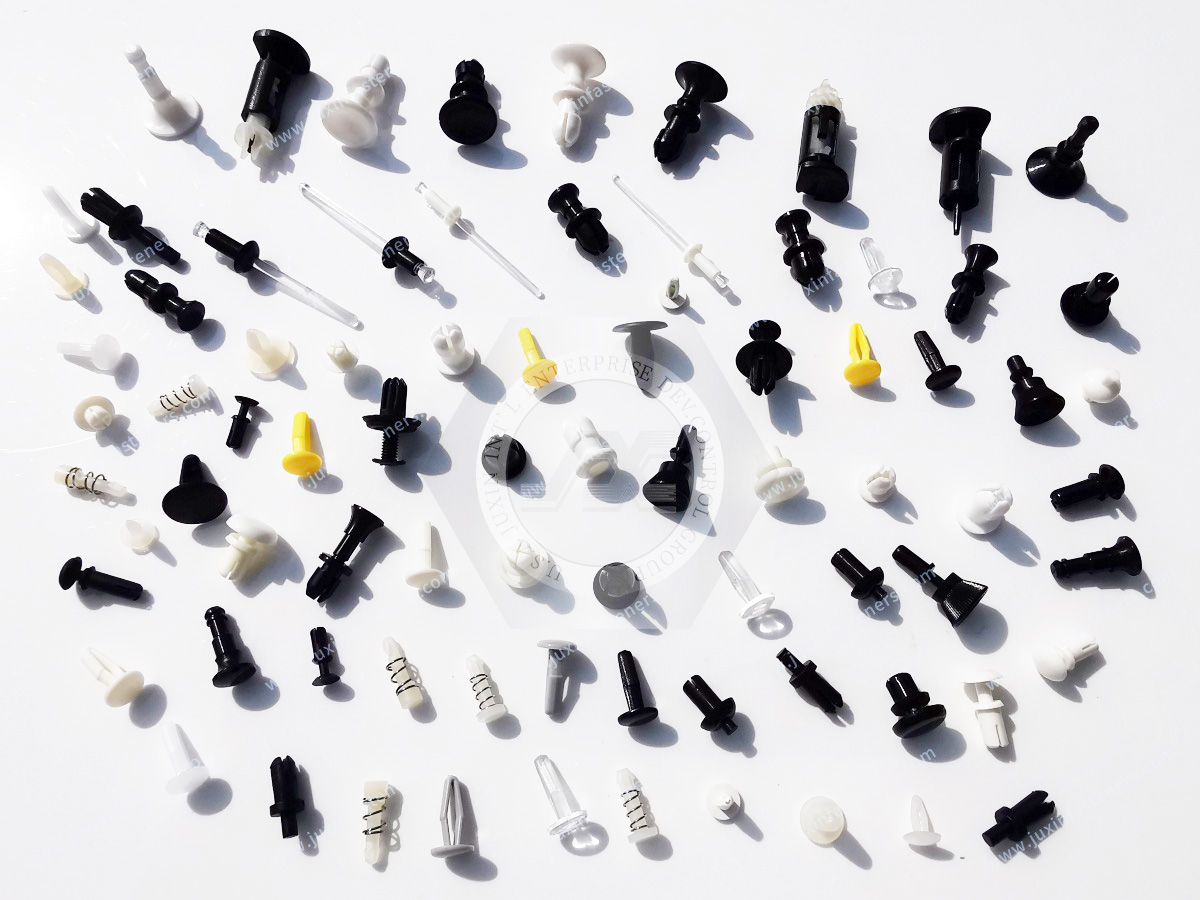
A plastic rivet normally joins a defined stack of components.
Relevant variables include:
Total stack thickness
Individual panel thickness
Compressibility
Hole alignment
Surface geometry
A fastener that fits a 3 mm stack should not automatically be expected to perform identically in a 5 mm stack.
Therefore:
Head Diameter + Hole Diameter ≠ Complete Rivet Specification
The panel stack must also be defined.
Plastic fasteners are often installed into polymer components.
The parent plastic can introduce additional variables such as:
Local deformation
Stress concentration
Creep
Cracking
Temperature sensitivity
Molded-hole variation
A stronger or larger rivet is not automatically safer.
Excessive interference or expansion can damage the component being fastened.
Plastic rivets rely on designed deformation or engagement.
Excessive installation force can cause:
Fastener damage
Leg deformation
Head damage
Panel cracking
Surface marks
Incomplete seating
Therefore:
More Installation Force ≠ Better Installation
The correct goal is repeatable seating within the intended joint geometry.
For high-volume assembly, a plastic fastener should not simply maximize retention.
Excessive insertion force can create:
Operator fatigue
Assembly difficulty
Panel damage
Automation problems
Insufficient retention can create:
Rattle
Panel movement
Fastener loss
Service issues
This creates an important engineering trade-off:
Higher Retention Is Not Automatically Better if Installation Becomes Unstable or the Panel Is Damaged.
The required insertion and retention window should match the assembly process.
A plastic rivet should not automatically be described as “vibration-proof.”
Dynamic performance depends on:
Fastener geometry
Panel stack
Hole
Retention
Material stiffness
Temperature
Creep
Excitation
Service duration
Therefore:
Plastic Rivet ≠ Automatic Anti-Vibration Solution
Representative assembly testing may be appropriate where vibration is important.
Plastic fasteners and metal or composite panels can have different thermal expansion behavior.
Repeated temperature cycling may affect:
Hole fit
Retention
Panel movement
Local stress
This is particularly relevant in EV assemblies exposed to changing environmental or equipment temperatures.
The complete material combination should therefore be evaluated.
Suitable plastic push rivet applications can include selected:
Insulation covers
Cable covers
Lightweight shields
Wire-harness supports
BMS-related covers
Plastic brackets
Non-structural protective components
The important distinction is that these are generally secondary fastening functions.
Battery enclosure structural joints require a different fastening analysis.
EVs contain extensive high-voltage and low-voltage wiring systems.
Plastic fasteners can support suitable:
Cable guides
Wire-harness brackets
Protective covers
Routing components
Benefits can include low mass and non-conductive material.
But the design must still consider:
Cable load
Temperature
Vibration
Abrasion
Chemical exposure
Required serviceability
Suitable applications can include:
ECU housings
BMS enclosures
Sensor housings
Electronic covers
Light mounting brackets
For electronics, engineers may also need to evaluate:
Electrical insulation
Flammability
Temperature
PCB clearance
Service access
Chemical environment
The fastener is one component of the complete electronic assembly.
Automotive interior applications can benefit from:
Rapid installation
Low component mass
Reduced surface scratching
Compact appearance
Potential applications include:
Trim panels
Covers
Interior plastic structures
Access panels
For customer-visible areas, additional requirements can include:
Head appearance
Color
Surface quality
Removal behavior
Rattle prevention
Where the rear side of an assembly cannot be accessed, a plastic blind rivet may provide a suitable lightweight fastening method.
Selection should consider:
Hole size
Grip or panel-stack requirement
Parent material
Required retention
Installation method
Environment
A plastic blind rivet should not be confused with a metal blind rivet nut.
The former typically provides a non-threaded fastening function.
The latter creates a reusable internal machine thread.
A plastic rivet may be preferable where the assembly prioritizes:
Low mass
Electrical insulation
Reduced surface damage
Lower fastening load
Polymer compatibility
A metal blind rivet may be preferable where higher mechanical loading or different structural performance is required.
The correct choice depends on the joint.
Plastic rivets can provide faster installation in suitable light-load assemblies.
Screws can provide advantages where:
Controlled clamp load is required
Repeated disassembly is required
Higher threaded-joint capability is needed
A rivet should not automatically replace a screw merely to reduce assembly time.
These fasteners serve fundamentally different purposes.
Typically provides direct mechanical panel retention.
Creates a reusable internal machine thread.
For EV battery enclosures and structural threaded attachment, rivet nuts may be relevant.
For lightweight covers, trim and insulation panels, plastic rivets may be more appropriate.
Separating these functions prevents incorrect fastener selection.
| Application Requirement | Direction to Evaluate |
|---|---|
| Lightweight panel retention | Nylon or plastic rivet |
| Rapid push-in assembly | Plastic push rivet |
| One-side non-threaded attachment | Plastic blind rivet |
| Electrical insulation desired | Evaluate suitable polymer fastener |
| High-temperature environment | Verify polymer grade and loaded service condition |
| Long-term constant load | Evaluate creep |
| Moisture-sensitive application | Evaluate conditioned nylon behavior |
| Chemical exposure | Verify actual chemical compatibility |
| Flammability requirement | Specify required material/product classification |
| Structural threaded connection | Evaluate metal threaded fastening instead |
| Repeated threaded service | Consider screw + suitable threaded insert/rivet nut |
| Safety-critical vehicle joint | Follow OEM-specific structural fastening requirements |
Possible contributors include:
Oversized hole
Incorrect panel stack
Wrong rivet geometry
Material softening
Creep
Possible contributors include:
Undersized hole
Incorrect rivet
Misalignment
Excessive panel stack
Possible contributors include:
Inappropriate polymer
Low-temperature behavior
Chemical exposure
Excessive installation deformation
Aging
Possible contributors include:
Excessive interference
Poor hole geometry
Incorrect rivet length
High installation force
Possible contributors include:
Creep
Thermal cycling
Panel compression
Hole wear
Insufficient retention
Possible contributors include:
Temperature
Moisture
UV
Chemical exposure
Incompatible polymer grade
Identifying the actual failure mode is more useful than simply changing to a harder or larger plastic rivet.
Useful drawing or specification information can include:
Fastener type
Head geometry
Body geometry
Nominal hole diameter
Hole tolerance
Panel stack
Individual panel thickness
Polymer
Polymer grade where required
Color
Installation method
Retention requirement
Insertion-force requirement where relevant
Removal requirement
Temperature range
Chemical exposure
Flammability requirement where applicable
Reusability requirement
Critical dimensions
The more functionally important the fastener becomes, the less useful a specification such as “black nylon push rivet” becomes.
For accurate quotation and supplier comparison, provide:
2D drawing
3D model where relevant
Existing part or sample where applicable
Rivet type
Hole diameter and tolerance
Panel materials
Panel stack thickness
Polymer requirement
Color
Required insertion behavior
Required retention
Removal or reusability requirement
Temperature range
Moisture exposure
Chemical exposure
Flammability requirement
Annual volume
Sample quantity
Packaging requirement
Documentation requirement
Existing supplier specification
Current assembly problem
Second-source objective
This gives the supplier enough information to evaluate the actual joint instead of quoting a visually similar plastic rivet.
Plastic fasteners are particularly easy to misqualify by appearance.
Two black nylon rivets can look nearly identical while differing in:
Polymer
Resin grade
Moisture condition
Additives
Geometry
Flexibility
Insertion force
Retention force
Temperature behavior
Chemical resistance
Flammability performance
Therefore:
Same Dimensions + Same Color ≠ Functional Equivalence
Supplier-development teams should qualify the characteristics that actually control assembly performance.
A plastic rivet can behave differently when tested in a simple metal coupon than when installed into the production assembly.
Representative testing should consider the actual:
Hole
Panel materials
Panel stack
Temperature
Installation method
Expected service environment
This is particularly important when flexible molded plastic panels form part of the joint.
Plastic rivets are often low-cost components, but their commercial impact can be much larger than their unit price.
Total installed cost can include:
Fastener price
Installation time
Operator effort
Automation compatibility
Panel damage
Rework
Rattle complaints
Replacement
Line interruption
Supplier-quality risk
For high-volume automotive production, a small difference in installation consistency can be commercially more important than a small difference in piece price.
Procurement should therefore evaluate:
Component Price + Assembly Time + Defect Risk + Production Stability
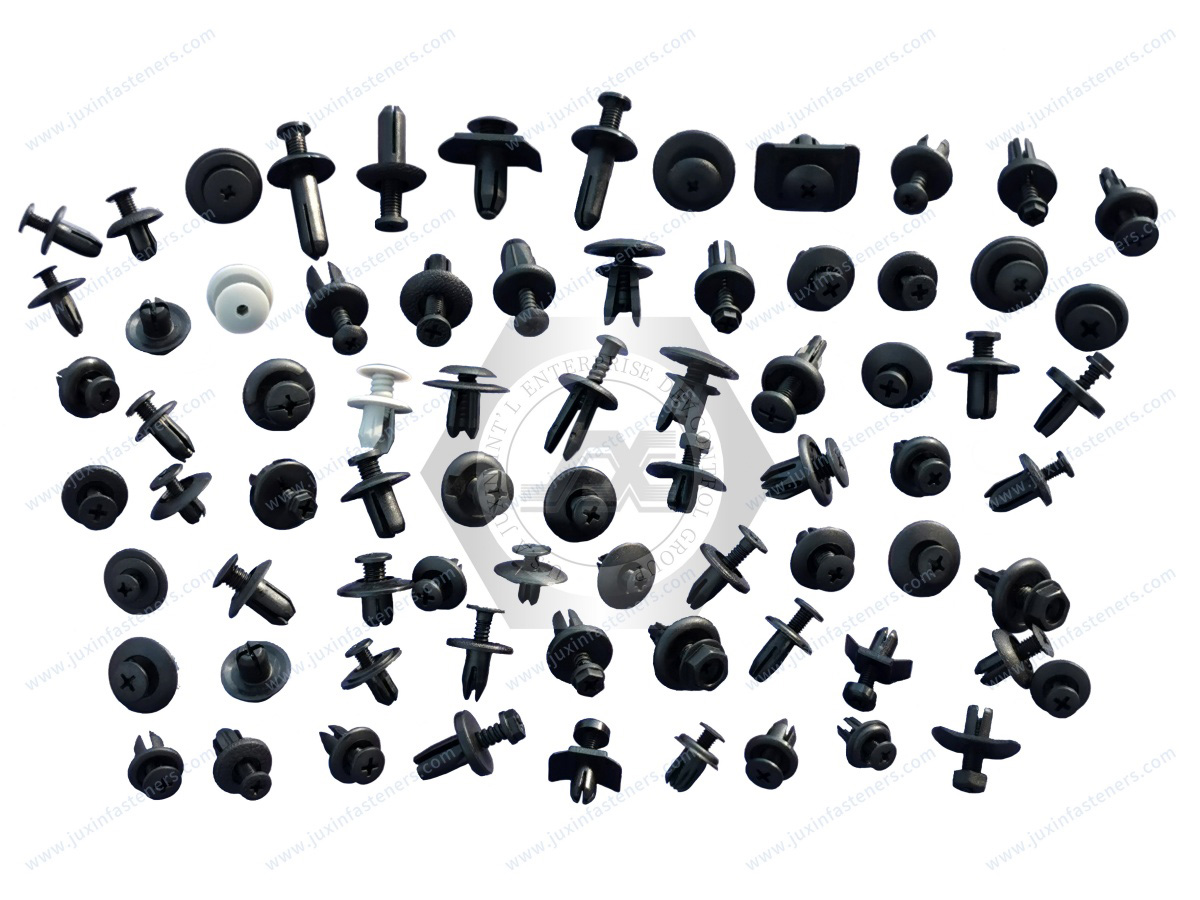
JUXIN FASTENERS supplies plastic and nylon fastening components for suitable automotive, EV, electronics and industrial applications.
Relevant capabilities include:
Nylon snap rivets
Plastic push rivets
Plastic blind rivets
Push-in fasteners
Ratchet-type plastic fasteners
Nylon screws
Plastic screws
Plastic bolts
Plastic nuts
Plastic washers
Plastic spacers
PCB supports
PCB standoffs
Card guides
Screw grommets
Threaded inserts for plastic
Drawing-based custom plastic fasteners
Depending on the application and fastener design, material options can include suitable PA6, PA66 and other engineering polymers such as POM, PP, PC, PVDF or PEEK.
Final polymer availability and suitability should be confirmed against the drawing and application requirements.
They can be used in suitable light-load applications such as insulation covers, cable-management components, electronic housings, plastic brackets, trim and protective panels.
Nylon is an electrically insulating polymer, but using a nylon rivet does not by itself establish high-voltage system compliance. The complete electrical design must be evaluated.
Not universally. The correct material depends on mechanical behavior, moisture, temperature, creep, chemical exposure and the fastener geometry.
Plastic fasteners do not rust like carbon steel, but the complete assembly may still contain metal components and can still experience environmental degradation or corrosion-related problems.
They can perform successfully in suitable applications, but vibration performance depends on the fastener geometry, hole, panel stack,
polymer, temperature and service conditions. It should not be assumed from material alone.
They can be used in suitable secondary functions such as insulation covers, cable management, plastic brackets and electronic components. Structural battery joints require a different fastening analysis.
No. Flammability claims should be based on the applicable material and product specification rather than polymer family alone.
A plastic blind rivet normally provides non-threaded panel retention. A blind rivet nut creates a reusable internal machine thread.
Some designs may allow removal or reuse, while others are intended for one-time installation. Reusability should be defined for the specific fastener.
Send the drawing or sample together with hole size, panel materials, panel stack, polymer requirement, temperature, environment, required retention,
installation method, annual volume and any second-source qualification requirements.
A reliable plastic rivet program should follow:
Application → Load → Panel Materials → Panel Stack → Hole Geometry → Rivet Geometry → Polymer → Installation → Retention
→ Temperature / Moisture / Creep → Chemical Exposure → Validation → Supplier Qualification
This is more reliable than selecting a plastic rivet from:
Appearance + Hole Diameter + Price
For design engineers, the fastener must work with the complete panel system.
For manufacturing engineers, insertion force and assembly consistency matter alongside retention.
For procurement teams, polymer grade and functional performance matter alongside dimensions.
For supplier-development teams, a visually identical alternative must still prove functional equivalence.
For a new EV, automotive electronics, battery-system or plastic-panel project, send JUXIN FASTENERS:
2D Drawing + 3D Model + Hole Size + Panel Materials + Panel Stack + Polymer Requirement + Retention Requirement + Installation Method
+ Temperature + Chemical / Environmental Exposure + Annual Volume
For an existing production component, you can also provide the current sample, specification, assembly problem or second-source objective.
JUXIN FASTENERS can evaluate suitable nylon snap rivets, plastic push rivets, plastic blind rivets and other drawing-based plastic fastening solutions according to the actual assembly requirements.
JUXIN FASTENERS
Email: info@juxinfasteners.com
Website: www.juxinfasteners.com
Connect this page to relevant existing JUXIN FASTENERS engineering resources using their current indexed URLs:
Plastic Fasteners for EV Battery Packs & Energy Storage Systems — the broader EV/ESS plastic fastening and polymer-selection page.
EV Fasteners & Battery Pack Fastening Solutions — for complete EV battery fastening architecture.
Rivet Nuts for EV & Automotive Applications — for metallic blind threaded attachments rather than non-threaded plastic panel retention.
Threaded Fastening Solutions for Aluminum EV Battery Enclosures — for threaded connections in structural aluminum battery enclosures.
Self-Clinching Nuts for EV & Automotive Sheet Metal Assemblies — for press-installed captive threads in suitable sheet metal.
Tapered Heat-Set Inserts for Plastic — for reusable metal threads in molded plastic components.
Electronic Equipment Rivets & PCB Fastening Solutions — for electronics and PCB-related lightweight fastening.
Rivets vs Screws vs Rivet Nuts — for choosing between direct riveting and threaded fastening methods.
Use the existing indexed JUXIN FASTENERS URL when implementing each internal link.
 MORE NEWS


Oct. 13, 2026
Contact Us
Tel.:
+86 020 8621 0320
+86 020 3121 6067
E-mail:
Technical Support:
Navigation
SEND INQUIREY