
Call Us
+86 136 6007 9809
Call Us
+86 136 6007 9809

Jan. 19, 2024
Plastic fasteners are increasingly considered in EV battery packs, battery management systems,
energy storage systems and associated electrical equipment where engineers need combinations of electrical isolation, low mass,
corrosion resistance, controlled mechanical performance and compatibility with polymer or electronic assemblies.
But replacing a metal screw with a plastic screw is not simply a material substitution.
A plastic fastener behaves differently under sustained load, temperature, moisture, chemical exposure and thermal cycling.
The surrounding boss, hole, mating thread and assembly process can govern joint performance before the fastener itself reaches its nominal material capability.
For design engineers and procurement teams, the correct question is therefore not simply:
“Which plastic screw is strongest?”
It is:
“Which polymer, fastener geometry and joint design can maintain the required function under the actual electrical, mechanical, thermal and chemical environment?”
JUXIN FASTENERS supplies plastic and nylon screws, bolts, nuts, washers, spacers, PCB hardware and drawing-based polymer fastening components for suitable EV battery,
energy storage, electronics, electrical equipment and industrial applications.
Metal fasteners remain essential where high structural loads and high clamp forces are required. Plastic fasteners serve a different engineering purpose.
Depending on the assembly, plastic fasteners can offer useful combinations of:
Electrical isolation
Low electrical conductivity
Lower component mass
Corrosion resistance in suitable environments
Compatibility with plastic housings
Reduced risk of scratching sensitive surfaces
Non-magnetic material options
Chemical resistance with selected polymers
Integration into electronic and PCB assemblies
Typical candidate applications can include:
Battery management system assemblies
PCB mounting
Electronic control modules
Sensor mounting
Low-load electrical housings
Insulating brackets
Cable-management assemblies
Covers and guards
Spacers and standoffs
Energy storage control equipment
Power electronics
Electrical cabinets and auxiliary equipment
Plastic fasteners should not automatically replace metal structural fasteners used in high-load battery pack connections, enclosure structures or vehicle mounting joints.
The correct choice depends on the required function of the joint.
One of the most important distinctions in EV and ESS fastening design is:
A non-conductive fastener does not by itself make the complete assembly electrically safe or compliant.
A plastic screw can remove one conductive path through a joint, but system-level electrical performance can also depend on:
Clearance
Creepage distance
Operating voltage
Pollution conditions
Adjacent conductive components
Surface contamination
Moisture
Polymer condition
Temperature
Assembly geometry
Applicable electrical requirements
Therefore, a plastic fastener should be evaluated as one component within the electrical insulation architecture.
It should not be described as providing complete high-voltage isolation, dielectric-system compliance or electrical safety unless the complete assembly has been designed and validated accordingly.
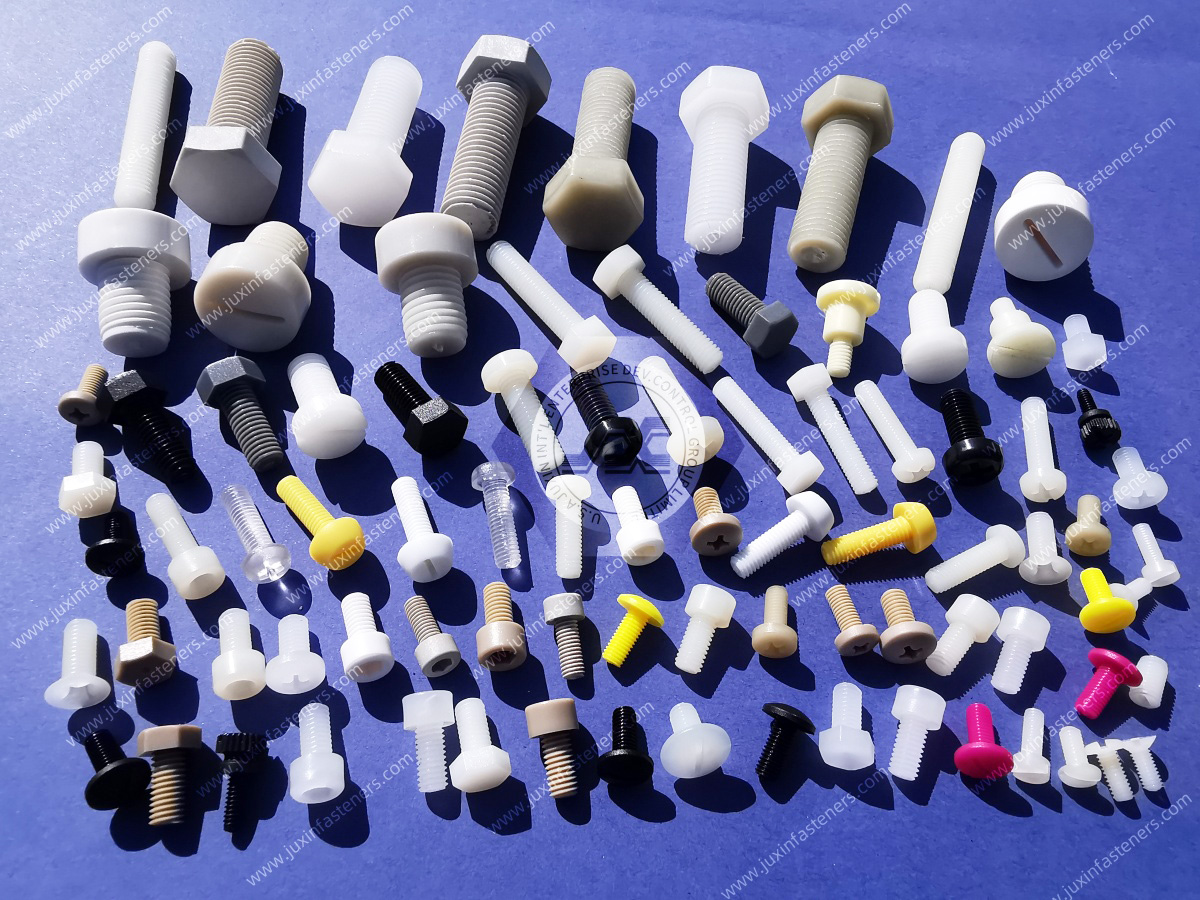
Metal-fastener selection frequently focuses on strength class and preload. Polymer fasteners require a different engineering mindset.
Five variables deserve particular attention.
Polymers are viscoelastic materials.
Under sustained load, a plastic fastener or the surrounding polymer component may gradually deform. This behavior is called creep.
As a result:
Initial tightening condition ≠ long-term retained clamp condition.
Creep is influenced by:
Polymer type
Material grade
Reinforcement
Temperature
Applied stress
Time
Moisture
Joint geometry
A plastic screw that survives initial assembly may still lose clamping effectiveness over extended service if sustained stress and temperature are not considered.
Temperature affects polymer stiffness, strength, creep and dimensional behavior.
The relevant engineering question is not simply the highest temperature listed on a resin datasheet.
Engineers should consider:
Continuous operating temperature
Short-duration peak temperature
Thermal cycling
Load at temperature
Exposure duration
Adjacent heat-generating components
Assembly geometry
A material's published thermal capability does not automatically establish the allowable temperature of a finished fastener under mechanical load.
Moisture can be particularly important for nylon materials.
Moisture absorption can change dimensional and mechanical behavior. This means that nylon fasteners should be evaluated under the expected environmental condition rather than solely from dry-as-molded material data.
Battery and energy-storage environments can involve cleaning agents, coolants, oils or other process chemicals.
Chemical compatibility depends on more than the generic statement that a polymer is "chemical resistant."
Important variables include:
Chemical identity
Concentration
Temperature
Exposure time
Mechanical stress
Polymer grade
A polymer suitable for one chemical environment may not be appropriate for another.
The strongest available polymer does not compensate for poor joint geometry.
Performance can depend on:
Boss diameter
Boss wall thickness
Hole diameter
Thread engagement
Edge distance
Mating material
Washer or bearing area
Installation torque
Assembly method
This leads to another important principle:
Strong Plastic Fastener ≠ Strong Plastic Joint
Nylon fasteners are widely used in electronic and electrical assemblies where moderate mechanical requirements combine with low mass and electrical isolation.
JUXIN FASTENERS can supply suitable PA6 and PA66 fastening components depending on drawing and application requirements.
Typical nylon components include:
Nylon screws
Nylon bolts
Nylon nuts
Nylon washers
Nylon spacers
Nylon rivets
PCB supports
PCB standoffs
Screw grommets
Potential applications include:
BMS electronics
PCB assemblies
Sensor modules
Electrical housings
Control equipment
Cable-management systems
Low-load covers and guards
Nylon selection should consider:
Required mechanical load
Sustained load duration
Temperature
Moisture
Chemical exposure
Required dimensional stability
Mating material
Thread engagement
Assembly method
Flame-performance requirement where applicable
Do not assume that all nylon grades behave identically.
PA6, PA66 and reinforced grades can have different mechanical, moisture, thermal and processing characteristics.
Material family alone is not a complete specification.
PEEK is an engineering thermoplastic considered for demanding applications where combinations of thermal capability, mechanical performance and chemical resistance are required.
Potential applications can include:
Battery testing equipment
Power electronics
Semiconductor-related equipment
High-temperature fixtures
Laboratory equipment
Electrically isolating mechanical assemblies
Specialized battery manufacturing equipment
However, PEEK should not be selected simply because it is a high-performance polymer.
Its higher material cost means engineers should determine whether the application genuinely requires its properties.
Selection should consider:
Actual service temperature
Sustained mechanical load
Chemical environment
Required dimensional stability
Electrical function
Fastener geometry
Mating component
Production volume
PEEK can be an appropriate engineering solution where the environment justifies it,
but using PEEK where PA66 or another suitable polymer meets the requirements can unnecessarily increase component cost.
PVDF fasteners can be considered where chemical resistance is a primary design requirement.
Potential uses may include selected:
Battery process equipment
Chemical-handling equipment
Laboratory equipment
Fluid-related systems
Corrosive industrial environments
Specialized electrical equipment
The chemical environment should be defined before material selection.
Procurement teams should provide:
Chemical or fluid identity
Concentration
Operating temperature
Exposure duration
Mechanical load
Cleaning process
This allows material selection to be based on the actual application rather than a generic claim of acid or alkali resistance.
Not every battery or energy-storage application requires a high-performance polymer.
Depending on the design, other engineering plastics can provide useful combinations of properties.
POM can be considered where dimensional stability, low friction and mechanical performance are useful.
Potential applications include:
Mechanisms
Guides
Spacers
Equipment components
Selected precision plastic fasteners
PP may be considered for suitable chemical environments and low-load applications where its particular material characteristics fit the assembly.
Polycarbonate can be considered for selected equipment and electronic assemblies depending on the required mechanical, environmental and dimensional characteristics.
The polymer should always be selected from the application requirements rather than from a generic material ranking.
A drawing that specifies only "nylon," "PEEK" or "plastic" may leave important performance variables uncontrolled.
Within a polymer family, material grades can differ in:
Reinforcement
Additives
Flame-retardant package
Viscosity
Mechanical properties
Thermal behavior
Moisture response
Colorants
Processing characteristics
Therefore:
Same polymer name ≠ same material performance.
For OEM repeat production, procurement and engineering teams should control the material specification at the level required by the application.
Where a specific resin grade or validated equivalent is required, that requirement should appear in the drawing or purchasing specification.
Fiber reinforcement can increase selected mechanical properties of engineering plastics, but it also changes material behavior.
Depending on the polymer and reinforcement system, engineers may need to consider:
Stiffness
Brittleness
Dimensional behavior
Surface characteristics
Thread performance
Wear against mating components
Processing direction
Electrical requirements
A reinforced polymer should therefore be treated as a different engineering material rather than simply a stronger version of the unfilled polymer.
When a plastic housing needs a threaded connection, engineers often face an important decision:
Use a plastic screw directly, or create a metal threaded interface?
These approaches serve different purposes.
Plastic screws may be useful when the design prioritizes:
Electrical isolation
Low load
low mass
corrosion behavior
polymer compatibility
Threaded inserts for plastic may be useful when the design requires:
Higher reusable thread capability
Repeated assembly and disassembly
A durable metal internal thread
Higher tightening capability than direct polymer threads can provide
JUXIN FASTENERS supplies heat-set inserts, ultrasonic inserts and brass threaded inserts for suitable plastic assemblies.
But an insert does not automatically create a strong joint.
Strong Metal Insert ≠ Strong Plastic Joint
The surrounding boss can still govern pull-out, torque-out or cracking performance.
For heat-set or ultrasonic inserts used in plastic battery electronics, controls can include:
Boss outside diameter
Boss height
Hole diameter
Hole depth
Polymer type
Insert geometry
Installation temperature or ultrasonic parameters
Mating screw
Tightening requirement
Distance from nearby walls or features
Incorrect boss geometry can result in:
Boss cracking
Poor insert retention
Incomplete installation
Excessive material displacement
Low pull-out resistance
Low torque-out resistance
The insert and plastic boss should therefore be engineered as a system.
The fastener itself is only one part of the polymer fastening architecture.
Plastic washers, spacers and standoffs can provide useful functions in BMS, PCB and electronic assemblies.
Depending on the design, these components may provide:
Physical spacing
Component positioning
Surface separation
Electrical isolation between selected components
Load distribution
PCB support
Typical JUXIN FASTENERS products include:
Nylon washers
Plastic spacers
PCB standoffs
PCB supports
Card guides
Screw grommets
These components can be used in battery-management electronics, control systems, power equipment, telecom equipment and industrial electronics where the actual design supports their use.
Plastic fasteners should not be described as inherently vibration-proof.
Vibration performance depends on the complete joint.
Relevant factors include:
Joint preload or clamping requirement
Polymer creep
Thread geometry
Mating material
Temperature
Joint movement
Fastener geometry
Locking strategy
Installation process
A plastic fastener may behave differently from a metal fastener under vibration, but material substitution alone does not establish anti-loosening performance.
If loosening resistance is functionally important, the actual joint should be tested under representative conditions.
Plastic screws may be used with:
Sealing washers
Gaskets
O-rings
Enclosure sealing systems
However:
Plastic Fastener + Seal ≠ Automatically Waterproof or IP-Rated
Enclosure sealing depends on the complete interface, including:
Fastener geometry
Seal material
Compression
Surface condition
Hole geometry
Enclosure stiffness
Assembly tolerance
Tightening process
Environmental exposure
An IP requirement applies to the validated enclosure or system configuration, not automatically to an individual screw.
EV battery and ESS equipment often combine:
Metals
Engineering plastics
PCB materials
Elastomers
Composite structures
These materials can expand and contract at different rates during temperature cycling.
A polymer fastener assembled through metal and plastic components may therefore experience changes in joint condition as temperature varies.
Engineers should consider:
Coefficient-of-thermal-expansion differences
Temperature range
Joint length
Fastener material
Clamped materials
Creep
Number of thermal cycles
This is especially important where dimensional stability or retained clamp is functionally important.
A useful selection process begins with the function rather than the material.
| Design Requirement | Engineering Question |
|---|---|
| Electrical isolation | Which conductive path must be interrupted? |
| Mechanical fastening | What load must the joint carry? |
| Sustained clamp | How will creep affect retained load? |
| Temperature | What are continuous and peak service temperatures? |
| Chemical resistance | Which chemicals, concentrations and temperatures are present? |
| Moisture | Will the polymer absorb moisture or change dimensions? |
| Low mass | Is component mass materially important to the design? |
| Repeated service | Will the connection be assembled repeatedly? |
| PCB support | Is spacing, retention or structural fastening required? |
| Sealing | What complete sealing system is being validated? |
This framework helps prevent material selection based only on a product name or datasheet headline.
| Application | Candidate Fastener Direction | Primary Design Concern |
|---|---|---|
| BMS PCB | Nylon screw, spacer or PCB support | Isolation, spacing, temperature |
| Sensor module | Nylon or engineered plastic screw | Low load, vibration, thermal cycling |
| Electronic housing | Plastic screw or threaded insert | Serviceability, boss design |
| Control cabinet electronics | Plastic spacer, washer or standoff | Isolation and positioning |
| Chemical process equipment | PVDF or suitable polymer fastener | Chemical compatibility |
| High-temperature equipment | PEEK or suitable high-performance polymer | Temperature under load |
| Plastic enclosure | Plastic screw or threaded insert | Boss strength and repeated assembly |
| PCB card assembly | PCB support or card guide | Positioning and retention |
Candidate materials still require application-specific validation.
Understanding failure modes is essential when qualifying plastic fastening components.
Sustained stress and temperature can gradually change polymer geometry and reduce retained clamping force.
Insufficient thread engagement or excessive installation torque can damage polymer threads.
Excessive torque can damage the drive or head, particularly where compact geometries are used.
Poor hole geometry, excessive interference, inappropriate insert installation or high assembly stress can crack a plastic boss.
An incompatible chemical environment can change mechanical or surface properties.
Temperature or moisture can alter dimensions sufficiently to affect assembly behavior.
A metal insert may pull out when boss geometry, polymer condition or installation is inadequate.
Different expansion rates between materials can change joint conditions during repeated temperature cycles.
Failure analysis should identify the actual mechanism rather than automatically substituting a higher-performance polymer.
Depending on the component, a controlled drawing may specify:
Thread size
Thread pitch
Overall length
Head geometry
Drive type
Critical dimensions
Polymer family
Specific material grade where required
Reinforcement where applicable
Color where functional
Temperature requirement
Chemical exposure requirement
Special dimensional tolerances
Mating component
Inspection requirements
Packaging requirements
For custom components, a 3D model can also help communicate geometry that is difficult to define with standard fastener terminology.
Plastic fastener supplier qualification requires more than comparing dimensions and unit price.
Important sourcing variables include:
Polymer identification
Material grade control
Reinforcement where specified
Dimensional consistency
Thread geometry
Molding or machining quality
Lot consistency
Critical performance requirements
Documentation
Packaging and identification
Sample validation
Production capacity
Change control
Lead time
Total installed cost
A visually identical plastic screw produced from a different polymer grade may behave differently in the application.
Therefore:
Same dimensions + same color ≠ functional equivalence.
Second sourcing is particularly important for OEM and Tier-1 supply chains, but polymer components require careful equivalence review.
When qualifying an alternative supplier, compare:
Material family
Exact grade where controlled
Reinforcement
Dimensions
Thread geometry
Critical tolerances
Moisture condition where relevant
Mechanical behavior
Thermal requirements
Chemical compatibility
Assembly performance
If the existing component has already been validated in a battery or ESS assembly, changing the resin, reinforcement or geometry may require application-level revalidation.
JUXIN FASTENERS supports OEM, ODM and drawing-based projects involving suitable:
Nylon screws
Plastic screws
Plastic bolts
Nylon nuts
Plastic nuts
Nylon washers
Plastic washers
Plastic spacers
Nylon rivets
PCB supports
PCB standoffs
Card guides
Screw grommets
Heat-set inserts for plastic
Ultrasonic inserts
Brass threaded inserts
Drawing-based custom fasteners
CNC-machined components
Depending on drawing and application requirements, suitable material capabilities can include:
PA6
PA66
POM
PP
PC
PVDF
PEEK
Material availability and final suitability should be confirmed against the actual component drawing, performance requirements and production quantity.
Nylon has electrically insulating material characteristics, but using a nylon screw does not automatically establish the electrical compliance or safety of the complete assembly.
System geometry, voltage, creepage, clearance, environment and other components must also be considered.
No. PEEK offers valuable properties for demanding environments, but nylon can be more appropriate for many moderate-temperature and moderate-load applications.
Selection should be based on functional requirements and total cost.
Only where the mechanical and environmental requirements permit. Plastic screws should not automatically replace structural steel fasteners used for high-load pack connections.
Not automatically. Vibration resistance depends on the complete joint, including geometry, load, creep, mating material, temperature and installation.
PVDF can offer strong resistance to many chemical environments, but compatibility must be checked against the actual chemical, concentration, temperature, exposure duration and mechanical stress.
No. Waterproof or IP performance is a system-level characteristic involving seals, enclosure geometry, compression, assembly control and validation.
Polymer creep and relaxation can change joint conditions under sustained load, particularly as temperature increases.
The fastener and surrounding polymer components should be evaluated under representative service conditions.
A plastic screw may suit low-load applications where electrical isolation or material compatibility is important.
A threaded insert may be preferable when repeated service or a more durable metal internal thread is required. Boss geometry and installation still determine much of the joint performance.
Send the 2D drawing and, where available, the 3D model together with the application, polymer requirement, mating component, mechanical load, operating temperature,
chemical exposure, electrical requirement, annual volume and sample quantity.
Plastic fastener selection for EV batteries and energy storage systems should follow a controlled engineering path:
Application → Required Function → Joint Load → Electrical Requirement → Polymer → Temperature → Chemical Exposure → Geometry → Installation → Validation → Supplier Qualification
This is more reliable than selecting a plastic screw from material strength or temperature data alone.
For design engineers, this approach helps identify whether the fastener, mating thread, boss or environmental condition will govern the assembly.
For procurement and supplier-development teams, it creates a technical basis for comparing suppliers and qualifying a second source without assuming that visually similar plastic parts are interchangeable.
For standard, custom or second-source plastic fastener projects, send JUXIN FASTENERS:
2D Drawing + 3D Model + Application + Polymer Requirement + Mating Component + Mechanical Load + Temperature + Chemical Environment + Electrical Requirement + Annual Volume
For existing parts, you can also provide a sample, current specification, assembly problem or second-source objective.
JUXIN FASTENERS can review suitable material and manufacturing options according to the actual drawing and application requirements.
JUXIN FASTENERS
Email: info@juxinfasteners.com
Website: www.juxinfasteners.com
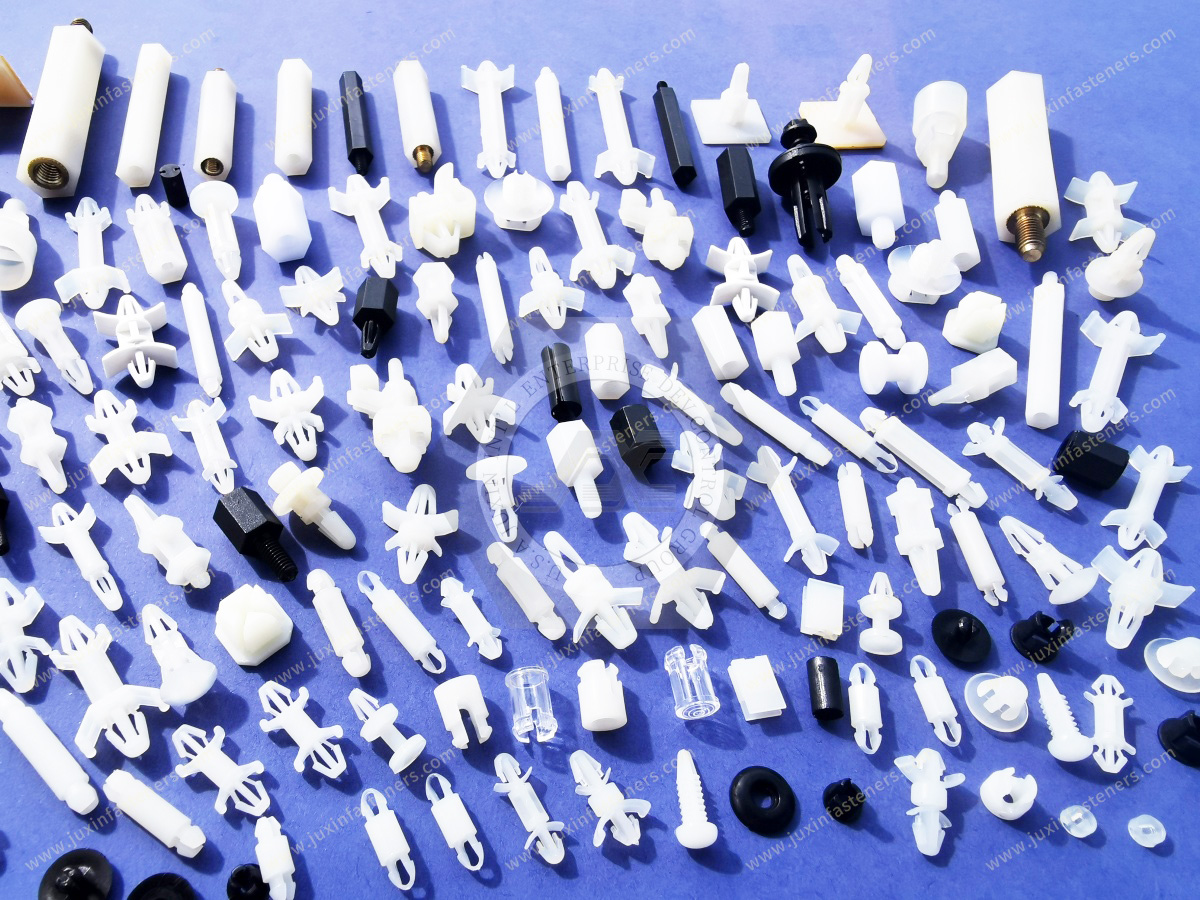
Connect this page to relevant existing JUXIN FASTENERS pages using their current indexed URLs:
EV Fasteners & Battery Pack Fastening Solutions — for the broader mechanical fastening architecture of EV battery packs.
High-Strength Bolts for Lithium-Ion Battery Manufacturing Equipment — for structural bolts used in battery production machinery rather than polymer fastening components.
Tapered Heat-Set Inserts for Plastic — for reusable metal threads in thermoplastic housings and components.
Electronic Equipment Rivets & PCB Fastening Solutions — for PCB, electronics and enclosure fastening.
Aluminum Fasteners for Telecom / Electronics / Data Center Equipment — for lightweight metallic fastening where plastic is not the appropriate material.
Fastener Installation Guide: Torque, Preload & Threaded Joint Reliability — for the fundamental differences between torque, preload and joint performance.
Use the existing indexed JUXIN FASTENERS URL when implementing each internal link.
 MORE NEWS


Oct. 13, 2026
Contact Us
Tel.:
+86 020 8621 0320
+86 020 3121 6067
E-mail:
Technical Support:
Navigation
SEND INQUIREY