
Call Us
+86 136 6007 9809
Call Us
+86 136 6007 9809

Aug. 18, 2026
Weld Nuts for Sheet Metal Joining – Industrial Fastening Solutions
Projection Weld Nuts, Hex and Square Weld Nuts, Custom Threaded Hardware and OEM Sheet Metal Assembly
Weld nuts provide permanent threaded attachment points in fabricated sheet metal assemblies where conventional loose nuts or directly tapped threads may be impractical.
For automotive manufacturers, EV battery enclosure suppliers, electrical cabinet manufacturers, HVAC equipment producers and industrial machinery OEMs,
a weld nut can simplify final assembly by allowing a bolt or machine screw to engage a threaded component already attached to the panel.
However, reliable weld nut performance depends on more than the nut's nominal thread size.
The nut geometry, weld projections, sheet material, panel thickness, mounting hole, welding process, surface condition and inspection method must work together.
Juxin Fasteners supplies standard and drawing-based custom weld nuts, weld screws, rivet nuts and related industrial fastening components for international OEM manufacturing.
This guide explains weld nut types, resistance projection welding, engineering selection, industrial applications, manufacturing risks, quality control and procurement requirements.
What Is a Weld Nut?
A weld nut is an internally threaded fastener designed to be attached to a compatible metal component by welding.
Unlike a loose nut, a properly welded nut remains fixed to the sheet during subsequent assembly.
This provides a captive threaded connection and can eliminate the need to hold a separate nut behind the panel.
Typical applications include:
Automotive body and chassis assemblies
EV battery enclosure structures
Industrial electrical cabinets
HVAC equipment
Machinery frames
Rail vehicle auxiliary equipment
Marine equipment
Appliances
Fabricated metal brackets
Industrial control systems
A weld nut is particularly useful when the sheet is too thin to provide sufficient thread engagement through direct tapping.
The completed connection must still be designed for the intended loading, installation method and service environment.
Why Manufacturers Use Weld Nuts in Sheet Metal Assemblies
Weld nuts provide several potential manufacturing advantages.
Captive Threaded Connection
The nut remains attached to the panel, allowing assembly from the accessible side.
Reduced Loose-Hardware Handling
Operators do not need to position and hold a separate nut during final assembly.
Compatibility With Automated Manufacturing
Suitable projection weld nuts can be integrated into automated feeding, positioning and resistance welding processes.
Repeatable Thread Location
Controlled tooling and positioning can support consistent threaded attachment points.
Thread Engagement in Thin Sheet
A separate threaded component provides more engagement than directly tapping a thin panel.
Simplified Final Assembly
A preattached nut may reduce handling operations during subsequent equipment assembly.
Engineering Information Gain: A Weld Nut Is Part of a Welded Joint
The nut's internal thread strength does not independently determine the strength of the completed attachment.
The joint can fail through the weld, surrounding sheet, thread or mating fastener.
Engineers should distinguish between:
Thread stripping
Weld separation
Push-out failure
Torque-out failure
Sheet tearing
Bolt failure
Fatigue-related damage
The governing failure mode depends on the actual assembly.
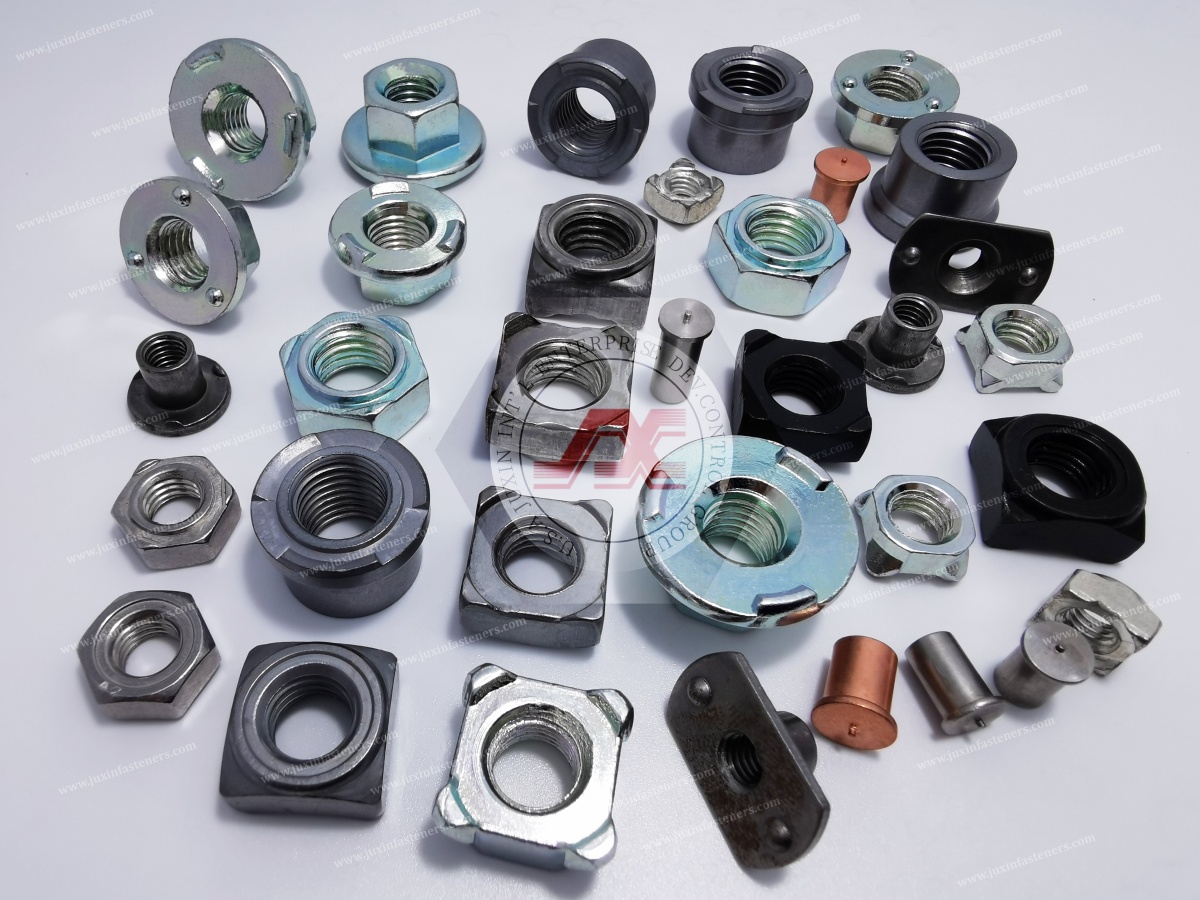
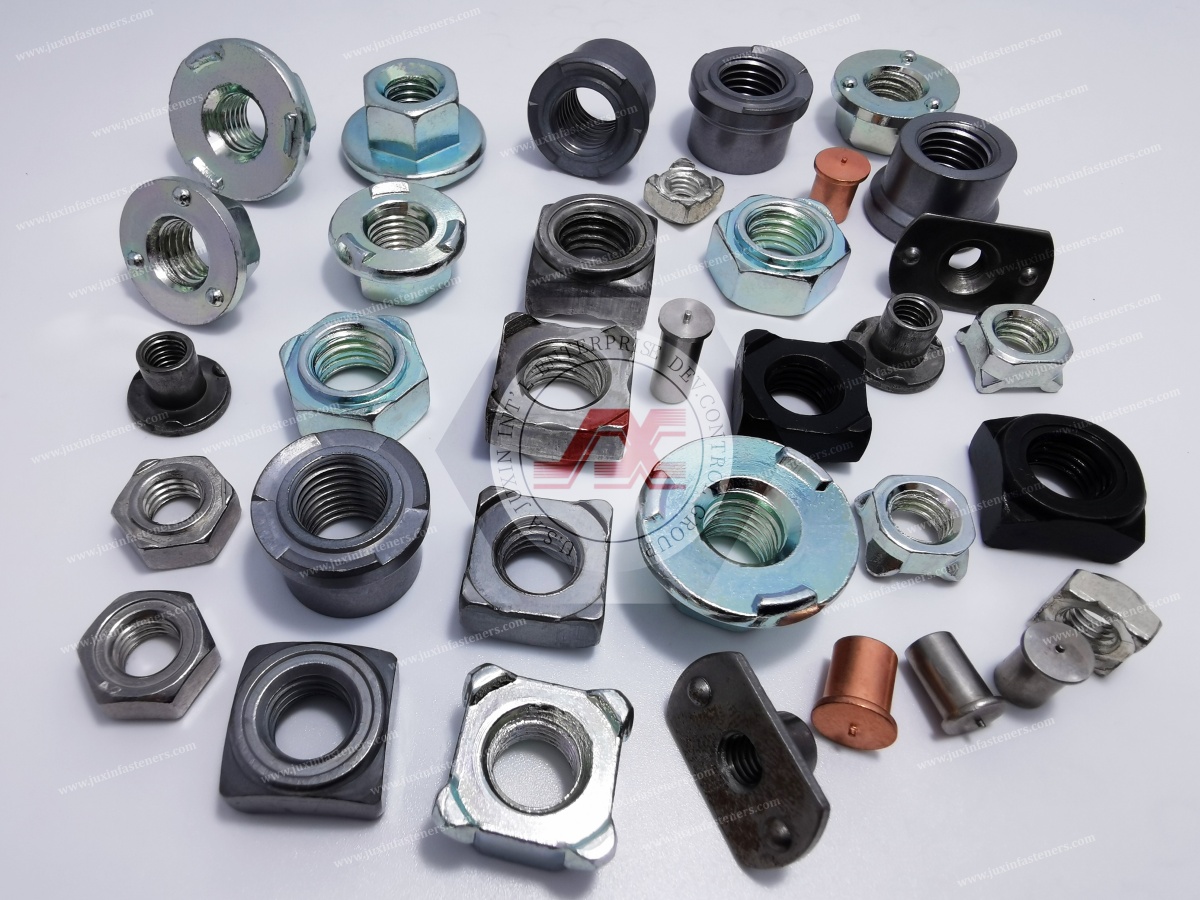
Types of Weld Nuts for Industrial Applications
Different weld nut designs serve different geometric, welding and assembly requirements.
The selection should consider nut geometry, weld projections, mounting hole, available space, feeding method and required joint performance.
Hex Weld Nuts
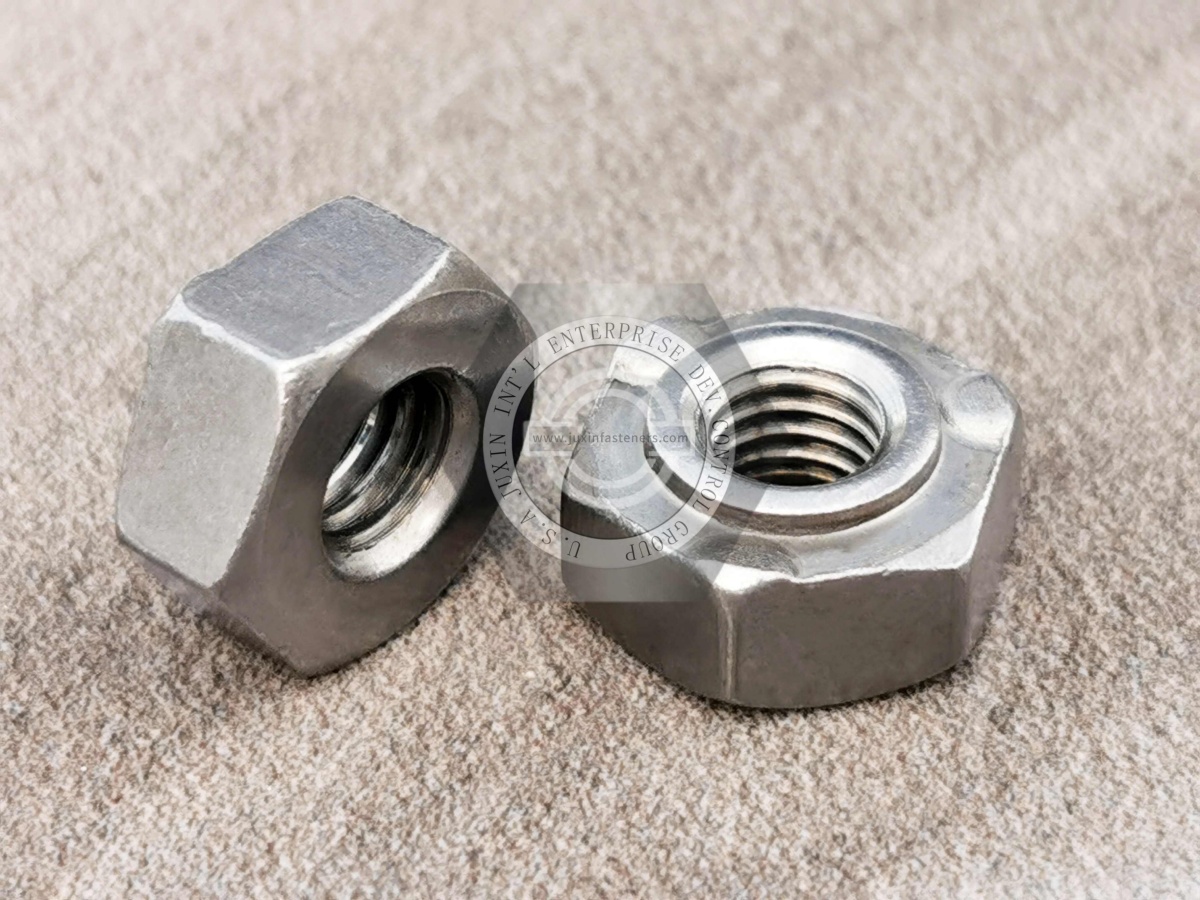
Hexagon weld nuts are used in many industrial sheet metal assemblies.
Potential applications include:
Automotive brackets
Vehicle body components
Machinery assemblies
Equipment frames
Electrical cabinets
Fabricated steel components
Hexagon weld nuts may have defined welding projections that establish contact with the panel during welding.
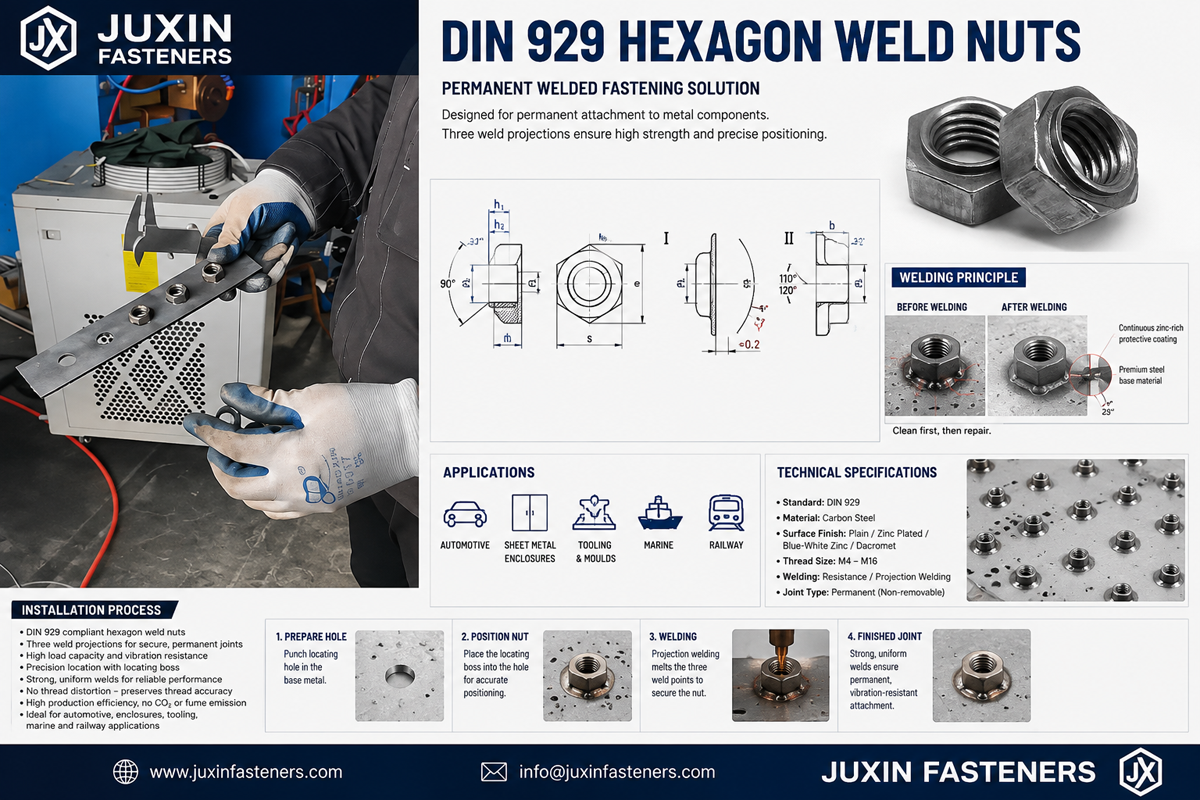
DIN 929 covers a standardized category of hexagon weld nuts.
Engineering Consideration
The external hexagon shape alone does not guarantee adequate torque-out resistance.
Actual resistance depends on weld quality, projection geometry and the completed joint.
Square Weld Nuts
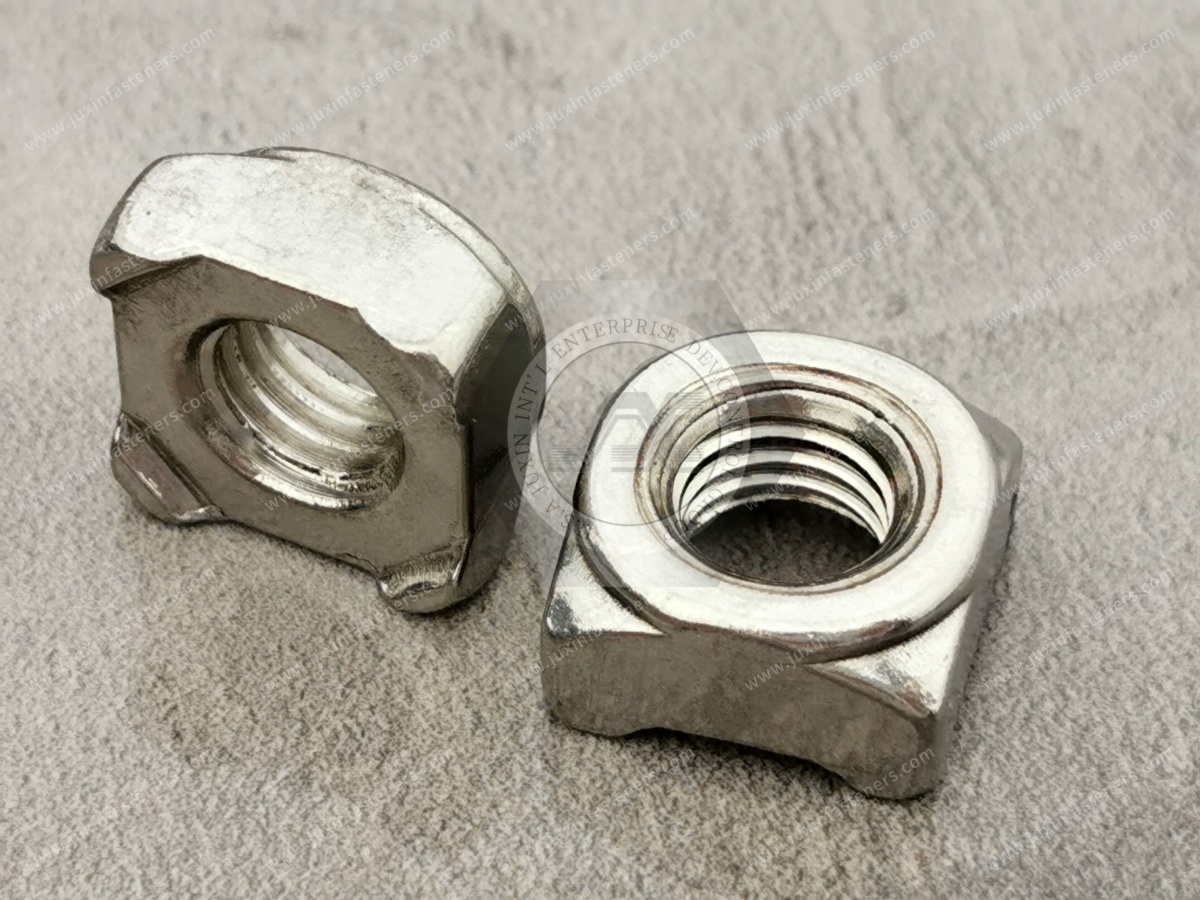
Square weld nuts are another established solution for sheet metal joining.
They may be used in:
Automotive brackets
Sheet metal structures
Electrical enclosures
Machinery frames
Industrial equipment
Selected railway equipment assemblies
DIN 928 specifies square weld nuts within its defined dimensional and thread range.
Engineering Consideration
Square geometry may assist handling and positioning in suitable production systems, but rotational resistance after welding must be established through the actual welded connection.
Round Weld Nuts
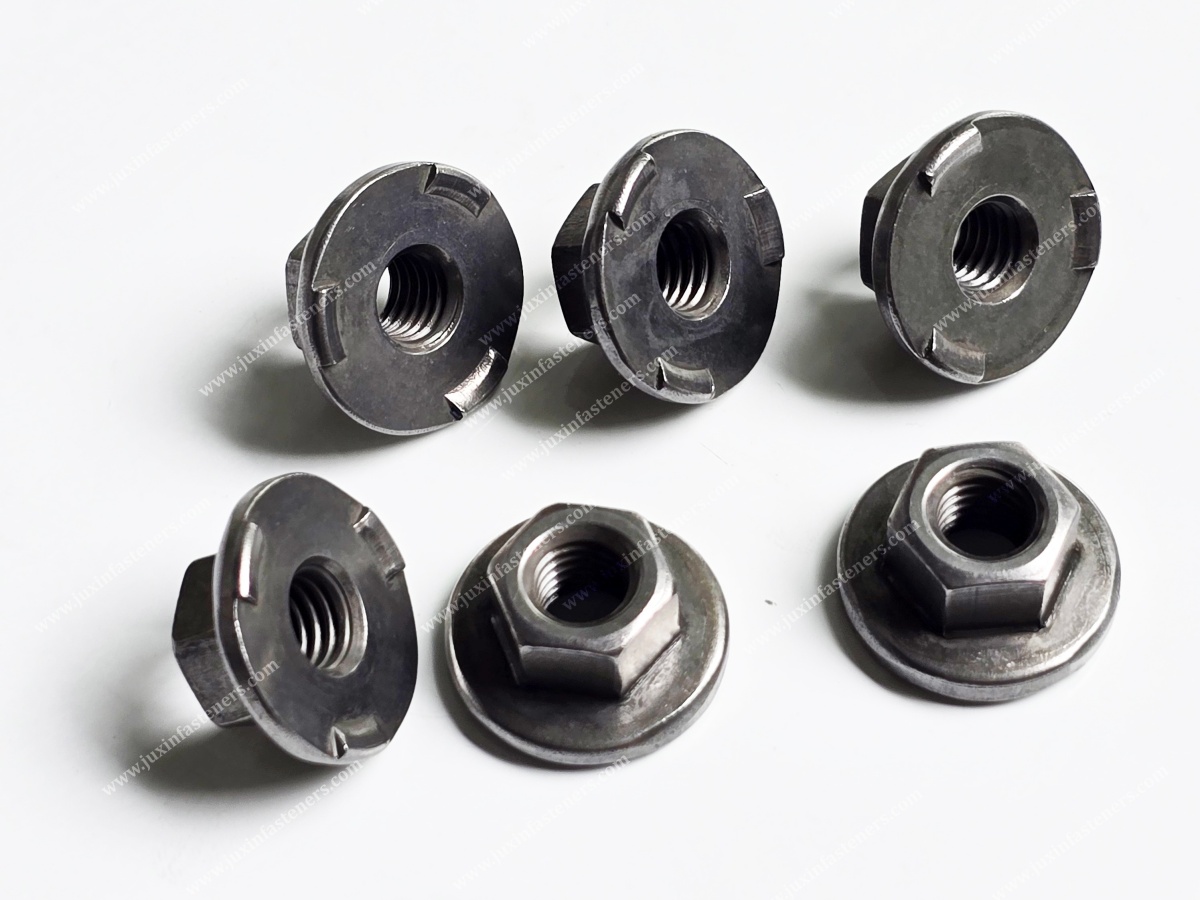
Round weld nuts may be selected where component geometry, mounting space or automated feeding requirements favor a circular configuration.
Potential applications include:
Sheet metal housings
Equipment mounting plates
Fabricated panels
Industrial enclosures
Some round weld nuts incorporate locating features or specifically designed weld projections.
Engineering Consideration
The relationship between the locating feature and mounting hole can influence alignment before welding.
Round weld nut dimensions and installation requirements should be taken from the actual product drawing.
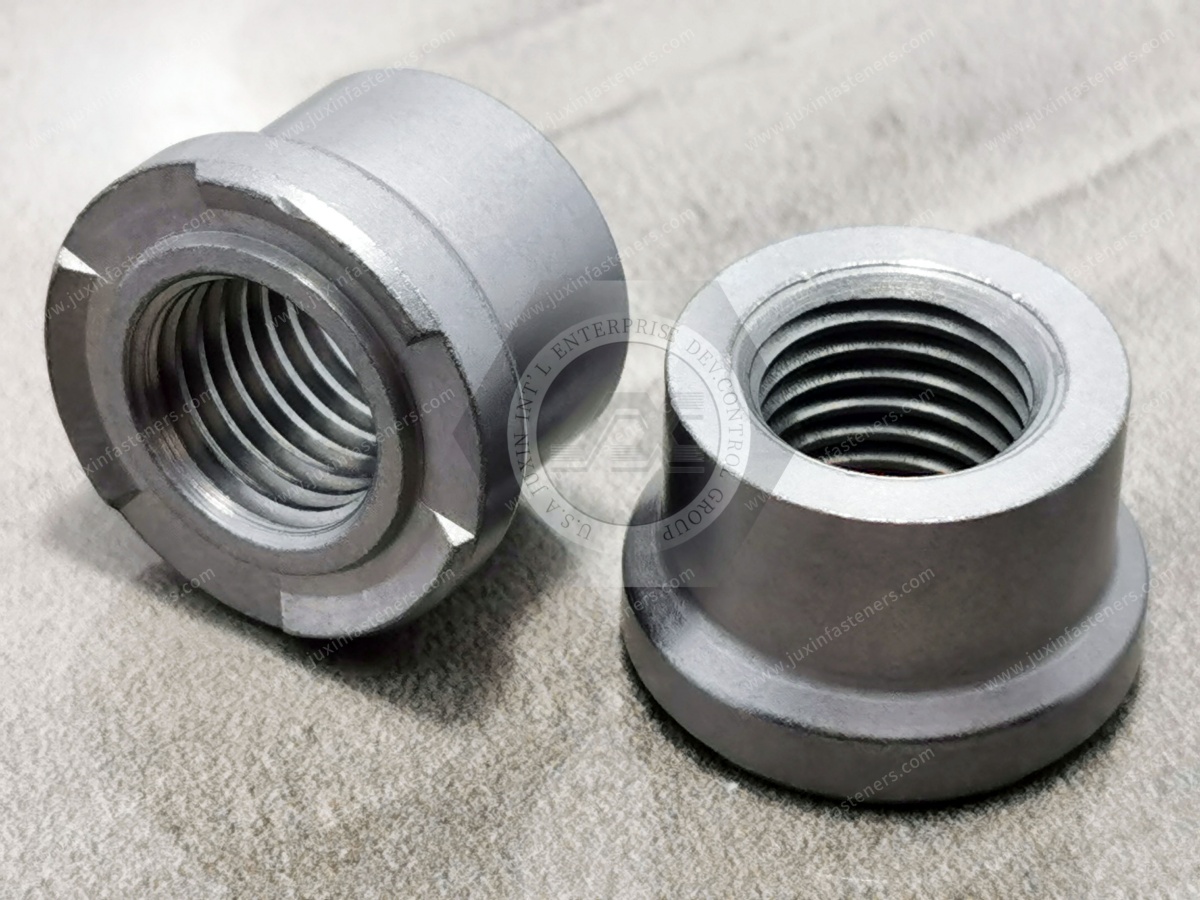
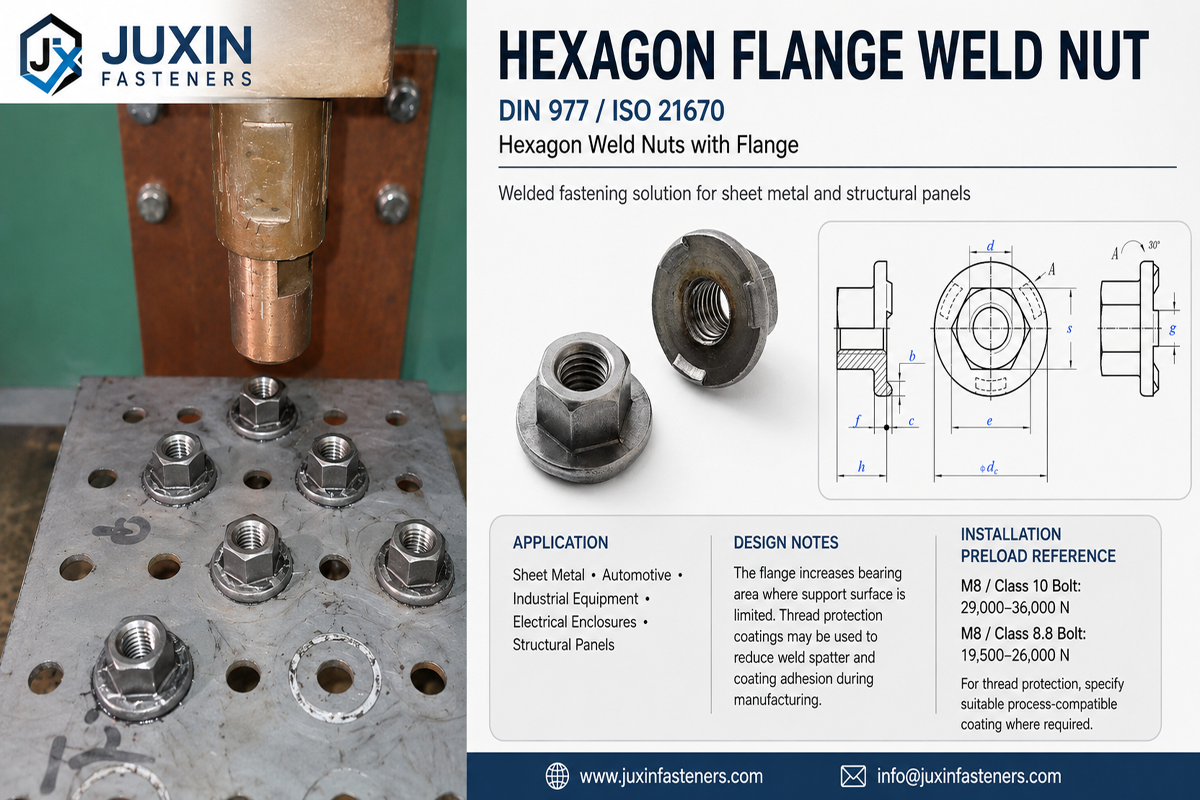
Flange Weld Nuts
Flange weld nuts incorporate an enlarged flange or bearing area.
They may be used in:
Automotive body components
Equipment brackets
Machinery frames
Electrical cabinets
HVAC equipment
Industrial assemblies
ISO 21670:2014 specifies hexagon weld nuts with flange within its defined product range.
Engineering Consideration
An enlarged flange does not automatically guarantee greater installed joint strength.
The welding interface, sheet geometry and load path remain critical.
Weld Nut Selection Matrix
| Weld nut type | Potential application | Main selection concern |
|---|---|---|
| Hex weld nut | General industrial and automotive sheet metal | Projection design and positioning |
| Square weld nut | Brackets, frames and equipment panels | Mounting geometry and welding access |
| Round weld nut | Compact equipment assemblies | Hole location and locating features |
| Flange weld nut | Equipment mounting and fabricated structures | Flange geometry and weld interface |
| Custom weld nut | OEM-specific sheet metal assembly | Drawing, process and qualification requirements |
The final selection must be verified against the actual component drawing and production process.
Automotive Weld Nuts for Body, Chassis and Interior Components
Automotive manufacturing is a major application area for weld nuts.
Vehicle assemblies may require fixed threaded attachment points in stamped or fabricated metal components.
Potential applications include:
Body-in-white assemblies
Chassis brackets
Instrument panel support structures
Interior mounting brackets
Underbody components
Engine compartment brackets
Exhaust system supports
Seat frame-related components
Battery mounting structures
Equipment brackets
Automotive manufacturing places particular emphasis on repeatable welding, dimensional control and reliable assembly.
Body-in-White Manufacturing
Projection weld nuts can be attached to stamped sheet metal components before subsequent body assembly operations.
Production Automation
Nut feeding, positioning and welding may be integrated into automated manufacturing cells.
Assembly Compatibility
Thread position must remain compatible with downstream mounting holes and fixtures.
Safety-Critical Applications
Seatbelt anchorage, occupant restraint, structural crash-load paths and other safety-related connections require application-specific design validation and customer approval.
Information Gain: A Successful Weld Does Not Automatically Mean a Successful Assembly
An automotive weld nut can be securely attached but incorrectly positioned.
This may create bolt cross-threading, assembly interference or downstream rework.
Automotive quality planning should address both weld integrity and positional accuracy.
EV Battery Enclosures and Energy Storage Equipment
EV battery enclosures and industrial energy storage cabinets contain numerous threaded mounting interfaces.
Potential applications include:
Battery enclosure brackets
Protective covers
Electrical module supports
Cable management brackets
Cooling system mounting hardware
Sensor brackets
Service access panels
Energy storage cabinets
Material Compatibility
Steel weld nuts may be appropriate for compatible steel sheet assemblies.
Aluminum battery enclosure structures require separate evaluation.
A conventional steel projection weld nut should not be assumed suitable for direct resistance welding to aluminum.
Corrosion Protection
Mixed-metal assemblies may require galvanic corrosion assessment.
Electrical Requirements
Fastener location and material must not compromise electrical isolation or required clearances.
Thermal Conditions
Operating temperature and material expansion may affect joint design.
Information Gain: Battery Enclosure Material Determines the Joining Strategy
If the enclosure uses aluminum rather than weld-compatible steel, alternatives such as appropriately qualified mechanical inserts,
rivet nuts or other engineered joining systems may be more practical.
The choice must consider electrical, structural, sealing and production requirements.
Weld Nuts for Rail Transit and Railway Equipment
Railway equipment may use welded threaded attachment points in suitable metal assemblies.
Potential applications include:
Electrical equipment enclosures
Traction converter cabinet hardware
Interior mounting plates
Cable management supports
Equipment brackets
Access panels
Auxiliary equipment structures
Railway service conditions may involve vibration, shock, corrosion and long maintenance intervals.
Engineering Consideration
Weld nut selection should reflect the specific equipment location, loading and customer qualification requirements.
Safety-critical railway connections require additional engineering validation.
Information Gain: Railway Equipment Location Changes the Joint Requirements
A weld nut installed inside a protected electrical cabinet may have different exposure and mechanical requirements from one installed on underfloor equipment.
The application should determine the specification rather than a generic railway industry label.
Marine and Shipbuilding Weld Nuts
Marine equipment can expose fastening components to moisture, chloride-containing environments and atmospheric corrosion.
Potential applications include:
Equipment brackets
Electrical cabinets
Pipe support assemblies
Deck equipment mounts
Marine control systems
Interior fabricated structures
Stainless steel weld nuts may be considered for suitable corrosion-resistant applications.
However, stainless steel selection alone does not establish suitability for every marine environment.
Material Compatibility
The weld nut and supporting sheet must be suitable for the intended welding method.
Corrosion Protection
The completed welded assembly should be assessed for its actual exposure.
Inspection
Weld integrity and surface condition should be evaluated according to the approved specification.
Information Gain: Corrosion Resistance Must Be Evaluated After Welding
Welding can alter local surface condition and corrosion behavior.
The corrosion protection strategy should consider the welded joint and surrounding panel, not only the original fastener finish.
Weld Nuts for HVAC and Sheet Metal Equipment
HVAC manufacturers use fabricated sheet metal panels, housings, brackets and equipment frames.
Potential applications include:
Air handling units
Ventilation equipment
Air-conditioning housings
Fan assemblies
HVAC cabinets
Mounting brackets
Control panels
Equipment frames
High-Volume Assembly
Preattached weld nuts may reduce loose-hardware handling.
Sheet Thickness
Thin-gauge material requires an appropriate nut and welding process.
Vibration
Fans and motors may introduce dynamic loading.
Maintenance
Some threaded connections may be opened repeatedly.
Information Gain: The Assembly Process Should Be Considered Before Choosing a Weld Nut
If a panel requires a threaded attachment point but welding is difficult or incompatible with its material or finish, a rivet nut or self-clinching fastener may be more appropriate.
The best choice depends on total manufacturing and assembly requirements.
Electrical Cabinets, Telecom Enclosures and Industrial Control Systems
Electrical enclosures contain numerous internal components requiring secure mounting.
Potential applications include:
Control module brackets
DIN rail supports
Cable management hardware
Equipment mounting plates
Cooling equipment supports
Access panels
Internal brackets
Telecom cabinet hardware
Thread Position
Must match the equipment mounting arrangement.
Panel Appearance
Weld nuts can provide internal threaded attachment points without requiring a loose nut during final assembly.
Electrical Safety
Conductive hardware must not compromise the equipment's insulation or clearance requirements.
Coating Sequence
Welding before final painting or coating may be appropriate for some assemblies, subject to the manufacturing process.
Information Gain: Electrical Enclosure Hardware Must Be Coordinated With Coating and Grounding Requirements
A welded nut may affect coating coverage, electrical bonding or assembly clearances.
These requirements should be addressed in the enclosure design.
Weld Nuts for Industrial Machinery and Automation Equipment
Industrial machinery commonly combines fabricated sheet metal, brackets, guards and equipment frames.
Potential applications include:
Automation equipment
Machine frames
Robotic equipment
Conveyor systems
Production-line machinery
Protective guards
Instrument housings
Industrial control cabinets
Assembly Accuracy
Weld nut location affects equipment installation.
Vibration
Joint design must reflect operational loading.
Maintenance
Repeated disassembly may influence thread and fastening requirements.
Production Repeatability
Consistent nut position can reduce rework.
Information Gain: Welding Fixtures Are Part of the Dimensional Control Strategy
Even a correctly manufactured nut can become misaligned if the welding fixture, locating pin or panel positioning is inadequate.
Manufacturing engineers should evaluate the entire installation process.
Appliance and Commercial Equipment Applications
Weld nuts can support high-volume assembly of fabricated metal products.
Potential applications include:
Refrigeration equipment
Washing machines
Air-conditioning equipment
Commercial kitchen equipment
Food-service equipment
Appliance cabinets
Metal chassis
Equipment frames
In high-volume manufacturing, production efficiency depends on reliable feeding, positioning, welding and downstream assembly.
Information Gain: High-Volume Cost Is Driven by More Than Fastener Price
A small reduction in weld nut unit price may be outweighed by increased machine stoppages, rework or rejected assemblies.
The purchasing decision should consider installed cost and process reliability.
Construction and Light-Gauge Steel Assemblies
Weld nuts may also be used in fabricated metal structures and suitable light-gauge steel assemblies.
Potential applications include:
Equipment brackets
Pipe support assemblies
Cable support structures
Fabricated frames
Light-gauge metal components
Mounting plates
The appropriate connection must be designed for the actual loading and applicable structural requirements.
Important Boundary
A general-purpose weld nut should not automatically be treated as a qualified structural connection for a load-bearing building or safety-critical assembly.
The responsible engineer must establish the required design and qualification.
How Resistance Projection Welding Works
Resistance projection welding is a common process for attaching suitable weld nuts to metal panels.
The weld nut contains defined projections that contact the supporting sheet.
During the welding cycle, electrical current and electrode force are applied through the assembly.
The projections concentrate electrical resistance and heating at selected contact locations.
As the material softens and the projections collapse under controlled force, welded connections form between the nut and the panel.
The process must be developed for the actual nut, sheet material, thickness, coating and equipment.
Key Welding Variables
Welding Current
Influences heat generation.
Welding Time
Affects the duration of electrical heating.
Electrode Force
Influences contact conditions and projection collapse.
Projection Geometry
Affects current distribution and the weld interface.
Sheet Thickness
Influences heat flow, deformation and joint behavior.
Surface Condition
Coatings, oil and contamination can affect welding consistency.
Electrode Condition
Wear or misalignment may affect the process.
Fixture Accuracy
Controls nut location relative to the panel.
Information Gain: There Is No Universal Welding Parameter for Every Weld Nut
A welding schedule developed for one nut size and uncoated steel panel should not automatically be transferred to a different material, coating or sheet thickness.
The welding process must be validated under the actual production conditions.
Weld Projection Geometry and Locating Features
Projection weld nut geometry can influence both installation and final joint performance.
Important features may include:
Projection height
Projection location
Projection consistency
Nut body geometry
Locating shank diameter
Locating shank height
Panel hole diameter
Nut-to-hole alignment
Locating Shank Diameter
If the shank is too small relative to the hole, excessive movement may reduce positional accuracy.
If it is too large, the nut may not locate correctly.
Locating Shank Height
If the locating feature interferes with proper seating, the projections may not contact the sheet as intended.
Information Gain: Hole Size and Shank Geometry Must Be Designed Together
The nut drawing and sheet metal drawing should be reviewed as one assembly.
Changing the panel hole without reviewing the locating shank can affect weld quality and final bolt alignment.
Weld Nut Performance: Push-Out, Torque-Out and Pull-Out
Weld nut performance can be evaluated through different test methods.
These tests do not measure the same failure mode.
Push-Out Resistance
Evaluates resistance to displacement from the panel under a defined pushing load.
Torque-Out Resistance
Evaluates resistance to rotation under a defined torque-loading test.
Pull-Out Resistance
Evaluates resistance to an applied axial extraction load under a specified test configuration.
Thread Strength
Evaluates the internal thread's ability to resist the applicable load.
Weld Integrity
Evaluates the welded attachment between nut and sheet.
Information Gain: Test Direction Changes the Meaning of the Result
A nut may perform well in one test but be unsuitable for another loading condition.
Purchasing specifications should define the required test method, loading direction, sample configuration and acceptance criteria.
Do not compare push-out, pull-out and torque-out results as though they were interchangeable measurements.
Common Weld Nut Installation Problems
| Problem | Potential contributing factors | Engineering response |
|---|---|---|
| Weak weld attachment | Unsuitable welding schedule, poor contact, contamination | Review process and weld validation |
| Nut misalignment | Hole tolerance, locating pin, fixture positioning | Verify complete locating system |
| Weld spatter in threads | Process instability or unsuitable protection | Review welding parameters and thread inspection |
| Thread distortion | Excessive heating or mechanical deformation | Evaluate welding process and nut geometry |
| Incomplete projection collapse | Insufficient or uneven heating, force or contact | Inspect projection and electrode conditions |
| Panel distortion | Localized heating and thin-sheet geometry | Review welding sequence and fixturing |
| Inconsistent welds | Electrode wear, material variation, feeding problems | Establish process monitoring |
| Coating-related variation | Coating condition and electrical contact changes | Validate coated-material process |
| Nut separation | Insufficient weld integrity or excessive applied loading | Investigate joint and test configuration |
Information Gain: Failure Analysis Must Identify the Actual Failure Location
If the nut separates from the sheet, engineers should determine whether failure occurred at the weld interface, within the sheet material or elsewhere.
Without identifying the failure mode, changing the nut material or increasing welding current may not solve the underlying problem.
Material Selection for Weld Nuts
Potential materials include:
Carbon steel
Stainless steel
Suitable alloy steels
Other customer-specified materials
Carbon Steel Weld Nuts
Commonly considered for compatible steel sheet assemblies.
Stainless Steel Weld Nuts
May be selected for suitable corrosion-resistant applications, provided the material and welding process are compatible.
Alloy Steel Weld Nuts
May be considered where the design and manufacturing requirements justify a specific alloy.
Information Gain: Mechanical Strength and Weldability Must Be Considered Together
A material with suitable mechanical properties is not automatically suitable for the intended welding process.
Material selection must consider both the finished threaded joint and the manufacturing operation.
Surface Treatment and Corrosion Protection
Potential finishes include:
Plain or uncoated condition
Zinc plating
Zinc-nickel plating
Zinc-based protective coatings
Other approved surface treatments
The finish must be compatible with the welding process and the final service environment.
Coating Before Welding
A preapplied coating may affect electrical contact, heat generation and welding behavior.
Coating After Welding
Post-weld coating may provide a different corrosion protection strategy but can affect thread dimensions and coating coverage.
Information Gain: Welding and Corrosion Protection Should Be Planned as One Process
The nut's finish, panel coating, welding sequence and final corrosion requirements must be coordinated.
A coating that is appropriate for an ordinary fastener may not automatically be appropriate for a projection weld nut.
Metric, UNC, UNF and Other Thread Systems
Weld nuts may be specified with metric or inch threads according to the customer's design.
Potential requirements include:
Metric coarse threads
Metric fine threads
UNC threads
UNF threads
Legacy BSW or BSF threads where applicable
These thread systems are not directly interchangeable.
For example, a metric nominal diameter close to an inch nominal diameter does not establish thread compatibility.
The complete specification should define:
Nominal thread size
Pitch or threads per inch
Thread tolerance class
Thread engagement
Mating bolt specification
Surface treatment requirements
Information Gain: Thread Size Alone Is Not a Complete Weld Nut Specification
Two weld nuts with the same internal thread may have different external geometry, projections, locating features and installation requirements.
Procurement teams should not approve a substitute based only on the thread designation.
Applicable International Standards
DIN 928 — Square Weld Nuts
Specifies requirements for standardized square weld nuts within its defined scope.
DIN 929 — Hexagon Weld Nuts
Specifies requirements for standardized hexagon weld nuts within its defined scope.
ISO 21670 — Hexagon Weld Nuts With Flange
Specifies characteristics for hexagon weld nuts with flange within the standard's applicable dimensional and thread ranges.
ISO 965 — Metric Screw Thread Tolerances
Relevant to applicable metric thread specifications.
ASME B1.1 — Unified Inch Screw Threads
Relevant to applicable UNC and UNF thread specifications.
ISO 898-2 — Mechanical Properties of Nuts
Relevant to applicable carbon and alloy steel nuts within the standard's scope.
ISO 3506-2 — Stainless Steel Nuts
Relevant to applicable corrosion-resistant stainless steel nuts within the standard's scope.
ISO 4042 — Electroplated Coatings for Fasteners
Relevant where applicable electroplated fastener coating requirements are specified.
ISO 14373 — Resistance Spot Welding Procedure
Addresses resistance spot welding of specified metallic materials.
Its scope must not be confused with a universal qualification standard for every projection-welded nut.
Standards Selection Principle
A product dimensional standard does not establish the strength of the welded assembly.
A thread standard does not establish welding process suitability.
A coating standard does not establish performance in every corrosion environment.
The customer must specify the applicable standards, editions and acceptance requirements.
Weld Nuts Versus Rivet Nuts and Self-Clinching Fasteners
Weld nuts are not the only way to create threaded attachment points in sheet metal.
| Selection factor | Weld nut | Rivet nut | Self-clinching fastener |
|---|---|---|---|
| Attachment method | Welding | Mechanical deformation | Press installation |
| Welding required | Yes | No | No |
| Suitable base material | Weld-compatible assembly | Depends on insert and panel | Depends on fastener and panel |
| Access requirement | Welding equipment access | Depends on installation type | Press and tooling access |
| Coated panels | Requires process evaluation | May suit certain finished panels | Requires installation evaluation |
| Automation | Possible | Possible | Possible |
| Joint performance | Weld and sheet dependent | Installation and sheet dependent | Installation and sheet dependent |
When a Weld Nut May Be Preferred
Compatible metal sheet
Established welding process
Suitable production volume
Required captive threaded connection
Appropriate access for welding equipment
When a Rivet Nut May Be Preferred
Welding is undesirable
The panel is already finished
Material combination is unsuitable for conventional weld nut installation
Mechanical insertion better suits the assembly
When a Self-Clinching Fastener May Be Preferred
The panel material and hardness are compatible
Press installation is available
The required installation geometry is suitable
A nonwelded captive threaded connection is preferred
Information Gain: The Best Fastener Depends on the Manufacturing Route
A weld nut may be economical in a high-volume stamped steel assembly with automated resistance welding.
The same weld nut may be less practical for a finished aluminum enclosure requiring mechanical installation.
Fastener selection should consider the entire production process, not just the finished joint.
Design for Manufacturability: Weld Nut Selection Checklist
Before approving a weld nut design, engineers should review:
Panel Design
Sheet material
Sheet thickness
Hole diameter
Hole location
Distance from edges and formed features
Available welding access
Nut Design
Thread size and class
Nut geometry
Projection design
Locating features
Material
Surface condition
Welding Process
Equipment compatibility
Electrode access
Welding current and time development
Electrode force
Fixturing
Nut feeding
Process validation
Final Assembly
Mating bolt
Thread engagement
Assembly direction
Tightening requirements
Service loading
Maintenance access
Information Gain: Weld Nut Design Must Be Released With the Panel Design
If the nut supplier and sheet metal manufacturer work from incompatible drawings, installation problems can occur even when each individual part conforms to its own drawing.
The approved assembly specification should establish the relationship between both components.
Automated Weld Nut Feeding and Production Efficiency
High-volume manufacturers may use automated or semi-automated weld nut installation.
Important process considerations include:
Feeding orientation
Nut separation
Positioning repeatability
Fixture design
Weld cycle stability
Electrode maintenance
Part detection
Rejection handling
Inspection strategy
Production Manager Perspective
Production efficiency depends on consistent delivery of correctly oriented, dimensionally conforming weld nuts.
Variation in external geometry, projection height or thread condition can disrupt automated production.
Information Gain: Weld Nut Consistency Influences Production Uptime
A nut may pass a basic dimensional inspection but still cause feeding problems if the features used by the automation system are not adequately controlled.
For automated programs, the supplier and production engineering team should identify all feed-critical and weld-critical dimensions.
Quality Control and Inspection Planning
Quality requirements may include:
Material verification
Thread gauge inspection
External dimensional inspection
Projection geometry inspection
Locating feature inspection
Surface treatment verification
Visual inspection
Welding performance evaluation
Push-out testing
Torque-out testing
Pull-out testing where applicable
Corrosion testing where specified
Part identification and batch records
Weld Nut Quality Control Matrix
| Characteristic | Potential inspection method |
|---|---|
| Internal thread | Appropriate thread gauge |
| Nut height | Dimensional measurement |
| External geometry | Dimensional inspection |
| Projection height | Suitable measurement method |
| Projection location | Dimensional or optical inspection |
| Locating shank | Diameter and height inspection |
| Surface condition | Visual or specified finish inspection |
| Material | Required material verification |
| Welded joint | Approved destructive or nondestructive evaluation |
| Torque-out resistance | Defined test procedure |
| Push-out resistance | Defined test procedure |
| Corrosion performance | Customer-specified test method |
The actual inspection plan should be established according to the approved product and assembly specifications.
Important Quality Boundary
Testing a loose weld nut is not equivalent to testing the completed welded assembly.
Installed joint performance should be verified using the actual or representative panel, welding process and approved test method.
Common OEM Procurement Problems
Incorrect Product Substitution
A nut with the correct thread may have unsuitable projections or locating geometry.
Unclear Material Requirements
The purchasing description may omit material grade or condition.
Incomplete Panel Information
The supplier may not receive sheet thickness, material or hole details.
Unspecified Surface Finish
The coating may affect welding or final thread fit.
Missing Test Requirements
The purchase order may not define weld strength acceptance criteria.
Revision Mismatch
The nut and panel drawings may not reflect the same approved assembly configuration.
Information Gain: Supplier Qualification Should Include the Installation Process
A weld nut supplier should be evaluated not only on the individual fastener but also on the ability to provide a product compatible
with the customer's validated welding and assembly requirements.
Custom Weld Nuts for OEM Manufacturing
Standard weld nuts may not satisfy every industrial assembly.
Drawing-based custom weld nut requirements may involve:
Special thread dimensions
Metric or inch thread systems
Modified nut body geometry
Custom projection locations
Custom flange dimensions
Special locating features
Customer-specified materials
Surface treatments
Packaging and identification requirements
Juxin Fasteners welcomes custom weld nut inquiries based on customer drawings, samples and technical specifications.
The feasibility of special geometry, materials, finishes, production quantities and documentation must be confirmed for each project.
Information Gain: Custom Projection Design Requires Process Validation
Changing projection geometry may affect weld formation, electrode force requirements, installation consistency and final joint performance.
A custom design should be evaluated as a new or modified welded assembly rather than assumed equivalent to the original product.
OEM Procurement and Supplier Development
Purchasing and supply chain teams should evaluate weld nut suppliers against technical and commercial requirements.
Technical Requirements
Product drawing
Thread specification
Material
Projection geometry
Sheet compatibility
Surface treatment
Inspection requirements
Production Requirements
Feeding compatibility
Welding process suitability
Dimensional consistency
Approved sample evaluation
Batch identification
Change control
Commercial Requirements
MOQ
Initial order quantity
Annual forecast
Lead time
Packaging
Delivery schedule
Repeat-order requirements
Information Gain: Unit Price Must Be Evaluated Alongside Installed Cost
A lower unit price may not provide savings if the fastener causes welding rejects, feeding interruptions, thread damage or assembly rework.
For production programs, supplier evaluation should consider conforming installed joints and process stability.
Why Juxin Fasteners for Weld Nuts?
Juxin Fasteners has more than 20 years of experience supplying industrial fastening components to international customers.
Our relevant product range includes:
Hex weld nuts
Square weld nuts
Round weld nuts
Flange weld nuts
Custom weld nuts
Weld screws
Rivet nuts
Self-clinching fasteners
Threaded inserts
Precision screws and bolts
Custom OEM fastening components
We welcome inquiries from manufacturers and purchasing teams in:
Automotive manufacturing
Electric vehicles
Battery and energy storage equipment
Rail transit
Marine equipment
HVAC
Electrical enclosures
Industrial machinery
Automation equipment
Appliances
Fabricated metal structures
Our team can review product drawings, sheet material information, dimensions, thread requirements, surface finishes,
welding requirements and order quantities for technical and commercial feasibility.
Specific material availability, manufacturing feasibility, testing, MOQ and delivery lead time must be confirmed for each project.
Frequently Asked Questions About Weld Nuts
What is a weld nut used for?
A weld nut creates a fixed threaded attachment point on a compatible metal component,
allowing a bolt or machine screw to be installed without holding a separate loose nut.
Are weld nuts suitable for thin sheet metal?
Yes, for appropriately designed and validated assemblies.
They can provide threaded engagement where directly tapping the sheet is impractical.
What is a projection weld nut?
A projection weld nut has defined welding projections that concentrate current and force at selected contact locations during resistance welding.
What is the difference between DIN 928 and DIN 929?
DIN 928 covers square weld nuts, while DIN 929 covers hexagon weld nuts within their respective standard scopes.
What does ISO 21670 cover?
ISO 21670 specifies hexagon weld nuts with flange within its defined product range.
What is the difference between a weld nut and a rivet nut?
A weld nut is attached by welding, while a rivet nut is mechanically installed into a prepared hole.
Can weld nuts be installed on galvanized sheet steel?
Suitable weld nut assemblies may be developed for galvanized steel, but the coating and welding process must be evaluated and validated.
Can steel weld nuts be welded directly to aluminum battery enclosures?
Direct compatibility should not be assumed. The material combination and joining process require engineering evaluation.
What is weld nut torque-out resistance?
It is the resistance of an installed weld nut to rotation under a defined test configuration.
What is weld nut push-out resistance?
It is the resistance to displacement from the sheet under a defined pushing load.
Why do weld nuts become misaligned?
Potential causes include unsuitable mounting hole dimensions, locating features, fixtures or welding equipment setup.
Can stainless steel weld nuts be used in marine applications?
They may be suitable for specified marine environments, but material compatibility, welding and corrosion requirements must be reviewed.
Are weld nuts used in automotive manufacturing?
Yes. They are used in suitable automotive sheet metal and fabricated assemblies requiring fixed threaded attachment points.
Can Juxin Fasteners supply custom weld nuts?
Drawing-based custom weld nut inquiries can be reviewed for manufacturing and supply feasibility.
OEM Weld Nut RFQ Checklist
For accurate technical review and quotation, please provide the following information where available.
Weld Nut Specification
Product type
Thread size and pitch
Thread tolerance class
Nut dimensions
Projection geometry
Locating features
Material grade
Surface finish
Applicable product standard
Drawing revision
Sheet Metal Information
Sheet material
Sheet thickness
Sheet coating
Mounting hole diameter
Hole position
Edge distance
Formed features near the weld location
Welding and Assembly Requirements
Welding process
Welding equipment information
Automated or manual feeding
Electrode access
Fixture requirements
Mating bolt specification
Assembly direction
Required mechanical performance
Quality Requirements
Dimensional inspection
Thread inspection
Projection inspection
Required weld performance tests
Corrosion requirements
Sample approval
Inspection documentation
Batch identification
Change notification requirements
Commercial Requirements
Prototype or sample quantity
Initial order quantity
Annual forecast
MOQ expectations
Required lead time
Packaging requirements
Delivery destination
Request Weld Nuts for Sheet Metal and OEM Industrial Assembly
Juxin Fasteners welcomes inquiries from automotive OEMs, sheet metal fabricators, EV equipment manufacturers, HVAC suppliers,
electrical enclosure manufacturers, industrial machinery producers and global procurement teams.
Whether your project requires standard hex weld nuts, square weld nuts, flange weld nuts, stainless steel weld nuts or customized projection weld nuts,
accurate sourcing begins with the complete component and assembly specification.
Send us your 2D drawing, thread requirements, nut geometry, sheet material, sheet thickness, mounting hole details,
surface treatment requirements, welding process information and purchasing quantities.
Our team will review the application for technical and commercial feasibility.
For safety-critical or specially qualified applications, include the applicable engineering, testing and approval requirements.
Company: Juxin Fasteners
Website: https://www.juxinfasteners.com/
Email: info@juxinfasteners.com
Juxin Fasteners — Weld Nuts, Sheet Metal Fasteners and Drawing-Based OEM Industrial Fastening Solutions.
 MORE NEWS

Oct. 13, 2026
Contact Us
Tel.:
+86 020 8621 0320
+86 020 3121 6067
E-mail:
Technical Support:
Navigation
SEND INQUIREY