Call Us
+86 136 6007 9809
Call Us
+86 136 6007 9809

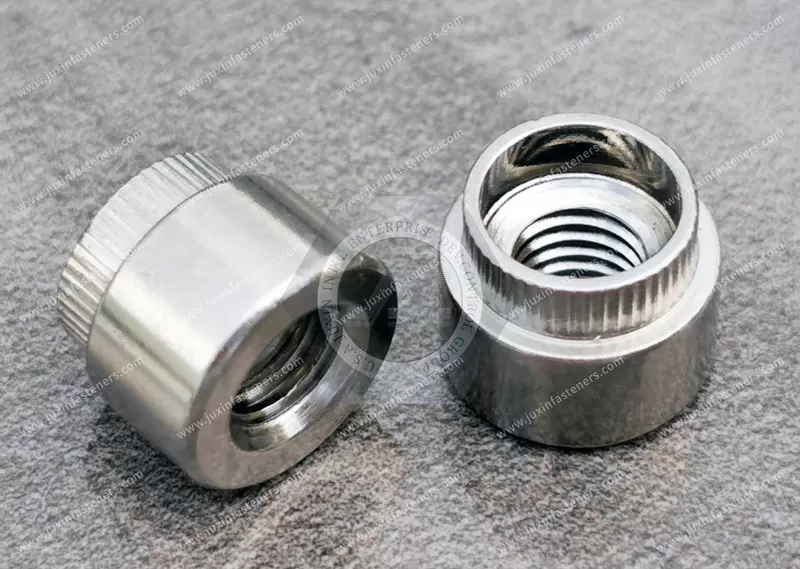
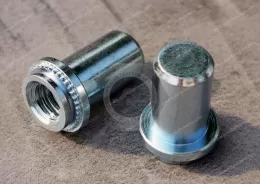
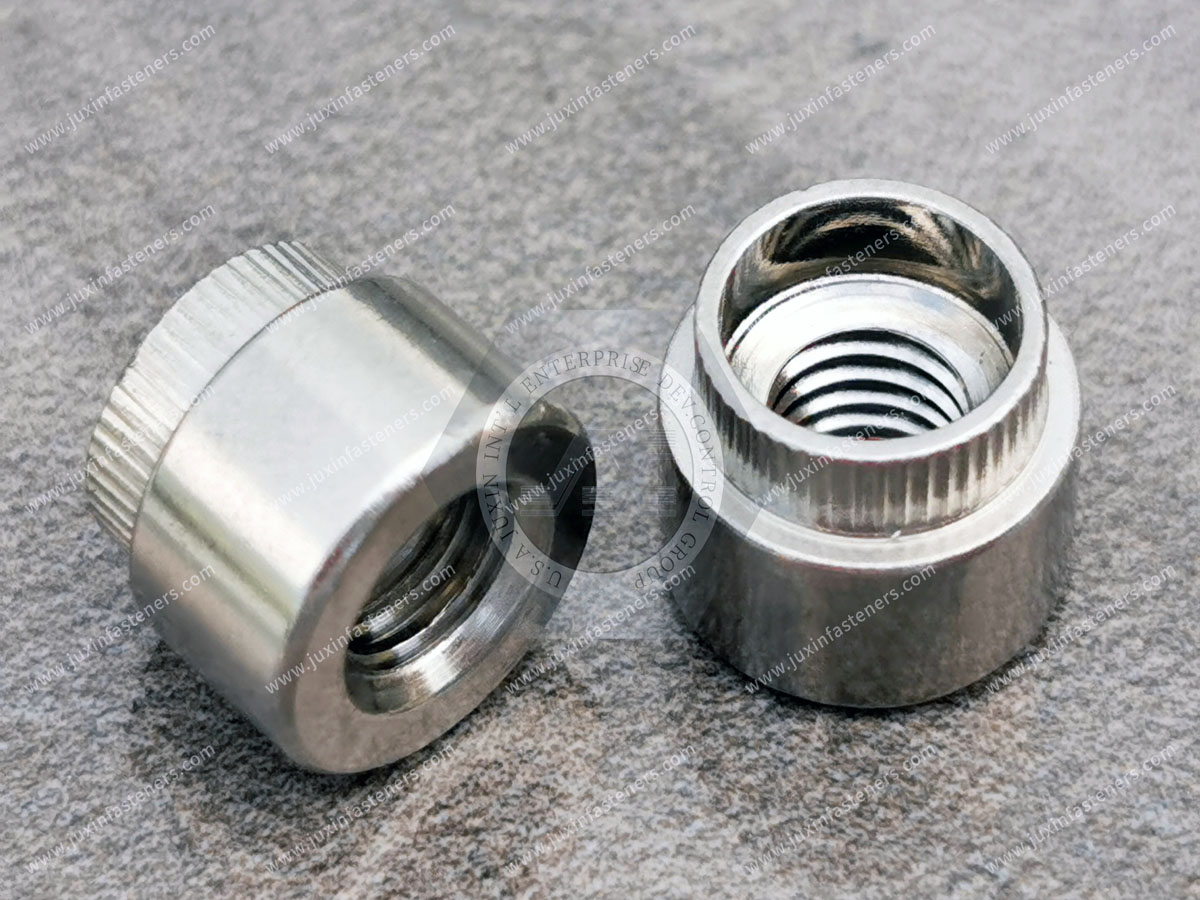
JUXIN FASTENERS supplies stainless steel knurled flare-in nuts for sheet-metal enclosures, industrial equipment and OEM panel assemblies. These threaded inserts combine an externally knurled cylindrical body with a mechanically formed retaining section.
The knurling can contribute to rotational resistance, while the flared section provides mechanical attachment to a compatible panel. Installation performance depends on the selected stainless steel grade, panel properties, hole geometry and forming process.
Product: Stainless Steel Knurled Flare-In Nut
Material: Stainless Steel
Body: Round, Externally Knurled
Attachment: Mechanical Flaring or Swaging
Thread Sizes: According to Approved Specifications
Finish: According to Material and Project Requirements
Custom Designs: Subject to Engineering Review
Product Specification
Stainless Steel Knurled Flare-In Nuts – Engineering Specifications and OEM Sheet-Metal Fastening Solutions
Product Overview
Stainless steel knurled flare-in nuts are internally threaded inserts designed to create mechanically retained fastening points in compatible sheet-metal panels.
Their construction combines a cylindrical body, external knurled engagement features and a section intended for mechanical flaring or swaging.
The knurled surface can contribute to resistance against rotation, while the formed retaining section helps secure the insert against axial separation.
These two retention functions should be evaluated independently during product qualification.
JUXIN FASTENERS supplies stainless steel knurled flare-in nuts for industrial enclosure manufacturing, equipment chassis and other suitable OEM sheet-metal assemblies.
For engineers and sourcing teams, the principal selection factors are stainless steel grade, mounting-hole geometry, panel material, forming compatibility, thread requirements and validated installed performance.
Product Specifications and Configuration
Product name: Stainless Steel Knurled Flare-In Nut
Alternative terminology: Stainless Steel Knurled Swage Nut, Knurled Flare-In Threaded Insert, Knurled Sheet-Metal Nut
Material family: Stainless Steel
Body geometry: Round body with external knurling
Internal thread: According to approved product drawing
Installation method: Mechanical flaring or swaging
Mounting hole: Defined by the selected fastener geometry
Panel thickness: According to the approved configuration
Surface finish: According to the stainless steel grade and customer requirements
Custom dimensions: Subject to drawing and manufacturing review
The available information identifies stainless steel as the material family but does not establish a single confirmed grade, dimensional table or mechanical performance rating for this page.
Exact specifications should be taken from the applicable JUXIN FASTENERS technical drawing or approved customer documentation.
How Stainless Steel Knurled Flare-In Nuts Work
The insert is positioned in a prepared mounting hole.
During installation, suitable forming tooling deforms the designated retaining section of the fastener.
The resulting geometry mechanically secures the insert to the panel.
The external knurling may engage the surrounding sheet and contribute to resistance against rotation.
After installation, the internal thread accepts a compatible mating screw.
The effectiveness of this connection depends on the actual insert geometry, sheet-metal characteristics and forming process.
A knurled flare-in nut should not be treated as interchangeable with a conventional self-clinching nut or blind rivet nut simply because all three provide internal threads in sheet metal.
Stainless Steel Material Selection
Stainless steel is a material family rather than a single mechanical or corrosion-performance specification.
Different grades can vary substantially in strength, ductility, hardness, machinability, magnetic behavior and corrosion resistance.
These differences matter because a flare-in nut must retain a functional internal thread while allowing its designated forming section to deform during installation.
Austenitic stainless steels may be considered where their material characteristics suit the application.
Martensitic or ferritic stainless steels have different mechanical and corrosion characteristics and should not be substituted without review.
The supplied material background includes several stainless steel grades, but their mention does not establish that every grade is available or qualified for every knurled flare-in nut configuration.
The final grade should be selected according to the approved drawing, service environment and installation requirements.
Engineering Information Gain – Corrosion Resistance and Formability Must Be Balanced
A common sourcing mistake is to select stainless steel solely by corrosion resistance.
For a mechanically flared insert, corrosion resistance is only one part of the selection process.
The fastener must also be compatible with the intended forming operation.
A material condition that is suitable for a machined component is not necessarily suitable for the same degree of plastic deformation during installation.
The engineering team should therefore review both the environmental exposure and the material's forming behavior.
If the selected grade or material condition changes, the installation process may need to be requalified.
Knurled Body Geometry
The external knurling is an important design feature.
Knurl diameter, profile, pitch, orientation and engagement length may influence the interaction between the insert and panel.
The approved drawing should define the relevant dimensions and tolerances.
An aggressive knurl profile may increase local panel deformation during insertion or forming.
Insufficient engagement may reduce the contribution of the knurled surface to rotational resistance.
The correct geometry depends on the surrounding sheet material and mounting-hole dimensions.
A visually similar knurled nut from another supplier should not automatically be considered dimensionally or mechanically equivalent.
Mechanical Flaring and Swaging
Mechanical flaring forms the retaining section of the insert against the panel.
The operation requires suitable tooling, alignment and support.
The forming process should produce a consistent retaining geometry without unacceptable cracking, distortion or damage to the internal thread.
Installation force or stroke must be determined from the actual fastener and tooling design.
The correct method should be documented in an approved installation procedure.
Uncontrolled impact installation should not be substituted for a specified forming process.
Where production volumes justify it, process monitoring and representative assembly checks may help maintain consistent results.
Engineering Information Gain – Why Stainless Steel Changes the Installation Window
Steel and stainless steel fasteners may have different deformation characteristics.
Changing from a steel flare-in nut to a stainless steel version can affect the forming force, tooling interaction and final retaining geometry.
Even if the nominal thread and outside diameter remain the same, the installation parameters may not transfer directly.
A stainless steel substitution should therefore be treated as an engineering change rather than a purely commercial material replacement.
Mounting-Hole Design
The mounting hole is a functional part of the attachment system.
Hole diameter, roundness, burr condition and edge quality influence how the insert seats and engages with the panel.
An oversized hole may reduce the effectiveness of knurl engagement.
An undersized hole may create excessive interference or damage the surrounding sheet.
The correct mounting-hole tolerance must be taken from the approved fastener drawing.
Hole dimensions from a smooth-body flare-in nut should not automatically be reused for a knurled version.
Where panels are laser-cut, punched or drilled, the resulting hole condition should be evaluated for the intended installation.
Panel Material Compatibility
The panel material must be capable of accommodating the required engagement and forming operation.
Panel hardness, thickness, ductility and surface condition can influence installation behavior.
A configuration qualified in a mild steel panel may not deliver the same performance in a stainless steel or aluminum panel.
Similarly, changing sheet thickness may alter the support available for the formed retaining section.
The product should be evaluated in the actual parent material used in production.
No universal panel-hardness limit or minimum sheet thickness is claimed for this product family without a verified dimensional specification.
Engineering Information Gain – The Fastener and Panel Form One Mechanical System
A knurled flare-in nut should not be evaluated in isolation.
The completed connection includes the insert, mounting hole, panel material, formed retaining section and mating screw.
Changes to any one of these elements may alter the installed performance.
For example, a supplier may provide a dimensionally acceptable stainless steel nut, but the finished connection can still be unsuitable if the customer's panel material or installation process differs from the qualified conditions.
This is why OEM qualification should focus on the assembled connection, not only incoming fastener dimensions.
Torque-Out Resistance
Torque-out resistance describes the installed insert's ability to resist rotation relative to the panel.
It is relevant during screw tightening, screw removal and repeated equipment servicing.
The external knurling may contribute to rotational restraint.
However, the actual result depends on the complete geometry and installation conditions.
No fixed torque-out value can be assumed from the presence of knurling alone.
Where the application requires a specified torque-out resistance, testing should be conducted on representative assemblies.
Pull-Out Resistance
Pull-out resistance concerns axial separation of the insert from the panel.
The formed retaining section is important to this function.
Pull-out performance depends on the retaining geometry, panel strength, thickness and installation quality.
A high torque-out result does not automatically establish high pull-out resistance.
Both performance requirements should be defined where they are important to the application.
Thread Strength and Screw Compatibility
The internal thread must be compatible with the selected mating screw.
ISO 261 and ISO 965 provide relevant references for ISO metric threads.
ASME B1.1 is relevant to Unified inch screw threads where specified.
Metric and Unified inch threads must not be treated as interchangeable.
Thread engagement, mating screw properties and the installed insert's retention all affect the completed connection.
The maximum suitable tightening torque must be established for the actual assembly.
A nominal thread designation alone does not determine the allowable joint torque.
Stainless Steel Thread Galling
Thread galling is a relevant consideration for certain stainless steel screw and nut combinations.
Under unfavorable conditions, sliding contact between mating stainless steel threads can produce adhesive damage or seizure.
The risk depends on the material pairing, thread condition, lubrication, tightening speed and loading.
For repeatedly serviced equipment, engineers should evaluate the selected mating screw and assembly procedure.
Where necessary, an approved lubrication or thread-treatment strategy may be considered.
Such treatments must be reviewed for compatibility with the application.
Engineering Information Gain – Insert Rotation and Thread Galling Are Different Failure Modes
An installed stainless steel insert may remain mechanically secure in the panel while the mating screw experiences thread galling.
Conversely, a screw may turn smoothly while the insert rotates in the mounting hole.
These problems require different corrective actions.
Thread galling concerns the interaction between the mating threads.
Insert rotation concerns the mechanical retention between the insert and panel.
A complete fastening evaluation should distinguish between these failure modes rather than treating both as general screw-tightening problems.
Corrosion and Environmental Exposure
Stainless steel knurled flare-in nuts may be selected for applications where corrosion resistance is an important design consideration.
However, stainless steel performance depends on the actual grade and service environment.
Humidity, chlorides, cleaning chemicals, temperature and contact with dissimilar metals may influence long-term behavior.
Stainless steel does not automatically provide universal resistance to marine environments or aggressive chemicals.
Where the fastener is installed in a dissimilar metal panel, galvanic corrosion and crevice conditions should be reviewed.
The interface between the insert and panel can create localized conditions that differ from those experienced by an exposed fastener surface.
Material selection should consider the completed assembly.
Surface Finish and Treatment
Stainless steel fasteners may be supplied with a finish or surface condition specified by the customer.
The appropriate treatment depends on the actual stainless steel grade and manufacturing process.
Where passivation is specified, ASTM A967/A967M may be a relevant reference.
This does not imply that every stainless steel knurled flare-in nut is passivated or certified to that standard.
Surface treatment must be confirmed in the approved order documentation.
If the finish affects dimensions or surface characteristics, installation compatibility should also be reviewed.
Electrical Enclosures and Control Cabinets
Stainless steel knurled flare-in nuts may be considered for suitable electrical enclosure and control cabinet assemblies.
Potential applications include removable panels, mounting brackets and internal equipment supports.
The design should account for panel thickness, mounting-hole quality, available installation access and expected servicing.
Where electrical bonding or grounding is required, mechanical retention alone is not evidence of electrical continuity.
Electrical performance must be verified separately.
Telecommunications Equipment
Telecommunications cabinets and equipment housings may require retained threaded attachment points.
Stainless steel knurled flare-in nuts can be evaluated where their installation method and geometry are compatible with the enclosure design.
For outdoor telecommunications equipment, environmental exposure and dissimilar-metal contact should be considered during material selection.
Corrosion resistance should be evaluated at the assembly level rather than inferred from the fastener material name.
Industrial Automation and Machinery
Industrial machinery enclosures may use retained threaded inserts for access panels, protective covers and mounting components.
The installation should be qualified for the intended service conditions.
Where vibration is present, resistance to insert rotation and resistance to mating screw loosening are separate requirements.
A knurled insert does not replace the need for an appropriate threaded-joint locking strategy where one is required.
Transportation and Equipment Housings
Transportation equipment may require fastening systems that tolerate repeated assembly, maintenance and environmental exposure.
Stainless steel knurled flare-in nuts may be evaluated for noncritical enclosure and panel applications where the geometry and performance are suitable.
For safety-related or highly loaded connections, the applicable engineering approval and validation requirements must be established before selection.
No transportation-industry approval or safety qualification is implied without supporting documentation.
Foodservice and Equipment Enclosures
Equipment used in foodservice or commercial kitchens may expose fastening components to humidity, cleaning processes and temperature variation.
Stainless steel threaded inserts may be considered where the selected grade and assembly design are compatible with these conditions.
The actual cleaning chemicals, washdown requirements and hygiene-related design constraints should be reviewed.
A stainless steel material designation alone does not establish food-contact suitability or compliance with equipment sanitation requirements.
Stainless Steel vs. Steel Knurled Flare-In Nuts
Steel and stainless steel versions may share a similar functional design but have different material characteristics.
Steel may be appropriate where the required mechanical performance and surface protection can be achieved with the selected specification.
Stainless steel may be preferred where its corrosion characteristics or other material properties are needed.
The correct choice depends on the complete application.
The two materials should not be substituted without considering installation forming behavior, thread performance and environmental requirements.
Knurled vs. Smooth Round Flare-In Nuts
Smooth round flare-in nuts do not incorporate the same external knurled engagement.
Knurled versions introduce additional surface geometry that may contribute to rotational restraint.
However, the actual advantage depends on the design and parent material.
A knurled version may also require different hole tolerances or installation parameters.
The selection should be based on validated performance rather than appearance alone.
Flare-In Nuts vs. Self-Clinching Nuts
Conventional self-clinching nuts typically rely on displacement of parent-sheet material into the fastener's retaining features.
Flare-in nuts rely on a mechanically formed retaining section.
The installation mechanisms and tooling requirements differ.
They should not be treated as direct replacements without checking the panel geometry, manufacturing process and installed performance.
Flare-In Nuts vs. Blind Rivet Nuts
Blind rivet nuts are commonly used where the installer has access to only one side of a panel.
Knurled flare-in nuts require the specific forming operation defined for their design.
The required tooling access may therefore differ.
Selection should consider installation accessibility, parent material, assembly sequence and the required mechanical performance.
OEM Quality and Supplier Evaluation
For OEM procurement, the approved drawing should define the actual product rather than relying solely on a commercial name.
Important characteristics include the stainless steel grade, internal thread, knurl geometry, body dimensions and forming section.
The customer's panel material and mounting-hole requirements should also be documented.
Where relevant, the specification should identify required torque-out resistance, pull-out resistance, corrosion requirements and inspection methods.
Supplier evaluation should consider the consistency of the finished geometry and the compatibility of the fastener with the customer's installation process.
For repeat production, engineering change control is important because dimensional or material changes may influence the completed attachment.
Installation Quality and Inspection
Inspection should verify that the insert is properly seated and that the retaining section has formed as intended.
The panel should be checked for unacceptable distortion, cracking or other installation damage.
The internal thread should remain functional after installation.
Where required, representative assemblies should undergo mechanical testing against agreed acceptance criteria.
Visual inspection alone cannot establish the full mechanical capacity of the connection.
Common Installation Problems
Insert rotates during screw tightening.
Possible factors include inadequate knurl engagement, mounting-hole variation, panel material characteristics or incorrect forming conditions.
Insert pulls out of the panel.
Possible factors include incomplete flaring, unsuitable sheet thickness, inadequate retaining geometry or excessive axial loading.
Panel becomes distorted.
Possible factors include excessive forming force, insufficient support or unsuitable fastener-to-panel geometry.
Internal thread becomes damaged.
Possible factors include installation-tool interference, incorrect mating screws, excessive tightening or thread galling.
Each issue should be investigated using the actual assembly conditions before corrective action is selected.
Frequently Asked Questions
What is a stainless steel knurled flare-in nut?
It is an internally threaded stainless steel insert with external knurling and a mechanically formed retaining feature for suitable sheet-metal panels.
Why use stainless steel instead of steel?
Stainless steel may be selected for its material and corrosion characteristics, provided the chosen grade is compatible with the forming process and application.
Does the knurled surface prevent rotation?
It can contribute to rotational resistance, but the installed performance depends on the complete fastener and panel design.
Can stainless steel knurled flare-in nuts be installed in aluminum panels?
Compatibility must be evaluated using the selected fastener geometry, panel material and installation procedure.
Are these nuts suitable for outdoor equipment?
Suitability depends on the stainless steel grade, environmental exposure and completed assembly design.
Can the same installation tooling be used for steel and stainless steel versions?
Not automatically. Material deformation behavior and tooling requirements must be reviewed.
Do these inserts prevent screw loosening under vibration?
No. Insert retention and screw-loosening resistance are separate engineering considerations.
Can a knurled flare-in nut be removed and reused?
Removal and reuse should not be assumed. The forming operation creates a mechanical attachment, and any repair or replacement procedure must be evaluated for the specific design.
Can JUXIN FASTENERS review custom specifications?
Customer-specific requirements may be evaluated using drawings and confirmed technical information.
What should an OEM buyer provide for a quotation?
Provide the fastener drawing, thread designation, stainless steel grade, panel material, sheet thickness, mounting-hole dimensions, finish requirements, performance criteria and expected purchasing quantities.
Relevant International Engineering References
ISO 261 – ISO metric screw thread general plan.
ISO 965 – ISO metric screw thread tolerances.
ASME B1.1 – Unified inch screw threads where applicable.
ASTM A967/A967M – Chemical passivation treatments for stainless steel parts where specified.
ISO 6508-1 and ASTM E18 – Rockwell hardness testing.
ISO 9227 and ASTM B117 – Salt-spray test methods where specified.
The applicability of each reference depends on the selected product and customer specification. Listing these references does not establish product certification or universal compliance.
Related JUXIN FASTENERS Product Categories
Steel Knurled Round Flare-In Nuts – for comparison of material selection and forming behavior.
Smooth Round Flare-In Nuts – for applications using cylindrical inserts without the same knurled engagement.
Brass Round Flare-In Nuts – for applications requiring brass material characteristics.
Hexagonal Flare-In Nuts – for compatible polygonal mounting-hole designs.
Self-Clinching Nuts – for conventional press-installed threaded fastening systems.
Self-Clinching Flush Nuts – for sheet-metal assemblies requiring a flush fastening arrangement.
Blind Rivet Nuts – for applications requiring suitable one-sided installation.
Self-Clinching Standoffs – for threaded mounting points that also provide spacing between components.
Connect these categories to the corresponding verified product pages on the JUXIN FASTENERS website.
Request a Stainless Steel Knurled Flare-In Nut Quotation
JUXIN FASTENERS supplies stainless steel knurled flare-in nuts and related industrial sheet-metal fastening products for OEM applications.
For a technical review and quotation, send your 2D drawing or 3D CAD model.
Please identify the required stainless steel grade, internal thread, knurl geometry, panel material, sheet thickness and mounting-hole dimensions.
Where applicable, include the required corrosion performance, torque-out resistance, pull-out resistance and inspection criteria.
Please also provide the estimated annual demand, initial order quantity and project schedule.
Our team can review the requested configuration and prepare a quotation based on confirmed technical and commercial requirements.
Email: info@juxinfasteners.com
Website: www.juxinfasteners.com
JUXIN FASTENERS – Stainless Steel Knurled Flare-In Nuts and OEM Sheet-Metal Fastening Solutions.
Product Packaging
Product Packaging
Stainless steel knurled flare-in nuts are packed according to the confirmed product dimensions, order quantity and shipment requirements.
Protective inner packaging may be used to reduce contact damage to the knurled surfaces and internal threads during handling and transportation.
Outer cartons and palletized shipping arrangements are selected according to the approved packing plan.
The supplied packaging information includes carton sizes of 29 × 19 × 19.5 cm and 23.5 × 17.5 × 8 cm. Suitability depends on the selected product dimensions and order quantity.
Polyfoam protection and pallet packaging can be arranged according to confirmed shipment requirements.
Different stainless steel grades, thread sizes and customer-specific configurations should be identified separately to support inventory control and OEM production.
Final packing quantities, carton weights, pallet dimensions and labeling requirements are confirmed before shipment.
For custom OEM packaging requirements, please include the details in your RFQ.
Email: info@juxinfasteners.com
Website: www.juxinfasteners.com
Product Pictures
Contact Us
Tel.:
+86 020 8621 0320
+86 020 3121 6067
E-mail:
Technical Support:
Navigation
SEND INQUIREY