Call Us
+86 136 6007 9809
Call Us
+86 136 6007 9809

JUXIN FASTENERS supplies JX-NZF knurled self-clinching hex nuts for creating permanent, reusable metric threads in compatible sheet-metal assemblies.
The hexagonal body and knurled retention features are designed to resist rotation after controlled press-fit installation.
Material options include carbon steel grades such as C45, C46, C20, and suitable free-machining steels, subject to the approved drawing.
These press-fit hex nuts are used in industrial enclosures, electrical equipment, machinery panels, and OEM metal assemblies.
Custom thread sizes, dimensions, and surface finishes can be reviewed for production requirements.
Product Specification
JX-NZF Knurled Self-Clinching Hex Nuts for Sheet-Metal Assemblies
Product Overview
JX-NZF knurled self-clinching hex nuts are internally threaded metal fasteners designed to create reusable threaded attachment points in compatible sheet-metal components.
JUXIN FASTENERS supplies the JX-NZF series for OEM equipment manufacturers, sheet-metal fabricators, electrical enclosure builders, industrial machinery producers, and purchasing organizations requiring press-installed threaded fasteners.
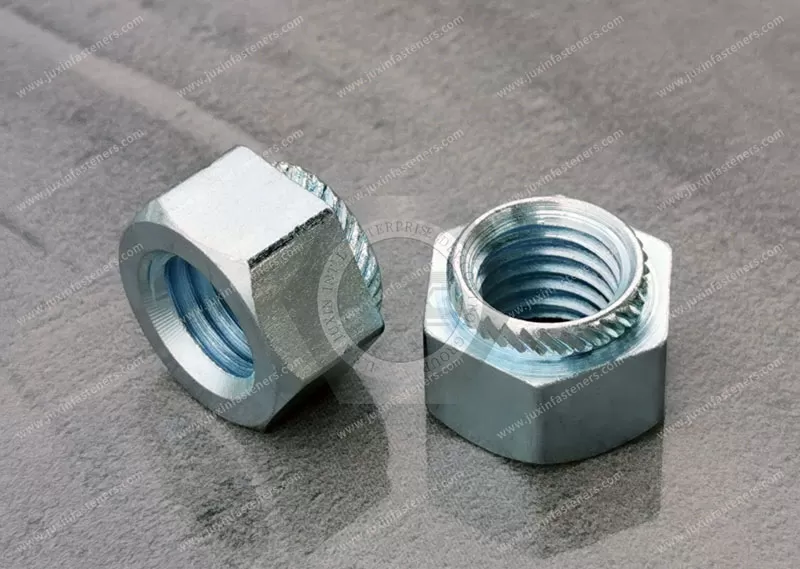
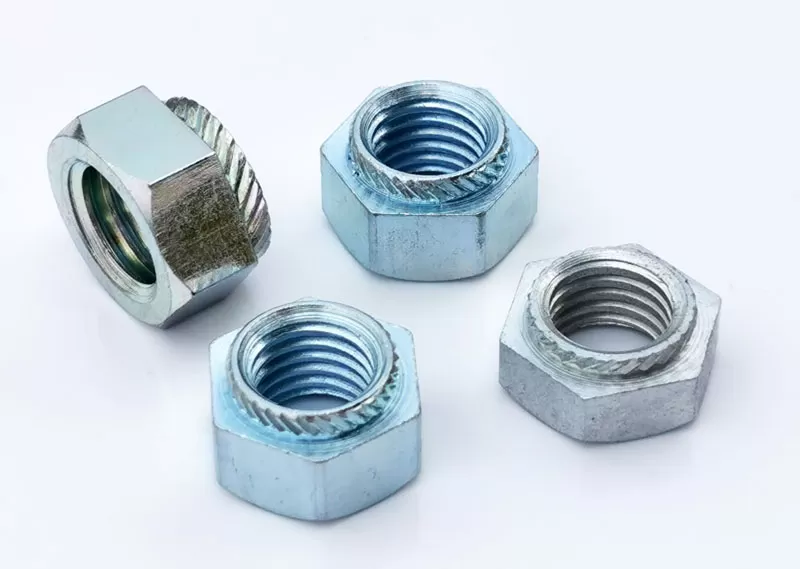
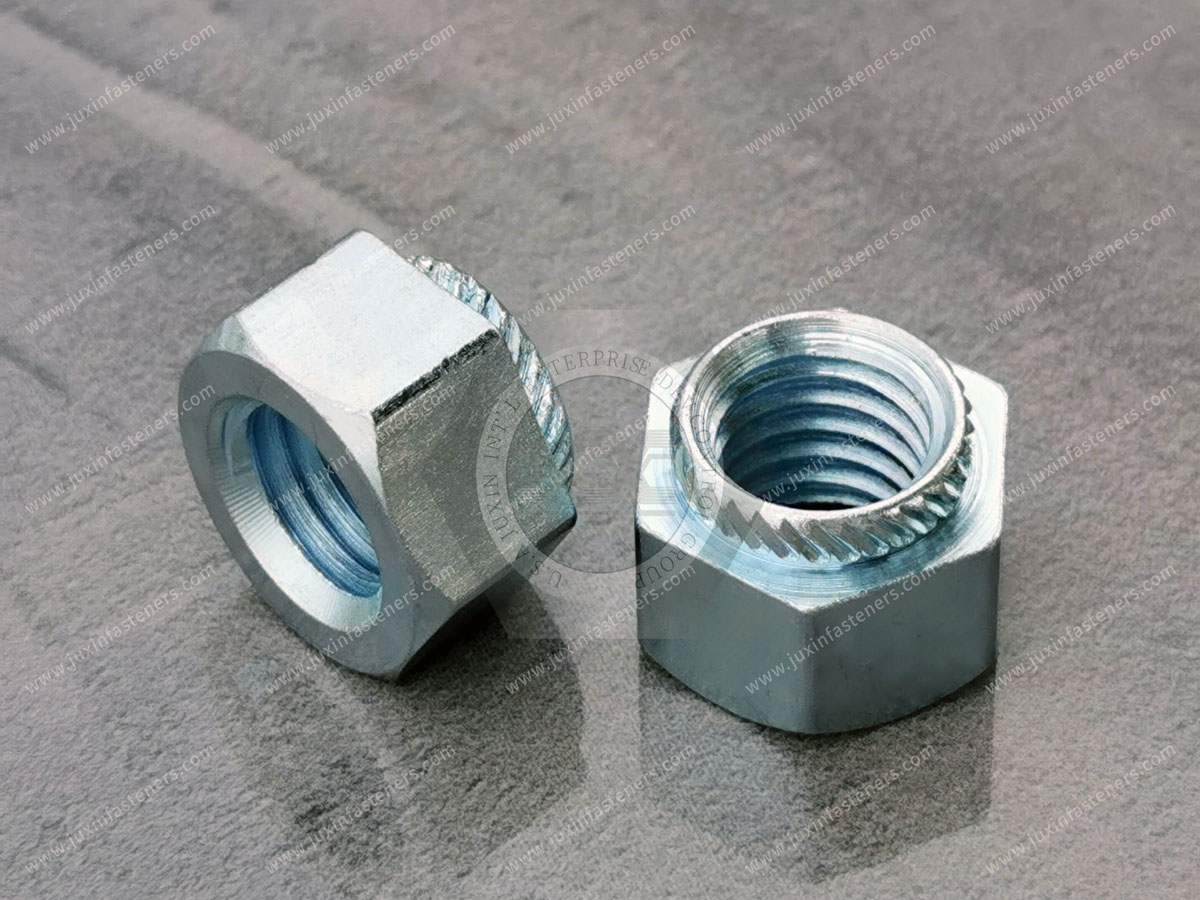
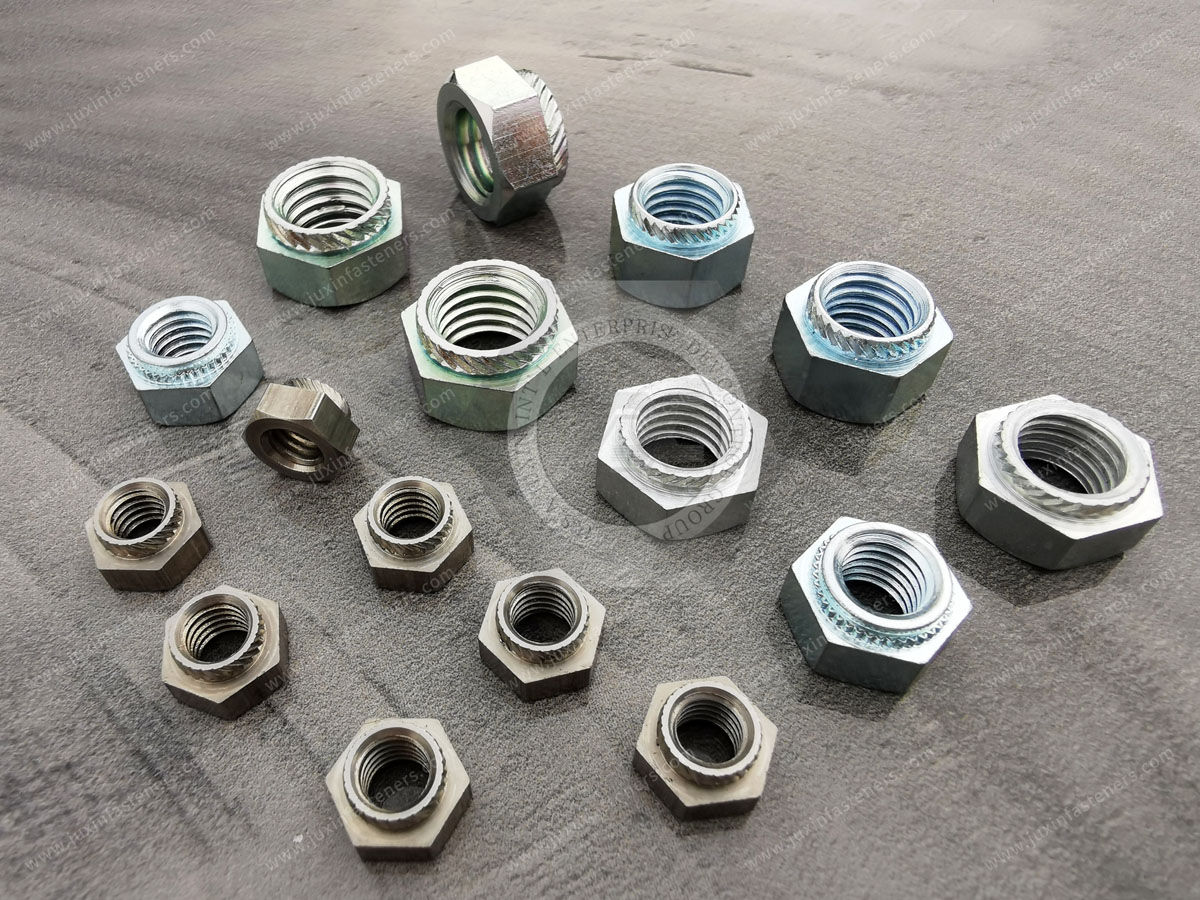
The product combines a hexagonal external body with knurled or mechanically engaging retention features.
During controlled press installation, suitable surrounding sheet material deforms into the designated retention features of the nut.
This mechanical engagement helps resist rotation and withdrawal during subsequent threaded assembly.
The resulting threaded connection can be used for repeated installation and removal of compatible screws or bolts, subject to the mechanical condition of the fastener and supporting panel.
Unlike weld nuts, self-clinching hex nuts do not require a welding operation.
Unlike loose hex nuts, they remain mechanically retained in the supporting sheet after proper installation.
The exact retention mechanism and installation requirements depend on the approved JX-NZF product geometry.
JX-NZF Product Construction and Retention Mechanism
The JX-NZF nut incorporates a hexagonal body and an internal metric thread.
The external body provides wrench-like geometry, while the designated retention features are intended to engage the surrounding panel material during installation.
The supplied product description identifies knurled and inclined retention features.
In a compatible press-fit arrangement, the fastener is positioned in a correctly prepared panel opening.
A controlled compressive force is then applied using suitable installation tooling.
The supporting sheet material deforms around the retention features, creating mechanical engagement.
The installed nut provides a fixed threaded attachment point for subsequent assembly.
The hexagonal external shape and knurled features may contribute to resistance against rotation.
However, the actual torque-out resistance depends on the product geometry, sheet material, panel thickness, hole preparation, and installation conditions.
The nut should not be assumed to provide a specific pushout or torque-out rating without test data.
Product Specifications and Material Options
Product series: JX-NZF
Product type: Knurled self-clinching hex nut
Alternative terminology: Press-fit hex nut, hex clinch nut, press-in captive nut
Body configuration: Hexagonal external profile
Retention features: Knurled or inclined mechanical engagement features
Thread configuration: Internal metric thread
Installation method: Controlled press-fit installation
Primary application: Permanent threaded attachment in compatible sheet-metal panels
Material options identified in the supplied information:
Carbon steel C45 / EN 1.0503-type material
Carbon steel C46-type material
Carbon steel C20-type material
Free-machining steel grades such as 1213, 1214, and 1215
Additional materials: Subject to engineering review
Surface finish: According to the approved specification
Potential finish option: Clear zinc plating for suitable steel configurations
Custom dimensions: Subject to approved OEM drawings
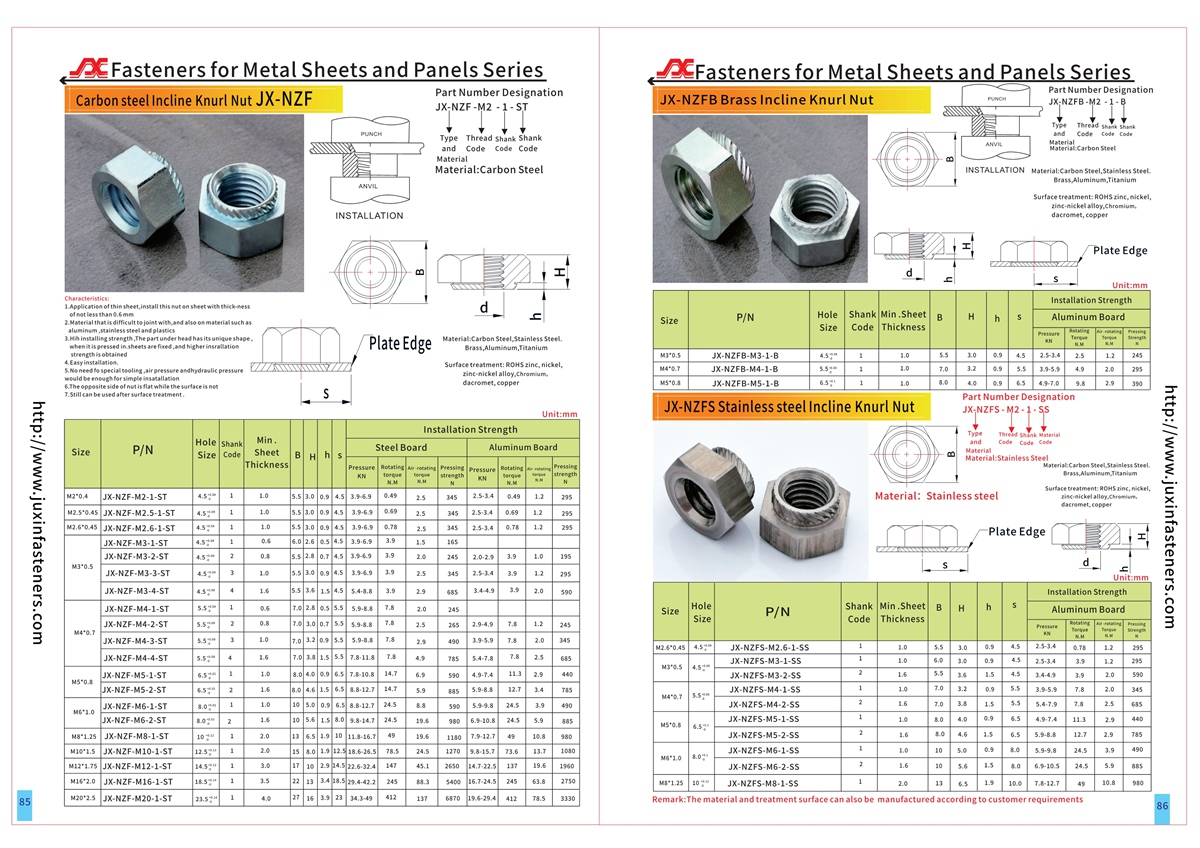
Technical reference: Product specification PDF and CAD documentation, pages 85–86
The supplied information does not establish a complete thread-size table, minimum hole diameter, nut height, installation force, or retention performance for every JX-NZF configuration.
These characteristics must be verified from the approved drawing.
Metric Internal Threads and International Thread Standards
The JX-NZF series is intended to provide reusable internal metric threads for compatible screws and bolts.
ISO metric thread designations should be specified according to the required nominal diameter, pitch, and tolerance class.
Relevant international thread standards include ISO 68-1, ISO 261, ISO 724, and ISO 965.
ASME B1.13M provides a corresponding metric screw thread reference used in the American industrial market.
A 6H internal thread tolerance class is common in metric fastening applications.
However, the exact JX-NZF thread tolerance must be verified against the approved product drawing.
The nut should not automatically be described as meeting every requirement of a particular standard without inspection or supporting documentation.
Metric and inch-thread systems are not directly interchangeable.
For international OEM programs, buyers should identify whether the mating fastener uses an ISO metric thread or a Unified inch thread.
UNC and UNF threads must not be substituted for metric threads based only on approximate diameter.
Sheet-Metal Thickness and Installation Compatibility
The supplied product information references sheet-metal applications involving panel thicknesses from approximately 0.6 mm, while another description identifies applications in sheet metal as thin as 1.0 mm.
These figures should be treated as configuration-dependent references rather than universal minimum thickness specifications.
The correct minimum panel thickness depends on the selected nut size, retention geometry, and supporting material.
For a successful press-fit installation, the panel must provide sufficient material for mechanical engagement.
An excessively thin panel may not provide adequate retention.
An excessively thick or unsuitable panel may interfere with the intended installation geometry.
The engineer should verify the applicable panel thickness range before specifying the fastener.
The supporting material must also be sufficiently ductile to deform into the nut's retention features without unacceptable cracking or damage.
Panel Hardness and Material Selection
Self-clinching fasteners rely on controlled deformation of the supporting sheet.
The supplied reference information identifies ductile sheet materials with hardness values around HRB 80 or lower for certain self-clinching applications.
This is a useful general selection consideration but does not establish a verified JX-NZF hardness limit.
The actual allowable panel hardness depends on the fastener material, heat treatment, retention geometry, and installation requirements.
For carbon steel panels, the engineer should verify that the selected fastener is suitable for the actual sheet grade and hardness.
For aluminum panels, the lower hardness may facilitate material flow, but the required retention strength must still be validated.
For copper and other ductile metals, compatibility depends on the specific material condition and sheet thickness.
Stainless steel panels can be significantly harder than mild steel or aluminum.
A standard carbon steel clinch nut should not automatically be assumed suitable for every stainless steel sheet grade.
For plastic panels, conventional self-clinching performance should not be assumed.
Plastic materials have different deformation, creep, and temperature characteristics.
Where plastic mounting is required, an appropriate threaded insert or specially validated fastening design may be more suitable.
Installation Procedure for Knurled Press-Fit Hex Nuts
Correct installation requires an appropriately prepared panel opening and suitable press tooling.
The fastener should be selected according to the approved JX-NZF drawing.
The panel hole must match the specified dimensions and tolerances.
The hole should be prepared using a suitable punching, drilling, or machining process.
Excessive burrs and deformation should be avoided.
The nut is positioned in the prepared opening according to the required installation orientation.
The supporting panel and nut must be aligned with the installation tooling.
A controlled compressive force is applied using a suitable arbor press, pneumatic press, hydraulic press, or equivalent pressure equipment.
The press operation should allow the supporting sheet material to engage the designated retention features.
The fastener should be seated according to the approved installation specification.
After installation, the nut should be inspected for proper seating, alignment, thread condition, and visible panel damage.
The exact punch and anvil geometry must match the selected fastener configuration.
The supplied information does not establish a universal installation force or tooling arrangement for all JX-NZF sizes.
Why Installation Force Matters
Self-clinching installation requires sufficient force to create the intended mechanical engagement.
Too little force may leave the nut incompletely seated.
Insufficient engagement can reduce resistance to rotation or withdrawal.
Excessive force can deform the supporting panel, damage the nut, or distort the internal thread.
The correct installation force depends on nut size, sheet thickness, sheet material, and tooling geometry.
For repeat production, the installation process should be validated using representative production materials.
Production managers should establish an appropriate inspection procedure for installed fasteners.
Where retention performance is critical, representative pushout and torque-out testing may be required.
Anti-Rotation and Pushout Performance
Two important performance characteristics for self-clinching hex nuts are resistance to rotation and resistance to axial withdrawal.
Torque-Out Resistance
Torque-out resistance describes the ability of the installed fastener to resist rotation within the supporting panel.
It is influenced by the external geometry, material engagement, and installation quality.
Pushout Resistance
Pushout resistance describes the force required to displace the installed fastener from the supporting panel in a defined test arrangement.
It depends on panel thickness, material properties, fastener geometry, and installation conditions.
These properties are not determined solely by the internal thread size.
A larger nut does not automatically provide a predictable increase in retention performance.
The applicable performance requirements should be established through engineering validation.
No numerical torque-out or pushout rating has been verified from the supplied product information.
Steel Material Selection for JX-NZF Hex Nuts
The supplied information identifies several steel material options.
C45 / EN 1.0503-Type Steel
C45 is a medium-carbon steel commonly selected for applications requiring a balance of machinability and mechanical properties.
The required material condition and any heat treatment must be defined in the product specification.
C46-Type Steel
C46-type carbon steel may be considered where the required composition and mechanical properties are compatible with the product design.
The exact material designation should be confirmed.
C20-Type Steel
C20 is a lower-carbon steel option that may be considered where formability and other manufacturing characteristics are relevant.
Its suitability depends on the final component geometry and required mechanical performance.
Free-Machining Steels
Grades such as 1213, 1214, and 1215 are associated with machining applications.
Their selection should consider machinability, strength, forming requirements, corrosion protection, and the finished product specification.
These grades should not automatically be treated as mechanically equivalent.
Material selection must be approved for the specific JX-NZF configuration.
Surface Finish and Corrosion Protection
Clear zinc plating is a common protective finish for carbon steel fastening components.
The supplied reference information identifies zinc-plated steel as a potential configuration.
Zinc plating can improve corrosion resistance compared with untreated carbon steel under suitable environmental conditions.
However, performance depends on coating thickness, post-treatment, and exposure.
Zinc plating should not automatically be described as suitable for continuous wet exposure, aggressive chemicals, or marine conditions.
The finish must also be compatible with the required thread tolerances and installation geometry.
Where RoHS or REACH compliance is required, the applicable material and surface-treatment documentation should be verified.
No blanket compliance claim should be made without supporting supplier declarations or test records.
JX-NZF Hex Nuts Compared with Weld Nuts
Weld nuts are attached to supporting metal components through a welding process.
Self-clinching hex nuts are installed through controlled mechanical pressing.
Press-fit installation can avoid welding heat and associated weld spatter.
This may be useful for selected sheet-metal assemblies where welding is undesirable or unnecessary.
However, weld nuts and self-clinching nuts have different installation requirements and mechanical performance characteristics.
Weld nuts may be appropriate for certain thicker or higher-strength structures.
Self-clinching hex nuts may be appropriate where the sheet material is compatible with mechanical clinching.
The correct choice depends on panel material, thickness, available installation equipment, and required retention performance.
JX-NZF Hex Nuts Compared with Rivet Nuts
Rivet nuts create threaded connections through deformation of a tubular or partially tubular fastener body.
Many rivet nuts can be installed where access is available from only one side.
Self-clinching hex nuts generally require access to both sides of the panel for suitable press tooling.
Rivet nuts may therefore be preferable for closed sections or assembled structures with limited rear access.
Self-clinching hex nuts may be advantageous in controlled factory sheet-metal production where press access is available.
The selection should consider installation access, panel thickness, required thread size, and mechanical performance.
JX-NZF Hex Nuts Compared with Standard Self-Clinching Nuts
Conventional self-clinching nuts are available in different external geometries and retention arrangements.
Some use round bodies with specially designed undercuts or displacer features.
The JX-NZF series incorporates a hexagonal external profile with knurled or inclined engagement features.
These geometric differences can influence installation behavior and retention performance.
However, the supplied information does not establish verified comparative torque-out or pushout ratings.
The two fastener types should be compared using actual product drawings and application-specific test data.
JX-NZF Hex Nuts Compared with Loose Hex Nuts
Loose hex nuts require access for positioning or holding during assembly.
Self-clinching hex nuts remain attached to the supporting panel after installation.
This can simplify repetitive assembly operations.
It may also reduce the need to handle separate nuts during final equipment assembly.
For production lines involving multiple threaded attachment points, captive threaded hardware can support more consistent assembly procedures.
The installed fastener must still be selected according to the required mechanical performance.
Industrial Applications
Electrical Cabinets and Control Enclosures
Electrical cabinets frequently require reusable threaded attachment points for brackets, panels, mounting plates, and internal equipment.
JX-NZF self-clinching hex nuts may be considered for compatible sheet-metal components.
Their press-installed construction can provide a retained thread before final equipment assembly.
The engineer should verify panel material, sheet thickness, electrical clearance, and installation access.
Power Distribution Equipment
Power distribution cabinets, industrial switchgear housings, and electrical equipment enclosures use numerous threaded connections.
Knurled press-fit hex nuts may be suitable for selected mechanical attachment points.
The fastening system must be evaluated for vibration, mechanical loading, and maintenance requirements.
Electrical bonding or grounding performance should not be assumed from the presence of a metal clinch nut.
AI Data Center and Server Infrastructure
AI data centers use server cabinets, electrical distribution equipment, power conversion systems, and supporting sheet-metal structures.
Self-clinching hex nuts may be considered for compatible enclosure panels, brackets, and modular equipment assemblies.
Their captive construction can simplify installation of selected serviceable components.
For production managers, retained threaded fasteners may reduce loose-part handling during repetitive cabinet assembly.
The product should not be assumed suitable for primary equipment support without engineering validation.
Telecommunications Equipment
Telecommunications enclosures and network equipment housings often use formed sheet-metal components.
JX-NZF nuts may provide reusable threaded mounting points for selected brackets and equipment panels.
The correct selection depends on panel material, corrosion exposure, and assembly requirements.
Industrial Automation Equipment
Automation equipment frequently incorporates control panels, machine guards, mounting brackets, and modular metal housings.
Press-fit hex nuts can provide permanent threaded attachment points in compatible sheet-metal structures.
For repeat production, controlled press installation may support consistent positioning of threaded hardware.
Machinery and Equipment Panels
Industrial machinery may use removable access panels, covers, guards, and internal support brackets.
Self-clinching hex nuts can provide captive threaded connections where the supporting material is suitable.
The engineer should consider vibration, service frequency, and the expected number of assembly cycles.
Automotive and EV Equipment
Automotive and electric vehicle equipment contains numerous sheet-metal assemblies.
Self-clinching hex nuts may be considered for selected brackets, covers, and enclosure components.
Material selection, corrosion protection, vibration performance, and production process capability must be validated for the specific application.
The supplied information does not establish automotive qualification or vehicle-specific approval.
Battery and Energy Storage Enclosures
Battery storage systems and power electronics equipment may incorporate metal enclosures, mounting brackets, and modular service panels.
Press-fit hex nuts can be evaluated for compatible mechanical fastening points.
The selected fastening system must meet the equipment's mechanical, electrical, and environmental requirements.
No battery safety or high-voltage certification is implied.
HVAC and Industrial Ventilation Equipment
HVAC equipment uses sheet-metal housings, covers, brackets, and service panels.
Self-clinching hex nuts may provide retained threads in suitable ductile sheet materials.
The correct selection depends on panel thickness, vibration, corrosion exposure, and assembly access.
Semiconductor Manufacturing Equipment
Semiconductor manufacturing equipment may include precision sheet-metal housings, equipment panels, and serviceable support structures.
Press-fit hex nuts may be considered for suitable mechanical fastening applications.
Where cleanliness, vibration, or material restrictions apply, additional engineering evaluation is necessary.
Medical and Laboratory Equipment
Medical and laboratory equipment may contain sheet-metal enclosures and removable access panels.
Self-clinching hex nuts can be considered for appropriate mechanical mounting functions.
Material selection, cleaning exposure, and applicable regulatory requirements must be evaluated separately.
The supplied information does not establish medical-device certification.
Production Efficiency and Manufacturing Cost Considerations
For production managers, the installed cost of a threaded fastening system includes more than the purchase price of the nut.
Relevant factors include hole preparation, installation tooling, operator handling, inspection, rework, and final assembly labor.
A press-fit hex nut may reduce the need to position a loose nut during final assembly.
It may also eliminate a welding operation where the sheet material and joint design permit mechanical clinching.
However, the installation process requires appropriate press access and tooling.
The supporting sheet must be compatible with the fastener.
For high-volume production, a controlled installation process can improve consistency.
The production team should verify that the fastener seats correctly and that the internal thread remains functional after installation.
Where mechanical retention is important, representative production testing should be included in process validation.
Common Installation Problems and Prevention
Incorrect Hole Diameter
An oversized hole may reduce mechanical engagement.
An undersized hole may prevent correct seating or damage the fastener.
The hole must match the approved drawing.
Insufficient Panel Thickness
A panel that is too thin may not provide enough material for retention.
The minimum panel thickness must be confirmed for the selected nut.
Excessive Panel Hardness
A hard supporting sheet may not deform sufficiently into the retention features.
Material hardness must be evaluated before installation.
Incorrect Installation Orientation
The fastener must be positioned according to the approved installation geometry.
Incorrect orientation may prevent proper seating.
Insufficient Press Force
Incomplete installation may reduce torque-out and pushout resistance.
Excessive Press Force
Overpressing may distort the panel, nut body, or internal thread.
Damaged Internal Threads
Thread damage may occur through incorrect tooling, excessive deformation, or incompatible mating fasteners.
Thread engagement should be checked after installation.
Unverified Stainless Steel Compatibility
The supplied product information mentions stainless steel panels among possible application materials.
However, suitability must be confirmed for the actual panel grade and hardness.
Standard carbon steel clinch nuts should not automatically be assumed compatible with all stainless steel sheets.
Unverified Plastic Compatibility
Conventional self-clinching installation relies on metal deformation.
Plastic materials require separate evaluation because their mechanical behavior differs from sheet metal.
OEM Engineering Selection Checklist
Before approving JX-NZF knurled self-clinching hex nuts for production, engineers should confirm:
Required internal metric thread
Thread pitch and tolerance class
Nut outside dimensions
Hexagonal body geometry
Knurled retention feature dimensions
Installation-hole diameter
Panel thickness
Panel material and hardness
Installation orientation
Available press access
Punch and anvil geometry
Required installation force
Torque-out performance requirements
Pushout performance requirements
Material grade
Surface finish
Corrosion requirements
Inspection and documentation requirements
Annual production quantity
The approved technical drawing should establish the final dimensions and installation requirements.
OEM Purchasing and Supplier Qualification
JUXIN FASTENERS supports inquiries from OEM manufacturers, sheet-metal fabricators, purchasing engineers, supplier development teams, procurement managers, and international industrial supply chains.
For accurate quotation, buyers should identify the required JX-NZF configuration and provide the applicable engineering drawing.
The purchasing specification should include thread size, nut dimensions, panel material, panel thickness, material grade, surface finish, and expected order quantity.
Where applicable, buyers may also specify torque-out and pushout testing requirements, material documentation, surface treatment specifications, and inspection procedures.
For repeat industrial purchasing programs, customers may identify annual demand, delivery schedules, lot identification, drawing revision control, and packaging requirements.
Any required RoHS or REACH documentation should be specified during quotation.
Manufacturing feasibility, inspection scope, and commercial conditions should be confirmed before order acceptance.
Custom JX-NZF Knurled Hex Nuts
JUXIN FASTENERS welcomes technical inquiries for standard and customer-specific JX-NZF knurled self-clinching hex nuts.
Potential customization requirements include:
Internal metric thread specification
Hexagonal body dimensions
Nut height
Knurled retention geometry
Installation-hole compatibility
Panel thickness requirements
Material grade
Heat treatment
Surface finish
Dimensional tolerances
Torque-out and pushout requirements
Inspection documentation
Customer-specific packaging
Annual production demand
Custom manufacturing feasibility depends on the required geometry, material specification, manufacturing process, tooling, inspection requirements, and production volume.
Customers are encouraged to submit 2D engineering drawings, available 3D CAD models, and purchasing specifications for review.
Frequently Asked Questions
What is a knurled self-clinching hex nut?
It is an internally threaded fastener with a hexagonal external body and mechanical retention features designed for press installation into compatible sheet-metal panels.
What does JX-NZF refer to?
JX-NZF is the product series designation used by JUXIN FASTENERS for this knurled hex nut configuration.
Are press-fit hex nuts the same as weld nuts?
No. Press-fit hex nuts use mechanical engagement with the supporting sheet, while weld nuts are attached through welding.
Can JX-NZF nuts be installed in thin sheet metal?
They are intended for compatible sheet-metal applications. The minimum panel thickness depends on the selected nut size and approved installation specification.
Can they be installed in aluminum panels?
Aluminum may be a suitable supporting material where the selected grade, thickness, and hardness meet the fastener requirements.
Can they be installed in stainless steel panels?
Compatibility must be verified according to the actual stainless steel grade and hardness. Not every self-clinching nut is suitable for stainless steel sheet.
Can they be installed in plastic panels?
Conventional metal self-clinching performance should not be assumed in plastics. A dedicated insert or validated fastening design may be required.
Do JX-NZF nuts require welding?
No. They are intended for mechanical press-fit installation.
Can standard pneumatic or hydraulic presses be used?
Suitable press equipment may be used where it provides the required controlled installation force and compatible tooling.
Are zinc-plated versions available?
Zinc plating may be specified for suitable steel configurations, subject to confirmation of the product specification and manufacturing feasibility.
Do these nuts provide reusable threads?
Yes. They are designed to provide retained internal threads for repeated assembly, subject to the condition of the fastener and supporting panel.
Are all JX-NZF nuts RoHS and REACH compliant?
Compliance must be verified through applicable material and surface-treatment documentation for the specific product configuration.
Can JUXIN FASTENERS review custom JX-NZF drawings?
Customer-specific drawings and technical requirements may be submitted for engineering review. Manufacturing feasibility and final specifications must be confirmed before quotation.
What information should an OEM purchasing team include in an RFQ?
An RFQ should include the required thread, nut dimensions, panel material, panel thickness, material grade, finish, estimated order quantity, quality requirements, and delivery expectations.
Related Sheet-Metal Fastening Solutions
For additional captive threaded fastening requirements, consider these related JUXIN FASTENERS product families:
Self-Clinching Nuts
Self-Clinching Hex Nuts
Floating Self-Clinching Nuts
Self-Clinching Standoffs
Rivet Nuts and Blind Threaded Inserts
Weld Nuts
Captive Panel Fasteners
Custom Sheet-Metal Fasteners
These product families offer different installation methods and retention mechanisms.
The appropriate fastening solution should be selected according to panel material, sheet thickness, installation access, mechanical performance, and production requirements.
Contact JUXIN FASTENERS for JX-NZF Hex Nut RFQs
JUXIN FASTENERS supplies industrial fastening components for OEM manufacturers, sheet-metal fabricators, purchasing engineers, supplier development teams, production managers, and international industrial supply chains.
For JX-NZF knurled self-clinching hex nuts, press-fit threaded fasteners, and customer-specific sheet-metal fastening components, our team can review technical drawings, material specifications, installation requirements, and purchasing quantities.
We welcome inquiries involving electrical enclosures, industrial machinery, telecommunications equipment, automotive assemblies, power electronics, and custom OEM metal components.
To request an engineering review or commercial quotation, please provide your technical drawings, required thread specifications, panel material and thickness, material requirements, estimated purchasing quantities, and delivery expectations.
Email: info@juxinfasteners.com
Website: www.juxinfasteners.com
Contact JUXIN FASTENERS to discuss JX-NZF hex nut selection, custom press-fit fastening requirements, and long-term OEM supply opportunities.
Product Packaging
JUXIN FASTENERS provides protective packaging for JX-NZF knurled self-clinching hex nuts and other precision industrial fastening components.
The supplied packaging arrangement includes inner polyfoam protection, outer corrugated cartons, and palletized packing for transportation.
Reference carton dimensions:
29 × 19 × 19.5 cm
23.5 × 17.5 × 8 cm
Reference pallet dimensions:
215 × 100 × 90 cm
These dimensions are reference packaging configurations and may vary according to nut dimensions, product weight, order quantity, and shipment requirements.
Packaging should protect the internal threads, hexagonal body, knurled retention features, and surface finish from damage during handling and transportation.
For OEM and industrial supply programs, customer-specific packaging arrangements may include protective separation, part-number identification, carton labeling, lot identification, and customer-defined packing instructions.
Final packing quantities, carton dimensions, pallet configurations, and labeling requirements will be confirmed according to the approved purchase order and shipment specifications.
Product Pictures
Contact Us
Tel.:
+86 020 8621 0320
+86 020 3121 6067
E-mail:
Technical Support:
Navigation
SEND INQUIREY