Call Us
+86 136 6007 9809
Call Us
+86 136 6007 9809

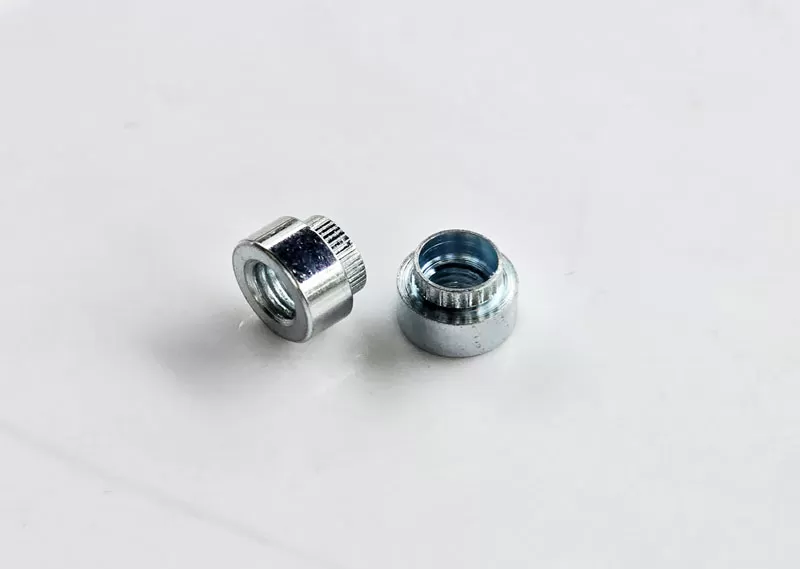
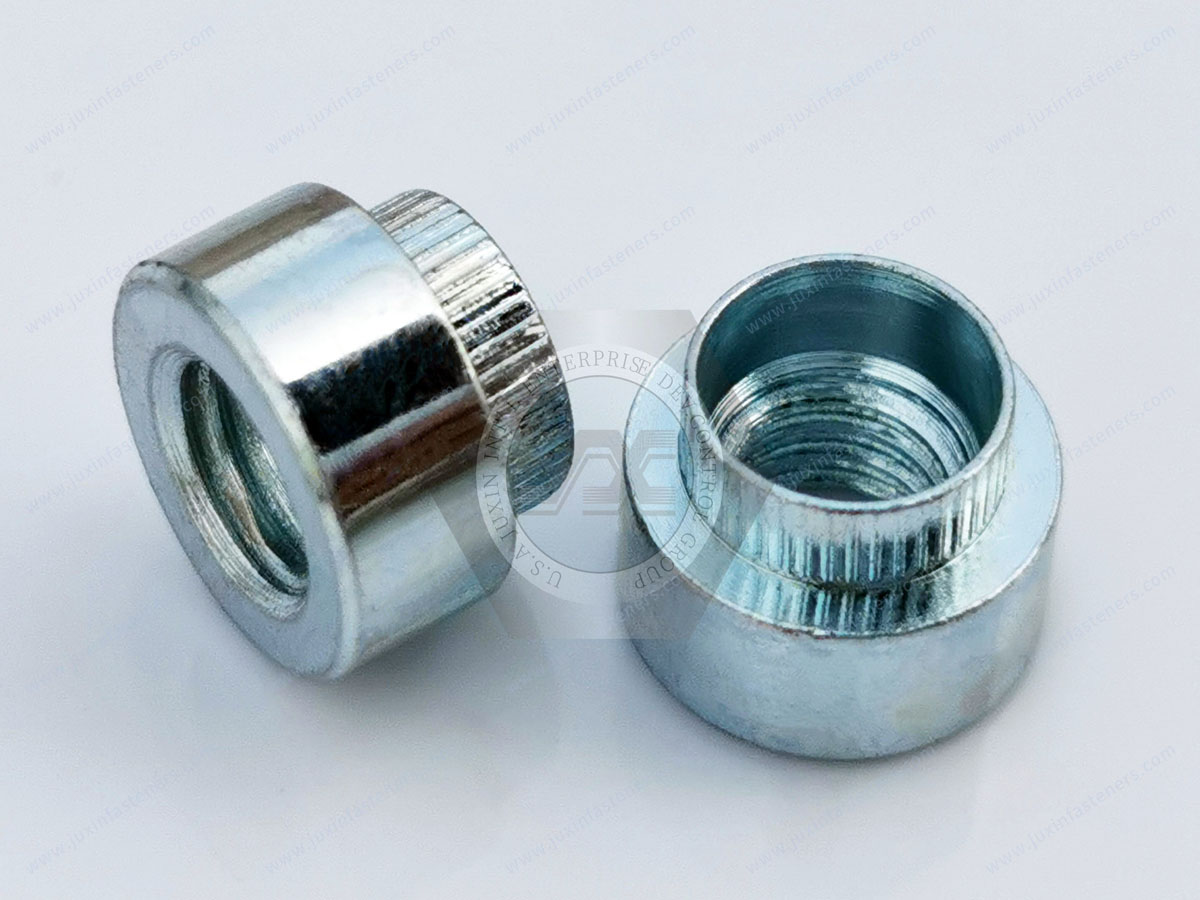
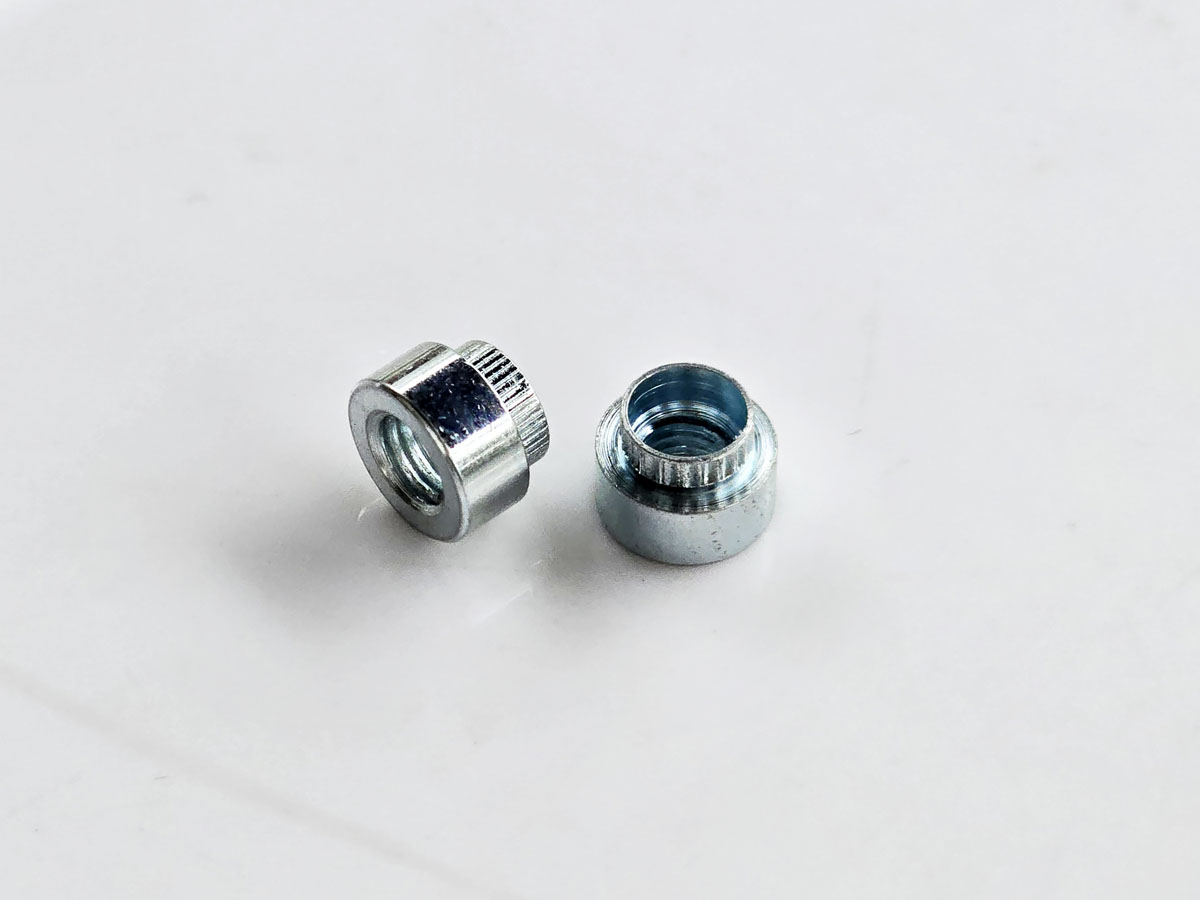
JUXIN FASTENERS supplies knurled round flare-in nuts for sheet-metal enclosures, industrial control cabinets and equipment chassis. These threaded inserts combine a cylindrical body with external knurling and a mechanically formed retaining section.
The knurled surface can contribute to rotational resistance when correctly engaged with a compatible panel, while the flared section provides mechanical retention. Actual performance depends on the fastener geometry, panel material and installation process.
Product Type: Knurled Round Flare-In Nut
Materials: Steel and Stainless Steel
Body: Round with External Knurling
Attachment: Mechanical Flaring or Swaging
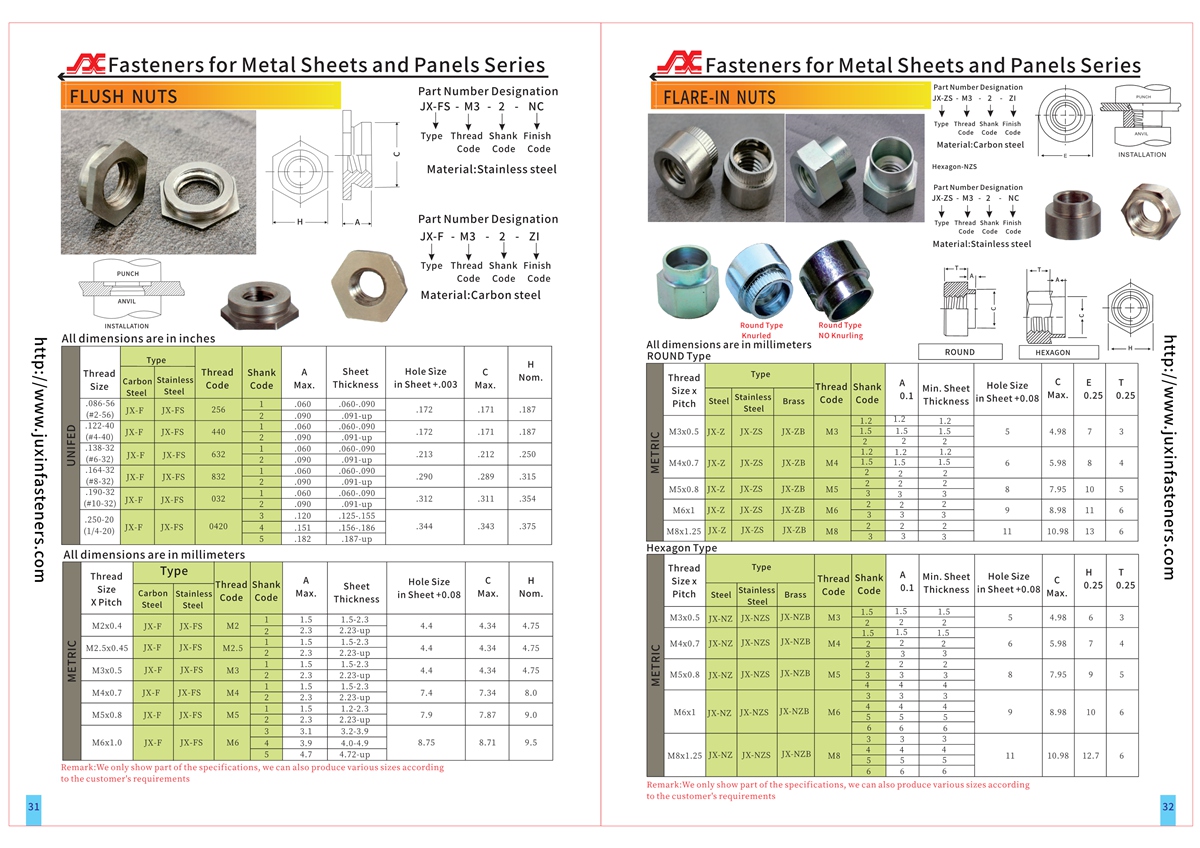
Threads and Dimensions: According to Approved Drawing
Surface Finish: According to Material and Application Requirements
OEM configurations are subject to technical review.
Product Specification
Knurled Round Flare-In Nuts – Engineering Design and OEM Sheet-Metal Fastening Solutions
Knurled round flare-in nuts are mechanically retained threaded inserts designed for installation in suitable sheet-metal components.
Unlike smooth round flare-in nuts, these fasteners incorporate a textured or knurled outer surface that can contribute to resistance against rotation within the mounting hole.
The flare-in attachment provides mechanical retention by deforming a designated portion of the insert during installation.
For OEM engineers, the principal design challenge is to achieve an appropriate balance between rotational engagement, axial retention, panel integrity and repeatable installation.
JUXIN FASTENERS supplies steel and stainless steel knurled round flare-in nuts for industrial sheet-metal fastening applications, with customer-specific configurations reviewed against approved engineering drawings.
Product Configuration
Product name: Knurled Round Flare-In Nut
Alternative names: Knurled Flare-In Threaded Insert, Knurled Round Swage Nut, Knurled Sheet-Metal Insert
Materials: Steel and Stainless Steel
Body geometry: Cylindrical body with external knurling
Thread configuration: Internal thread
Attachment principle: Mechanical flaring or swaging
Mounting-hole geometry: According to the selected fastener drawing
Thread sizes: According to confirmed product specifications
Surface treatment: According to the selected material and approved requirements
Custom dimensions: Subject to drawing review
The exact knurl pattern, forming geometry, thread range and dimensional tolerances must be confirmed for the selected configuration.
How Knurled Round Flare-In Nuts Work
A knurled round flare-in nut is inserted into a prepared mounting hole.
The installation operation brings the external knurled surface into engagement with the surrounding panel according to the fastener design.
A designated portion of the nut is mechanically expanded or flared to create the retaining connection.
After installation, the fastener provides an internal thread for the mating screw.
The knurled region and the flared region may perform different functions within the installed joint.
The knurled surface can contribute to rotational restraint.
The formed retaining feature provides resistance to axial separation.
The relative contribution of each feature depends on the actual product geometry and installation conditions.
Engineering Information Gain – Knurling and Flaring Solve Different Problems
A common mistake is to assume that the presence of knurling automatically provides sufficient retention in every loading direction.
Knurling primarily influences engagement between the outer surface of the fastener and the surrounding panel.
The flared retaining section establishes the mechanical attachment that helps prevent axial withdrawal.
These functions must be evaluated separately.
A fastener can resist rotation while still having inadequate axial retention.
Conversely, an insert can remain securely retained against axial loading but rotate when the mating screw is tightened.
The engineering design should therefore address both torque-out and pull-out performance.
Knurled vs. Smooth Round Flare-In Nuts
Smooth round flare-in nuts use cylindrical bodies without the same external knurled engagement.
Their rotational resistance depends on the particular formed connection and any other retention features.
Knurled round flare-in nuts add an external textured surface that may contribute to mechanical engagement with the panel.
However, the presence of knurling does not establish a universal performance advantage.
Knurl geometry, mounting-hole fit, sheet hardness and installation conditions all influence the result.
The two styles should not be substituted solely because they share the same nominal internal thread.
Where rotational resistance is critical, compare validated performance under representative installation conditions.
Knurled vs. Hexagonal Flare-In Nuts
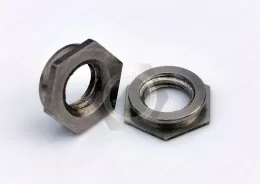
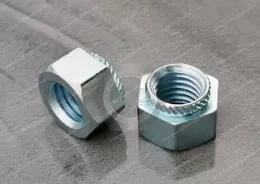
Hexagonal flare-in nuts use polygonal body geometry and may provide geometric resistance to rotation through a compatible polygonal hole.
Knurled round flare-in nuts use round mounting-hole geometry and external surface features to contribute to rotational engagement.
The preferred design depends on the panel manufacturing process, available tooling, required retention and installation accessibility.
Round holes may be convenient for certain drilling or punching operations.
Polygonal holes require appropriate manufacturing capability and dimensional control.
Neither design should be selected without reviewing the required installation and mechanical performance.
Knurl Geometry and Contact Mechanics
The external knurl is an important feature of the installed connection.
Relevant design parameters may include knurl diameter, profile, pitch, orientation and engagement length.
Different knurl patterns can produce different contact conditions during installation.
The actual geometry must be defined by the approved fastener drawing.
A deeper or more aggressive knurl is not automatically better.
Excessive interference may damage the mounting hole, deform the sheet or increase installation difficulty.
Insufficient engagement may reduce rotational resistance.
The correct design balances panel deformation with the required mechanical retention.
Engineering Information Gain – Knurl Engagement Is a Panel Design Problem
The fastener and panel should be treated as one engineered connection.
A knurled insert may perform differently in a relatively soft sheet than in a harder sheet.
The panel must be capable of accommodating the intended local deformation or engagement without unacceptable cracking or distortion.
This means the same insert cannot automatically be qualified for every sheet-metal grade.
A change in panel material may require revalidation even when the nominal thickness and hole diameter remain unchanged.
Steel Material Selection
Steel knurled flare-in nuts may be selected for applications requiring suitable mechanical properties and economical production.
The supplied material information identifies carbon steel and free-machining steel families as potential manufacturing materials.
The exact grade must be confirmed for the specific fastener.
Material hardness, ductility and manufacturing condition can influence both thread performance and the ability to form the retaining section.
A material that is too hard for the intended forming operation may present installation difficulties.
A material that is too soft may not meet the required thread or retention performance.
Material selection should therefore consider the entire manufacturing and installation process.
Stainless Steel Material Selection
Stainless steel knurled flare-in nuts may be considered where corrosion resistance or other stainless steel material characteristics are required.
The actual stainless steel grade must be specified and confirmed.
Different stainless steel grades have different strength, ductility, corrosion and machining characteristics.
Not every stainless steel grade is equally suitable for the same mechanical flaring process.
The selected material must support the intended forming operation without unacceptable cracking or damage.
Stainless steel should not automatically be described as suitable for all outdoor, marine or chemical environments.
Corrosion performance depends on the specific grade, surrounding materials and exposure conditions.
Engineering Information Gain – Fastener Hardness and Panel Hardness Must Be Evaluated Together
For knurled fastening systems, the relative mechanical behavior of the insert and parent sheet is important.
The knurled region must engage the panel appropriately during installation.
The retaining section must also deform as intended.
These requirements may create different material-selection considerations.
A fastener material that works in one sheet alloy may not behave the same way in another.
Engineers should not apply hardness limits from unrelated self-clinching nut families without verifying their relevance to this flare-in design.
Where the application is critical, material hardness and installation trials should be included in the qualification process.
Mounting-Hole Diameter and Tolerance
The mounting-hole diameter is a critical installation variable.
An oversized hole may reduce engagement between the knurled surface and the panel.
An undersized hole may cause excessive interference, local distortion or installation damage.
The correct hole dimension depends on the selected fastener's actual knurl and body geometry.
Hole roundness, edge condition and burr formation should also be controlled.
Mounting-hole dimensions must be obtained from the approved drawing.
The hole size for a smooth round flare-in nut should not automatically be reused for a knurled version.
Sheet Thickness and Panel Support
Sheet thickness affects the available material supporting the installed insert.
It also influences the geometry of the formed retaining feature.
A panel that is too thin for the selected fastener may not provide the required support.
A panel that is too thick may interfere with the intended forming operation.
The supplied information does not establish a universal minimum panel thickness or grip range for every knurled round flare-in nut.
These requirements must be confirmed for the actual design.
Where a customer uses several panel thicknesses, compatibility should be verified for each intended configuration.
Installation Tooling
Knurled round flare-in nuts require suitable tooling to create the intended mechanical attachment.
The installation process may involve positioning, support and controlled forming operations.
Tool geometry and installation stroke depend on the product design.
The fastener should not be installed by uncontrolled hammering unless the approved installation procedure specifically permits that method.
An arbor press or other controlled press system may be considered where compatible with the required tooling.
The correct equipment must be selected according to the approved installation process.
Tool alignment is important because uneven loading can damage the fastener or distort the panel.
Installation Access and Assembly Sequence
The forming operation may require access for tooling and support.
This requirement should be reviewed during enclosure design.
Some panels may be easier to process before bending or final assembly.
However, the installed fastener must not interfere with subsequent forming operations.
The production sequence should account for available clearances, tool access and the position of nearby components.
A knurled flare-in nut should not automatically be described as a blind or one-sided fastener.
Such capability depends on the specific installation design.
Torque-Out Resistance
Torque-out resistance describes the installed fastener's ability to resist rotation relative to the panel.
It is particularly important where the mating screw will be tightened or removed repeatedly.
The result depends on the knurl geometry, panel properties, mounting-hole fit and installation quality.
No universal torque-out rating can be assigned without verified data.
Where rotational resistance is important, the customer should specify an appropriate performance requirement.
Testing should use representative sheet-metal materials and production installation conditions.
Pull-Out Resistance
Pull-out resistance describes the ability of the installed insert to resist axial separation from the panel.
The flared retaining feature is an important part of this connection.
Actual performance depends on the formed geometry and the strength of the surrounding sheet.
The performance should be established through appropriate testing when required by the application.
A successful torque-out test does not automatically demonstrate acceptable pull-out resistance.
Thread Strength and Mating Screw Selection
The internal thread must be compatible with the mating screw.
The complete thread designation should be defined on the drawing.
ISO 261 and ISO 965 provide relevant references for ISO metric screw threads.
ASME B1.1 is relevant to Unified inch screw threads.
Metric and Unified inch threads are not interchangeable.
The selected thread must also provide adequate engagement for the intended joint.
Thread stripping, screw failure and insert rotation are different failure modes.
The allowable tightening torque must be established for the complete assembly rather than inferred from thread size alone.
Engineering Information Gain – Why Higher Installation Force Is Not Always Better
Increasing installation force does not necessarily improve the finished connection.
Excessive force may distort the panel, damage the internal thread or produce undesirable deformation.
Insufficient force may leave the retaining section incompletely formed.
The correct installation parameters should produce the intended geometry consistently.
For repeat production, engineers should establish an approved process window and suitable inspection criteria.
The process should be qualified using representative fasteners, panels and tooling.
Installation Quality Inspection
Inspection should focus on the finished attachment rather than appearance alone.
Relevant checks may include the condition of the formed retaining feature, panel distortion, thread integrity and correct fastener seating.
The insert should be checked for visible cracking or other unacceptable installation damage.
Where required, representative assemblies may be subjected to torque-out or pull-out testing.
Inspection methods and acceptance limits should be defined by the customer or approved engineering specification.
Visual appearance alone cannot establish the mechanical capacity of the installed joint.
Surface Treatment and Corrosion Considerations
Steel knurled flare-in nuts may require a suitable surface finish depending on the service environment.
The actual coating system must be defined by the approved specification.
ISO 4042 is a relevant reference for electroplated coating systems on fasteners where applicable.
ISO 9227 and ASTM B117 describe salt-spray test methods where specified.
A salt-spray test result should not be interpreted as a direct prediction of service life.
For stainless steel versions, corrosion performance depends on the actual grade and environmental exposure.
Any material or regulatory compliance claim must be supported by appropriate documentation.
Engineering Information Gain – Coating Can Affect Installation
A coating can change the effective dimensions and surface characteristics of a knurled fastener.
The installation operation can also place strain on the coating.
For a knurled flare-in nut, coating thickness and surface condition may influence engagement with the mounting hole.
The coating should therefore be evaluated as part of the installed fastening system.
Where a customer specifies a special coating, the finished fastener and installation process may require additional verification.
Industrial Electrical Enclosures
Knurled round flare-in nuts may be used to provide retained threaded attachment points in suitable electrical enclosures.
Potential applications include internal mounting brackets, removable covers and panel-mounted components.
The engineer should consider sheet thickness, mounting-hole accuracy and the required assembly torque.
Where electrical continuity is important, it must be evaluated separately from mechanical retention.
Control Cabinets and Automation Equipment
Industrial control cabinets frequently require threaded attachment points in formed sheet-metal panels.
Knurled flare-in nuts may be considered where the selected design and installation method are compatible with the cabinet manufacturing process.
Repeated access to service panels makes resistance to insert rotation an important consideration.
The complete joint should be designed for the expected assembly and maintenance conditions.
Telecommunications and Electronic Equipment
Telecommunications equipment and electronic housings often require compact fastening solutions.
Knurled round flare-in nuts may provide retained threads in suitable metal panels.
The design must account for internal clearances, tool access and the proximity of sensitive components.
Mechanical retention should be validated where the connection is subject to repeated servicing.
Industrial Machinery Covers
Machinery covers and removable equipment panels may benefit from permanently retained threaded inserts.
Knurled flare-in nuts can be evaluated where the installation geometry and mechanical requirements are suitable.
For vibrating equipment, the mating screw's resistance to loosening must be considered separately from the insert's torque-out resistance.
An anti-rotation insert does not automatically prevent a threaded joint from loosening under vibration.
Instrument Housings and Precision Equipment
Precision equipment housings may require compact threaded attachment points with controlled assembly geometry.
Knurled round flare-in nuts may be considered where the panel can accommodate the required mounting-hole and forming operations.
The engineering team should review dimensional tolerances, panel distortion and installation repeatability.
Where cosmetic appearance is important, the finished assembly should be evaluated after installation.
Knurled Flare-In Nuts vs. Conventional Self-Clinching Nuts
Conventional self-clinching nuts generally rely on displacement of the parent-sheet material into retaining features on the fastener.
Knurled flare-in nuts use a mechanical forming operation to create the retaining attachment.
The knurled surface may also contribute to rotational engagement.
These are different installation mechanisms.
The products should not be treated as direct substitutes without reviewing the mounting hole, tooling, sheet material and mechanical performance.
Knurled Flare-In Nuts vs. Blind Rivet Nuts
Blind rivet nuts are commonly selected where installation must be completed from one accessible side.
Knurled flare-in nuts require the forming process specified for the selected design.
Tooling access and installation sequence may therefore differ.
The correct technology depends on the manufacturing requirements and the available access to the panel.
Knurled Flare-In Nuts vs. Weld Nuts
Weld nuts require a welding attachment process.
Knurled flare-in nuts use mechanical forming.
Mechanical attachment may be considered where welding is undesirable or incompatible with the panel manufacturing process.
However, the total installed cost depends on tooling, cycle time, inspection and the required performance.
The appropriate solution should be selected for the complete production system.
OEM Supplier Qualification
OEM purchasing teams should request a clearly defined product specification before comparing suppliers.
The specification should identify the material grade, internal thread, body dimensions, knurl geometry and forming features.
The mounting panel material, thickness and hole dimensions should also be provided.
Where applicable, the RFQ should define required torque-out and pull-out performance.
For recurring production, consistency of the knurled geometry and forming section is important.
Engineering changes should be reviewed because even a small geometric difference can affect the installed connection.
A supplier comparison based only on the nominal thread size or product photograph is insufficient.
Frequently Asked Questions
What is a knurled round flare-in nut?
It is a cylindrical threaded insert with external knurling and a mechanically formed retaining feature for installation in suitable panels.
What is the purpose of the knurled surface?
The knurled surface can contribute to resistance against rotation when properly engaged with the surrounding panel.
Does knurling guarantee higher torque resistance?
No. Actual performance depends on the complete fastener and panel design and must be verified.
How is a knurled flare-in nut installed?
The insert is positioned in a prepared hole and mechanically formed using tooling suitable for the selected fastener design.
Can it be installed in stainless steel panels?
Compatibility depends on the specific fastener, panel hardness, mounting-hole geometry and installation process.
Are steel and stainless steel versions interchangeable?
Not automatically. Material properties, forming behavior and installed performance must be reviewed.
Can a knurled flare-in nut replace a smooth round flare-in nut?
Only after confirming mounting-hole compatibility, tooling requirements and mechanical performance.
Does a knurled flare-in nut prevent screw loosening?
No. Resistance to insert rotation and resistance to screw loosening are different engineering requirements.
Can custom knurled flare-in nuts be supplied?
Customer-specific designs may be reviewed against approved drawings and manufacturing requirements.
What information should be included in an OEM RFQ?
Provide the drawing, thread designation, material grade, knurl geometry, panel material, sheet thickness, mounting-hole dimensions, finish and required performance.
Relevant International Engineering References
ISO 261 – ISO metric screw thread general plan.
ISO 965 – ISO metric screw thread tolerances.
ASME B1.1 – Unified inch screw threads where applicable.
ISO 6508-1 and ASTM E18 – Rockwell hardness testing.
ISO 4042 – Electroplated coating systems for fasteners where applicable.
ISO 9227 and ASTM B117 – Salt-spray testing methods where specified.
These references should be applied only where relevant to the selected product and approved specification. Their inclusion does not establish certification or compliance for every configuration.
Related JUXIN FASTENERS Product Categories
Smooth Round Flare-In Nuts – for cylindrical threaded inserts without the same external knurled engagement.
Brass Round Flare-In Nuts – for applications where brass material characteristics are required.
Hexagonal Flare-In Nuts – for compatible polygonal mounting-hole designs.
Self-Clinching Nuts – for conventional press-installed sheet-metal threaded attachments.
Self-Clinching Flush Nuts – for applications requiring a flush threaded fastening arrangement.
Blind Rivet Nuts – for suitable one-sided installation applications.
Self-Clinching Standoffs – for retained threaded mounting points that also provide spacing between components.
Internal links should connect these topics to the corresponding verified JUXIN FASTENERS product pages.
Request an OEM Knurled Flare-In Nut Quotation
JUXIN FASTENERS supplies knurled round flare-in nuts and related industrial sheet-metal fastening products.
For an engineering review and quotation, please send your 2D drawing or 3D CAD model.
Include the required material, thread designation, knurl geometry, panel material, sheet thickness and mounting-hole dimensions.
Please also provide the required surface finish, mechanical performance criteria, estimated annual demand and initial order quantity.
Our team can review the proposed configuration and prepare a quotation based on confirmed technical and commercial requirements.
Email: info@juxinfasteners.com
Website: www.juxinfasteners.com
JUXIN FASTENERS – Knurled Round Flare-In Nuts and OEM Sheet-Metal Fastening Solutions.
Product Packaging
Product Packaging
Knurled round flare-in nuts are packed according to the confirmed product dimensions, material, order quantity and shipment requirements.
Protective inner packaging may be used to help reduce contact damage to the knurled surfaces and internal threads during handling and transportation.
Outer cartons and pallet arrangements are selected according to the confirmed order and shipping requirements.
Steel and stainless steel versions, different thread sizes and customer-specific configurations should be clearly identified to support inventory control and OEM assembly operations.
Standard carton options referenced in the supplied packaging information include 29 × 19 × 19.5 cm and 23.5 × 17.5 × 8 cm. Their suitability depends on the product size and shipment quantity.
Polyfoam inner protection and palletized shipment can be arranged according to the confirmed packing plan.
Final packing quantities, carton weights, pallet dimensions and labeling requirements are confirmed during order processing.
For OEM packaging or identification requirements, please include the details in your RFQ.
Email: info@juxinfasteners.com
Website: www.juxinfasteners.com
Product Pictures
Contact Us
Tel.:
+86 020 8621 0320
+86 020 3121 6067
E-mail:
Technical Support:
Navigation
SEND INQUIREY