Call Us
+86 136 6007 9809
Call Us
+86 136 6007 9809

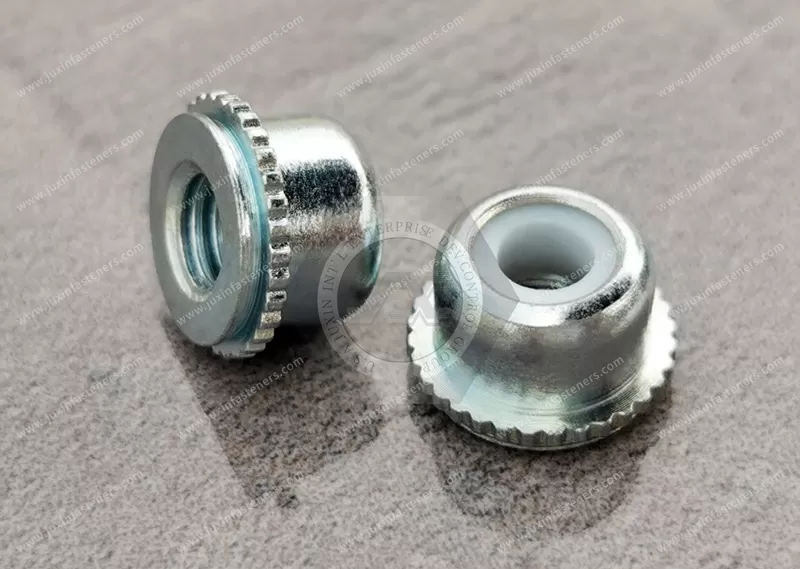
JUXIN FASTENERS supplies JX-PL and JX-PLC nylon insert self-locking self-clinching nuts for thin-sheet metal assemblies requiring captive internal threads and reusable prevailing-torque locking.
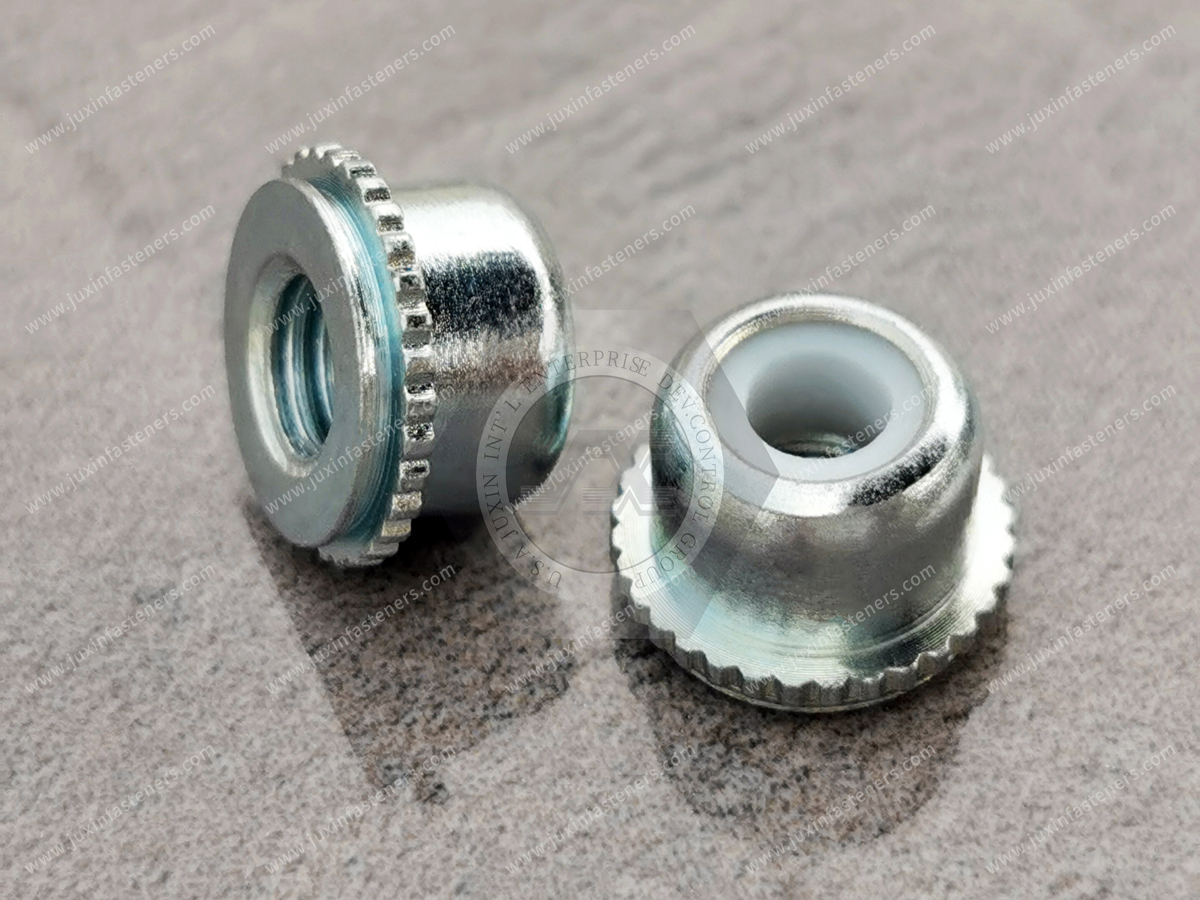
A non-metallic nylon locking element creates controlled interference with the mating screw, while the knurled clinching collar and undercut geometry retain the fastener in a properly prepared metal sheet.
This separates the thread-locking function from the sheet-retention function.
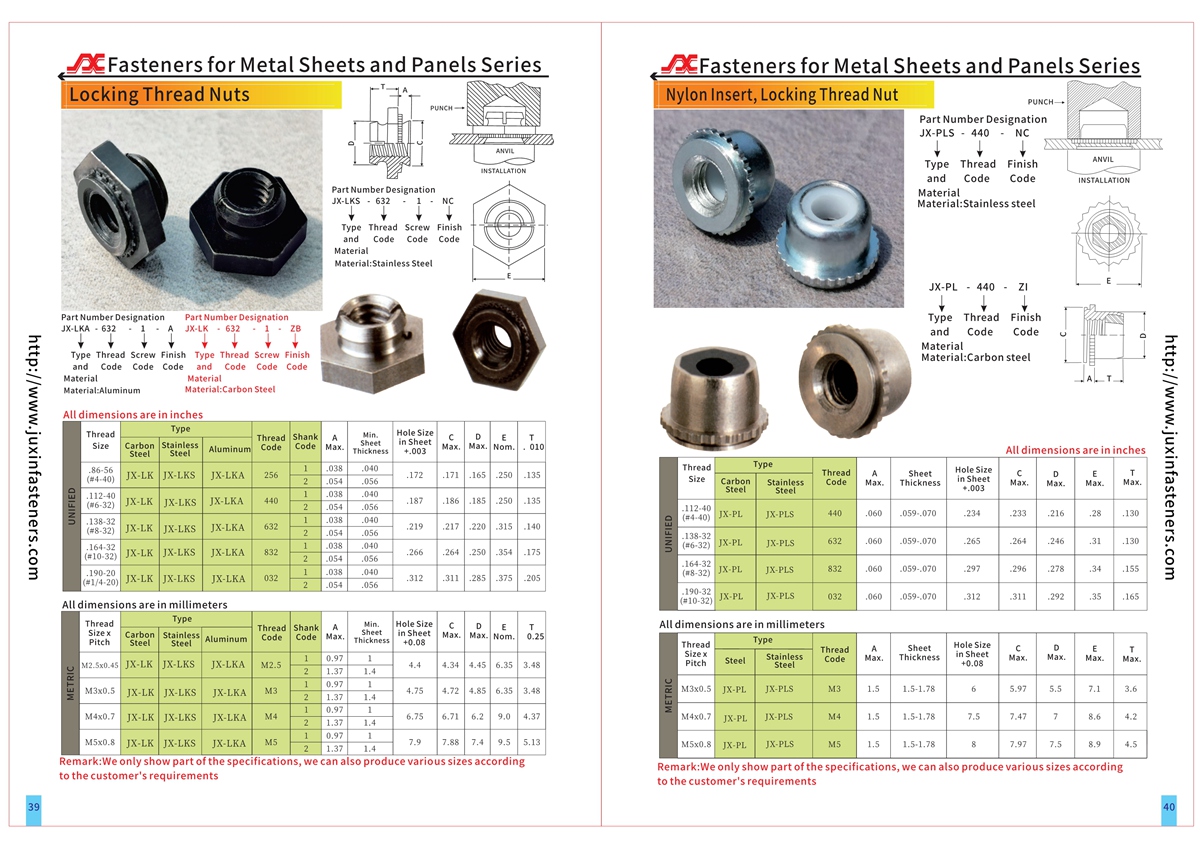
The referenced product family includes selected Unified inch-series threads from #4 to #10 and metric threads from M3 to M5. Steel material options and customer-specific requirements are subject to drawing review.
Typical applications include electronic enclosures, industrial control cabinets, serviceable equipment panels and mechanical assemblies requiring captive locking threads.
For dimensional drawings, installation guidance and OEM quotations, contact info@juxinfasteners.com.
Website: www.juxinfasteners.com
Product Specification
Nylon Insert Self-Locking Self-Clinching Nuts – JX-PL and JX-PLC
Engineering Selection, Installation, Prevailing-Torque Performance and Industrial Sheet Metal Applications
Product Overview
JX-PL and JX-PLC are nylon insert self-locking self-clinching nuts designed to provide captive internal threads with an integrated prevailing-torque locking feature.
These fasteners combine two mechanical functions.
The self-clinching structure permanently retains the nut in a compatible sheet metal panel.
The nylon locking element produces resistance to rotation when a mating screw engages the internal thread.
This combination is useful in assemblies where loose nuts are undesirable and the threaded joint requires a defined locking characteristic.
Unlike all-metal locking clinch nuts, the JX-PL and JX-PLC series relies on a non-metallic locking element.
Material compatibility, temperature exposure, screw finish and reuse requirements must therefore be evaluated as part of product selection.
Product Identification
Product category: Nylon insert self-locking self-clinching nuts
Product series: JX-PL and JX-PLC
Thread type: Internal threads with prevailing-torque locking
Locking element: Nylon insert
Locking element geometry: Hexagonal configuration described in the supplied product reference
Retention feature: Knurled self-clinching collar with undercut geometry
Installation method: Press installation into prepared sheet metal holes
Referenced metric sizes: M3 to M5
Referenced Unified inch-series sizes: #4 to #10
Exact thread pitches and size availability: According to approved product drawings
Material family: Steel
Dimensional reference: Product PDF or CAD documentation, pages 39–40
Custom requirements: Subject to technical review
How Nylon Insert Locking Works
The nylon locking element creates interference with the mating screw thread.
As the screw passes through the locking region, the nylon material deforms locally around the thread profile.
This interaction generates prevailing torque.
Prevailing torque is the rotational resistance created by the locking feature before the joint reaches its final clamped condition.
The locking mechanism does not require a separate washer or a loose locking nut.
However, the actual torque depends on nylon properties, insert geometry, screw dimensions, surface condition and operating environment.
Why Nylon Locking Is Different from All-Metal Locking
Nylon insert locking nuts and all-metal locking nuts solve a similar assembly problem using different mechanisms.
Nylon insert locking nuts use polymer interference to create rotational resistance.
All-metal locking nuts use deformation or elastic movement of metal locking features.
Nylon inserts can provide controlled contact with mating threads, but their behavior is influenced by temperature, aging and chemical exposure.
All-metal locking designs avoid polymer inserts but have different friction and thread-contact characteristics.
Neither design should be considered universally superior.
The correct selection depends on the application.
The Role of the Knurled Collar
The JX-PL and JX-PLC fasteners incorporate a knurled collar designed to engage the surrounding sheet material during installation.
The knurl provides geometric resistance to rotation after the fastener is correctly installed.
This is important because the nylon locking feature generates torque whenever the mating screw passes through the locking region.
The clinching attachment must resist that torque without rotating in the sheet.
Knurl geometry, sheet material and installation quality all influence the result.
The Role of the Undercut
The supplied product design includes an undercut beneath the clinching collar.
During press installation, the surrounding sheet material is displaced into this retention region.
This helps create mechanical resistance to axial displacement.
The undercut and knurled collar therefore contribute to different aspects of fastener retention.
The undercut helps resist push-out.
The knurled geometry helps resist rotation.
Actual performance depends on the complete installed geometry and host-sheet condition.
Engineering Information Gain: Locking Torque Must Be Lower Than Available Retention Capacity
The nylon insert deliberately creates resistance when a screw is installed or removed.
That resistance transfers torque into the captive nut.
If the nut's installed torque-out resistance is inadequate, the entire fastener may rotate in the sheet instead of maintaining its captive position.
For this reason, nylon locking performance cannot be evaluated independently of the clinching attachment.
The design should consider:
Initial prevailing torque
Prevailing torque after repeated use
Assembly tightening torque
Installed torque-out resistance
Installed push-out resistance
Host-sheet hardness
Sheet thickness
Hole tolerance
Mating screw condition
A stronger nylon locking element is not automatically a better design if the surrounding sheet cannot retain the nut under the resulting loads.
Prevailing Torque Versus Tightening Torque
Prevailing torque is the resistance created by the nylon locking element during screw rotation.
Tightening torque is the torque applied during final assembly to establish the intended joint condition.
These values are not interchangeable.
A torque-controlled assembly process must account for the locking resistance when establishing the relationship between applied torque and clamp load.
For critical joints, the tightening method should be validated using the actual mating screw, fastener and joint materials.
Initial Locking Torque
Initial locking torque describes the prevailing-torque behavior during the first engagement of the mating screw.
It can be affected by:
Thread size
Thread tolerance
Nylon insert dimensions
Nylon material condition
Mating screw finish
Lubrication
Temperature
Screw alignment
Installation speed
A nominal thread designation alone does not define the initial locking torque.
The required acceptance range should be specified in the purchasing or engineering documentation.
Repeated-Use Locking Performance
The supplied product description identifies a reusable nylon locking feature.
Repeated use is an important design consideration for removable equipment panels and serviceable assemblies.
However, the locking torque may change as the screw repeatedly engages the nylon insert.
Possible influences include wear, material deformation, temperature history and contamination.
The OEM should define the expected number of installation and removal cycles.
Performance should be checked against the required locking torque limits after the specified cycles.
Nylon Insert Temperature Limitations
The nylon insert is a functional part of the locking mechanism.
Its mechanical behavior can change with temperature.
At elevated temperatures, the insert may soften or experience time-dependent deformation.
At low temperatures, its stiffness and deformation behavior may change.
Long-term exposure can also affect locking performance.
No universal operating temperature rating should be assigned without identifying the actual nylon grade and product qualification conditions.
For applications involving sustained high temperatures, an all-metal locking clinch nut may be evaluated as an alternative.
Moisture and Chemical Exposure
Nylon properties can be influenced by moisture absorption and exposure to certain chemicals.
These effects may influence dimensional stability and prevailing torque.
For equipment exposed to cleaning chemicals, industrial fluids or changing humidity, the nylon insert should be evaluated under representative conditions.
The required material grade and environmental resistance should be included in the OEM specification.
Protecting Mating Screw Threads
The nylon locking element provides a non-metallic contact region.
This can be useful where the design seeks to reduce aggressive metal-to-metal interference in the locking section.
However, the presence of nylon does not guarantee that thread galling or thread damage cannot occur.
Mating screw material, finish, thread tolerance, alignment and lubrication remain important.
The entire threaded joint should be evaluated.
Locking Element Colors
The supplied product information references blue, black and white nylon locking elements.
It also contains inconsistent statements about which colors correspond to metric and Unified thread versions.
Therefore, color should not be used as the sole method of identifying thread system, size or product conformity.
Locking element color must be confirmed against the approved product drawing and purchase specification.
No specific color is guaranteed for every JX-PL or JX-PLC configuration.
Material Options
The supplied steel material references include:
C45
C46
C20
SAE/AISI 1213
SAE/AISI 1214
SAE/AISI 1215
These grades differ in chemical composition, machining characteristics, strength and forming behavior.
The exact material grade must be selected according to the approved fastener design and manufacturing process.
Not every listed steel grade should be assumed interchangeable.
The material condition, hardness and any required heat treatment must be reviewed.
Steel Grade Selection
Material selection should consider:
Mechanical strength
Clinchability
Manufacturing method
Dimensional stability
Corrosion environment
Surface treatment
Cost
Required inspection
The steel fastener must also be compatible with the host-sheet material.
A material grade suitable for machining is not automatically suitable for every self-clinching geometry.
Surface Treatment and Corrosion Protection
The supplied information does not establish one universal coating for all JX-PL and JX-PLC fasteners.
Any required zinc plating, passivation or other finish must be confirmed during quotation.
ISO 4042 may be relevant when specifying electroplated coatings on fasteners.
Salt-spray testing under ISO 9227 or ASTM B117 may be specified where appropriate.
A salt-spray result is not a direct prediction of service life.
Coating selection must also consider the nylon insert and the finished fastener's locking performance.
Hydrogen Embrittlement Considerations
For certain high-strength or hardened steel fasteners, electroplating processes may introduce hydrogen embrittlement risk.
The risk depends on material condition, hardness, manufacturing process and coating procedure.
The engineering team should evaluate the applicable requirements when selecting a surface treatment.
No general claim of hydrogen embrittlement resistance should be made without supporting evidence.
Metric Thread Specifications
The referenced metric thread range is M3 to M5.
Relevant international thread standards may include ISO 261 and ISO 965.
The final specification should identify:
Nominal thread diameter
Thread pitch
Tolerance class
Required engagement length
Mating screw specification
The exact available sizes must be confirmed against the JX-PL or JX-PLC dimensional drawing.
Unified Inch-Series Thread Specifications
The supplied reference identifies selected #4 through #10 Unified thread sizes.
ASME B1.1 may be used for relevant Unified thread designations and tolerances.
The final drawing must identify the required thread pitch and class.
A #4 or #10 nominal designation alone is not a complete thread specification.
Unified inch-series threads and ISO metric threads are not directly interchangeable.
Locking Torque Standards
The supplied material refers to locking performance equivalent to applicable NASM25027 requirements.
This is a technical reference that must be verified for the actual product and size.
It should not be presented as a blanket certification.
Where NASM25027 is specified, the customer and supplier should agree on:
Applicable revision
Thread size
Initial prevailing-torque requirements
Removal torque requirements
Reuse-cycle requirements
Test conditions
Mating screw requirements
Acceptance criteria
Required supporting test documentation
A product-specific qualification report is necessary before making a formal compliance claim.
Self-Clinching Installation Principle
JX-PL and JX-PLC fasteners are installed by applying controlled squeezing force.
The mounting sheet must have a correctly sized installation hole.
During installation, the clinching collar engages the surrounding sheet.
Sheet material flows into the fastener's retention features.
This secures the nut in the panel.
The actual press force and tooling dimensions must follow the approved installation drawing.
Recommended Installation Sequence
A typical process includes:
Prepare the mounting hole according to the product specification.
Inspect the hole condition and sheet thickness.
Position the fastener correctly.
Support the sheet with suitable installation tooling.
Align the punch and anvil.
Apply the specified squeezing force.
Seat the fastener to the required installed condition.
Inspect the installed nut.
Verify thread engagement.
Perform retention and locking tests where required.
The process must be validated for the selected fastener and sheet combination.
Mounting Hole Requirements
Mounting hole quality directly affects self-clinching retention.
Important variables include:
Hole diameter
Hole tolerance
Hole roundness
Sheet thickness
Sheet hardness
Burr condition
Distance to sheet edges
Distance to bends
Adjacent hole spacing
Tooling accessibility
A generic drilled or punched hole should not be assumed suitable without checking the product drawing.
Minimum Sheet Thickness
The supplied reference does not provide a verified universal minimum sheet thickness for JX-PL and JX-PLC.
The minimum thickness must be established for the selected size and installation geometry.
If the sheet is too thin, insufficient material may be available to fill the retention undercut.
This can reduce the installed fastener's mechanical retention.
The correct thickness should be confirmed before finalizing the sheet metal design.
Host-Sheet Hardness
Self-clinching installation depends on controlled deformation of the mounting sheet.
The host sheet must be compatible with the selected fastener's retention geometry.
If the sheet is too hard, the required material flow may not occur.
The result can be incomplete installation or inadequate retention.
Host-sheet hardness limits must be confirmed from product-specific data.
Torque-Out Resistance
Torque-out resistance describes the installed fastener's ability to resist rotation in the sheet.
This is especially important for a nylon locking clinch nut because the nylon insert intentionally creates resistance during screw engagement.
The required torque-out value must account for the actual assembly process.
No universal torque-out rating can be assigned without product-specific test data.
Push-Out Resistance
Push-out resistance describes the fastener's resistance to axial displacement from the installed sheet.
The undercut geometry contributes to this characteristic.
Push-out resistance depends on sheet material, sheet thickness, hole dimensions and installation quality.
The OEM should define the required test condition and acceptance value.
Common Installation Problems
Potential problems include:
Oversized mounting holes
Undersized mounting holes
Incorrect sheet thickness
Excessive sheet hardness
Insufficient installation force
Excessive installation force
Misaligned tooling
Incomplete collar embedding
Damage to the nylon insert
Thread contamination
Poor fastener seating
Inadequate torque-out resistance
A validated installation process reduces the risk of these conditions.
Application: Industrial Control Cabinets
Industrial control cabinets often use removable covers, access panels and mounting brackets.
Nylon insert locking clinch nuts may be evaluated where captive threads and prevailing-torque resistance are required.
The design should consider service frequency, available sheet thickness and the mating screw specification.
The locking feature should be validated as part of the complete joint.
Application: Electronic Equipment Enclosures
Electronic equipment enclosures may require captive threaded attachments that remain in the panel during assembly and maintenance.
JX-PL and JX-PLC can be considered where a nylon locking feature is compatible with the equipment's operating conditions.
Engineers should assess internal temperatures, electrical clearance, maintenance cycles and installation access.
Application: Telecommunications Equipment
Telecommunications equipment may contain removable modules, brackets and protective panels.
Captive locking threads can simplify assembly and reduce loose hardware handling.
The nylon insert must be evaluated against the expected environmental conditions and service life.
Application: Industrial Machinery
Machine guards, equipment covers and sheet metal brackets may require removable threaded joints.
A nylon insert locking clinch nut may provide a suitable captive fastening option.
However, vibration exposure, preload retention and joint design must be evaluated separately.
Prevailing torque alone does not guarantee that a joint will remain secure under every dynamic load condition.
Application: Electrical Distribution Equipment
Electrical equipment housings may use captive fasteners to attach covers and internal brackets.
Selection should consider mechanical loading, service accessibility, temperature and electrical design requirements.
The fastener's presence does not establish electrical insulation or grounding performance.
Those requirements must be assessed at assembly level.
Application: Transportation Equipment
Transportation equipment may involve vibration, repeated service and changing environmental conditions.
Nylon insert self-locking clinch nuts can be evaluated for appropriate non-critical or qualified applications.
The design team must verify locking performance, installed retention and temperature suitability.
Applications with safety-critical requirements require appropriate engineering approval and qualification.
Nylon Insert Locking Nuts Versus All-Metal Locking Nuts
Nylon insert locking nuts use polymer interference.
All-metal locking nuts use metal locking geometry.
Nylon locking may be attractive where controlled thread contact is important.
All-metal locking may be preferable where polymer temperature or chemical limitations are unsuitable.
The decision should consider:
Operating temperature
Chemical exposure
Required reuse cycles
Prevailing torque
Mating screw material
Corrosion environment
Installed retention strength
Total assembly cost
Nylon Insert Locking Nuts Versus Free-Running Clinch Nuts
Free-running clinch nuts provide captive internal threads without an intentional locking feature.
Nylon insert locking clinch nuts add prevailing-torque resistance.
The locking version can be useful when the joint specification requires rotational resistance.
The free-running version may be appropriate where another locking method is used.
The selection should follow the intended assembly requirements.
Nylon Insert Clinch Nuts Versus Weld Nuts
Weld nuts require a welding operation to attach the threaded component.
Self-clinching nuts use a mechanical press process.
Press installation may simplify certain sheet metal production workflows by avoiding a welding operation at the attachment point.
However, self-clinching requires suitable sheet properties and accurately prepared holes.
Welded and clinched joints must be evaluated according to their actual load requirements.
Nylon Insert Clinch Nuts Versus Blind Rivet Nuts
Blind rivet nuts can be installed from one side of a panel using an appropriate setting tool.
Self-clinching nuts generally require press access and supporting tooling.
Blind rivet nuts may be more suitable when the back of the panel is inaccessible.
Self-clinching nuts may be attractive where press installation is integrated into sheet metal manufacturing.
The two technologies should not be considered directly interchangeable without design review.
Engineering Example: Reusable Access Panel
Consider an industrial access panel that is removed periodically for maintenance.
The assembly requires captive threads and a defined prevailing-torque locking feature.
The engineer first confirms the panel material and thickness.
Next, the mounting hole and fastener geometry are selected.
The mating screw and required locking torque are defined.
The installed nut is tested for torque-out and push-out resistance.
Repeated screw installation and removal are then evaluated.
This approach verifies both the locking function and the mechanical attachment.
Engineering Example: Electronics Housing with Temperature Variation
Consider an electronics housing exposed to varying internal temperatures.
A nylon insert locking nut may appear suitable because of its compact design.
However, the nylon insert is exposed to the housing's thermal environment.
The engineer must verify the actual nylon material and expected temperature range.
Locking torque should be evaluated after representative temperature exposure.
If the polymer locking element cannot meet the application requirements, an all-metal locking clinch nut may be a more appropriate candidate.
Design for Manufacturability
The fastener should be selected early in the sheet metal design process.
The assembly must provide sufficient space for:
Fastener body
Installation hole
Installation punch
Supporting anvil
Mating screw
Assembly tool
Nearby bends
Panel edges
Maintenance access
Early selection can reduce the need for later hole-location or tooling changes.
Supplier Qualification for OEM Procurement
Purchasing and supplier-development teams should verify:
Product type
Material grade
Thread specification
Dimensional drawing
Nylon insert material
Locking element color if specified
Surface treatment
Installation requirements
Initial locking torque
Repeated-use locking torque
Torque-out resistance
Push-out resistance
Inspection requirements
Lot identification
Packaging
Engineering change control
Required documentation should be agreed upon before production approval.
Why Nylon Insert Consistency Matters
The nylon element is a functional component rather than a cosmetic feature.
Variation in insert geometry or material properties may affect locking torque.
For this reason, the purchasing specification should identify the required performance characteristics.
A change in nylon material, insert geometry or manufacturing process should be evaluated before approval.
This is particularly important for repeat-order OEM programs.
Procurement Risk: Do Not Specify Only the Thread Size
A purchase order that states only M4 nylon locking clinch nut is incomplete.
Different fasteners may have the same thread size but different:
Body dimensions
Knurl geometry
Undercut geometry
Nylon insert properties
Sheet thickness requirements
Hole tolerances
Locking torque
Installation tooling
The correct product type and drawing revision should be identified.
Frequently Asked Questions
What is a nylon insert self-locking clinch nut?
It is a captive nut installed into sheet metal that uses a nylon element to create prevailing-torque resistance.
What is the difference between JX-PL and JX-PLC?
Both are identified as nylon insert locking self-clinching fasteners. Their exact dimensional and configuration differences must be confirmed from the relevant product drawings.
What thread sizes are referenced?
The supplied family references selected #4 through #10 Unified sizes and M3 through M5 metric sizes.
Can the nylon locking element be reused?
The design is intended for repeated engagement, but the required reuse cycles and torque performance must be verified.
Does the nylon insert prevent the nut from rotating in the sheet?
No. The nylon insert provides thread locking, while the clinching features provide sheet retention.
Does nylon eliminate thread galling?
Not necessarily. The nylon contact region can reduce certain metal-to-metal interactions, but mating thread compatibility still requires evaluation.
Can these nuts be used in high-temperature applications?
Only when the actual nylon material and qualified operating conditions are suitable.
Do these products meet NASM25027?
The supplied information references equivalent performance. Formal compliance requires product-specific verification and documentation.
Are blue, black and white inserts available?
The supplied reference mentions these colors, but the exact color and availability must be confirmed for each product configuration.
Can custom specifications be requested?
Customer drawings and special requirements can be submitted for technical review.
Related Products and Internal Linking
Relevant JUXIN FASTENERS product categories include:
All-Metal Self-Locking Self-Clinching Nuts – JX-LK, JX-LKA and JX-LKS
Miniature Self-Clinching Nuts – JX-FE, JX-FEO, JX-FEOX and JX-FEX
Non-Locking Floating Self-Clinching Nuts – JX-AS and JX-AC
Locking Floating Self-Clinching Nuts – JX-LAS and JX-LAC
Self-Clinching Blind Nuts – JX-B and JX-BS
Standard Self-Clinching Nuts
Self-Clinching Studs
Self-Clinching Standoffs
Blind Rivet Nuts
Industrial Sheet Metal Fastening Solutions
The nylon-versus-all-metal comparison should link to the JX-LK, JX-LKA and JX-LKS product page.
The free-running comparison should link to the standard self-clinching nuts category.
The one-sided installation comparison should link to the blind rivet nuts category.
Use verified internal URLs and descriptive anchor text when publishing.
Request an OEM Quotation
JUXIN FASTENERS welcomes engineering, purchasing and supplier-development inquiries for JX-PL and JX-PLC nylon insert self-locking clinch nuts.
To request a quotation, please provide:
Product type
Thread size and pitch
Material requirement
Host-sheet material
Sheet thickness
Product drawing
Nylon insert requirements
Surface finish
Required prevailing torque
Expected reuse cycles
Torque-out and push-out requirements
Estimated order quantity
Annual demand forecast
Required delivery schedule
Packaging requirements
Providing these details helps establish the correct technical and commercial scope.
Email: info@juxinfasteners.com
Website: www.juxinfasteners.com
Product Packaging
JX-PL and JX-PLC nylon insert self-locking self-clinching nuts can be packaged according to product size, material, locking element configuration and customer order requirements.
Protective inner packaging, outer cartons and palletized shipment may be used where appropriate.
Packaging should protect the nylon locking inserts, internal threads, knurled collars and clinching retention features from mechanical damage, contamination and unsuitable storage conditions.
Different thread sizes, product types and approved locking element configurations should be separated and clearly identified.
For OEM and industrial distribution orders, packaging requirements may include part-number identification, thread specification, lot identification and specified packing quantities.
Carton quantities, carton dimensions, pallet configuration and shipment weights will be confirmed according to the approved order.
Customer-specific packaging and labeling requirements can be reviewed during quotation.
Email: info@juxinfasteners.com
Website: www.juxinfasteners.com
Product Pictures
Contact Us
Tel.:
+86 020 8621 0320
+86 020 3121 6067
E-mail:
Technical Support:
Navigation
SEND INQUIREY