Call Us
+86 136 6007 9809
Call Us
+86 136 6007 9809

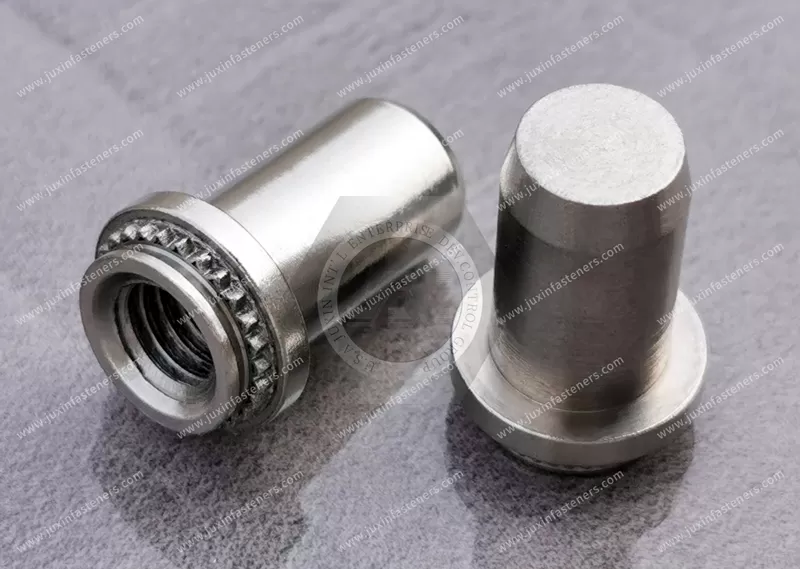
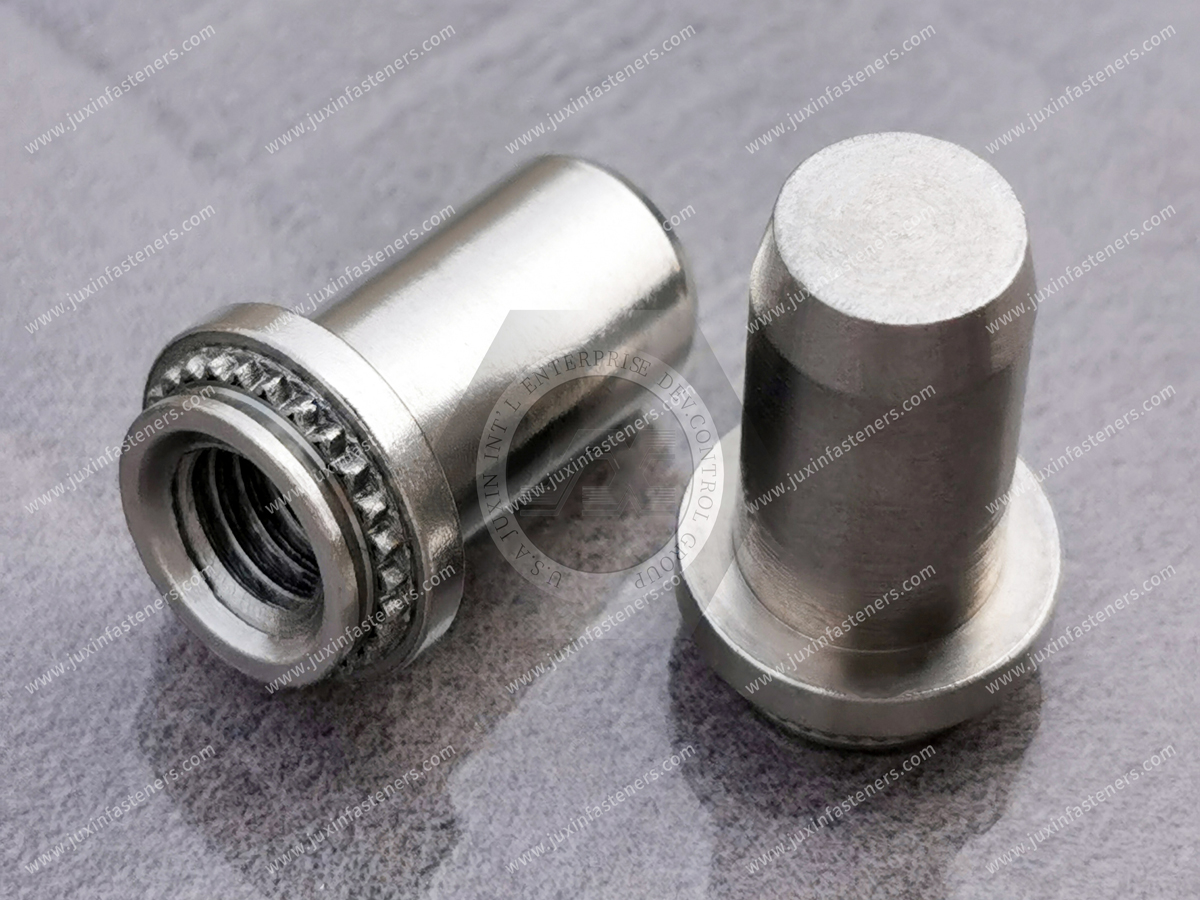
JUXIN FASTENERS supplies JX-BS stainless steel self-clinching blind nuts for OEM manufacturers, sheet metal fabricators and industrial equipment supply chains. These closed-end captive fasteners provide reusable internal threads while helping limit screw penetration into sensitive assemblies.
JX-BS blind nuts are intended for press installation in compatible metal sheets and are relevant to electronic enclosures, control cabinets, display systems and industrial hardware assemblies.
For purchasing and supplier-development teams, quotation requirements include thread size, stainless steel grade, panel specifications, fastener dimensions, order quantity and applicable inspection criteria. Custom configurations can be submitted for technical feasibility review.
Send your drawing, annual demand and project requirements to info@juxinfasteners.com.
Website: www.juxinfasteners.com
Product Specification
JX-BS Stainless Steel Self-Clinching Blind Nuts – OEM Sourcing and Engineering Specification Guide
Product Overview
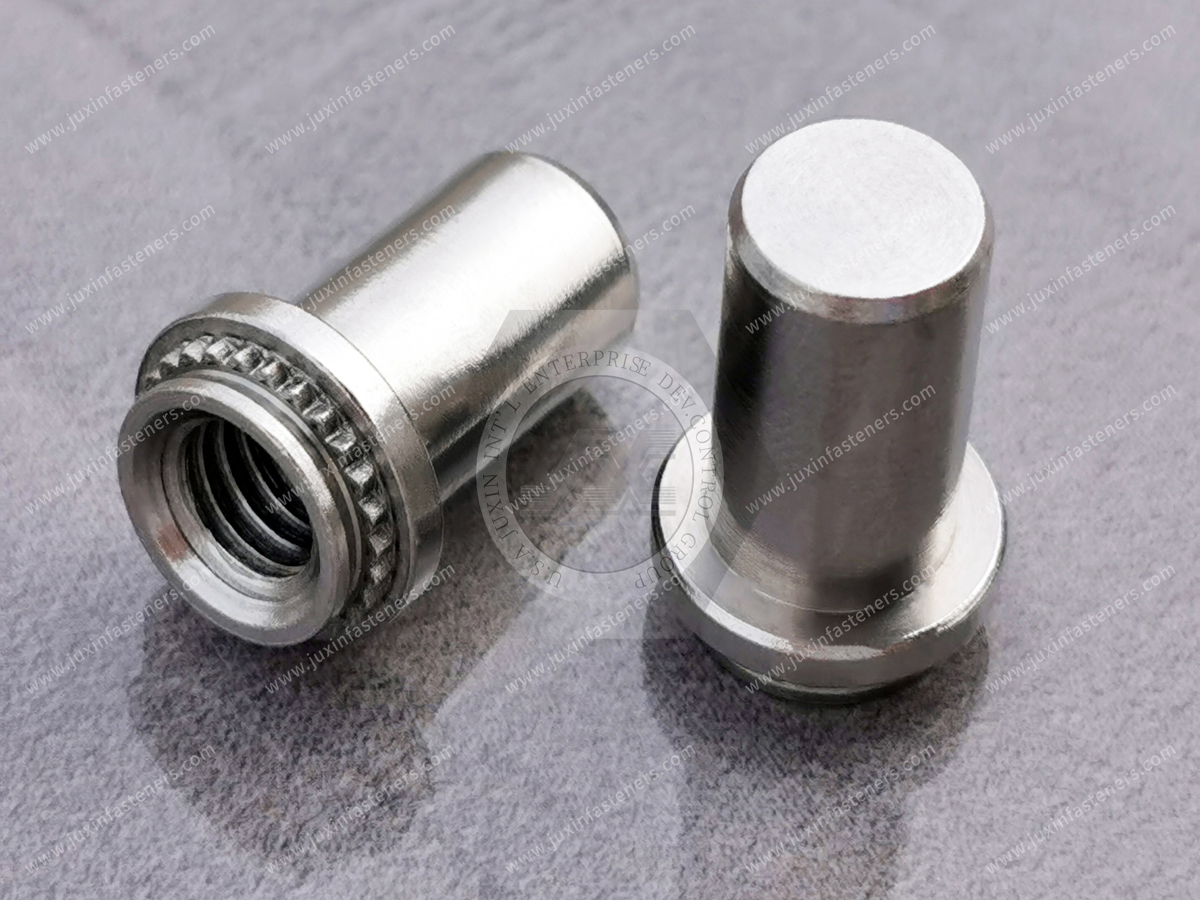
JX-BS stainless steel self-clinching blind nuts are closed-end internally threaded fasteners designed to create captive attachment points in compatible thin metal sheets.
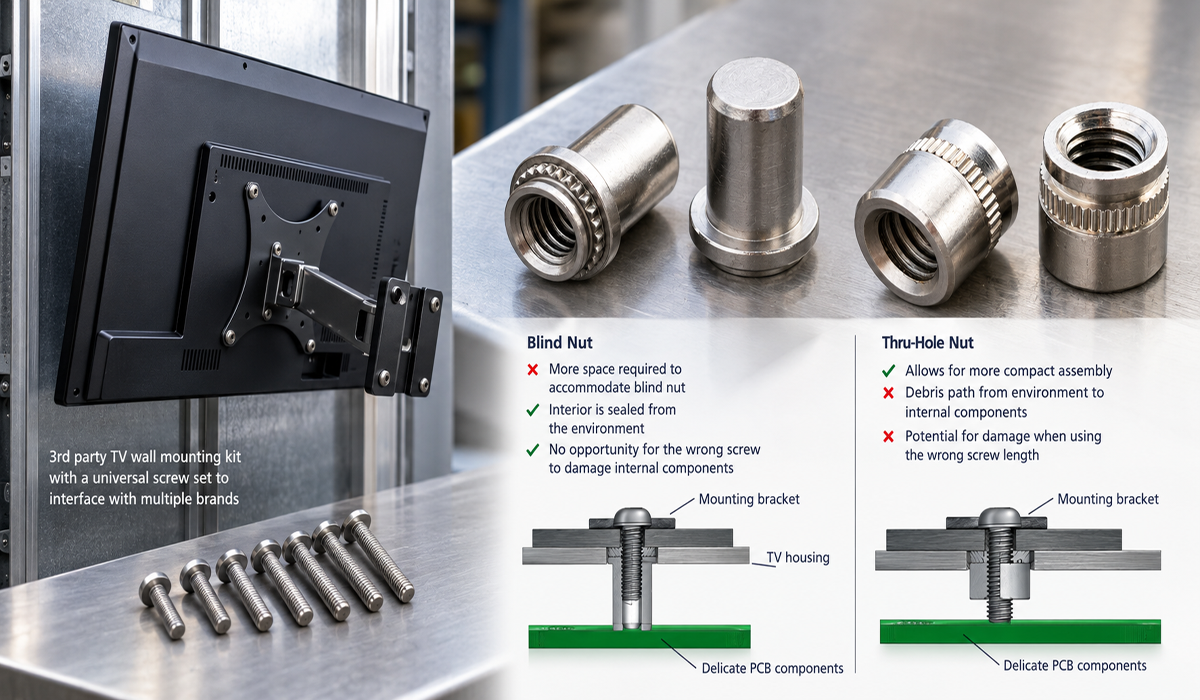
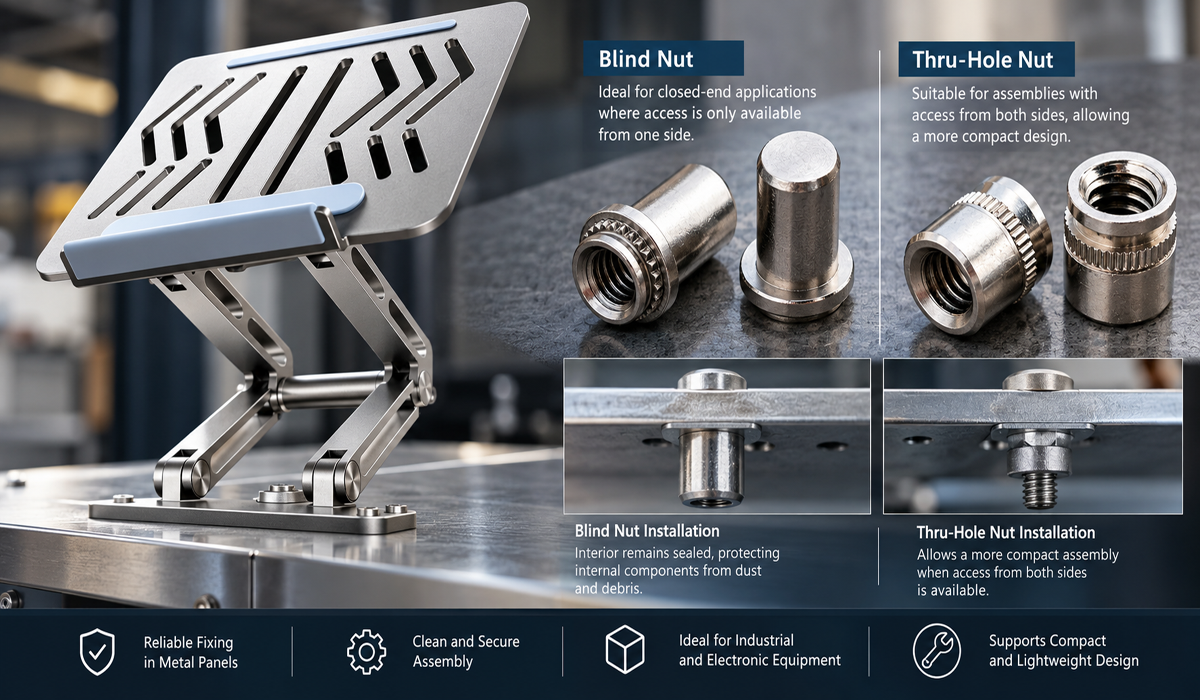
Unlike conventional through-hole nuts, the closed-end cavity limits the travel of the mating screw and helps prevent direct entry of foreign matter through the threaded opening.
This product is particularly relevant to OEM buyers sourcing fasteners for electronic housings, electrical equipment, industrial enclosures and fabricated sheet metal components.
For successful procurement, the fastener must be specified together with its installation sheet, mounting hole, mating screw and required mechanical performance.
A quoted thread size alone is not enough to confirm suitability.
Product Identification
Product name: Stainless Steel Self-Clinching Blind Nuts
Product designation: JX-BS
Fastener family: Self-clinching nuts
Thread type: Internal female thread
End configuration: Closed end
Material family: Stainless steel
Installation method: Press-installed self-clinching retention
Typical applications: Thin sheet metal assemblies and equipment enclosures
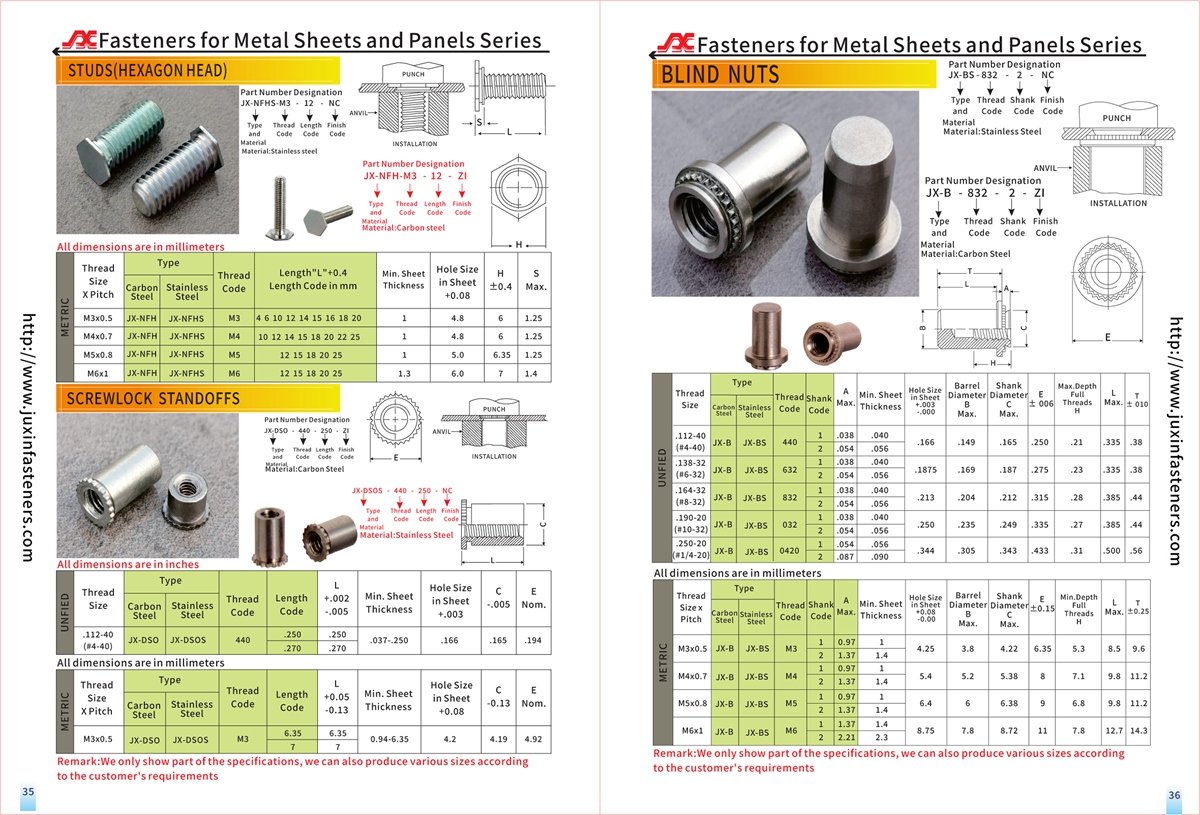
Metric thread range: M3 to M6, subject to the selected product configuration
Inch-series references: Selected #4 through 1/4-inch thread sizes, subject to drawing confirmation
Minimum sheet thickness: Selected configurations may be suitable for approximately 1.0 mm (0.040 in) sheet; individual size requirements must be verified
Product dimensions: Refer to the applicable technical drawing and catalog pages 35–36
Custom dimensions: Subject to manufacturing and installation feasibility review
Stainless Steel Material Options
The supplied material references include stainless steel grades from the 302, 303, 316, 410, 420 and 430 families.
These materials differ significantly in corrosion resistance, hardness, machinability and mechanical behavior.
Austenitic stainless steels may be relevant where corrosion resistance is a major requirement.
Martensitic and ferritic grades may be evaluated for different mechanical or manufacturing requirements.
However, not every stainless steel grade is suitable for every self-clinching nut geometry or host sheet.
Material selection must account for the hardness relationship between the fastener and the mounting panel.
A stainless steel fastener should not be assumed to install reliably into any stainless steel sheet simply because the material family is the same.
Where a customer requires an ASTM or EN material designation, the specified grade and its applicable requirements should be identified on the approved drawing.
Why OEM Buyers Specify Closed-End Blind Nuts
A closed-end nut can help solve several design and purchasing problems simultaneously.
It provides a permanently retained threaded attachment point.
It helps prevent an excessively long mating screw from extending beyond the nut cavity.
It reduces the possibility of foreign matter passing directly through the threaded opening.
It can simplify assembly by eliminating the need to position a loose nut behind the panel.
It can provide a repeatable fastening interface for equipment that requires maintenance or component replacement.
These advantages are relevant when the complete fastener and panel design is properly validated.
The closed end does not, by itself, guarantee waterproofing, airtight sealing or a specific ingress protection rating.
Understanding the JX-BS Installation Process
JX-BS blind nuts are installed into correctly prepared holes in suitable sheet metal.
The fastener is positioned in the mounting hole.
A controlled press applies squeezing force through aligned installation tooling.
The host sheet material deforms around the designed clinching features.
This deformation creates mechanical retention between the fastener and the panel.
The installed fastener provides a captive internal thread.
Unlike a blind rivet nut, the JX-BS fastener is not retained by collapsing a tubular shank behind the sheet.
It requires a compatible self-clinching installation process and appropriate tooling access.
Production installation should follow the approved fastener drawing and installation instructions.
Sheet Material Compatibility
The mounting panel is a critical part of the fastening system.
Before approving a JX-BS blind nut, engineers should identify the panel material, thickness and hardness.
The host sheet must be capable of deforming around the fastener's retention features without unacceptable cracking, distortion or loss of retention.
Important parameters include:
Sheet alloy and material condition
Sheet hardness
Nominal and minimum sheet thickness
Mounting hole diameter
Hole tolerance
Burr direction and hole quality
Distance from the mounting hole to panel edges
Proximity to bends or formed features
Press tooling geometry
Installation force and displacement
Required retention performance
These parameters should be verified for the specific application.
Minimum Sheet Thickness and Panel Design
The supplied product information identifies selected self-clinching blind nuts for metal sheets as thin as approximately 1.0 mm (0.040 in).
This does not mean every thread size or stainless steel configuration is suitable for a 1.0 mm panel.
The applicable minimum sheet thickness depends on the fastener dimensions, mounting sheet and installation design.
For panels close to the minimum permitted thickness, engineers should pay particular attention to local sheet distortion and retention testing.
If the sheet is too thin or too hard for the selected fastener, the required mechanical engagement may not develop.
The approved installation drawing should govern the final selection.
Closed-End Cavity Depth and Screw Selection
One of the most important engineering considerations is the relationship between the internal thread depth and the mating screw length.
The blind cavity must provide sufficient usable thread engagement.
At the same time, the screw must not reach the closed end before the joint is properly clamped.
If the screw bottoms out prematurely, tightening torque may increase without producing the intended clamp load.
This can result in an incorrectly assembled joint even when the screw appears tight.
For OEM applications, the drawing should specify:
Thread size and pitch
Usable thread depth
Maximum permissible screw insertion
Mating screw length
Attached component thickness
Washer thickness where applicable
Thread engagement requirements
Required tightening conditions
This is particularly important in consumer electronics and industrial equipment that may be serviced using replacement screws.
Metric and Inch Thread Selection
JX-BS blind nuts may be evaluated with selected ISO metric and unified inch-series threads.
For metric threads, ISO 261 and ISO 965 may be referenced where applicable.
For unified inch threads, ASME B1.1 may be referenced where applicable.
The thread designation, tolerance and inspection requirements should be stated on the approved drawing.
M3, M4, M5 and M6 are metric thread sizes.
Selected inch-series threads may be available according to the applicable product configuration.
Metric threads are not interchangeable with UNC or UNF threads.
Approximate diameter conversions must not be used as evidence of mechanical compatibility.
Corrosion Resistance and Environmental Exposure
Stainless steel is often selected to reduce corrosion risk in demanding environments.
However, corrosion resistance varies substantially between stainless steel grades.
The operating environment should be reviewed for moisture, chlorides, cleaning agents, industrial contaminants and dissimilar-metal contact.
For outdoor electrical equipment or equipment exposed to chemical cleaning, the actual stainless steel grade is more important than a generic stainless steel description.
Where relevant, ISO 9227 or ASTM B117 may be used as laboratory corrosion test methods.
Test duration and acceptance criteria must be established by the project specification.
Salt-spray results should not be treated as direct predictions of field service life.
Galvanic corrosion may also require evaluation when stainless steel nuts are installed into aluminum panels in wet or electrically conductive environments.
Mechanical Performance Requirements
For OEM qualification, the following properties may be relevant:
Push-out resistance
Torque-out resistance
Thread stripping resistance
Retention after installation
Joint clamp-load capability
Resistance to installation damage
Behavior under vibration
Performance after repeated assembly
Environmental durability
No universal mechanical performance value should be assigned to every JX-BS size.
The test results depend on the actual fastener geometry, sheet material, sheet thickness and installation process.
Where a customer requires specific mechanical acceptance criteria, these should be included in the RFQ and validated using representative assemblies.
Application: Television and Display Equipment
Televisions, monitors and digital display housings often have limited internal space.
Mounting screws may be installed close to electronic boards, wiring and other sensitive components.
A closed-end captive nut can help prevent the mating screw from extending beyond the specified fastening cavity.
This is relevant when equipment may be mounted using third-party brackets or serviced with replacement hardware.
However, the closed-end nut must still be designed for the required screw engagement and load.
It does not eliminate the need for a defined mounting screw specification.
Application: Electrical Control Cabinets
Electrical cabinets and industrial control enclosures frequently use sheet metal panels with captive fastening points.
JX-BS blind nuts may be considered for removable components, internal mounting hardware and selected equipment interfaces.
Stainless steel material selection may be relevant where humidity, cleaning or environmental exposure affects the fastener specification.
Panel compatibility and electrical bonding requirements should be assessed separately.
Application: Telecommunications Equipment
Telecommunications enclosures may require repeatable threaded mounting locations for brackets, internal assemblies and removable equipment.
Closed-end nuts help control the screw's penetration into areas containing cables or electronic modules.
For high-volume production, installation consistency and supplier-controlled dimensions can be important purchasing considerations.
Application: Industrial Automation
Automation controllers, machine interfaces and equipment housings often contain densely arranged electrical and mechanical components.
Blind captive threads can help define the permissible screw insertion depth.
The final design must also account for vibration, equipment servicing, installation accessibility and panel strength.
Application: Laboratory and Instrumentation Equipment
Laboratory equipment and industrial instruments may require corrosion-conscious material selection and repeatable mechanical assembly.
Stainless steel blind nuts may be considered where the selected grade, installation panel and service environment are compatible.
The application should define any cleaning chemical exposure, corrosion criteria or material documentation requirements.
JX-BS Versus JX-B: Purchasing Comparison
JX-BS identifies the stainless steel version of the blind self-clinching nut family.
JX-B identifies the steel version.
Both designs can provide captive closed-end threads, but their material and installation requirements must be evaluated independently.
JX-BS may be considered when stainless steel is specified for corrosion resistance or other material requirements.
JX-B may be suitable where the approved steel material and specified surface finish meet the application requirements.
The procurement decision should consider material specification, installation compatibility, required testing, unit cost, annual demand and long-term supply consistency.
A material substitution should not be approved based on appearance or nominal thread size alone.
What Determines the Price of JX-BS Blind Nuts?
For industrial procurement, there is no reliable universal unit price for every JX-BS configuration.
The final quotation depends on several factors.
Stainless steel grade
Thread size and pitch
Fastener body dimensions
Blind cavity depth
Required dimensional tolerances
Standard or custom geometry
Surface treatment or finishing requirements
Inspection and testing scope
Documentation requirements
Order quantity
Annual purchasing forecast
Packaging specification
Delivery schedule
A custom fastener requiring additional machining, inspection or special material may have a different cost structure from a standard catalog configuration.
To obtain a meaningful quotation, the buyer should provide the complete technical specification rather than requesting a price based only on the product family name.
Total Installed Cost Versus Unit Price
The lowest fastener unit price does not always produce the lowest assembly cost.
Procurement and manufacturing teams should consider the total installed cost.
This may include:
Fastener purchase cost
Mounting hole preparation
Press installation cycle time
Tooling and setup
Inspection requirements
Assembly rework
Fastener replacement due to installation defects
Packaging and handling
Inventory management
Supplier change-control requirements
A correctly specified captive nut can reduce loose-part handling and support repeatable production.
However, these benefits depend on the actual manufacturing process and should be evaluated against alternative fastening methods.
Supplier Qualification for OEM Programs
A procurement team evaluating a JX-BS supplier should establish the required product definition before production approval.
The approved specification should include the exact fastener designation and drawing revision.
Material grade and dimensional tolerances should be documented.
The installation panel should be identified.
Any required push-out, torque-out, corrosion or thread inspection criteria should be agreed.
Where applicable, the customer may also request sample evaluation, first-article inspection, material documentation, batch identification or agreed change-control procedures.
The availability and scope of these services should be confirmed during the RFQ process.
Managing Product Revisions and Interchangeability
A supplier change or drawing revision may affect installation performance even when the nominal thread remains unchanged.
Changes to the clinching geometry, body length, stainless steel grade or cavity depth may alter the behavior of the assembled joint.
For this reason, an OEM should not approve a replacement fastener based solely on thread designation and overall appearance.
The comparison should include the full dimensional specification, host-sheet requirements, installation tooling and validated performance.
Where an approved part number is already in production, proposed changes should follow the customer's engineering change-control process.
Custom Stainless Steel Blind Nuts
JUXIN FASTENERS accepts technical inquiries for standard and drawing-based stainless steel self-clinching blind nuts.
Custom engineering review may address:
Thread dimensions
Body length
Blind cavity depth
Stainless steel grade
Installation geometry
Dimensional tolerances
Application-specific inspection requirements
Packaging and identification
Custom configurations require confirmation of manufacturing feasibility and suitability for the intended mounting sheet.
A requested drawing change should not be assumed to preserve the performance of the original catalog fastener.
Internal Product Comparison and Related Solutions
For buyers evaluating different fastening approaches, the following related JUXIN FASTENERS product categories may be useful.
Stainless Steel Self-Clinching Blind Nuts JX-BS – General Product Specifications
Steel Self-Clinching Blind Nuts JX-B
Self-Clinching Nuts
Self-Clinching Flush Nuts
Self-Clinching Standoffs
Blind Threaded Standoffs
Blind Rivet Nuts
Self-Clinching Studs
These product names can be used as internal-link anchor text and connected to their verified product pages.
For this OEM sourcing page, the general JX-BS product page should serve as the primary technical product reference.
Frequently Asked Questions
Can I request a price for JX-BS blind nuts without a drawing?
A preliminary inquiry can identify the required thread size and approximate demand.
However, a reliable technical quotation should be based on the selected fastener dimensions, material and installation requirements.
Are stainless steel blind nuts suitable for every metal panel?
No. The mounting sheet material, hardness, thickness and hole preparation must be compatible with the selected self-clinching design.
Can JX-BS nuts be supplied with metric threads?
The supplied product family information identifies metric sizes from M3 to M6. The exact available configuration should be confirmed against the product drawing.
Can inch-series threads be requested?
Selected inch-series configurations may be reviewed according to the applicable product specification. Metric and unified threads must not be treated as interchangeable.
What information is needed for a custom blind nut quotation?
Provide the technical drawing, thread specification, stainless steel grade, panel details, performance requirements and expected purchasing volume.
Do closed-end blind nuts prevent all moisture or dust ingress?
No. The closed cavity reduces a direct opening through the thread, but complete enclosure sealing requires separate design and validation.
Can the same JX-BS nut be installed into aluminum and stainless steel panels?
Not without confirming the applicable installation requirements. Different panel materials and hardness levels can change clinching performance.
What is the difference between a blind clinch nut and a blind rivet nut?
A blind clinch nut relies on controlled deformation of the mounting sheet around its retention features. A blind rivet nut uses a different installation process involving deformation of the fastener body.
Request an OEM Quotation
To request pricing, technical review or a drawing-based quotation for JX-BS stainless steel self-clinching blind nuts, please provide:
Product designation: JX-BS
Required thread size
Applicable metric or inch thread specification
Stainless steel grade
Product drawing or CAD file
Sheet material and thickness
Mounting hole requirements
Usable thread depth and mating screw details
Mechanical performance requirements
Environmental or corrosion requirements
Order quantity and estimated annual usage
Inspection and documentation requirements
Packaging requirements
Requested delivery schedule
JUXIN FASTENERS will review the submitted requirements and provide feedback according to the confirmed technical and commercial scope.
Email: info@juxinfasteners.com
Website: www.juxinfasteners.com
Product Packaging
JX-BS stainless steel self-clinching blind nuts can be packaged according to the approved order, product dimensions and customer handling requirements.
Protective inner foam, outer cartons and palletized shipment may be used where appropriate.
For OEM and industrial distribution orders, packaging requirements may include part-number identification, lot separation, protective handling, carton labeling and pallet configuration.
Actual quantities per carton, carton dimensions, pallet dimensions and shipment weights are determined by the approved packing arrangement.
Customer-specific packaging and labeling instructions can be reviewed during quotation.
For packaging specifications and bulk order inquiries, contact info@juxinfasteners.com.
Website: www.juxinfasteners.com
Product Pictures
Contact Us
Tel.:
+86 020 8621 0320
+86 020 3121 6067
E-mail:
Technical Support:
Navigation
SEND INQUIREY