Call Us
+86 136 6007 9809
Call Us
+86 136 6007 9809

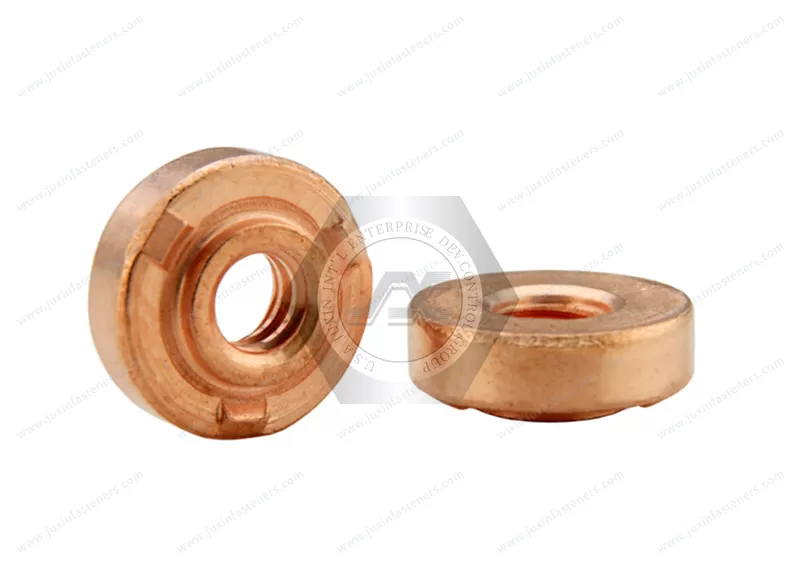
Brass Self-Locating Projection Weld Nuts – JX-WN / JX-WNS
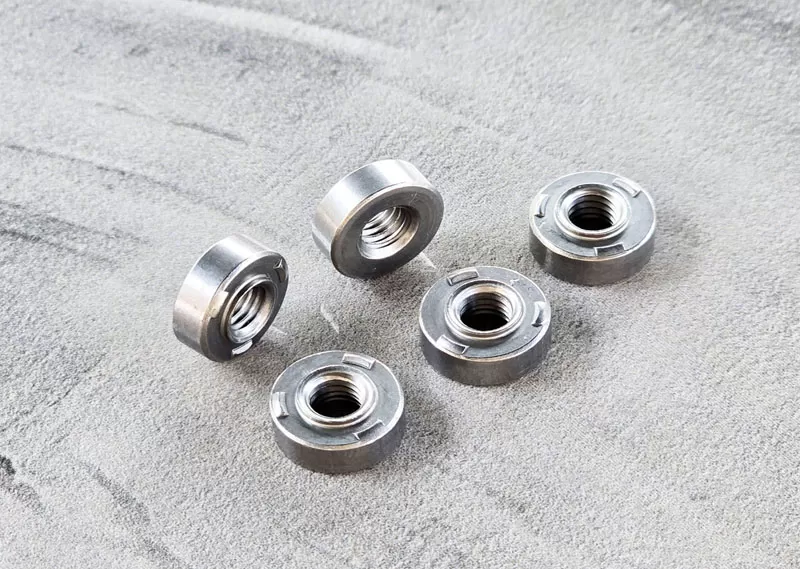
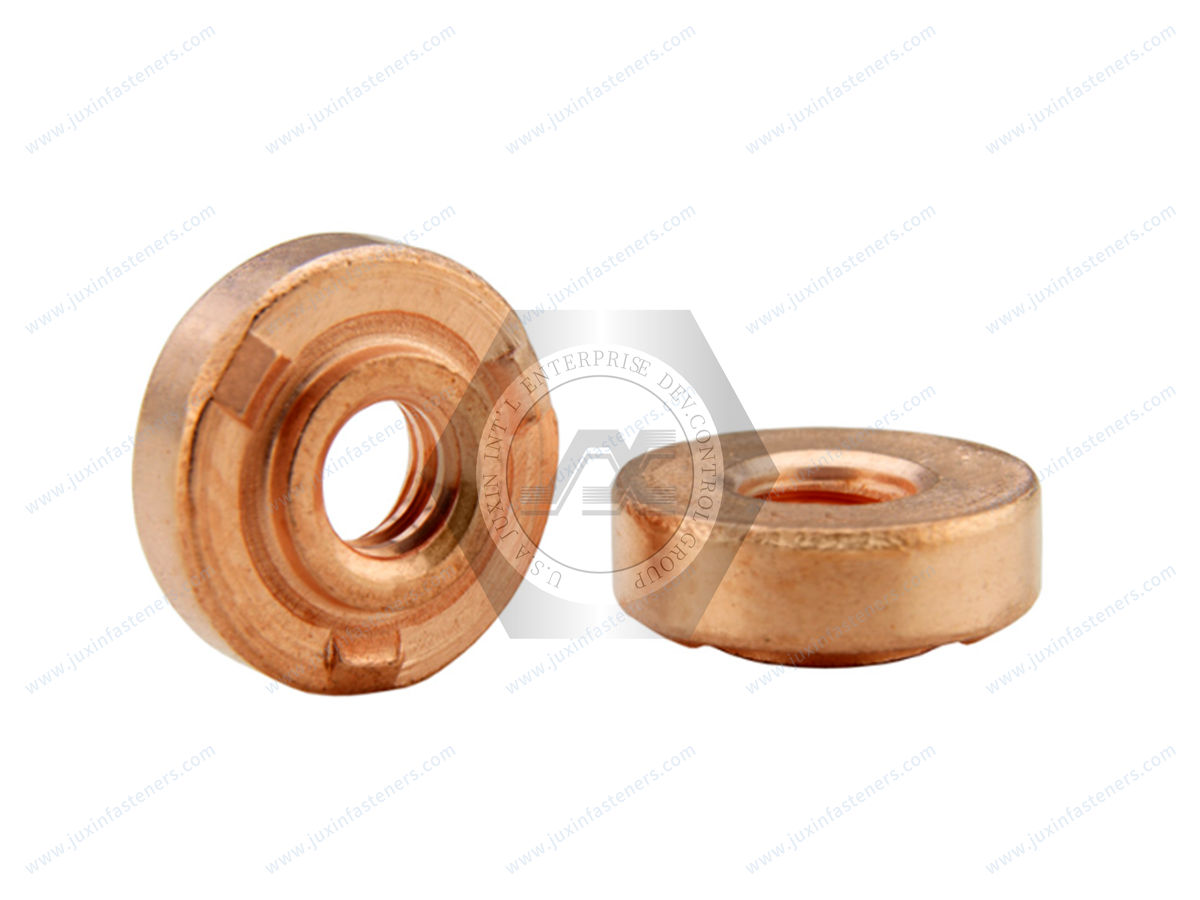
JUXIN FASTENERS offers brass and brass-alloy versions of JX-WN and JX-WNS self-locating projection weld nuts for OEM threaded fastening applications.
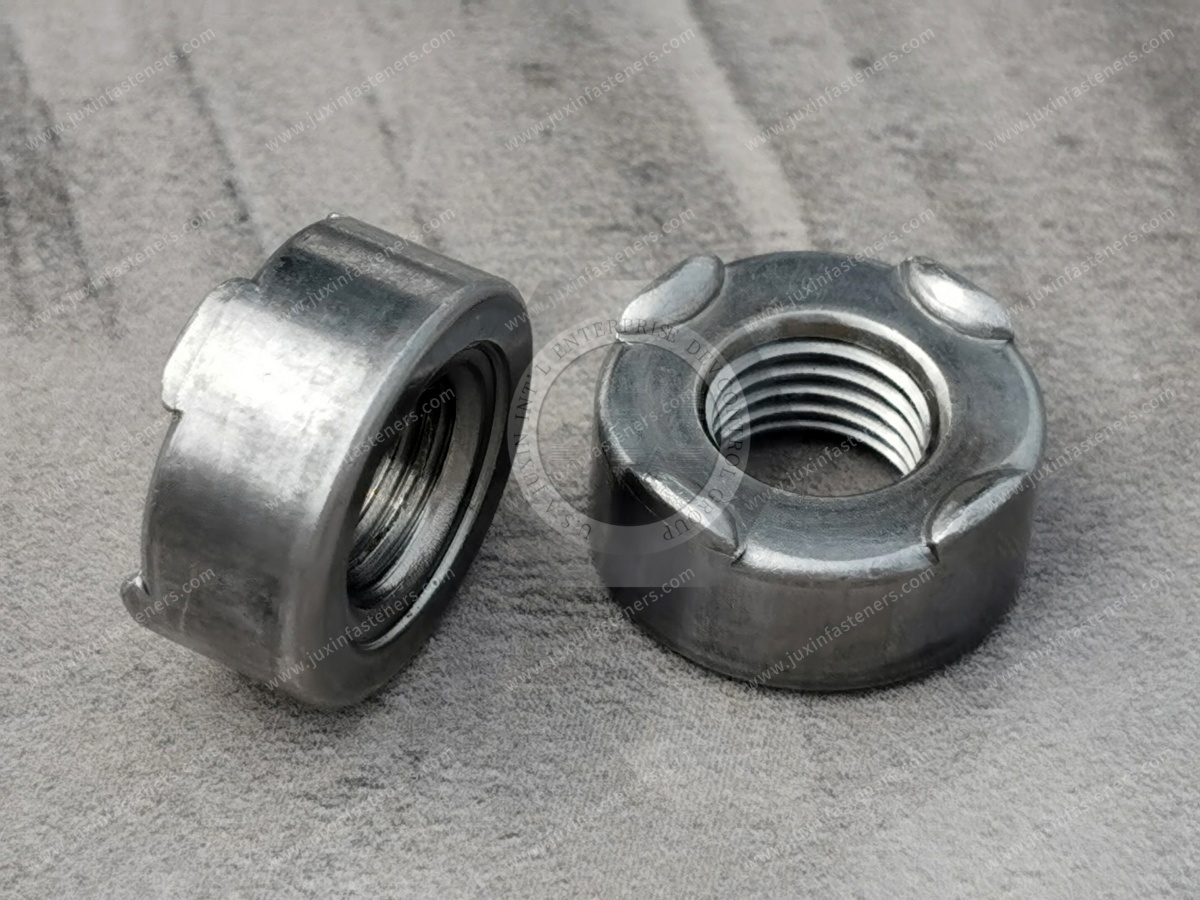
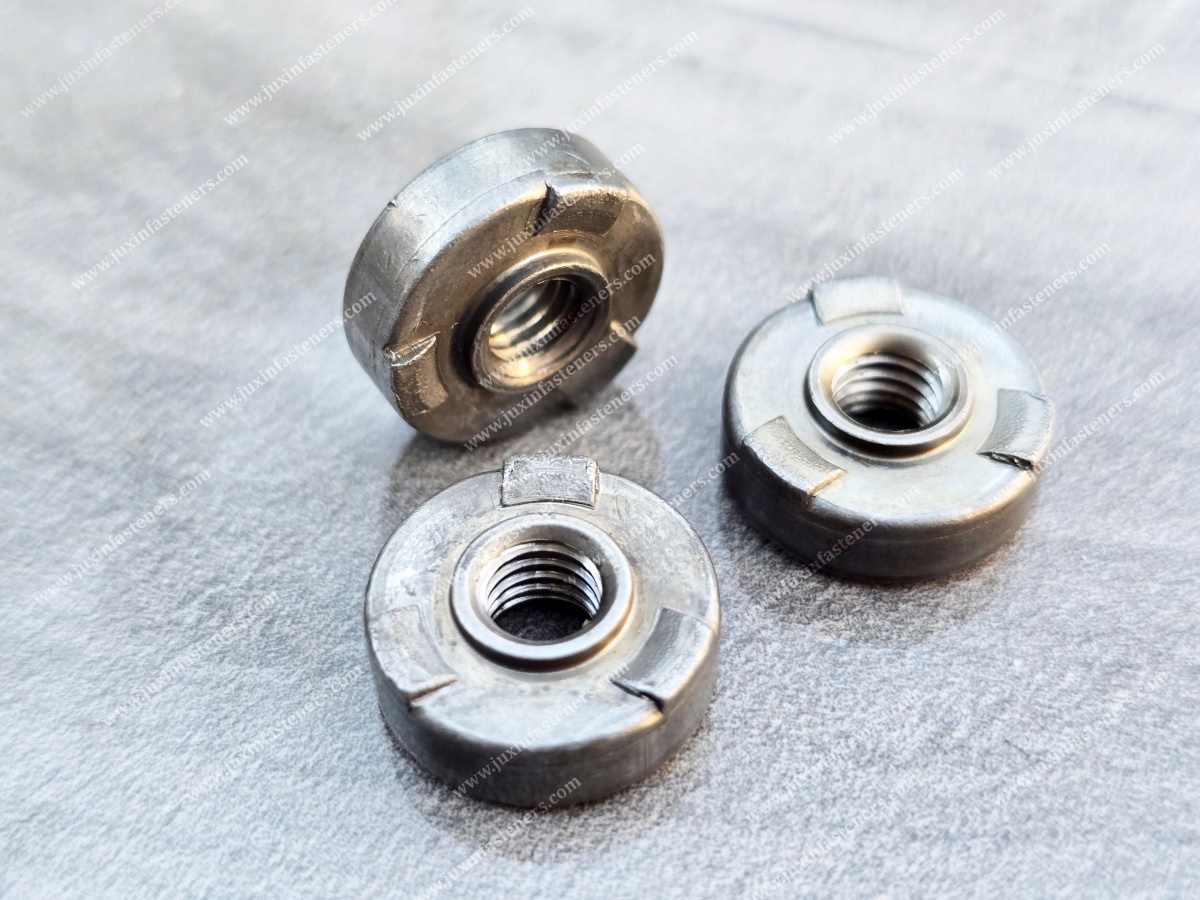
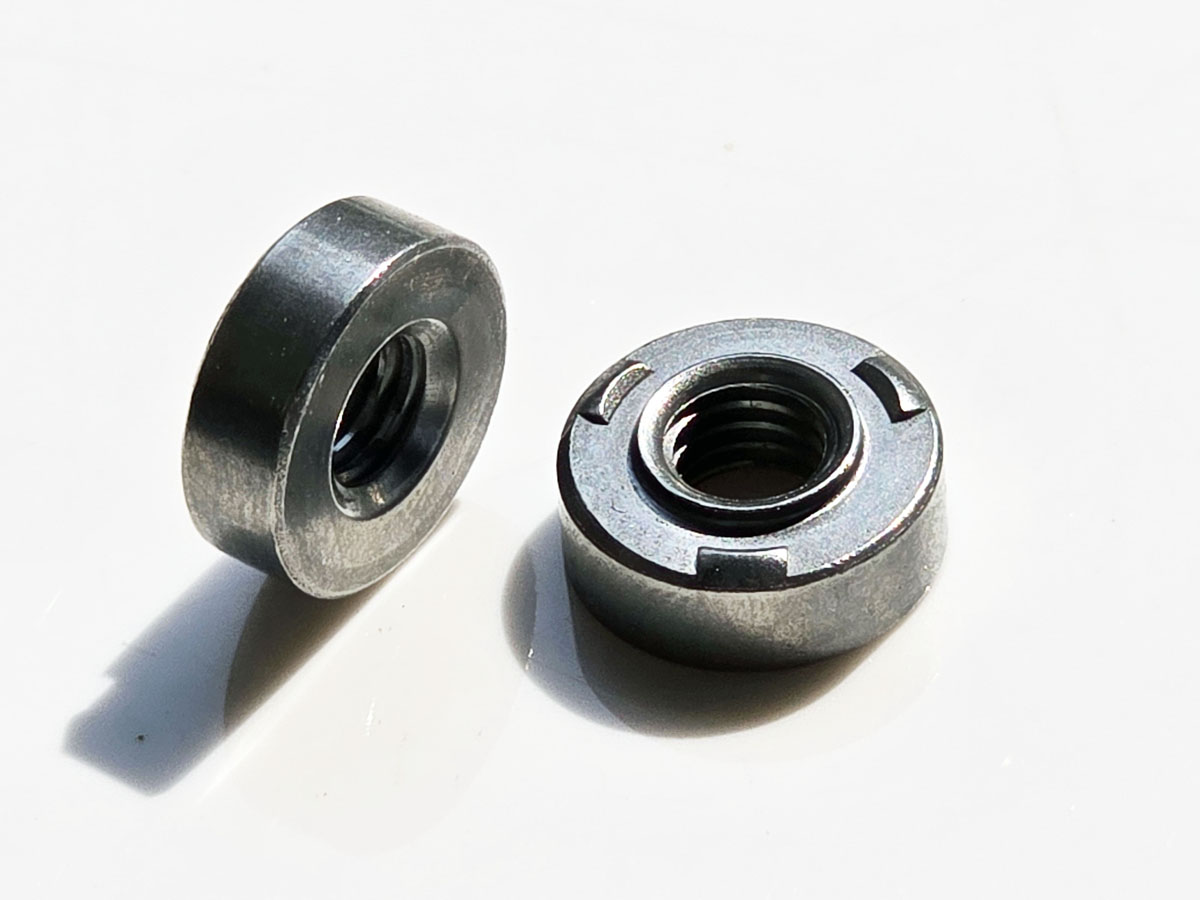
These round nuts combine internal threads with self-locating geometry and projection features intended for attachment to compatible metal components.
Brass materials may be considered where electrical conductivity, corrosion behavior, appearance or specific material requirements influence fastener selection.
Unlike conventional steel projection weld nuts, brass versions require separate joining-process evaluation because copper alloys have different electrical resistance and thermal conductivity.
Key Features
Round self-locating projection weld nut design.
Internal threads for mating bolts and screws.
Brass and brass-alloy material options.
Referenced metric thread range: M3 to M6.
Referenced Unified inch thread range: #4 to 1/4 inch.
Suitable for OEM evaluation in fabricated metal assemblies.
Customer-specific dimensions and materials subject to engineering review.
Joining method and attachment strength require application-specific validation.
Material Options
Brass and brass alloys, including material designations H63, H65, H68, H70 and H90, are referenced for this product family.
Equivalent ASTM or EN material grades should be established through verified chemical composition and mechanical-property comparison rather than designation alone.
Technical Documentation
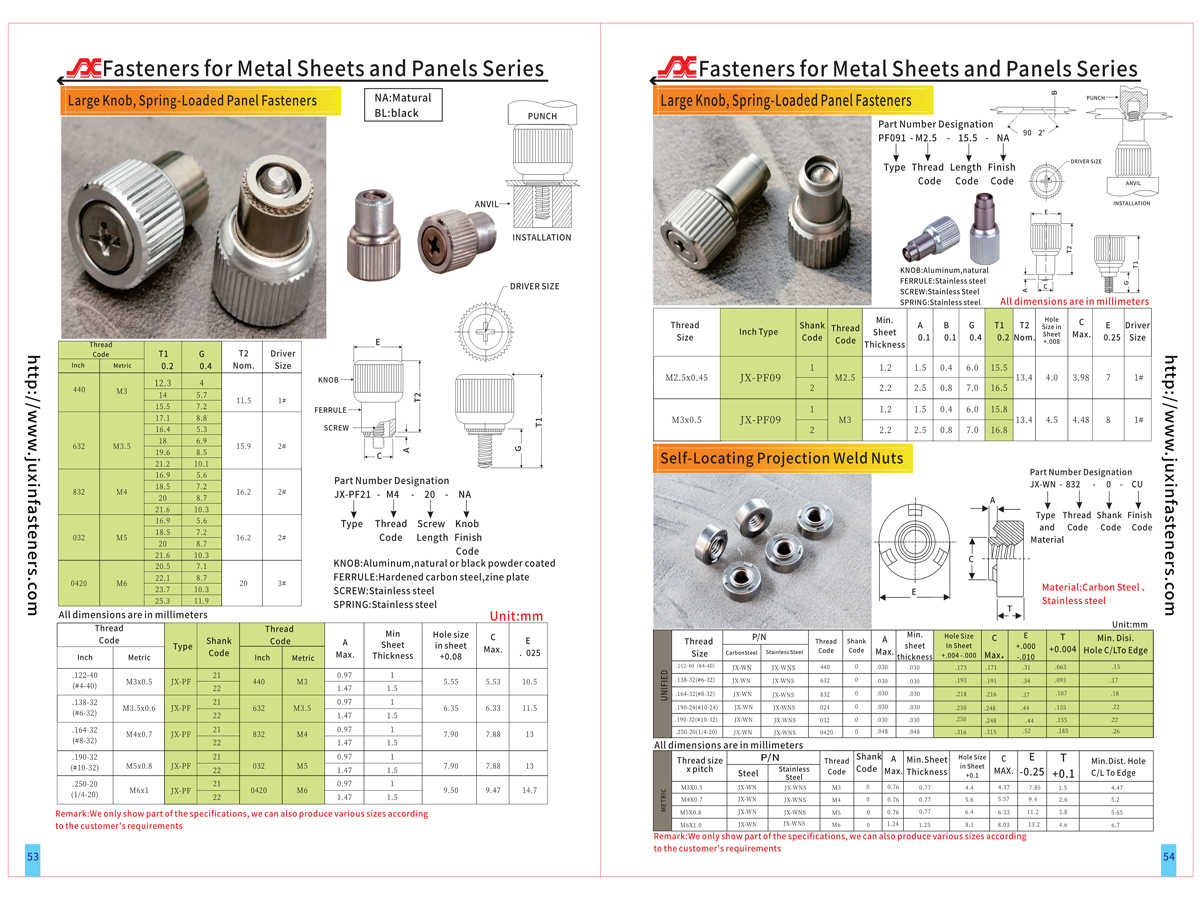
Please refer to the product specification PDF and CAD drawings on pages 53–54 for detailed dimensions and configurations.
Product Specification
Brass Self-Locating Projection Weld Nuts – JX-WN / JX-WNS
Engineering Material Selection, Joining Feasibility and OEM Sheet-Metal Fastening Solutions
Product Overview
JUXIN FASTENERS offers JX-WN and JX-WNS brass self-locating projection weld nuts for engineering evaluation and customer-specific industrial fastening requirements.
These threaded fasteners are based on a round self-locating projection weld nut configuration.
The locating geometry is intended to assist positioning relative to a prepared mounting hole, while the projection features provide designated contact locations for a joining operation.
Brass versions must be evaluated separately from steel and stainless steel weld nuts because the material properties can significantly affect the joining process.
The suitability of a brass projection weld nut depends on the specific alloy, mating sheet material, joint design, welding equipment and required mechanical performance.
Product Identification and Specifications
Product name: Brass Self-Locating Projection Weld Nuts
Model series: JX-WN / JX-WNS
Product configuration: Round self-locating projection weld nut
Material family: Brass and brass alloys
Referenced alloy designations: H63, H65, H68, H70 and H90
Referenced metric threads: M3, M4, M5 and M6
Referenced Unified inch thread range: #4 to 1/4 inch
Application: Threaded attachment to compatible fabricated metal components
Dimensional reference: Product PDF and CAD drawings, pages 53–54
Custom dimensions: Subject to drawing review and manufacturing feasibility
The exact available thread sizes, alloy grades, projection configurations and dimensions must be confirmed before quotation or production.
Brass Material Selection
Brass is a copper-zinc alloy family with properties that vary according to chemical composition and processing condition.
Different brass grades may offer different combinations of formability, machinability, strength, electrical conductivity and corrosion behavior.
These differences matter when selecting a threaded fastener for a fabricated assembly.
The supplied product information identifies H63, H65, H68, H70 and H90 as possible brass material designations.
These designations should not be treated as interchangeable.
Material selection should consider the required thread strength, manufacturing method, joining process, environmental conditions and any customer-specified chemical composition.
Understanding H63, H65, H68, H70 and H90 Brass
The referenced designations indicate different nominal copper-content families.
A higher copper content does not automatically make a material better for every fastening application.
Differences in composition can affect mechanical properties, manufacturing behavior and joining characteristics.
For example, an alloy selected for forming performance may not provide the same machinability or mechanical characteristics as another brass alloy.
The approved material grade should be specified using a recognized material standard or an agreed chemical and mechanical specification.
Where an ASTM or EN equivalent is requested, equivalence must be verified against the actual material requirements.
No direct equivalence should be assumed solely from the nominal alloy designation.
Why Brass Projection Weld Nuts Require Special Engineering Review
Conventional resistance projection welding is commonly associated with steel fasteners and compatible steel sheet-metal assemblies.
Brass behaves differently because of its comparatively high electrical and thermal conductivity.
These properties affect resistance heating at the joint interface.
A welding schedule developed for a carbon steel projection weld nut may not generate suitable weld formation when applied to brass.
Increasing welding current alone does not guarantee a successful joint.
The alloy composition, projection geometry, electrode design, base sheet material and equipment capacity must all be evaluated.
For this reason, brass JX-WN and JX-WNS configurations should be treated as application-specific joining solutions rather than direct replacements for steel weld nuts.
Resistance Projection Welding Feasibility
A resistance projection welding process uses electrical current and mechanical force to create localized joining at defined contact locations.
For brass components, obtaining an acceptable joint can be more challenging than with conventional steel combinations.
The process may require different electrode arrangements, welding parameters or component geometry.
The selected material combination must be evaluated through representative welding trials.
A successful visual attachment alone is not sufficient evidence of acceptable mechanical performance.
The completed joint should be tested against the application's defined requirements.
If reliable resistance welding cannot be established, an alternative fastening or joining method should be considered.
The Importance of Mating Sheet Material
The base sheet material is a critical part of the joint design.
Brass-to-steel, brass-to-stainless-steel and brass-to-copper-alloy combinations have different joining characteristics.
A process suitable for one material combination may not be suitable for another.
Material compatibility should be reviewed before selecting the final fastener.
The engineer should identify the sheet grade, thickness, coating condition and required joint loading.
Where dissimilar metals are involved, both joining feasibility and long-term environmental performance should be evaluated.
Self-Locating Geometry and Hole Alignment
Self-locating projection weld nuts are intended to assist positioning relative to a prepared mounting hole.
Correct alignment helps ensure that the internal thread is positioned appropriately for the mating screw or bolt.
However, the locating feature does not compensate for unlimited hole-position error.
Hole diameter, positional tolerance, sheet flatness and fixture accuracy remain important.
The locating geometry must also provide sufficient clearance for the chosen joining process.
Production drawings should define the relevant dimensions and tolerances.
Thread Sizes and International Thread Standards
The supplied specification references metric sizes M3 through M6 and Unified inch threads from #4 through 1/4 inch.
Metric threads should be specified using applicable ISO thread standards.
ISO 261 provides general metric thread designations.
ISO 965 provides metric thread tolerance requirements.
Unified inch threads should be specified using ASME B1.1.
The approved drawing should identify the thread size, pitch and tolerance class.
Metric and Unified threads are not interchangeable.
A nominally similar diameter does not establish thread compatibility.
Thread Strength in Brass Fasteners
Thread performance depends on the selected alloy, thread engagement length, geometry and loading conditions.
Brass generally has different mechanical properties from common carbon steel fastener grades.
The designer should therefore avoid transferring tightening torque values from a steel nut to a brass nut without verification.
Potential failure modes include thread stripping, local deformation and damage from excessive tightening.
Where repeated assembly is required, thread wear should also be considered.
The required tightening procedure should be validated for the selected brass alloy and mating bolt.
Projection Geometry and Joint Quality
The projection features influence how contact is established during resistance welding.
Their dimensions and consistency can affect local heating and joint formation.
For brass components, projection geometry may need additional evaluation because the material responds differently from steel.
A change in projection height, shape or location can affect the joining process.
Custom projection geometry should therefore be treated as an engineering change requiring validation.
The customer should provide the required dimensional drawing and joint-performance criteria.
Avoiding Thread Damage and Distortion
Joining operations can introduce thermal and mechanical effects near the internal threads.
Possible concerns include distortion, thread contamination and changes in dimensional accuracy.
The severity depends on the selected process and component geometry.
Thread gauging after joining may be appropriate for controlled production applications.
Where bolt installation is sensitive to alignment, the completed assembly should also be checked using the intended mating fastener.
Any required thread-protection method should be defined during process development.
Corrosion and Dissimilar Metal Contact
Brass is often selected for its corrosion-related properties.
However, corrosion performance depends on the alloy, environment and contact with other materials.
In assemblies containing dissimilar metals, galvanic corrosion may occur when an electrically conductive moisture path is present.
The design should consider the mating sheet, bolt material, surface treatment and service environment.
Electrical contact requirements may also influence whether protective coatings or isolation methods are appropriate.
No universal corrosion-resistance rating should be assigned without a defined test environment and supporting evidence.
Surface Finish and Coating Considerations
The supplied product family references possible zinc, zinc-nickel and copper-based surface treatments.
These options should not be assumed suitable for every brass alloy or joining process.
Coatings can affect surface conductivity, corrosion behavior and joining performance.
The correct processing sequence may depend on whether the component is joined before or after finishing.
Where corrosion protection is required, the customer should specify the intended environment and any applicable ASTM, ISO or EN test requirements.
Coating compatibility must be confirmed before production.
Brass Versus Carbon Steel Projection Weld Nuts
Carbon steel projection weld nuts are commonly selected for resistance welding to compatible steel sheet-metal assemblies.
Brass may be considered when a particular material property or application requirement justifies its use.
However, brass is not automatically a substitute for steel.
Material strength, joining characteristics, thread performance and cost can differ significantly.
If the application does not specifically require brass, a conventional steel projection weld nut may offer a more straightforward joining solution.
The selection should be based on validated performance rather than material preference alone.
Brass Versus Stainless Steel Projection Weld Nuts
Stainless steel projection weld nuts may be preferred where corrosion resistance and mechanical requirements support their selection.
Brass may offer different electrical, manufacturing or appearance characteristics.
Neither material is universally superior.
The base sheet, service environment and installation process should guide the choice.
For critical assemblies, the selected material should be validated as part of the complete joint.
When a Brass Self-Clinching Nut May Be More Suitable
Some applications specify brass because of electrical or material requirements but do not specifically require welding.
In such cases, a mechanically installed threaded fastener may be worth evaluating.
A suitable self-clinching nut may avoid the thermal effects associated with welding.
However, self-clinching installation requires compatible panel material, hardness and thickness.
A brass self-clinching nut should not be substituted without confirming its availability and installation requirements.
This comparison is particularly relevant when the main design objective is a permanent threaded attachment rather than a welded joint.
When a Brass Rivet Nut May Be More Suitable
A rivet nut provides threaded attachment through mechanical deformation.
It may be useful where welding equipment is unavailable or where installation access is limited.
Rivet nuts also have their own grip-range, hole-preparation and mechanical-performance requirements.
For thin sheet-metal assemblies, the engineer should compare installation access, loading, material compatibility and production cost.
A brass rivet nut may be considered only where its material and size configuration is available and suitable.
Electrical and Electronic Equipment Applications
Brass threaded fasteners may be considered in selected electrical and electronic equipment assemblies.
Possible applications include mounting structures, instrument housings and components where a copper-alloy material is specified.
However, the suitability of a projection-welded brass nut must be confirmed for the actual base material and joining process.
Electrical conductivity alone does not establish that a welded connection is suitable for grounding or current-carrying service.
Such functions require separate electrical and mechanical validation.
Industrial Enclosures and Equipment Housings
Fabricated metal enclosures often require permanent threaded attachment points.
Brass projection weld nuts may be evaluated when the product specification calls for a copper-alloy fastener.
Potential applications include instrument housings, control equipment and specialized fabricated components.
The final design must account for the sheet material, installation method and required joint strength.
Instrumentation and Precision Equipment
Instrumentation assemblies may use brass threaded components for material-specific or functional reasons.
A self-locating geometry may help with component positioning during assembly.
However, the joining process must not compromise the dimensional accuracy of the surrounding structure.
Applications with tight alignment requirements should include appropriate dimensional inspection after installation.
Custom OEM Fabricated Assemblies
Some OEM applications require fasteners that do not match standard catalog configurations.
Custom brass projection weld nuts may be considered where a specific alloy, thread or locating geometry is required.
The customer should provide an engineering drawing and the intended installation conditions.
Manufacturing and joining feasibility must be established before the configuration is approved.
Custom production requirements should include inspection criteria and any necessary qualification testing.
Engineering Example: Brass Threaded Attachment in a Metal Housing
Consider an OEM metal housing requiring a brass threaded attachment point.
The initial design proposes a self-locating brass projection weld nut.
Before approval, the engineer identifies the housing material and thickness, selected brass alloy, mating screw and required joint loading.
The team then evaluates whether resistance projection welding can create an acceptable joint for that material combination.
Representative samples are tested for attachment strength and thread function.
If the process cannot meet the required performance, the design is reviewed for a mechanically installed brass fastener or another validated solution.
This approach avoids committing to a welding process solely because the fastener has projection features.
Installation Qualification and Testing
A brass projection weld nut assembly should be qualified using the actual production materials.
The qualification plan may include visual inspection, thread gauging, dimensional verification and mechanical testing.
Depending on the application, torque resistance, push-out or pull-out testing may be appropriate.
The required test values should come from the customer's engineering specification.
No universal installation strength or welding parameter can be guaranteed across all brass alloys and base sheet combinations.
The approved joining procedure should be documented before serial production.
Relevant International Standards
ISO 261 – ISO metric screw thread general plan.
ISO 965 – ISO metric screw thread tolerances.
ASME B1.1 – Unified inch screw threads.
ISO 14329 – Resistance welding destructive testing and failure assessment, where applicable.
ISO 14270 – Resistance welding mechanized peel testing, where applicable.
ASTM B36/B36M – Copper-alloy plate, sheet and strip, where the selected alloy and product form fall within its scope.
Applicable ASTM or EN copper-alloy material standards should be selected according to the verified material composition and product form.
These standards are references for specification development and testing.
Their inclusion does not imply that every brass JX-WN or JX-WNS configuration is certified to them.
OEM Purchasing and Material Traceability
Procurement teams should identify the exact brass alloy rather than ordering by the general description "brass."
The approved purchase specification should define the material composition, thread requirements and dimensional tolerances.
Where required, material inspection reports and batch identification should be agreed upon before production.
For joining-sensitive applications, the OEM should also define whether fasteners will be supplied as individual components or as part of a validated welded assembly.
The supplier qualification process should distinguish fastener manufacturing capability from responsibility for the final joining operation.
RFQ Requirements for Brass JX-WN / JX-WNS
To support engineering review and quotation, please provide:
Required JX-WN or JX-WNS model and engineering drawing.
Brass alloy or approved international material specification.
Metric or Unified thread size and pitch.
Nut dimensions and locating geometry.
Projection dimensions and tolerances.
Mating sheet material, thickness and surface condition.
Intended joining or installation method.
Required attachment strength and thread performance.
Surface finish and corrosion requirements.
Inspection and qualification requirements.
Estimated order quantity and annual demand.
Delivery schedule and packaging instructions.
Complete application information helps determine whether the requested brass configuration is suitable for the intended assembly.
Frequently Asked Questions
What are brass self-locating projection weld nuts?
They are internally threaded brass or brass-alloy fasteners with locating and projection features intended for attachment to compatible metal components.
Can brass projection weld nuts be resistance welded?
Some combinations may be technically feasible, but welding suitability cannot be assumed. The alloy, base sheet and process must be evaluated and tested.
Are H63, H65, H68, H70 and H90 interchangeable?
No. Their compositions and properties differ. The required material must be specified and verified.
Are M3 to M6 sizes available?
The supplied product range references M3 to M6. Availability of each size and alloy combination must be confirmed.
Are Unified inch threads available?
The supplied specification references #4 to 1/4 inch. Exact pitch and configuration require confirmation.
Can brass projection weld nuts replace steel weld nuts?
Not automatically. Material strength and welding characteristics differ, so the complete joint requires engineering review.
Can custom brass weld nuts be manufactured?
Custom dimensions and material requests can be evaluated using drawings and application requirements.
What information is needed for a quotation?
The most important information includes alloy grade, thread size, dimensions, base sheet material, joining method, required performance and quantity.
Related JUXIN FASTENERS Products
Steel and Stainless Steel Self-Locating Projection Weld Nuts
Compare conventional projection weld nut materials and joining requirements with brass configurations.
Self-Clinching Nuts
Review mechanically installed threaded fasteners for compatible sheet-metal applications.
Self-Clinching Floating Nuts
Consider threaded attachment solutions where limited hole-misalignment compensation is needed.
Blind Rivet Nuts
Explore mechanically installed threaded fasteners for applications requiring one-sided installation access.
Self-Clinching Standoffs
Review threaded and unthreaded spacing solutions for compatible sheet-metal assemblies.
These product names should be linked to the corresponding verified JUXIN FASTENERS product pages or categories.
Request a Brass Projection Weld Nut Quotation
JUXIN FASTENERS supports OEM fastener sourcing and customer-specific threaded component requirements.
For brass JX-WN and JX-WNS inquiries, please submit your drawings, alloy requirements, thread specifications, base material information, intended installation process and estimated purchasing volume.
Our team can review the requested component configuration and manufacturing feasibility.
Any required joining performance or process qualification must be agreed upon for the intended application.
Email: info@juxinfasteners.com
Website: www.juxinfasteners.com
Product Packaging
JUXIN FASTENERS provides protective export packaging for brass JX-WN and JX-WNS self-locating projection weld nuts.
Standard Packaging
Products may be packed in protective polybags or small boxes, followed by suitable export cartons.
Palletizing can be arranged for international shipments according to order quantity and logistics requirements.
Protection of Brass Components
Packaging should protect the internal threads, locating features, projection geometry and exposed brass surfaces from damage or contamination.
Where appearance or surface condition is important, additional separation or protective packaging may be specified.
Traceability and Identification
Packaging labels can include the product model, brass alloy designation, thread size, quantity and batch or lot identification.
Customer-specific barcode and labeling requirements can be incorporated into the approved packaging instructions.
Customized OEM Packaging
Customized packing quantities, carton markings, private labels and pallet arrangements can be reviewed according to customer requirements.
Final packaging details will be confirmed before shipment.
Product Pictures
Contact Us
Tel.:
+86 020 8621 0320
+86 020 3121 6067
E-mail:
Technical Support:
Navigation
SEND INQUIREY