Call Us
+86 136 6007 9809
Call Us
+86 136 6007 9809

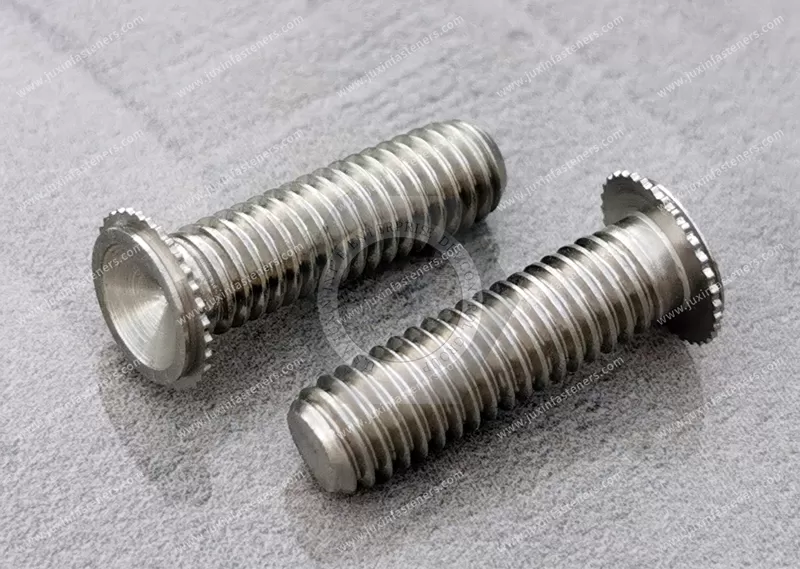
JUXIN FASTENERS supplies stainless steel concealed-head self-clinching studs for metal assemblies requiring captive external threads and an uninterrupted opposite panel surface. The stud head is installed into a precisely machined blind recess, where controlled pressing displaces surrounding material into the head's retention features.
These hidden-head threaded studs are designed for engineering evaluation in electronics enclosures, instrumentation, control equipment and precision sheet-metal assemblies. Stainless steel selection, panel hardness and blind-hole geometry must be evaluated together.
Product Series: JX-CFHA, JX-CFHC, JX-CHA, JX-CHC
Material: Stainless Steel; Specific Grade Subject to Confirmation
Installation: Press Clinching into a Machined Blind Recess
Thread Reference: #4–#10; Metric Range Requires Drawing Confirmation
Panel Thickness: 0.062 in (approximately 1.57 mm) Family Reference, Configuration-Dependent
Custom Dimensions: Subject to Drawing and Technical Review
Product Specification
Stainless Steel Concealed-Head Self-Clinching Studs for Precision Sheet-Metal Assemblies
Product Overview
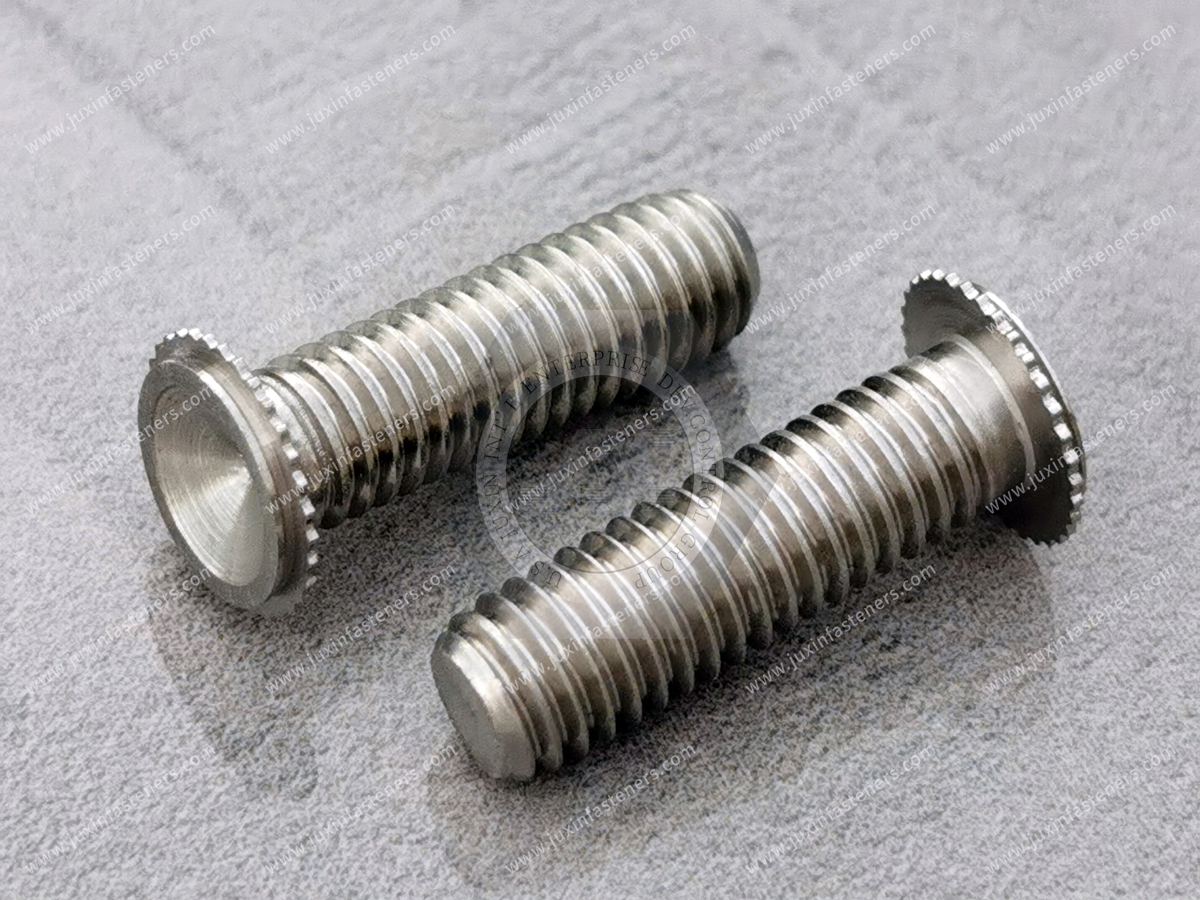
Stainless steel concealed-head self-clinching studs create permanently retained external threaded attachment points while keeping the opposite surface of a metal panel free from visible fastener heads and through-holes.
These hidden-head fasteners are installed into a machined blind recess rather than a conventional through-hole.
During press installation, the surrounding parent material is displaced into the fastener head's retention features. The stud becomes mechanically retained within the panel, while its threaded shank remains available for mounting components.
This construction is useful when engineers need a combination of corrosion-resistant fastener material, concealed attachment geometry and serviceable threaded connections.
JUXIN FASTENERS offers concealed-head stud configurations identified as JX-CFHA, JX-CFHC, JX-CHA and JX-CHC for technical review and OEM sourcing.
Product Specifications
Product Type: Stainless Steel Concealed-Head Self-Clinching Stud
Alternative Names: Hidden-Head Clinch Stud, Concealed Threaded Stud, Blind-Hole Clinch Stud
Product Series: JX-CFHA, JX-CFHC, JX-CHA, JX-CHC
Fastener Material Family: Stainless Steel
Material References Supplied: SUS302, SUS303, SUS316, SUS410, SUS420 and SUS430
Actual Material Grade: To Be Confirmed for the Selected Configuration
Head Configuration: Concealed Retention Head
Thread Configuration: External Male Thread
Installation Feature: Machined Blind Recess
Installation Process: Controlled Mechanical Press Clinching
Installation Tooling: Suitable Solid Punch and Hollow Supporting Anvil, According to Configuration
Thread Reference: #4–#10; Metric Sizes Require Confirmation
Stud Length: According to Approved Drawing
Minimum Panel Thickness: According to Selected Configuration
Published Family Thickness Reference: 0.062 in, Approximately 1.57 mm
Blind-Recess Dimensions: According to Applicable Product Drawing
Surface Finish: According to Approved Specification
Custom Requirements: Subject to Technical Review
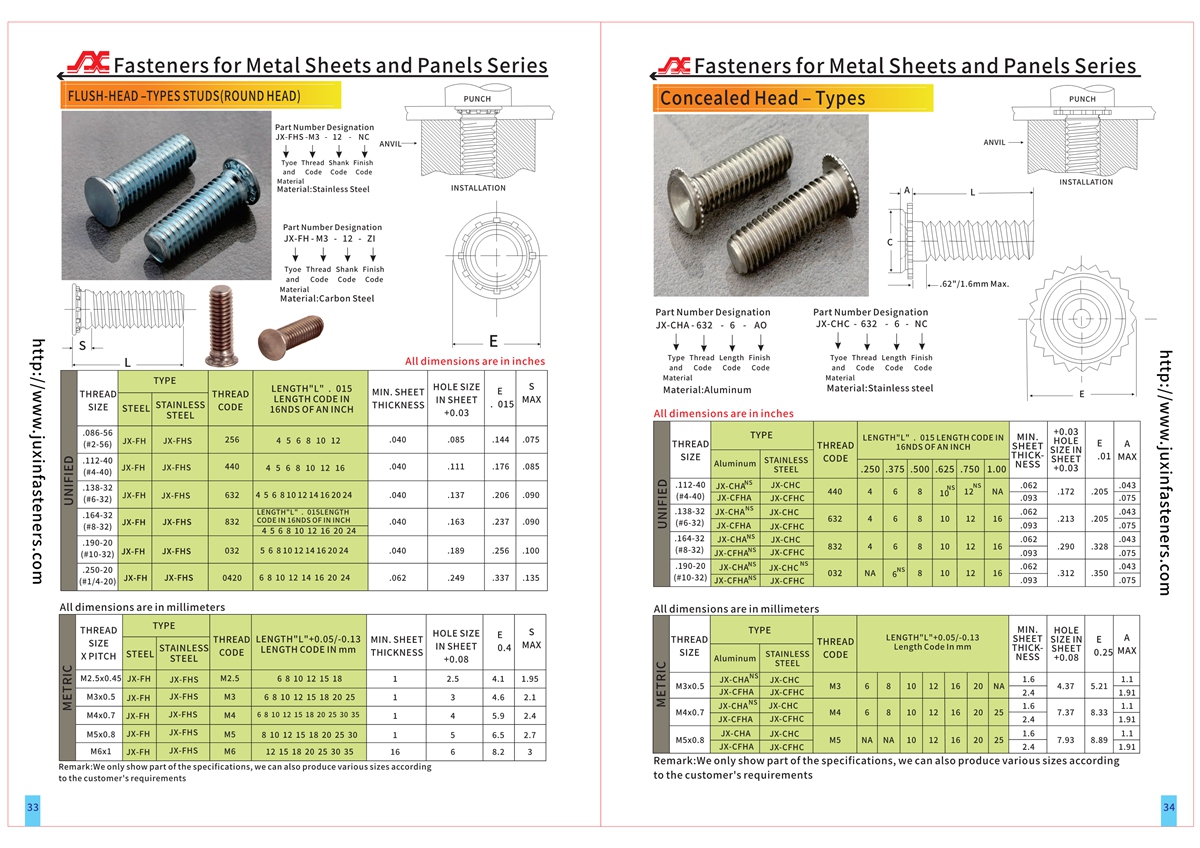
Detailed dimensional requirements should be verified against the applicable specification sheet and CAD drawings. The supplied product reference identifies catalog pages 33–34.
What Makes a Concealed-Head Stud Different?
A conventional self-clinching stud generally passes through a prepared panel hole, leaving the head on one side of the sheet.
A concealed-head stud instead uses a blind machined recess.
Its retention head is secured inside the parent material without intentionally breaking through the opposite panel surface.
The external thread remains accessible from the installation side.
This arrangement can support internal component mounting while preserving the appearance of the opposite surface.
The result is a mechanically retained male-threaded fastener without a visible through-hole on the exterior.
Why Choose Stainless Steel?
Stainless steel may be selected for corrosion resistance, material compatibility, appearance or customer-specific requirements.
However, stainless steels are not a single interchangeable material family.
Different grades have different corrosion behavior, hardness, strength, machinability and magnetic characteristics.
The selected grade affects both the stud itself and the interaction between the stud and the parent sheet.
For concealed-head self-clinching applications, material selection must therefore consider the complete installation system.
Stainless Steel Grade Selection
The supplied material information includes SUS302, SUS303, SUS316, SUS410, SUS420 and SUS430.
These designations represent different stainless steel families and should not be treated as equivalent.
Austenitic stainless steels such as 302 and 316 are commonly considered where corrosion resistance is important.
Grade 303 is often selected for machinability, although its corrosion behavior differs from that of other austenitic grades.
Grades 410 and 420 are martensitic stainless steels whose properties depend strongly on their processing and heat-treatment condition.
Grade 430 is a ferritic stainless steel with different corrosion and mechanical characteristics from austenitic grades.
The supplied grade list is a material reference, not confirmation that every grade is available for every concealed-head stud configuration.
The actual material must be agreed in the approved drawing.
International Stainless Steel Specifications
Where applicable, stainless steel materials can be specified using recognized international systems.
Relevant references may include ASTM A276 for stainless steel bars and shapes, ASTM A582 for applicable free-machining stainless steel bar products, and EN 10088 for stainless steel material designations and technical requirements.
These standards apply only where the material form, grade and purchasing specification are appropriate.
A JIS grade designation should not automatically be converted into an ASTM or EN grade without checking the relevant composition and property requirements.
No material certification or compliance is implied without supporting documentation.
Engineering Information Gain – Stainless Steel Does Not Automatically Improve Clinching Performance
It is tempting to assume that replacing a carbon steel stud with stainless steel produces a superior fastener.
For a self-clinching connection, that assumption can be incorrect.
Clinching relies on controlled deformation of the surrounding parent material.
The relative hardness and deformation behavior of the stud and mounting sheet are therefore critical.
A stainless steel stud may have excellent corrosion resistance but still be unsuitable for a particular stainless steel panel.
If the panel is too hard to flow into the retention features, the stud may not develop adequate mechanical engagement.
Material selection must be based on both corrosion requirements and installation compatibility.
Parent Sheet Hardness and Material Compatibility
The parent material must be suitable for the selected self-clinching stud.
The fastener's retention features must remain effective while the surrounding panel material deforms.
A hard or heavily work-hardened sheet may resist the required material flow.
A very soft or thin sheet may deform excessively.
Compatibility should be established using the manufacturer's configuration-specific installation guidance and representative testing.
The supplied information does not establish a universal parent-sheet hardness limit for these four product references.
The allowable hardness must therefore be confirmed rather than assumed.
Can Stainless Steel Concealed-Head Studs Be Installed in Stainless Steel Panels?
This depends on the exact fastener configuration and the properties of the stainless steel panel.
The phrase stainless steel stud does not automatically mean stainless steel sheet compatibility.
Some self-clinching fasteners are intended for softer sheet materials.
Other designs may be suitable for different material conditions.
Before selecting a concealed-head stud for stainless steel sheet, engineers should verify the approved parent material, hardness range, blind-recess geometry and installation performance.
If these conditions cannot be met, an alternative attachment method should be considered.
Concealed-Head Installation Principle
The stud head is positioned inside a prepared blind recess.
A controlled press applies the installation load through suitable tooling.
The surrounding sheet material flows into the head's retention features.
The fastener becomes mechanically retained inside the panel.
The opposite panel surface remains uninterrupted when the recess and installation process are correctly designed.
The exact installation force and head geometry depend on the selected configuration.
Blind-Hole Machining
The concealed-head design requires a machined blind recess with controlled dimensions.
The hole must accommodate the fastener head while leaving sufficient material beneath it.
The machining process should control diameter, depth, location and surface condition.
A suitable center-cutting end mill may be used where appropriate for the required recess geometry.
The finished recess should be free of chips and defects that interfere with seating.
Hole dimensions must come from the applicable product drawing.
Cutting-tool availability and any special tooling supply should be confirmed separately.
Engineering Information Gain – Why Remaining Wall Thickness Matters More Than the Catalog Minimum
The supplied information refers to installations in panels as thin as 0.062 inch, approximately 1.57 mm.
This is a family reference rather than a universal minimum for every thread size and stud design.
The critical dimension is the sound parent material remaining beneath the blind recess.
A nominal sheet thickness does not fully describe that condition.
Sheet tolerance, recess-depth variation and local machining conditions all influence the remaining wall.
If the recess is too deep, the opposite surface may distort or become structurally weakened.
If the recess is too shallow, the head may not seat or engage correctly.
Engineering drawings should therefore specify the recess depth and the minimum remaining wall where required.
Preventing Exterior Surface Damage
The principal advantage of a concealed-head stud is preservation of the opposite surface.
However, that surface can still be damaged by incorrect machining or pressing.
Potential defects include dimpling, local bulging, breakthrough and surface marking.
These problems may result from excessive recess depth, insufficient remaining material, unsuitable tooling or excessive installation force.
The installation process should be qualified using representative panel material and thickness.
Exterior-surface inspection should be included when appearance is a critical requirement.
Installation Tooling
The supplied installation method refers to a hollow anvil and solid punch.
The tooling must support the workpiece and accommodate the fastener geometry.
Correct alignment helps prevent bending of the stud and uneven head seating.
The press should deliver a controlled installation stroke or force appropriate to the design.
Tooling clearance must also be checked against nearby panel features.
The exact punch and anvil arrangement should be approved for the selected stud.
Recommended Installation Sequence
Prepare the blind recess according to the approved drawing.
Inspect the recess for correct geometry and machining quality.
Remove chips and unwanted burrs.
Position the concealed stud head in the prepared recess.
Support the panel using the appropriate tooling.
Apply the specified controlled press operation.
Verify head seating and stud alignment.
Inspect the opposite surface for deformation or damage.
Perform retention testing when required by the application.
The process should not rely on uncontrolled impact installation.
Why Press Force Is Not a Universal Number
The force required to install a concealed-head stud depends on several interacting factors.
These include stud geometry, parent material, sheet hardness, recess dimensions and remaining wall thickness.
Using a force value from an unrelated stud can produce an unacceptable assembly.
Insufficient force may leave the head incompletely engaged.
Excessive force may damage the panel or fastener.
The installation process should be established from the applicable technical data and validated on representative production material.
Torque-Out Resistance
Torque-out resistance describes the installed stud's ability to resist rotation in the mounting panel.
It becomes important when tightening or removing a mating nut.
Retention-feature geometry and the surrounding deformed material contribute to rotational resistance.
Actual performance depends on the selected stud and installation conditions.
No universal torque-out value is stated for the JX-CFHA, JX-CFHC, JX-CHA or JX-CHC configurations.
Where rotational loading is important, the buyer should specify the required acceptance criteria and test conditions.
Axial Retention and Pushout Resistance
Axial retention is another important consideration for concealed-head studs.
The installed fastener must resist the relevant loading direction without unacceptable displacement.
Performance depends on the head geometry, mechanical engagement and remaining parent material.
A fastener suitable for light internal component mounting may not be suitable for a heavily loaded structural connection.
Where required, representative assembly testing should be used to establish acceptable performance.
The test should reflect the intended loading direction and installation condition.
Thread Selection
The studs provide external male threads for use with compatible nuts or internally threaded components.
The supplied thread reference includes Unified inch sizes #4 through #10.
The metric range in the source information is inconsistently written as M8 to M5.
The exact available metric thread sizes must therefore be checked against the dimensional table.
For ISO metric threads, ISO 261 and ISO 965 provide relevant thread references.
For Unified inch threads, ASME B1.1 is relevant.
Metric and Unified inch threads are not directly interchangeable.
The final thread designation and tolerance class should be included in the approved drawing.
Stud Length and Thread Engagement
The projecting threaded length must suit the intended assembly.
Engineers should consider the thickness of brackets, spacers, washers and mating nuts.
The design should also account for the required thread engagement and available internal clearance.
A stud that is too short may not provide adequate engagement.
A stud that is unnecessarily long may interfere with nearby equipment.
The approved drawing should identify the overall stud geometry and required projection.
Corrosion Resistance and Environmental Exposure
Stainless steel can provide useful corrosion resistance in many environments.
However, corrosion performance depends on the selected grade, surface condition, mating materials and exposure.
Grade 316 may be considered for certain more demanding environments, but it is not universally resistant to corrosion.
Crevice conditions, chlorides and dissimilar-metal contact can influence service performance.
No corrosion-test result or service-life guarantee is claimed without supporting data.
If the application has defined environmental requirements, these should be included in the RFQ.
Galvanic Compatibility
A stainless steel stud installed into another metal may create a dissimilar-metal combination.
In the presence of a conductive electrolyte, galvanic corrosion may occur depending on the materials and environment.
The effect depends on factors such as surface area ratio, electrical continuity and moisture exposure.
The complete assembly should be reviewed where outdoor, marine or wet-service conditions are expected.
Material compatibility should not be evaluated from the stud grade alone.
Surface Treatment and Passivation
Some stainless steel components may require surface cleaning or passivation depending on the manufacturing process and customer specification.
ASTM A967 and ASTM A380 are relevant references for applicable stainless steel passivation and cleaning practices.
These processes should not be assumed to be included unless specified and confirmed.
The required finish, appearance and verification method should be agreed before production.
Applications in Electronics Enclosures
Concealed-head studs can be considered for electronic equipment housings where visible exterior fasteners are undesirable.
They can provide captive threaded mounting points for internal brackets and components.
The designer must still consider panel thickness, electrical clearance and mechanical loads.
The metal stud itself does not provide electrical insulation.
Applications in Medical Equipment Housings
Selected stainless steel concealed-head studs may be considered for equipment covers, instrument enclosures and non-implantable mechanical assemblies.
The design may benefit from a smooth exterior and internal threaded attachment points.
Material compatibility, cleaning requirements and any applicable regulatory obligations must be separately assessed.
The product is not represented as medically certified.
Applications in Industrial Instrumentation
Precision instruments may require compact internal mounting points without visible fasteners on the exterior.
A concealed-head stud can support this arrangement where the panel permits blind-hole machining.
The engineer should assess vibration, service loads and installation access.
Applications in Control Cabinets
Industrial control cabinets may require internal threaded mounting points while preserving the visible exterior.
Concealed-head studs may be evaluated for suitable brackets and accessories.
The final selection depends on parent-sheet compatibility, available thickness and load requirements.
Any required enclosure ingress protection or electrical bonding must be validated separately.
Applications in Telecommunications Equipment
Telecommunications and networking equipment may use concealed threaded attachment points for internal assemblies.
The design should account for limited internal space, mounting clearance and production repeatability.
Environmental exposure and maintenance requirements should also be reviewed.
Applications in Automotive Interior Equipment
Concealed-head studs may be considered for selected metal interior housings and equipment panels.
The designer should evaluate vibration, fatigue, assembly loading and corrosion exposure.
Any automotive-specific approval or validation requirement must be established separately.
No automotive qualification is implied by the product description.
Concealed-Head Studs vs. Conventional Flush-Head Studs
A conventional flush-head stud normally passes through a prepared panel hole.
Its head is designed to sit flush with one panel surface.
A concealed-head stud is retained within a blind recess and leaves the opposite surface uninterrupted.
The concealed-head design is therefore particularly relevant when the visible exterior must not contain a fastener opening.
The trade-off is the additional machining and remaining-wall requirement.
Concealed-Head Studs vs. Weld Studs
Weld studs can provide permanent threaded mounting points without the same blind-hole machining requirement.
However, welding may introduce heat-related distortion, spatter and process-control considerations.
Concealed-head clinching avoids a welded attachment but requires suitable parent material and precise recess preparation.
Neither method is universally superior.
The selection should consider the total assembly design, cosmetic requirements, production volume and load conditions.
Concealed-Head Studs vs. Blind Rivet Studs
Blind rivet studs use a deformable rivet body to provide external threads in suitable one-sided-access applications.
Concealed-head studs use a different retention mechanism based on parent-material displacement within a machined recess.
The installation tools, panel preparation and performance characteristics are different.
Blind rivet studs may be preferable when rear access is unavailable.
Concealed-head studs may be preferable when preserving the opposite panel surface is essential and the installation process is feasible.
Concealed-Head Studs vs. Swaged Fasteners
Swaging secures a fastener through controlled deformation of a fastener feature or associated geometry.
Self-clinching relies on the displacement of the parent material into retention features.
These methods should not be confused.
Their suitability depends on material properties, assembly access and required retention performance.
Engineering Information Gain – Corrosion Resistance and Clinching Compatibility Are Separate Decisions
A purchasing specification that says only stainless steel concealed stud is incomplete.
The engineer must first determine which stainless steel grade meets the environmental and mechanical requirements.
The engineer must then determine whether the selected stud can be installed successfully in the intended parent sheet.
These decisions are related but not identical.
A corrosion-resistant grade may be unsuitable for a particular clinching process.
A mechanically compatible stud may not meet the environmental requirements.
Both conditions must be satisfied before approving the attachment.
Engineering Information Gain – Smooth Exterior Does Not Mean Waterproof
Because the blind recess does not intentionally penetrate the opposite surface, the exterior may remain continuous.
This can be useful in enclosure design.
However, the concealed-head feature does not automatically establish waterproofing, airtightness or a defined ingress-protection rating.
Machining damage, material defects and other enclosure features may affect environmental performance.
Where sealing is critical, the complete enclosure should be tested against the applicable customer requirements.
Engineering Information Gain – Evaluate the Complete Manufacturing Cost
Concealed-head studs may require additional machining compared with conventional through-hole clinch studs.
This increases the importance of total installed cost.
Procurement teams should consider the stud price, blind-hole machining, tooling, press installation, inspection and possible rework.
The design may nevertheless eliminate visible exterior fasteners or separate cosmetic covers.
For high-volume OEM assemblies, the most economical solution is the one that meets the required appearance and performance at the lowest validated total assembly cost.
A simple unit-price comparison can be misleading.
Design for Manufacturability
The concealed-head stud should be selected before the final panel drawing is released.
The machining process must be capable of producing the specified blind recess.
The press must have adequate access and suitable tooling.
Nearby bends, flanges and internal components can restrict installation.
The manufacturing sequence should account for machining, deburring, press installation and subsequent operations.
Production tolerances should be evaluated using representative parts.
Quality Control and Inspection
Incoming stud inspection should follow the approved drawing.
Relevant characteristics may include thread dimensions, head geometry, length and material specification.
Blind-recess inspection should address diameter, depth and location.
After installation, the assembly should be checked for stud alignment, head seating and opposite-surface damage.
Where required, torque-out and axial retention testing should be conducted.
The acceptance criteria should be defined before production rather than inferred from generic product descriptions.
Common Installation Problems
Stud rotation may result from insufficient material engagement or incorrect recess geometry.
Low axial retention may indicate incomplete clinching or inadequate surrounding material.
Exterior surface deformation may result from excessive recess depth or inappropriate press conditions.
Thread damage may be caused by unsuitable tooling or misalignment.
Inconsistent production results may indicate variation in parent-sheet hardness, thickness or machining dimensions.
The corrective action should address the verified cause.
Frequently Asked Questions
What is a stainless steel concealed-head self-clinching stud?
It is a captive male-threaded fastener installed into a prepared blind recess so the opposite panel surface remains uninterrupted.
Does the installation require a through-hole?
No. A correctly designed blind recess is used instead.
Can the stud be installed in stainless steel sheet?
Only when the selected configuration is compatible with the sheet material and hardness. Stainless steel stud material alone does not establish compatibility.
What is the minimum panel thickness?
The supplied family reference is 0.062 inch, but the actual minimum must be verified for the selected configuration.
Are all stainless steel grades interchangeable?
No. Different grades have different mechanical, corrosion and manufacturing characteristics.
Can the studs be used outdoors?
Suitability depends on the selected grade, environment and complete assembly design.
Does a concealed-head stud provide a waterproof joint?
Not automatically. Any sealing requirement must be separately validated.
Can the studs be customized?
Customer drawings and special requirements can be reviewed for manufacturing feasibility.
What information should be included in an OEM inquiry?
Provide the stud drawing, material grade, thread, length, parent-sheet material, thickness, blind-hole geometry, quantities and performance requirements.
Relevant International Engineering References
ISO 261 – ISO metric screw thread general plan.
ISO 965 – ISO metric screw thread tolerances.
ASME B1.1 – Unified inch screw threads.
EN 10088 – Stainless steel material specifications where applicable.
ASTM A276 – Stainless steel bars and shapes where applicable.
ASTM A582 – Free-machining stainless steel bars where applicable.
ISO 6508-1 and ASTM E18 – Rockwell hardness testing.
ISO 6506-1 and ASTM E10 – Brinell hardness testing.
ASTM A967 – Chemical passivation treatments for stainless steel parts where specified.
ASTM A380 – Cleaning, descaling and passivation practices for stainless steel parts where applicable.
These are engineering references, not claims of automatic product certification or compliance.
Related JUXIN FASTENERS Products
Steel Concealed-Head Self-Clinching Studs – For comparable hidden-head designs where the approved steel material meets the application requirements.
Stainless Steel Flush-Head Self-Clinching Studs JX-FHS – For compatible panels where a conventional through-hole clinch stud is acceptable.
Steel Flush-Head Self-Clinching Studs JX-FH – For suitable steel or aluminum panel applications.
Self-Clinching Standoffs – For maintaining controlled spacing between components.
Self-Clinching Nuts – For creating captive internal threads in compatible sheet materials.
Blind Rivet Studs – For applications requiring an appropriate blind-installed male-threaded fastener.
Blind Rivet Nuts – For one-sided installation of internal threads.
These related product names should be linked to verified JUXIN FASTENERS product or category pages.
OEM Sourcing and Supplier Qualification
For an OEM project, the concealed-head stud and the mounting panel should be treated as a matched fastening system.
The purchase specification should identify the approved stud geometry, stainless steel grade, thread, length and dimensional tolerances.
It should also define the parent-sheet material, hardness, thickness and blind-recess dimensions.
Where retention performance is important, the buyer should specify the required testing and acceptance criteria.
A replacement stud should not be approved solely because its external thread and length match an existing part.
Changes to the head geometry or material can affect installation performance.
For ongoing supply, drawing revisions and material changes should be controlled according to the agreed purchasing requirements.
Request a Stainless Steel Concealed-Head Stud Quotation
JUXIN FASTENERS supports engineering and purchasing inquiries for stainless steel concealed-head self-clinching studs and related sheet-metal fastening solutions.
Please send your 2D drawing or CAD file together with the required thread, stud length, stainless steel grade and application details.
Include the parent-sheet material, thickness, blind-hole dimensions, estimated order quantity and annual demand.
If corrosion resistance, torque-out resistance or axial retention is critical, include the relevant acceptance requirements.
Our team can review the supplied information for product selection and quotation.
Email: info@juxinfasteners.com
Website: www.juxinfasteners.com
JUXIN FASTENERS – Stainless Steel Concealed-Head Self-Clinching Studs for OEM Engineering and Procurement.
Product Packaging
Product Packaging
Stainless steel concealed-head self-clinching studs are packed with protective inner materials and outer cartons according to the confirmed order requirements.
Polyfoam inner protection, carton packing and palletized shipment can be arranged as specified.
Reference carton sizes include 29 × 19 × 19.5 cm and 23.5 × 17.5 × 8 cm. A referenced pallet configuration is 215 × 100 × 90 cm. Actual packing dimensions and quantities are confirmed for each shipment.
Different stud sizes, material grades and drawing revisions should be clearly identified to support OEM receiving and inventory management.
Customer-specific packing, labeling and logistics requirements can be reviewed before order confirmation.
Email: info@juxinfasteners.com
Website: www.juxinfasteners.com
Product Pictures
Contact Us
Tel.:
+86 020 8621 0320
+86 020 3121 6067
E-mail:
Technical Support:
Navigation
SEND INQUIREY