Call Us
+86 136 6007 9809
Call Us
+86 136 6007 9809

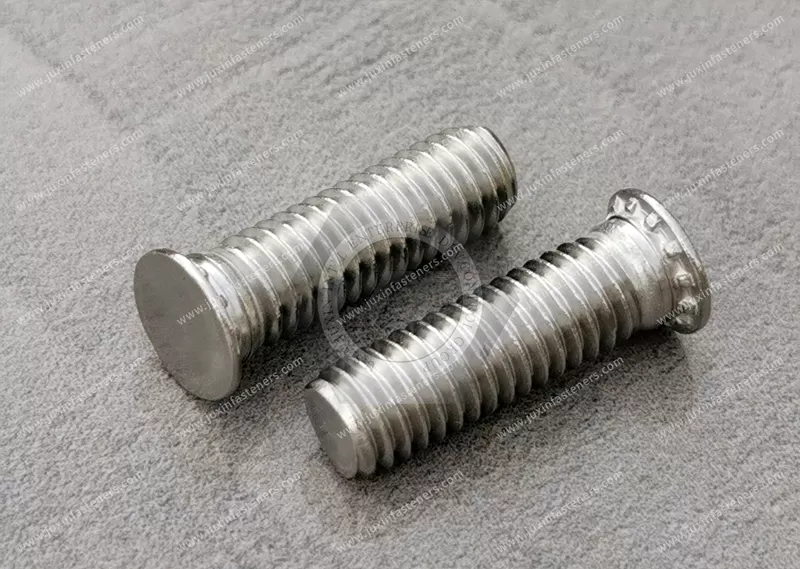
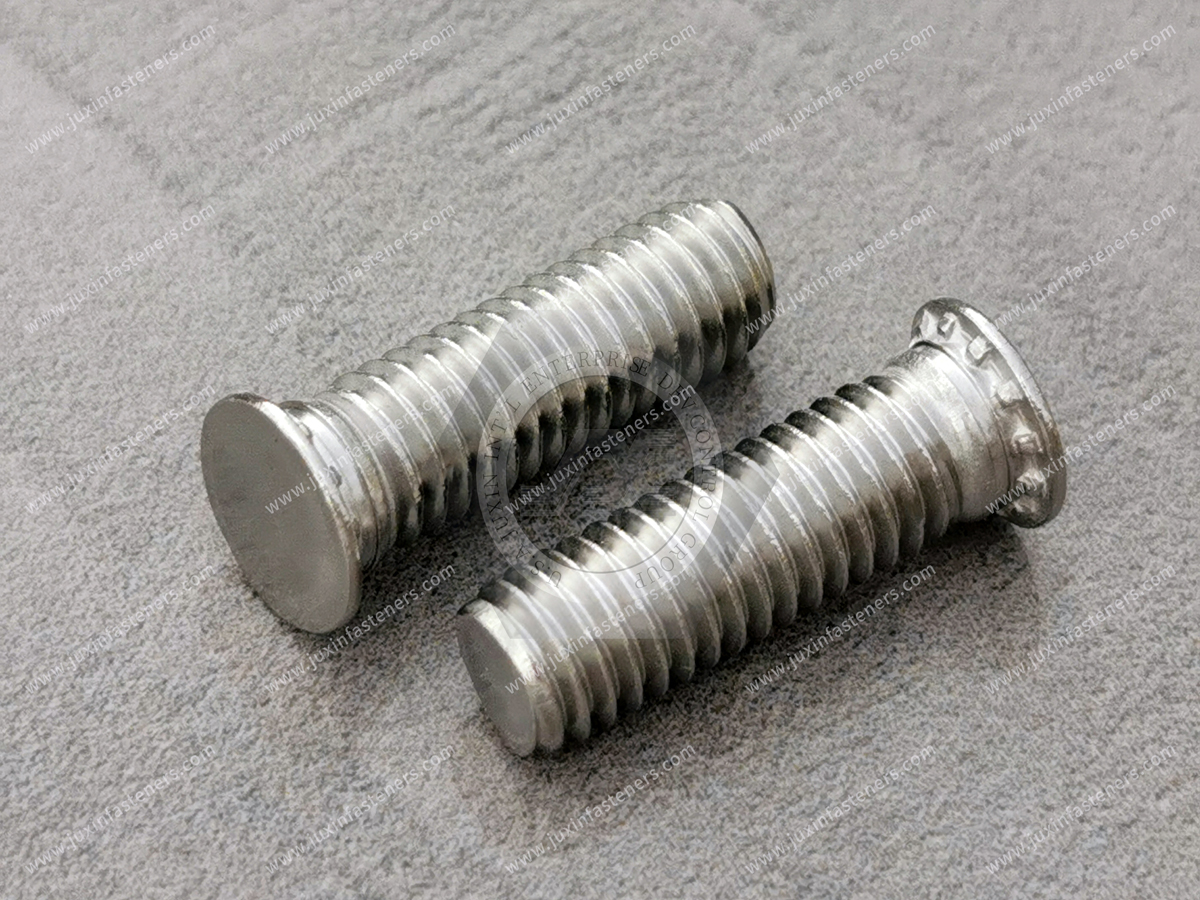
JUXIN FASTENERS supplies JX-FHS stainless steel flush-head self-clinching studs for sheet-metal assemblies requiring permanently retained external threads. These studs are installed by controlled pressing into accurately prepared panel holes, allowing surrounding sheet material to engage the stud's clinching features.
The flush-head configuration provides a substantially level installation-side surface while the threaded shank remains available for component attachment. JX-FHS studs are intended for compatible steel and aluminum panels within the specified hardness limits.
Product Type: Flush-Head Self-Clinching Stud
Series: JX-FHS
Material: Stainless Steel
Parent Sheet: Compatible Steel or Aluminum
Panel Hardness Guidance: Maximum HRB 70 or HB 125
Installation: Controlled Press Clinching
Thread and Length: According to Approved Drawing
Product Specification
Stainless Steel Flush-Head Self-Clinching Studs – JX-FHS Engineering Specifications and OEM Applications
Product Overview
JX-FHS stainless steel flush-head self-clinching studs provide permanently retained external threads in compatible sheet-metal panels.
The studs are designed for applications requiring a captive threaded mounting point without a conventional bolt head protruding from the installation side of the sheet.
A controlled press installation embeds the specially designed stud head into the parent panel. Sheet material flows into the stud's retention features, forming a mechanical connection that resists rotation and axial displacement.
The externally threaded shank projects from the opposite side of the panel and can be used with a compatible nut or internally threaded component.
This arrangement supports efficient assembly in electrical enclosures, electronics chassis, industrial equipment housings, telecommunications cabinets and other fabricated sheet-metal products.
JUXIN FASTENERS supplies JX-FHS stainless steel clinch studs for engineering evaluation and OEM procurement projects.
Technical Product Information
Product Name: Stainless Steel Flush-Head Self-Clinching Stud
Series: JX-FHS
Fastener Type: Externally Threaded Captive Stud
Base Material: Stainless Steel
Head Configuration: Flush-Head Clinching Design
Attachment Method: Mechanical Self-Clinching
Installation Process: Controlled Parallel Squeezing Force
Recommended Parent Materials: Compatible Steel or Aluminum Sheet
Parent-Sheet Hardness Guidance: HRB 70 Maximum or HB 125 Maximum
Thread Size: According to Selected Product Drawing
Thread Pitch: According to Approved Thread Specification
Stud Length: According to Approved Drawing
Minimum Sheet Thickness: According to Selected Stud Configuration
Mounting Hole: According to Product-Specific Dimensional Requirements
Surface Condition: According to Confirmed Product Specification
Custom Dimensions: Subject to Technical Review
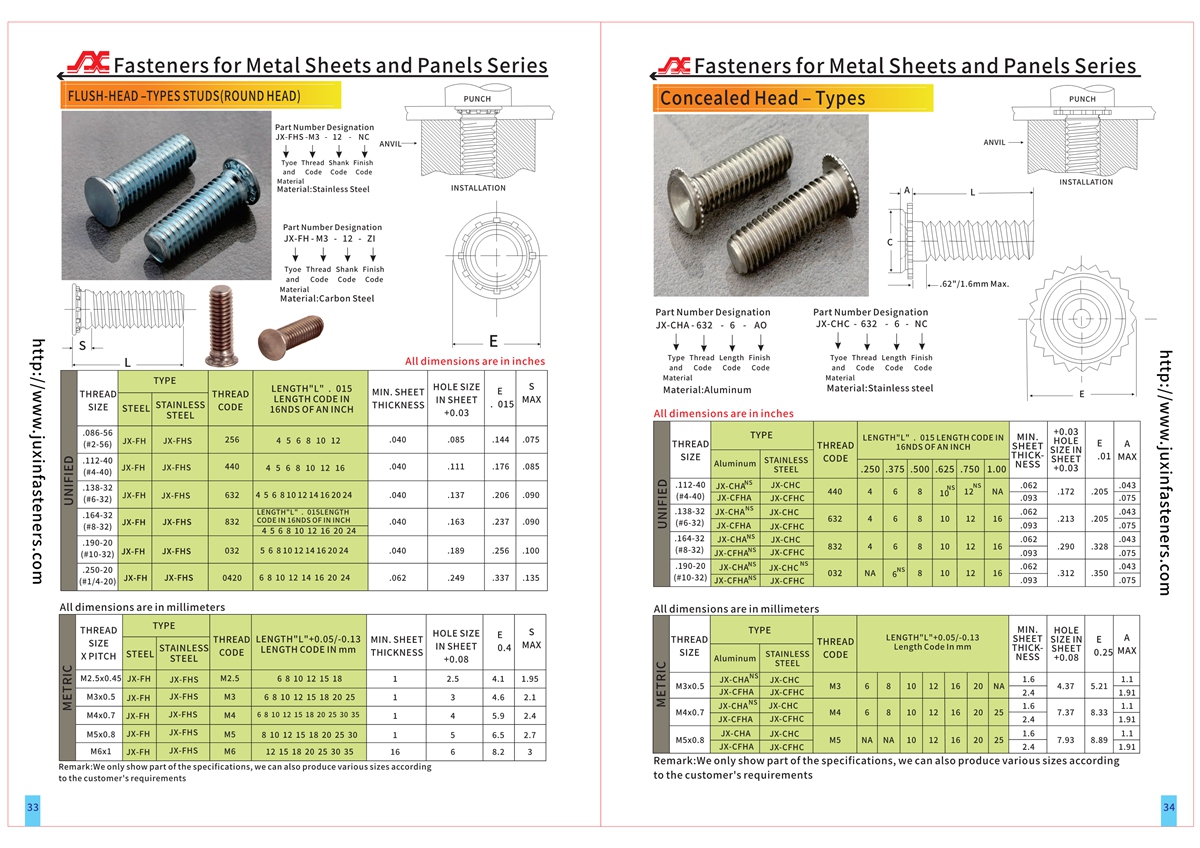
Detailed product dimensions should be checked against the applicable catalog drawings and CAD information. The supplied technical reference identifies pages 33–34.
What Is a Stainless Steel Flush-Head Self-Clinching Stud?
A stainless steel flush-head self-clinching stud is a permanently retained fastener that creates an external threaded attachment point in a compatible metal sheet.
Unlike a loose bolt, the stud becomes mechanically secured to the panel during installation.
The projecting male thread can then be used to mount brackets, components or other assemblies.
The head is designed to sit flush with the installation-side panel surface when the correct stud, sheet thickness and press conditions are used.
The opposite side retains the projecting threaded shank.
This makes flush-head clinch studs useful where assembly access, compact packaging and a level panel surface are important.
How the Self-Clinching Mechanism Works
The self-clinching process relies on controlled deformation of the parent sheet.
The stud is inserted into a correctly prepared mounting hole.
A suitable press applies force to seat the head against and into the panel.
The surrounding sheet material flows into the stud's undercut and other retention features.
This material engagement mechanically locks the stud in place.
The installed fastener is designed to resist rotation when a mating nut is tightened and resist axial displacement under applicable loads.
The actual retention depends on the stud geometry, panel properties, mounting-hole accuracy and installation conditions.
Engineering Information Gain – Stainless Steel Studs Do Not Automatically Suit Stainless Steel Panels
One of the most important selection considerations for JX-FHS studs is the relationship between stud material and parent-sheet hardness.
JX-FHS is identified as a stainless steel stud series.
However, the supplied application guidance recommends installation in steel or aluminum sheets with a maximum hardness of HRB 70 or HB 125.
This distinction matters because self-clinching depends on the parent material flowing into the stud's retention features.
A harder stainless steel panel may not provide the required deformation under the same installation conditions.
Using a stainless steel stud in a stainless steel panel without verifying compatibility can result in inadequate clinching, panel distortion or installation damage.
For stainless steel enclosures, engineers should select a clinching stud specifically suitable for the actual parent-sheet material and hardness.
Material Selection and Stainless Steel Grades
The supplied material background identifies stainless steel families including SUS302, SUS303, SUS316, SUS410, SUS420 and SUS430.
These grades have different chemical compositions, corrosion characteristics, hardness responses and manufacturing properties.
They should not be treated as interchangeable materials.
The actual grade used for a particular JX-FHS configuration must be confirmed against the product drawing or purchase specification.
Austenitic stainless steels and martensitic stainless steels can behave differently during forming, machining and service.
Corrosion resistance also varies with grade, environment, surface condition and manufacturing process.
For applications requiring a specific stainless steel composition, the purchaser should identify the grade and applicable material standard.
No particular grade is claimed as the default JX-FHS material without confirmation.
Engineering Information Gain – Corrosion Resistance and Clinching Performance Are Separate Requirements
Stainless steel may be selected because of corrosion-related requirements.
However, corrosion resistance alone does not establish that a stud is suitable for a particular clinching application.
A fastener must also have the correct head geometry, mechanical properties and installation compatibility.
The parent sheet must be capable of deforming into the clinching features.
The designer therefore needs to evaluate two different questions.
First, is the selected stainless steel suitable for the service environment?
Second, can the selected stud be reliably clinched into the specified parent sheet?
Both questions must be answered before approving the assembly.
Recommended Parent-Sheet Materials
The supplied JX-FHS guidance identifies compatible steel and aluminum sheets as recommended parent materials.
The stated hardness limit is HRB 70 maximum or HB 125 maximum.
These values are application guidance and should be verified against the selected configuration.
The sheet must also meet the required thickness, ductility and mounting-hole conditions.
A material meeting the hardness limit is not automatically suitable if the sheet is too thin or the hole is incorrect.
Panel material certificates and actual hardness measurements may be relevant for critical OEM applications.
Hardness References
Rockwell hardness measurements may be specified using ISO 6508-1 or ASTM E18.
Brinell hardness measurements may be specified using ISO 6506-1 or ASTM E10.
Rockwell B and Brinell values are different hardness scales.
The stated limits should not be interpreted as exact mathematical equivalents for every material.
When qualification depends on a hardness threshold, the test method and acceptance requirement should be agreed.
Flush-Head Design and Surface Clearance
The flush-head design is intended to create a substantially level surface on the installation side of the panel.
This can be useful where a protruding bolt head would interfere with adjacent parts.
Applications include compact electronics enclosures, equipment mounting panels and sheet-metal chassis.
The flush condition depends on the designated minimum sheet thickness and correct installation geometry.
The threaded shank remains exposed on the opposite side.
The design should not be confused with a fully concealed fastener that leaves no visible installation feature.
Minimum Panel Thickness
Every self-clinching stud configuration has minimum sheet-thickness requirements.
The appropriate minimum depends on the stud head geometry, thread size and selected product design.
The supplied material does not establish one universal minimum sheet thickness for all JX-FHS configurations.
The engineer should use the applicable product drawing rather than applying a generic value.
If a project uses multiple sheet gauges, each panel should be checked independently.
Using an undersized sheet may prevent adequate retention even when the mounting hole is correctly produced.
Mounting Hole Requirements
The mounting hole must be accurately sized for the selected stud.
An oversized hole can reduce the material available for mechanical engagement.
An undersized hole can interfere with insertion or cause unwanted deformation.
Hole roundness, edge condition and location also affect installation consistency.
The hole should be positioned with sufficient surrounding material.
Edge distance and proximity to bends, flanges or formed features must be considered.
The exact hole diameter and tolerance should come from the approved JX-FHS dimensional drawing.
Engineering Information Gain – Hole Quality Can Be as Important as Stud Quality
A correctly manufactured stud can still perform poorly when installed in an unsuitable hole.
Sheet-metal holes may be produced by punching, drilling or laser cutting.
Each process can create different edge conditions.
Burrs, tapered edges, local hardening or dimensional variation may affect how the panel material flows during clinching.
When an OEM changes its hole-making process, the installation should be reviewed even if the nominal hole diameter remains unchanged.
This is particularly important when transferring production between different fabrication suppliers.
Installation Procedure
JX-FHS studs are installed by controlled pressing rather than uncontrolled impact.
The panel is prepared with the specified mounting hole.
The stud is positioned correctly in the hole.
Suitable tooling supports the panel and accommodates the threaded shank.
The press applies a controlled force perpendicular to the panel.
The head is seated until the required installation geometry is achieved.
The resulting material flow secures the stud to the sheet.
The finished assembly should be checked for head seating, panel distortion and thread damage.
The correct installation force and tooling dimensions depend on the selected configuration.
No universal press-force value is claimed without verified technical data.
Why Hammer Installation Is Not Recommended
Self-clinching requires controlled and consistent deformation.
Hammering can introduce impact loads, misalignment and localized distortion.
These conditions may damage the clinching features or parent panel.
A suitable press provides more controlled force application and repeatable installation conditions.
For production assemblies, the press setup should be qualified using representative materials and components.
Torque-Out Resistance
Torque-out resistance is the ability of the installed stud to resist rotation within the parent sheet.
It is important when tightening or removing a mating nut.
The stud's anti-rotation features and surrounding displaced sheet material contribute to rotational retention.
Actual torque-out resistance depends on the stud design and installation conditions.
A numerical torque-out rating should be taken from verified test data for the selected configuration.
The allowable tightening torque of the assembled joint is a separate engineering consideration.
Pushout Resistance
Pushout resistance describes the installed stud's ability to resist axial displacement from the panel.
The clinched head and retention geometry contribute to this resistance.
Actual performance depends on the sheet thickness, hardness, hole preparation and installation quality.
The applicable load direction should be considered when defining the test.
For projects with significant axial loading, representative pushout testing may be appropriate.
No guaranteed pushout value is stated without product-specific validation.
Engineering Information Gain – Torque-Out and Pushout Measure Different Failure Modes
A stud may resist rotation adequately but still lack sufficient axial retention for a particular application.
Conversely, a stud with satisfactory axial retention may rotate if the mating nut is tightened beyond the installed fastener's rotational capacity.
These are different performance requirements.
Engineers should identify the relevant service loads and assembly operations.
Procurement specifications should not use a generic statement such as high strength in place of defined acceptance criteria.
External Thread Selection
The threaded shank must be compatible with the intended mating nut or internally threaded component.
For ISO metric threads, ISO 261 and ISO 965 provide relevant references for thread designation and tolerances.
For Unified inch threads, ASME B1.1 may apply when specified.
The nominal thread diameter, pitch, tolerance class and usable length should be identified.
Metric and Unified inch threads must not be substituted based on approximate diameter alone.
For example, M6 has a nominal diameter of approximately 0.236 inch, but it is not interchangeable with a similarly sized UNC or UNF thread.
Any requested inch-thread version must be confirmed as an actual available configuration.
Stud Length and Component Stack-Up
The correct stud length depends on the assembly.
The engineer should consider the mounted component thickness, washers, spacers, nut engagement and available clearance.
Insufficient projecting length may prevent adequate thread engagement.
Excessive projecting length may interfere with nearby equipment.
Tolerance accumulation should also be considered.
For OEM projects, the drawing should identify the required threaded length and any critical overall dimensions.
Self-Clinching Studs and Joint Preload
The clinching operation secures the stud to the panel.
Tightening the mating nut creates the clamping action between assembled components.
These functions should be evaluated separately.
A stud that is securely clinched does not automatically guarantee that the assembled bolted joint will resist loosening.
Joint preload, vibration, mating fastener selection and service loads remain important.
If a locking feature is required, it should be specified independently.
Corrosion and Environmental Considerations
Stainless steel is often selected for applications where corrosion behavior matters.
However, performance depends on the actual grade and service environment.
Exposure to chlorides, cleaning chemicals, humidity or dissimilar metals may affect material selection.
Galvanic corrosion should be considered where the stainless steel stud contacts a different metal in an electrically conductive environment.
The design should account for the complete material combination rather than evaluating the stud in isolation.
No universal corrosion-resistance guarantee is implied.
Surface Condition and Finishing
Stainless steel clinch studs may be supplied with a surface condition specified by the approved drawing.
Any additional treatment should be evaluated for its effect on dimensions, cleanliness and service requirements.
Passivation requirements, if applicable, should be stated explicitly and supported by the agreed process specification.
ASTM A967/A967M may be relevant where chemical passivation of stainless steel parts is specified.
No passivation treatment or certification is claimed unless confirmed for the order.
Electronics Chassis Applications
Electronics chassis often require fixed threaded mounting points for brackets, modules and internal hardware.
A captive stud can simplify assembly by eliminating the need to position a separate bolt.
The flush-head installation side can also help maintain a compact enclosure profile.
For assemblies containing circuit boards, electrical clearance and insulation requirements must be evaluated separately.
A metal clinch stud is not an insulating component.
Electrical Enclosures and Control Cabinets
Electrical control cabinets may use self-clinching studs for mounting rails, brackets, support components and internal equipment.
The captive design can reduce loose fastener handling.
Flush installation may help where external surface clearance is limited.
Electrical grounding and bonding performance must be verified separately when required.
Mechanical retention alone does not establish electrical continuity.
Telecommunications and Network Equipment
Telecommunications housings frequently require compact mounting points for internal components.
Stainless steel flush-head clinch studs can be considered for compatible sheet-metal assemblies.
The final selection depends on panel hardness, sheet thickness, service loads and environmental exposure.
For outdoor equipment, corrosion and moisture-management requirements should be reviewed at the complete enclosure level.
Industrial Automation Equipment
Automation systems may use captive threaded studs for sensor brackets, covers, mounting hardware and auxiliary components.
The installed stud can simplify repeated assembly operations.
Where machinery produces vibration, the complete bolted connection should be evaluated.
The stud's retention within the sheet and the mating nut's resistance to loosening are separate design requirements.
Medical and Laboratory Equipment Housings
Stainless steel self-clinching studs may be considered for suitable equipment enclosures and instrument housings.
Material selection may be influenced by cleaning procedures, corrosion exposure and appearance requirements.
Any application involving regulated equipment must be evaluated against the applicable customer specifications.
No medical-device approval or suitability for direct patient contact is implied.
Transportation Equipment
Compatible transportation equipment panels may use captive threaded studs to simplify component mounting.
Vibration, fatigue, corrosion and service access should be considered.
The specific fastener and assembly must be validated for the intended application.
No automotive, aerospace or rail qualification is claimed without supporting documentation.
Self-Clinching Studs vs. Weld Studs
Self-clinching studs are installed mechanically through controlled sheet deformation.
Weld studs require a welding process.
Self-clinching may be attractive when the panel material is compatible and avoiding welding is desirable.
Weld studs may be preferable for other material combinations, thicknesses or loading requirements.
The technologies should be compared based on the complete assembly rather than purchase price alone.
Self-Clinching Studs vs. Blind Rivet Studs
Blind rivet studs are intended for applications requiring an appropriate blind installation process.
Self-clinching studs require controlled press access and suitable support tooling.
Both provide external threads, but they use different retention mechanisms.
They should not be treated as direct substitutes without engineering review.
The available installation access and assembly sequence are important selection factors.
Flush-Head vs. Concealed-Head Studs
Flush-head studs are designed to sit level with the designated installation-side panel surface.
Concealed-head studs use a different attachment approach intended to preserve an uninterrupted visible surface in suitable applications.
Concealed-head installation may require specially prepared blind recesses and sufficient remaining material thickness.
The required machining and installation geometry depend on the selected concealed-head design.
A JX-FHS flush-head stud should not be described as a concealed-head stud.
If the exterior surface must remain completely uninterrupted, the engineer should review an appropriate concealed-head alternative.
Engineering Information Gain – A Flush Head Is Not a Waterproof Seal
A flush-head self-clinching stud can improve surface clearance and appearance.
However, the clinched interface is not automatically a pressure-tight or watertight seal.
For equipment requiring protection against liquid or dust ingress, sealing performance must be addressed separately.
An enclosure design may require a gasket, sealant, alternative fastening method or validated sealing arrangement.
The relevant enclosure protection requirements should be defined by the customer.
Flush appearance alone is not evidence of sealing performance.
Self-Clinching Studs Used with Spacers
A self-clinching stud can serve as an externally threaded mounting point for a component separated from the panel by a suitable spacer.
This may be useful in electronics, control cabinets and equipment assemblies.
The spacer material, length and bearing surfaces should be selected according to the mechanical and electrical requirements.
The resulting assembly should be evaluated for thread engagement and load transfer.
The clinch stud itself should not be confused with an integral self-clinching standoff.
Design for Manufacturability
The installation sequence should be established during the initial sheet-metal design process.
Press tooling requires access to the stud location and adequate support for the panel.
Nearby bends, flanges or formed features may restrict access.
The engineer should determine whether the stud must be installed before later fabrication or assembly operations.
The effects of subsequent forming, coating or handling should be reviewed.
Early design coordination can reduce rework and improve installation consistency.
Engineering Information Gain – Total Installed Cost Matters More Than Unit Price
The purchase price of a stud is only one part of the fastening cost.
Other factors include mounting-hole preparation, installation tooling, handling, inspection and downstream assembly labor.
A captive stud may simplify assembly because a loose bolt does not need to be positioned each time a component is mounted.
However, the benefit depends on an efficient and repeatable press installation process.
For OEM production, procurement and manufacturing engineering should evaluate the total installed cost.
Supplier Qualification and Change Control
The JX-FHS designation alone may not define every dimensional and material requirement.
The approved drawing should identify the actual stainless steel grade, thread, length, head geometry and applicable tolerances.
The parent-sheet material and installation conditions should also be documented where relevant.
Changes to material grade, head geometry, mounting-hole dimensions or manufacturing process may affect performance.
A visually similar replacement should not be considered interchangeable without review.
For repeat orders, drawing revision control is important.
Quality Inspection Considerations
Incoming inspection may include dimensional verification, thread inspection and material identification where specified.
Installation qualification should use representative sheet material and thickness.
The installed head position and panel condition should be checked.
Where required, torque-out and pushout tests can be used to evaluate the actual clinched connection.
Acceptance criteria should be agreed before production.
No particular test result is claimed without supporting evidence.
Common Installation Problems
Stud rotation after installation may indicate insufficient material engagement, incorrect hole size or unsuitable parent-sheet properties.
Low pushout resistance may result from inadequate clinching, incorrect sheet thickness or an unsuitable installation setup.
Panel distortion may result from excessive press force or insufficient tooling support.
Incomplete flush seating may indicate a mismatch between the stud configuration and panel requirements.
Damaged threads may result from incorrect tooling clearance or installation misalignment.
Troubleshooting should refer to the approved drawing and representative production conditions.
Frequently Asked Questions
What is a JX-FHS self-clinching stud?
JX-FHS is a stainless steel flush-head self-clinching stud series designed to provide captive external threads in compatible sheet-metal panels.
Can JX-FHS studs be installed in aluminum panels?
The supplied technical guidance identifies suitable aluminum sheet as a recommended parent material, subject to the stated hardness and dimensional requirements.
Can JX-FHS studs be installed in stainless steel panels?
Compatibility with stainless steel panels should not be assumed. A configuration specifically suitable for the actual stainless steel sheet must be verified.
What is the recommended panel hardness?
The supplied guidance specifies HRB 70 maximum or HB 125 maximum for recommended steel or aluminum parent sheets, subject to configuration-specific confirmation.
Does the head remain flush?
The head is intended to sit flush with the designated installation-side surface when the specified panel and installation requirements are met.
Does the stud provide a male or female thread?
The JX-FHS stud provides an external male thread.
Can the stud be installed with a hammer?
Controlled press installation is the intended method. Uncontrolled hammering is not an equivalent installation process.
Does a stainless steel stud guarantee corrosion resistance in every environment?
No. Corrosion performance depends on the actual stainless steel grade, environmental exposure and assembly materials.
Can custom dimensions be requested?
Customer-specific requirements can be reviewed against drawings and manufacturing feasibility.
What should an OEM buyer provide for a quotation?
The buyer should provide the thread, stud length, required material grade, panel material, sheet thickness, installation requirements, drawing revision and order quantity.
Relevant International Engineering References
ISO 261 – ISO metric screw thread general plan.
ISO 965 – ISO metric screw thread tolerances.
ASME B1.1 – Unified inch screw threads where specified.
ISO 6508-1 – Rockwell hardness testing.
ASTM E18 – Rockwell hardness testing.
ISO 6506-1 – Brinell hardness testing.
ASTM E10 – Brinell hardness testing.
ASTM A967/A967M – Chemical passivation treatments for stainless steel parts where specified.
These references may support the engineering specification but do not establish certification or conformity for every supplied configuration.
Related JUXIN FASTENERS Products
Steel Flush-Head Self-Clinching Studs – JX-FH: An alternative stud material configuration for compatible sheet-metal applications.
Self-Clinching Nuts: For creating captive internal threads in suitable metal panels.
Self-Clinching Standoffs: For providing threaded attachment points with a defined component spacing function.
Blind Rivet Studs: For applications requiring suitable one-sided installation.
Blind Rivet Nuts: For creating internal threads using a blind installation process.
Concealed-Head Self-Clinching Studs: For applications requiring an uninterrupted visible surface, subject to the selected design.
Use verified JUXIN FASTENERS product or category URLs for these related internal links.
OEM Procurement and RFQ Requirements
JUXIN FASTENERS supplies stainless steel JX-FHS flush-head self-clinching studs for OEM and industrial fastening projects.
To evaluate your requirements, please provide the product drawing or CAD model.
Specify the required thread designation, stud length, stainless steel grade and dimensional tolerances.
Include the parent-sheet material, thickness, hardness and mounting-hole requirements.
Where applicable, identify torque-out, pushout, corrosion and inspection requirements.
For purchasing evaluation, provide the sample quantity, initial production quantity and estimated annual demand.
The proposed configuration can then be reviewed against the technical and commercial requirements of your project.
Request a Quotation
Email: info@juxinfasteners.com
Website: www.juxinfasteners.com
JUXIN FASTENERS – Stainless Steel Flush-Head Self-Clinching Studs and OEM Sheet-Metal Fastening Solutions.
Product Packaging
Product Packaging
JX-FHS stainless steel flush-head self-clinching studs are packed according to the confirmed thread size, stud length and order quantity.
Polyfoam inner protection, outer cartons and palletized shipment arrangements are available according to the approved packing requirements.
Available carton sizes include 29 × 19 × 19.5 cm and 23.5 × 17.5 × 8 cm, subject to product dimensions and packing suitability.
A reference pallet dimension of 215 × 100 × 90 cm is provided in the supplied packing information. Final pallet dimensions and loading arrangements must be confirmed for each shipment.
Different product sizes, material grades and drawing revisions should be identified separately to support OEM inventory control.
Final packing quantities, carton weights and customer-specific labeling requirements are confirmed before shipment.
Email: info@juxinfasteners.com
Website: www.juxinfasteners.com
Product Pictures
Contact Us
Tel.:
+86 020 8621 0320
+86 020 3121 6067
E-mail:
Technical Support:
Navigation
SEND INQUIREY