Call Us
+86 136 6007 9809
Call Us
+86 136 6007 9809

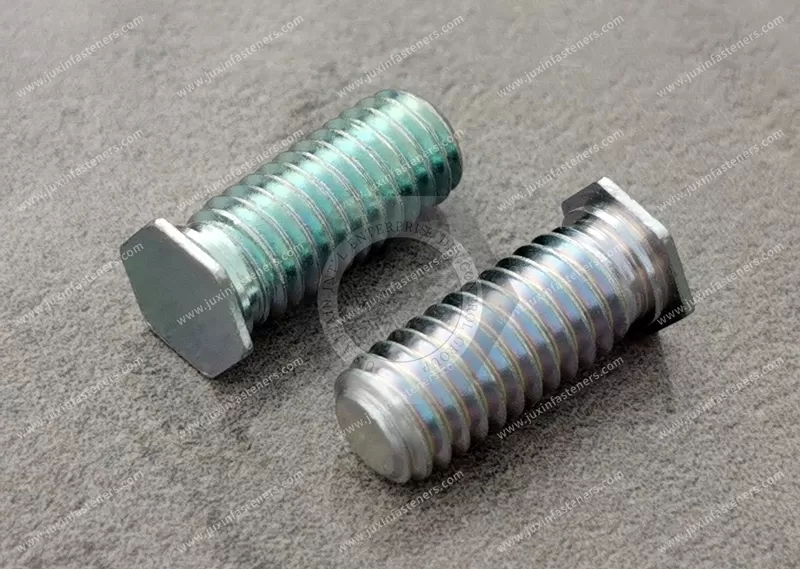
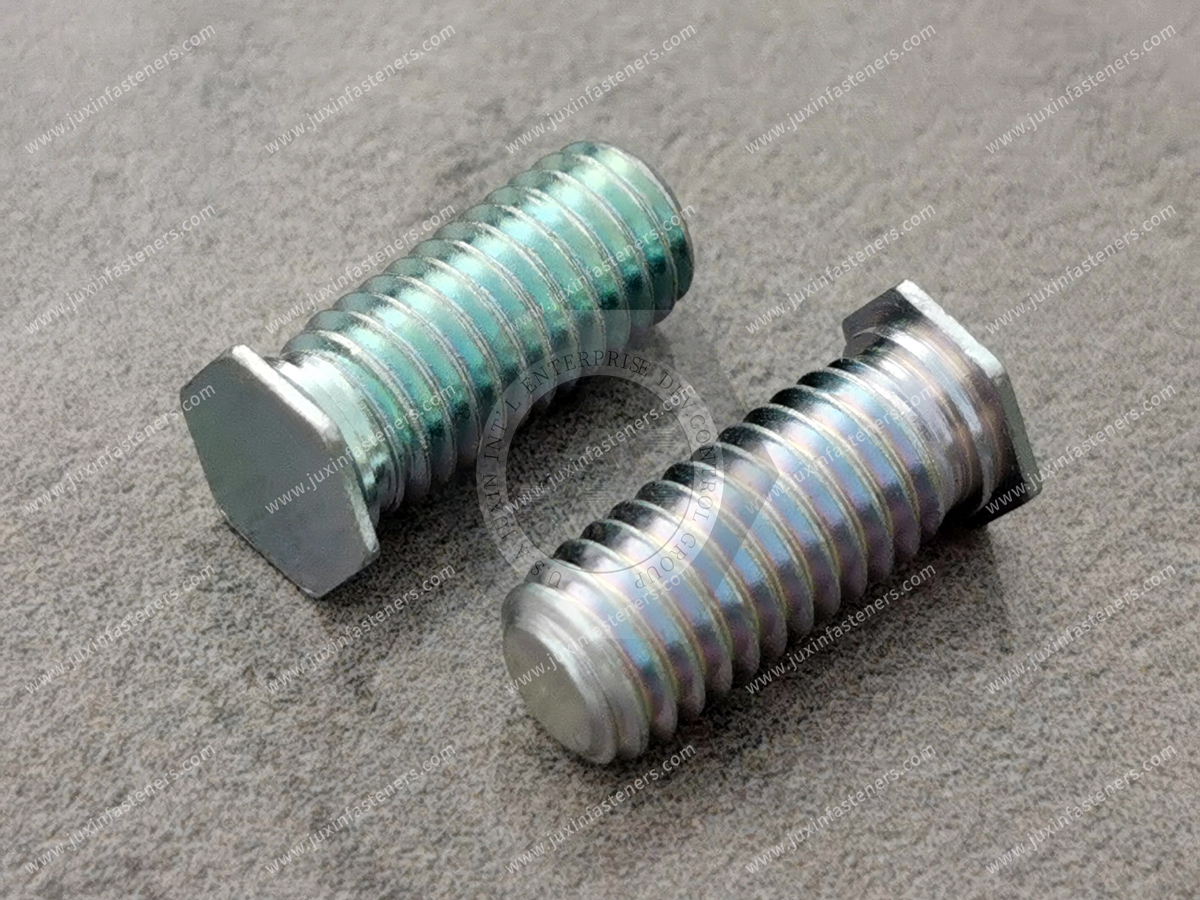
JUXIN FASTENERS supplies JX-NFH steel hex-head self-clinching studs for installing permanent external threads in compatible sheet-metal panels. Their hexagonal head geometry and clinching features support mechanical retention when the studs are pressed into correctly prepared mounting holes.
Designed for steel and aluminum sheet applications, these press-in threaded studs can simplify mounting of brackets, electrical components and industrial enclosure hardware without loose bolts inserted from behind the panel.
Product Type: Hex-Head Self-Clinching Stud
Series: JX-NFH
Material: Steel
Thread Sizes: M3–M6
Recommended Parent Sheet Hardness: HRB 80 Maximum or HB 150 Maximum
Installation: Controlled Press Clinching
Minimum Sheet Thickness: According to Selected Stud Size and Approved Drawing
Custom Dimensions: Subject to Technical Review
Product Specification
Steel Hex-Head Self-Clinching Studs JX-NFH for Sheet Metal Assembly
Product Overview
Steel hex-head self-clinching studs are permanently installed male-threaded fasteners designed for compatible sheet-metal panels.
Unlike loose bolts that require access to both sides during initial assembly, a self-clinching stud becomes retained in the parent sheet and provides a projecting external thread for subsequent fastening operations.
The JX-NFH series uses a hexagonal head configuration together with mechanical clinching features.
When installed into a correctly prepared hole using suitable press tooling, the surrounding sheet material is displaced into the stud's retention geometry.
The resulting assembly provides a captive threaded attachment point for compatible nuts and components.
JUXIN FASTENERS supplies JX-NFH hex-head studs for OEM engineering, industrial purchasing and custom sheet-metal fastening inquiries.
Product Specifications
Product Name: Steel Hex-Head Self-Clinching Stud
Product Series: JX-NFH
Alternative Names: Hexagon-Head Clinch Stud, Hex-Head Press-In Stud, Captive Male-Threaded Stud
Fastener Material: Steel
Material References Supplied: C45, C46, C20 and Free-Machining Steel Families
Actual Steel Grade: According to Approved Product Specification
Head Configuration: Hexagonal Head
Thread Type: External Male Thread
Metric Thread Sizes: M3, M4, M5 and M6
Thread Standard Reference: ISO Metric Screw Threads
Installation Method: Press Clinching
Recommended Parent Sheet: Suitable Steel or Aluminum Sheet
Parent Sheet Hardness Limit: HRB 80 Maximum or HB 150 Maximum, According to Supplied Series Guidance
Minimum Parent Sheet Thickness: Configuration-Dependent
Installation Hole Diameter: According to Applicable Dimensional Drawing
Stud Length: According to Selected Size or Approved Drawing
Surface Treatment: According to Approved Specification
Special Configurations: Subject to Manufacturing Review
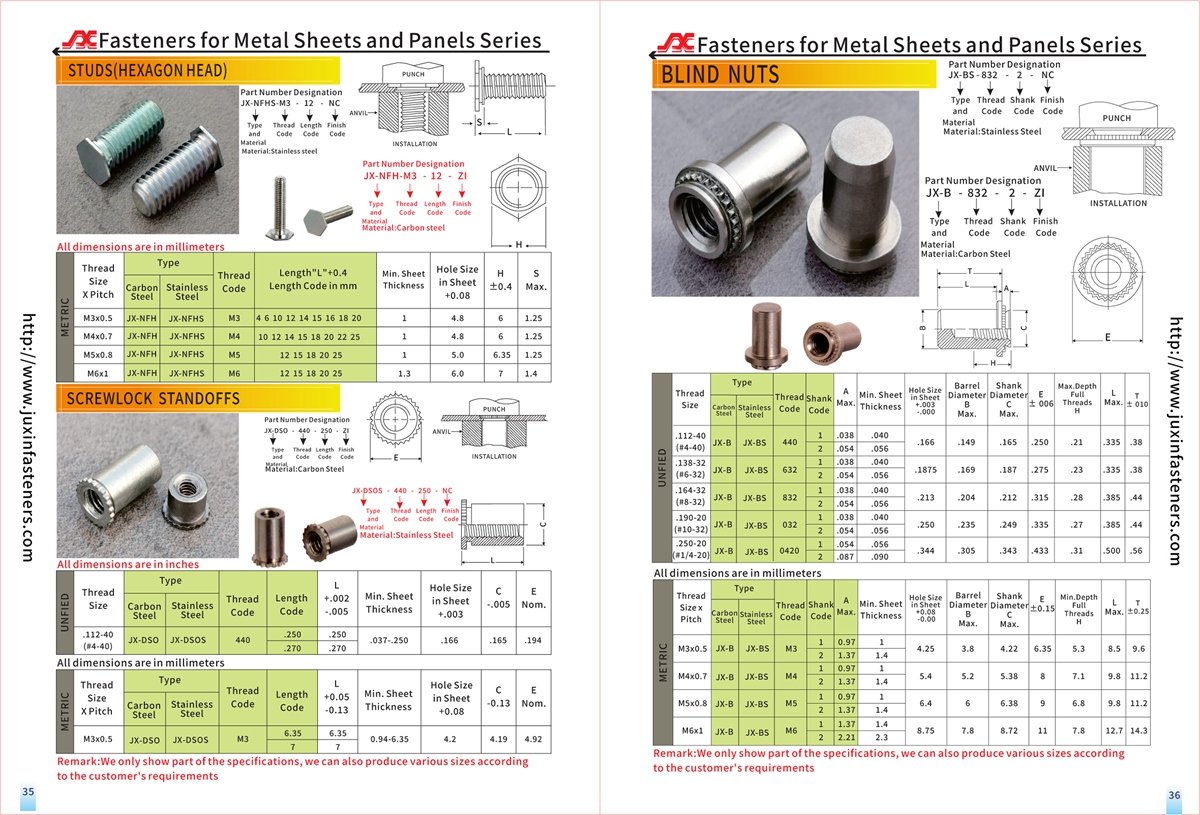
The product's detailed dimensional information should be verified against the applicable PDF or CAD specification. The supplied catalog reference identifies pages 35–36.
What Is a Hex-Head Self-Clinching Stud?
A hex-head self-clinching stud is a captive fastener with a projecting male thread and a head designed to become mechanically retained in sheet metal.
The hexagonal head is a defining feature of the JX-NFH series.
It distinguishes this product from conventional round-head flush-head studs and other self-clinching stud geometries.
During installation, the fastener is placed in a correctly sized hole and pressed into the sheet.
The surrounding material deforms around the head and retention features.
Once installed, the stud provides an attachment point for a nut or another compatible internally threaded component.
The assembly can then be repeatedly assembled and disassembled within its validated service limits.
Why Use a Hexagonal Head?
The hexagonal head introduces a different geometry from a conventional circular stud head.
Its shape can contribute to mechanical engagement and resistance to rotation when the complete retention design and surrounding material are suitable.
However, the external hexagon alone does not establish a specific torque-out rating.
The stud's retention performance depends on its complete head geometry, clinching features, hole dimensions, sheet hardness and installation conditions.
For engineers, the practical question is not simply whether the head is hexagonal.
It is whether the selected head and retention system provide sufficient rotational and axial resistance for the intended assembly.
Hex-Head Studs vs. Conventional Flush-Head Studs
The JX-NFH hex-head stud and JX-FH flush-head stud both provide external male threads through press installation.
Their head geometries are different.
The JX-FH series uses a conventional flush-head configuration.
The JX-NFH series uses a hexagonal head configuration.
These products should not be considered interchangeable solely because their thread sizes or stud lengths match.
Differences in head geometry may affect the required hole, sheet thickness, installation tooling, final head position and retention performance.
When replacing one style with another, the complete mounting arrangement must be reviewed.
Material Selection for JX-NFH Studs
The supplied material references include C45, C46, C20 and free-machining steel families.
These materials can differ substantially in composition, machinability, mechanical properties and heat-treatment response.
A material designation alone does not establish the finished stud's hardness or strength.
The actual grade, processing condition and any heat treatment must be specified and verified for the selected product.
The source information does not confirm that every listed steel grade is offered for every JX-NFH dimension.
For an OEM purchase, the approved drawing and material specification should take precedence over a general material list.
Relevant Steel Material Standards
Applicable international steel specifications may include EN 10083 for certain steels intended for quenching and tempering, and relevant SAE or ASTM material specifications for selected carbon and free-machining steels.
The exact standard must match the approved material grade, product form and manufacturing condition.
A steel name that appears similar in two designation systems should not be treated as a certified equivalent without checking its requirements.
No specific material certification is implied by the product description.
Parent Sheet Material Compatibility
The supplied JX-NFH guidance recommends installation into suitable steel or aluminum sheets with a hardness not exceeding HRB 80 or HB 150.
These limits are material-selection guidance for the series, not a guarantee of retention performance in every sheet meeting the stated hardness.
Actual compatibility also depends on the sheet thickness, mechanical properties, hole preparation and selected stud geometry.
The parent material must be capable of flowing into the stud's retention features during installation.
If the material is too hard, the required deformation may not occur.
If it is too soft or too thin, the sheet may deform excessively.
A representative installation trial is advisable when the application has demanding performance requirements.
Why Sheet Hardness Matters
Self-clinching depends on a controlled interaction between the fastener and the parent sheet.
The fastener must maintain its functional geometry while the surrounding sheet material undergoes localized plastic deformation.
The resulting material engagement retains the stud.
A harder sheet may require different installation conditions or a different fastener design.
Using excessive press force to compensate for an unsuitable sheet can damage the assembly rather than improve retention.
Engineers should check the sheet material and hardness before finalizing the fastener selection.
Rockwell and Brinell Hardness References
The supplied JX-NFH recommendations refer to Rockwell B and Brinell hardness limits.
ISO 6508-1 and ASTM E18 provide relevant Rockwell hardness test methods.
ISO 6506-1 and ASTM E10 provide relevant Brinell hardness test methods.
Rockwell and Brinell values are obtained using different test methods.
Approximate conversions should not replace a properly specified hardness requirement when the installation design depends on material hardness.
The customer should identify the applicable test method when hardness verification is required.
Sheet Thickness Requirements
The JX-NFH series must be installed in sheet material meeting the minimum thickness requirement for the selected stud.
The supplied information does not identify one universal minimum sheet thickness covering M3 through M6.
Therefore, a single minimum value should not be applied to the entire series.
Minimum thickness may vary with the stud's head geometry, thread size and retention design.
An insufficiently thick sheet may not provide enough material for proper mechanical engagement.
It may also experience distortion during pressing.
The appropriate thickness must be confirmed using the relevant dimensional table.
Installation Hole Preparation
Correct hole preparation is essential for reliable self-clinching.
The installation hole should match the approved stud drawing.
The specified diameter and tolerance must be maintained.
Hole location, edge distance and nearby formed features also require consideration.
Burrs, excessive deformation or unsuitable hole geometry may interfere with head seating and material flow.
Punching or drilling may be suitable depending on the approved manufacturing process and hole-quality requirements.
The finished hole should be inspected before stud installation.
Do Hex-Head Clinch Studs Require Hexagonal Holes?
Not necessarily.
A hexagonal stud head does not automatically mean that the panel requires a hexagonal mounting hole.
Many self-clinching studs use round installation holes despite having noncircular head features.
The correct hole shape must be determined from the specific JX-NFH dimensional drawing.
Engineers should not specify a hexagonal hole based only on the product name or appearance.
This distinction is important because incorrect hole geometry can prevent proper clinching and reduce retention.
How Are JX-NFH Studs Installed?
JX-NFH studs are installed using a controlled pressing operation.
The stud is positioned in the prepared sheet-metal hole.
Suitable tooling supports the sheet and applies force to the fastener.
As the stud head enters its intended position, the surrounding parent material flows into the retention features.
The completed installation creates a mechanically retained male-threaded fastener.
The process should be performed using tooling compatible with the selected head and stud length.
The installation force and stroke should be established from the applicable technical guidance.
Installation Process
Confirm the stud designation and dimensional requirements.
Verify the parent sheet material, hardness and thickness.
Prepare the mounting hole to the approved dimensions.
Remove chips and burrs that could interfere with installation.
Position the stud correctly in the hole.
Support the panel using suitable press tooling.
Apply a controlled squeezing force.
Confirm that the head has seated as intended.
Inspect the stud for alignment and thread damage.
Verify retention performance when required by the assembly specification.
Uncontrolled hammering or impact installation should not be substituted for the approved pressing process.
Installation Tooling and Access
Press tooling must accommodate the stud head, projecting thread and surrounding sheet geometry.
The support arrangement should prevent unwanted panel deformation.
The punch must apply the installation load without damaging the thread.
Tool alignment is especially important when the stud is long relative to its diameter.
Nearby bends, flanges and structural features can restrict access.
Tooling feasibility should therefore be evaluated during panel design rather than after the component is manufactured.
Engineering Information Gain – Why Installation Sequence Affects Assembly Cost
The timing of stud installation can influence manufacturing efficiency.
In some designs, installing studs while the sheet is still flat provides easier access for press tooling.
Later bending or forming operations may reduce access to the mounting location.
However, installing before forming is not automatically suitable for every design.
The installed stud may interfere with forming tools or experience unintended loads during subsequent operations.
The correct sequence depends on the panel geometry and production process.
OEM engineering teams should evaluate both installation access and downstream manufacturing operations before releasing the assembly drawing.
Torque-Out Resistance
Torque-out resistance describes the installed stud's ability to resist rotation within the parent sheet.
This characteristic matters when a nut is tightened or removed from the projecting thread.
The hexagonal head geometry and clinching features can contribute to mechanical retention.
However, the actual resistance depends on the selected stud and its installation conditions.
No numerical torque-out rating has been confirmed in the supplied information.
Where a minimum torque-out requirement is critical, the acceptance value and test method should be agreed before production.
Pushout Resistance
Pushout resistance describes the installed stud's ability to resist displacement from the parent sheet under an applied axial load.
It is influenced by the engagement between the stud head and the deformed sheet material.
Sheet thickness, hardness, hole preparation and installation quality can all affect the result.
A stud that remains secure under a light assembly load may not be appropriate for a more demanding application.
Pushout performance should be verified against the actual design requirements.
The product should not be assigned an unverified load rating.
Axial Loading and Joint Design
A self-clinching stud forms one part of a larger mechanical joint.
The complete connection includes the stud, parent sheet, mating nut or component, and any washers or spacers.
Its reliability depends on the load path through these components.
Engineers should consider tensile loading, shear loading, vibration and possible bending moments.
A projecting stud can experience bending when the attached component applies an offset load.
The clinched connection should be evaluated for the actual service conditions rather than only the stud's thread size.
Thread Sizes and Standards
The supplied JX-NFH range includes M3, M4, M5 and M6 external threads.
These are ISO metric thread designations.
ISO 261 provides the general plan for ISO metric screw threads.
ISO 965 provides relevant thread tolerance requirements.
The final thread pitch and tolerance class should be verified against the approved drawing.
If a customer requires a nonstandard pitch or an inch-thread alternative, availability must be confirmed separately.
Metric threads and UNC or UNF threads are not directly interchangeable.
Metric and Inch Size References
For engineering comparison, the nominal major diameters are:
M3: 3.00 mm, approximately 0.118 in.
M4: 4.00 mm, approximately 0.157 in.
M5: 5.00 mm, approximately 0.197 in.
M6: 6.00 mm, approximately 0.236 in.
These inch values are dimensional conversions only.
They do not represent interchangeable Unified thread sizes.
Thread Engagement and Stud Length
Stud length should be selected according to the components being attached.
The design must account for the thickness of the mounted bracket or component, washers and mating nut.
Sufficient thread engagement is necessary for the intended joint.
Excessive stud projection may interfere with adjacent equipment or enclosure covers.
Insufficient projection may prevent correct nut engagement.
The drawing should define the required stud length and installation orientation.
Surface Finish and Corrosion Protection
Steel self-clinching studs may require surface protection depending on the operating environment.
Possible finishing requirements must be specified in the purchasing documentation and confirmed for the selected product.
ISO 4042 provides relevant requirements for electroplated coating systems on fasteners where applicable.
The coating system, appearance, thickness and any corrosion-performance requirement should be agreed before production.
A coating color alone does not establish a complete technical specification.
No particular zinc coating or corrosion-resistance rating is confirmed for this JX-NFH page.
Hydrogen Embrittlement Considerations
Certain steel fasteners can be susceptible to hydrogen embrittlement depending on material strength, hardness and manufacturing processes.
Hydrogen may be introduced during some surface-treatment operations.
The risk must be assessed using the actual steel condition and processing route.
Where relevant, appropriate process controls and specifications should be agreed with the customer.
No universal baking requirement or hydrogen-embrittlement resistance claim is made for the JX-NFH series.
Industrial Applications
Electrical Enclosures
Hex-head self-clinching studs can provide captive threaded mounting points for suitable steel or aluminum electrical enclosures.
They may be used to secure brackets, internal supports and accessories.
The panel design must allow correct press installation and provide adequate retention for the mounted components.
Industrial Control Cabinets
Control cabinets often contain components requiring repeatable mechanical attachment.
A captive stud can reduce the need to hold a loose bolt during final assembly.
Engineers should consider installation access, stud projection and service requirements.
Telecommunications Equipment
Telecommunications housings may require compact threaded attachment points for internal brackets and supporting structures.
JX-NFH studs may be evaluated where the sheet material and mounting conditions are compatible.
The design should account for maintenance access and vibration.
Industrial Machinery Guards
Machine covers and guards may require threaded mounting points for selected accessories.
The stud and panel must be evaluated for the relevant service loads.
A general self-clinching stud description does not establish suitability for a safety-critical guarding application.
Automotive Equipment Panels
Selected automotive sheet-metal components may use captive threaded studs to simplify assembly.
The design must account for vibration, fatigue, corrosion and any customer-specific validation requirements.
No automotive qualification is implied without supporting evidence.
HVAC and Mechanical Equipment
Metal equipment housings may benefit from permanently retained threaded studs for brackets and internal components.
The installation should be assessed for panel material, thickness and operating conditions.
Instrumentation and Electronics
Instrument enclosures may use clinch studs to mount internal components while reducing loose assembly hardware.
Stud length, thread engagement and clearance are important considerations in compact equipment.
Engineering Information Gain – The Hex Head Does Not Replace Joint Validation
A hexagonal head may provide a useful mechanical retention geometry, but the overall connection still depends on the surrounding sheet material.
An assembly can fail even when the stud itself remains undamaged.
For example, a stud may rotate because the parent sheet did not flow adequately into its retention features.
It may be pushed out because the sheet is too thin or the installation is incomplete.
It may bend because the mounted component applies an unexpected moment.
These are different failure mechanisms and require different design responses.
Engineers should evaluate the complete fastening system rather than relying on head shape alone.
Engineering Information Gain – Installation Hole Control Is a Purchasing Issue
Hole geometry is often treated as a sheet-metal manufacturing detail.
For self-clinching studs, it is also a fastener performance requirement.
A supplier may deliver studs that meet their dimensional drawing while the finished assembly performs poorly because the holes are outside the required tolerance.
OEM purchasing teams should therefore ensure that the stud specification and panel drawing are coordinated.
The panel manufacturer and fastener supplier should work from compatible revision-controlled requirements.
This can reduce disputes during production and improve assembly consistency.
Engineering Information Gain – Cost per Installed Connection
The unit price of a stud is only one part of its economic value.
The complete installed cost includes hole preparation, press installation, tooling, inspection and downstream assembly labor.
A captive stud may simplify final assembly by eliminating a separate bolt insertion operation.
It may also reduce handling of loose hardware.
However, these benefits depend on production volume, automation and assembly layout.
For sourcing teams, comparing the total installed cost provides a more useful basis for evaluating competing fastening solutions.
JX-NFH vs. Weld Studs
Weld studs provide external threads through a welded attachment.
They may be suitable where the panel material and production process support welding.
Self-clinching studs avoid the welding operation but require appropriate sheet properties and mechanical installation access.
Welding can introduce heat-related process considerations.
Clinching introduces hole preparation and press-tooling requirements.
The best choice depends on the complete assembly design and manufacturing process.
JX-NFH vs. Blind Rivet Studs
Blind rivet studs can provide external threads where installation access is limited to one side of a suitable panel.
They use a deformable rivet body rather than the same parent-material flow mechanism as self-clinching studs.
Their tooling and installation conditions differ.
Blind rivet studs may be considered where press access or parent-sheet compatibility makes self-clinching impractical.
The alternatives should be compared using validated assembly requirements.
JX-NFH vs. Loose Bolts
A loose bolt can be inexpensive and straightforward to replace.
However, assembly may require access to the bolt head and mating nut.
A self-clinching stud becomes captive in the panel.
This can simplify assembly when the stud location is fixed and repeated installation is required.
The captive design should be selected when its manufacturing and service benefits justify the installation process.
Quality Inspection
A JX-NFH inspection plan should identify the characteristics that affect fit and performance.
These may include thread dimensions, stud length, head geometry and material specification.
The mounting panel should be checked for hole dimensions, thickness and relevant material properties.
After installation, inspection may include head seating, alignment and visible panel distortion.
Where specified, torque-out and pushout tests can be included in the qualification plan.
Test conditions and acceptance criteria must be agreed before production.
Common Installation Problems
Stud Rotation
Possible causes include unsuitable parent-sheet hardness, incorrect hole dimensions or incomplete clinching.
Stud Pushout
Possible causes include inadequate sheet thickness, poor material engagement or unsuitable installation conditions.
Panel Distortion
Possible causes include excessive installation force, insufficient support or unsuitable tooling.
Thread Damage
Possible causes include tooling interference, misalignment or handling damage.
Inconsistent Installation
Possible causes include variation in sheet hardness, thickness, hole preparation or press settings.
Corrective actions should be based on inspection and verified root-cause analysis.
Frequently Asked Questions
What is a hex-head self-clinching stud?
It is a male-threaded fastener with a hexagonal head and clinching features designed for mechanical retention in compatible sheet metal.
What thread sizes are available in the JX-NFH series?
The supplied range includes M3, M4, M5 and M6.
Can JX-NFH studs be installed in aluminum panels?
The supplied series guidance identifies suitable aluminum sheets within the stated hardness limits. The final configuration and panel requirements must still be verified.
Can they be installed in steel sheets?
Yes, for suitable steel sheets meeting the approved material, hardness, thickness and hole requirements.
Can they be installed in stainless steel panels?
Stainless steel panel compatibility has not been established by the supplied JX-NFH guidance. A configuration specifically approved for the intended stainless steel sheet should be selected.
Does a hexagonal head require a hexagonal hole?
Not automatically. The required mounting hole must be taken from the applicable JX-NFH drawing.
What is the minimum sheet thickness?
It depends on the selected stud size and geometry. The applicable dimensional table must be consulted.
What is the installation method?
The studs are installed by controlled mechanical pressing using suitable tooling.
Are custom stud lengths available?
Custom requirements can be submitted for technical and manufacturing review.
Can JX-NFH studs replace another manufacturer's clinch studs?
Only after verifying dimensional, material, installation and performance compatibility. Similar thread sizes do not establish interchangeability.
Relevant International Standards
ISO 261 – ISO metric screw thread general plan.
ISO 965 – ISO metric screw thread tolerances.
ISO 6508-1 – Rockwell hardness testing.
ISO 6506-1 – Brinell hardness testing.
ASTM E18 – Rockwell hardness testing.
ASTM E10 – Brinell hardness testing.
ISO 4042 – Electroplated coating systems for fasteners, where applicable.
EN 10083 – Relevant steel material specifications, where applicable.
Applicable SAE and ASTM material specifications may also be used when identified in the approved purchasing documentation.
These standards are technical references and do not imply that the JX-NFH series has been independently certified to every listed standard.
Related JUXIN FASTENERS Products
Steel Flush-Head Self-Clinching Studs JX-FH – For conventional flush-head stud applications.
Stainless Steel Flush-Head Self-Clinching Studs JX-FHS – For suitable assemblies requiring an approved stainless steel stud configuration.
Concealed-Head Self-Clinching Studs – For designs requiring an uninterrupted opposite panel surface.
Self-Clinching Nuts – For creating captive internal threads in compatible sheet metal.
Self-Clinching Standoffs – For spacing and mounting components within enclosures.
Blind Rivet Studs – For suitable one-sided installation applications.
Blind Rivet Nuts – For creating internal threads where rear-side access is restricted.
These related product names can be used as internal-link anchor text once their corresponding JUXIN FASTENERS page URLs have been verified.
OEM Purchasing and Supplier Qualification
For OEM projects, JX-NFH studs should be purchased using a controlled product specification.
The RFQ should identify the required thread size, stud length, material, finish and dimensional requirements.
The buyer should also provide the parent-sheet material, hardness, thickness and hole details.
Where mechanical retention is critical, the required torque-out and pushout performance should be defined.
Purchasing teams should not assume that two hex-head studs are interchangeable based on appearance.
The head geometry, installation conditions and retention features may differ between designs.
Any proposed alternative should be reviewed against the approved assembly requirements.
Request a JX-NFH Hex-Head Clinch Stud Quotation
JUXIN FASTENERS supports OEM and industrial sourcing inquiries for steel hex-head self-clinching studs and related sheet-metal fastening products.
For a technical quotation, please provide:
Required Product Series: JX-NFH
Thread Size: M3, M4, M5 or M6
Stud Length and Drawing
Required Steel Material and Surface Finish
Parent Sheet Material, Hardness and Thickness
Mounting Hole Dimensions
Mechanical Performance Requirements, if Applicable
Estimated Order Quantity and Annual Demand
Delivery and Packaging Requirements
Our team can review the supplied information for product selection, technical clarification and quotation.
Email: info@juxinfasteners.com
Website: www.juxinfasteners.com
JUXIN FASTENERS – Steel Hex-Head Self-Clinching Studs for OEM Sheet-Metal Assembly.
Product Packaging
Product Packaging
JX-NFH steel hex-head self-clinching studs are packed with protective inner materials and outer cartons according to the confirmed order requirements.
The supplied packaging arrangement includes polyfoam inner protection, cartons and palletized shipment.
Reference carton dimensions include 29 × 19 × 19.5 cm and 23.5 × 17.5 × 8 cm.
A referenced pallet configuration is 215 × 100 × 90 cm.
Actual carton selection, packing quantities and pallet arrangements depend on the stud dimensions, order quantity and shipping requirements.
For OEM orders, product identification and packaging requirements can be reviewed before shipment to support receiving inspection and inventory management.
Customer-specific packaging and labeling requirements are subject to confirmation.
Email: info@juxinfasteners.com
Website: www.juxinfasteners.com
Product Pictures
Contact Us
Tel.:
+86 020 8621 0320
+86 020 3121 6067
E-mail:
Technical Support:
Navigation
SEND INQUIREY