Call Us
+86 136 6007 9809
Call Us
+86 136 6007 9809

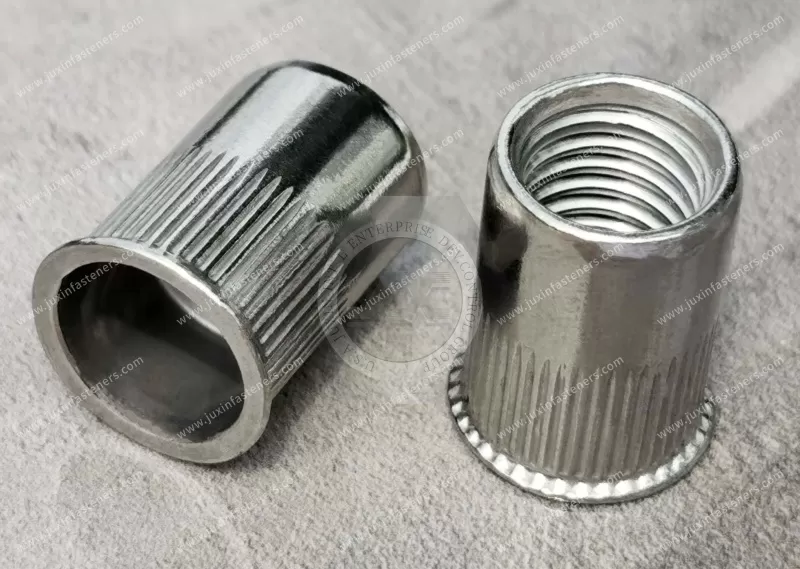
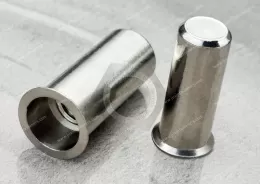
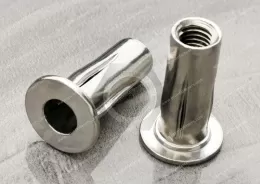
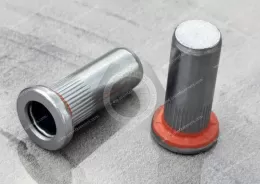
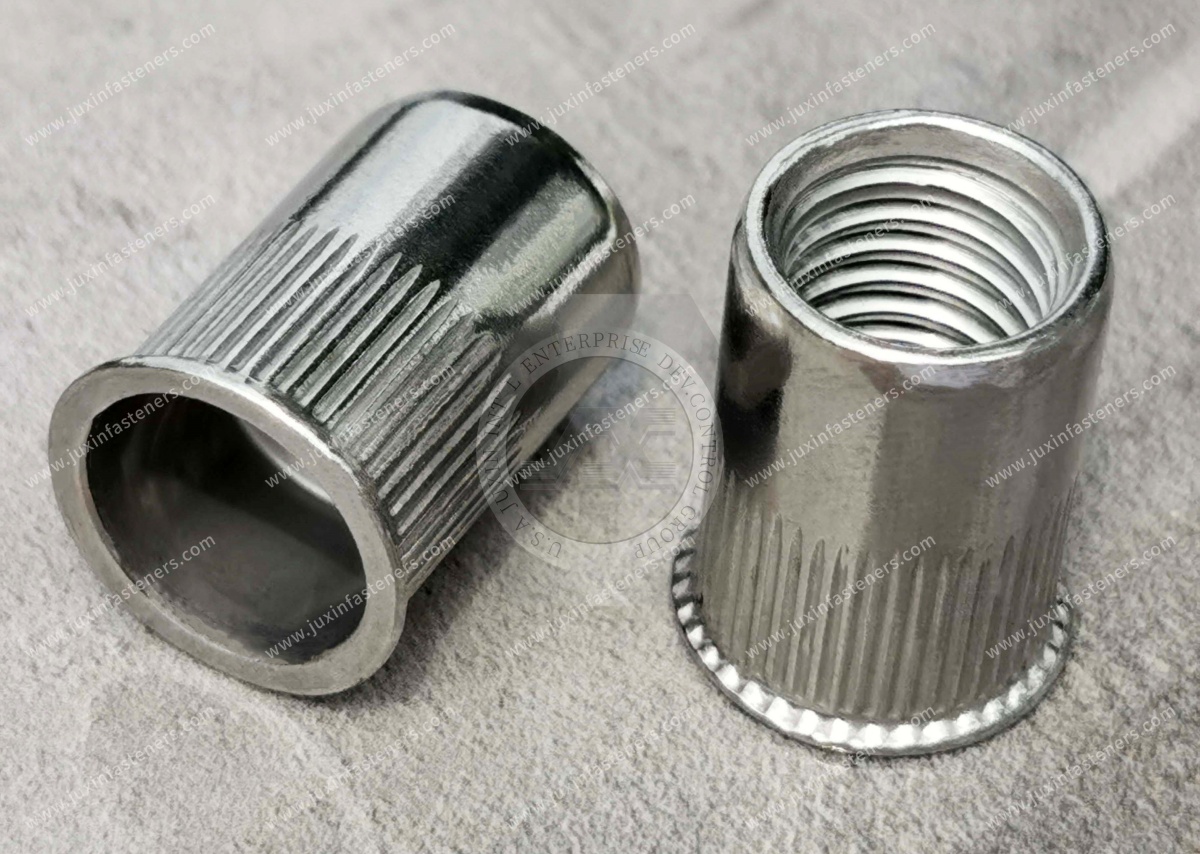
JUXIN FASTENERS manufactures stainless steel thin head, open-end knurled round body blind rivet nuts for creating reusable internal threads in thin sheet metal, compact enclosures, and OEM assemblies requiring one-sided installation.
The low-profile flange reduces head projection, while the external knurling or ribs help resist insert rotation in compatible round mounting holes. The open-end design allows screw extension where sufficient backside clearance is available.
Product Features
Metric threads: M3, M4, M5, M6, M8, M10
Inch-series threads: Custom OEM requirements subject to drawing review
Material: Stainless steel (grade subject to confirmation)
Grip range: 0.5–3.5 mm (approx. 0.020–0.138 in), depending on size
Head: Thin head / Low-profile flange
Body: Knurled / Ribbed round body
End: Open end
Mounting hole: Round hole, according to product drawing
Installation: One-sided blind installation
Applications include automotive components, electrical enclosures, electronics housings, industrial machinery, HVAC equipment, appliances, and compact OEM sheet-metal assemblies requiring low-profile threaded connections.
Product Specification
Technical Specifications — Stainless Steel Thin Head Open-End Knurled Body Blind Rivet Nuts
Engineering Specifications for Low-Profile Knurled Threaded Inserts
JUXIN FASTENERS stainless steel thin head open-end knurled body blind rivet nuts are designed to create mechanically retained internal threads in thin sheet metal,
hollow sections and fabricated industrial assemblies.
The product combines a low-profile flange, an externally knurled cylindrical body and an open-ended threaded bore.
The thin-head configuration reduces flange projection above the mounting surface.
The knurled body introduces external surface features intended to improve mechanical engagement with the parent material.
The open-end configuration allows the mating bolt to extend through the insert when sufficient blind-side clearance is available.
These characteristics must be considered together when selecting a threaded insert for OEM equipment.
Product Technical Data
| Technical Parameter | Specification |
|---|---|
| Product Type | Stainless Steel Low-Profile Knurled Blind Rivet Nut |
| Head Configuration | Thin Head / Low-Profile Flange |
| Body Configuration | Knurled Round Body / Ribbed Cylindrical Body |
| End Configuration | Open End |
| Material | Stainless Steel |
| Metric Thread Sizes | M3, M4, M5, M6, M8, M10 |
| Product-Family Grip Range | 0.5–3.5 mm |
| Installation Method | One-Sided Blind Installation |
| Mounting Hole | Round Hole per Approved Drawing |
| Material Grade | Confirm for Selected Variant |
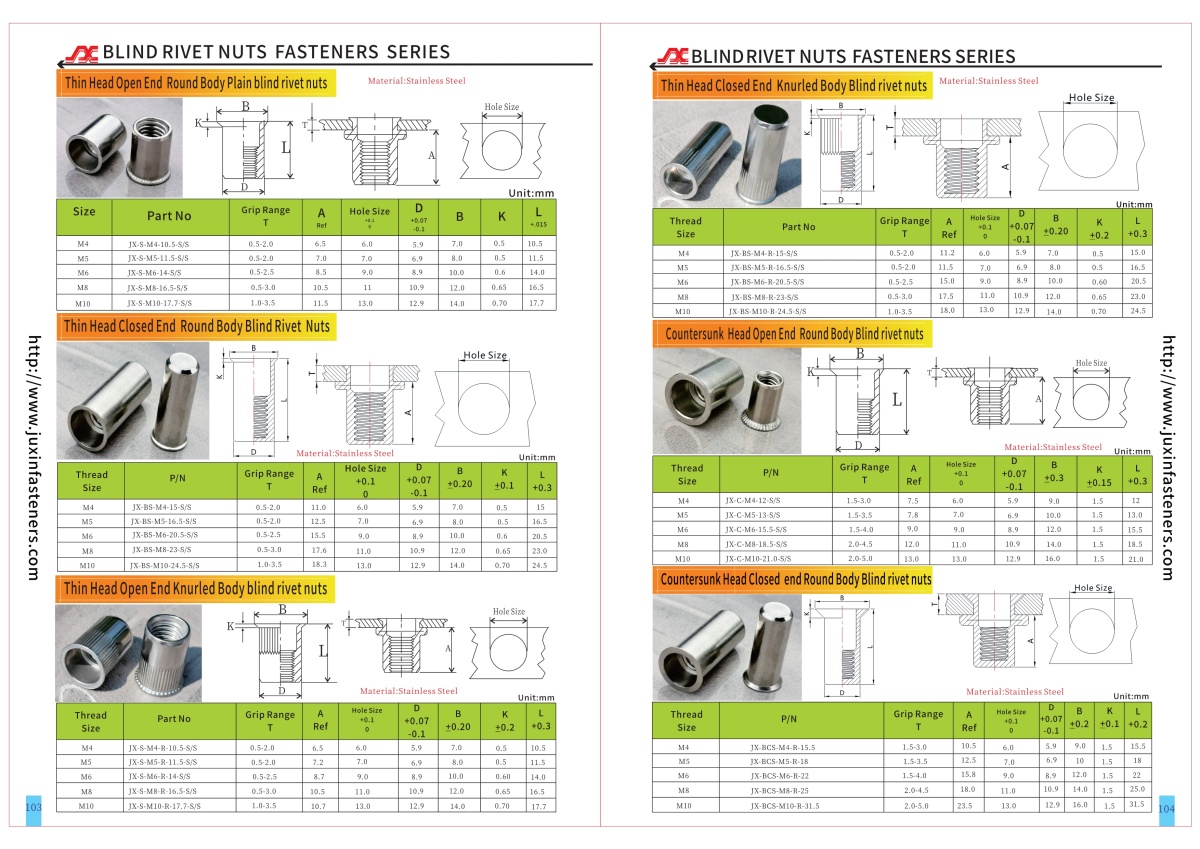
| Dimensional Reference | Product Technical PDF, Pages 103–104, Subject to Drawing Confirmation |
| OEM Customization | Drawing-Specific Requirements |
The product-family grip range should not be interpreted as the permitted thickness range for every individual size.
The actual flange dimensions, body diameter, overall length, hole diameter, grip range and thread tolerances must be confirmed from the approved product drawing.
Thin Head Geometry and Installed Clearance
The low-profile flange is designed to reduce the height of the fastening point above the mounting surface.
This can be valuable where equipment covers, mounting brackets or adjacent components require limited clearance.
The installed head projection depends on flange thickness, panel flatness, seating condition and mounting-hole quality.
A thin-head rivet nut is not necessarily completely flush with the panel.
Where a precise maximum projection is required, the engineering drawing should specify the allowable installed height.
For fully flush applications, a suitable countersunk rivet nut may be more appropriate.
Knurled Body Design and Mechanical Engagement
The knurled body is the principal structural difference between this product and a plain round-body rivet nut.
External knurling introduces surface features that engage the surrounding mounting-hole material during installation.
This engagement can help resist insert rotation when the mating bolt is tightened or removed.
The effectiveness of the knurled design depends on the knurl geometry, parent-material strength, hole dimensions and setting process.
A softer parent material may deform differently from a harder sheet-metal panel.
The installation process must therefore be evaluated using representative production materials.
Why Knurled Rivet Nuts Can Still Rotate
Knurling can improve rotational engagement, but it does not eliminate every risk of insert rotation.
An oversized mounting hole may reduce contact between the knurled body and the parent material.
Insufficient setting may prevent the retaining bulge and surrounding contact conditions from developing correctly.
A weak or highly deformable parent material may not provide sufficient resistance to the applied tightening torque.
Repeated bolt removal may also expose limitations in the installed joint.
For applications where insert rotation would create significant maintenance or assembly problems, torque-to-turn requirements should be defined and verified through testing.
Knurled Body Versus Plain Body Versus Full-Hex
A plain round-body rivet nut has a smooth cylindrical exterior and relies on the installed deformation and contact conditions for retention.
A knurled round-body rivet nut introduces external surface features intended to improve rotational engagement while retaining a round-hole installation format.
A full-hex rivet nut uses a noncircular body installed in a corresponding hexagonal opening to provide geometric resistance to rotation.
These designs should not be treated as interchangeable.
A knurled body may offer a useful balance between round-hole installation and rotational engagement.
A full-hex design may be worth evaluating when more demanding anti-rotation requirements justify the associated hole geometry.
The correct choice depends on the parent material, installation process and required mechanical performance.
Low-Profile Flange and Axial Retention
The thin-head configuration prioritizes reduced surface projection.
Compared with a larger flange design, it may provide a different bearing geometry at the mounting surface.
Axial retention depends on the flange, blind-side retaining bulge and parent material.
The engineer should not assume that a low-profile flange provides the same pull-through resistance as a larger flange configuration.
Where axial loads are significant, the installed assembly should be evaluated using representative samples.
The correct head style should be selected according to both surface clearance and mechanical loading.
Open-End Thread Configuration
The open-ended threaded bore permits the mating bolt to extend through the rivet nut.
This can provide flexibility in bolt length and thread engagement.
However, the designer must verify that sufficient clearance exists behind the panel.
Bolt protrusion may interfere with wiring, electronic components, moving parts or other internal equipment features.
The open-ended bore also creates a direct passage through the threaded insert.
Where environmental sealing or controlled bolt penetration is required, a closed-end configuration may be more suitable.
Grip Range and Thin-Sheet Engineering
The stated product-family grip range is 0.5–3.5 mm.
Grip range refers to the thickness of the parent material or captured material stack that a particular rivet nut configuration is designed to retain.
The selected body length must correspond to the actual grip thickness.
If the workpiece falls outside the specified range, the retaining bulge may not form correctly.
Incorrect deformation can affect axial retention, rotational resistance and installation repeatability.
For multi-layer assemblies, the actual captured stack thickness should be established before product selection.
The correct grip range must be verified for each individual size and body length.
Mounting-Hole Dimensions and Tolerances
Mounting-hole accuracy is especially important for knurled round-body rivet nuts.
The hole must permit insertion while providing appropriate contact with the knurled exterior.
An oversized hole may reduce rotational engagement.
An undersized hole may prevent correct insertion or damage the surrounding material.
Hole roundness, burr condition, surface coating thickness and panel flatness can also influence the installation result.
For punched holes, the engineer should consider edge quality and burr direction.
For drilled holes, dimensional accuracy and appropriate deburring are important.
The actual installation-hole diameter and tolerance must be taken from the approved product drawing.
Installation in Coated and Painted Panels
Low-profile knurled rivet nuts may be used in selected coated or painted sheet-metal assemblies when the installation process is compatible with the coating system.
However, the knurled body and installation deformation create local mechanical interaction with the parent material.
This interaction may affect coatings around the mounting hole.
The process should not be assumed to leave every surface finish undamaged.
Where coating integrity is critical, representative installation trials should be performed.
The engineer should evaluate flange seating, coating thickness, local abrasion and corrosion protection after installation.
One-Sided Installation and Setting Equipment
Stainless steel thin-head knurled rivet nuts can be installed using compatible manual, pneumatic, hydro-pneumatic or automated setting equipment,
depending on the selected product and production requirements.
The setting tool engages the internal thread and applies axial force to deform the body behind the panel.
The resulting retaining bulge secures the insert without requiring rear-side access.
The setting mandrel must match the internal thread.
The nosepiece must support the low-profile flange without causing unnecessary distortion.
Stainless steel inserts may require different setting parameters from comparable aluminum or carbon steel products.
Insufficient setting may result in poor retention.
Excessive setting may damage the internal thread, distort the flange or deform the surrounding panel.
For OEM production, setting parameters should be established using representative workpieces and actual installation equipment.
Blind-Side Clearance and Bolt Protrusion
Although the rivet nut is installed from one accessible side, sufficient space is required behind the panel.
The uninstalled body must fit within the available cavity.
During setting, the deformable section forms a retaining bulge behind the workpiece.
After installation, the mating bolt may extend through the open-ended insert.
The engineer should therefore review body length, final retaining geometry, bolt engagement and blind-side clearance together.
For compact equipment, bolt protrusion may be a more important design constraint than flange height.
Torque-to-Turn Resistance
Torque-to-turn resistance describes the ability of an installed rivet nut to resist rotation within the parent material.
This is distinct from the strength of the internal thread and from the tightening torque applied to the mating bolt.
Knurling can contribute to rotational engagement, but the installed performance depends on the complete assembly.
Relevant factors include knurl geometry, mounting-hole dimensions, parent-material properties, grip thickness and setting parameters.
Where rotational resistance is a critical requirement, the acceptance criteria should be defined in the engineering specification.
Representative installed-joint testing should be performed under conditions appropriate to the application.
Pull-Out, Pull-Through and Thread Integrity
The axial retention of a blind rivet nut depends on the mechanical interaction between the flange, retaining bulge and parent material.
Under excessive axial loading, the insert may pull out of the mounting hole or the surrounding panel may deform.
The low-profile flange may introduce different bearing conditions from a larger flange configuration.
Thread stripping is a separate failure mechanism involving the internal thread, mating bolt and engagement conditions.
For demanding applications, axial retention, rotational retention and thread integrity should be evaluated separately.
A high torque-to-turn result does not automatically establish adequate pull-out resistance.
Stainless Steel Material Selection
The supplied product information identifies stainless steel without confirming a specific grade for every variant.
A2 stainless steel is commonly associated with 304-type austenitic stainless steel.
A4 stainless steel is commonly associated with 316-type compositions and may be evaluated for selected chloride-containing environments.
The actual material grade and availability must be confirmed through the approved specification.
Corrosion performance depends on environmental exposure, surface condition, temperature and contact with dissimilar metals.
Where stainless steel inserts are installed in aluminum or coated carbon steel, galvanic corrosion should be considered if an electrolyte is present.
International Engineering References
Metric thread designations may be established using ISO 261, with applicable thread tolerances defined under ISO 965.
Where Unified inch-thread configurations are requested as custom options, ASME B1.1 may provide a relevant engineering reference.
The standard product information supplied for this page identifies metric M3–M10 sizes. UNC and UNF availability should not be assumed without separate confirmation.
Relevant ASTM or EN material specifications may be selected according to the actual stainless steel grade and customer requirements.
These standards provide engineering references but do not independently establish product certification.
Automotive Equipment Engineering
Automotive brackets, fabricated housings and service panels may require threaded fastening points in thin sheet metal.
Low-profile knurled rivet nuts can be evaluated where surface clearance and rotational engagement are important.
For vibration-sensitive applications, engineers should validate tightening torque, joint preload, rotational retention and installation repeatability.
Safety-critical applications require project-specific qualification.
Electrical Enclosure Engineering
Electrical cabinets and control panels may require retained threads in thin sheet-metal walls.
The low-profile flange can reduce interference with covers and mounting brackets.
The knurled body may provide additional rotational engagement during assembly and maintenance.
Because the threaded bore is open, the fastening point must be evaluated separately where environmental sealing is required.
Electronics and Instrumentation Engineering
Compact electronics housings may have limited clearance around mounting points.
Thin-head knurled rivet nuts can provide retained threads while reducing flange projection.
Engineers should review installed head height, blind-side clearance, mating bolt protrusion and rotational retention.
Industrial Machinery and Equipment Covers
Machinery guards, removable panels and equipment covers may require threaded connections that remain attached to the workpiece.
Knurled rivet nuts can be evaluated where resistance to insert rotation is important during repeated servicing.
The final selection should reflect panel strength, tightening torque and installation conditions.
HVAC and Appliance Manufacturing
HVAC equipment, ventilation housings and appliance assemblies often incorporate thin sheet-metal components.
Low-profile knurled rivet nuts can provide one-sided threaded fastening where clearance and rotational engagement are important.
The product should be selected according to panel thickness, mounting-hole geometry, corrosion exposure and mechanical requirements.
OEM Manufacturing and Drawing-Based Customization
JUXIN FASTENERS manufactures industrial fasteners and custom components using production processes selected according to product geometry, material and functional requirements.
Our manufacturing capabilities include cold heading, cold forming, secondary CNC machining and turning, metal stamping,
plastic injection molding and combined manufacturing processes where appropriate.
For suitable custom metal components, cold forming may be followed by secondary machining to achieve specified dimensions, tolerances and functional features.
JUXIN can review OEM requirements involving low-profile flange dimensions, knurled body geometry, thread sizes, grip ranges, stainless steel grades and custom body lengths.
Manufacturing feasibility is determined according to the approved drawing, material specification, tooling requirements and production quantity.
Quality Inspection and Production Approval
For OEM production, inspection requirements should reflect the approved drawing and intended application.
Relevant dimensional characteristics may include thread size, flange thickness, flange diameter, body diameter, knurled surface geometry and overall length.
Installed-joint evaluation may include flange seating, retaining bulge formation, thread integrity, rotational retention and axial retention where required.
For coated panels, the effect of installation on the surrounding surface may also need to be evaluated.
The inspection plan should distinguish product dimensional conformity from installed-joint mechanical performance.
Technical RFQ and Procurement Requirements
For an accurate quotation, please provide the required thread size, stainless steel grade, parent-material thickness, mounting-hole dimensions and product drawing.
For low-profile applications, the maximum permitted flange projection is particularly important.
For knurled-body applications, the expected tightening torque and required rotational retention should be identified.
For open-end configurations, the mating bolt length and available blind-side clearance must also be considered.
Estimated annual demand, order quantity, sample requirements, inspection expectations and packaging instructions will support the technical and commercial review.
Why Choose a Thin Head Knurled Rivet Nut?
Design engineers frequently encounter assemblies where a conventional threaded nut cannot be accessed from the rear of the panel.
In other applications, a standard flat-head rivet nut may project too far above the mounting surface and interfere with an adjacent bracket, cover or equipment component.
A thin-head blind rivet nut addresses the surface-clearance requirement by reducing flange projection.
The knurled body addresses a different requirement: mechanical resistance to insert rotation.
When correctly installed, the knurled exterior engages the surrounding mounting-hole material while the deformable section forms a retaining bulge behind the panel.
This combination can be useful when the design requires both reduced head height and additional rotational engagement.
The actual rotational resistance depends on parent-material strength, mounting-hole geometry, knurl design and setting conditions.
Knurled Body for Improved Rotational Engagement
The externally knurled cylindrical body is a defining feature of this product.
Unlike a plain round-body rivet nut, which has a smooth exterior, the knurled body introduces surface features intended to increase mechanical engagement with the parent material.
This can help reduce the risk of the insert rotating during mating bolt installation or removal.
However, knurling does not guarantee a particular torque-to-turn value.
For high-torque or frequently serviced assemblies, rotational retention should be evaluated using representative installed samples.
Where especially demanding anti-rotation requirements exist, a full-hex rivet nut installed in a matching hexagonal hole may be an alternative worth evaluating.
Thin Head for Compact Surface Geometry
The low-profile flange is designed to reduce the height of the fastening point above the mounting surface.
This can be advantageous for removable covers, mounting brackets and compact equipment assemblies where clearance is limited.
A thin-head configuration may reduce the need for additional clearance features in adjacent components.
However, low-profile does not automatically mean flush.
The installed flange projection depends on the actual head thickness, seating condition and panel geometry.
For applications requiring a completely flush surface, a suitable countersunk rivet nut may be more appropriate.
Open-End Construction for Flexible Bolt Engagement
The open-ended threaded bore allows the mating bolt to extend through the insert.
This can provide flexibility in selecting bolt length and engagement, provided sufficient clearance exists behind the panel.
It may be useful for equipment brackets and assemblies with varying attached component thicknesses.
Engineers must still verify thread engagement, bolt protrusion and possible interference with internal components.
Because the threaded bore remains open, the product does not create a sealed barrier through the fastening point.
Where moisture or dust exclusion is required, a closed-end or dedicated sealed rivet nut should be evaluated.
Stainless Steel for Industrial Environments
Stainless steel is commonly selected for fastening components where corrosion resistance and durability are important.
The exact grade must be established according to the approved product specification.
A2 stainless steel is commonly associated with 304-type austenitic stainless steel, while A4 stainless steel is commonly associated with 316-type compositions.
These are material-selection references and should not be interpreted as confirmation that every grade is available in every product size.
For outdoor, humid or chemically exposed environments, the final material selection should consider the complete assembly and actual service conditions.
One-Sided Installation in Thin and Hollow Materials
Blind rivet nuts provide mechanically retained internal threads without requiring access to the rear of the workpiece.
During installation, a compatible setting tool engages the internal thread and applies axial force.
The deformable body section collapses behind the panel, forming a retaining bulge that secures the insert.
The thin-head flange remains on the accessible side, while the knurled exterior engages the mounting-hole region.
The stated product-family grip range of 0.5–3.5 mm supports selection for suitable thin-material applications.
The correct variant must be chosen according to the actual panel thickness and installation geometry.
Engineering Applications
Automotive Brackets and Equipment Housings
Automotive equipment assemblies may require retained threads in thin sheet-metal panels with restricted rear access.
Low-profile knurled rivet nuts can be evaluated where surface clearance and resistance to insert rotation are important.
For vibration-sensitive applications, engineers should validate rotational retention, joint preload and installation repeatability.
Electrical Enclosures and Control Cabinets
Electrical cabinets, control panels and mounting brackets may require low-profile fastening points.
The knurled body can provide additional mechanical engagement, while the open-ended bore permits bolt penetration where clearance is available.
Where the enclosure requires environmental sealing, the open-end configuration must be evaluated as part of the overall sealing design.
Electronics and Industrial Instrumentation
Compact electronics housings may have limited surface clearance around mounting points.
Thin-head knurled rivet nuts can provide retained threads with reduced flange projection.
Designers should review installed head height, blind-side clearance and the effect of tightening torque on the surrounding panel.
Industrial Machinery and Equipment Covers
Machinery guards, removable panels and equipment covers often require serviceable threaded connections.
The knurled body can be useful where resistance to insert rotation is important during repeated assembly or maintenance.
Actual performance should be verified against the expected service conditions.
HVAC and Climate-Control Equipment
Ventilation equipment, fabricated housings and sheet-metal brackets may benefit from one-sided installation and low-profile fastening points.
The knurled exterior can provide additional engagement with suitable parent materials.
Material selection and installation conditions should reflect the operating environment.
Appliance and General Sheet-Metal Manufacturing
Selected appliance housings and fabricated metal components may require low-profile threaded inserts for brackets, covers and serviceable assemblies.
The product can be evaluated where a conventional loose nut is impractical and where additional rotational engagement is desirable.
OEM Manufacturing and Custom Engineering
JUXIN FASTENERS manufactures industrial fasteners and drawing-specific components for OEM applications.
Our manufacturing capabilities include cold heading, cold forming, secondary CNC machining and turning,
metal stamping, plastic injection molding and combined production processes where appropriate.
For suitable custom metal components, cold forming may be followed by secondary machining to achieve specified dimensions, tolerances and functional features.
JUXIN can review OEM requirements involving low-profile flange dimensions, knurled body geometry, grip ranges, internal thread sizes, stainless steel grades and custom product configurations.
Manufacturing feasibility is evaluated according to the approved drawing, material specification, tooling requirements and production quantity.
Engineering and Procurement Support
For design engineers, the main selection factors include head clearance, mounting-hole geometry, parent-material thickness, rotational retention, mating bolt engagement and blind-side clearance.
For sourcing engineers, purchasing managers and supplier development teams, important considerations include material specification,
dimensional consistency, inspection requirements, production volume and delivery planning.
JUXIN FASTENERS supports drawing-based OEM inquiries and customer-specific industrial fastening projects.
Request an OEM Quotation
For technical review and quotation, please provide the required thread size, stainless steel grade, panel thickness, mounting-hole dimensions,
head-clearance requirements, mating bolt details and technical drawing.
Where rotational retention is critical, please identify the required torque-to-turn performance and installation conditions.
Estimated annual demand, sample requirements and inspection criteria can also be reviewed.
JUXIN FASTENERS
Email: info@juxinfasteners.com
Website: www.juxinfasteners.com
Product Packaging
Product Packaging — Stainless Steel Thin Head Open-End Knurled Body Blind Rivet Nuts
Industrial Packaging for Stainless Steel Low-Profile Knurled Rivet Nuts
JUXIN FASTENERS provides industrial packaging arrangements for stainless steel thin head open-end knurled body blind rivet nuts supplied to OEM manufacturers,
industrial equipment producers, distributors and international purchasing programs.
Packaging is selected according to the product dimensions, thread size, material requirements, order quantity and customer-specific handling instructions.
The packaging arrangement should protect the functional features of the rivet nuts while supporting efficient transportation, storage, inventory management and production-line handling.
Protection of Low-Profile Flanges and Knurled Bodies
The thin flange and externally knurled cylindrical body are important functional features of this product.
Packaging and handling should minimize unnecessary impact or deformation that could affect flange flatness, installed head projection or knurled surface geometry.
The internal threads should remain protected against contamination or mechanical damage that could interfere with setting-tool engagement or mating bolt installation.
The knurled body should also be protected against deformation that could affect insertion into the specified mounting hole.
Where surface cleanliness is important, suitable handling and protective packaging arrangements should be selected.
Inner Packaging and Outer Cartons
Suitable inner protective packaging and outer cartons can be reviewed according to the selected product and confirmed purchase order.
Inner packaging materials, quantities per package, carton dimensions and carton weights are established according to the actual product dimensions and order requirements.
Different thread sizes and body lengths may require different packing quantities or protective arrangements.
The final packaging configuration is confirmed during order preparation.
Stainless Steel Handling and Storage
Stainless steel rivet nuts should be stored and handled under conditions compatible with the approved material specification.
Where surface cleanliness or corrosion resistance is important, handling procedures should reduce unnecessary contamination from carbon steel particles, moisture or unsuitable storage environments.
Special protective packaging can be reviewed where the customer requires additional surface protection or cleanliness control.
Palletized Packaging for International Shipment
For larger industrial orders, palletized packaging can be arranged according to shipment quantity, carton dimensions and transportation requirements.
Pallet loading, protective arrangements and shipment weights are confirmed for the actual order.
Packaging should support safe handling and efficient receiving operations at the customer's facility.
OEM Packaging Identification
For OEM manufacturing programs, packaging identification can be coordinated with customer requirements for product descriptions, part numbers,
thread sizes, material specifications, batch identification and shipment marking.
Customers may specify preferred packing quantities and labeling formats to support receiving inspection, warehouse management and production-line replenishment.
Where traceability or supporting documentation is required, the relevant identification and record requirements should be agreed during order confirmation.
Custom Packaging for OEM and Distribution Programs
JUXIN FASTENERS can review customer-specific packaging arrangements for industrial purchasing and distribution programs.
Requirements may include preferred packing quantities, product separation, carton identification, palletization and warehouse handling.
The final packaging method is established according to the confirmed product specification and purchase order.
Request Packaging Information or an OEM Quotation
For accurate packaging coordination, please provide the required thread size, product drawing or part number, stainless steel grade, order quantity, preferred packaging arrangement and shipping destination.
JUXIN FASTENERS
Email: info@juxinfasteners.com
Website: www.juxinfasteners.com
Stainless Steel Low-Profile Knurled Rivet Nuts | OEM Manufacturing | Industrial Packaging Solutions
Product Pictures
Contact Us
Tel.:
+86 020 8621 0320
+86 020 3121 6067
E-mail:
Technical Support:
Navigation
SEND INQUIREY