Call Us
+86 136 6007 9809
Call Us
+86 136 6007 9809

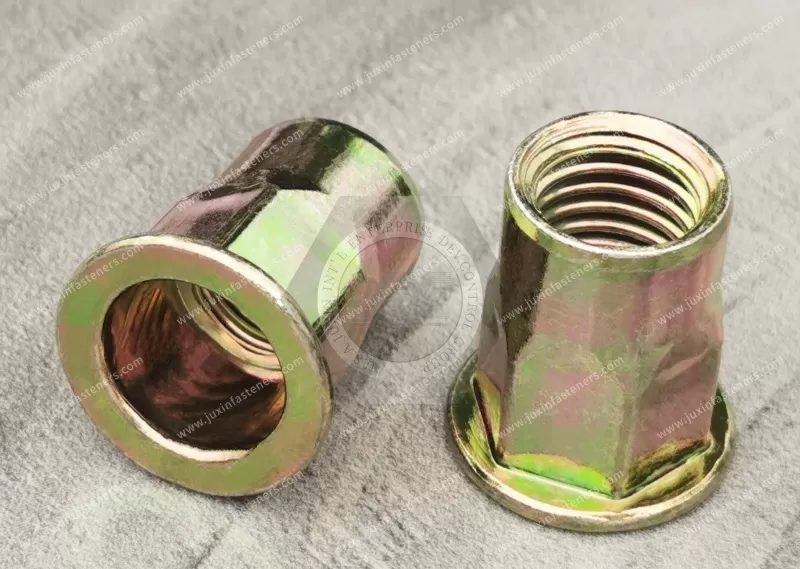
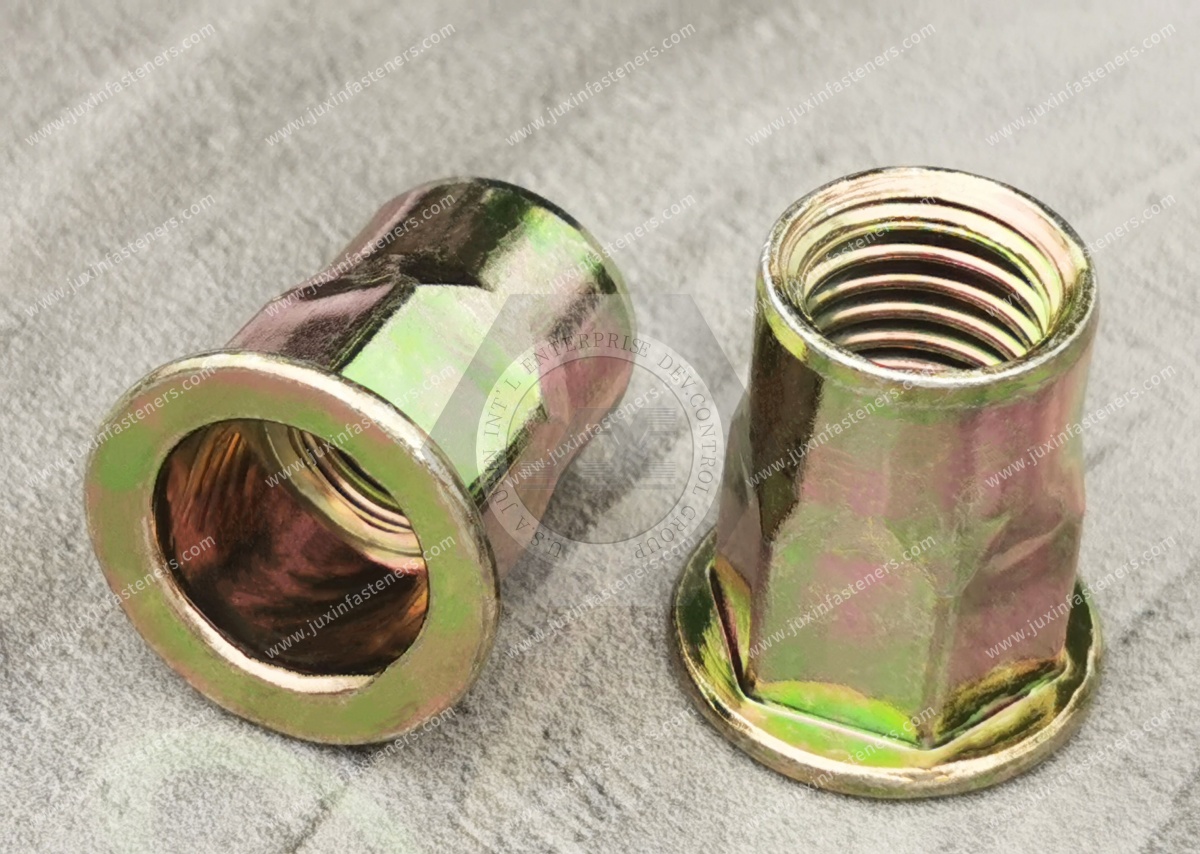
JUXIN FASTENERS manufactures flat head, open-end half-hex steel blind rivet nuts for creating reusable internal threads in thin sheet metal, hollow sections, and industrial assemblies requiring one-sided installation.
The partial hexagonal body engages with a matching non-round mounting hole to help resist insert rotation. The flat flange provides a bearing surface, while the open-end barrel allows screw extension where sufficient backside clearance is available.
Product Features
Metric thread sizes: M3, M4, M5, M6, M8, M10, M12
Inch-series threads: Custom OEM requirements subject to drawing review
Material: Steel
Surface finish: Color zinc plating
Grip range: 0.5–5.0 mm (approx. 0.020–0.197 in) across the product family, depending on configuration
Head style: Flat head / Large flange
Body style: Half-hex / Partial hexagonal body
End style: Open end
Installation: One-sided blind installation into compatible half-hex mounting holes
Typical applications include electrical enclosures, control cabinets, commercial vehicle components, machinery housings, and OEM sheet-metal assemblies requiring improved rotational resistance.
Product Specification
Technical Specifications — Flat Head Open-End Half-Hex Steel Blind Rivet Nuts
Metric Thread Specifications
| Thread Size | Standard Pitch | Nominal Diameter (in) |
|---|---|---|
| M3 × 0.5 | 0.50 mm | 0.1181 |
| M4 × 0.7 | 0.70 mm | 0.1575 |
| M5 × 0.8 | 0.80 mm | 0.1969 |
| M6 × 1.0 | 1.00 mm | 0.2362 |
| M8 × 1.25 | 1.25 mm | 0.3150 |
| M10 × 1.5 | 1.50 mm | 0.3937 |
| M12 × 1.75 | 1.75 mm | 0.4724 |
Metric thread requirements may be defined using ISO 261, ISO 724, and ISO 965, as applicable.
These values identify nominal thread sizes and pitches. They do not represent rivet nut body diameters or installation hole dimensions.
Unified Inch Thread Options for OEM Projects
North American purchasing programs may require Unified inch-thread inserts.
The following thread configurations can be submitted for manufacturing feasibility review.
| Thread Size | Thread Series | Availability |
|---|---|---|
| #4-40 | UNC | Custom inquiry |
| #6-32 | UNC | Custom inquiry |
| #8-32 | UNC | Custom inquiry |
| #10-24 | UNC | Custom inquiry |
| #10-32 | UNF | Custom inquiry |
| 1/4-20 | UNC | Custom inquiry |
| 5/16-18 | UNC | Custom inquiry |
| 3/8-16 | UNC | Custom inquiry |
| 1/2-13 | UNC | Custom inquiry |
Unified inch-thread specifications may reference ASME B1.1.
These are potential custom thread configurations, not confirmed stock sizes for this particular half-hex product.
Grip Range
Published product-series grip range:
0.5–5.0 mm (approximately 0.020–0.197 in)
The grip range is the host material thickness interval for which a particular rivet nut configuration is designed to install correctly.
The full published range must not be interpreted as the installation range of every individual thread size.
Confirm the actual grip range against the product drawing and installation specification.
Installation Hole Geometry
Half-hex rivet nuts require compatible non-round hole geometry to achieve their intended anti-rotation engagement.
A standard round hole should not be assumed suitable for the hexagonal section.
The approved drawing should define:
Hexagonal section dimensions
Required hole geometry
Hole tolerance
Flange diameter
Body length
Deformable section length
Installation grip range
Tool mandrel requirements
Installed protrusion
Where the product combines hexagonal and round body sections, the installation hole and setting process must accommodate the actual transition geometry.
Installation Procedure
Confirm the thread size and selected grip range.
Verify the panel material and thickness.
Prepare the specified installation hole.
Remove burrs and inspect the hole geometry.
Select the correct installation mandrel and tool.
Engage the rivet nut with the mandrel.
Position the insert correctly in the prepared hole.
Keep the installation tool perpendicular to the panel.
Apply the validated setting stroke or force.
Allow the body to deform behind the workpiece.
Release the installation tool.
Inspect the installed flange and thread condition.
Verify spin-out and pull-out performance where required.
Manual, pneumatic, or hydraulic setting tools may be suitable, depending on the insert size and production requirements.
Tool compatibility must be confirmed before installation.
Engineering Qualification and Testing
For OEM production approval, recommended evaluation criteria include:
Spin-Out Torque
Measures the resistance of the installed insert to rotation under applied torque.
Axial Pull-Out Strength
Evaluates the force required to extract the installed insert from the host material.
Push-Out Resistance
Assesses resistance to displacement through the mounting hole under the specified loading direction.
Installation Repeatability
Confirms that the selected tooling and setting parameters produce consistent installations across production samples.
Thread Integrity
Verifies that installation deformation has not damaged the internal thread.
Corrosion Performance
Evaluates the selected coating against the project's environmental requirements.
Joint Reliability
For assemblies exposed to vibration or cyclic loading, evaluate the complete screw-and-insert joint rather than relying solely on rivet nut strength.
Drawing and Catalog Reference
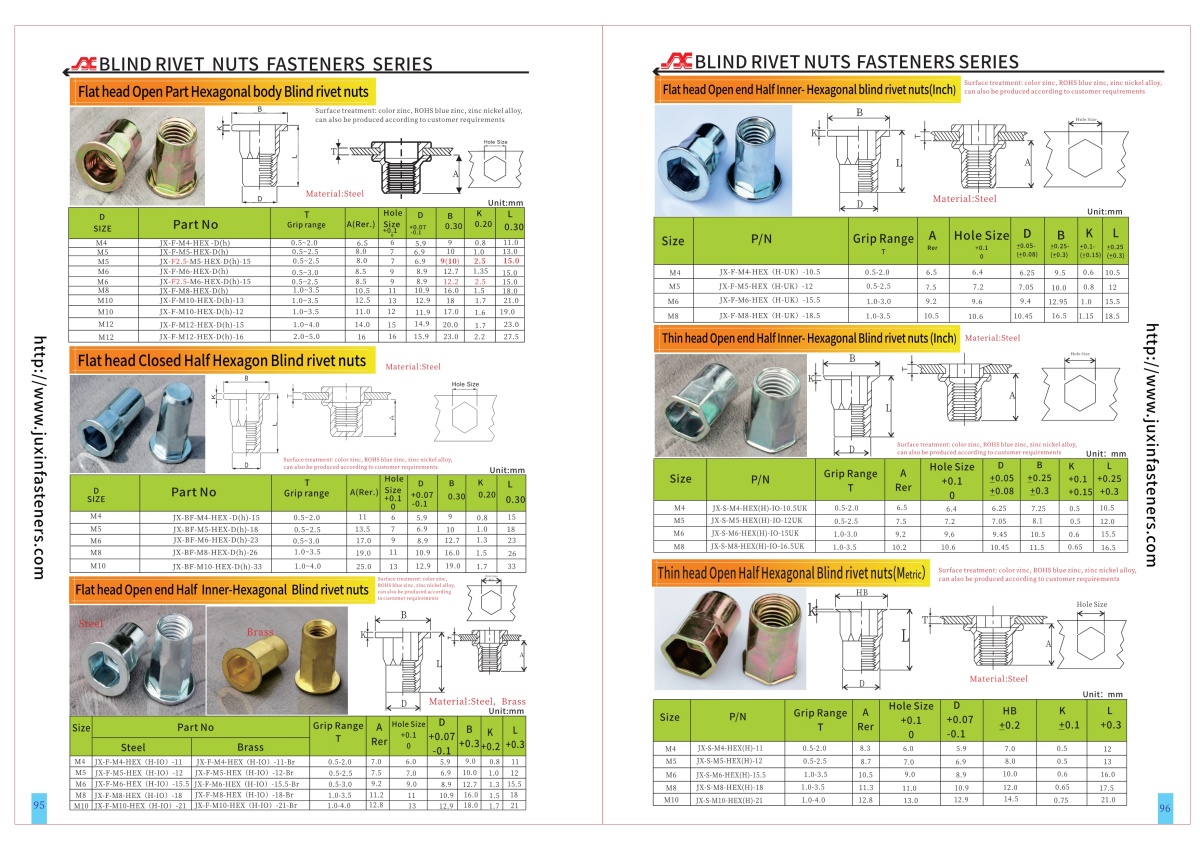
Detailed dimensional specifications should be verified using the product PDF and CAD drawings.
Original catalog reference: Pages 95–96.
For custom OEM requirements, please submit a technical drawing showing the complete installation geometry.
Engineering RFQ Checklist
To prepare an accurate quotation, provide:
Required thread size and pitch
Metric or Unified inch-thread specification
Flat head diameter
Partial hex body dimensions
Installation hole geometry
Panel material and hardness
Panel thickness
Required grip range
Setting tool information
Expected tightening torque
Required spin-out and pull-out performance
Surface finish and corrosion requirements
Drawing revision
Order quantity and annual forecast
Packaging requirements
Why Choose Half-Hex Blind Rivet Nuts?
1. Improved Anti-Rotation Performance
The defining feature of a half-hex rivet nut is its partially hexagonal body.
Unlike a conventional smooth round-body rivet nut, which primarily relies on deformation and friction to resist rotation,
a half-hex insert can mechanically engage with a matching hexagonal hole.
This geometric engagement helps resist spin-out during screw tightening, repeated maintenance, and equipment assembly.
For OEM applications, anti-rotation performance depends on the relationship between the insert geometry and the mounting hole.
Critical factors include:
Hexagonal hole dimensions and tolerances
Host material thickness and hardness
Rivet nut body geometry
Installation stroke and deformation
Mating screw tightening torque
Installed spin-out torque requirements
The half-hex design should not be treated as an automatic guarantee of high torque resistance. Mechanical testing is recommended for production approval.
2. Large Flange for Improved Load Distribution
The flat head, also described as a large flange, provides a wider bearing surface against the installation panel than reduced-head alternatives.
This can help distribute the applied load and reduce the risk of local panel deformation or pull-through.
It is particularly useful for selected thin-gauge sheet metal assemblies where a larger bearing surface is desirable.
Actual push-through resistance depends on flange geometry, material strength, installation conditions, and the applied loading.
3. One-Sided Installation Without Welding
Half-hex blind rivet nuts can be installed from one accessible side of the workpiece.
A compatible setting tool pulls the threaded section toward the flange, deforming the designated body section behind the panel.
The resulting mechanical attachment creates an internally threaded fastening point without welding or conventional tapping.
This is valuable for:
Enclosed electrical cabinets
Box-section fabrications
Hollow metal profiles
Pre-finished sheet metal components
Equipment with restricted rear access
Avoiding welding can also eliminate localized welding heat input and associated thermal distortion during fastener installation.
4. Open-End Design for Flexible Screw Engagement
The open-end configuration allows a mating screw to extend through the rivet nut body.
Compared with a closed-end design, this can provide greater flexibility when selecting screw length or accommodating protruding threaded components.
However, the assembly must provide adequate clearance behind the installed rivet nut.
Open-end inserts do not provide a sealed threaded cavity.
Applications requiring protection against fluid or contaminant ingress should evaluate closed-end inserts or separately engineered sealing arrangements.
5. Reusable Threads in Thin Sheet Materials
Thin sheet metal frequently lacks sufficient thickness to support a durable directly tapped thread.
A properly selected blind rivet nut provides a dedicated internal thread that can accommodate repeated screw installation and removal,
subject to the fastener's mechanical limits and the condition of the joint.
This can simplify equipment servicing and panel replacement.
Half-Hex Versus Full-Hex and Round-Body Rivet Nuts
| Design | Main Advantage | Engineering Consideration |
|---|---|---|
| Half-Hex Body | Mechanical anti-rotation engagement | Requires matching hole geometry |
| Full-Hex Body | Non-round engagement along a greater body length | Hole preparation and grip selection |
| Knurled Round Body | Enhanced frictional and mechanical engagement | Round-hole tolerance and material |
| Smooth Round Body | Simpler round-hole preparation | Spin-out resistance must be evaluated |
A half-hex rivet nut may be preferable when an OEM needs positive geometric resistance to rotation but does not require a full-length hexagonal body.
Selection should be based on the actual hole geometry, panel material, installation process, and performance requirements.
Industrial Applications
Electrical Cabinets and Control Enclosures
Half-hex blind rivet nuts are particularly useful in electrical cabinet manufacturing.
They provide threaded mounting points for:
Cabinet side and rear panels
Internal mounting brackets
Control equipment support rails
Removable access covers
Fan mounting assemblies
Cable management hardware
Equipment mounting plates
Their one-sided installation capability is especially useful when rear access is restricted.
Where a connection forms part of a protective earthing or bonding path, electrical continuity must be independently verified.
Zinc plating and mechanical contact alone do not establish grounding compliance.
Industrial Machinery and Automation Equipment
Half-hex rivet nuts can be used in fabricated machine housings, guards, inspection panels, and equipment brackets.
The anti-rotation geometry is valuable where panels are removed periodically for maintenance.
Automotive and Commercial Vehicles
Potential applications include non-structural brackets, interior equipment mounting points, vehicle electrical enclosures, and fabricated body accessories.
Applications subject to significant vibration or cyclic loading require appropriate joint-level validation.
HVAC and Refrigeration Equipment
Suitable applications may include fabricated housings, service panels, mounting brackets, and equipment enclosures.
The open-end design should be evaluated carefully wherever moisture protection is required.
Railway Interior Equipment
Half-hex rivet nuts may be considered for non-structural railway interior brackets, equipment covers, and removable assemblies.
Project-specific mechanical, vibration, material, and documentation requirements must be confirmed before approval.
Industrial Furniture and Metal Fabrications
These inserts provide reusable threaded fastening points for metal frames, panels, brackets, and serviceable assemblies.
Material and Surface Finish
Steel Construction
Steel half-hex blind rivet nuts provide a combination of mechanical strength, formability, and cost efficiency for industrial fastening applications.
The exact steel grade and mechanical properties should be specified through the approved product drawing or purchasing documentation.
Color Zinc Plating
The standard product information identifies a color zinc-plated finish.
Zinc plating provides sacrificial corrosion protection for the underlying steel.
For OEM sourcing programs, coating specifications may reference ASTM B633 or ISO 2081 where applicable.
Plating thickness, passivation chemistry, corrosion performance, and restricted-substance requirements should be confirmed before production.
The appearance of a color zinc finish does not independently establish RoHS compliance.
OEM Manufacturing and Custom Fastening Solutions
JUXIN FASTENERS supports drawing-based inquiries for half-hex blind rivet nuts and related industrial threaded inserts.
Customer-specific requirements may include:
Metric and Unified inch threads
Modified flange dimensions
Special body lengths
Custom grip ranges
Alternative material specifications
Surface treatment requirements
Application-specific installation geometry
Customer-defined inspection requirements
Custom configurations are subject to technical feasibility, tooling, production quantities, and commercial review.
OEM Procurement and Supplier Development
For procurement managers, strategic sourcing teams, and supplier development engineers, the total cost of a fastening solution extends beyond the individual rivet nut price.
Important sourcing considerations include installation repeatability, panel preparation, tooling compatibility,
assembly cycle time, rework risk, corrosion protection, and long-term supply consistency.
A properly specified half-hex rivet nut can reduce dependence on welding operations and loose backside nuts in suitable assemblies.
JUXIN FASTENERS can review technical drawings, project quantities, annual demand forecasts, packaging requirements, and delivery schedules for industrial purchasing programs.
Request an OEM Quotation
Please send your part drawing, thread requirements, host material details, grip thickness, installation hole dimensions, coating specification, and estimated order quantity.
JUXIN FASTENERS will review your requirements and provide a quotation based on the requested product configuration.
JUXIN FASTENERS
Email: info@juxinfasteners.com
Website: www.juxinfasteners.com
Contact: https://www.juxinfasteners.com/contact-us/
Product Packaging
Export Packaging and OEM Supply
Standard Packaging
JUXIN FASTENERS provides protective packaging for flat head open-end half-hex steel blind rivet nuts.
The standard packaging arrangement consists of plastic inner bags, outer cartons, and palletized shipments when required.
Final packaging quantities depend on product dimensions, order volume, and customer requirements.
Reference Packaging Dimensions
| Packaging Type | Dimensions |
|---|---|
| Carton Option 1 | 29 × 19 × 19.5 cm |
| Carton Option 2 | 23.5 × 17.5 × 8 cm |
| Reference Pallet | 215 × 100 × 90 cm |
The listed dimensions are reference packaging sizes. Final packing configurations and shipment dimensions are confirmed for each order.
Custom OEM Packaging
Customer-specific packaging arrangements can be reviewed, including:
Bulk industrial packaging
Customized bag quantities
Customer part-number identification
Barcode and batch labels
Lot traceability information
Protective packaging for plated components
Customized carton sizes
Palletized export shipments
Customer-defined shipping marks
Industrial Purchasing Programs
JUXIN FASTENERS supports quotation requests for recurring OEM requirements and project-based bulk purchasing.
Purchasing teams may submit annual demand forecasts, delivery schedules, technical drawings, quality requirements, and packaging instructions for review.
For commercial quotations and technical inquiries:
JUXIN FASTENERS
Email: info@juxinfasteners.com
Website: www.juxinfasteners.com
Contact: https://www.juxinfasteners.com/contact-us/
Product Pictures
Tags
Contact Us
Tel.:
+86 020 8621 0320
+86 020 3121 6067
E-mail:
Technical Support:
Navigation
SEND INQUIREY