Call Us
+86 136 6007 9809
Call Us
+86 136 6007 9809

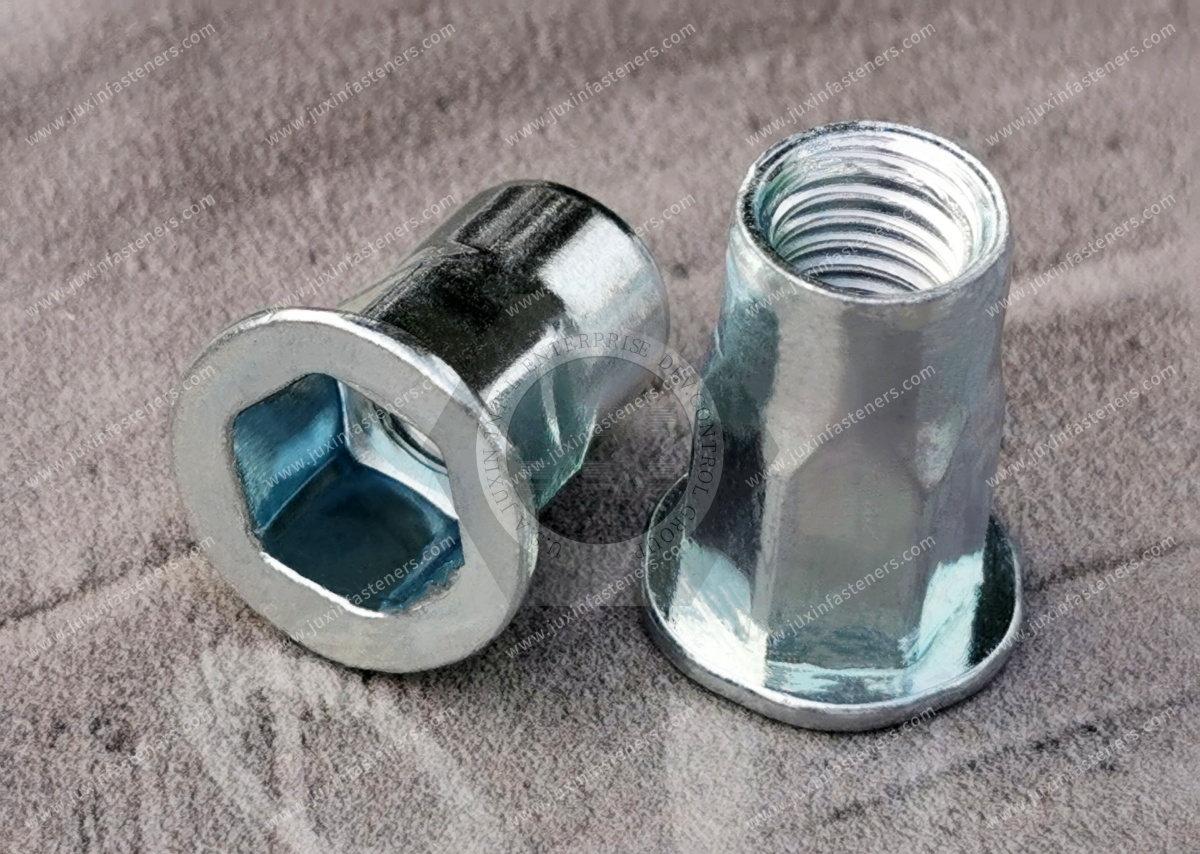
JUXIN FASTENERS provides flat head open-end half-hex blind rivet nuts for creating reusable internal threads in thin sheet metal, fabricated enclosures,
hollow sections, and industrial equipment assemblies where installation access is available from only one side.
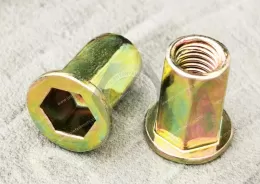
These steel threaded inserts feature a partially hexagonal body designed to engage with a matching non-round mounting hole.
The mechanical engagement helps resist insert rotation during bolt tightening, removal, and repeated servicing.
The flat head provides a bearing surface against the panel,
while the open-end configuration allows a mating screw to extend through the insert when adequate clearance is available behind the workpiece.
Also known as open-end half-hex rivet nuts, partial hex blind rivet nuts, hex-body nutserts, and blind threaded inserts,
these fasteners provide an alternative to welded nuts, loose nuts, and directly tapped threads in applications where those methods are unsuitable.
The standard product family includes metric sizes M3, M4, M5, M6, M8, and M10, with a stated series grip range of 0.5–4.0 mm.
Half-Hex Body: Provides geometric anti-rotation engagement with a correctly formed mounting hole.
Open-End Design: Allows a mating screw to pass through the insert, subject to backside clearance.
Flat Head: Provides a relatively broad bearing area around the installation hole.
Steel Construction: Supports mechanically robust threaded connections when properly selected and installed.
Blue Zinc Finish: Provides sacrificial corrosion protection for the steel substrate.
Single-Sided Installation: Suitable for enclosed structures where the opposite side cannot be accessed.
Cold-Forming Installation: Eliminates the need to weld a nut to the panel.
Reusable Internal Threads: Supports equipment assembly, disassembly, and maintenance.
OEM Customization: Special dimensions, thread specifications, coatings, and packaging can be evaluated against customer drawings.
A conventional round-body rivet nut generally relies on friction and mechanical retention generated during the setting process.
A half-hex rivet nut uses a partially hexagonal body section that engages with a corresponding non-round mounting hole.
This geometry provides a mechanical resistance path against rotation, which is particularly useful when the installed threaded insert is subjected to repeated tightening and loosening.
However, anti-rotation performance is not determined by body geometry alone.
Important engineering variables include:
Hexagonal hole dimensions and tolerances
Host panel material and hardness
Grip range and actual panel thickness
Insert wall thickness and body geometry
Installation stroke or setting force
Mating screw thread and tightening torque
Surface condition and coating thickness
The installed joint should be tested under representative assembly conditions to establish its actual spin-out torque.
Unlike a closed-end rivet nut, an open-end blind rivet nut does not have an enclosed barrel at the back of the internal thread.
This allows a mating screw or threaded stud to extend beyond the insert where the assembly provides sufficient clearance.
For design engineers, this can be advantageous when the screw length is determined by multiple stacked components or when the assembly requires greater thread penetration flexibility.
The screw must still provide sufficient thread engagement without interfering with adjacent components.
An open-end rivet nut should not be selected where the application requires the rear thread cavity to be enclosed against contamination unless additional protection is provided.
The flat head, also described as a large flange in some product catalogs, provides a bearing surface against the host panel.
This helps distribute the applied load around the mounting hole and can reduce the risk of localized deformation when the joint is correctly designed.
The flange also contributes to resistance against the insert being pushed through the panel.
Actual push-out resistance depends on the flange diameter, panel properties, installation geometry, and joint loading.
Thin sheet metal may not provide sufficient thread engagement for direct tapping.
Welded nuts can introduce heat, distortion, additional processing, and accessibility challenges.
Half-hex blind rivet nuts provide an alternative method of creating an internal thread without applying welding heat to the workpiece.
The insert is placed into a correctly prepared mounting hole and installed using a compatible rivet nut setting tool.
During installation, the designated deformable portion of the insert forms a retaining bulge behind the panel.
This creates a mechanically retained threaded connection accessible from the front side.
| Parameter | Specification |
|---|---|
| Product Type | Open-End Half-Hex Blind Rivet Nut |
| Alternative Names | Partial Hex Rivet Nut, Half-Hex Nutsert |
| Head Style | Flat Head / Flanged Head |
| Body Configuration | Partially Hexagonal |
| End Style | Open End |
| Material | Steel |
| Surface Treatment | Blue Zinc Plating |
| Metric Sizes | M3, M4, M5, M6, M8, M10 |
| Series Grip Range | 0.5–4.0 mm |
| Installation | Single-Sided Blind Setting |
| Custom Sizes | Subject to Engineering Review |
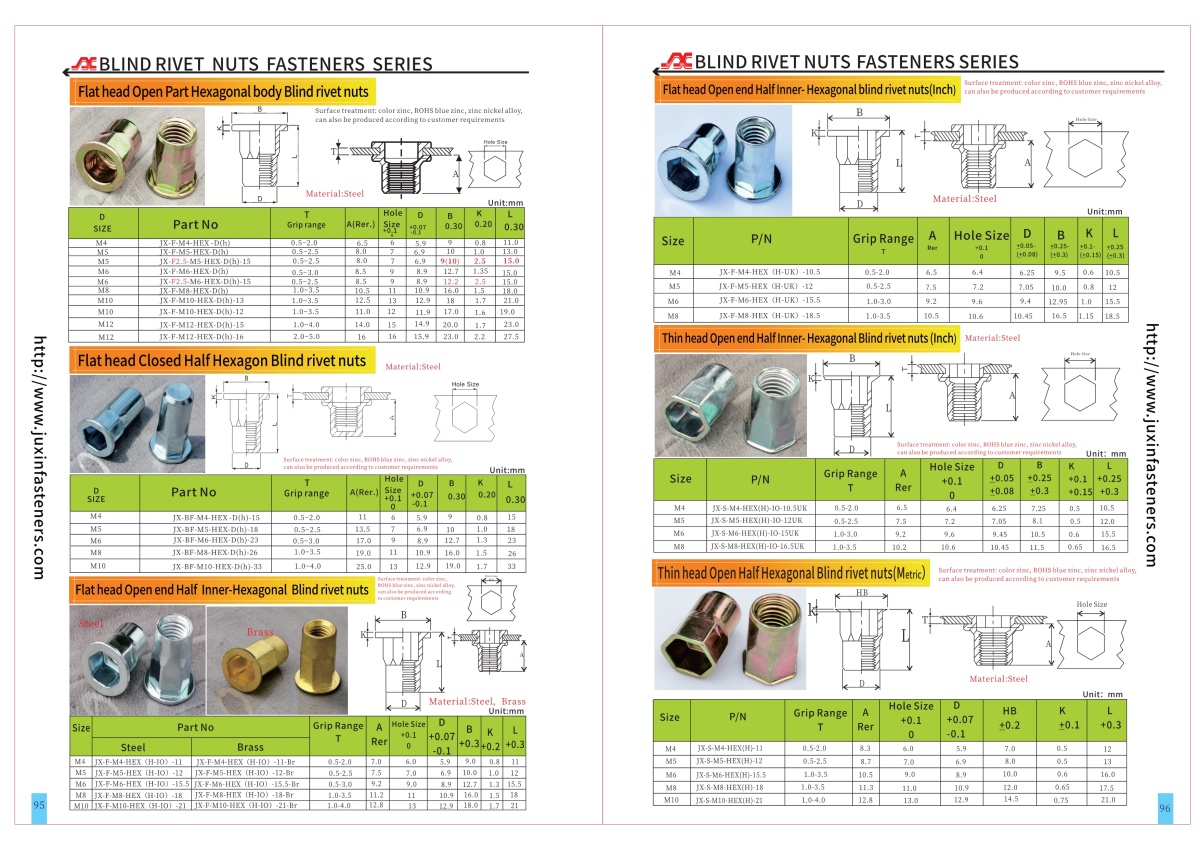
| Catalog Reference | Pages 95–96 |
Note: The stated grip range describes the product family. Individual thread sizes and body configurations may have different grip ranges. Final dimensions should be confirmed against the approved specification drawing.
Half-hex blind rivet nuts can provide reusable threaded mounting points for electrical cabinets, control enclosures, equipment brackets, and removable access panels.
These applications often involve relatively thin steel panels where welding may introduce distortion or damage a pre-finished surface.
The half-hex body helps resist rotation during installation and subsequent maintenance.
Typical applications include:
Electrical control cabinet mounting brackets
Distribution enclosure assemblies
Internal equipment support rails
Removable service panels
Fan and accessory mounting brackets
Industrial control equipment housings
Where a fastening point forms part of an electrical bonding or protective grounding system, electrical continuity must be verified separately.
Open-end half-hex rivet nuts may be considered for non-safety-critical brackets, interior equipment housings, serviceable panels, and fabricated sheet metal components.
They provide an alternative to welded nuts when backside access is restricted.
Vibration resistance, thread engagement, joint preload, and fatigue performance must be evaluated for the specific application.
Industrial machines frequently incorporate removable covers, guards, equipment housings, and mounting brackets.
A reusable threaded insert allows maintenance personnel to remove and reinstall fasteners without accessing the opposite side of the panel.
The anti-rotation geometry can be beneficial where repeated service operations might otherwise loosen a conventional round-body insert.
Potential applications include ventilation housings, equipment access panels, mounting brackets, and serviceable mechanical enclosures.
For equipment exposed to condensation or corrosive environments, coating selection and environmental suitability require separate evaluation.
Half-hex blind rivet nuts are suitable for evaluation in:
Fabricated sheet metal housings
Hollow steel profiles
Equipment frames
Industrial furniture components
Instrument housings
Control panel assemblies
Mechanical support brackets
The correct insert must be selected according to panel thickness, material, hole geometry, and required mechanical performance.
| Engineering Factor | Open-End Half-Hex | Closed-End Half-Hex |
|---|---|---|
| Thread Cavity | Open through the barrel | Enclosed at the rear |
| Screw Penetration | Can extend through the insert | Limited by internal depth |
| Anti-Rotation | Half-hex engagement | Half-hex engagement |
| Single-Sided Installation | Yes | Yes |
| Rear Contamination Barrier | Not enclosed | Enclosed barrel |
| Hole Geometry | Matching half-hex profile | Matching half-hex profile |
| Typical Selection Priority | Screw penetration flexibility | Enclosed thread cavity |
Choose the open-end configuration when the assembly requires screw penetration flexibility and does not require an enclosed rear thread cavity.
Choose the closed-end configuration when limiting direct contamination through the back of the threaded insert is important.
Neither configuration should be assumed watertight without validation of the complete installed joint.
The documented standard product family uses metric threads from M3 to M10.
For North American OEM projects, JUXIN FASTENERS can evaluate customer drawings specifying Unified inch threads.
Common requested Unified thread designations include:
#6-32 UNC
#8-32 UNC
#10-24 UNC
1/4-20 UNC
5/16-18 UNC
3/8-16 UNC
These are reference thread designations for custom inquiry evaluation, not confirmed stock sizes for this product.
Metric thread geometry may be specified using applicable ISO standards, while Unified threads may be specified according to ASME B1.1.
A metric rivet nut must not be treated as interchangeable with an inch-thread rivet nut merely because the nominal diameters appear similar.
The thread system, pitch, mating screw, mounting hole, body dimensions, and setting tool must all be compatible.
The blue zinc-plated finish provides sacrificial corrosion protection for the steel insert.
The coating specification should be defined by measurable requirements rather than visual appearance alone.
Relevant coating specifications may include ISO 2081 and ASTM B633, subject to the selected plating process.
For OEM purchasing and qualification, specify:
Required zinc coating thickness
Passivation chemistry
Restricted-substance requirements
Corrosion resistance criteria
Coating appearance
Hydrogen embrittlement risk controls where applicable
Inspection and acceptance requirements
Where RoHS compliance is required, the plating chemistry and relevant supporting documentation should be confirmed for the actual production batch.
JUXIN FASTENERS supports drawing-based technical review for custom industrial fastening applications.
Customer requirements may include:
Non-standard thread sizes
Unified inch threads
Modified flange dimensions
Special partial hexagonal body geometry
Alternative grip ranges
Special barrel lengths
Customer-specified surface treatments
Inspection requirements
Production packaging and labeling
Scheduled OEM purchasing programs
Manufacturing feasibility, minimum order quantities, tooling, and delivery schedules depend on the approved technical requirements.
For engineering evaluation, new supplier qualification, and production sourcing, please send:
Required metric or inch thread size
Technical drawing or CAD file
Panel material and thickness
Installation hole dimensions
Required grip range
Mechanical performance requirements
Coating specification
Estimated order quantity
Annual demand forecast
Packaging and inspection requirements
JUXIN FASTENERS can review the submitted requirements and prepare a quotation based on the confirmed product configuration.
JUXIN FASTENERS
Email: info@juxinfasteners.com
Website: www.juxinfasteners.com
Contact: https://www.juxinfasteners.com/contact-us/
Product Specification
| Thread Size | Standard Coarse Pitch | Nominal Thread Diameter |
|---|---|---|
| M3 | 0.50 mm | 3 mm |
| M4 | 0.70 mm | 4 mm |
| M5 | 0.80 mm | 5 mm |
| M6 | 1.00 mm | 6 mm |
| M8 | 1.25 mm | 8 mm |
| M10 | 1.50 mm | 10 mm |
The metric thread designations follow the applicable ISO metric thread system.
The above table identifies thread sizes and standard coarse pitches. It does not specify the required installation hole dimensions or individual product body dimensions.
The stated product family grip range is 0.5–4.0 mm.
The selected rivet nut must match the actual host panel thickness.
An insert used outside its validated grip range may not develop the intended backside deformation or mechanical retention.
Refer to the approved product specification PDF and CAD drawing for size-specific dimensions.
Catalog Reference: Pages 95–96.
The half-hex body requires a corresponding mounting hole geometry.
The mounting hole must be designed to engage the partially hexagonal body section while allowing the insert to seat correctly.
Important dimensional controls include:
Across-flats dimension
Round-section diameter where applicable
Hole profile tolerance
Panel thickness
Minimum edge distance
Burr condition
Flange seating surface
Coating thickness
Installation accessibility
A conventional round hole must not be assumed interchangeable with the specified half-hex mounting hole.
Verify the rivet nut thread size and selected grip range.
Confirm the host panel material and thickness.
Prepare the mounting hole according to the approved drawing.
Remove burrs and inspect the hole profile.
Select the appropriate rivet nut setting tool.
Fit the correct threaded mandrel.
Engage the rivet nut with the tool.
Position the insert fully into the mounting hole.
Keep the setting tool perpendicular to the panel.
Apply the validated installation stroke or force.
Allow the insert body to deform behind the panel.
Release the setting mandrel.
Inspect flange seating and thread condition.
Verify mechanical retention as required by the application.
Manual, pneumatic, or hydraulic setting equipment may be used when compatible with the selected insert.
Measures resistance to rotation of the installed insert relative to the host panel.
This test is particularly important for half-hex rivet nuts used in repeatedly serviced assemblies.
Evaluates resistance to extraction under axial loading.
Results depend on the insert, panel material, thickness, and installation conditions.
Evaluates resistance to displacement through the panel.
The flat-head flange geometry contributes to this behavior.
Confirms that the internal thread remains usable following the installation process.
Evaluates consistency of setting performance across representative production samples.
A half-hex rivet nut and a round-body rivet nut may have the same nominal thread size but require different mounting hole geometry.
Substituting one for the other without reviewing the hole design can reduce mechanical retention or prevent correct installation.
For OEM production, the approved hole geometry should be controlled as part of the assembly drawing and manufacturing inspection process.
| Requirement | Information Needed |
|---|---|
| Thread | Metric or Unified inch designation |
| Panel | Material, thickness, hardness |
| Mounting Hole | Profile, dimensions, tolerances |
| Grip Range | Minimum and maximum panel thickness |
| Flange | Head diameter and thickness |
| Mechanical Performance | Torque-out, pull-out, push-out |
| Coating | Thickness, chemistry, corrosion criteria |
| Drawing | Revision-controlled PDF or CAD |
| Order Quantity | Trial and production volumes |
| Forecast | Estimated annual demand |
JUXIN FASTENERS
Email: info@juxinfasteners.com
Website: www.juxinfasteners.com
Product Packaging
JUXIN FASTENERS provides protective packaging for flat-head open-end half-hex steel blind rivet nuts.
Standard packaging consists of plastic inner bags, outer cartons, and palletized packaging when required.
Packing quantities are determined according to thread size, product dimensions, order quantity, and customer requirements.
| Packaging Type | Dimensions |
|---|---|
| Carton Option 1 | 29 × 19 × 19.5 cm |
| Carton Option 2 | 23.5 × 17.5 × 8 cm |
| Reference Pallet | 215 × 100 × 90 cm |
Packaging dimensions are reference values and may be adjusted according to order requirements.
Available packaging arrangements may be evaluated for:
Bulk industrial orders
Customer-specific packing quantities
Part-number identification
Lot and batch traceability
Barcode labels
Protective packaging for plated steel components
Customized cartons
Palletized export shipments
Customer-specific shipping marks
For recurring OEM programs, customers may provide annual forecasts, scheduled delivery requirements, and approved packaging instructions.
JUXIN FASTENERS
Email: info@juxinfasteners.com
Website: www.juxinfasteners.com
Contact: https://www.juxinfasteners.com/contact-us/
Product Pictures
Tags
Contact Us
Tel.:
+86 020 8621 0320
+86 020 3121 6067
E-mail:
Technical Support:
Navigation
SEND INQUIREY