Call Us
+86 136 6007 9809
Call Us
+86 136 6007 9809

As automotive OEMs accelerate the transition to electric mobility, lightweighting, thermal management, electrical safety, and serviceability have become increasingly important in EV component design.
Engineered plastics, glass-fiber-reinforced polymers, flame-retardant materials, and composite structures are increasingly used in battery enclosures, power electronics housings,
BMS components, thermal management systems, cable management structures, and electrical modules.
Product Specification
As automotive OEMs accelerate the transition to electric mobility, lightweighting, thermal management, electrical safety, and serviceability have become increasingly important in EV component design.
Engineered plastics, glass-fiber-reinforced polymers, flame-retardant materials, and composite structures are increasingly used in battery enclosures,
power electronics housings, BMS components, thermal management systems, cable management structures, and electrical modules.
These materials offer important advantages in weight reduction, corrosion resistance, electrical insulation, design flexibility, and integration.
However, creating a reliable threaded connection directly in plastic or composite materials can be challenging.
Repeated tightening may lead to thread stripping, creep, deformation, or loss of clamping performance, particularly when components experience vibration, thermal cycling, mechanical shock, or repeated service.
JUXIN Fasteners manufactures custom threaded inserts for EV battery enclosures and plastic or composite automotive components, creating durable metal threads within engineered polymer structures.
The insert, plastic boss, installation process, and mating screw should be considered as a complete fastening system.
Properly designed, this system can provide repeatable assembly, improved thread durability, and stable mechanical fastening performance for demanding EV applications.
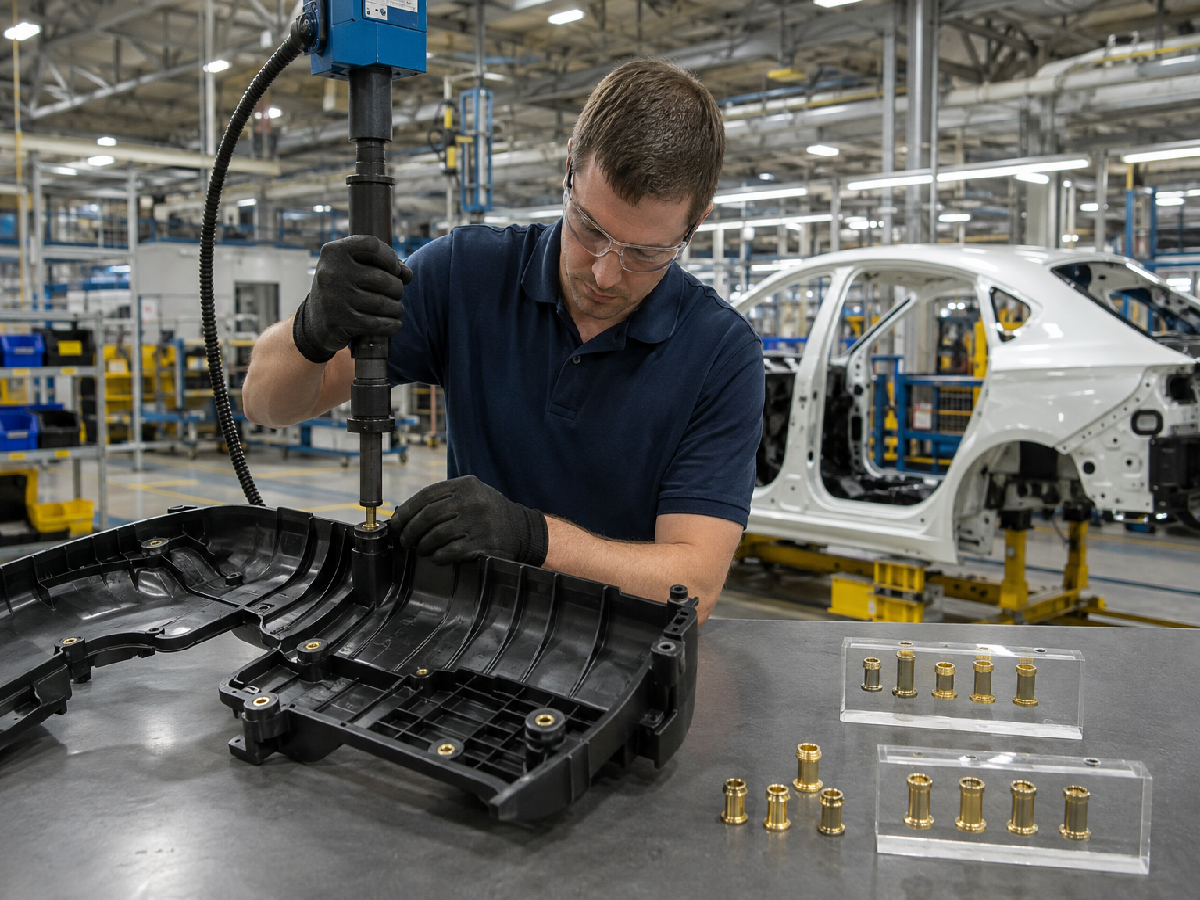
Electric vehicle systems combine structural, electrical, thermal, and electronic functions within increasingly compact assemblies. Threaded inserts can provide durable fastening points where direct plastic threading is not suitable.
Threaded inserts can be used for fastening battery enclosure covers, service access panels, module retainers, protective covers, internal brackets, and structural components.
For plastic and composite battery enclosure components, insert design should consider the material's mechanical properties, boss geometry, installation method, and required assembly torque.
Battery Management System assemblies contain sensors, control electronics, connectors, brackets, and protective housings that may require repeated fastening during assembly or service.
Threaded inserts for plastic housings can provide durable metal threads for PCB brackets, sensor mounts, controller housings, and internal support structures.
EV power electronics systems such as PDU housings, inverter housings, DC-DC converter assemblies, and electrical control modules require reliable mechanical fastening while managing weight and electrical insulation requirements.
Threaded inserts can provide defined fastening points for covers, brackets, shields, connectors, and internal components.
EV battery systems depend heavily on thermal management. Plastic components may be used in coolant manifolds, valve bodies, pump housings, sensor brackets, fluid distribution components, and protective covers.
In these applications, insert material and surface treatment should be selected according to temperature, moisture, coolant exposure, corrosion conditions, and mechanical loading.
High-voltage systems require carefully positioned cable routing and retention components.
Typical applications may include:
Busbar retainers
High-voltage cable clamps
Wiring harness channels
Connector brackets
Cable routing structures
Electrical module mounting brackets
Threaded inserts allow these components to be securely fastened while maintaining the design flexibility of plastic and composite structures.
EV fastening systems must be evaluated according to the actual material, operating environment, assembly process, and service requirements.
EV components may experience repeated temperature changes during charging, driving, thermal management operation, and vehicle shutdown.
Different coefficients of thermal expansion between the metal insert and surrounding plastic or composite material can affect joint performance.
Insert selection should therefore consider:
Operating temperature range
Thermal expansion characteristics
Plastic or composite material
Boss geometry
Installation method
Required clamping force
Moisture and environmental exposure
Automotive components are exposed to continuous vibration as well as mechanical shock from road conditions and vehicle operation.
For demanding applications, torque-out and pull-out performance should be considered during insert and boss design.
The appropriate insert geometry should be selected according to the material strength and the required load direction rather than treating the insert as an isolated component.
One of the primary advantages of polymer and composite components is weight reduction.
However, reducing material thickness can also reduce the available area around a fastening point. Insert geometry therefore needs to be balanced against:
Boss diameter
Wall thickness
Insert length
Thread size
Installation force or energy
Required pull-out resistance
Required torque-out resistance
Available assembly space
A well-designed fastening system can help maintain mechanical performance without unnecessarily increasing component weight.
EV components may require repeated access for inspection, maintenance, replacement, or end-of-life disassembly.
A metal threaded insert can provide a more durable fastening point than a directly molded or tapped plastic thread, particularly where repeated assembly and disassembly are required.
For electrically sensitive applications, material selection and the overall fastening design should also consider electrical conductivity, insulation requirements, grounding strategy, and galvanic compatibility.
The correct insert material depends on the application rather than a single universal specification.
Brass threaded inserts are widely used in plastic and electronic applications because of their good machinability, thermal conductivity, and compatibility with heat-staking processes.
Typical applications include:
BMS housings
Sensor housings
Electrical modules
Control units
Plastic brackets
Interior electronic components
Aluminum threaded inserts can be considered where weight reduction is an important design objective.
They may be suitable for applications involving lightweight structures and aluminum mating components, subject to the required mechanical performance and corrosion considerations.
For EV applications, the insert and surrounding materials should be evaluated together to reduce the risk of galvanic corrosion.
Stainless steel threaded inserts provide higher corrosion resistance and can be considered for demanding environmental conditions.
Potential applications include:
Thermal management components
Moisture-exposed assemblies
Underbody components
High-stress mounting points
Components requiring enhanced corrosion resistance
The appropriate stainless steel grade should be selected according to the actual environment and design requirements.
Installation technology is an important part of the insert design process.
Heat staking threaded inserts are commonly used with thermoplastic components.
Heat softens the surrounding plastic, allowing the insert to be positioned into the boss. After cooling, the material solidifies around the external geometry of the insert.
The insert geometry, boss dimensions, temperature, installation force, and process parameters should be optimized together.
Ultrasonic threaded inserts use localized ultrasonic energy to soften thermoplastic material around the insert.
This method can support efficient automated assembly and is often considered for higher-volume automotive and electronics production.
Press-fit inserts can be used where the plastic or composite material and boss geometry provide sufficient interference and retention.
The required insertion force and resulting stress in the boss should be evaluated during product development.
For selected applications, inserts can be positioned during molding to become an integrated part of the plastic component.
This approach can reduce secondary assembly operations, but requires early coordination between the insert design, mold design, plastic material, and molding process.
A reliable EV insert solution begins with the complete assembly rather than simply selecting a standard insert.
The engineering team should consider:
Polymer type
Glass-fiber or mineral reinforcement
Material strength
Thermal characteristics
Wall thickness
Moisture absorption
Operating temperature
Chemical exposure
For reinforced materials, fiber orientation and local boss geometry may also influence fastening performance.
The plastic boss provides the structural foundation around the insert.
Important parameters include:
Boss outer diameter
Boss height
Wall thickness
Draft angle
Distance to surrounding features
Rib configuration
Distance between adjacent bosses
An appropriately designed boss can help distribute installation and service loads through the surrounding plastic.
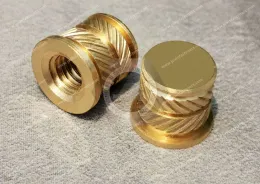
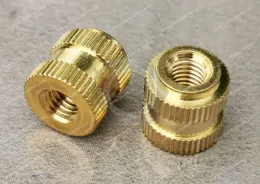
External insert geometry should be selected according to the plastic material and installation process.
Depending on the application, design variables may include:
External knurl or retention geometry
Insert length
Flange configuration
Internal thread specification
Lead-in geometry
Installation method
The objective is to achieve the required retention without creating excessive stress in the plastic boss.
The mating screw torque is an important input for insert selection.
Assembly torque, thread size, insert geometry, plastic material, and boss dimensions should be evaluated together.
The insert should be designed to withstand the required assembly conditions without causing excessive deformation or damage to the surrounding plastic.
For critical EV components, pull-out and torque-out requirements should be established according to the actual application.
Testing can help evaluate the complete joint, including:
Insert geometry
Plastic material
Boss design
Installation method
Assembly torque
Load direction
This provides a more meaningful evaluation than considering the insert alone.
EV components may encounter humidity, road contaminants, condensation, thermal cycling, and other environmental conditions.
Surface treatment should therefore be selected according to the application and mating materials.
JUXIN provides customized plating and surface treatment solutions according to customer requirements.
For demanding applications, salt spray performance of up to 1,200 hours can be achieved when specified, depending on the substrate, coating system, testing requirements, and customer specification.
For metal-to-metal combinations, engineers should also evaluate galvanic compatibility rather than selecting a coating based only on salt spray performance.
EV manufacturers and Tier-1 suppliers often require fastening components designed around specific plastic parts rather than standard catalog dimensions.
JUXIN can manufacture custom threaded inserts according to customer drawings, specifications, samples, and application requirements.
Customization may include:
Thread specification
Insert length
External retention geometry
Flange dimensions
Head configuration
Material selection
Surface treatment
Installation method
Packaging requirements
The objective is to develop an insert that works with the customer's plastic component, boss geometry, assembly process, and final fastening requirements.
Automotive production requires consistent components that can integrate into controlled assembly processes.
Important procurement considerations include:
Dimensional consistency
Material specification
Surface treatment requirements
Thread quality
Installation consistency
Pull-out and torque-out requirements where specified
Packaging and identification
Batch control according to customer requirements
Inspection documentation
For high-volume applications, insert geometry should also be suitable for the customer's automated feeding, assembly, and inspection processes.
JUXIN supports OEM and Tier-1 sourcing teams with manufacturing processes including CNC machining, cold forming, and other production methods according to product design and volume requirements.
EV programs often move through several development stages, from early prototypes to engineering validation and high-volume production.
JUXIN can support the development process by coordinating:
Application and drawing review
Material and insert design selection
Prototype development
Installation and assembly evaluation
Performance testing according to customer requirements
Production process development
Quality inspection
Mass production and packaging
Early cooperation between the insert supplier and component design team can help identify potential issues with boss dimensions,
installation method, assembly torque, material compatibility, and production efficiency before mass production.
JUXIN Fasteners combines fastener manufacturing experience with application-oriented engineering support for plastic and composite components.
Our approach focuses on the complete fastening system:
Plastic material → Boss design → Insert geometry → Installation process → Mating screw → Operating environment
This approach helps OEM and Tier-1 engineering teams select a fastening solution based on the actual requirements of the component rather than simply choosing a standard insert.
JUXIN can support custom threaded insert requirements for EV battery systems, electronic housings, thermal management components, automotive sensors, power electronics, cable management, and other plastic or composite assemblies.
Custom threaded inserts can support a wide range of applications, including:
EV battery enclosures
Battery module components
BMS housings
PDU housings
Inverter and converter housings
Thermal management systems
Sensor modules
Electronic control units
High-voltage cable management
Plastic structural brackets
Automotive interior and exterior components
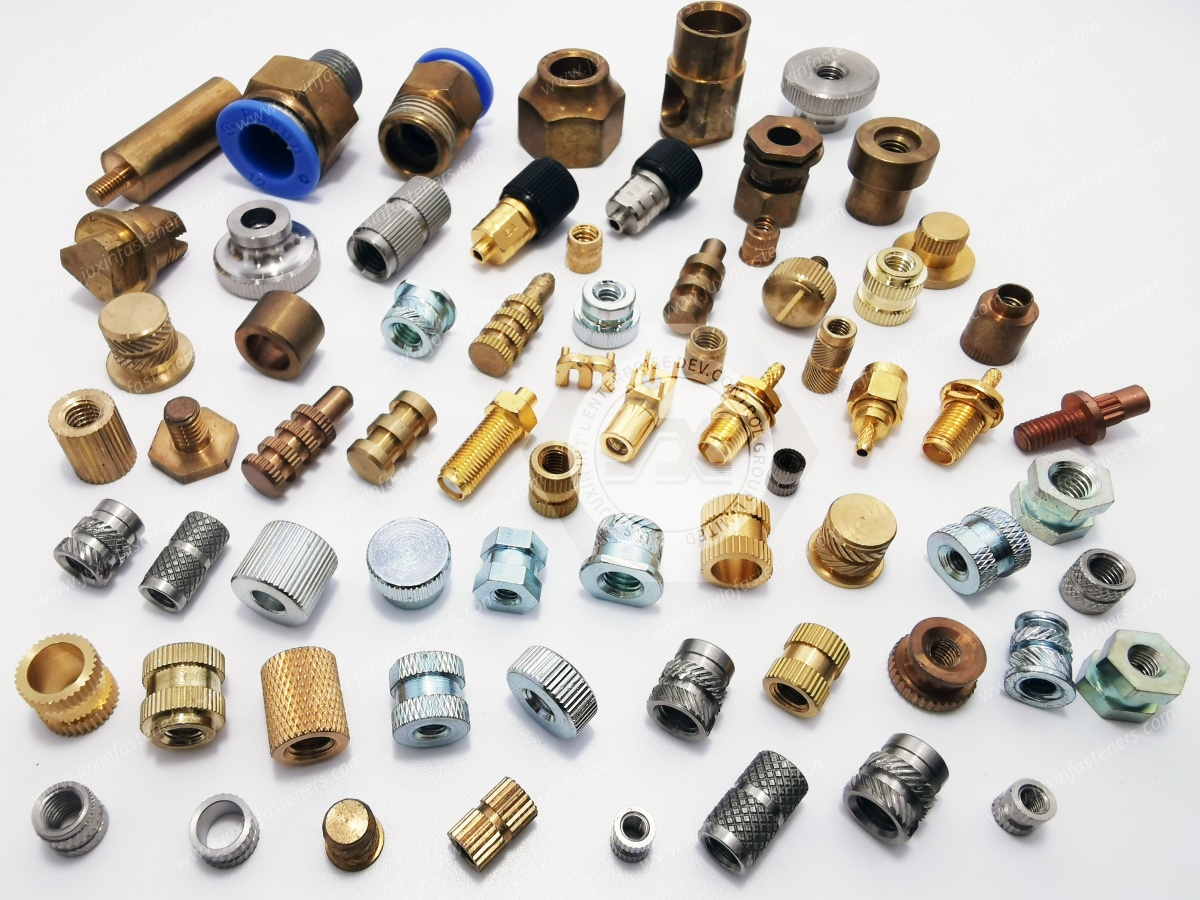
If you are developing a plastic or composite EV component and need a reliable metal fastening point, JUXIN can review your drawing, sample, material, installation process, and performance requirements.
Send us your application details or technical drawing for evaluation.
Email: info@juxinfasteners.com
Website: www.juxinfasteners.com
Product Packaging
Packaging Standard
At Juxin Fasteners, we apply standardized export packaging to ensure product protection, traceability, and compliance with international logistics requirements.
1. Standard Export Packaging
Unless otherwise specified, all products will be packed according to our factory standard export packaging, which includes:
Moisture-resistant inner protection
Poly bag or small box packing as required
Reinforced export cartons
Clear labeling with part number, specification, batch number, and quantity
Palletizing for sea or air shipment when necessary
Our standard packaging is designed to ensure safe transportation, efficient warehousing, and long-distance international shipping.
2. Customized Packaging Options
We also provide customized packaging solutions according to customer requirements, including but not limited to:
Private labeling
Customized barcodes
Specific carton dimensions
Retail packaging
Special pallet configuration
Customer-specific marking and identification
So that you know, customized packaging may involve additional costs and extended lead time depending on the complexity of the requirements.
3. Compliance & Quality Assurance
All packaging processes are controlled under our ISO 9001 quality management system to ensure consistency, traceability, and product integrity throughout the supply chain.
Product Pictures
Hot Products
Contact Us
Tel.:
+86 020 8621 0320
+86 020 3121 6067
E-mail:
Technical Support:
Navigation
SEND INQUIREY