Call Us
+86 136 6007 9809
Call Us
+86 136 6007 9809

Fastener environmental compliance is no longer limited to selecting a material that appears environmentally preferable.
For OEM manufacturers, industrial equipment producers, automotive suppliers, electrical equipment manufacturers, and global sourcing teams,
compliance can involve the base material, alloy composition, plating system, conversion coating, restricted substances,
supplier documentation, customer-specific requirements, and the regulatory scope of the finished product.
Product Specification
Fastener environmental compliance is no longer limited to selecting a material that appears environmentally preferable.
For OEM manufacturers, industrial equipment producers, automotive suppliers, electrical equipment manufacturers,
and global sourcing teams, compliance can involve the base material, alloy composition, plating system, conversion coating,
restricted substances, supplier documentation, customer-specific requirements, and the regulatory scope of the finished product.
The most commonly encountered frameworks include RoHS for applicable electrical and electronic equipment,
REACH chemical requirements, the EU End-of-Life Vehicles (ELV) framework for applicable automotive products,
customer Restricted Substance Lists (RSLs), material declarations, and industry-specific supply-chain reporting systems.
The key engineering principle is simple:
A fastener should be evaluated as part of the customer's complete product and supply chain, not as an isolated metal component.
For example, a steel weld nut may appear technically simple, but its compliance profile can depend on the steel grade, plating, conversion coating,
lubricant, passivation system, manufacturing process, and the customer's restricted-substance requirements.
Similarly, specifying "RoHS compliant fastener" is not sufficient by itself.
The procurement team should establish which regulation applies, which product configuration is covered, which substances are restricted, what evidence is required,
and whether the supplier can maintain consistent compliance across production batches.
For OEM procurement, environmental compliance therefore becomes a combination of:
Material selection
Surface-treatment selection
Chemical-substance control
Supplier qualification
Documentation management
Change control
Traceability
Customer-specific requirements
Regulatory monitoring
Production consistency
JUXIN FASTENERS supports OEM and industrial customers with fasteners, weld fasteners, self-clinching fasteners, rivet nuts, threaded inserts,
custom machined components, and application-specific surface-treatment options for projects where environmental and supply-chain requirements must be
considered together with mechanical performance and manufacturability.
Many fastener sourcing guides treat environmental compliance as a simple checklist: choose stainless steel, choose RoHS plating, obtain a declaration, and ship the product.
That approach is too simplistic for modern OEM supply chains.
A more useful approach is to separate environmental compliance into four technical layers:
Regulatory applicability
Material and chemical composition
Surface-treatment and manufacturing chemistry
Evidence and supply-chain control
These four layers should be reviewed together.
A fastener can have a suitable mechanical specification but still require additional compliance review because of its coating system or manufacturing chemistry.
Conversely, a fastener may use a conventional steel material but satisfy the applicable customer requirements when its complete material and surface-treatment system is properly controlled.
This is why environmental compliance should be incorporated into fastener engineering and procurement before mass production rather than being treated as a document request at the end of the project.
The regulatory framework relevant to a fastener depends on the final application and market.
Common areas of consideration include:
RoHS requirements for applicable electrical and electronic equipment
REACH chemical-management obligations
ELV requirements for applicable automotive applications
Customer Restricted Substance Lists
Material declarations
Full Material Declaration requirements
Automotive material-data requirements such as IMDS
Conflict minerals reporting where applicable
Customer-specific environmental specifications
Chemical restrictions associated with specific markets or product categories
The important distinction is that these frameworks do not all work in the same way.
RoHS focuses on restricted substances within its defined scope of electrical and electronic equipment.
REACH establishes a broader European chemical regulatory framework covering substances, mixtures, and articles,
with obligations depending on the substance, concentration, use, supply-chain position, and applicable requirements.
ELV addresses substances and materials in applicable end-of-life vehicle contexts and includes restrictions subject to specified conditions and exemptions.
Customer specifications can be even more restrictive than the baseline regulatory framework.
For this reason, procurement teams should avoid treating one declaration as universal evidence that a fastener satisfies every environmental requirement.
REACH is particularly important for global suppliers because its obligations are not limited to the metallic substrate of a fastener.
The compliance review may need to consider:
Base metal composition
Alloying elements
Plating chemistry
Conversion coatings
Passivation systems
Lubricants
Sealants
Organic coatings
Processing chemicals
Substances of Very High Concern (SVHCs)
Customer-specific chemical restrictions
For articles, supply-chain obligations can include communication requirements associated with substances meeting applicable criteria and thresholds.
Therefore, procurement teams should not simply ask:
"Is this fastener REACH certified?"
A more useful RFQ question is:
"Can the supplier provide the applicable REACH/SVHC status and supporting material or substance information for the specified fastener configuration?"
This creates a much clearer technical and commercial requirement.
REACH should also be treated as an ongoing compliance-management issue rather than a document that is obtained once and never reviewed again.
If a plating chemistry, raw material source, lubricant, or manufacturing process changes, the compliance status may need to be reassessed according to the customer's requirements.
Environmental compliance becomes much easier to manage when the supplier can identify what is actually present in the supplied component.
This is why material declarations and substance-level transparency have become increasingly important in OEM procurement.
A Full Material Declaration, or FMD, is a detailed representation of the materials and substances associated with a component.
Depending on the customer's system and reporting requirements, this may include information about:
Base material
Alloy composition
Coating layers
Conversion coatings
Lubricants
Sealants
Organic materials
Manufacturing-related substances where applicable
Substance percentages or ranges
Material classifications
Supplier information
Part identification
An FMD is not simply the same thing as a general certificate.
A certificate may state that a product meets a defined requirement.
A material declaration provides information that allows the customer to evaluate the component within its own compliance system.
For OEM procurement, this distinction is important.
A fastener supplier should be able to identify the actual supplied configuration rather than relying on generic statements about a product family.
For example, "steel fastener" is not sufficient material information when the component has multiple coating layers.
A more useful technical description might identify:
Steel substrate → zinc coating → conversion coating → optional sealant or lubricant
The exact composition and reporting requirements depend on the specified product and customer system.
For automotive programs, the International Material Data System (IMDS) is an important material-data reporting system used throughout automotive supply chains.
IMDS is not a universal certification for fasteners.
Instead, it is a structured system for managing material information within the automotive supply chain.
A fastener supplied into an automotive assembly may therefore require more than a general environmental declaration.
The customer may require:
Material data
Substance composition
Part identification
Supplier information
Material classifications
IMDS submission
Customer-specific approval
Revision control
This is particularly relevant to:
Automotive body structures
EV battery systems
Chassis components
Seating systems
Electrical systems
Power electronics
Interior and exterior assemblies
Thermal-management systems
The earlier material data is prepared, the lower the risk of delaying customer approval later in the product-development cycle.
Environmental compliance creates two different but connected decision paths.
Engineering teams are primarily concerned with whether the selected fastener will function reliably.
Procurement teams are concerned with whether the supplier can deliver the specified fastener consistently, competitively, and with the required documentation.
The best sourcing strategy addresses both.
Engineering teams typically evaluate:
Base material
Mechanical properties
Thread specification
Fastener geometry
Parent-material compatibility
Installation method
Weldability where applicable
Corrosion environment
Surface-treatment compatibility
Hydrogen-embrittlement considerations for susceptible high-strength steels
Thread fit after coating
Assembly torque and friction behavior
Electrical requirements where applicable
Temperature and environmental exposure
Dimensional tolerances
Manufacturing repeatability
Change-control requirements
Environmental compliance should be considered together with these parameters.
For example, changing from one coating system to another may alter more than the environmental documentation.
It can also influence:
Coating thickness
Thread fit
Friction
Installation behavior
Appearance
Corrosion performance
Hydrogen-embrittlement risk for susceptible materials
Production process
Cost
Therefore, engineering approval should cover the complete fastener configuration rather than only the substrate material.
Procurement teams need to answer a different set of questions:
Can the supplier manufacture the required configuration?
Can the supplier maintain the same material and coating system during serial production?
Can compliance documentation be provided?
Can the supplier support customer-specific RSL requirements?
Can material changes be controlled?
Can the supplier support audits?
Can documentation be updated when regulations change?
Can the supplier maintain consistent quality across production batches?
Can the supplier provide traceability?
Can the supplier support global delivery requirements?
Can the supplier provide competitive total cost?
Can the supplier support engineering changes without uncontrolled substitution?
This is why environmental compliance is also a supplier-qualification issue.
A low-cost fastener without reliable compliance documentation can create substantially higher downstream costs through customer approval delays,
requalification, production disruption, or rejected shipments.
Environmental requirements vary significantly between industries.
The correct approach is to identify the final application and then determine which regulatory and customer requirements apply.
Automotive programs commonly involve:
ELV requirements
Customer Restricted Substance Lists
Material declarations
IMDS
Supplier chemical controls
Surface-treatment specifications
Corrosion requirements
Traceability
Engineering change control
Fasteners may be used in:
Body-in-white
Chassis
Seating
Interior systems
Battery enclosures
Electrical systems
Power electronics
HVAC systems
EV thermal-management systems
JUXIN FASTENERS supplies fastening solutions for automotive and new-energy vehicle applications, including self-clinching fasteners,
weld fasteners, rivet nuts, threaded inserts, plastic fastening components, clips, rivets, and custom components.
EV battery systems combine mechanical fastening with demanding environmental and electrical requirements.
Fasteners may be used in:
Battery enclosures
Cooling systems
Electrical housings
Busbar assemblies
Battery-management-system housings
Structural battery components
Service-access panels
Thermal-management components
In these applications, the surface treatment must be evaluated together with:
Parent material
Corrosion exposure
Electrical considerations
Mechanical requirements
Assembly process
Hydrogen-embrittlement considerations
Customer environmental specifications
A coating should therefore not be selected only because it is described as "environmentally friendly."
It must also be suitable for the actual engineering environment.
Electrical and electronic equipment can fall within the scope of RoHS depending on the finished product.
Fasteners used in these systems may include:
Self-clinching nuts
Self-clinching studs
Weld nuts
Weld studs
Rivet nuts
Threaded inserts
Machine screws
Custom metal components
Typical concerns include:
Restricted substances
Surface coatings
Corrosion resistance
Electrical compatibility
Thread reliability
Assembly repeatability
Customer documentation
Telecommunications equipment may require long service life and controlled material selection.
Fasteners are commonly used in:
Equipment cabinets
Sheet-metal enclosures
Network hardware
Outdoor communication equipment
Power modules
Thermal-management assemblies
Environmental requirements may be combined with:
Corrosion requirements
Outdoor exposure
Customer RSLs
Material declarations
Surface-treatment specifications
Industrial machinery manufacturers often use large quantities of standard and custom fasteners.
Environmental requirements can apply to:
Machine housings
Control cabinets
Electrical systems
Production equipment
Automation systems
Industrial enclosures
Procurement teams should consider both regulatory requirements and customer-specific sustainability policies.
Railway applications can require tightly controlled materials, coatings, corrosion performance, and supplier documentation.
Fasteners may be used in:
Electrical cabinets
Interior structures
HVAC equipment
Equipment housings
Structural assemblies
Passenger systems
The applicable environmental requirements depend on the specific vehicle, equipment, market, and customer specification.
Solar, energy-storage, power-conversion, and electrical equipment can involve extensive outdoor exposure and long service-life requirements.
Fastener selection may need to consider:
Corrosion environment
Base material
Coating system
Mechanical requirements
Electrical compatibility
Environmental restrictions
Customer specifications
JUXIN FASTENERS supports industrial fastening requirements for power and energy equipment with application-specific material and surface-treatment options.
HVAC and sheet-metal assemblies frequently use:
Weld nuts
Weld studs
Self-clinching fasteners
Rivet nuts
Threaded inserts
Custom sheet-metal fasteners
The selected surface treatment should be evaluated according to the environment, substrate, mechanical requirement, assembly method, and customer environmental specification.
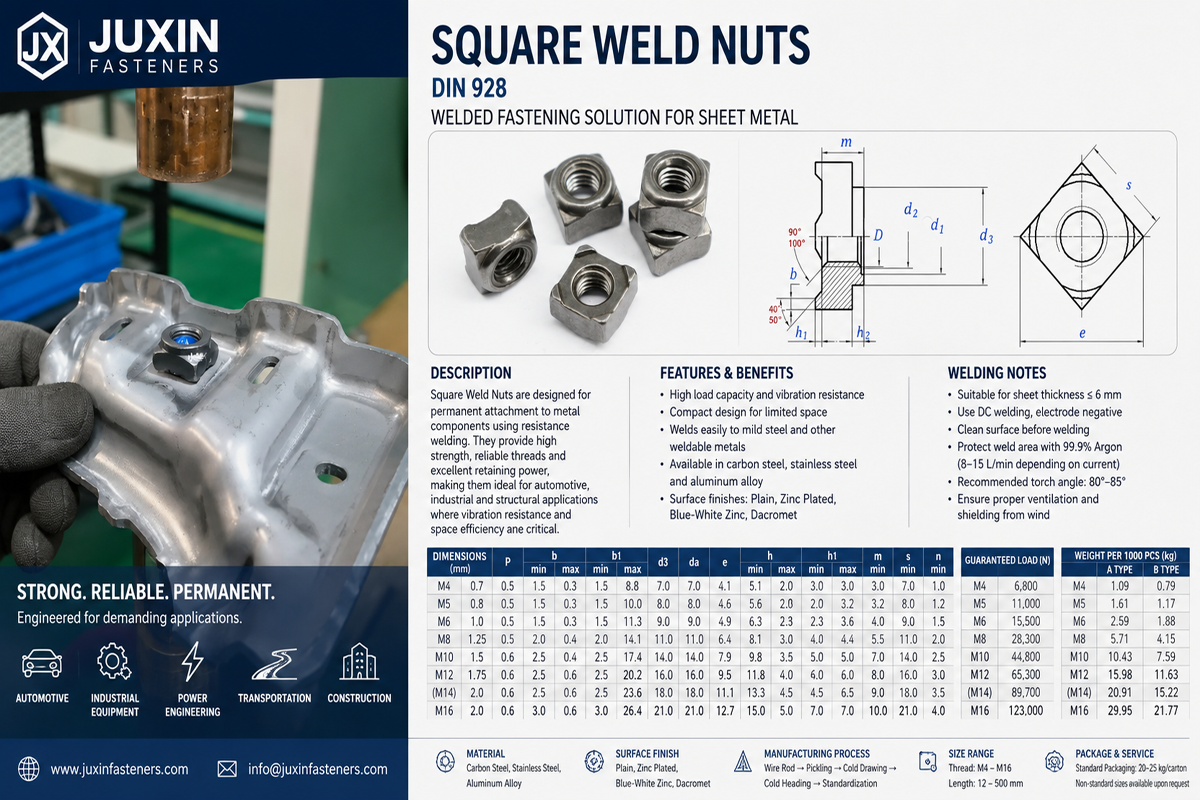
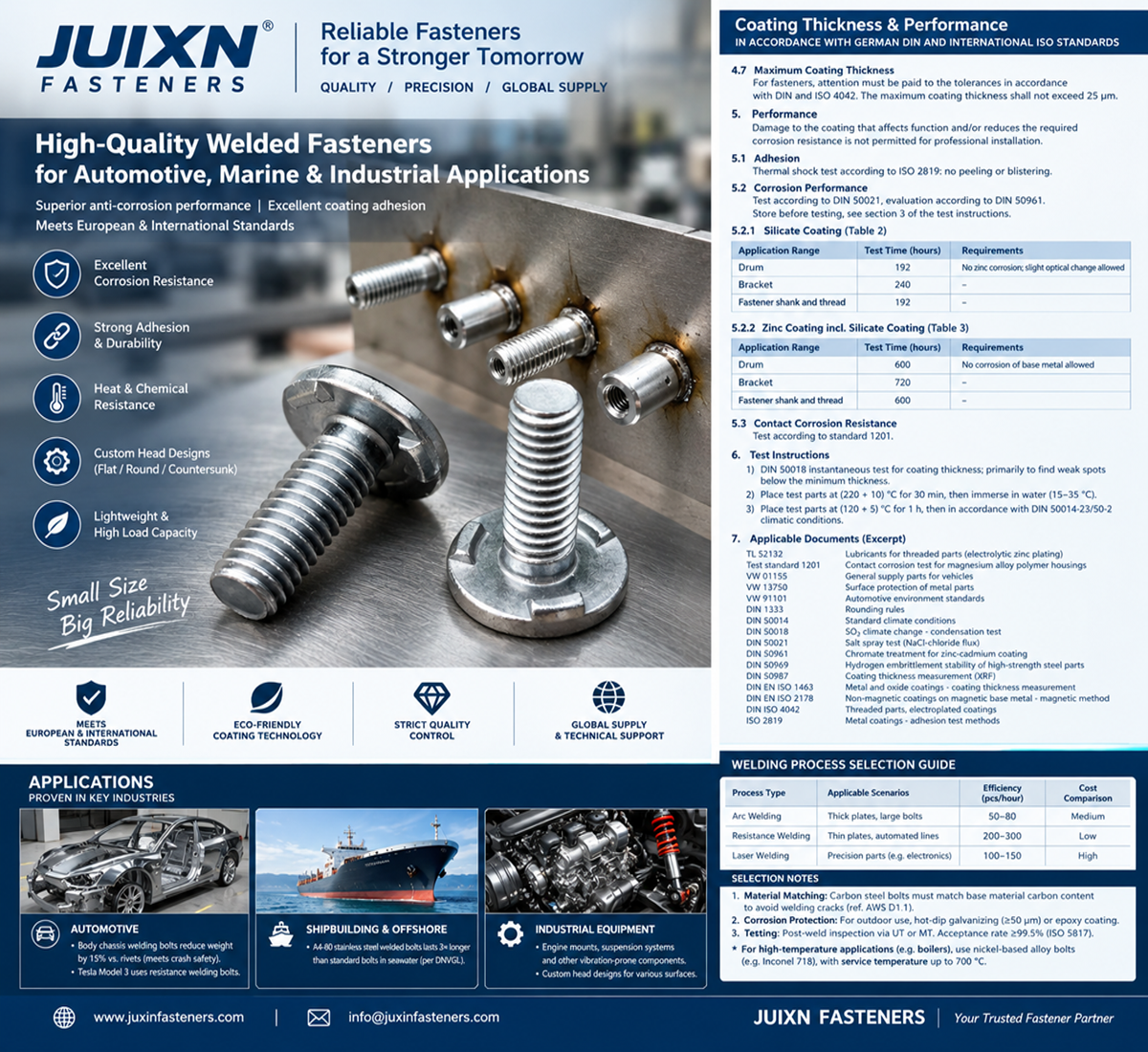
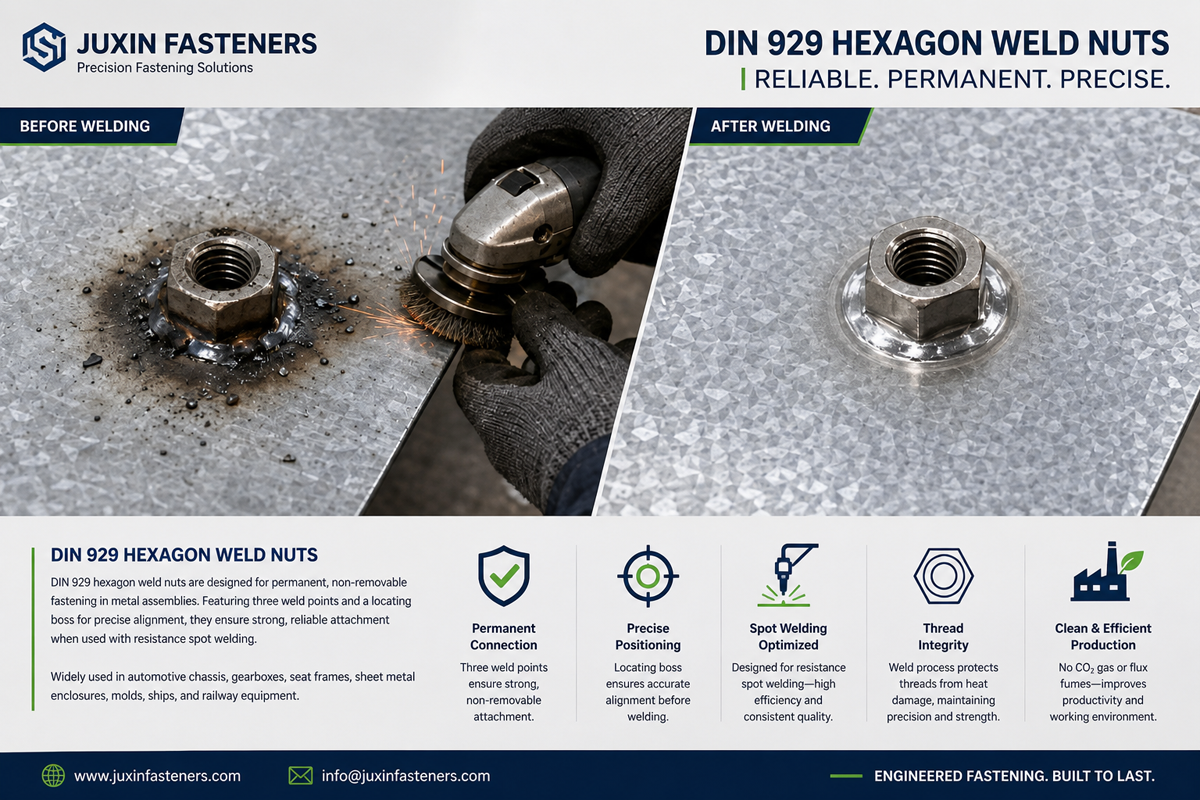
Weld fasteners deserve particular attention because the environmental compliance profile can involve both the fastener material and the welding process.
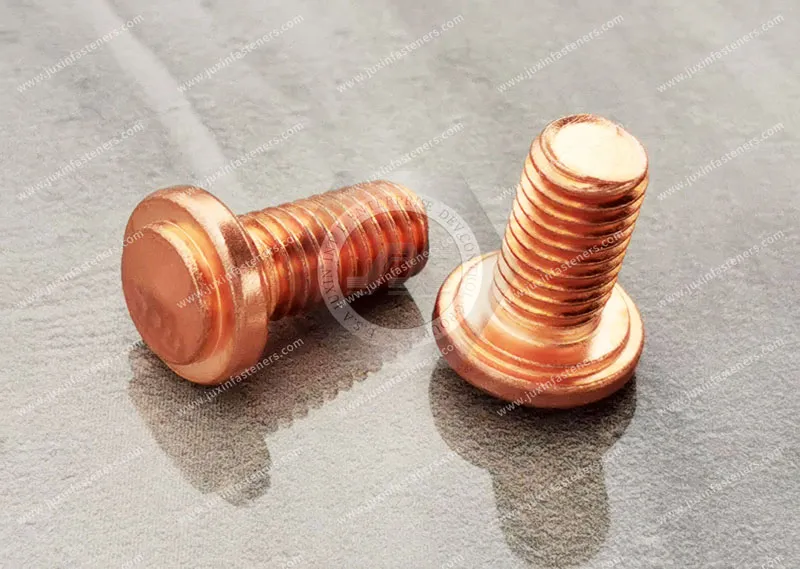
Common products include:
Projection weld nuts
Hex weld nuts
Square weld nuts
Flanged weld nuts
Weld studs
Weld screws
Custom projection weld fasteners
A weld fastener specification should consider:
Parent material
Sheet thickness
Weld process
Projection geometry
Welding current and process control
Coating condition
Post-weld corrosion protection
Thread specification
Mechanical requirements
Production volume
Customer environmental requirements
Surface treatment can be especially important.
Some coatings may influence welding behavior, electrical contact, weld quality, fumes, post-weld protection, or downstream finishing requirements.
Therefore, the coating specification should be established before production rather than changed independently by the supplier.
For OEM applications, JUXIN FASTENERS can support the selection of weld nuts, weld studs,
weld screws, and custom weld fasteners according to the component geometry, parent material, assembly process, and applicable customer requirements.
Zinc-plated steel fasteners are widely used in industrial and OEM applications because zinc provides sacrificial corrosion protection to steel.
The environmental discussion should distinguish the zinc coating from the conversion coating applied over it.
A typical system may include:
Steel substrate → zinc coating → conversion coating/passivation → optional sealer or additional treatment
Trivalent chromium conversion systems are widely used as alternatives to older hexavalent-chromium-based processes.
However, the term "trivalent chromium" alone does not automatically establish complete RoHS compliance.
Compliance depends on the complete product configuration and the applicable regulatory/customer requirements.
When evaluating a trivalent chromium zinc-plated fastener, procurement and engineering teams should review:
Base material
Zinc coating
Conversion coating
Coating thickness
Corrosion requirement
Mechanical grade
Thread specification
Lubrication
Regulatory requirements
Customer restricted substances
Documentation requirements
JUXIN FASTENERS provides trivalent chromium zinc-plated fastener options for applicable OEM and industrial applications and evaluates surface treatment together with substrate,
mechanical requirements, corrosion environment, thread fit, assembly process, and customer requirements.
For high-strength steel fasteners, hydrogen-embrittlement risk should also be considered when the applicable manufacturing and surface-treatment process creates such a risk.
Different applications require different surface-treatment strategies.
Potential options may include:
Zinc plating
Trivalent chromium conversion systems
Zinc-nickel plating
Zinc-aluminum coatings
Dacromet-type systems
Stainless steel passivation
Other application-specific treatments
Zinc-nickel coatings, for example, may be considered where the application requires a different combination of corrosion resistance, coating behavior, and environmental performance.
However, no surface treatment should be selected solely on the basis of a generic performance label.
The engineering evaluation should include:
Substrate
Required corrosion performance
Mechanical strength
Hydrogen-embrittlement sensitivity
Thread fit
Friction behavior
Installation process
Temperature exposure
Customer specifications
Environmental restrictions
Cost
Production capability
For OEM procurement, the coating should be treated as part of the complete fastener specification.
This distinction is critical.
A fastener can satisfy a particular environmental requirement while still being unsuitable for a demanding corrosion environment.
Conversely, a coating can provide strong corrosion performance while requiring additional review against a customer-specific restricted-substance requirement.
Environmental compliance and corrosion performance are therefore two different engineering dimensions.
The correct selection process is:
Regulatory requirements + chemical restrictions + mechanical requirements + corrosion environment + assembly requirements + customer specifications
For example, changing a coating because of an environmental requirement may affect:
Coating thickness
Thread fit
Friction
Torque behavior
Clamping behavior
Appearance
Corrosion performance
Production process
This is why a coating change should be treated as an engineering change, not simply a purchasing substitution.
A well-written RFQ can significantly reduce environmental-compliance risk.
Instead of simply requesting "RoHS and REACH compliant fasteners," procurement teams should provide or request the following information.
Part number
Drawing revision
Fastener type
Thread specification
Material specification
Mechanical grade
Dimensions
Surface treatment
Coating requirements
Application
Applicable regulatory framework
Customer Restricted Substance List
RoHS requirement where applicable
REACH/SVHC requirements
ELV requirements where applicable
Material declaration requirements
IMDS requirements for applicable automotive programs
Conflict minerals reporting where applicable
Customer-specific chemical restrictions
Material declaration
Applicable compliance declaration
Surface-treatment information
Raw-material information where required
Manufacturing-location information
Change-control procedure
Traceability information
Supporting test or analytical documentation where required
The more precise the RFQ is, the less likely the supplier will make an incorrect assumption.
Environmental compliance should form part of the supplier-qualification process.
A procurement team should evaluate whether the supplier can control:
Can the supplier maintain the specified steel, stainless steel, aluminum, brass, or other material?
Can the supplier maintain the specified coating and conversion system?
Can the supplier provide updated compliance documentation when required?
Will the supplier notify the customer before changing:
Raw material
Plating supplier
Coating chemistry
Manufacturing location
Manufacturing process
Lubricant
Surface treatment
Can the supplier identify the relevant production batch and material information when required?
Can the supplier respond to customer environmental questionnaires, declarations, and material-data requests?
This supplier capability can be more valuable than a generic compliance statement.
The lowest unit price is not always the lowest sourcing cost.
Environmental compliance can affect total cost through:
Engineering review
Documentation
Customer approval
Testing
Supplier qualification
Requalification
Production interruption
Material changes
Regulatory updates
Customer audits
Nonconforming shipments
A supplier that provides clear documentation and controlled production can reduce these hidden costs.
For OEM procurement, total cost should therefore consider:
Part price + tooling + logistics + compliance management + quality risk + requalification risk + supply-chain risk
This is particularly important for high-volume automotive, EV, electrical, industrial, and energy applications.
Environmental requirements should be written clearly on engineering drawings.
Avoid vague notes such as:
"Must be environmentally friendly."
Instead, identify the applicable requirements.
For example:
Material: As specified
Surface Treatment: As specified
Environmental Requirement: Meet applicable customer Restricted Substance List requirements and applicable regulatory requirements for the intended application.
Documentation: Supplier shall provide applicable material and environmental compliance documentation upon request.
Change Control: Material or surface-treatment changes require customer approval where required by the applicable quality agreement or purchasing specification.
The exact wording should always be adapted to the customer's contractual and regulatory requirements.
This approach gives engineering and procurement teams a common technical reference.
Before approving an OEM fastener supplier, procurement teams can review the following checklist:
Is the applicable market identified?
Is the final product within the scope of the relevant regulation?
Are customer-specific requirements identified?
Are applicable exemptions or special conditions understood?
Is the base material clearly specified?
Is the material grade controlled?
Is the supplier able to provide required material information?
Is the plating system clearly identified?
Is the conversion coating identified where relevant?
Has corrosion performance been evaluated?
Has hydrogen-embrittlement risk been considered for susceptible materials?
Has thread fit after coating been considered?
Is a material declaration required?
Is an FMD required?
Is IMDS required?
Is a customer compliance declaration required?
Is supporting test information required?
Is the supplier qualified?
Is material traceability available?
Is change control established?
Are subcontracted plating processes controlled?
Can the supplier support customer audits and questionnaires?
Is the approved configuration locked?
Are coating and material substitutions controlled?
Is batch consistency monitored?
Are quality records retained according to customer requirements?
JUXIN FASTENERS provides a range of fastening solutions for OEM and industrial applications where mechanical performance,
manufacturability, surface treatment, and supply-chain requirements must be considered together.
Product categories include:
Self-clinching nuts
Self-clinching studs
Self-clinching fasteners
Blind rivet nuts
Rivet nuts
Blind threaded studs
Threaded inserts for plastic
Weld nuts
Weld studs
Weld screws
Custom screws
Custom bolts
CNC-machined fasteners
Stainless steel fasteners
High-strength fasteners
Surface-treatment options can include:
Zinc plating
Trivalent chromium zinc plating
Zinc-nickel
Zinc-aluminum
Dacromet-type systems
Stainless steel passivation
Other application-specific treatments
The correct selection depends on the complete engineering specification.
For example, a fastener used in an EV battery enclosure may require a different solution from a fastener used in an indoor industrial control cabinet, even when the nominal fastener dimensions are similar.
JUXIN FASTENERS evaluates material, geometry, surface treatment, application environment, assembly method, and customer requirements as part of the sourcing process.
Environmental compliance should not begin when the purchasing department places the production order.
A stronger process begins during product development.
Engineering identifies:
Material
Fastener geometry
Assembly method
Surface treatment
Environmental conditions
Regulatory requirements
The team validates:
Installation
Thread fit
Mechanical performance
Surface treatment
Corrosion behavior where required
Customer documentation
Procurement evaluates:
Manufacturing capability
Quality systems
Material control
Surface-treatment control
Environmental documentation
Change-control procedures
The supplier maintains:
Approved material
Approved coating
Production consistency
Traceability
Documentation
Change control
Any change involving:
Material
Coating
Lubricant
Manufacturing location
Plating supplier
Production process
should be evaluated according to the customer's change-control requirements.
This lifecycle approach is much more robust than treating compliance as a one-time certificate.
Global OEMs increasingly operate multi-country supply chains.
A fastener may be:
Designed in Germany
Sourced from Asia
Plated by a specialized supplier
Assembled in the United States
Installed into equipment sold globally
This creates a complex compliance chain.
The procurement organization therefore needs visibility into:
Raw material → Fastener manufacturing → Surface treatment → Documentation → OEM assembly → Final market
A change at any stage can potentially trigger a new compliance review.
This is especially important when multiple factories or suppliers provide supposedly equivalent fasteners.
"Equivalent dimension" does not necessarily mean "equivalent compliance configuration."
The same DIN or ASME dimensional designation can be produced using different materials, coatings, lubricants, or manufacturing routes.
For controlled OEM programs, the complete configuration should therefore be defined.
Environmental compliance is easiest to manage when it is considered before the fastener is frozen into the product design.
Late-stage changes can affect:
Drawings
BOMs
Supplier approvals
Customer submissions
Material declarations
Testing
Production tooling
Assembly processes
Inventory
Cost
For example, if a coating is found to be unsuitable after production tooling and customer approval have already been completed, changing the coating may require engineering review and requalification.
By identifying the environmental requirement at the beginning, engineering can select a suitable fastener configuration before the design becomes difficult to change.
This is particularly valuable for:
Automotive
EV
Battery systems
Electrical equipment
Data-center equipment
Power electronics
Industrial automation
Renewable energy
Railway equipment
For OEM customers, a structured RFQ process can make environmental compliance significantly easier.
Provide:
Drawing
Part number
Revision
Quantity
Target application
Identify:
Base material
Mechanical requirement
Surface treatment
Corrosion requirement
Environmental restrictions
Specify applicable:
RoHS requirements
REACH requirements
ELV requirements
Customer RSL
Material declaration requirements
IMDS requirements
Other customer-specific requirements
The supplier evaluates:
Manufacturability
Material
Geometry
Thread
Coating
Assembly
Quality requirements
The customer validates the proposed configuration.
The supplier provides the documentation required by the customer and applicable program.
The approved material, surface treatment, and manufacturing configuration are controlled throughout serial production.
Any relevant change is communicated and reviewed according to the applicable customer requirements.
This process aligns engineering, procurement, quality, and compliance teams around one approved fastener configuration.
For projects involving environmental compliance and OEM fastener sourcing, relevant JUXIN FASTENERS solutions include:
Trivalent Chromium Zinc-Plated Fasteners
Useful when the project requires zinc-plated steel fasteners with an environmentally considered conversion-coating system and controlled surface-treatment specifications.
Weld Fasteners for Sheet Metal
Suitable for OEM sheet-metal assemblies where weld nuts, weld studs, weld screws, or custom projection fasteners must be matched to the parent material and welding process.
Automotive and EV Fastening Solutions
Includes self-clinching fasteners, weld fasteners, rivet nuts, threaded inserts, clips, rivets, and custom fastening components for automotive and new-energy vehicle applications.
Blind Rivet Nuts and Studs
Useful where internal threads must be installed into accessible or difficult-to-access sheet-metal structures.
Threaded Inserts for Plastic
Suitable for plastic components where the design requires a more durable internal threaded connection.
Custom CNC-Machined Fasteners
For applications where standard fasteners do not satisfy the required geometry, material, thread, surface treatment, or assembly requirements.
These solutions can be evaluated according to the customer's drawing, application environment, production requirements, and environmental specifications.
No.
RoHS applies to electrical and electronic equipment within its defined scope.
A fastener used in an applicable product may therefore become part of the customer's RoHS compliance management, but the applicability should be determined based on the final product and regulatory scope.
No.
RoHS and REACH address different regulatory frameworks.
RoHS focuses on specified restricted substances in applicable electrical and electronic equipment,
while REACH is a broader chemical regulatory framework covering substances, mixtures, and articles under defined obligations.
No.
Trivalent chromium describes the oxidation state of chromium used in a conversion-coating system. It does not, by itself, establish complete RoHS compliance for the entire fastener configuration.
The complete material and surface-treatment system must be evaluated against the applicable requirements.
Not in the simple sense of a universal product certification.
REACH creates obligations that depend on the substances, articles, uses, supply-chain role, and applicable requirements.
Customers may request REACH-related declarations or substance information as part of their supplier-compliance process.
Not every fastener in every situation automatically requires the same IMDS treatment.
For automotive supply chains where IMDS reporting is required by the customer or program, the fastener material information may need to be submitted through IMDS.
No.
Zinc-nickel is a surface-treatment option with particular technical characteristics. Its suitability must be evaluated against the complete application,
including corrosion requirements, substrate, mechanical properties, hydrogen-embrittlement considerations, thread fit, customer specifications, and environmental requirements.
No.
Stainless steel can be an excellent material for many applications, but material selection alone does not establish compliance with every applicable regulation or customer requirement.
For controlled OEM programs, a coating change should not be treated as an insignificant substitution.
The coating can affect corrosion performance, friction, thread fit, assembly behavior, appearance, chemical composition, and customer compliance documentation.
Any change should therefore be evaluated according to the applicable drawing, purchasing specification, quality agreement, and change-control process.
At minimum, the RFQ should identify the part number, drawing revision, material, surface treatment, application, applicable regulatory requirements,
customer Restricted Substance List, required declarations, and any automotive material-data requirements such as IMDS.
Yes. JUXIN FASTENERS can evaluate custom fasteners according to the customer's drawing, material, geometry, surface treatment, application, production requirements,
and applicable environmental or customer-specific specifications.
Environmental compliance should not be treated as a final paperwork exercise.
For OEM programs, the correct fastener solution needs to connect:
Engineering specification + Material + Surface treatment + Regulatory requirements + Documentation + Production control
JUXIN FASTENERS supports global OEM and industrial customers with fastening solutions including self-clinching fasteners, weld nuts, weld studs,
weld screws, rivet nuts, threaded inserts, custom screws, bolts, CNC-machined fasteners, and application-specific surface treatments.
If your project requires environmental documentation, restricted-substance control, material declarations, customer-specific compliance requirements,
or a controlled surface-treatment specification, provide the drawing and purchasing requirements for technical review.
Our team can evaluate the fastener configuration against:
Material requirements
Thread and dimensional requirements
Surface-treatment requirements
Corrosion environment
Assembly process
Environmental requirements
Customer documentation
Production and sourcing requirements
Send your OEM fastener drawing and requirements to:
JUXIN FASTENERS
Precision Fastening Solutions Since 2003
Fastener environmental compliance is not simply a matter of adding "RoHS" or "REACH" to a purchase order.
A reliable OEM compliance strategy requires the complete fastener configuration to be understood and controlled.
The most important factors are:
Determine which regulations actually apply to the final product.
Define the base material clearly.
Define the complete surface-treatment system.
Identify customer-specific Restricted Substance Lists.
Establish material and substance documentation requirements.
Use appropriate material-data systems where required.
Control suppliers and subcontracted surface-treatment processes.
Maintain traceability and change control.
Evaluate environmental compliance together with mechanical and corrosion requirements.
Address compliance during product development rather than after production begins.
For procurement teams, the objective is not simply to purchase a fastener with a compliance statement.
The objective is to establish a controlled, technically suitable, documented, and repeatable fastening solution that can support the customer's product lifecycle and global supply chain.
That is the difference between checking a compliance box and building a reliable OEM fastening program.
Product Packaging
Packaging Standard
At Juxin Fasteners, we apply standardized export packaging to ensure product protection, traceability, and compliance with international logistics requirements.
1. Standard Export Packaging
Unless otherwise specified, all products will be packed according to our factory standard export packaging, which includes:
Moisture-resistant inner protection
Poly bag or small box packing as required
Reinforced export cartons
Clear labeling with part number, specification, batch number, and quantity
Palletizing for sea or air shipment when necessary
Our standard packaging is designed to ensure safe transportation, efficient warehousing, and long-distance international shipping.
2. Customized Packaging Options
We also provide customized packaging solutions according to customer requirements, including but not limited to:
Private labeling
Customized barcodes
Specific carton dimensions
Retail packaging
Special pallet configuration
Customer-specific marking and identification
So that you know, customized packaging may involve additional costs and extended lead time depending on the complexity of the requirements.
3. Compliance & Quality Assurance
All packaging processes are controlled under our ISO 9001 quality management system to ensure consistency, traceability, and product integrity throughout the supply chain.
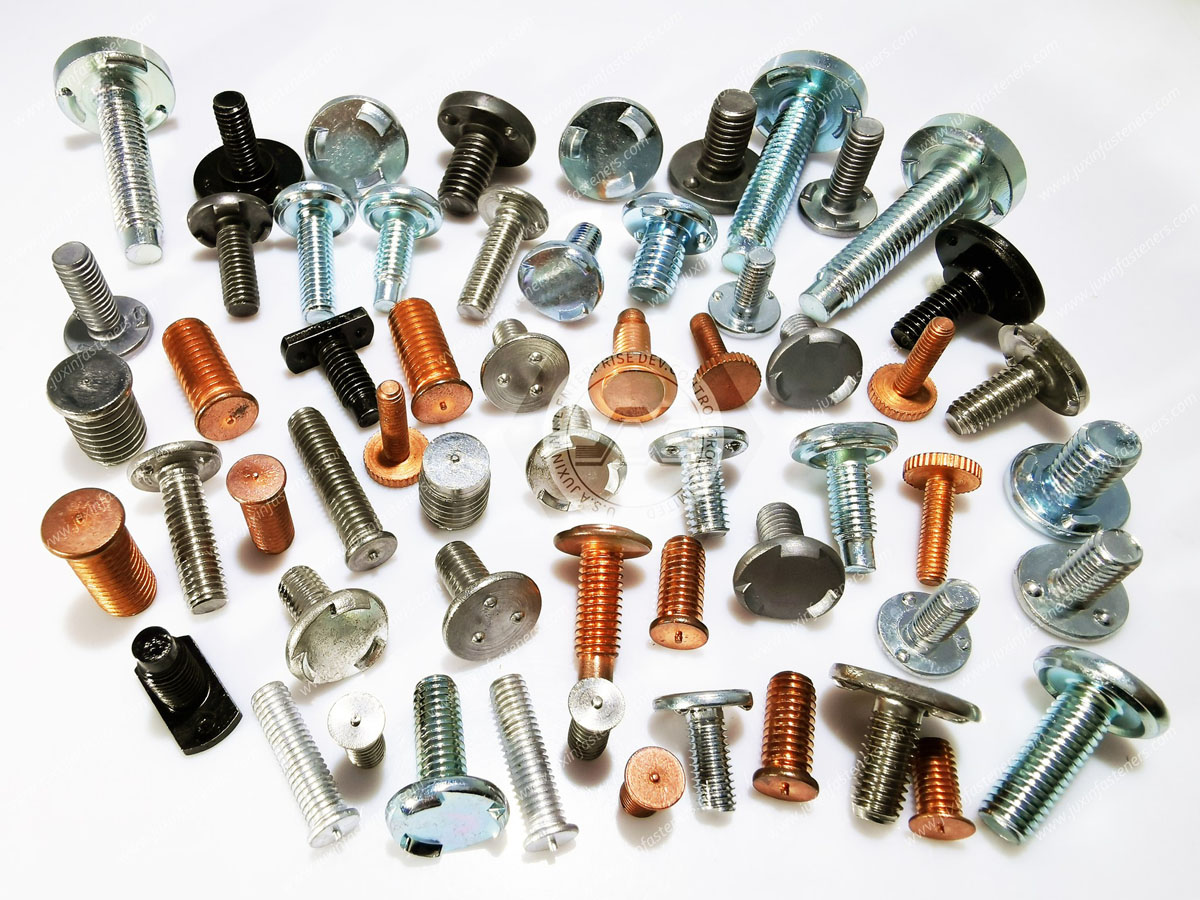
Product Pictures
Contact Us
Tel.:
+86 020 8621 0320
+86 020 3121 6067
E-mail:
Technical Support:
Navigation
SEND INQUIREY