Call Us
+86 136 6007 9809
Call Us
+86 136 6007 9809

How do industrial engineers select fastener surface finishes and coatings for welded assemblies?
Fastener surface finishes and coatings must be selected as part of the complete fastening system rather than as an isolated cosmetic or corrosion-protection feature.
Product Specification
How do industrial engineers select fastener surface finishes and coatings for welded assemblies?
Fastener surface finishes and coatings must be selected as part of the complete fastening system rather than as an isolated cosmetic or corrosion-protection feature.
For OEM weld fasteners, the selected surface condition can influence:
Corrosion resistance
Resistance-welding behavior
Electrical contact resistance
Hydrogen-embrittlement risk
Thread dimensional stability
Friction during tightening
E-coating compatibility
Paint adhesion
Galvanic corrosion behavior
Environmental durability
Assembly automation
Regulatory compliance
Long-term supply-chain consistency
Because weld nuts and weld studs can be integrated directly onto stamped or fabricated metal panels before downstream painting and finishing,
the surface-treatment sequence must be considered together with the welding process.
An inappropriate coating, excessive coating buildup, unsuitable surface chemistry, or poorly controlled pre-weld condition can contribute to:
Welding instability
Increased contact resistance
Weld spatter
Electrode contamination
Thread interference
Changes in friction behavior
Coating adhesion problems
Corrosion at interfaces
Hydrogen-related risk for susceptible high-strength steel
Dimensional variation
A simplified OEM surface-treatment architecture can be represented as:
   [ Base Fastener Material ]
               |
               v
   [ Pre-Weld Surface Condition ]
               |
               v
   [ Resistance Welding Process ]
               |
               v
   [ Post-Weld / Downstream Finish ]
               |
               v
   [ E-Coating / Painting / Assembly ]
               |
               v
   [ Environmental Exposure ]
               |
               v
   [ Corrosion + Mechanical Durability ]
An alternative manufacturing sequence may place a specified coating before welding, after welding, or use a weld-compatible surface condition followed by downstream finishing.
The correct sequence depends on the customer's process.
For international fastener engineering, standards such as ISO 4042 for electroplated coating systems and ISO 10683 for non-electrolytically
applied zinc-flake coatings can provide useful specification frameworks where applicable.
Other standards and customer specifications may apply depending on the fastener, coating system, industry, and region.
ASTM B117 is widely used as a neutral salt spray test method for evaluating corrosion behavior under defined laboratory conditions.
It should be treated as a comparative or qualification test method, not as a direct prediction of field service life.
For OEM procurement, the correct question is therefore not:
“Which coating has the highest salt-spray number?”
The better question is:
“Which surface-treatment system provides the required corrosion, welding, dimensional, electrical, assembly, environmental, and regulatory performance for this specific production process?”
JUXIN FASTENERS supports OEM and industrial customers in evaluating fastener materials, surface treatments, welding requirements, corrosion requirements, and production specifications as part of a complete sourcing program.
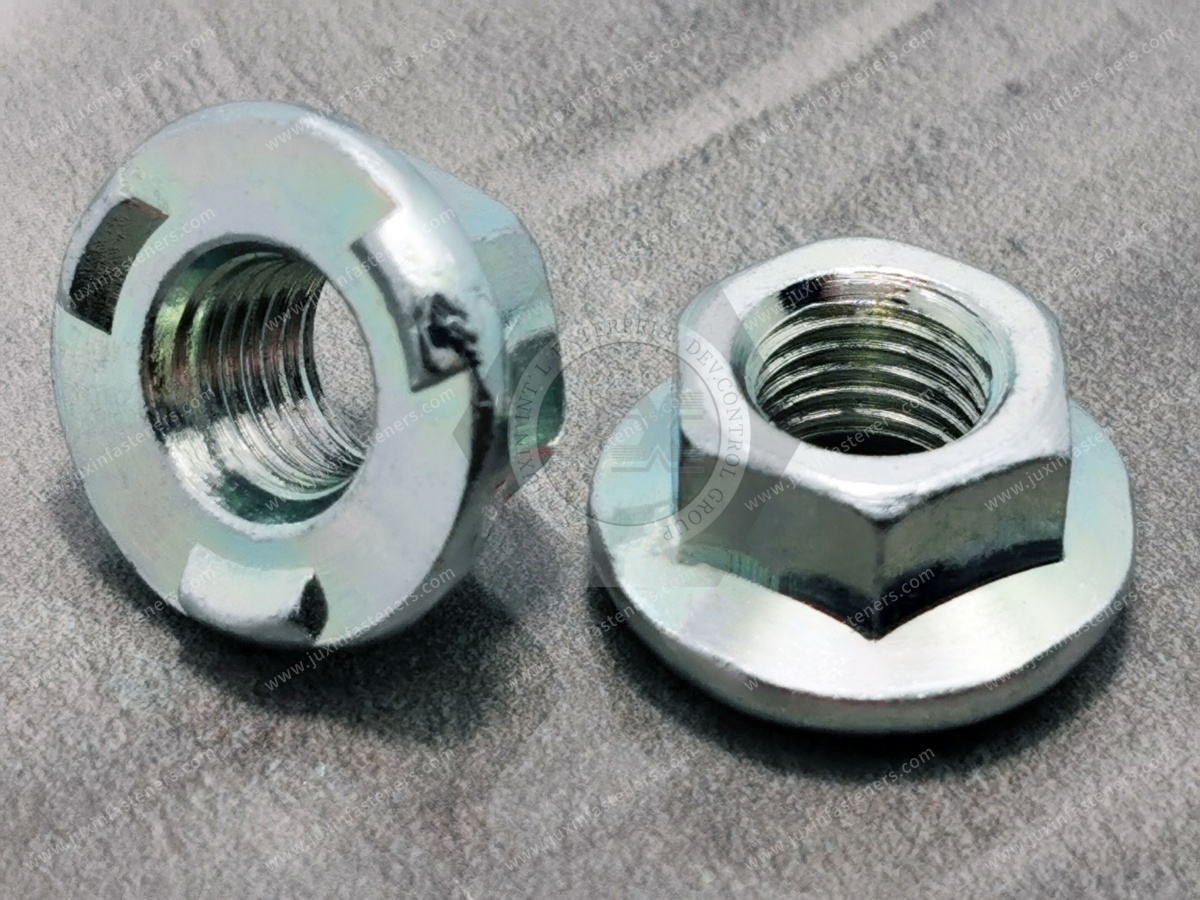
Industrial fasteners may use different surface finishes depending on the required combination of corrosion protection, welding compatibility, appearance, friction, electrical performance, and manufacturing sequence.
There is no single coating that is optimal for every weld fastener.
Zinc electroplating provides sacrificial corrosion protection for steel fasteners and is widely used in industrial fastening applications.
Its engineering considerations include:
Coating thickness
Thread dimensional buildup
Hydrogen generation during electrolytic processing
Post-plating hydrogen-relief requirements where applicable
Corrosion performance
Welding sequence
Surface passivation
Friction characteristics
For susceptible high-strength steel fasteners, electrolytic processing requires appropriate hydrogen-embrittlement risk management.
The coating specification should therefore be considered together with:
Fastener hardness
Material condition
Plating process
Cleaning and pickling process
Hydrogen-relief treatment
Customer specification
Zinc-nickel (Zn-Ni) coatings are used when a higher level of corrosion protection is required than may be provided by conventional zinc systems.
Potential advantages can include:
Improved corrosion resistance
Strong sacrificial protection
Suitability for demanding automotive and industrial environments
Compatibility with selected downstream coating systems
Controlled appearance and surface characteristics
Nickel content, coating structure, passivation, topcoat, coating thickness, and process chemistry can vary by coating system.
Therefore, a statement such as “Zn-Ni always contains 12–15% nickel” should not be treated as a universal specification.
Likewise, salt-spray performance such as 720 hours, 1,000 hours, or another target must always be tied to the actual coating configuration, test method, acceptance criterion, specimen condition, and customer specification.
JUXIN FASTENERS has discussed zinc-nickel coating configurations capable of meeting demanding corrosion-test requirements, including 720-hour-class testing under specified conditions. This should be understood as a product/configuration-specific reference rather than a universal guarantee for every JUXIN FASTENERS coated product.
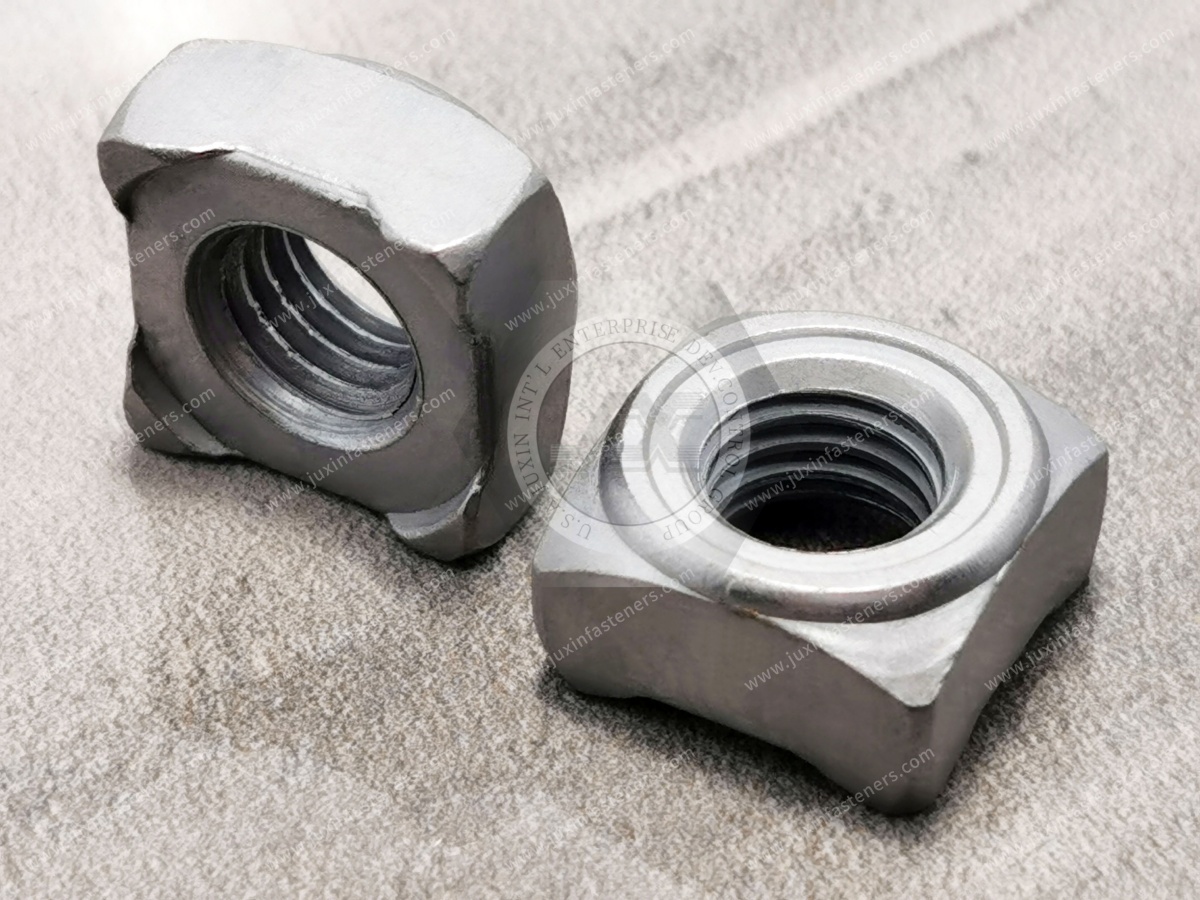
Zinc-flake coating systems are non-electrolytically applied coating technologies used for corrosion protection in applications where coating architecture and hydrogen-management considerations are important.
ISO 10683 provides an international framework for non-electrolytically applied zinc-flake coatings on fasteners.
Potential benefits can include:
Sacrificial zinc protection
Controlled coating thickness
Suitable corrosion performance for specified applications
Reduced reliance on electrolytic deposition
Compatibility with selected high-strength fastener applications
However, zinc-flake systems are not interchangeable with every zinc or zinc-nickel system.
The complete specification should define:
Base coating
Topcoat
Coating thickness
Friction requirements
Corrosion requirement
Temperature exposure
Electrical requirements
Customer approval requirements
Mechanical plating deposits metallic coating through mechanical impact rather than conventional electrolytic deposition.
It can be considered where hydrogen-entry risk associated with electrolytic plating is an important design consideration.
However, it should not be described as automatically “hydrogen-free.”
Hydrogen risk depends on the entire manufacturing sequence, including:
Cleaning
Acid exposure
Surface preparation
Plating
Material susceptibility
Hardness
Residual stress
Subsequent processing
For high-strength fasteners, the coating process should therefore be evaluated within the complete hydrogen-embrittlement prevention strategy.
Surface-treatment decisions are a classic example of dual-intent industrial search.
Engineers ask:
“Will this coating work with my welding, thread, preload, corrosion, and assembly requirements?”
Procurement managers ask:
“Can this supplier consistently deliver the specified coating at the required cost, volume, quality level, and documentation standard?”
A strong OEM sourcing page must answer both questions.
Engineering teams typically investigate:
Coating type
Coating thickness
Thread dimensional effects
Welding compatibility
Hydrogen-embrittlement risk
Corrosion resistance
Friction behavior
Electrical contact
E-coating compatibility
Temperature exposure
Galvanic compatibility
Surface-treatment sequence
Coating thickness can affect functional dimensions.
For threaded fasteners, excessive or poorly controlled coating buildup may influence:
Internal thread fit
External thread fit
Assembly torque
Bolt/nut friction
Gauge results
Mating-component compatibility
This is why coating thickness should be specified according to the applicable coating standard, customer drawing, and functional requirement rather than using one universal thickness for every fastener.
ISO 4042 can provide a framework for electroplated coating requirements on fasteners where applicable.
A supplier should understand the relationship between:
Thread Specification + Coating Thickness + Functional Fit + Friction + Assembly Process
rather than treating plating as an isolated finishing operation.
For weld nuts and weld studs, the surface condition at the welding interface can influence resistance welding behavior.
Resistance welding generates heat according to the interaction of:
Electrical current
Resistance
Time
Electrode force
Contact conditions
The simplified relationship involving I²Rt is useful for explaining heat generation, but actual welding parameters must be developed for the specific fastener, parent material, sheet thickness, electrode configuration, and production equipment.
Heavy organic coatings or unsuitable surface films can interfere with the intended electrical and thermal behavior of the welding interface.
Therefore, a coating specified for post-weld corrosion protection should not automatically be assumed to be suitable for pre-weld application.
Some high-strength steels are susceptible to hydrogen embrittlement when hydrogen enters the material and interacts with susceptible microstructures under tensile stress.
Potential hydrogen-entry stages include:
Acid cleaning
Pickling
Electrolytic plating
Other chemical-processing operations
Risk depends on more than nominal fastener strength.
Relevant factors can include:
Material
Hardness
Microstructure
Residual stress
Applied tensile stress
Surface treatment
Cleaning process
Plating process
Geometry
Electrolytic plating can generate hydrogen during processing.
For susceptible high-strength fasteners, the manufacturing process should therefore include appropriate hydrogen-risk controls according to the applicable specification.
Possible controls can include:
Controlled cleaning
Controlled pickling
Process monitoring
Hydrogen-relief treatment where specified
Material/hardness verification
Delayed-fracture testing where required
Zinc-nickel plating can provide excellent corrosion performance, but an electrolytically deposited Zn-Ni coating should not automatically be described as eliminating hydrogen-embrittlement risk.
The deposition process itself can involve hydrogen generation.
Therefore:
Corrosion Performance ≠ Hydrogen-Embrittlement Immunity
Both requirements must be evaluated separately.
Non-electrolytic coating systems can be attractive for applications where minimizing hydrogen entry during coating is important.
However, the entire manufacturing sequence still needs evaluation.
A coating should not be selected solely because it is labeled “non-electrolytic.”
Cathodic electrodeposition, commonly called e-coating or cathodic e-coating, is widely used as a downstream corrosion-protection process for metal assemblies.
Weld fasteners may become part of an assembly that subsequently passes through:
Cleaning
Pretreatment
E-coating
Rinsing
Curing
Additional painting or finishing
The fastener therefore needs to be considered as part of the complete coating system.
E-coating can introduce coating material into threaded regions.
Potential issues include:
Thread interference
Assembly difficulty
Increased friction
Reduced usable thread
Cleaning requirements
Customer-specific masking requirements
Thread protection may therefore be necessary depending on the assembly design.
E-coating can contribute to corrosion protection of a complete assembly, but it should not be described as automatically making a weld-fastener interface hermetic or leak-tight.
If the customer requires:
IP-rated enclosure protection
Fluid sealing
Coolant containment
Pressure sealing
Environmental ingress protection
the complete assembly must be designed and validated for that requirement.
Some fasteners require temporary protection during:
Storage
Transportation
Assembly
Production staging
Options may include:
Controlled oil films
Temporary protective treatments
Packaging with moisture control
Temporary protection should not be confused with long-term environmental corrosion protection.
For long-term exposure, the engineering team may evaluate:
Zinc plating
Zinc-nickel coatings
Zinc-flake systems
Organic topcoats
Multi-layer coating systems
Stainless-steel fasteners where appropriate
Selection depends on environmental exposure and system requirements.
For grounding or bonding applications, coating selection becomes more complex.
The engineering team may need to consider:
Contact resistance
Coating conductivity
Contact pressure
Bare-metal contact area
Corrosion
Assembly sequence
Grounding architecture
A conductive coating does not automatically establish compliant grounding.
Likewise, tightening a bolt does not guarantee reliable penetration through an arbitrary paint or coating system.
For visible components, appearance can be part of the specification.
Requirements may include:
Color
Gloss
Surface uniformity
Coating consistency
Resistance to cosmetic corrosion
Appearance requirements should be defined separately from structural or corrosion-performance requirements.
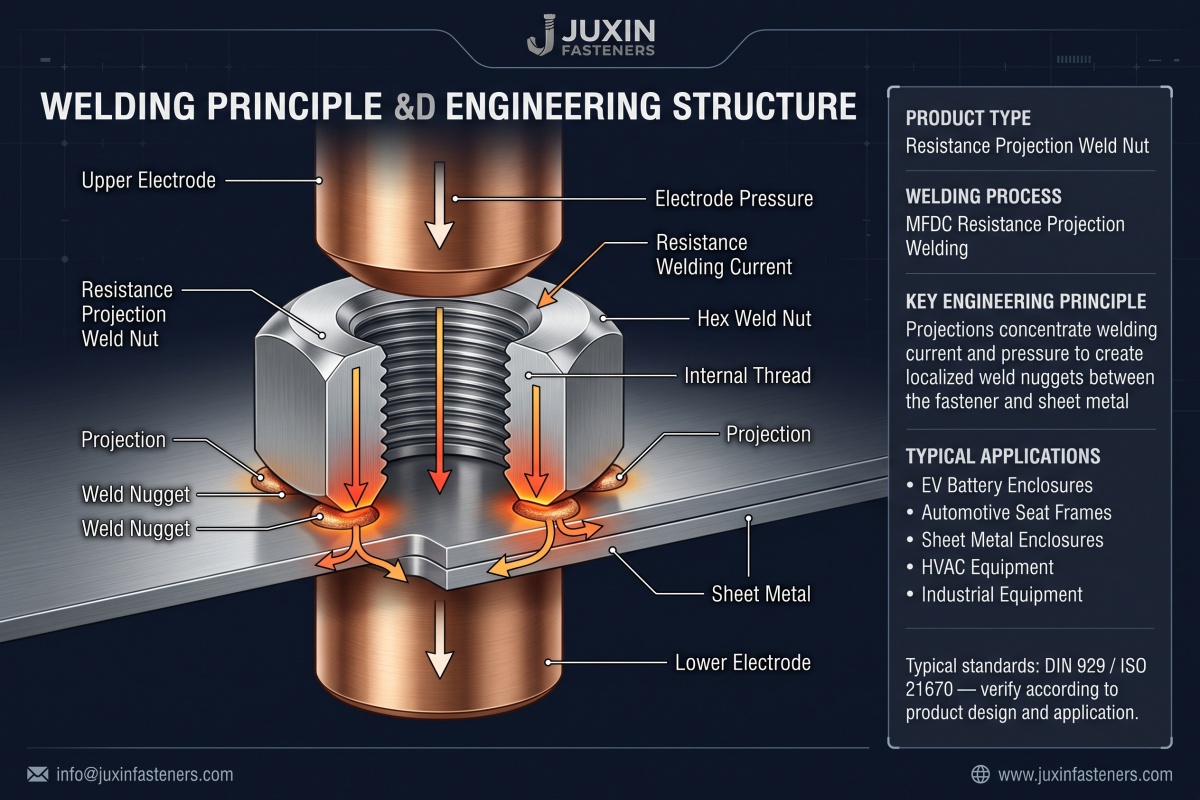
When a weld nut or weld stud is resistance welded to sheet metal, the surface condition at the weld interface is critical.
Potential conditions include:
Controlled plain steel
Weld-compatible surface condition
Temporary corrosion protection
Specified plating
Customer-defined weld-through coating
The appropriate solution depends on the welding sequence.
In many production systems, the fastener is welded first and the complete assembly is subsequently coated.
This approach can provide a different engineering balance from pre-coated fasteners.
Potential benefits may include:
Better control of the welding interface
Integrated corrosion protection of the complete assembly
Reduced need for weld-through coatings
However, post-weld coating also creates requirements for:
Thread protection
Drainage
Cleaning
E-coating coverage
Coating thickness
Masking
Unsuitable surface films can contribute to electrode contamination.
This can affect:
Contact resistance
Electrode life
Welding consistency
Spatter
Maintenance frequency
Therefore, surface treatment should be reviewed together with the welding process rather than specified independently by the procurement department.
ASTM B117 is a standardized laboratory test method for operating salt-spray apparatus and exposing specimens to a controlled corrosive environment.
It is widely used for comparative evaluation and coating qualification.
However:
ASTM B117 is a test method, not a universal field-life prediction model.
A salt-spray result should not be converted directly into:
“X years of outdoor service”
“X years of automotive service”
“X years in marine conditions”
because real-world corrosion depends on:
Wet/dry cycling
Temperature
Contaminants
UV exposure
Mechanical damage
Coating defects
Geometry
Drainage
Galvanic couples
Environmental chemistry
For zinc-based coatings, corrosion products may appear before visible red rust of the underlying steel substrate.
The exact appearance and acceptance criteria depend on the coating system.
Therefore, an OEM specification should define:
Test method
Exposure duration
Evaluation method
Acceptance criteria
Corrosion-product classification
Specimen condition
A statement such as “720-hour corrosion resistance” has meaning only when the complete test specification is known.
The RFQ should identify:
Coating system
Substrate
Coating thickness
Test method
Test duration
Acceptance criterion
Sample preparation
Evaluation method
For example, a JUXIN FASTENERS zinc-nickel configuration may be evaluated against a 720-hour-class salt-spray requirement under specified test conditions.
This should never be interpreted as a universal 720-hour guarantee for all JUXIN FASTENERS products or all field environments.
Salt spray can be useful, but some applications may require additional or alternative corrosion testing.
Real vehicles and industrial equipment may experience:
Wet periods
Dry periods
Temperature cycling
Road salt
Dirt
Condensation
Mechanical abrasion
Cyclic corrosion tests can sometimes provide a more representative evaluation of such environments.
The correct test should therefore be selected according to the engineering question.
When different metals are electrically connected in the presence of an electrolyte, galvanic corrosion can occur.
Examples may involve:
Carbon steel
Stainless steel
Aluminum
Zinc-coated steel
Risk depends on:
Metal combination
Electrochemical potential
Exposed area ratio
Electrical connection
Electrolyte
Temperature
Coating condition
Environmental exposure
Therefore, selecting a coating based only on the fastener material is insufficient.
Aluminum structures require careful evaluation when steel fasteners are used.
Potential issues include:
Galvanic corrosion
Coating damage
Moisture retention
Electrical contact
Mechanical interface degradation
A zinc-based coating can provide sacrificial protection in some applications, but its effectiveness depends on the complete joint architecture.
Stainless steel can provide strong corrosion resistance, but it does not automatically eliminate galvanic or crevice-corrosion considerations.
Surface condition, environment, geometry, and contact with other metals remain important.
Weld fasteners used in automotive structures may be exposed to:
Road salt
Water spray
Mud
Temperature cycling
Vibration
Mechanical loads
Coating selection must therefore balance corrosion protection with:
Welding
Assembly
Thread performance
Mechanical durability
OEM coating process
BIW weld nuts and studs may be welded before the body proceeds through downstream coating processes.
Engineering considerations include:
Weldability
Electrode access
Thread protection
E-coating coverage
Corrosion performance
Dimensional stability
EV battery enclosures can introduce additional requirements involving:
Moisture exposure
Coolant environment
Thermal cycling
Electrical bonding
Corrosion
Sealing architecture
A coating should therefore be selected together with the enclosure design.
A weld fastener coating does not automatically make the battery enclosure IP67 or IP68.
Heavy equipment may encounter:
Mud
Moisture
Fertilizer
Road salt
Hydraulic fluids
Outdoor exposure
Mechanical abrasion
Vibration
Surface treatment should be selected according to the actual environmental exposure and maintenance conditions.
Marine and offshore applications can impose aggressive chloride exposure.
A “marine-grade” label should not replace an engineering specification.
The customer should define:
Environmental exposure
Required coating system
Corrosion test
Acceptance criteria
Galvanic compatibility
Service conditions
Surface-treatment specifications may also be influenced by environmental regulations and customer requirements.
Depending on the destination market and application, procurement teams may need to consider:
RoHS
REACH
ELV requirements for automotive applications
Restricted substances
Chemical declarations
Customer-specific material compliance
These are compliance requirements rather than substitutes for a technical coating specification.
A supplier should provide the appropriate compliance documentation when required by the customer and applicable regulation.
International standards can help create a common technical language between engineering, procurement, and suppliers.
Depending on the product and coating system, relevant references may include:
ISO 4042 — electroplated coating systems for fasteners
ISO 10683 — non-electrolytically applied zinc-flake coatings for fasteners
ASTM B117 — salt spray test method
Applicable ASTM fastener and coating specifications
Applicable SAE requirements
Applicable EN or DIN product requirements
Customer-specific OEM specifications
The exact standard and revision should always be confirmed for the customer's project.
A standard reference does not automatically prove that a particular supplier's product complies.
Compliance must be supported by the appropriate technical documentation and verification.
Procurement teams should evaluate how the supplier controls the coating process.
Potential documentation includes:
Material certificate
Heat/lot traceability
Mechanical property documentation where required
Coating specification
Coating thickness results
Surface-treatment records
Batch/lot information
Corrosion test reports where required
Thread inspection
Dimensional inspection
Friction testing where specified
Weldability validation where applicable
Electrical contact testing where required
A material certificate should not be confused with a coating test report.
Likewise, a salt-spray report should not be treated as proof of every other functional characteristic.
Surface treatment can affect friction.
For a threaded joint, the relationship between:
Torque → Friction → Preload
can change when the coating system changes.
This means that changing from one coating to another without reviewing the assembly process may alter:
Installation torque
Clamp force
Thread friction
Torque scatter
Joint preload
For critical applications, procurement should therefore communicate whether the customer has:
Torque requirements
Preload requirements
Friction coefficient requirements
Torque-tension validation
Thread-class requirements
This is particularly important when changing suppliers or coating systems.
Weld fasteners may also function as mounting or grounding points.
The engineering team should consider:
Coating resistivity
Contact area
Surface preparation
Contact pressure
Corrosion
Grounding path
Assembly sequence
A coated fastener should not automatically be assumed to provide electrical continuity merely because it is mechanically attached.
Where electrical bonding is critical, the complete interface should be designed and tested according to the applicable electrical requirements.
Before approving a coated weld fastener, engineering teams should review:
Material
Hardness
Thread
Critical dimensions
Projection geometry
Surface finish
Weld interface condition
Welding sequence
Electrode compatibility
Surface contamination
Spatter
Electrode life
Coating type
Coating thickness
Pre-weld or post-weld application
Hydrogen risk
Corrosion target
Friction requirement
Electrical requirement
E-coating
Powder coating
Painting
Curing temperature
Thread masking
Cleaning
Indoor
Outdoor
Automotive
Marine
Chemical exposure
Temperature cycling
A common procurement mistake is to specify:
“Zinc plated fastener.”
That description may be insufficient for an OEM production program.
A stronger specification identifies, where applicable:
Base material
Fastener hardness/property class
Coating system
Coating standard
Coating thickness
Passivation
Topcoat
Friction requirement
Corrosion-test method
Acceptance criteria
Thread requirements
Hydrogen-relief requirements
Environmental compliance
Packaging and traceability
The same principle applies to zinc-nickel and zinc-flake coatings.
“Zn-Ni” or “zinc-flake” alone may not define the complete coating architecture.
| Requirement | Potential Surface-Treatment Direction | Key Engineering Question |
|---|---|---|
| Basic corrosion protection | Zinc-based coating | What corrosion environment and acceptance criteria apply? |
| Higher corrosion requirement | Zinc-nickel system | What exact coating configuration and test target are specified? |
| High-strength fastener with hydrogen concern | Non-electrolytic or controlled coating route | What is the complete hydrogen-risk assessment? |
| E-coating downstream | Weld-compatible surface + downstream coating | Where should the coating be applied in the process? |
| Electrical bonding | Specified conductive/bonding interface | What contact-resistance requirement applies? |
| High-friction sensitivity | Controlled friction coating/system | Is torque-tension validation required? |
| Outdoor equipment | Corrosion-resistant coating system | What environment and cyclic exposure apply? |
| Marine/coastal | Application-specific corrosion system | What chloride and galvanic risks exist? |
This matrix is a starting point, not a universal material-selection rule.
The cheapest coating is not necessarily the lowest-cost solution.
Procurement teams should consider:
Fastener Cost + Coating Cost + Welding Impact + Assembly Impact + Inspection + Corrosion Risk + Warranty Risk + Supply Risk
A coating with a higher unit cost may be commercially justified if it:
Reduces corrosion failures
Reduces rework
Improves assembly consistency
Reduces maintenance
Improves downstream coating compatibility
Reduces supplier quality risk
Conversely, an unnecessarily high-performance coating can add cost without providing meaningful value if the application environment does not require it.
The correct target is therefore:
Required Performance at the Lowest Sustainable Total Cost.
For an accurate coating quotation, OEM procurement teams should provide:
2D drawing
3D CAD model
Material
Hardness/property class
Thread specification
Critical dimensions
Coating type
Applicable standard
Coating thickness
Passivation/topcoat
Friction requirements
Hydrogen-relief requirements
Corrosion-test requirement
Welding process
Parent-sheet material
Sheet thickness
Welding sequence
E-coating process
Painting process
Indoor/outdoor
Temperature
Humidity
Salt exposure
Chemical exposure
Marine/coastal conditions
Inspection requirements
Material documentation
Coating reports
Corrosion test reports
Traceability
Change-control requirements
Prototype quantity
Annual usage
Production forecast
Packaging
Delivery requirements
Possible causes include:
Incorrect coating
Insufficient coating control
Damaged coating
Galvanic interaction
Environmental exposure beyond the original assumption
Potential causes include:
Excessive coating buildup
Incorrect coating process
Poor dimensional control
Inadequate masking
Potential causes include:
Unsuitable pre-weld coating
Surface contamination
Coating buildup
Changed contact resistance
Welding-process mismatch
Potential contributors include:
Susceptible material
High hardness
Hydrogen-generating processing
Tensile stress
Inadequate process control
Potential contributors include:
Coating between electrical contact surfaces
Corrosion
Insufficient contact pressure
Poor bonding design
Environmental degradation
A practical engineering workflow is:
Application Environment
        ↓
Fastener Material + Hardness
        ↓
Welding Process
        ↓
Corrosion Requirement
        ↓
Hydrogen Risk Assessment
        ↓
Coating System Selection
        ↓
Thread / Friction Review
        ↓
E-Coating / Paint Compatibility
        ↓
Prototype Validation
        ↓
Corrosion / Functional Testing
        ↓
Supplier Qualification
        ↓
Mass Production Control
This workflow connects engineering selection with procurement and manufacturing.
Surface treatment is often treated as a final purchasing detail.
For OEM weld fasteners, that can be a mistake.
The coating can affect:
Welding
Threads
Assembly torque
Corrosion
Electrical contact
Hydrogen risk
Downstream coating
Packaging
Cost
Discussing the surface treatment at RFQ stage allows engineering and procurement to determine whether the selected finish is technically appropriate before production begins.
JUXIN FASTENERS supports industrial and OEM customers with fastening requirements involving:
Weld nuts
Weld studs
Self-clinching fasteners
Blind rivet nuts
Custom weld fasteners
High-strength fasteners
Zinc-plated fasteners
Zinc-nickel coated fasteners
Custom surface-treatment requirements
The correct coating solution should be evaluated together with:
Fastener Material + Hardness + Welding + Coating + Thread + Assembly + Environment + Quality Requirements
JUXIN FASTENERS can review customer drawings and RFQ requirements to help determine the appropriate manufacturing and surface-treatment route for the specified application.
The objective is not simply to offer the most corrosion-resistant coating.
The objective is to select a coating system that is technically appropriate, manufacturable, inspectable, commercially viable, and compatible with the customer's production process.
Fastener Surface Finishes & Coatings Guide
Fastener Hydrogen Embrittlement Prevention Guide
Fastener Corrosion Resistance & Salt Spray Testing
Substrate Material Compatibility for Weld Fasteners
Weld Fastener DFM Engineering Guide
Custom Weld Fasteners: Engineering & OEM Sourcing Guide
Automotive BIW Weld Fasteners
EV Battery Enclosure Weld Fasteners
Electrical Enclosure Weld Fasteners & Grounding
Fastener Supplier Quality Audits & Certifications
Fastener Procurement & RFQ Best Practices
Fastener Packaging & Feeder Compatibility
Fastener Fatigue Strength & Cyclic Loading
A: There is no single best finish for every application. Zinc, zinc-nickel, zinc-flake, mechanical plating, and other systems should be evaluated according to corrosion exposure,
welding sequence, hydrogen risk, thread requirements, friction, electrical requirements, downstream coating, and customer specifications.
A: Zinc-nickel can provide higher corrosion performance in applications where that performance is required, but the correct choice depends on the specified environment,
coating configuration, test requirement, cost, and manufacturing process.
A: No. Electrolytically deposited zinc-nickel can still involve hydrogen generation during processing. Hydrogen-embrittlement risk must be evaluated according to fastener material,
hardness, processing sequence, stress condition, and applicable requirements.
A: Non-electrolytic zinc-flake coatings can reduce hydrogen-entry risk associated specifically with electrolytic deposition,
but they should not be described as universally eliminating hydrogen-related failure. The complete manufacturing sequence must still be evaluated.
A: ASTM B117 provides a laboratory method for salt-spray exposure. It can be used for comparative coating evaluation and qualification when specified, but salt-spray hours should not be directly converted into field service life.
A: No. A salt-spray result is a laboratory test result under defined conditions. It should not be converted directly into an equivalent number of days, months, or years of field service.
A: It depends on the specific coating, welding process, parent material, and production sequence. A coating that is suitable for final corrosion protection is not automatically suitable at the resistance-welding interface.
A: Yes, depending on the coating and manufacturing sequence. Engineers should evaluate weldability, thread protection, e-coating coverage, curing conditions, corrosion requirements, and assembly functionality.
A: No. E-coating may enter threaded areas depending on the process and geometry. Thread protection or masking may be required according to the customer's assembly requirements.
A: It can. Coating buildup can affect functional thread dimensions and mating behavior. The coating specification should therefore be coordinated with the thread specification and functional inspection requirements.
A: Depending on the project, documentation can include material certificates, coating specifications, coating-thickness results, corrosion-test reports, dimensional inspection reports, thread inspection, lot traceability, and regulatory compliance documentation.
A: No. A material test certificate primarily addresses the specified material and related properties. Coating performance should be verified through the appropriate coating documentation and test reports.
A: The RFQ should define the coating system, applicable test method, exposure duration, acceptance criteria, specimen condition, and evaluation method. “720 hours” alone is not a complete coating specification.
A: JUXIN FASTENERS can evaluate zinc-nickel and other surface-treatment requirements for weld nuts, weld studs,
and custom fasteners according to the customer's drawing, corrosion requirement, welding sequence, and production specifications.
If your OEM program requires a specific corrosion performance, coating system, welding sequence, e-coating process, or hydrogen-embrittlement control strategy,
send the technical requirements to JUXIN FASTENERS for engineering and commercial review.
Please provide:
2D engineering drawing
3D CAD model
Fastener material
Hardness/property class
Thread specification
Coating specification
Corrosion-test requirement
Welding process
Parent-sheet material
Sheet thickness
E-coating or painting process
Friction/torque requirements
Electrical requirements where applicable
Annual volume
Prototype quantity
Quality documentation requirements
EMAIL: info@juxinfasteners.com
WEBSITE: www.juxinfasteners.com
JUXIN FASTENERS supports OEM customers in evaluating fastener material, surface treatment, welding compatibility, corrosion performance,
thread requirements, downstream coating processes, quality documentation, and production sourcing.
For industrial OEM fasteners, surface treatment should never be selected as an isolated finishing operation.
The correct engineering decision is:
Fastener Material + Surface Finish + Welding Process + Assembly + Environment + Validation + Quality Control
That is how corrosion protection becomes a reliable part of the complete fastening system rather than simply a coating specification on a purchase order.
Precision Fastening Solutions Since 2003.
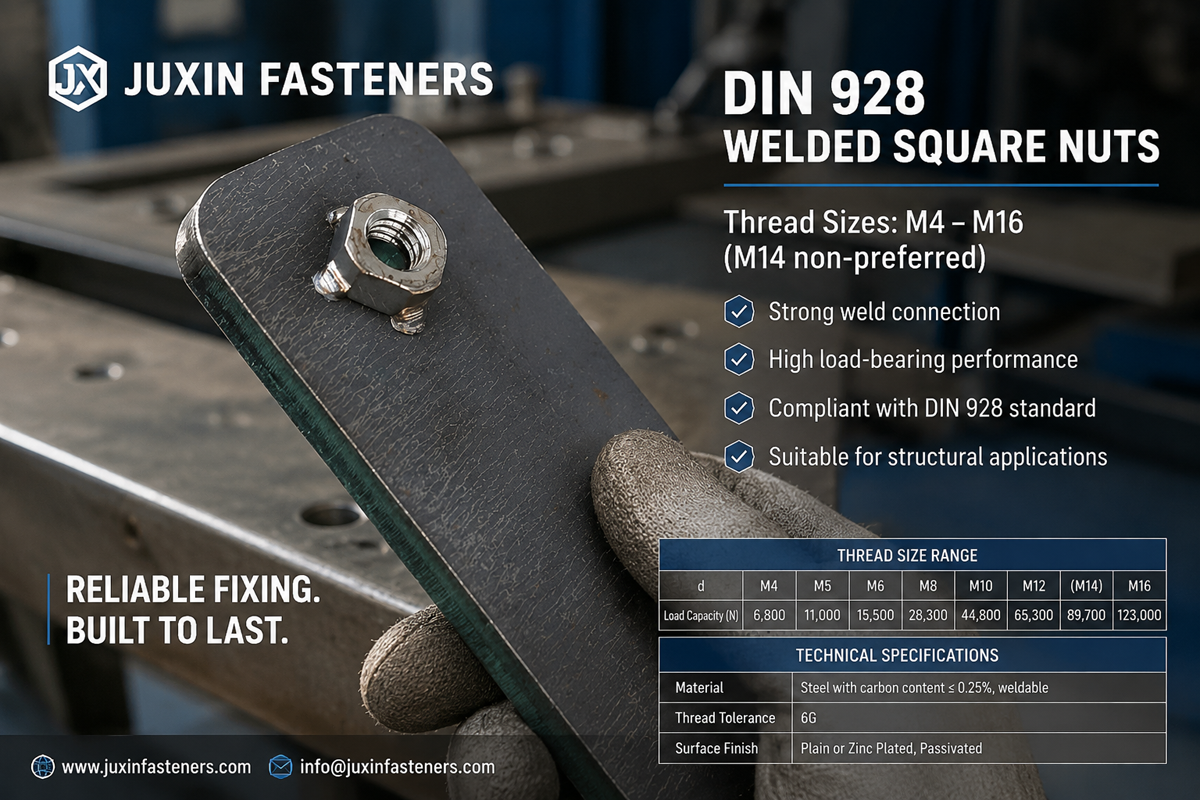
Product Packaging
Packaging Standard
At Juxin Fasteners, we apply standardized export packaging to ensure product protection, traceability, and compliance with international logistics requirements.
1. Standard Export Packaging
Unless otherwise specified, all products will be packed according to our factory standard export packaging, which includes:
Moisture-resistant inner protection
Poly bag or small box packing as required
Reinforced export cartons
Clear labeling with part number, specification, batch number, and quantity
Palletizing for sea or air shipment when necessary
Our standard packaging is designed to ensure safe transportation, efficient warehousing, and long-distance international shipping.
2. Customized Packaging Options
We also provide customized packaging solutions according to customer requirements, including but not limited to:
Private labeling
Customized barcodes
Specific carton dimensions
Retail packaging
Special pallet configuration
Customer-specific marking and identification
So that you know, customized packaging may involve additional costs and extended lead time depending on the complexity of the requirements.
3. Compliance & Quality Assurance
All packaging processes are controlled under our ISO 9001 quality management system to ensure consistency, traceability, and product integrity throughout the supply chain.
Product Pictures
Contact Us
Tel.:
+86 020 8621 0320
+86 020 3121 6067
E-mail:
Technical Support:
Navigation
SEND INQUIREY