Call Us
+86 136 6007 9809
Call Us
+86 136 6007 9809

Designing automotive plastic fasteners requires more than selecting a polymer and creating a clip-shaped component.
For engineers, the critical question is how the fastener interacts with the complete mounting interface: the hole, panel thickness, mating component,
retention mechanism, installation direction, material behavior, tolerance range, and service environment.
Product Specification
Designing automotive plastic fasteners requires more than selecting a polymer and creating a clip-shaped component.
For engineers, the critical question is how the fastener interacts with the complete mounting interface: the hole, panel thickness, mating component,
retention mechanism, installation direction, material behavior, tolerance range, and service environment.
This is particularly important for automotive plastic retainers, push-type retainers, trim clips, panel clips, screw-type retainers, cable clips, and other customer-specific polymer fastening components.
A useful engineering principle is:
Mounting Interface → Hole Geometry → Panel Thickness → Retention Mechanism → Fastener Geometry → Material → Tolerance → Installation → Environment
Starting with this sequence can help prevent a common design problem: a fastener that appears geometrically suitable in CAD but does not provide the required assembly behavior across the actual production tolerance range.
JUXIN FASTENERS supplies customer-specific and non-standard automotive fastening components according to customer drawings, specifications, material requirements, and application conditions.
Unlike many rigid metal fastening joints, plastic retainers and clips frequently rely on controlled elastic deformation to achieve insertion, retention, positioning, or removal.
The retention mechanism may use:
Flexible legs
Cantilever features
Barbs
Ribs
Hooks
Snap-fit features
Expanding sections
Flange engagement
Interference features
Threaded or screw-receiving interfaces
The exact mechanism depends on the component design and application.
The engineering challenge is to control the relationship between deformation and retention.
If the retention feature is too rigid, assembly may require excessive insertion force or may damage the component or mating panel.
If it is too flexible, the joint may not provide the required retention or positioning function.
Therefore, plastic fastener design is fundamentally an interface and deformation problem, not simply a material-selection problem.
An interference fit occurs when the fastener geometry is intentionally larger than a corresponding mating feature, requiring controlled deformation during assembly.
In plastic fastening, this can occur between:
Retention legs and a mounting hole
Ribs and a panel opening
A snap feature and a mating slot
A plastic component and another polymer component
A fastener body and a molded mounting feature
The resulting deformation creates contact forces between the fastener and mating component.
However, interference should not be treated as automatically beneficial.
The design must consider:
Polymer stiffness
Geometry of the retention feature
Wall thickness
Local stress concentration
Hole size
Hole edge condition
Installation direction
Assembly speed
Temperature
Material condition
Required serviceability
A high-interference design may increase retention while also increasing assembly effort or local stress.
A lower-interference design may simplify installation while providing less retention.
The correct balance is application-specific.
Plastic components are sensitive to local geometry.
Sharp transitions, thin sections, abrupt changes in wall thickness, and concentrated contact areas can influence how stress is distributed through the fastener.
For a clip or retainer, engineers may therefore examine:
Radius transitions
Retention-leg thickness
Root geometry
Rib geometry
Local wall thickness
Contact areas
Load direction
Deflection during installation
This is particularly relevant where the same fastener may be installed repeatedly or where the assembly requires a defined service-removal process.
The goal is not simply to maximize retention.
The goal is to create a geometry that provides the required retention and assembly behavior without imposing unnecessary stress on the polymer or mating component.
One of the most important design variables in plastic fastener engineering is the mounting hole.
The hole provides the interface through which the retention mechanism operates.
Engineers should define:
Hole diameter
Hole shape
Hole position
Dimensional tolerance
Edge condition
Panel thickness
Nearby features
Accessibility
Installation direction
The nominal hole diameter alone may not be enough.
A production hole has a tolerance range, and its actual condition can be influenced by stamping, drilling, punching, molding, or another manufacturing process.
The plastic fastener should therefore be evaluated against the acceptable hole range, rather than only the nominal CAD dimension.
Hole edges can influence installation.
Burrs, sharp edges, deformation, or inconsistent hole geometry can interact with flexible plastic retention features during insertion.
Depending on the design, this can influence:
Insertion force
Local polymer deformation
Retention engagement
Component damage
Assembly consistency
For this reason, the hole specification and fastener specification should be treated as a mating pair.
Panel thickness is another fundamental design variable.
A plastic retainer may have a defined grip range or engagement geometry intended for a specific substrate thickness.
If the panel is outside the intended range, several conditions may occur.
A panel that is too thin may allow excessive movement or insufficient engagement.
A panel that is too thick may interfere with full engagement or increase assembly difficulty.
The practical design relationship is:
Panel Thickness + Fastener Grip Geometry = Retention Interface
The engineer should therefore define the complete panel thickness range, including relevant production tolerances, rather than using only the nominal panel gauge.
Grip range should not be treated simply as a dimensional specification.
It determines whether the fastener can interact correctly with the actual substrate.
When specifying a plastic fastener, engineers should consider:
Minimum panel thickness
Maximum panel thickness
Fastener engagement depth
Retention-feature position
Head or flange geometry
Adjacent component thickness
Tolerance stack-up
This becomes especially important where several layers are assembled together.
For example:
Trim Panel + Bracket + Fastener
may create a different effective grip requirement from:
Trim Panel + Single Sheet + Fastener
The fastener must be designed around the actual stack-up.
A plastic fastener may be dimensionally correct by itself while still producing inconsistent assembly results when combined with multiple components.
The complete stack-up may include:
Fastener dimensions
Mounting-hole diameter
Panel thickness
Bracket position
Mating component geometry
Molding dimensions
Stamped-sheet tolerances
Assembly positioning
For example, a nominal hole dimension may look appropriate in CAD, but the production assembly may experience the minimum or maximum condition of several dimensions simultaneously.
This is why engineers should evaluate both:
Nominal Geometry
and
Worst-Case or Statistical Tolerance Conditions, according to the customer's design methodology.
For customer-specific components, the relevant tolerance requirements should be defined in the approved drawing or engineering specification.
A plastic fastener can have the correct hole size and grip range and still be unsuitable if the assembly direction is incompatible with the vehicle architecture.
Engineers should consider:
Direction of insertion
Available clearance
Access to the fastener head
Robotic or manual assembly
Nearby brackets
Hidden structures
Installation angle
Required installation sequence
Flexible retention arms need sufficient space to deflect during installation.
Push-type retainers may require a defined insertion direction.
Snap-fit components may require the mating component to move through a particular path before the retention feature engages.
For a broader explanation of push-retainer mechanisms and installation considerations, see Push-Type Retainers for Automotive Applications: Engineering & Sourcing Guide.
The retaining mechanism should be selected according to the required function.
Common approaches include:
Push-type retainers typically use a body, pin, expanding feature, or flexible retention structure that engages after insertion.
The exact mechanism varies by design.
Snap-fit components use elastic deformation of a feature such as a hook, arm, or flexible section.
The mating geometry determines when the feature deflects and when it returns to its retained position.
Barbs and ribs can engage the edges or surfaces of a mounting opening.
Their geometry influences insertion and extraction behavior.
The fastener head or flange can retain a panel from one side while the body engages the mounting hole.
Some plastic retainers incorporate an internal threaded or screw-receiving feature.
These components are useful when a screw is required as part of the final joint.
The selection should always follow the application rather than assuming that one retention mechanism is universally better than another.
Insertion and extraction forces are often important engineering parameters for automotive plastic fasteners.
However, they should not be assigned as generic universal values.
The actual force can depend on:
Polymer material
Fastener geometry
Hole diameter
Panel thickness
Surface condition
Installation speed
Temperature
Mating component geometry
Retention mechanism
A useful design objective is to establish an acceptable relationship between:
Assembly Effort ↔ Retention Requirement ↔ Serviceability
For production applications, the customer may define acceptable insertion and extraction force ranges based on the assembly process.
JUXIN FASTENERS can manufacture customer-specific components according to the applicable customer specification and approved drawing.
Polymer materials generally respond differently to temperature changes than steel or aluminum.
This creates an important design consideration when a plastic fastener is installed into a metal body panel or bracket.
Engineers should consider:
Fastener material
Mating material
Temperature range
Hole geometry
Fastener flexibility
Differential dimensional change
Retention requirements
The issue is particularly relevant when the fastener spans two different materials.
For example:
Plastic Retainer + Steel Panel
can behave differently from:
Plastic Retainer + Plastic Panel
The design should therefore account for the material pairing rather than evaluating the polymer fastener in isolation.
Material selection should follow the required function and application environment.
Common engineering polymer families considered for automotive fastening applications can include:
Nylon, including PA6 and PA66 families where specified, can be considered for applications requiring a combination of mechanical performance, flexibility, and retention behavior.
However, Nylon is moisture-sensitive, and its dimensional and mechanical behavior can change with moisture condition and temperature.
This should be considered when designing tight mating interfaces.
POM can be considered where stiffness, dimensional behavior, and friction characteristics are important to the application.
Its suitability depends on the specific component geometry and environment.
PP can be evaluated for applications where its material characteristics align with the required flexibility, chemical environment, and component function.
The appropriate polymer grade must be defined according to the customer application.
Other polymer families may be considered where the customer specification requires them.
The correct selection depends on the actual application, material grade, environment, geometry, and validation requirements.
JUXIN FASTENERS should not be assumed to supply every polymer family or every grade. The applicable material should be confirmed from the customer specification and project requirements.
Nylon requires particular attention because moisture can influence its dimensional and mechanical behavior.
For a nylon fastener used in a close-fit mounting interface, engineers may need to consider:
Moisture condition
Storage condition
Assembly environment
Temperature
Dimensional change
Mechanical behavior
Long-term retention requirements
This does not mean Nylon is unsuitable.
It means that the polymer's environmental condition should be included in the engineering evaluation when dimensional stability and retention are important.
For a broader overview of automotive polymer fastening solutions, see Automotive Plastic Fasteners: Types, Applications & OEM Sourcing Guide.
Long-term polymer behavior is another important difference between plastic and metal fastening.
Under sustained deformation or load, some polymers can exhibit creep or stress relaxation.
For automotive plastic fasteners, the relevance depends on the mechanism.
A simple locating clip may have different requirements from a component that continuously maintains a clamping or retention force.
Engineers should therefore ask:
Is the plastic fastener primarily locating, retaining, spacing, clamping, or supporting another component?
This functional definition helps determine whether long-term deformation behavior is a major design consideration.
Nylon should not automatically be selected simply because a component is lightweight.
Depending on the application, another polymer or a metal fastening component may be more appropriate.
Potential reasons for further evaluation can include:
Moisture sensitivity
Temperature exposure
Chemical compatibility
Required stiffness
Long-term deformation
Dimensional stability
Electrical requirements
Installation method
Structural function
The correct approach is:
Application Requirement → Material Requirement → Fastener Geometry
rather than:
Available Material → Fastener Geometry → Application
This distinction is especially important for OEM engineering.
Automotive plastic fasteners are used across many vehicle systems.
Potential applications include:
Door trim
Instrument panels
Center consoles
Interior panels
Garnish components
Access covers
The engineering priorities can include panel retention, installation effort, serviceability, appearance, and mating geometry.
Applications can include:
Body mouldings
Exterior trim
Spoiler components
Protective panels
Wheel-arch and underbody components
Environmental exposure and material compatibility become more important as the component moves outside the passenger compartment.
Plastic clips can also be designed around cable diameter, routing direction, mounting-hole geometry, and retention requirements.
The fastening component is therefore part of the overall cable-management interface rather than an independent commodity item.
Trim and moulding clips frequently rely on carefully designed engagement between the clip and the panel.
Possible mechanisms include:
Snap-fit arms
Barbed shafts
Ribbed bodies
Flange retention
Hook features
Sliding engagement
The geometry must match the actual mounting hole, slot, panel thickness, and trim component.
For more detailed engineering considerations, see Automotive Trim & Moulding Clips: Engineering, Retention & OEM Sourcing Guide.
Modern automotive assemblies frequently combine polymer and metal fastening components.
A vehicle system may use:
Plastic retainers for trim
Nylon clips for locating or retaining panels
Screw-type retainers for service-access joints
Metal screws and bolts for higher mechanical requirements
Weld nuts for integrated threaded interfaces
Rivet nuts for sheet-metal mounting
Pins and shafts for moving mechanisms
This means that plastic fastener design should not be isolated from the broader vehicle fastening architecture.
A rear spoiler can combine polymer and metal fastening components within the same assembly.
For example, a Nylon Rear Spoiler Clip may be used together with an Automotive Spoiler Slide Bolt.
JUXIN FASTENERS supplies confirmed spoiler slide bolt configurations including M5 and M6, with representative M6 × 14 and M6 × 20 configurations.
Applicable configurations can include property classes 8.8 or 10.9 and specified finishes such as Color Zinc, Zinc-Nickel Alloy, or Black Zinc.
The slide bolt uses special head geometry to engage a mounting slot, track, or channel. The assembly concept can be understood as:
Slide → Position → Engage → Tighten
Any anti-rotation effect depends on the mating geometry of the bolt head and mounting interface.
This is a useful example of why engineers should define the complete fastening system rather than specifying only a generic "plastic clip."
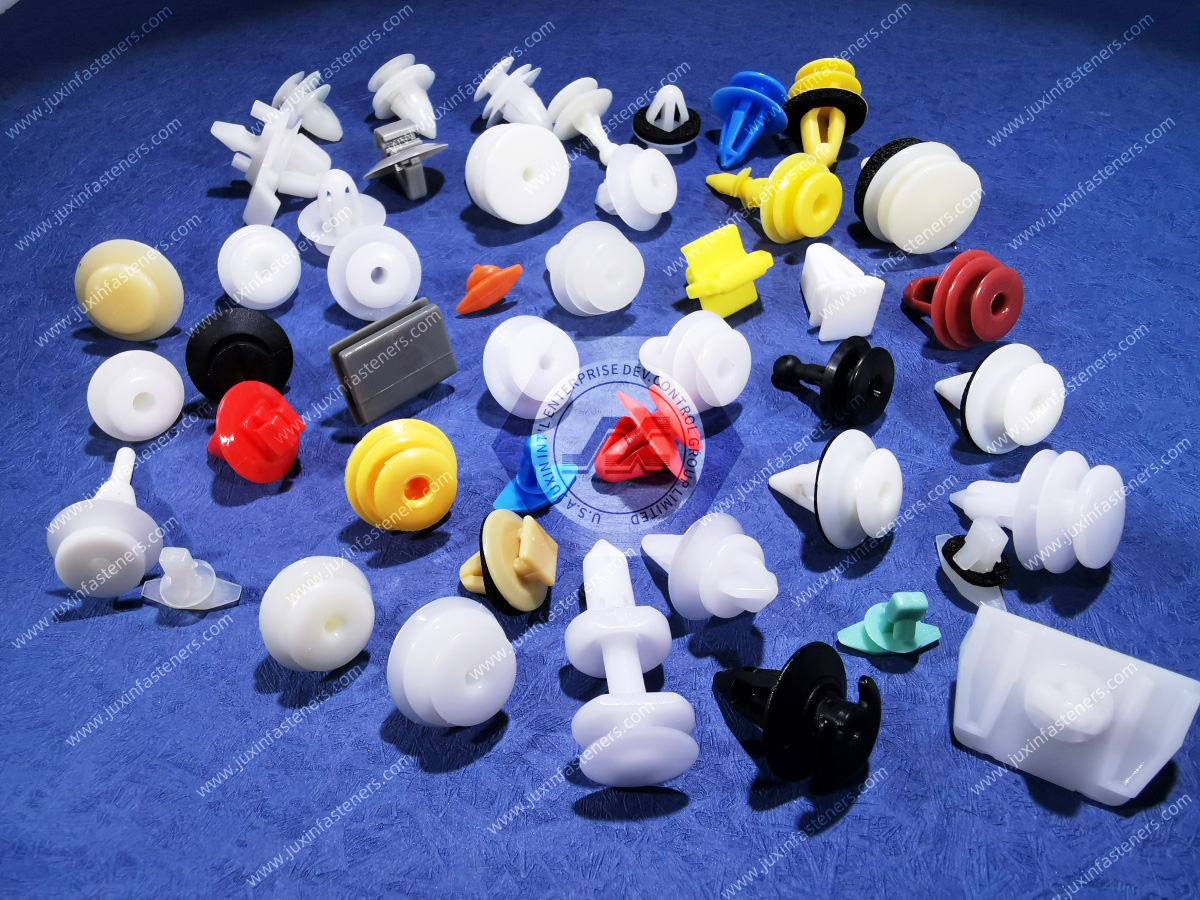
The same engineering principles can be applied to different vehicle applications, while the actual requirements remain application-specific.
Potential areas include:
Door systems
Instrument panels
Seat assemblies
Sunroof systems
Rear spoiler systems
Wiper systems
Chassis and undercarriage
Gear-shifting mechanisms
Interior trim
Exterior body components
Electrical and electronic assemblies
JUXIN FASTENERS supplies both plastic/polymer and metal customer-specific fastening components across these application areas, depending on the customer requirement.
A successful custom fastener project requires engineering and procurement teams to evaluate different parts of the same specification.
Design and structural engineers may focus on:
Mounting-hole geometry
Panel thickness
Grip range
Retention mechanism
Insertion direction
Deflection
Material behavior
Thermal effects
Tolerance stack-up
Environmental exposure
Assembly requirements
Serviceability
The key question is:
Will the component perform the required fastening function across the defined design and production conditions?
Sourcing and supply-chain teams may focus on:
Drawing clarity
Material specification
Dimensional consistency
Production requirements
Packaging
Documentation
Sample approval
Commercial quantity
Delivery requirements
Change communication
Long-term supply suitability
The key question is:
Can the specified component be sourced consistently according to the approved engineering requirements?
Both perspectives are necessary.
A fastener that works in a prototype but is difficult to control in production creates a sourcing problem.
A low-cost component that does not meet the required mounting interface creates an engineering problem.
A useful design sequence is:
Identify the vehicle system and function.
Identify exactly what the fastener connects, retains, locates, or spaces.
Specify:
Hole
Slot
Flange
Panel edge
Molded feature
Bracket
Other mating geometry
Specify nominal dimensions and allowable tolerance range.
Specify minimum, nominal, and maximum relevant thickness conditions.
Select the appropriate:
Push mechanism
Snap-fit
Barbed retention
Ribbed retention
Flange retention
Screw-receiving interface
Other application-specific mechanism
Ensure the fastener geometry corresponds with the complete substrate thickness range.
Consider:
Installation direction
Access
Assembly speed
Manual or automated installation
Insertion force
Removal requirements
Evaluate:
Polymer family
Material grade
Moisture behavior
Temperature exposure
Chemical compatibility
Long-term deformation
Evaluate the fastener, mounting hole, panel, and mating components as a complete tolerance stack.
Consider:
Temperature
Moisture
Chemicals
UV exposure where applicable
Vibration
Service conditions
Provide:
Approved drawing
CAD data
Material requirement
Dimensional requirements
Quantity
Packaging
Inspection/documentation requirements where applicable
This sequence turns "I need an automotive plastic clip" into a manufacturable engineering specification.
For a custom automotive plastic fastener RFQ, the following information is useful.
Provide the latest customer drawing or 3D CAD model.
Identify:
Hole diameter
Hole shape
Hole tolerance
Slot geometry
Panel thickness
Mating component
Define whether the component is intended primarily for:
Retention
Positioning
Locating
Spacing
Clamping
Cable management
Serviceable attachment
Specify the required polymer family and grade where already defined.
If the material is not yet fixed, provide the application environment and functional requirements so the material decision can be evaluated appropriately.
Where available, provide:
Installation direction
Insertion-force requirements
Extraction-force requirements
Assembly method
Service/removal requirements
Provide relevant:
Temperature conditions
Moisture exposure
Chemical exposure
UV exposure where applicable
Vibration or movement conditions
Include:
Prototype quantity
Production quantity
Annual demand estimate
Packaging requirements
Delivery requirements
Documentation requirements
The mounting hole is part of the fastening system.
Designing the clip independently can create compatibility problems later.
Production tolerances can shift the actual assembly condition.
The design should consider the relevant dimensional range.
A fastener may fit the hole while failing to match the actual substrate thickness.
Grip range should therefore be defined early.
More interference does not automatically mean a better design.
Insertion effort, polymer deformation, panel damage, and serviceability must also be considered.
Nylon can be highly useful, but moisture condition can influence its dimensional and mechanical behavior.
The environment should be included in the material evaluation.
Plastic and metal fasteners respond differently to temperature, deformation, and long-term loading.
Material-specific design considerations are required.
Two clips may look similar while having different hole requirements, grip ranges, retention geometries, or installation directions.
Visual similarity does not establish interchangeability.
JUXIN FASTENERS is an OEM-oriented supplier of customer-specific and non-standard automotive fastening components.
Relevant product categories include:
Automotive plastic fasteners
Nylon retainers
Automotive plastic clips
Push-type retainers
Trim and moulding clips
Screw-type retainers
Nylon Rear Spoiler Clips
Automotive Spoiler Slide Bolts
Customer-specific screws
Customer-specific bolts
Nuts
Rivet nuts
Weld nuts
High-strength fastening components
Application-specific pins and shafts
JUXIN FASTENERS manufactures customer-specific components according to customer drawings, specifications, material requirements, and application conditions.
The actual component geometry, polymer selection, dimensional requirements, and production specification should be established from the customer's approved engineering data.
For customer-specific plastic fasteners, the most effective development process begins with the mating interface, not simply the product name.
For engineers and procurement teams, the following model provides a practical way to communicate a custom plastic fastener requirement:
Application
↓
Mating Components
↓
Mounting Hole / Slot
↓
Panel Thickness
↓
Retention Function
↓
Fastener Geometry
↓
Grip Range
↓
Polymer / Material
↓
Tolerance
↓
Installation Method
↓
Environmental Conditions
↓
Customer Validation Requirements
↓
Production & Packaging
↓
OEM Sourcing
This model connects engineering design directly with procurement development.
It also helps suppliers understand whether the customer is looking for a standard component, a modified component, or a completely customer-specific fastening solution.
Mounting-hole geometry determines how the retention features interact with the substrate. Hole diameter, shape, tolerance, edge condition,
and panel thickness can all influence insertion, retention, positioning, and extraction behavior.
Grip range defines the substrate thickness range over which the fastener's retention geometry can operate as intended.
The complete panel-thickness range, including relevant tolerances, should be considered during design.
Plastic and metal components can change dimensions differently as temperature changes.
Engineers should consider polymer behavior, mating materials, hole geometry, flexibility, and the required retention function when evaluating differential thermal expansion.
No. Nylon is one commonly considered engineering polymer, but the appropriate material depends on moisture exposure, temperature, chemical environment, stiffness,
dimensional requirements, long-term deformation, and the function of the component.
An interference fit occurs when mating dimensions intentionally require controlled deformation during assembly.
In plastic fastening, interference can contribute to retention, but excessive interference can increase assembly effort or local stress.
Start with the application and mating interface. Define the mounting hole, panel thickness, retention mechanism, grip range, material, tolerances,
installation method, environment, and relevant validation requirements before finalizing the component specification.
Procurement should ideally provide the approved drawing or CAD data, material specification, dimensional requirements, mounting interface, quantity,
packaging, delivery requirements, and documentation requirements. Engineering requirements such as hole geometry, panel thickness, retention function, and installation conditions should also be included.
JUXIN FASTENERS supplies customer-specific and non-standard automotive fastening components according to customer drawings, specifications,
material requirements, and application conditions. The specific component design and applicable material should be confirmed against the customer's engineering requirements.
A successful automotive plastic fastener starts with the joint, not the catalog name.
If your project involves a custom automotive clip, retainer, push-type fastener, trim fastener, nylon component, or another application-specific polymer fastening component, provide the available engineering information.
Useful starting information includes:
Drawing or 3D CAD
Mounting-hole dimensions
Hole tolerance
Panel thickness
Grip range
Retention function
Material requirement
Installation method
Environmental conditions
Quantity
Packaging requirements
JUXIN FASTENERS can evaluate customer-specific and non-standard fastening requirements based on the available engineering specification.
Contact:
JUXIN FASTENERS
OEM-Oriented Supplier of Customer-Specific and Non-Standard Automotive Fastening Components
Product Packaging
Packaging Standard
At Juxin Fasteners, we apply standardized export packaging to ensure product protection, traceability, and compliance with international logistics requirements.
1. Standard Export Packaging
Unless otherwise specified, all products will be packed according to our factory standard export packaging, which includes:
Moisture-resistant inner protection
Poly bag or small box packing as required
Reinforced export cartons
Clear labeling with part number, specification, batch number, and quantity
Palletizing for sea or air shipment when necessary
Our standard packaging is designed to ensure safe transportation, efficient warehousing, and long-distance international shipping.
2. Customized Packaging Options
We also provide customized packaging solutions according to customer requirements, including but not limited to:
Private labeling
Customized barcodes
Specific carton dimensions
Retail packaging
Special pallet configuration
Customer-specific marking and identification
So that you know, customized packaging may involve additional costs and extended lead time depending on the complexity of the requirements.
3. Compliance & Quality Assurance
All packaging processes are controlled under our ISO 9001 quality management system to ensure consistency, traceability, and product integrity throughout the supply chain.
Product Pictures
Hot Products
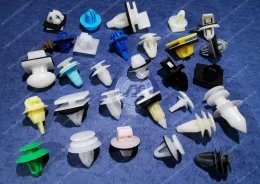
Nylon vs Other Plastics for Automotive Retainers: Engineering Performance Guide
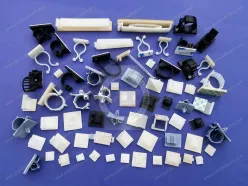
Automotive Trim & Moulding Clips: Engineering, Retention & OEM Sourcing Guide
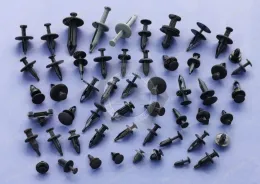
Plastic Push Rivets for Automotive Body Panels: Engineering & Sourcing Guide
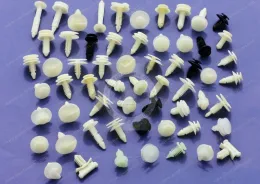
Automotive Plastic Retainers and Clips: Types, Functions & Applications
Contact Us
Tel.:
+86 020 8621 0320
+86 020 3121 6067
E-mail:
Technical Support:
Navigation
SEND INQUIREY