Call Us
+86 136 6007 9809
Call Us
+86 136 6007 9809

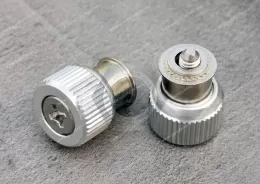
Tool-Only, Non-Flush, Spring-Loaded Captive Panel Screws – Type JX-PFC2P
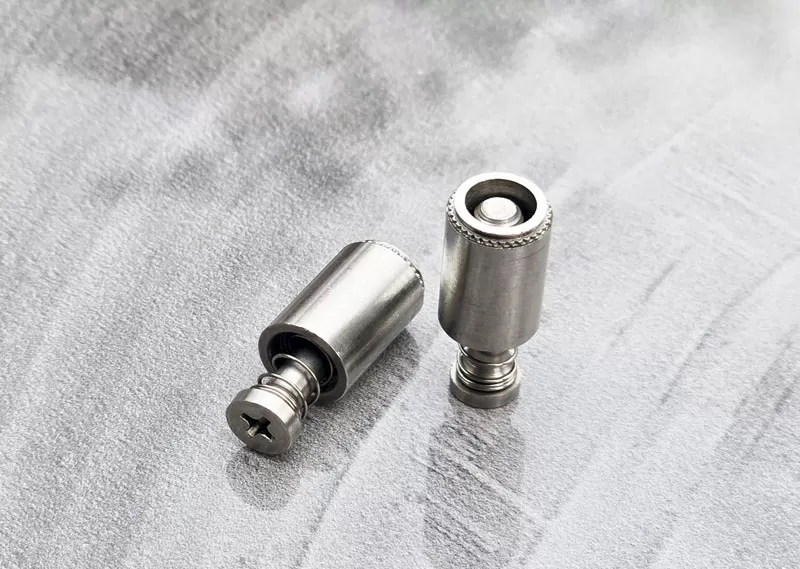
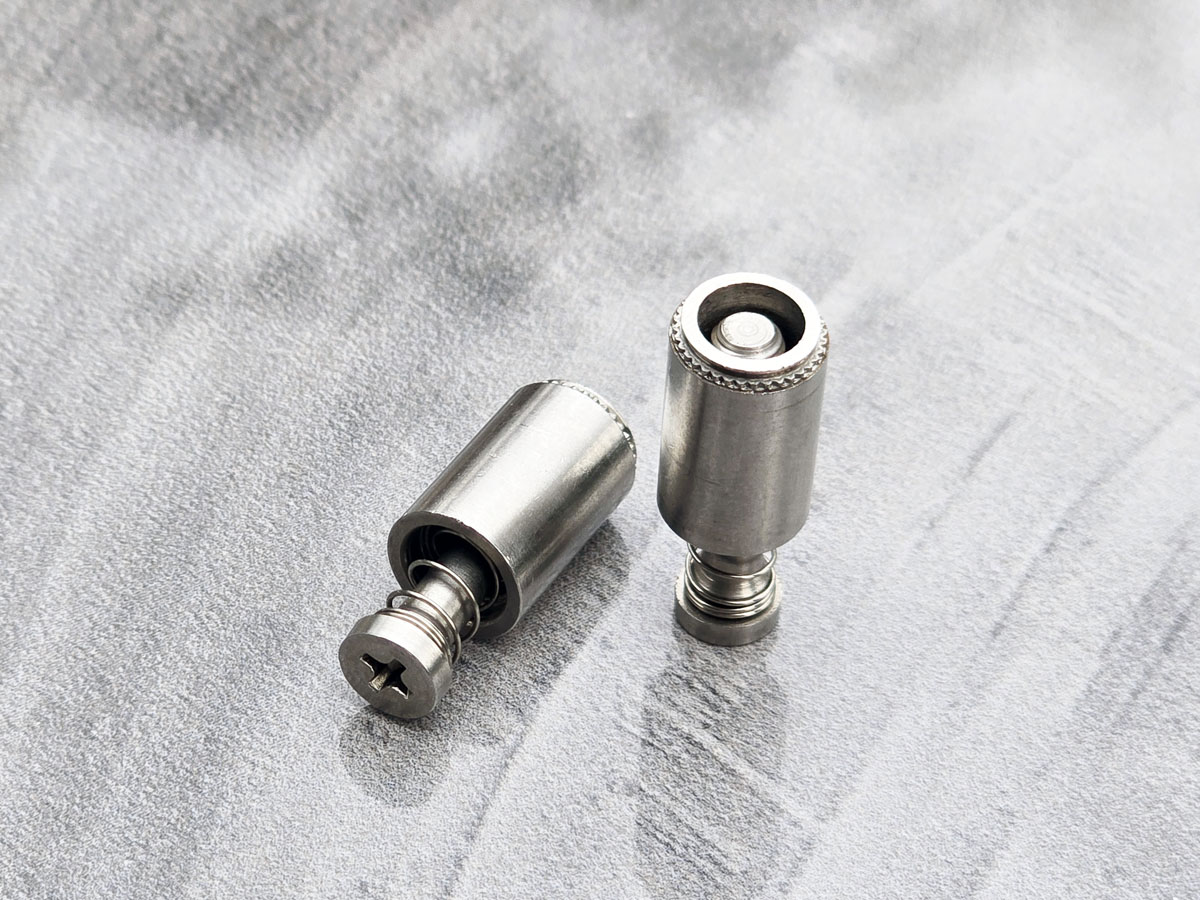
JX-PFC2P captive panel screws feature a concealed screw head for tool-only operation, a non-flush mounting profile and a spring-loaded captive mechanism that keeps the screw retained in the panel when disengaged.
The design is suitable for removable service covers, electrical enclosures, electronic equipment and industrial control panels where tool-operated access and retained hardware are required.
Key Features
Fully concealed screw head for tool-only access.
Spring-loaded captive screw construction.
Non-flush configuration for compatible equipment panels.
Assorted screw lengths for different assembly requirements.
Referenced Unified thread sizes from #4 to 1/4 inch and metric sizes from M3 to M6.
Material Options
Stainless steel grades including SUS302, SUS303, SUS316, SUS410, SUS420 and SUS430 are listed for technical review. Actual materials and component configurations are subject to the approved product specification.
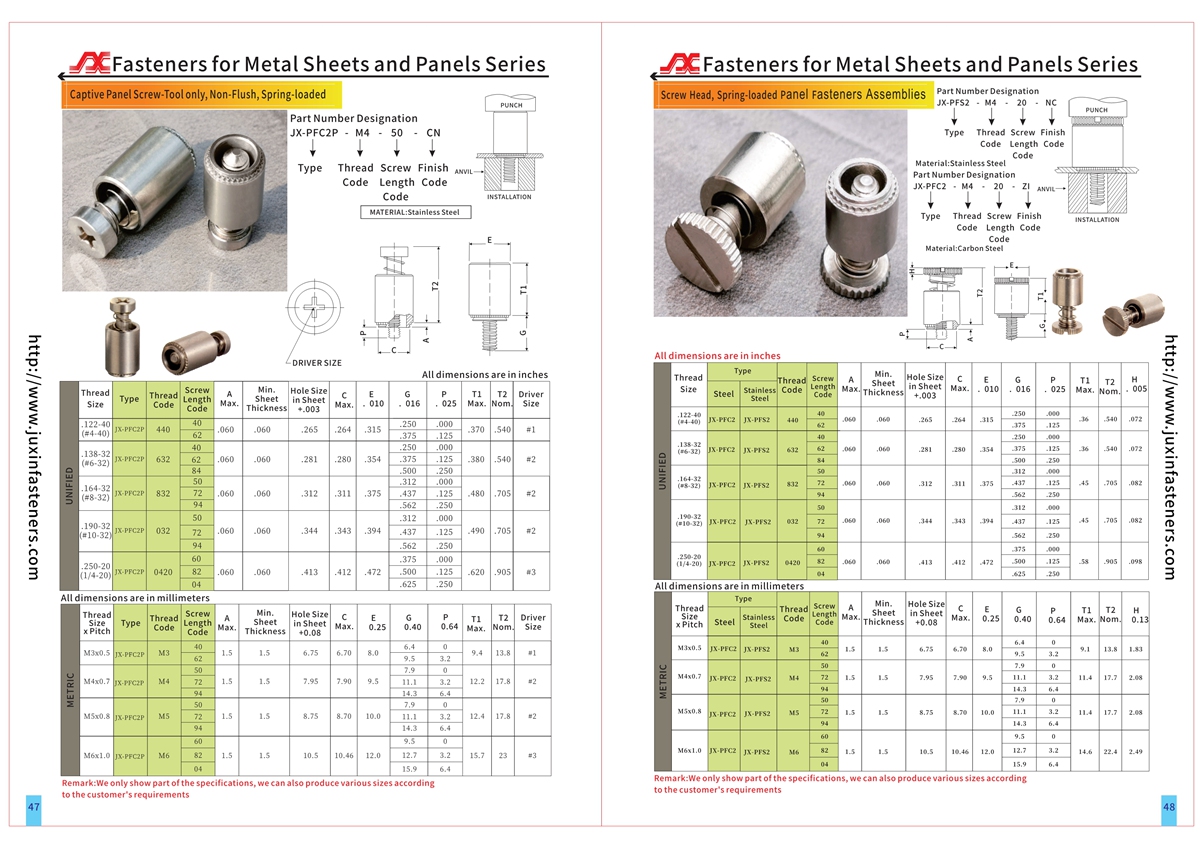
Detailed dimensions, mounting requirements and available configurations are provided in the product PDF and CAD documentation on pages 47–48.
Product Specification
Tool-Only Non-Flush Spring-Loaded Captive Panel Screws – JX-PFC2P
Engineering and OEM Fastening Solutions for Tool-Access Equipment Panels
JX-PFC2P is a spring-loaded captive panel screw designed for equipment assemblies requiring a concealed screw head and tool-only operation.
Unlike finger-operated captive screws with exposed knobs, the JX-PFC2P configuration places the screw head within the retaining assembly.
This makes it suitable for service covers where access using an appropriate tool is preferred.
The captive mechanism keeps the screw associated with the panel when disengaged, while the spring supports the intended screw movement.
Product Specifications
Series: JX-PFC2P
Product type: Tool-only captive panel screw
Head configuration: Concealed screw head
Profile: Non-flush
Operating method: Tool-operated
Mechanism: Spring-loaded captive screw
Referenced Unified thread range: #4 through 1/4 inch
Referenced metric thread range: M3 through M6
Screw lengths: Assorted lengths according to configuration
Material options: Stainless steel, subject to approved specifications
Applications: Service covers, electrical enclosures, industrial equipment and electronic housings
Technical drawings: Product PDF and CAD, pages 47–48
Custom dimensions: Available for technical review according to customer requirements
Concealed-Head Tool-Only Operation
The concealed screw-head arrangement is the primary distinguishing feature of JX-PFC2P.
It reduces direct finger access to the operating head and requires a compatible tool for screw engagement and disengagement.
This makes the design relevant to equipment panels that are intended to be opened during maintenance rather than routine operator use.
The exact drive recess and required operating tool must be confirmed from the product drawing.
Tool-only operation should not be confused with a tamper-proof locking mechanism.
Non-Flush Mounting Design
JX-PFC2P is identified as a non-flush captive panel fastener.
The retaining assembly may project above the surrounding panel surface even though the screw head is concealed.
For compact enclosures, the engineer should verify the installed height and available tool clearance.
The designation non-flush should not be interpreted as flush-mounted or countersunk.
Spring-Loaded Captive Retention
The spring-loaded mechanism helps position the screw when disengaged from its mating thread.
The screw remains retained in the mounting panel, reducing loose-hardware handling during service.
This is useful in equipment where a dropped screw could interfere with nearby components.
The spring does not provide the joint's primary clamping force.
Thread engagement and the mating assembly must be designed to meet the required mechanical performance.
Exact spring travel, screw extension and retraction must be confirmed from the approved drawing.
Unified and Metric Thread Options
The referenced product family includes Unified inch threads from #4 through 1/4 inch and metric threads from M3 through M6.
Unified threads should be specified according to the applicable ASME B1.1 designation.
Metric threads should be specified according to applicable ISO 261 and ISO 965 requirements.
The exact thread pitch and tolerance class must be confirmed for the selected part number.
Metric and Unified threads are not interchangeable.
OEM drawings should clearly identify the thread system to prevent incorrect substitutions.
Screw Length and Assembly Stack-Up
Different screw lengths allow the captive fastener to accommodate different panel assemblies.
Selection should consider mounting panel thickness, mating thread location, required engagement and the available disengaged screw clearance.
A screw that is too short may not provide adequate thread engagement.
A screw that is too long may interfere with internal components or bottom out.
The spring-loaded operating travel must also be considered.
The correct configuration should be selected using the actual assembly drawing rather than nominal thread size alone.
Material Selection
The supplied material information references stainless steel grades including SUS302, SUS303, SUS316, SUS410, SUS420 and SUS430.
These grades differ in corrosion resistance, mechanical properties and manufacturability.
The actual available grade must be confirmed for the selected configuration.
The screw, retainer and spring may have different material requirements.
Where corrosion resistance is important, the complete assembly should be reviewed.
Applicable material and surface-treatment requirements should be defined in the approved purchasing specification.
Panel Installation Requirements
The selected captive fastener must be compatible with the mounting panel.
Mounting-hole dimensions, sheet thickness, panel material and installation method are important.
The installation process must secure the retaining assembly without restricting the intended screw movement.
Different captive fastener attachment technologies use different installation conditions.
Therefore, mounting dimensions or hardness limits from another captive screw series should not be applied automatically to JX-PFC2P.
The correct installation procedure must be based on the approved drawing.
Tool-Only Access and Equipment Safety
Tool-operated panel fasteners may support equipment designs in which access to internal components is intended for service personnel.
Historical product descriptions reference UL 1950 and UL 60950.
These references do not establish current product certification.
For applicable electronic equipment, IEC/UL 62368-1 may be relevant, depending on the equipment category and governing requirements.
Other electrical and industrial equipment may be subject to different standards.
A captive screw alone does not establish conformity with any complete-equipment safety standard.
Any UL approval or certification claim must be supported by valid documentation for the specific product.
Engineering Selection: Tool-Only Versus Finger-Operated
Tool-only captive screws are appropriate where controlled service access is more important than rapid hand operation.
Finger-operated captive screws may be preferable for panels opened frequently by authorized operators.
The selection should consider service frequency, access requirements, tool availability and surrounding clearance.
A concealed-head design may discourage casual access but does not replace a security lock.
Engineering Selection: Spring-Loaded Versus No-Spring
Spring-loaded captive screws support controlled axial movement when disengaged.
No-spring captive screws use a different retention arrangement without spring-assisted positioning.
Where the panel must be removed without screw interference, spring-loaded retraction may be beneficial.
However, the actual retraction distance must be verified.
For installations with limited space or infrequent access, a no-spring design may also be appropriate.
The correct choice depends on the complete panel geometry and service procedure.
Industrial Applications
Electrical Equipment Enclosures
Tool-only captive screws can be considered for service covers intended to be opened using appropriate maintenance tools.
Industrial Control Cabinets
Retained fasteners can help reduce loose hardware during inspection and maintenance of control equipment.
EV Charging Equipment
Tool-operated captive screws may be suitable for selected charging equipment service panels, subject to enclosure design and applicable electrical safety requirements.
Telecommunications Equipment
Communication equipment housings may require removable panels with retained fastening hardware.
Electronic Equipment Enclosures
Concealed-head captive screws can support compact service-access designs where finger-operated knobs are undesirable.
Industrial Automation Equipment
Automation modules and equipment consoles may require retained fasteners for periodic maintenance.
Test and Measurement Equipment
Instrument housings may use tool-operated service covers where repeated access is required.
Engineering Example: Electrical Enclosure Service Cover
Consider an industrial electrical enclosure with a removable maintenance cover.
The cover is intended to be opened using a screwdriver during servicing.
Conventional screws become loose when removed.
A JX-PFC2P captive screw arrangement can retain the screws in the cover.
The concealed-head configuration supports tool-only operation, while the spring-loaded mechanism supports the intended disengaged screw position.
Before approval, the engineer should verify mounting-hole geometry, panel thickness, screw length, thread engagement and operating-tool clearance.
The selected materials must also be appropriate for the service environment.
The complete equipment must independently satisfy its applicable safety requirements.
OEM Procurement and Supplier Qualification
Purchasing teams should specify the complete JX-PFC2P configuration rather than purchasing only by thread size.
A suitable purchasing specification identifies the required thread, screw length, mounting geometry, material and surface finish.
For replacement projects, the installed height and screw travel should also be compared.
A visually similar captive fastener may not be dimensionally interchangeable.
Drawing review and sample approval are recommended for OEM production projects.
RFQ Information
Product series: JX-PFC2P
Required Unified or metric thread
Screw length and operating travel
Mounting panel material and thickness
Mounting-hole dimensions
Installed height and tool clearance
Mating thread specification
Material and surface finish
Environmental conditions
Estimated order quantity and annual demand
Engineering drawing and revision
Inspection requirements
Packaging and labeling requirements
Providing these details helps JUXIN FASTENERS review the application and prepare a quotation based on the confirmed configuration.
Quality and Functional Verification
A suitable inspection plan may include dimensional inspection, thread verification, material confirmation and functional checks.
The screw should remain captive when disengaged.
The spring-loaded mechanism should operate smoothly.
The mounting retainer should remain secure.
The screw should engage the mating thread correctly.
The concealed head should accept the intended operating tool.
Where required, the OEM may specify repeated operation testing and retention checks.
Acceptance criteria should be established before production.
Frequently Asked Questions
What is a tool-only captive panel screw?
It is a captive screw designed for operation using a compatible tool rather than direct finger operation.
What does non-flush mean?
It means the installed fastener assembly should not be assumed to sit completely flush with the panel surface.
Is JX-PFC2P spring-loaded?
Yes. It is identified as a spring-loaded captive panel screw.
What thread sizes are referenced?
Unified #4 through 1/4 inch and metric M3 through M6, subject to configuration availability.
Does JX-PFC2P have a concealed screw head?
Yes. The supplied product description identifies a concealed-head configuration.
Is JX-PFC2P UL certified?
Product-specific UL certification has not been established from the supplied information.
Can custom screw lengths be requested?
Custom dimensions can be reviewed using customer drawings and application requirements.
Related JUXIN FASTENERS Products
Spring-Loaded Captive Panel Screws – JX-PFC2 / JX-PFS2
Alternative spring-loaded captive panel screws for equipment covers.
Low-Profile Captive Panel Screws – JX-PF30 / JX-PF31 / JX-PF32
Spring-loaded captive screws with low-profile operating knobs.
Phillips and Six-Lobe Captive Panel Screws – JX-PF50 / JX-PF60
Recessed-drive captive screws for removable equipment panels.
No-Spring Captive Panel Screws – JX-PFHV
Compact retained panel screws without spring-assisted retraction.
Self-Clinching Standoffs
Threaded support and spacing solutions for sheet-metal assemblies.
These related product names should link to their corresponding verified JUXIN FASTENERS pages.
Request an OEM Quotation
JUXIN FASTENERS supplies captive panel fastening solutions for industrial equipment manufacturers, electronic enclosure designers and international OEM procurement teams.
For JX-PFC2P inquiries, please provide the required thread size, screw length, panel material, sheet thickness, installation geometry and expected order quantity.
Engineering drawings, annual demand and inspection requirements will help support technical review and quotation preparation.
Email: info@juxinfasteners.com
Website: www.juxinfasteners.com
Product Packaging
JX-PFC2P captive panel screws can be supplied with protective inner packaging and export cartons according to confirmed order requirements.
Packaging arrangements are selected to protect the concealed screw heads, threads, spring-loaded mechanisms and retaining components during handling and transportation.
Custom carton quantities, part-number labeling, batch identification and OEM packaging requirements can be reviewed before order confirmation.
Product Pictures
Contact Us
Tel.:
+86 020 8621 0320
+86 020 3121 6067
E-mail:
Technical Support:
Navigation
SEND INQUIREY