
Call Us
+86 136 6007 9809
Call Us
+86 136 6007 9809

Jun. 28, 2022
JUXIN FASTENERS is an industrial fastener manufacturer and supplier supporting OEM, Tier-1, Tier-2, engineering, procurement,
and supplier-development teams with standard fasteners, custom fasteners, and drawing-based precision components.
Established in 2003, we have developed our business around a practical requirement shared by industrial customers worldwide: a fastener is not simply a catalog item.
Its performance depends on the material, geometry, mating component, installation process, surface treatment, operating environment, and manufacturing consistency of the complete assembly.
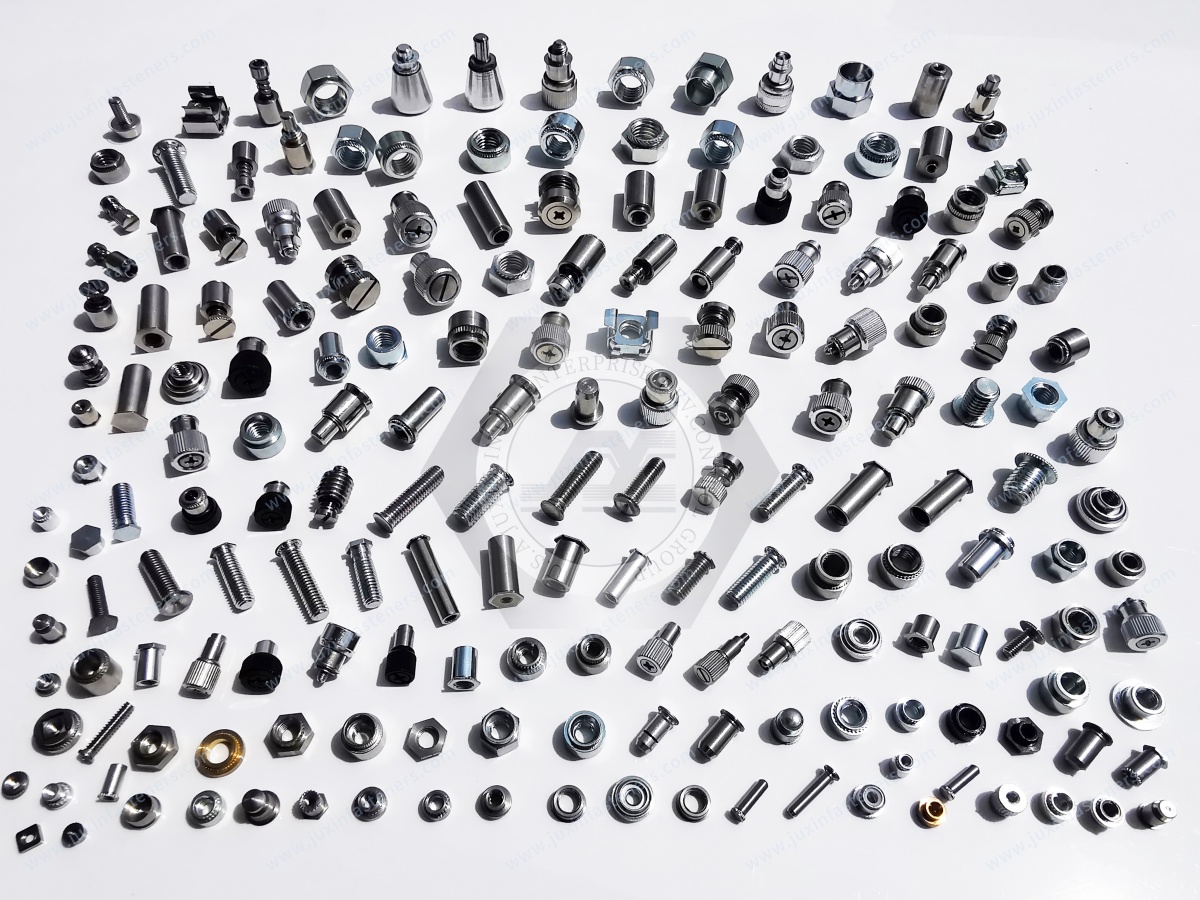
Our product scope includes metal fasteners, plastic and nylon fasteners, weld fasteners, blind fastening systems,
threaded inserts, self-clinching fasteners, locking nuts, custom screws and bolts, and CNC machined components.
For engineered and non-standard parts, we work from customer drawings, specifications, samples,
and application requirements to evaluate manufacturability and develop an appropriate production and inspection approach.
JUXIN FASTENERS
Email: info@juxinfasteners.com
Website: www.juxinfasteners.com
For a production buyer, finding a fastener with the correct thread size is only the beginning.
For an engineer, dimensional similarity does not automatically establish functional equivalence.
For a supplier-development team, a lower piece price does not necessarily mean a lower sourcing cost.
An industrial fastener supplier may need to support several decisions simultaneously:
Can the part be manufactured consistently to the controlled drawing?
Is the selected material appropriate for the mechanical and environmental requirements?
Does the surface treatment affect thread fit, friction, installation, or corrosion behavior?
Does the fastener interact correctly with the mating sheet, bolt, plastic boss, insert, hole, or welded parent material?
Can the supplier control critical dimensions and characteristics during repeat production?
What inspection or validation is required before a new source is approved?
Can the product move from sample evaluation to stable production supply?
This is why JUXIN FASTENERS approaches OEM fastener sourcing as a combination of product selection, manufacturing control,
application understanding, validation, and supply-chain execution.
Our manufacturing and sourcing capabilities cover multiple fastening technologies rather than a single fastener family.
Our weld fastener range includes products such as:
DIN 929 hex weld nuts
DIN 928 square weld nuts
Projection weld nuts
Hex flange weld nuts
Threaded weld studs
CD weld studs
Arc weld studs
Projection weld studs
Drawing-based weld fasteners
Weld fastener performance cannot be evaluated from the nut or stud alone.
Parent material, sheet thickness, projection geometry, welding process, current, time, electrode force, tooling, alignment, surface condition,
and thread protection can all influence the finished welded assembly.
A strong fastener does not automatically create a strong welded joint.
For OEM projects, the welding process and final joint should therefore be validated under the customer's actual production conditions.
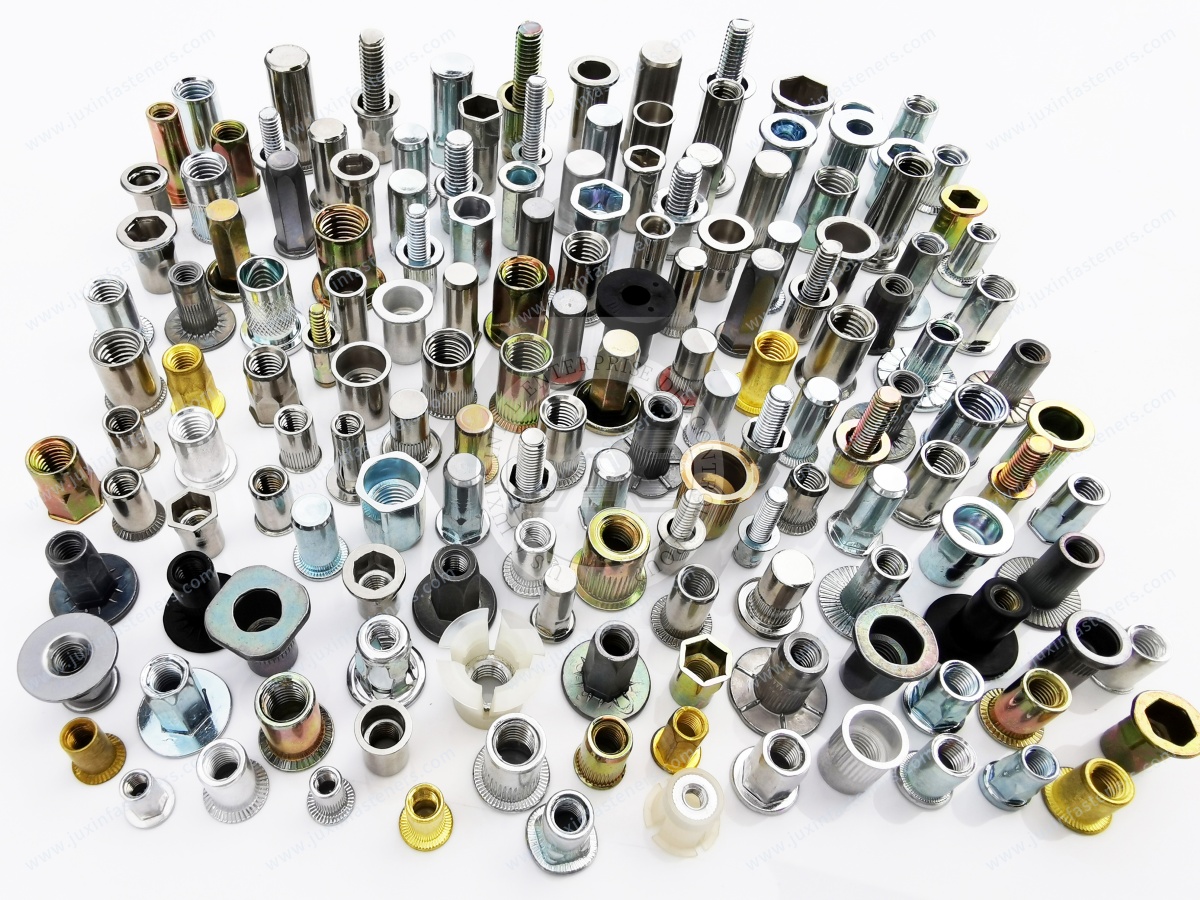
JUXIN FASTENERS supplies blind rivet nuts for applications where a durable internal thread is required and access may be available from only one side of the assembly.
Product configurations can include:
Open-end rivet nuts
Closed-end rivet nuts
Round-body rivet nuts
Knurled-body rivet nuts
Hex-body rivet nuts
Different flange configurations
Drawing-based rivet nut designs
Rivet nut selection should not be based only on thread size.
Grip range, parent material, sheet thickness, hole geometry, body style, installation tooling, setting parameters, pull-out resistance, and spin-out resistance can all affect the installed joint.
Pull-out resistance and spin-out resistance describe different failure modes.
A closed-end rivet nut may help address specific sealing or contamination requirements, but a closed-end construction alone does not establish a waterproof joint or an IP rating.
Those requirements must be evaluated at assembly level.
Our blind fastening range supports sheet-metal and industrial assembly applications where conventional two-sided fastening is impractical.
Selection variables can include:
Rivet diameter
Grip range
Total joint stack
Hole diameter and condition
Parent materials
Head style
Rivet and mandrel material
Shear requirements
Tensile requirements
Installation tooling
Correct diameter + incorrect grip range = incorrect rivet selection.
The nominal strength of a blind rivet also should not be confused with the performance of the installed joint. Sheet properties,
hole quality, edge distance, joint stack and installation consistency remain important.
JUXIN FASTENERS supplies self-clinching nuts, studs and standoffs for selected sheet-metal applications.
Self-clinching is a controlled material-flow process.
The sheet material must flow correctly into the retention features of the fastener during installation. As a result, sheet hardness, sheet thickness, hole geometry,
edge distance, fastener geometry and press conditions must be considered together.
Simply increasing press force is not a reliable solution to an unsuitable fastener-to-sheet combination.
Where push-out or torque-out performance is important, the installed fastener should be evaluated in the actual production sheet or a representative equivalent.
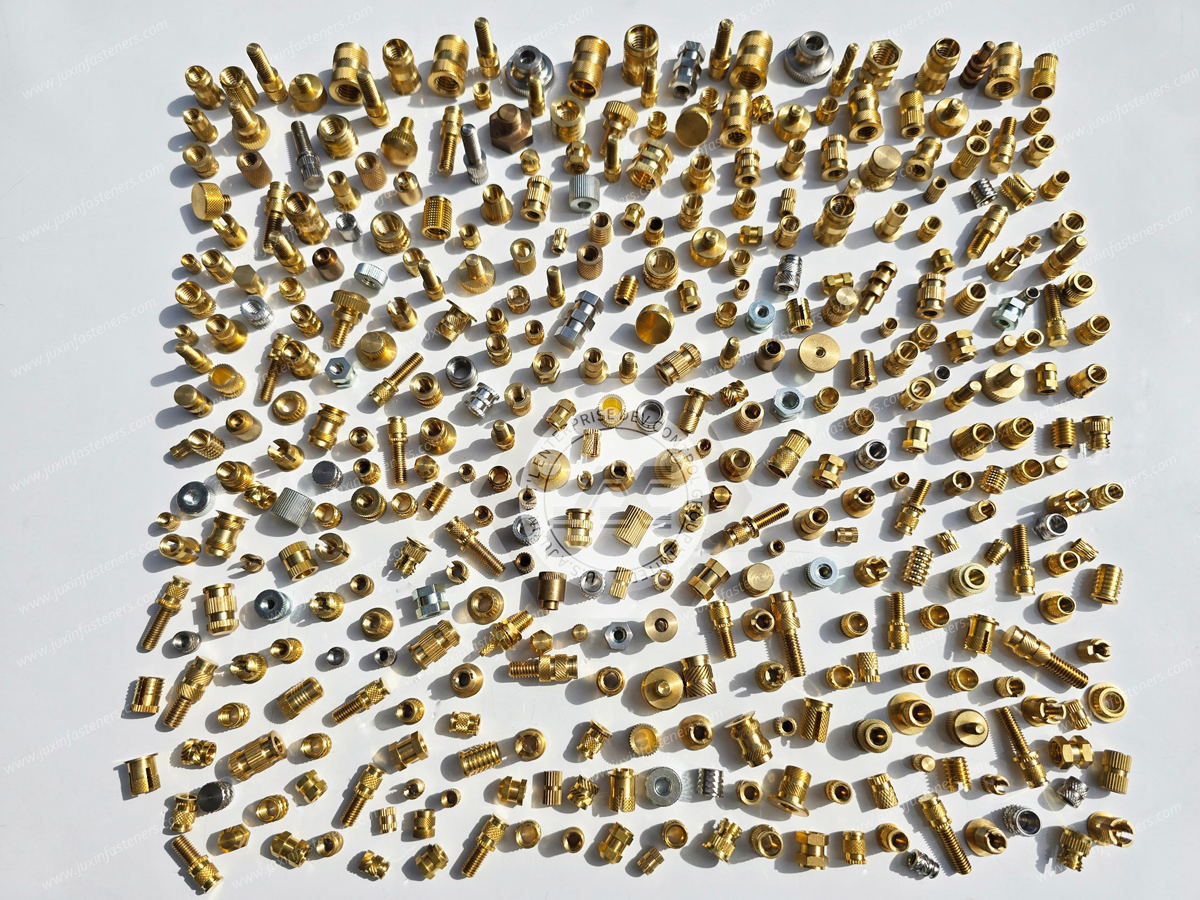
Threaded inserts can provide reusable metal threads in thermoplastic components when correctly matched to the polymer, boss design and installation process.
Available product families include:
Heat-set inserts
Ultrasonic inserts
Brass threaded inserts
Application-specific insert geometries
Insert performance depends on more than the strength of the insert itself.
Polymer type and grade, reinforcement, boss diameter, wall thickness, hole geometry, installation temperature or process settings,
thread engagement, service temperature, moisture, creep, and repeated assembly can influence the joint.
A strong insert does not automatically create a strong plastic joint.
For production applications, the plastic component and insert should therefore be treated as an engineered system.
Our plastic fastener range includes selected:
Nylon rivets
Plastic rivets
Nylon screws
Plastic bolts
Plastic nuts
Plastic washers
Plastic spacers
PCB supports
PCB standoffs
Card guides
Screw grommets
Other drawing-based plastic fastening components
Plastic fasteners can be useful where low mass, electrical isolation, component protection, corrosion considerations, assembly convenience or material compatibility are important.
However, the polymer name alone does not define finished-part performance.
PA6, PA66, POM, PP, PC, PVDF, PEEK and other engineering polymers can behave differently under moisture, temperature, sustained load,
chemicals and thermal cycling. Grade, reinforcement and processing history can also matter.
For nylon components in particular, moisture conditioning and long-term stress relaxation should be considered where dimensional stability or sustained clamp load is important.
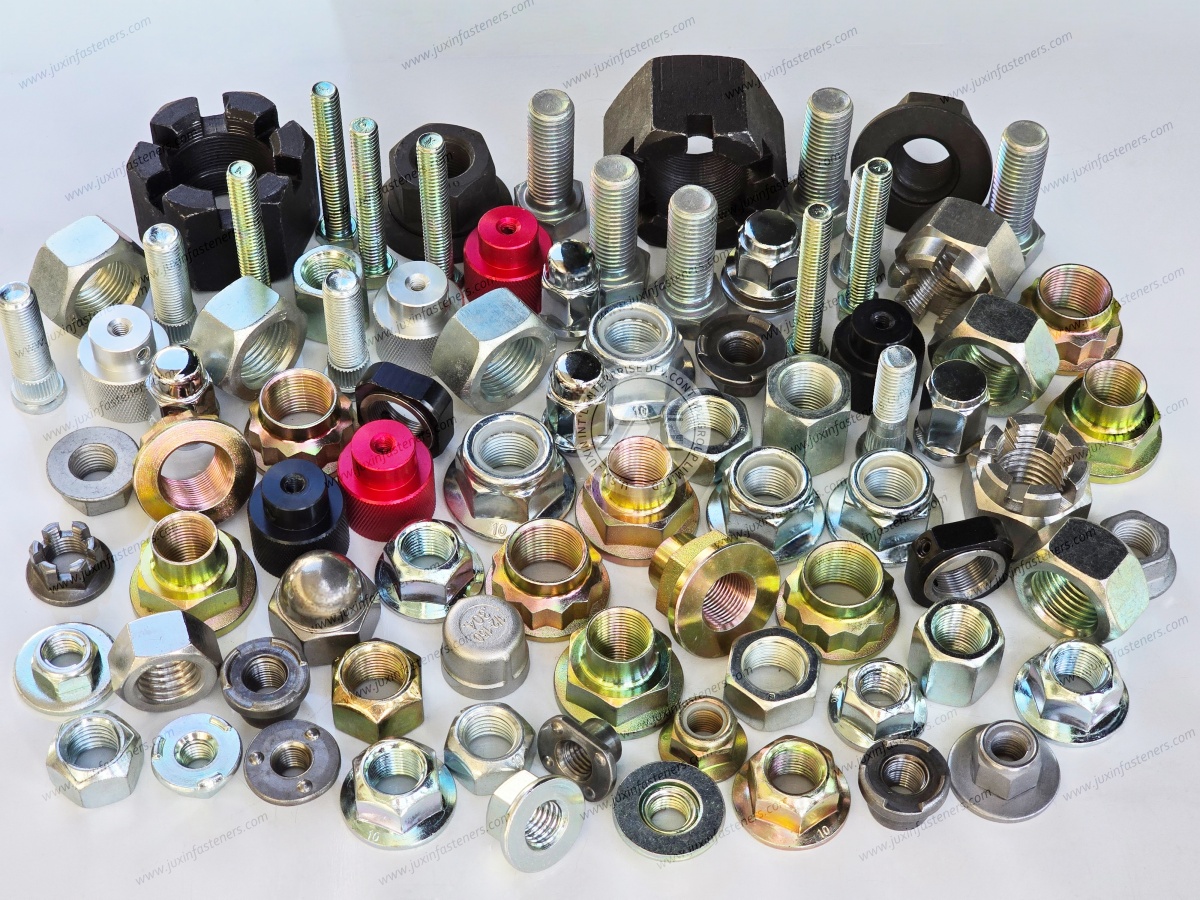
JUXIN FASTENERS supplies multiple nut configurations for industrial assembly, including:
Nylon insert lock nuts
Flange nuts
All-metal lock nuts where applicable
Hex nuts
Square nuts
High-strength nuts
Stainless steel nuts
Aluminum nuts
Brass nuts
Custom large nuts
Drawing-based special nuts
Locking performance, bolt compatibility, proof requirements, coating, friction and operating conditions should be evaluated according to the specific assembly.
Prevailing torque is not preload.
A locking feature can help resist rotational loosening under selected conditions, but it does not replace correct joint design or tightening control.
Not every industrial fastening requirement can be solved with a catalog part.
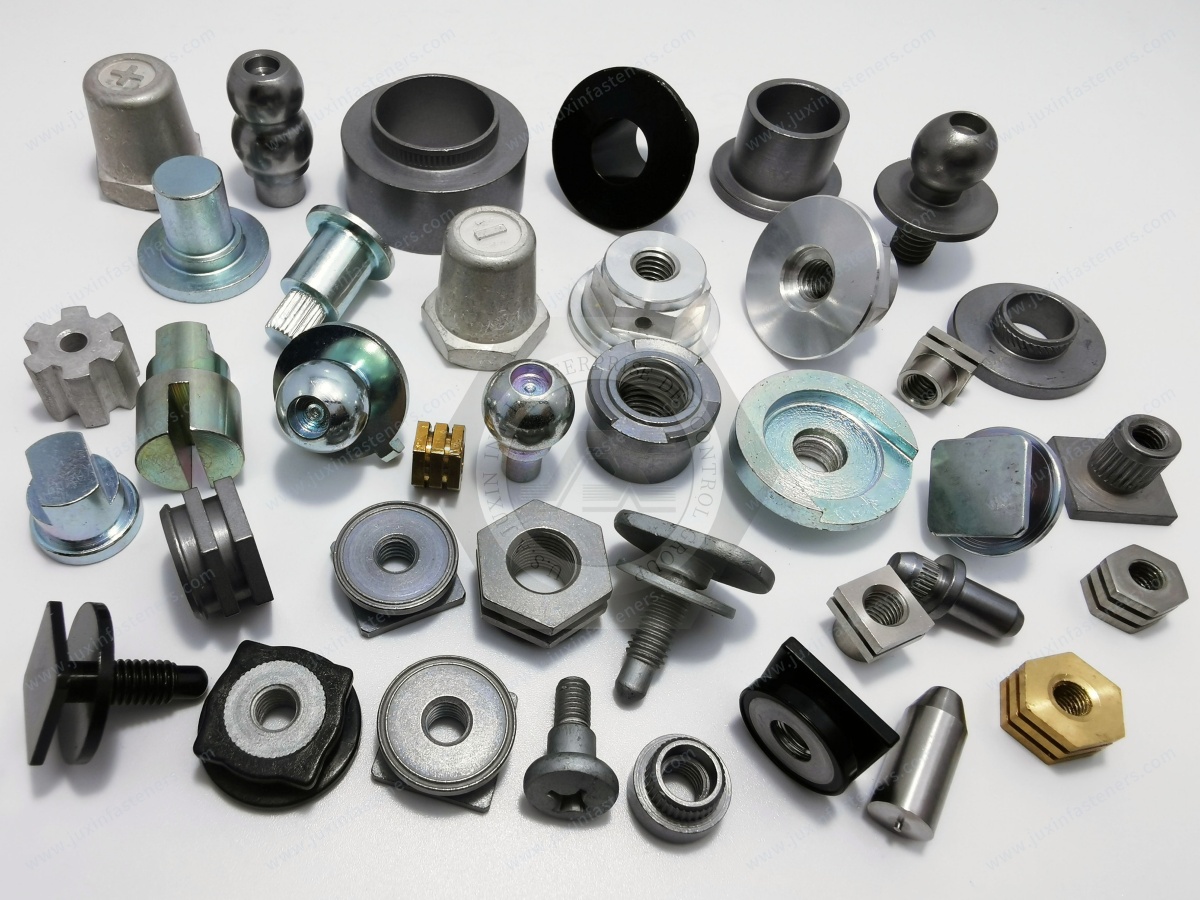
JUXIN FASTENERS supports custom screws, custom bolts, special fasteners and drawing-based components where geometry, material, thread,
head configuration, drive style, surface treatment or assembly function differs from standard hardware.
A useful custom-fastener RFQ should identify the characteristics that are functionally important rather than simply requesting a visually similar component.
Depending on the project, manufacturing feasibility may be evaluated against:
Part geometry
Thread specification
Material
Mechanical requirements
Tolerances
Surface treatment
Mating components
Application environment
Expected production volume
Inspection requirements
Exact manufacturing availability is subject to engineering review of the specific drawing and project requirements.
For components that are better suited to machining than conventional fastener-forming processes, JUXIN FASTENERS can support selected CNC machined and custom precision components.
These projects are normally drawing-driven.
Material, tolerances, geometric requirements, surface condition, secondary processes, inspection requirements and production quantity should be reviewed before the manufacturing route is confirmed.
A standard fastener is generally preferable when it can meet the engineering and commercial requirements without unnecessary customization.
Standardization can simplify sourcing, replacement, inventory management and supplier comparison.
A custom fastener becomes more appropriate when the application requires characteristics that a standard part cannot provide efficiently, such as:
Special geometry
Restricted installation space
Unique anti-rotation features
Captive assembly
Special material combinations
Application-specific thread engagement
Unusual head or flange geometry
Integration with automated assembly
Replacement of multiple components with one engineered part
Customization should solve a measurable engineering or manufacturing problem. It should not be added merely because a non-standard design is possible.
This distinction can reduce unnecessary tooling, qualification work and long-term supply complexity.
For custom and application-specific components, the customer drawing should become the primary technical communication document.
A productive engineering review normally starts with the controlled 2D drawing and, where useful, a 3D model.
The review may consider:
| Engineering Input | Why It Matters |
|---|---|
| Part and drawing revision | Prevents quotation or production against obsolete data |
| Material | Influences strength, forming, machining, corrosion and application behavior |
| Thread specification | Controls mating compatibility and functional engagement |
| Critical dimensions | Identifies characteristics requiring tighter manufacturing control |
| Tolerances | Affect process capability, inspection effort and cost |
| Surface treatment | Can affect corrosion behavior, friction, thread fit and appearance |
| Mating component | Helps evaluate the fastener as part of the assembly |
| Installation method | Influences geometry, tooling and functional requirements |
| Operating environment | Helps identify temperature, moisture, chemical or corrosion concerns |
| Functional requirement | Defines what the part actually needs to accomplish |
| Annual volume | Influences the appropriate manufacturing process and tooling strategy |
This approach helps separate characteristics that are genuinely functional from dimensions that may unnecessarily increase manufacturing cost.
JUXIN FASTENERS works with multiple fastener materials depending on product type and project requirements.
These may include selected carbon steels, stainless steels, aluminum alloys, brass, titanium alloys and engineering polymers.
Material selection should not be reduced to a simple hierarchy of "better" and "worse."
For example:
Stainless steel may provide useful corrosion resistance, but the appropriate grade depends on the environment.
304 and 316 stainless steels should not be treated as universally interchangeable. Chloride exposure, chemicals, temperature, mating materials,
galling risk and galvanic interaction can affect the selection.
Aluminum can reduce component mass, but thread strength, alloy, engagement length, mating material, preload and galvanic corrosion require consideration.
A high-strength aluminum alloy should not be assumed to behave like a high-strength steel fastener.
Brass may be selected for machinability, electrical characteristics or particular environmental requirements, but "brass" alone does not establish electrical,
potable-water, marine or other system-level compliance.
Polymer fasteners can provide low mass and electrical isolation, but creep, stress relaxation, moisture absorption,
temperature and chemical compatibility can dominate long-term behavior.
Material selection should follow the application, not the material name.
Industrial buyers frequently specify coatings for corrosion protection or appearance, but a surface treatment can influence more than corrosion behavior.
Depending on the fastener, coating can affect:
Friction
Tightening behavior
Preload
Thread fit
Dimensional allowance
Assembly compatibility
Appearance
Corrosion performance
For high-strength steel components, process selection may also require consideration of hydrogen embrittlement risk.
A coating substitution should therefore not automatically be treated as a purchasing-only change.
Same torque + different friction can produce different preload.
Similarly, salt-spray test duration should not be interpreted directly as a prediction of field service life.
Real service conditions depend on environment, joint design, damage, drainage, temperature, contaminants and mating materials.
Our fastener technologies are used across industrial manufacturing sectors where repeatable assembly and controlled component sourcing are important.
Relevant products can include weld nuts, weld studs, rivet nuts, blind rivets, locking nuts, threaded inserts, plastic clips, plastic fasteners and drawing-based components.
Applications may include selected body, interior, enclosure, battery-related, electrical, bracket, sheet-metal and auxiliary assemblies depending on OEM specifications and validation requirements.
Battery energy storage systems, converters, inverters, power distribution equipment and electrical enclosures may require a combination of sheet-metal fasteners,
threaded inserts, plastic components and custom hardware.
Electrical isolation, thermal cycling, corrosion, serviceability and automated assembly may become important selection variables depending on the system.
Server infrastructure, power equipment, cabinets, racks, telecom hardware, cooling equipment and control systems can require compact threaded attachment,
panel fastening, PCB support and serviceable enclosure solutions.
Relevant products can include self-clinching fasteners, rivet nuts, plastic spacers, PCB supports, threaded inserts and drawing-based precision components.
Automation equipment often combines sheet metal, machined components, electrical enclosures, sensors, tooling and moving assemblies.
Fastener selection may therefore depend on installation access, repeatability, vibration, service requirements, equipment footprint and production automation.
Solar equipment, energy-storage systems and related power infrastructure can require corrosion-conscious fastening, sheet-metal attachment and custom components.
The actual material and coating system should be selected according to the installation environment rather than relying on a generic "outdoor" classification.
JUXIN FASTENERS can support selected railway interior, equipment, enclosure and secondary fastening applications according to customer drawings and project requirements.
Railway fastening requirements must be evaluated by application.
Fasteners for primary load-bearing structures, running gear, braking systems, crash structures or other safety-critical locations require the applicable OEM or project specification and formal validation.
A general industrial fastener should never be assumed to be automatically qualified for a safety-critical railway application.
Selected fasteners and precision components may be used in medical equipment, laboratory equipment and precision instruments where dimensional control,
material selection and clean assembly design are important.
The use of a particular material such as stainless steel or engineering polymer does not by itself establish medical, biocompatibility, sterilization or regulatory compliance.
Those requirements must be defined and validated for the specific product and application.
Industrial sourcing works more effectively when commercial and engineering information move together.
A typical JUXIN FASTENERS project may progress through:
Technical Requirement → Drawing Review → Manufacturability Review → Quotation → Sample → Customer Validation → Production Approval → Repeat Supply
The exact process depends on the complexity and qualification requirements of the project.
For drawing-based components, we review available technical information to understand what must be manufactured and which characteristics are critical.
Questions may include:
Which dimensions are functional?
What is the mating component?
How is the fastener installed?
What loads or failure modes matter?
Is the specified material essential?
Is the coating part of the functional specification?
Are special inspection requirements defined?
A dimensionally correct sample is not automatically a production-approved component.
Depending on the product, validation may need to include dimensional inspection, thread checks, material verification,
mechanical testing, coating evaluation, installation trials or assembly-level functional testing.
The customer remains responsible for validating the component in the intended application and approving it according to the applicable project requirements.
Production control should focus on characteristics that influence fit, function and repeatability.
Depending on the product and specification, inspection may include:
Material verification
Dimensional inspection
Thread inspection
Mechanical property testing
Surface-treatment inspection
Visual inspection
Functional checks
Production traceability
JUXIN FASTENERS operates under an ISO 9001 certified quality management system.
Project-specific documentation and testing requirements should be identified during RFQ and supplier qualification rather than assumed after production begins.
Comparing only unit price can hide significant downstream cost.
For an OEM, the more useful question is:
What is the total installed and supplied cost of this fastener in our production system?
A practical sourcing model is:
Total Installed Cost = Part Price + Installation + Tooling + Inspection + Rework + Scrap + Downtime + Logistics + Supply Risk
For example, a lower-priced fastener may become more expensive if it requires slower installation, creates inconsistent feeding in automated equipment,
causes higher scrap, requires additional inspection, or produces assembly rework.
Procurement and engineering should therefore evaluate the part and the manufacturing process together.
Second-source development can reduce supply risk, but dimensional similarity alone is not sufficient.
Same dimensions do not automatically mean functional equivalence.
When qualifying an alternative fastener supplier, the comparison may need to include:
Controlled drawing and revision
Material specification
Mechanical properties
Heat treatment where applicable
Thread specification
Critical geometry
Surface treatment
Coating thickness where relevant
Friction requirements where relevant
Installation behavior
Functional testing
Packaging requirements
Production inspection
Assembly validation
For products such as weld fasteners, rivet nuts, self-clinching fasteners and threaded inserts, installed performance can depend strongly on the customer's parent material and installation process.
A second-source sample should therefore be tested as part of the assembly, not only inspected as an isolated component.
A detailed RFQ allows engineering and procurement teams to receive a more meaningful technical and commercial response.
For custom or drawing-based fasteners, provide as much of the following information as available:
2D drawing
3D model where applicable
Part number
Drawing revision
Fastener type
Thread specification
Material
Mechanical or property-class requirements
Surface treatment
Critical dimensions and tolerances
Mating component
Installation method
Functional or load requirements
Operating environment
Inspection and validation requirements
Packaging requirements
Estimated annual volume
Sample quantity
Target production schedule
Product-specific information may also be necessary.
For rivet nuts, include sheet thickness, hole size and required grip range.
For weld fasteners, include parent material, sheet thickness and welding process information where available.
For threaded inserts, include polymer, boss geometry and installation method.
For self-clinching fasteners, include sheet material, hardness where known, thickness and hole geometry.
The more accurately the assembly conditions are defined, the less the sourcing decision depends on assumptions.
This company profile should function as a gateway to deeper technical pages rather than duplicate every product guide.
Relevant internal-link paths include:
Weld Nuts and Weld Studs → detailed weld-fastener product and engineering pages
Blind Rivet Nuts → rivet nut selection, installation and application pages
Blind Rivets → blind rivet product and engineering pages
Self-Clinching Fasteners → sheet-metal fastening and installation pages
Threaded Inserts for Plastic → insert selection and plastic-joint design pages
Plastic and Nylon Fasteners → material-selection and industrial application pages
Lock Nuts → locking technology and vibration-related pages
Stainless Steel Fasteners → stainless material-selection pages
Custom Fasteners → drawing-based manufacturing and RFQ pages
Fastener Failure → failure-mode and engineering troubleshooting resources
Use the existing indexed JUXIN FASTENERS URL when implementing each internal link.
This structure allows engineers to move from company qualification into detailed technical evaluation while allowing procurement teams to
move toward supplier qualification and RFQ without creating duplicate content across the website.
Yes. JUXIN FASTENERS supports drawing-based custom fasteners and selected precision components. Manufacturing feasibility depends on geometry,
material, tolerances, quantity, secondary processes and project requirements and is subject to engineering review.
A controlled 2D drawing is the best starting point. A 3D model, material specification, mating component, application information, surface treatment,
annual volume and validation requirements can further improve the technical review.
JUXIN FASTENERS supports industrial OEM, Tier-1 and Tier-2 sourcing projects across multiple fastening technologies.
Project-specific technical, quality and documentation requirements should be defined during RFQ and supplier qualification.
We can evaluate second-source opportunities against the customer's drawing and project requirements.
Equivalent dimensions alone should not be treated as proof of equivalent performance.
Material, mechanical properties, coating, friction, installation behavior and functional validation may also need comparison.
Use a standard part when it satisfies the mechanical, installation, environmental and commercial requirements.
Consider customization when a standard part creates a genuine limitation in geometry, assembly, automation, material compatibility or functional performance.
No. Material selection depends on mechanical load, temperature, corrosion environment, mating materials, installation method, service life and other application requirements.
Higher strength or greater corrosion resistance does not automatically produce a better joint.
If you are evaluating a new industrial fastener manufacturer, developing a second source, replacing a difficult-to-source component,
or designing a new assembly, send us the technical information available for your project.
For the most effective engineering review, include:
2D Drawing + 3D Model + Part / Revision + Application + Material + Mating Component + Load Requirement + Surface Treatment + Environment + Annual Volume
Where relevant, also provide sheet thickness, hole size, grip range, thread specification, property class, welding process, installation method and validation requirements.
Our team can review the project against JUXIN FASTENERS' applicable manufacturing and supply capabilities and discuss the next step toward quotation, sample evaluation and production sourcing.
JUXIN FASTENERS
Industrial Fasteners | Custom Fasteners | Drawing-Based Components | OEM Fastening Solutions
Email: info@juxinfasteners.com
Website: www.juxinfasteners.com
Previous: Industrial Fastener Solutions
Contact Us
Tel.:
+86 020 8621 0320
+86 020 3121 6067
E-mail:
Technical Support:
Navigation
SEND INQUIREY



