
Call Us
+86 136 6007 9809
Call Us
+86 136 6007 9809

Apr. 08, 2026
Automotive self-tapping screws can eliminate a separate tapping operation by creating or forming a mating thread during installation.
That simple manufacturing advantage makes them attractive for high-volume vehicle assembly—but it also creates an important engineering dependency:
The screw and the parent material form the thread together.
A self-tapping screw that performs well in a steel bracket may be unsuitable for an aluminum panel.
A screw designed for thermoplastic may generate excessive radial stress in a different polymer.
A pilot hole that provides strong retention in one material can cause excessive drive torque or thread stripping in another.
And a screw that installs successfully during prototype assembly may lose clamp force, damage the boss or fail during repeated service.
For automotive engineers and sourcing teams, the correct selection process is therefore not:
Thread Size → Screw
It is:
Parent Material → Material Thickness / Boss Geometry → Pilot Hole → Screw Thread Geometry → Engagement → Drive Torque
→ Clamp Requirement → Strip Torque → Environment → Production Process → Validation
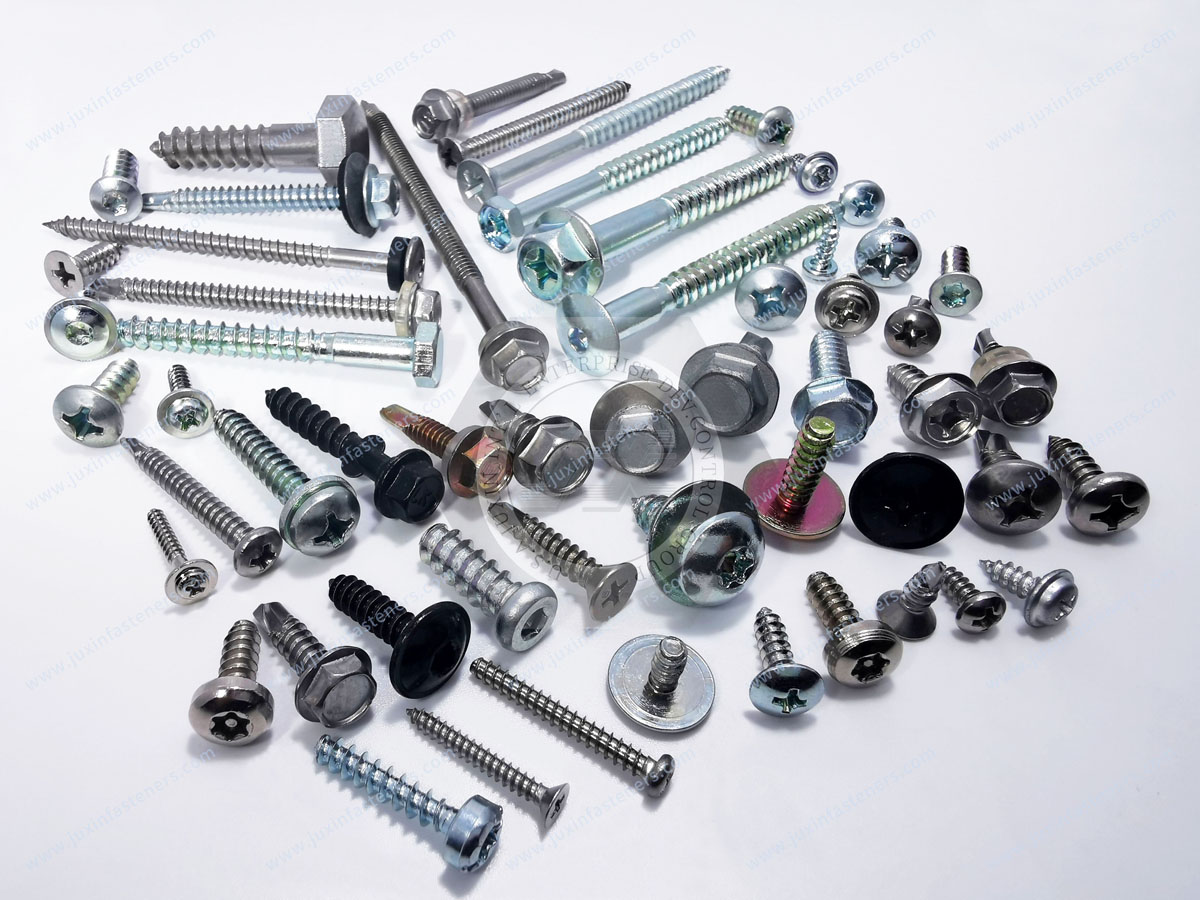
JUXIN FASTENERS supplies standard and drawing-based self-tapping, thread-forming and specialty screws for selected automotive and industrial OEM applications, including:
Self-tapping screws for metal
Thread-forming screws
Screws for thermoplastics
Screws for automotive interior components
Screws for electrical and electronic housings
Self-drilling screws for suitable sheet-metal applications
SEMS and combination screws
Torx-drive screws
Hex-socket screws
Corrosion-resistant coated screws
Stainless steel screws
Custom cold-formed screws
Drawing-based specialty screws
This guide focuses on how to select and source these screws according to the material and joint—not merely the nominal thread diameter.
| Parent Material / Application | Engineering Priority | Screw Technology to Evaluate |
|---|---|---|
| Thin steel sheet | Thread formation and strip resistance | Metal thread-forming / self-tapping screw |
| Thin aluminum sheet | Controlled thread formation without stripping | Material-compatible thread-forming screw |
| Thermoplastic housing | Low radial stress and strong thread engagement | Plastic-specific thread-forming screw |
| Reinforced polymer | Material-specific thread formation | Plastic-specific screw validated for grade |
| Interior trim | Controlled installation and appearance | Plastic screw / self-tapping screw |
| Electrical housing | Thread retention and controlled assembly | Plastic or metal thread-forming screw |
| Sheet-metal bracket | Eliminate separate tapping | Thread-forming screw |
| Suitable sheet requiring drilling | Combined drilling and fastening | Self-drilling screw |
| Frequently serviced component | Repeated assembly durability | Evaluate insert or machine-thread solution |
The final choice depends on the actual parent material, geometry and service requirement.
These terms are frequently mixed together in RFQs.
That can create specification errors.
“Self-tapping” is a broad term for screws capable of creating their own mating thread during installation.
Depending on design, the screw may form or cut the thread.
A thread-forming screw primarily creates the mating thread through material displacement rather than conventional cutting.
The parent material is plastically displaced around the screw thread.
A thread-cutting design removes material while generating the mating thread.
A self-drilling screw incorporates a drilling feature intended to create the initial hole and subsequently form or engage the thread in suitable material.
Therefore:
Self-Tapping ≠ Self-Drilling.
And:
Thread-Forming ≠ Thread-Cutting.
This distinction should be clear on automotive drawings and RFQs.
DIN 7500 is widely associated with metric thread-forming screws for metallic materials.
These screws can create a mating metric thread in a suitably designed preformed hole without requiring a conventional tapping operation.
Potential benefits can include:
Reduced machining operations
Fewer production steps
No separate tapping process
Efficient high-volume assembly
Potentially secure thread engagement
However, specifying only:
“DIN 7500 M5”
does not complete the joint design.
Performance still depends on:
Parent material
Material hardness
Material thickness
Pilot-hole geometry
Engagement
Installation torque
Screw material
Surface treatment
For a conventional machine screw installed into a pre-tapped hole, the mating thread already exists.
For many self-tapping and thread-forming screws, the pilot hole becomes part of the thread-generation process.
That makes pilot-hole diameter a functional engineering parameter.
If the hole is too small:
Drive torque can increase
Assembly load can increase
Screw damage may occur
Parent material may deform
Plastic bosses may crack
If the hole is too large:
Thread engagement may decrease
Strip torque may decrease
Pull-out resistance may decrease
Joint retention may become inconsistent
Therefore:
Pilot Hole ≠ Clearance Hole.
There is no universal pilot-hole diameter that is correct simply because the screw is M4 or M5.
Pilot-hole selection can depend on:
Parent material
Material hardness
Sheet thickness
Polymer grade
Reinforcement
Screw geometry
Engagement length
Required drive torque
Required strip torque
For OEM applications, pilot-hole recommendations should be validated in the actual production material.
A self-tapping screw does not create its joint strength independently.
The mating thread is formed in the parent material.
Therefore:
Strong Screw ≠ Strong Mating Thread.
The screw may be manufactured from high-strength material while the functional limitation remains:
Thin steel
Aluminum
Polymer
Composite
Molded boss
The parent material can fail before the screw.
Thin steel components can be used throughout automotive:
Interior brackets
Electrical brackets
Equipment housings
Covers
Secondary sheet-metal components
Thread-forming or self-tapping screws can reduce the need for separate tapping operations.
Important variables include:
Sheet thickness
Steel grade
Hardness
Pilot hole
Screw geometry
Thread engagement
Installation torque
A conventional tapped hole requires sufficient material to create useful thread engagement.
Thin sheet inherently limits available engagement.
This means a direct self-tapping screw may not always be the correct solution.
Depending on load and service requirements, alternatives may include:
Rivet nuts
Self-clinching nuts
Weld nuts
Extruded holes
Other engineered threaded attachments
The correct decision depends on the joint.
| Requirement | Self-Tapping / Thread-Forming Screw | Rivet Nut | Self-Clinching Nut |
|---|---|---|---|
| Separate female fastener | Not required | Required installed insert | Required installed fastener |
| Thin sheet | Application-dependent | Strong candidate | Strong candidate with compatible sheet |
| One-sided installation | Often possible | Yes | Installation normally requires press access |
| Repeated service | Material-dependent | Often suitable | Often suitable |
| Production simplicity | Potentially high | Requires setting operation | Requires press installation |
| Parent material dependence | Very high | High | Very high |
| Replaceable screw | Yes | Yes | Yes |
The lowest part count is not automatically the best long-term assembly.
Aluminum requires separate evaluation from steel because it has different:
Hardness
Yield behavior
Thread strength
Friction
Surface condition
A screw geometry optimized for steel should not automatically be transferred to aluminum.
Important considerations include:
Aluminum alloy
Material condition
Thickness
Pilot hole
Engagement
Screw material
Galvanic compatibility
Using a higher-strength steel screw does not increase the strength of the aluminum mating thread indefinitely.
The aluminum can strip first.
Therefore:
Stronger Mating Screw ≠ Stronger Mating Thread.
This is particularly important when procurement proposes a screw material upgrade without reviewing the parent component.
Stainless steel screws may provide excellent corrosion resistance, but stainless steel and aluminum form a dissimilar-metal combination.
Where moisture or another electrolyte is present, galvanic corrosion of the aluminum may need to be considered.
Therefore:
Corrosion-Resistant Screw ≠ Corrosion-Resistant Assembly.
Plastic fastening requires a different engineering approach from metal fastening.
Automotive polymers may include different:
Thermoplastics
Reinforced polymers
Filled polymers
Engineering plastics
Their behavior can vary substantially.
The screw must generate useful thread engagement without creating excessive:
Radial stress
Hoop stress
Installation heat
Boss deformation
Cracking
Plastic-specific screw designs may use thread geometries intended to reduce material stress and improve engagement.
Important variables can include:
Thread angle
Thread pitch
Thread depth
Root geometry
Core diameter
Lead geometry
The correct design depends on the polymer and component geometry.
Therefore:
Same Nominal Diameter ≠ Same Plastic Joint Performance.
An RFQ saying only:
“Screw for plastic”
is incomplete.
Engineering should ideally know:
Polymer family
Exact grade where available
Reinforcement
Filler
Moisture condition
Service temperature
Boss geometry
A screw validated in one PA66 grade should not automatically be assumed equivalent in:
Glass-filled PA66
ABS
PC
PP
POM
Other engineering polymers
For example, two materials both described as “nylon” can have different:
Reinforcement
Moisture absorption
Stiffness
Strength
Creep behavior
Therefore:
Same Polymer Name ≠ Same Finished Joint Performance.
For screws installed into molded bosses, the surrounding plastic geometry is critical.
Boss design can influence:
Radial stress
Cracking
Pull-out
Strip torque
Long-term deformation
The screw should not be selected independently from the boss.
If the boss wall is insufficient for the screw and polymer combination, installation can generate excessive stress.
Possible consequences include:
Cracking
Splitting
Stress whitening
Reduced retention
More plastic is not automatically better.
Thick molded sections can create manufacturing and dimensional concerns depending on component design.
Therefore, boss geometry should be developed together with the plastic-part design team.
Longer thread engagement can increase the amount of parent material participating in the joint.
But:
More Engagement ≠ Unlimited Strength.
Performance can still be limited by:
Boss geometry
Polymer strength
Screw design
Material cracking
Creep
Installation torque
One of the most useful engineering concepts for self-tapping screw joints is the relationship between:
Drive Torque
and:
Strip Torque
The torque required to install the screw and create or engage the mating thread.
The torque at which the formed mating thread or parent material loses its ability to sustain further tightening.
The installation process needs a usable operating window between these conditions.
For a thread-forming screw, part of the installation torque is consumed by forming the mating thread.
Therefore:
Drive Torque ≠ Final Clamp Torque.
This is one reason a torque value from a conventional machine screw should not automatically be transferred to a thread-forming application.
Excessive installation torque can cause:
Parent-thread stripping
Plastic boss damage
Screw damage
Head or drive damage
Excessive component stress
Therefore:
More Torque ≠ Better Installation.
The objective is a controlled assembly window.
For production engineering, one useful validation approach is to measure:
Drive torque
Seating torque
Strip torque
in the actual parent material.
This helps establish whether the assembly process has sufficient margin for production variation.
The exact acceptance criteria should be defined by the OEM or component engineering requirement.
A prototype housing may use a different:
Polymer grade
Mold condition
Machined plastic
Sheet material
Hardness
than the final production component.
That can change self-tapping screw performance.
Therefore:
Prototype Validation ≠ Automatic Production Validation.
The production material should be included in final joint testing.
Plastic joint performance can be affected by:
Mold conditions
Fiber orientation
Weld lines
Boss geometry
Material moisture
Dimensional variation
A test block may not reproduce all these conditions.
Final validation should therefore include production-representative components where appropriate.
The original article described high pull-out strength as a general benefit of automotive self-tapping screws.
That is too broad.
Pull-out performance depends on:
Parent material
Screw geometry
Pilot hole
Engagement length
Boss geometry
Material condition
Therefore:
Self-Tapping Screw ≠ Guaranteed High Pull-Out Strength.
Pull-out performance should be verified for the specific joint.
These are different failure modes.
Pull-out concerns axial extraction.
Strip torque concerns rotational failure of the mating thread during tightening.
Therefore:
Pull-Out ≠ Strip Torque.
Both may matter depending on the application.
Automotive interiors and electrical modules can experience prolonged temperature exposure.
Engineering polymers can exhibit:
Creep
Stress relaxation
over time.
This can reduce clamp force even when initial installation is correct.
Therefore:
Initial Tightness ≠ Long-Term Clamp Retention.
This is especially important for plastic assemblies under sustained clamp load.
Vehicle components can experience repeated temperature changes.
Metal screws and polymer housings have different thermal expansion behavior.
Thermal cycling can influence:
Clamp force
Interface movement
Thread stress
Long-term joint stability
Room-temperature installation results do not fully describe service behavior.
Potential applications include:
Instrument-panel components
Center consoles
Door trim
Interior brackets
Decorative panels
HVAC interior components
Seat-related secondary trim assemblies
Important requirements can include:
Controlled installation torque
Low boss stress
Reliable retention
Appearance
Tool access
Production speed
Interior fastening is not only about whether the screw breaks.
Relative movement between components can contribute to:
Squeak
Rattle
Buzz
The solution may involve:
Joint preload
Interface design
Component stiffness
Fastener location
Material pairing
Therefore:
Higher Screw Torque ≠ Automatic NVH Improvement.
Self-tapping and thread-forming screws may be used in selected:
Control-unit housings
Sensor housings
Junction boxes
Wiring-harness brackets
Electrical covers
Power-electronics auxiliary components
Parent materials may include:
Plastic
Aluminum
Thin steel
Each requires a different fastening strategy.
A metal screw may mechanically secure an electrical housing.
That does not automatically qualify it for:
Grounding
Bonding
Current carrying
Electrical safety
Therefore:
Mechanical Fastening ≠ Electrical Safety Function.
If the screw participates in an electrical function, that requirement must be separately defined and validated.
Composite is a broad material category.
It can include materials with very different:
Fiber type
Fiber orientation
Matrix
Density
Layer structure
Therefore, generic claims such as:
“Suitable for composite panels”
are insufficient.
The exact substrate should be identified and tested.
A screw optimized for injection-molded thermoplastic should not automatically be applied to:
Fiber-reinforced laminates
Sandwich panels
Thermoset composites
The fastening mechanism can be different.
Self-tapping screws are attractive for initial assembly, but repeated removal and reinsertion can change the mating thread.
This is especially important in:
Plastic housings
Soft aluminum
Thin sheet
If a component requires frequent service, engineers should ask:
How many assembly cycles must the thread survive?
For a low-service plastic component, a direct plastic-specific screw may offer excellent production economics.
For repeated service, a threaded insert may provide a more durable reusable female thread.
The correct decision depends on:
Service cycles
Load
Polymer
Boss geometry
Cost
Installation process
A direct self-tapping screw eliminates a separate insert.
That reduces initial part count.
But if repeated servicing damages the plastic thread, the long-term cost may be higher.
Therefore:
Lowest Part Count ≠ Lowest Lifecycle Cost.
Drive selection affects assembly tooling and production consistency.
Potential drive styles include:
Torx
Hex socket
Phillips
Other customer-specific systems
For automated or controlled assembly, drive engagement can influence:
Tool alignment
Torque transmission
Cam-out tendency
Bit wear
Production consistency
A Torx-type drive can improve tool engagement in suitable applications.
But:
Drive Geometry ≠ Joint Strength.
Joint strength still depends on:
Parent material
Thread
Engagement
Preload
Screw geometry
Carbon-steel self-tapping screws may use engineered surface treatments to provide:
Corrosion protection
Friction control
Appearance
Potential systems can include:
Zinc plating
Zinc-nickel
Zinc-flake systems
Customer-specified coatings
Selection depends on the application.
Surface treatment can influence:
Friction
Drive torque
Seating torque
Thread-forming behavior
Final preload
Thread fit
This is particularly important for thread-forming screws because installation already includes parent-material deformation.
Therefore:
Coating Substitution Can Be an Engineering Change.
If a production screw changes from one coating system to another, the engineering team should review whether the change affects:
Friction
Drive torque
Seating
Strip margin
This is particularly important in automated assembly.
An RFQ saying only:
“zinc plated”
or:
“Zn-Ni”
may not fully define:
Thickness
Passivation
Topcoat
Friction
Color
Corrosion requirement
Therefore:
Coating Name ≠ Complete Coating Specification.
Laboratory corrosion testing can be useful under defined conditions.
But:
Salt Spray Hours ≠ Field Service Life.
Actual vehicle environments can involve:
Temperature cycling
Water
Road salts
Chemicals
Mechanical damage
Dissimilar metals
Corrosion requirements should follow the OEM application specification.
Stainless steel may be considered where corrosion requirements support its use.
But engineers should evaluate:
Thread-forming capability
Strength
Galling
Friction
Mating material
Galvanic corrosion
Therefore:
Stainless Steel ≠ Automatic Upgrade.
A self-tapping screw creates or engages its own mating thread.
That does not automatically make it vibration-proof.
Self-loosening depends on the complete joint.
Important variables include:
Clamp load
Interface movement
Joint stiffness
Thread friction
Thermal cycling
Therefore:
Self-Tapping ≠ Anti-Loosening Feature.
Increasing thread friction may resist rotation, but it can also reduce the preload generated from a given installation torque.
Therefore:
Higher Friction ≠ Automatically Better Vibration Resistance.
The complete torque-preload relationship matters.
Where the application requires additional locking, engineers may evaluate compatible:
Pre-applied thread-locking systems
Mechanical locking features
Customer-specific locking methods
But:
Locking Feature ≠ Correct Tightening.
The base joint must still be correctly designed.
Self-drilling screws can eliminate a separate drilling operation in compatible metallic substrates.
They may be useful in selected manufacturing or equipment applications.
But they should not be confused with all self-tapping screws.
Important variables include:
Drill-point geometry
Substrate
Material thickness
Thread
Installation speed
Corrosion protection
Eliminating a pre-drilled hole does not eliminate the need to engineer:
Substrate thickness
Edge distance
Tool speed
Installation alignment
Joint load
Production efficiency still depends on correct process design.
SEMS screws integrate one or more captive washers with the screw.
Potential automotive applications include:
Electrical modules
Brackets
Equipment housings
Interior assemblies
Potential production benefits include:
Reduced loose parts
Simplified handling
Reduced assembly steps
Easier inventory management
But:
Captive Washer ≠ Automatic Anti-Loosening Feature.
The washer's actual function must be defined.
High-volume automotive manufacturing requires more than a screw that functions in a laboratory.
The fastener should also support the assembly process.
Important production factors can include:
Feeding
Orientation
Drive engagement
Installation speed
Torque monitoring
Seating detection
Cross-thread prevention
Tool wear
Head shape, drive geometry and screw proportions can affect:
Bowl feeding
Rail feeding
Robotic handling
Bit engagement
Installation access
Therefore, DFM for an automotive screw should include assembly automation where relevant.
A self-tapping joint can be sensitive to variation in:
Pilot hole
Sheet thickness
Material hardness
Molded boss diameter
Polymer condition
Coating friction
A design that works only at nominal dimensions may have a narrow production window.
Engineering validation should consider realistic manufacturing variation.
For a critical direct-threaded joint, engineers may evaluate combinations of:
Minimum Material Condition + Maximum Material Condition + Hole Variation + Fastener Variation + Assembly Torque Variation
The exact validation plan depends on the OEM and application.
This provides more useful information than testing only one nominal sample.
Potential causes include:
Oversized pilot hole
Insufficient engagement
Weak parent material
Excessive tightening torque
Wrong screw geometry
Potential causes include:
Pilot hole too small
Material too hard
Wrong thread geometry
High friction
Misalignment
Potential causes can include:
Excessive radial stress
Incorrect pilot hole
Wrong screw geometry
Insufficient boss wall
Material brittleness
Potential causes can include:
Insufficient engagement
Oversized hole
Weak substrate
Inappropriate thread geometry
Damaged parent material
Potential causes may include:
Excessive drive torque
Material mismatch
Installation error
Insufficient torsional capability
Incorrect heat treatment
Failure analysis should identify the mechanism before changing the screw.
If the parent thread strips, increasing screw strength may accomplish nothing.
If the plastic boss cracks, a harder screw may worsen the problem.
If drive torque is excessive, increasing installation torque may increase failures.
Therefore:
Fix the Failure Mechanism, Not the Symptom.
Depending on the application, potential screw materials can include:
Carbon steel
Alloy steel
Stainless steel
Other customer-specified materials
Material selection should consider:
Required strength
Thread-forming behavior
Torsional requirement
Corrosion
Surface treatment
Parent material
Potential manufacturing processes include:
Cold heading
Thread rolling
Secondary machining
Heat treatment where applicable
Surface treatment
For suitable high-volume automotive screw designs, cold heading and thread rolling can provide scalable production.
For a thread-forming screw, thread geometry is not merely cosmetic.
It directly affects how the parent material is displaced.
Manufacturing control may therefore need to include:
Major diameter
Minor/core geometry
Pitch
Thread form
Lead geometry
Functional installation behavior
A screw can meet dimensional inspection and still fail in the actual assembly because of:
Wrong pilot hole
Parent-material variation
Coating friction
Boss geometry
Installation process
Therefore:
Drawing Compliance ≠ Installed Joint Validation.
Depending on the product and customer requirement, control may include:
Material verification
Dimensional inspection
Thread inspection
Hardness or mechanical testing where applicable
Surface-treatment inspection
Drive testing
Functional installation testing
Torque testing
Corrosion testing where specified
The test plan should follow the actual fastener and application.
For thread-forming and plastic screws, installation into a representative substrate can reveal information that dimensional inspection alone cannot.
Potential measurements include:
Drive torque
Seating behavior
Strip torque
Pull-out performance where required
This can be particularly useful during development and second-source qualification.
A replacement screw should not be approved merely because it has:
Same nominal diameter
Same length
Similar head
Same drive
Functional equivalence can depend on:
Material
Heat treatment
Thread geometry
Core diameter
Lead geometry
Surface treatment
Friction
Installation behavior
Therefore:
Same Dimensions ≠ Functional Equivalence.
This is particularly important for:
Plastic screws
Thread-forming metal screws
Proprietary thread geometries
A screw may pass dimensional comparison but generate different:
Drive torque
Strip torque
Pull-out performance
in the actual component.
The mating part should therefore be part of second-source validation where function depends on substrate interaction.
Self-tapping screws can reduce operations such as:
Tapping
Insert installation
Loose nut handling
But the true cost depends on the assembly system.
A useful model is:
Total Installed Cost = Screw Price + Hole Preparation + Installation + Tooling + Inspection + Rework + Scrap + Downtime + Service Cost + Supply Risk
A direct-threading screw may have:
Lower component count
Faster initial assembly
A threaded insert may have:
Additional installation cost
Better repeated serviceability
Neither is universally cheaper.
The correct decision depends on production and lifecycle requirements.
For an effective technical and commercial review, provide:
2D screw drawing
3D model where available
Part number
Drawing revision
Application
Parent material
Parent-material grade
Material thickness
Pilot-hole diameter
Engagement length
Screw material
Thread geometry
Head style
Drive style
Surface treatment
Installation method
Required drive torque where defined
Required strip torque where defined
Pull-out requirement where applicable
Corrosion requirement
Service temperature
Annual volume
Sample quantity
Validation requirements
Applicable ISO, DIN, EN, ASTM, SAE, ASME/ANSI or OEM specification
For screws installed into plastic, provide:
Polymer family
Exact grade where available
Reinforcement
Boss inside diameter
Boss outside diameter
Engagement depth
Molded hole geometry
Service temperature
Number of expected service cycles
A plastic-component drawing is highly valuable.
Provide:
Steel or aluminum grade
Material thickness
Hardness where relevant
Hole diameter
Hole-forming method
Edge distance
Required clamp function
Repeated service requirement
Do not specify only:
“M5 self-tapping screw for metal.”
A custom screw may be required when a standard design cannot satisfy:
Parent-material requirements
Restricted installation space
Special head geometry
Automated feeding
Controlled thread formation
Integrated washer requirements
Corrosion requirements
JUXIN FASTENERS can review drawing-based projects for:
Cold-heading feasibility
Thread-form design
Material selection
Surface treatment
Secondary operations
Production volume
Early samples may sometimes use alternative manufacturing routes to verify:
Fit
Head geometry
Length
Assembly access
But the production process should be validated separately when it affects functional properties.
Therefore:
Prototype Process ≠ Production Process Qualification.
A controlled development process can follow:
Application → Parent Material → Component Geometry → Pilot Hole → Screw Technology → Thread Geometry → Material / Coating
→ Sample → Installation Torque Study → Strip / Pull-Out Validation → Assembly Validation → Approval → Production
For plastic applications:
Polymer Grade → Boss Geometry → Pilot Hole → Screw Geometry → Drive / Strip Window → Thermal / Service Review → Production-Part Validation
This creates a more reliable path than selecting a screw from diameter alone.
This page should function as the dedicated Automotive Self-Tapping & Thread-Forming Screw resource.
Recommended internal links include:
Automotive Fastener Selection Guide → overall automotive fastener technology selection
Automotive Threaded Fasteners → preload, friction and locking
Automotive Thin Sheet Fasteners → self-tapping vs rivet nut vs self-clinching / weld nut
Lightweight Automotive Fasteners → material selection for EV and lightweight vehicles
Automotive Fastener Quality Control → inspection and supplier qualification
Fastener Surface Treatment & Coating Selection → corrosion and friction
Zinc-Nickel Coated Fasteners → automotive corrosion protection
Stainless Steel Fasteners → stainless corrosion and galling
Fasteners for Aluminum → fastening aluminum automotive components
Threaded Inserts → reusable threads for plastic and metal
Custom Fastener Manufacturing → cold heading, CNC and DFM
Fastener Failure Modes → stripping, loosening and assembly failure
Use the existing indexed JUXIN FASTENERS URL when implementing these internal links.
It is a screw designed to create or generate its mating thread during installation in a suitable parent material, reducing or eliminating a separate tapping operation.
No. A self-drilling screw includes a drilling feature intended to create the initial hole in suitable material. A self-tapping screw may require a preformed pilot hole.
A thread-forming screw creates a mating thread primarily by displacing the parent material rather than conventionally cutting it.
DIN 7500 is associated with metric thread-forming screws for metallic materials.
Actual joint performance still depends on parent material, pilot hole, engagement and installation conditions.
Not automatically. Steel and aluminum have different hardness, strength, friction and thread-forming behavior.
The screw and pilot hole should be validated for the actual material.
A screw may physically enter the material, but that does not mean it is the correct design.
Plastic-specific screws can use different thread geometry to manage engagement and radial stress.
There is no universal answer based only on M4.
The correct pilot hole depends on the screw geometry, parent material, material thickness or boss geometry, and required installation performance.
It affects thread engagement, drive torque, strip torque, pull-out resistance and parent-material stress.
Drive torque is required to install and form or engage the thread. Strip torque is the torque at which the mating thread or parent material loses its ability to sustain tightening.
Not by itself. The joint needs a practical and repeatable installation window between normal installation requirements and failure.
No. Pull-out performance depends on parent material, hole, engagement, screw geometry and component design.
Possible causes include excessive radial stress, an undersized pilot hole, unsuitable screw geometry, insufficient boss wall thickness or brittle material behavior.
Sometimes, but repeated installation can alter the formed plastic thread. If frequent servicing is required, a threaded insert or another reusable-thread solution may be more appropriate.
Self-tapping describes thread creation, not automatic resistance to self-loosening. Vibration performance depends on preload, joint stiffness, interface movement and locking strategy.
It can. Surface treatment can change friction and therefore drive, seating and tightening behavior.
Compare material, geometry, thread form, coating and manufacturing requirements, then validate installation behavior in the actual or representative parent component.
Provide the screw drawing, mating-component drawing, parent material, pilot hole, engagement, required torque performance,
surface treatment, environment, annual volume and validation requirements.
The most important principle for automotive self-tapping screws is:
The parent material is part of the thread system.
The screw cannot be selected independently from:
Parent Material + Material Thickness / Boss Geometry + Pilot Hole + Thread Geometry + Engagement + Drive Torque + Strip Torque + Environment + Production Process
That means:
Self-Tapping ≠ Self-Drilling
Strong Screw ≠ Strong Mating Thread
More Torque ≠ Better Joint
Same Nominal Diameter ≠ Same Joint Performance
Same Dimensions ≠ Functional Equivalence
For automotive OEM and Tier supplier projects, the strongest technical package is therefore not only a screw drawing.
It is:
Screw Drawing + Mating Component + Parent Material + Pilot Hole + Installation Requirement + Functional Requirement
JUXIN FASTENERS supports drawing-based automotive and industrial screw projects including:
Self-tapping screws for metal
Thread-forming screws
DIN 7500-type thread-forming screws
Plastic thread-forming screws
Automotive interior screws
Electrical-housing screws
Self-drilling screws
SEMS screws
Torx-drive screws
Corrosion-resistant coated screws
Stainless steel screws
Custom cold-formed screws
If you are developing a new automotive interior, electrical housing, thin-metal bracket, plastic module or second-source program,
send the technical package for engineering and commercial review.
For an effective RFQ, provide:
2D Drawing + 3D Model + Part / Revision + Application + Parent Material + Material Grade + Thickness / Boss Geometry + Pilot Hole
+ Engagement + Screw Material + Thread Geometry + Surface Treatment + Installation Method + Annual Volume
Where relevant, also provide:
Drive Torque + Seating Torque + Strip Torque + Pull-Out Requirement + Service Temperature + Corrosion Requirement + Reuse Cycles + Assembly Automation + Functional Validation
JUXIN FASTENERS
Automotive Self-Tapping Screws | Thread-Forming Screws | Screws for Plastic | Screws for Thin Metal | Custom Automotive Screws
Email: info@juxinfasteners.com
Website: www.juxinfasteners.com
Contact Us
Tel.:
+86 020 8621 0320
+86 020 3121 6067
E-mail:
Technical Support:
Navigation
SEND INQUIREY



