Call Us
+86 136 6007 9809
Call Us
+86 136 6007 9809

Nov. 20, 2026
In industrial machinery, automotive subframes, power equipment, and metal enclosures, a bolted joint must transfer structural loads safely while fitting inside tight packaging envelopes and surviving automated assembly. Yet many OEM field failures begin with a seemingly simple design choice: specifying a stronger bolt than the joint can support, or selecting a head geometry that looks clean in CAD but crushes the mating surface during tightening.
When a high-strength socket head cap screw indents a cast aluminum housing, when an electroplated Class 12.9 bolt suffers delayed brittle fracture, or when a countersunk screw fails to achieve expected clamp load, the root cause is a mismatch between property class, head geometry, mating substrate, and installation process. As an industrial fastener manufacturer, Juxin Fasteners works with design engineers, manufacturing engineers, and OEM purchasing managers to align standard and custom-engineered fasteners with real joint mechanics before drawings enter batch production.
Understanding ISO 898-1 Property Classes: Nominal vs. Specified Minimum Values
Under ISO 898-1, metric carbon and alloy steel bolts, screws, and studs carry a two-number property class designation. The first number represents one-hundredth of the nominal tensile strength in megapascals (MPa), while the second number indicates ten times the ratio of nominal yield strength (or 0.2 percent proof stress) to nominal tensile strength.
A critical detail that design and quality engineers frequently overlook is that specified minimum tensile and 0.2 percent proof-stress values can differ from the nominal values encoded in the property class designation, and hardness is an important input to hydrogen-embrittlement risk assessment.
| ISO 898-1 Property Class | Diameter Scope (ISO 898-1) | Nominal Tensile / Yield (MPa) | Specified Min. Tensile / 0.2% Non-Proportional Extension Stress (MPa) | Proof Stress (MPa) | Hardness Range (HV / Approx. HRC) | Matching ISO 898-2 Nut Class |
|---|---|---|---|---|---|---|
| Class 8.8 | d ≤ 16 mm | 800 / 640 | 800 / 640 | 580 | 250 to 320 HV (22 to 32 HRC) | Class 8 (or Class 10) |
| Class 8.8 | 16 mm < d ≤ 39 mm | 800 / 640 | 830 / 660 | 600 | 255 to 335 HV (23 to 34 HRC) | Class 8 (or Class 10) |
| Class 10.9 | Applicable product/diameter range; verify ISO 898-1 | 1,000 / 900 | 1,040 / 940 | 830 | 320 to 380 HV (32 to 39 HRC) | Class 10 (or Class 12) |
| Class 12.9 | Applicable product/diameter range; verify ISO 898-1 | 1,200 / 1,080 | 1,220 / 1,100 | 970 | 385 to 435 HV (39 to 44 HRC) | Class 12 |
Exact mechanical, impact, and tempering requirements depend on nominal diameter, fastener type, and the applicable edition of ISO 898-1. In North American inch-series designs, SAE J429 Grade 5 and Grade 8 play broadly parallel roles to Metric Class 8.8 and Class 10.9, while Class 12.9 has no standard SAE J429 hex-bolt counterpart (high-strength inch socket head cap screws follow ASTM A574). Never treat metric and inch grades as drop-in substitutes without recalculating thread stress area and mating nut capacity.
Matching Nut Compatibility Under ISO 898-2
A bolt can only be tightened safely to its intended preload if the mating nut or tapped hole resists thread stripping first. Under ISO 898-2, nut property classes (Class 8, Class 10, Class 12) are engineered so that a properly paired nut withstands the bolt's proof load without stripping. Pairing a Class 10.9 or Class 12.9 bolt with a lower-class nut—or mismatching nut height styles such as ISO 4032 Style 1 versus ISO 4033 Style 2—can cause internal thread stripping well before the bolt reaches design tension.
Why Higher Property Classes Are Not Always Better
Upgrading automatically from Class 8.8 to Class 10.9 or Class 12.9 is one of the most common over-specification mistakes in OEM design. Higher strength introduces real metallurgical and assembly risks that can lower overall joint reliability.
Reduced Ductility and Sensitivity to Bending
Quenching and tempering alloy steel to Class 12.9 hardness narrows the plastic deformation margin before fracture. Class 12.9 bolts are significantly more notch-sensitive than Class 8.8 bolts. If a welded bracket or cast flange is slightly out of parallel, a Class 8.8 bolt often accommodates minor local bending safely, whereas a Class 12.9 bolt experiences elevated fatigue crack risk at the head-to-shank fillet or first engaged thread.
Hydrogen Embrittlement and ISO 4042 Risk Assessment
Internal hydrogen embrittlement can cause delayed, sudden brittle fracture in high-strength steel fasteners hours or days after installation. ISO 4042 requires appropriate assessment of internal hydrogen embrittlement risk. Hardness and strength are important factors, but material, pretreatment, plating chemistry, residual hydrogen, applied stress, and geometry also matter:
Lower-hardness fasteners generally present lower susceptibility, but risk still depends on the steel, processing, geometry, and service stress.
As hardness and tensile strength rise, susceptibility increases. Class 10.9 parts require a documented risk assessment of pretreatment, plating, loading, and any applicable mitigation measures.
High-hardness Class 12.9 parts require especially careful evaluation. Neither a single hardness threshold nor baking alone guarantees freedom from hydrogen embrittlement.
For this reason, many OEM specifications restrict electrolytic coating routes for Class 12.9 fasteners and consider non-electrolytic zinc-flake systems under ISO 10683, with pretreatment and service conditions controlled. Black oxide/oil may be suitable for certain protected indoor applications but does not provide equivalent outdoor corrosion protection. Selecting Class 12.9 where Class 8.8 or 10.9 meets the structural load unnecessarily restricts finish options and raises piece-part and quality-control costs.
Substrate Strength and Thin-Sheet Limits
Upgrading bolt strength adds little or no clamping security when the mating material yields first. Driving a Class 12.9 screw into 1.5 mm electrical cabinet sheet metal, cast aluminum, or thin plastic bosses may strip internal threads or deform the bearing face before the fastener reaches its intended design preload. In thin sheet metal, upgrading the thread anchor—using self-clinching nuts, blind rivet nuts, or projection weld nuts—solves the actual failure mode far more effectively than upgrading bolt class.
Comparing Five Core Fastener Head Styles
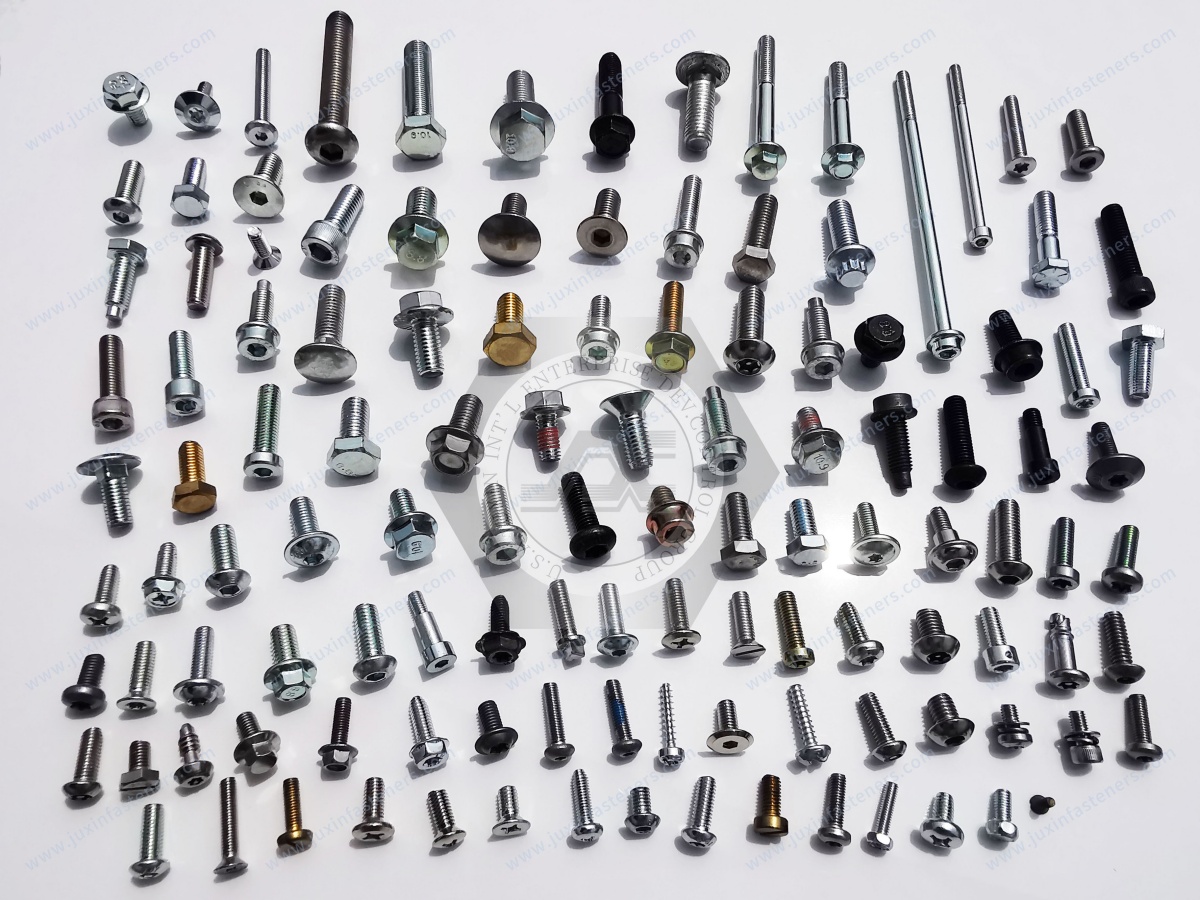
Once required clamp load and substrate limits define the property class, head style must be selected to match bearing-surface stress, drive torque transfer, and tool accessibility.
| Head Style (Reference Standards) | Drive Type | Bearing Area | Radial Tool Clearance | Engineering Advantages | Key Limitations |
|---|---|---|---|---|---|
| Hex Head (ISO 4014 / ISO 4017) | External 6-flat socket or wrench | Moderate (often used with flat washer) | High radial clearance | High torque transfer, universal field service tools, simple visual check | Needs wide tool swing; may indent soft substrates without a hardened washer |
| Hex Flange Head (ISO 4162 / DIN 6921) | External hex with built-in flange | Wide integrated bearing collar | Moderate to high | Spreads clamping pressure, spans slotted holes, removes separate loose washer | Larger head OD; serrated flanges can gouge paint, e-coat, or soft aluminum |
| Socket Head Cap Screw — SHCS (ISO 4762 / DIN 912) | Internal hex socket | Small annular bearing ring | Minimal (sits in counterbore) | Compact bolt circle, high Class 12.9 loadability, deep recessed seating | High under-head bearing stress can crush aluminum or coated steel without hardened washers |
| Hexalobular / Torx Drive (ISO 14579 / 14580 / 14583) | Internal 6-lobe star (pan, flange, low-head) | Profile-dependent | Minimal; straight axial entry | High torque transfer with minimal cam-out; long bit life on automated lines | Requires Torx bits for field service; upward recesses can collect water outdoors |
| Countersunk / Flat Head (ISO 10642 / ISO 14581) | Internal hex or Torx in conical head | Angled conical seat (90° metric / 82° inch) | Flush; zero head protrusion | Smooth exterior profile; self-centering in accurate countersinks | Reduced loadability must be checked against ISO 10642 product requirements; radial wedging stress; lower drive torque capacity |
Bearing Pressure, Embedment, and ISO 10642 Reduced Loadability
Managing Bearing Stress Under the Head
Every clamped substrate has a maximum allowable surface compressive stress. A Class 12.9 ISO 4762 socket head cap screw produces high axial preload over a narrow annular ring beneath the head. Clamped directly onto aluminum alloy, magnesium, or powder-coated steel, that concentrated pressure can exceed the substrate's compressive yield strength, causing head embedment and rapid preload loss. Engineers prevent embedment by adding a hardened flat washer, such as ISO 7090 300 HV, beneath an SHCS or switching to a plain ISO 4162 / DIN 6921 hex flange bolt that distributes the same clamp load across a larger bearing diameter.
Countersunk Screws and Reduced Loadability
A frequent structural design error is substituting an ISO 10642 countersunk screw for an ISO 4762 socket head cap screw solely to achieve a flush exterior. Under ISO 898-1 and ISO 10642:2019, ISO 10642 specifies reduced-loadability hexagon socket countersunk head screws, including designated classes 08.8, 010.9, and 012.9 and corresponding minimum ultimate tensile loads. The leading zero distinguishes reduced loadability from a conventional full-loadability fastener; designers must use the product-standard load table rather than assume the full tensile capacity of an equal-diameter ISO 4762 screw. In addition, the conical head introduces outward wedging forces and higher under-head friction, reducing the portion of tightening torque converted into axial clamp load. In thin sheet metal, countersinking removes structural wall thickness and degrades pull-through capacity.
Tool Access and Automated Assembly Ergonomics
External hex and hex flange heads require surrounding radial clearance for automated nut-runner sockets or service wrenches. When fasteners sit tightly against gearbox ribs, narrow cabinet channels, or hydraulic manifold pockets, internal drives (SHCS or Torx pan/flange heads) permit straight axial access. For automated assembly of smaller diameters (M3 to M8), hexalobular (Torx) drives substantially reduce cam-out and bit wear compared to cruciform or slotted recesses.
Practical OEM Selection Examples
Automotive Coated Brackets and Chassis Mounts: Plain-face DIN 6921 / ISO 4162 Class 10.9 hex flange bolts are widely evaluated where high preload, wide bearing support, automated feeding, and coating preservation are required. Smooth flanges avoid tearing e-coat or galling cast aluminum housings, while zinc-nickel or non-electrolytic zinc-flake coatings are selected according to OEM corrosion and hydrogen-embrittlement rules.
Compact Machinery, Hydraulic Manifolds, and Actuators: Where bolt circles are tightly constrained in steel or ductile-iron blocks, ISO 4762 Class 12.9 socket head cap screws recessed into counterbores deliver compact high preload—paired with hardened bearing surfaces or hardened flat washers, such as ISO 7090 300 HV, and adequate thread engagement depth.
Industrial Sheet-Metal Cabinets and Enclosures: In 1.2 mm to 2.5 mm cold-rolled steel or aluminum enclosures, joint strength is governed by the sheet metal or threaded insert rather than bolt fracture strength. Class 8.8 carbon steel or ISO 3506 A2/A4 stainless steel fasteners with Torx pan, truss, or flange heads optimize assembly speed and bearing distribution without over-specifying costly Class 12.9 alloy steel.
Direct Engineering Q&A
When is Class 10.9 a better choice than Class 12.9 for OEM equipment?
Class 10.9 is frequently the more balanced industrial choice whenever a joint requires significantly higher yield strength than Class 8.8 (940 MPa vs. 640 MPa minimum for d ≤ 16 mm, or 660 MPa for 16 mm < d ≤ 39 mm) while retaining better ductility, lower notch sensitivity, broader coating compatibility, and lower total manufacturing cost than Class 12.9.
Can an ISO 10642 countersunk screw replace an ISO 4762 socket head cap screw at the same diameter?
Not automatically. Because ISO 10642 countersunk screws have reduced loadability (08.8, 010.9, and 012.9), higher under-head friction, and wedging stress, replacing an SHCS requires verifying reduced tensile capacity, countersink wall thickness, and actual torque-tension behavior in the specific joint.
Engineering Validation and OEM Manufacturing at Juxin Fasteners
Before freezing OEM fastener drawings, engineering teams should validate clamping load, under-head bearing indentation, mating-thread safety factor, coating compatibility, and tool access on production-representative assemblies.
As an industrial fastener manufacturer, Juxin Fasteners supplies standard ISO, DIN, ASME, and SAE fasteners alongside custom made-to-drawing OEM/ODM components for industrial batch production. Depending on each drawing's head geometry, property class, material, tolerances, and annual volume, we evaluate cold heading, cold forming, CNC turning and milling, thread rolling, and applicable secondary operations—including coordinated heat treatment and surface finishing—rather than forcing every component through one fixed route.

Request an OEM Drawing Review and Quotation
Send your engineering and procurement requirements to info@juxinfasteners.com, or submit your drawings through our website. Please include:
2D engineering drawings (PDF) and 3D CAD models (STEP/IGES)
Applicable standard (ISO, DIN, ASME, SAE) or custom head, flange, and shank dimensions
Target property class (e.g., 8.8, 10.9, 12.9, or stainless grade), matching nut class, and surface finish
Mating substrate material, thickness, coating, and installation tool/clearance constraints
Sample verification needs and Estimated Annual Usage (EAU) for industrial batch production
Contact Us
Tel.:
+86 020 8621 0320
+86 020 3121 6067
E-mail:
Technical Support:
Navigation
SEND INQUIREY