
Call Us
+86 136 6007 9809
Call Us
+86 136 6007 9809

Aug. 14, 2026
Heavy-Duty Hex Head Tapping Screws for Masonry and Concrete
High-Performance Concrete and Masonry Fastening for Heavy Equipment and Structural Applications
When fastening equipment, brackets, steel components, and support systems directly to concrete or masonry, engineers need a fastening system that combines reliable load transfer,
efficient installation, and resistance to vibration and demanding service conditions.
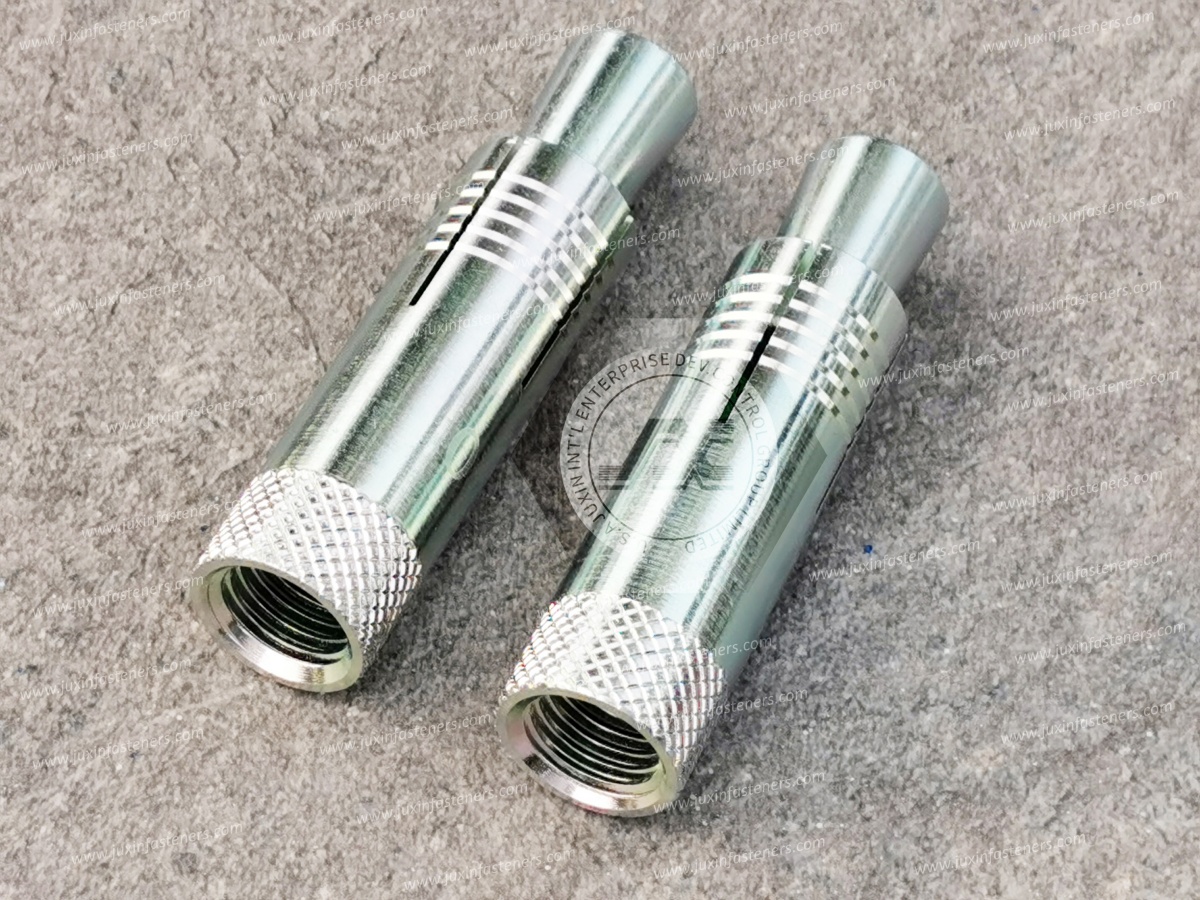
JUXIN FASTENERS heavy-duty hex head tapping screws for masonry and concrete are designed for applications requiring direct mechanical fastening into
concrete and masonry without traditional expansion sleeves or chemical adhesive systems.
Also commonly referred to as heavy-duty concrete tapping screws or heavy-duty Tapcon-style concrete screws,
these fasteners use hardened steel threads designed to cut into a properly drilled pilot hole and form a mechanical thread in the base material.
For industrial purchasing teams, structural engineers, contractors, OEMs, and construction professionals, concrete tapping screws can provide
a practical alternative to conventional expansion anchors for many fastening applications.
Heavy-Duty Concrete Tapping Screws for Direct Installation
Unlike expansion anchors that rely primarily on radial expansion, concrete tapping screws create their holding mechanism through
hardened threads that cut into the concrete or masonry substrate.
The installation process is straightforward:
Drill a pilot hole using a compatible hammer drill or rotary hammer bit.
Remove drilling dust and debris.
Position the fixture or equipment.
Drive the concrete tapping screw into the prepared hole.
Continue installation until the hex head and integrated flange are properly seated.
The screw thread engages directly with the concrete, creating mechanical resistance against pull-out and shear loads.
This direct-installation concept can simplify fastening for contractors and reduce the number of components required compared with some traditional anchoring systems.
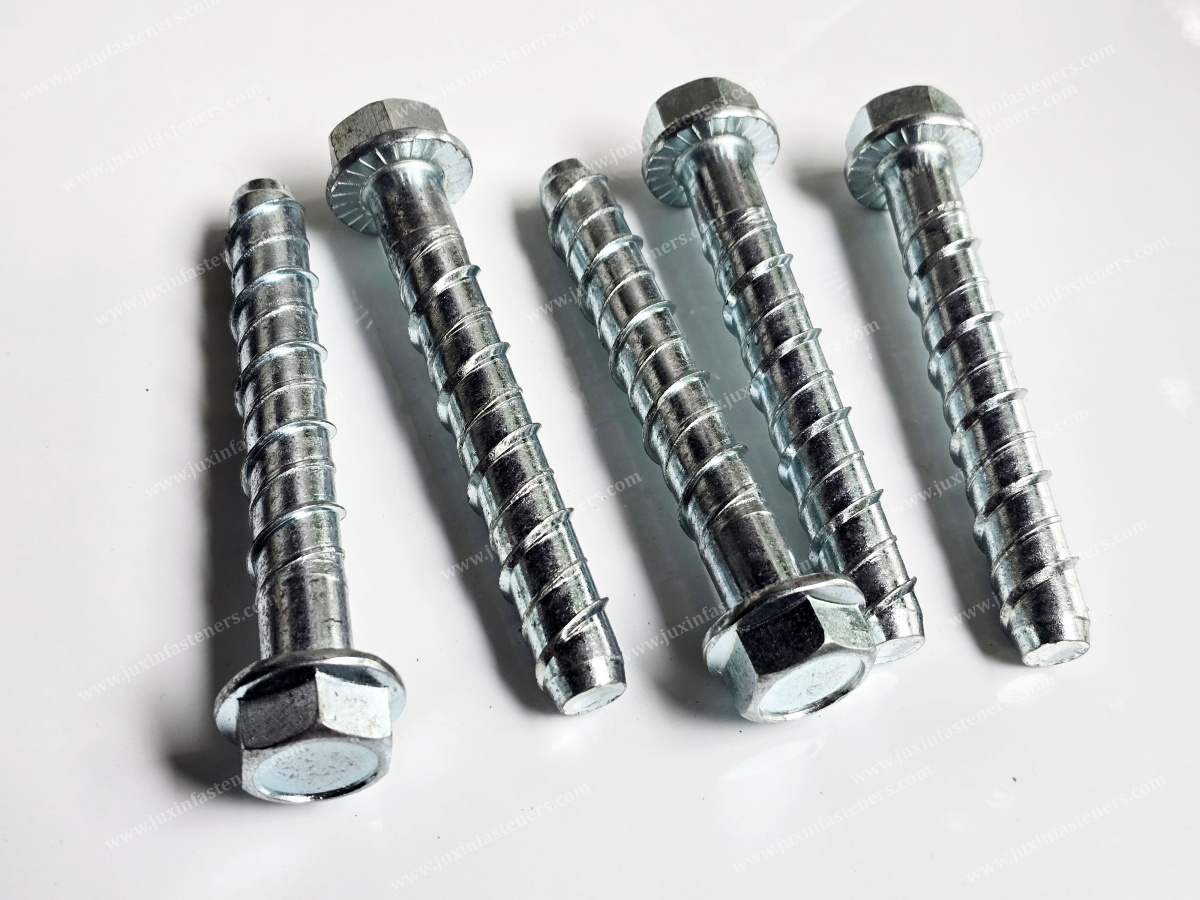
Heavy-Duty Hex Head Design
The external hex head concrete screw provides a secure interface for installation using standard compatible driving tools.
A larger integrated flange can distribute bearing pressure over a wider area around the fixture, reducing localized contact pressure and helping stabilize the connection.
For applications exposed to vibration, an appropriately designed flange and serrated bearing surface can also help resist rotation when installed according to the manufacturer's specifications.
Key design advantages include:
External hexagonal head
Large bearing surface
Hardened cutting threads
Direct mechanical engagement
Efficient installation
Reduced component count
Suitable for selected overhead applications
Practical fastening for equipment and structural fixtures
Self-Cutting Mechanical Interlocking Technology
For advanced heavy-duty anchoring applications, self-cutting mechanical anchors can provide a different anchoring mechanism from conventional expansion anchors.
During installation, the cutting mechanism forms a mechanical locking cavity at the bottom of the drilled hole. The anchor then engages this cavity to establish a mechanical interlock with the concrete.
This design can provide several potential advantages:
Reduced Expansion Stress
Because the anchoring mechanism is based on mechanical interlocking rather than conventional radial expansion, the system can be suitable for applications where minimizing expansion pressure is important.
Edge and Spacing Flexibility
Reduced expansion forces can provide greater flexibility for selected installations near concrete edges or closely spaced anchor locations, subject to the specific product's engineering data.
Mechanical Locking
The interlocking mechanism provides a positive mechanical connection between the anchor and concrete rather than relying solely on friction.
High Load Potential
Heavy-duty self-cutting anchor designs can be engineered for demanding tension and shear applications where higher load performance is required.
Engineering Note: Self-cutting undercut anchors, concrete tapping screws, and conventional expansion anchors use different load-transfer mechanisms.
They should not be treated as interchangeable products without reviewing the applicable technical data and approvals.
Heavy-Duty Applications in Concrete
Heavy-duty concrete screws are suitable for a wide range of industrial and construction applications when the selected product has been engineered for the required loads.
Potential applications include:
Heavy machinery
Equipment bases
Steel brackets
Structural supports
Steel framing
Curtain wall support systems
Mechanical equipment
Electrical equipment
Industrial racks
Conveyor systems
Crane-related support components
Infrastructure equipment
General construction fixtures
For critical structural applications, engineers should verify the applicable design loads, concrete strength, anchor spacing, edge distance, embedment, and product approvals.
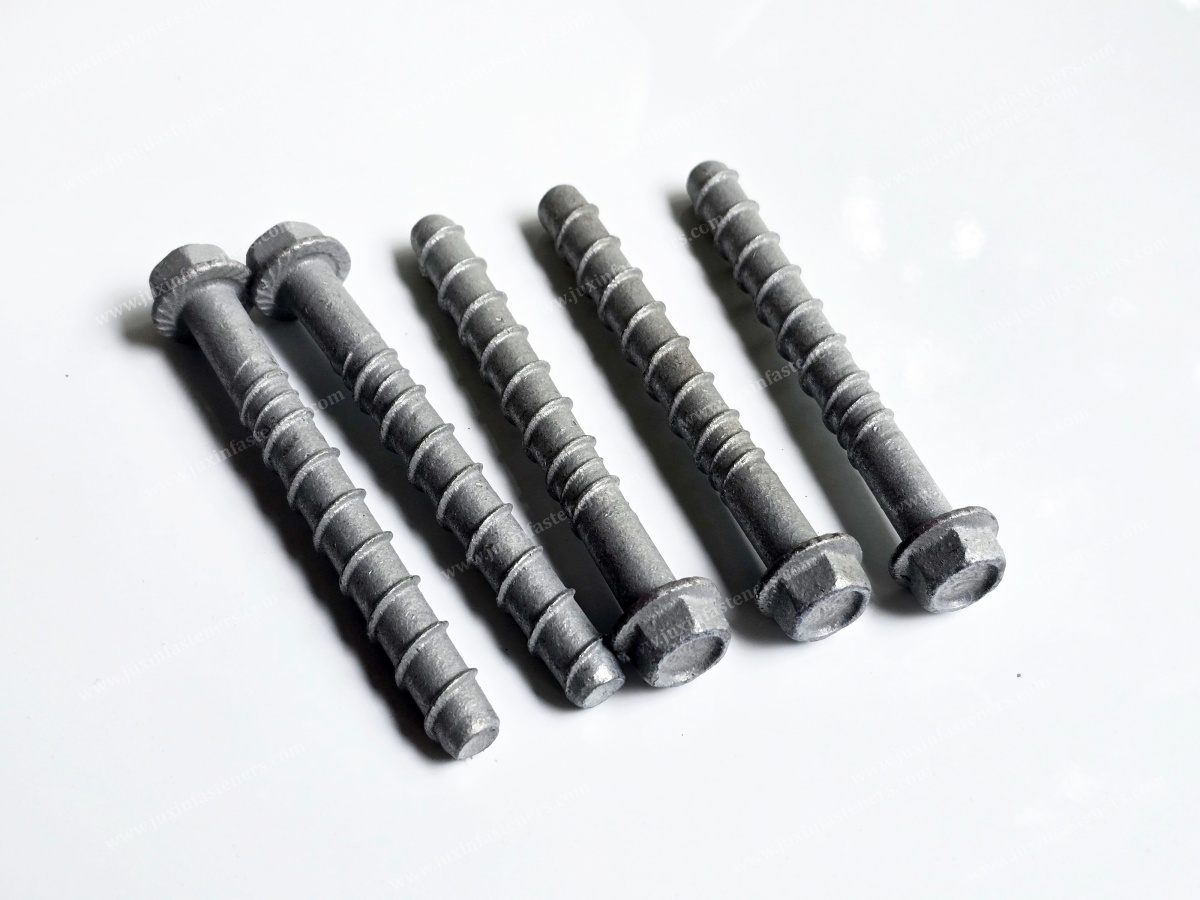
High-Load Structural Anchoring
For heavy-duty applications, the anchor's steel strength is only one part of the connection design.
A complete concrete anchoring system must consider both the fastener and the surrounding substrate.
Important failure modes can include:
Steel tension failure
Steel shear failure
Concrete breakout
Pull-out
Concrete splitting
Edge failure
Combined tension and shear
Cyclic loading effects
A properly engineered heavy-duty anchor should be selected according to the governing failure mode and required safety factors.
Claims regarding ultimate tensile or shear strength should not be used directly as allowable design values.
For example, where a product specification states that pull-out or shear values are 25% of ultimate test values,
that value must be interpreted according to the applicable testing and engineering methodology rather than treated as a universal safety factor.
Materials and Corrosion Protection
Selecting the correct material and coating is important for the service life of concrete tapping screws.
Zinc-Plated Steel
Zinc-plated concrete screws are a common and economical choice for indoor applications and areas with occasional moisture exposure.
Typical applications include:
Indoor factories
Warehouses
Commercial construction
Equipment installation
General concrete fastening
Industrial maintenance
410 Stainless Steel
410 stainless steel concrete screws provide higher hardness and wear resistance than many standard stainless steel fasteners.
They can be considered for applications where mechanical strength and wear resistance are important,
although 410 stainless steel generally provides less corrosion resistance than 316 stainless steel.
316 Stainless Steel
316 stainless steel concrete screws offer enhanced corrosion resistance and are particularly valuable in demanding environments.
Potential applications include:
Coastal construction
Marine environments
Saltwater exposure
Outdoor infrastructure
Chemical processing environments
High-humidity installations
Harsh weather conditions
316 stainless steel should still be evaluated against the specific chemicals and service conditions involved.
Galvanized Steel
Galvanized concrete screws provide an economical corrosion-resistant option for many wet and outdoor applications.
They can offer good resistance to general atmospheric corrosion but may be unsuitable for direct exposure to saltwater or aggressive chemical environments where corrosion can accelerate.
Concrete Screw vs. Expansion Anchor
Engineers often compare concrete tapping screws with expansion anchors when selecting a fastening system.
Feature | Heavy-Duty Concrete Tapping Screw | Mechanical Expansion Anchor |
Installation | Direct threaded installation | Expansion mechanism |
Pilot Hole | Required | Required |
Adhesive | Not required | Not required |
Components | Typically one primary fastener | Anchor + nut/washer depending on design |
Load Transfer | Thread engagement | Mechanical expansion |
Installation Speed | Fast | Fast |
Edge Applications | Product dependent | Requires edge-distance evaluation |
Removal | Fastener can often be removed | Anchor may remain permanently installed |
Best Use | General and heavy-duty direct fastening | Applications requiring expansion anchoring |
Neither system is universally superior. The correct choice depends on the substrate, design load, installation conditions, corrosion environment, and applicable approvals.
Self-Cutting Undercut Anchors vs. Ordinary Expansion Anchors
Heavy-duty self-cutting undercut anchors should be clearly distinguished from conventional expansion anchors.
Conventional Expansion Anchors
These anchors develop holding force through expansion against the concrete.
Post-Installed Undercut Anchors
These create a mechanical interlock with an enlarged cavity near the bottom of the drilled hole.
Concrete Tapping Screws
These cut threads directly into the concrete during installation.
These three systems have different installation procedures, load-transfer mechanisms, and engineering requirements.
For critical projects, the selected anchor should be matched to the specific application and supported by the appropriate technical documentation, test data, and approvals.
Seismic and Cyclic Loading Considerations
Industrial equipment and structural systems may experience repeated or cyclic loading.
Potential applications include:
Industrial machinery
Crane support systems
Manufacturing equipment
Structural steel
Bridge-related components
Seismic support systems
Industrial infrastructure
A heavy-duty mechanical interlocking anchor can offer advantages for certain cyclic-load applications, but seismic suitability cannot be assumed from the anchor design alone.
Engineers should verify:
Seismic design category
Concrete condition
Cracked concrete performance
Anchor spacing
Edge distance
Installation quality
Cyclic load test data
Product certification
Applicable seismic design requirements
For life-safety or seismic applications, the selected product should have the required certification and project approval.
Installation in Concrete and Masonry
Correct installation is essential for reliable performance.
Step 1 — Drill the Pilot Hole
Create a pilot hole using the specified drill diameter and drilling method.
Step 2 — Control Hole Depth
Ensure that the hole meets the required depth and provides sufficient embedment for the selected fastener.
Step 3 — Clean the Hole
Remove dust and loose particles before installing the fastener.
Step 4 — Position the Fixture
Place the equipment, bracket, steel component, or support fixture over the hole.
Step 5 — Install the Fastener
Drive the heavy-duty hex head tapping screw into the pilot hole using the specified installation tool.
Step 6 — Apply the Correct Installation Torque
Do not exceed the manufacturer's recommended installation torque.
Excessive torque can damage the threads or substrate and may reduce connection performance.
Step 7 — Verify the Connection
Confirm that the head is correctly seated and the fixture is properly secured.
Engineering Note: Pilot-hole diameter, embedment depth, concrete strength, installation torque, edge distance, spacing,
and drilling method directly influence the performance of concrete tapping screws.
Masonry Applications
Heavy-duty hex head tapping screws can also be used in selected masonry applications when the product is specifically rated for the substrate.
Potential substrates may include:
Solid concrete
Solid brick
Solid masonry
Approved concrete block
Hollow or low-strength masonry requires careful evaluation because the available thread engagement and substrate strength may differ substantially from solid concrete.
Engineers should never assume that a fastener approved for concrete automatically has the same capacity in brick or block.
Industrial Applications Across Multiple Sectors
Heavy Machinery
Secure equipment frames, machinery bases, brackets, and support components where direct concrete fastening is appropriate.
Structural Steel
Connect selected steel brackets, support systems, and structural components to concrete.
Construction
Fasten framing, fixtures, equipment supports, and building components during commercial and industrial construction.
Curtain Wall Systems
Support selected curtain wall brackets and secondary steel components where the anchor system meets the project requirements.
Energy & Infrastructure
Provide fastening solutions for selected industrial equipment, support systems, and infrastructure components.
Bridge and Transportation Infrastructure
Heavy-duty mechanical anchors can be considered for selected structural support applications subject to engineering design and required approvals.
Nuclear and High-Safety Facilities
Critical facilities require specially qualified fastening systems. Product selection should be based on project-specific certification, qualification testing, traceability,
and engineering requirements rather than general heavy-duty anchor claims.
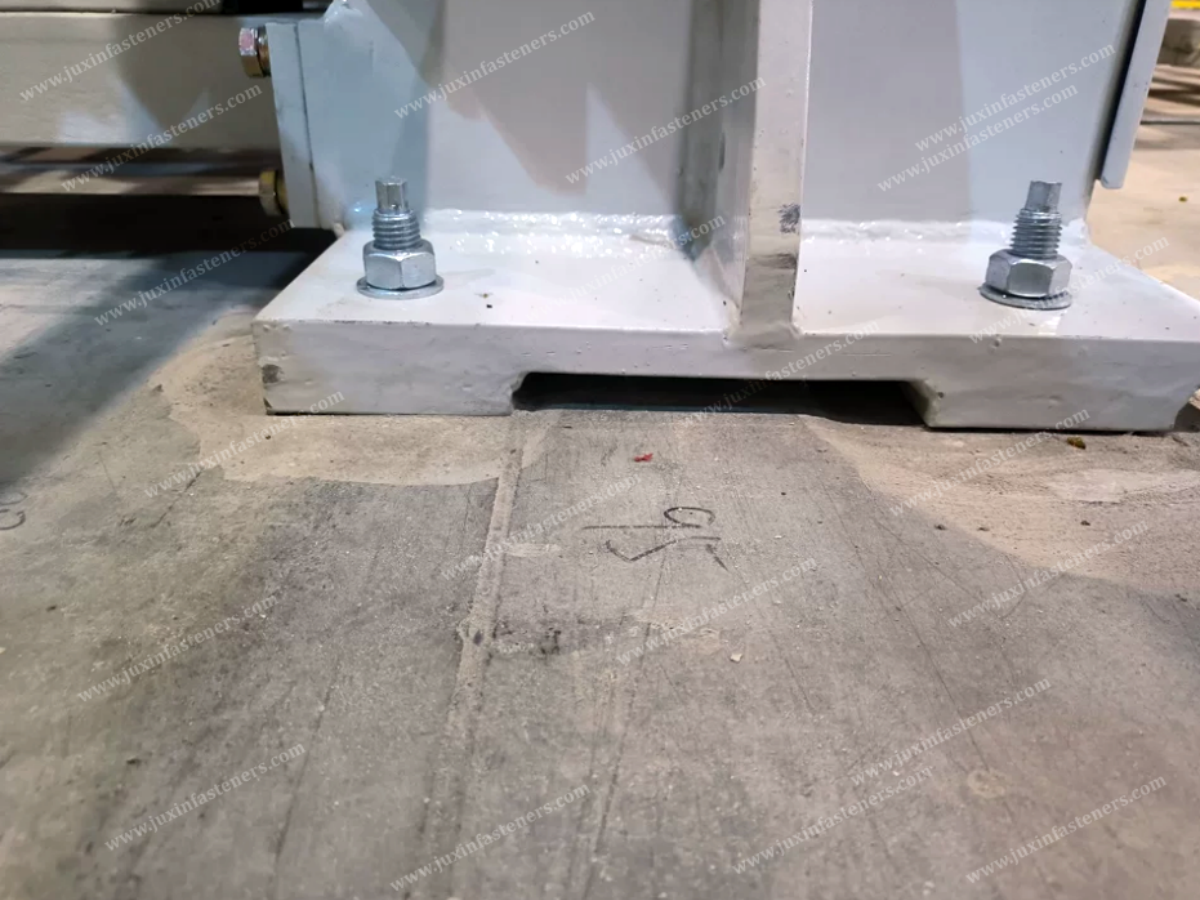
Crane Rails and Heavy Steel Structures
Applications such as crane rail supports, steel column bases, and heavy structural connections can involve substantial static, dynamic, and cyclic loads.
For these applications, engineers should consider:
Vertical load
Horizontal load
Moment
Fatigue
Dynamic loading
Concrete strength
Anchor spacing
Edge distance
Embedment
Steel grade
Corrosion protection
Installation tolerance
Required certification
A standard concrete tapping screw should not automatically be substituted for an engineered structural anchor in crane rail, column-base, or other critical structural applications.
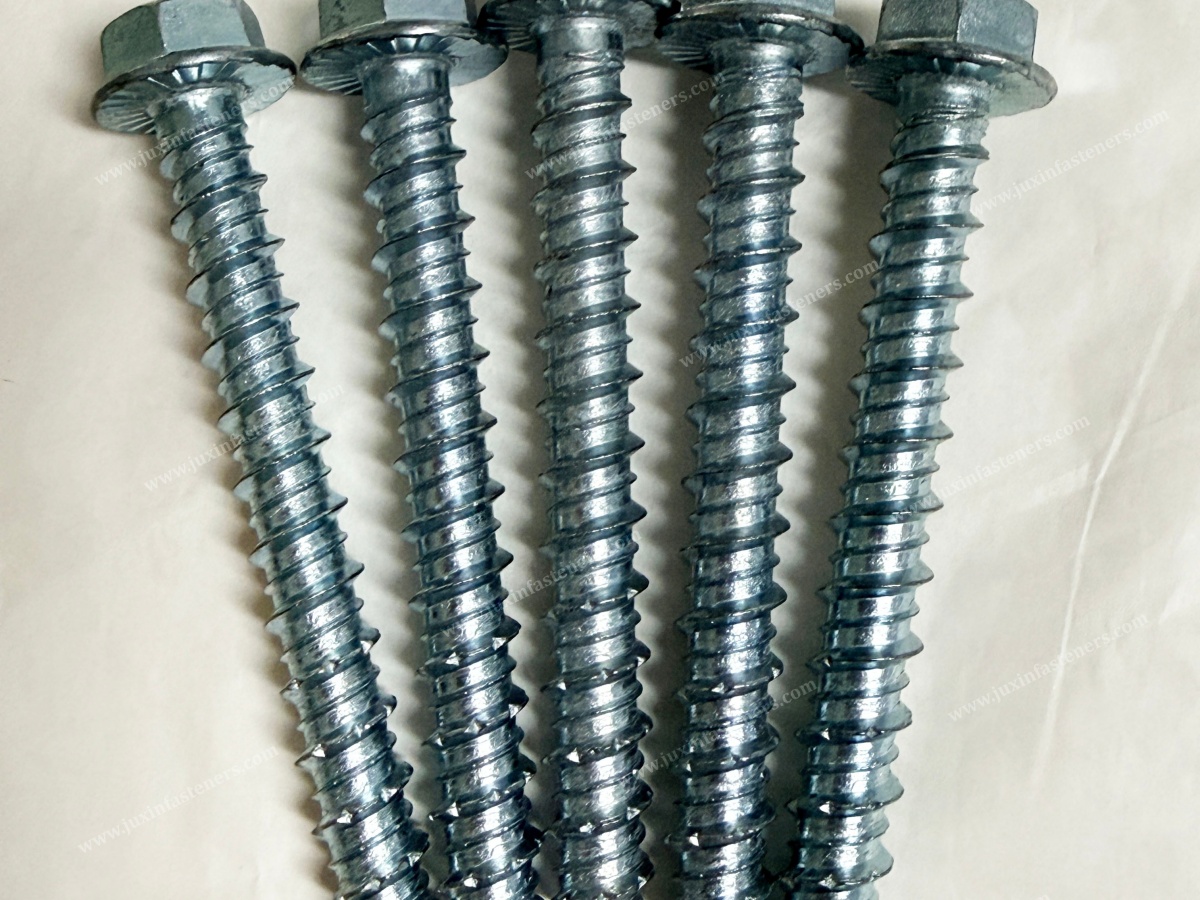
Why Choose JUXIN FASTENERS?
JUXIN FASTENERS supplies industrial concrete fastening solutions for OEMs, distributors, contractors, engineering companies, and industrial purchasing teams.
Our fastening solutions can support applications involving:
Concrete
Masonry
Heavy machinery
Structural steel
Industrial equipment
HVAC and mechanical systems
Electrical infrastructure
Construction
Infrastructure
Industrial maintenance
For customers sourcing heavy-duty hex head concrete screws, masonry tapping screws, self-cutting mechanical anchors, concrete tapping screws,
and corrosion-resistant concrete fasteners, JUXIN FASTENERS focuses on consistent manufacturing, application-specific requirements, and international B2B supply.
Engineering and Procurement Selection Guide
Before selecting a heavy-duty concrete screw or self-cutting anchor, purchasing and engineering teams should confirm:
Base material
Concrete strength
Cracked or uncracked concrete condition
Fastener diameter
Fastener length
Effective embedment
Required tensile capacity
Required shear capacity
Combined loading
Edge distance
Anchor spacing
Installation torque
Pilot-hole diameter
Static or dynamic loading
Vibration or fatigue conditions
Corrosion environment
Required coating or stainless steel grade
Applicable certification
Required test data
Project-specific engineering approval
For high-safety applications, verify the product's technical data, cracked-concrete qualification, type-test results, and applicable approvals before specification.
Frequently Asked Questions
What are heavy-duty hex head tapping screws used for?
They are used for direct fastening into suitable concrete and masonry substrates.
Typical applications include equipment supports, machinery, steel brackets, framing, construction fixtures, and industrial installations.
Are concrete tapping screws stronger than standard concrete screws?
Heavy-duty designs can provide substantially higher performance than standard light-duty concrete screws, depending on the product geometry,
steel grade, diameter, embedment, concrete strength, and installation conditions. Performance should always be based on tested product data.
Do concrete tapping screws require expansion?
No. Concrete tapping screws create holding force primarily through threaded engagement with the drilled substrate rather than conventional expansion.
Can concrete tapping screws be used near concrete edges?
Some products can be suitable for edge applications, but edge distance and concrete strength remain critical.
The actual product's technical data should be checked before installation.
Which is more corrosion resistant: 410 or 316 stainless steel?
316 stainless steel generally provides significantly better corrosion resistance than 410 stainless steel, especially in marine, saltwater, and many chemical environments.
410 stainless steel generally offers greater hardness and wear resistance.
Are galvanized concrete screws suitable for saltwater?
Galvanized steel can provide good atmospheric corrosion protection, but direct or prolonged saltwater exposure can accelerate corrosion.
For marine applications, 316 stainless steel may be a more appropriate option depending on the environment and project requirements.
Are heavy-duty self-cutting anchors suitable for seismic applications?
Some engineered self-cutting or undercut anchor systems can be qualified for seismic applications.
However, seismic suitability must be confirmed through the specific product's certification and technical documentation.
Can these anchors replace expansion anchors?
Not automatically. Concrete tapping screws, self-cutting undercut anchors, wedge anchors, and other mechanical anchors use different load-transfer mechanisms.
Substitution should be based on engineering evaluation and applicable approvals.
High-Performance Concrete Fastening for Industrial Applications
Reliable concrete fastening requires more than a high-strength steel fastener.
The complete connection must be designed around the anchor, concrete substrate, load, embedment, installation procedure, environment, and required service life.
JUXIN FASTENERS provides heavy-duty hex head tapping screws for masonry and concrete, concrete tapping screws, self-cutting mechanical anchors,
and corrosion-resistant concrete fastening solutions for demanding industrial and construction applications.
For engineering specifications, OEM projects, distributor inquiries, and industrial procurement:
Email: info@juxinfasteners.com
Website: www.juxinfasteners.com
 MORE NEWS
Sep. 27, 2026
Sep. 27, 2026
Sep. 27, 2026
Contact Us
Tel.:
+86 020 8621 0320
+86 020 3121 6067
E-mail:
Technical Support:
Navigation
SEND INQUIREY