
Call Us
+86 136 6007 9809
Call Us
+86 136 6007 9809

Aug. 15, 2026
Industrial automation equipment combines electronics, sensors, communication modules and mechanical components inside increasingly compact enclosures.
PLCs, industrial switches, controllers, sensors, gateways, network equipment and machine-control systems frequently use engineered plastic housings because polymers can support:
Low component weight
Complex molded geometry
Electrical isolation strategies
Efficient high-volume manufacturing
Integration of mounting features
Compact enclosure design
But plastic housings still require durable threaded connections for covers, PCBs, brackets, connectors, electronic modules and serviceable components.
Threaded inserts provide a metal internal thread inside the engineered plastic component.
However, selecting an insert for industrial automation equipment involves much more than choosing the correct thread.
A reliable engineering path is:
Equipment Function → Polymer → Boss Geometry → Insert Geometry → Installation Process → Mating Screw → Load & Vibration
→ Temperature & Environment → Electrical Requirements → Validation → Supplier Qualification
The central principle is:
Strong Insert ≠ Reliable Automation Equipment Joint.
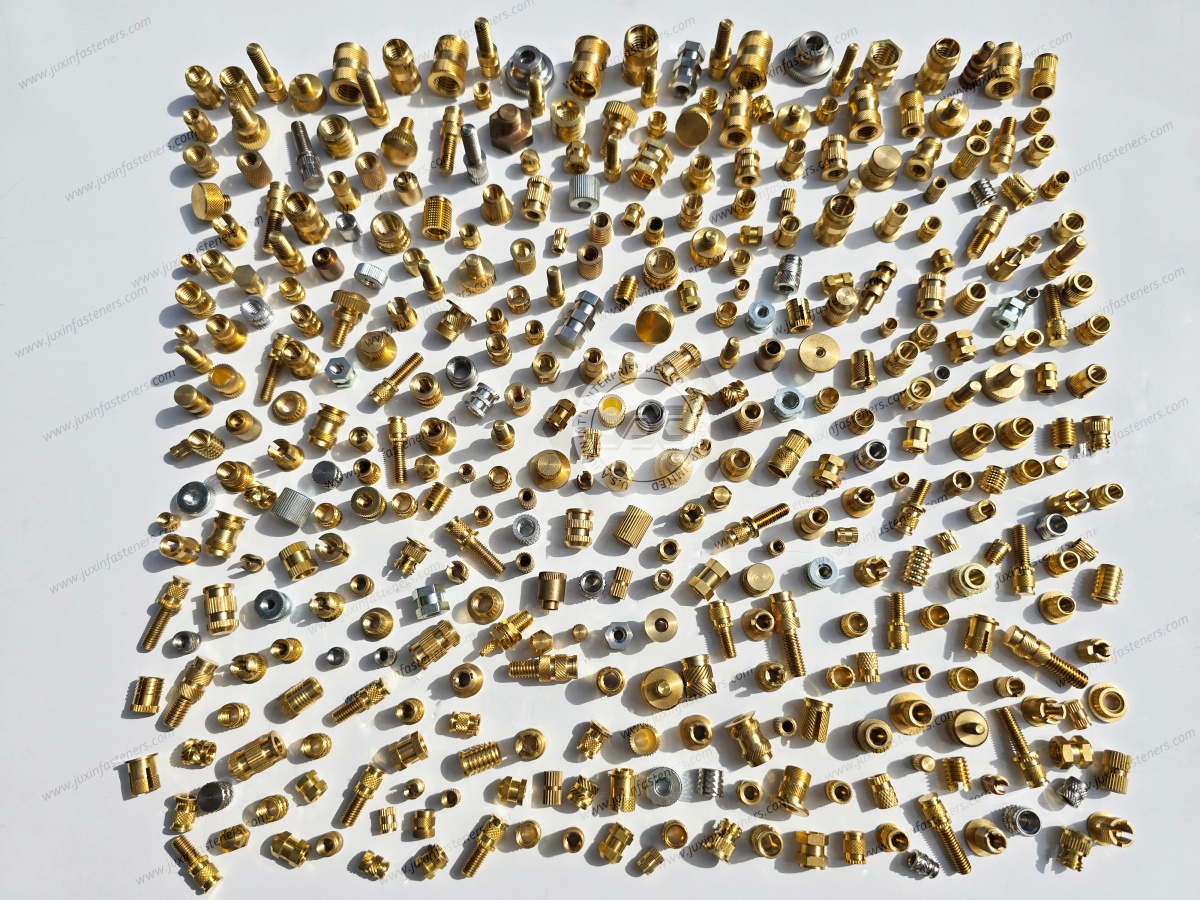
JUXIN FASTENERS supplies threaded inserts for engineered plastic components, including heat-set inserts, ultrasonic insert solutions,
tapered threaded inserts, stainless steel inserts and drawing-based custom fastening components for industrial automation, electronics and communication equipment.
Start with the housing and operating environment rather than the insert catalogue.
Define:
What equipment uses the insert?
What does the threaded joint secure?
What polymer and exact grade are used?
Is the polymer reinforced?
What boss geometry is available?
What screw and thread are required?
What pull-out resistance is required?
What torque resistance is required?
Will the equipment experience vibration?
What operating temperature range applies?
Are humidity, condensation, dust or chemicals present?
Will the enclosure be repeatedly opened for maintenance?
Which installation process will be used?
Is installation automated?
Does the insert have any electrical, grounding or shielding function?
What documentation and traceability are required?
Then select:
Insert Material + Retention Geometry + Hole Geometry + Installation Method + Surface Condition
This is more reliable than:
Thread Size → Material → Unit Price
Automation equipment may require repeated access for:
Commissioning
Maintenance
Calibration
PCB replacement
Connector replacement
Troubleshooting
Product upgrades
Field servicing
Direct plastic threads may be appropriate for some components.
But repeated screw installation can contribute to:
Thread wear
Thread stripping
Local plastic deformation
Reduced serviceability
A metal threaded insert provides a reusable internal thread.
But:
Metal Thread ≠ Metal Joint.
The insert still transfers load into the surrounding polymer.
If the plastic boss cracks, creeps or loses retention, the strength of the metal internal thread cannot prevent joint failure.
The mechanical load path is:
Mating Screw → Internal Insert Thread → Insert Body → External Retention Geometry → Polymer → Boss → Housing
Possible failure modes include:
Internal thread damage
Insert pull-out
Insert rotation
Plastic boss cracking
Boss splitting
Local deformation
Polymer creep
Loss of clamp load
Screw loosening
Therefore:
Insert Strength ≠ Installed Joint Strength.
The insert, plastic component and screw must be treated as one mechanical system.
Potential applications include:
Threaded inserts may support:
Housing covers
Internal brackets
PCB assemblies
Electronic modules
Connector supports
Mounting features
Compact sensor housings may require threaded mounting points for:
Covers
Internal electronics
Mounting brackets
Protective components
Connector-related structures
Potential applications include:
Plastic enclosures
Service covers
Display assemblies
Internal electronic modules
Mounting brackets
Threaded inserts can be evaluated for:
Electronic housings
Communication modules
Internal brackets
Serviceable covers
Mounting components
Gateways and industrial IoT devices can combine:
Sensors
PCBs
Wireless modules
Connectors
Displays
Plastic enclosures
Threaded inserts can provide compact reusable mounting locations where appropriate.
Potential applications include selected:
Control modules
Electrical enclosures
Terminal-related housings
Electronic subassemblies
Machine-control equipment
But:
Industrial Equipment Application ≠ One Universal Insert Specification.
Each joint should be evaluated according to its actual function.
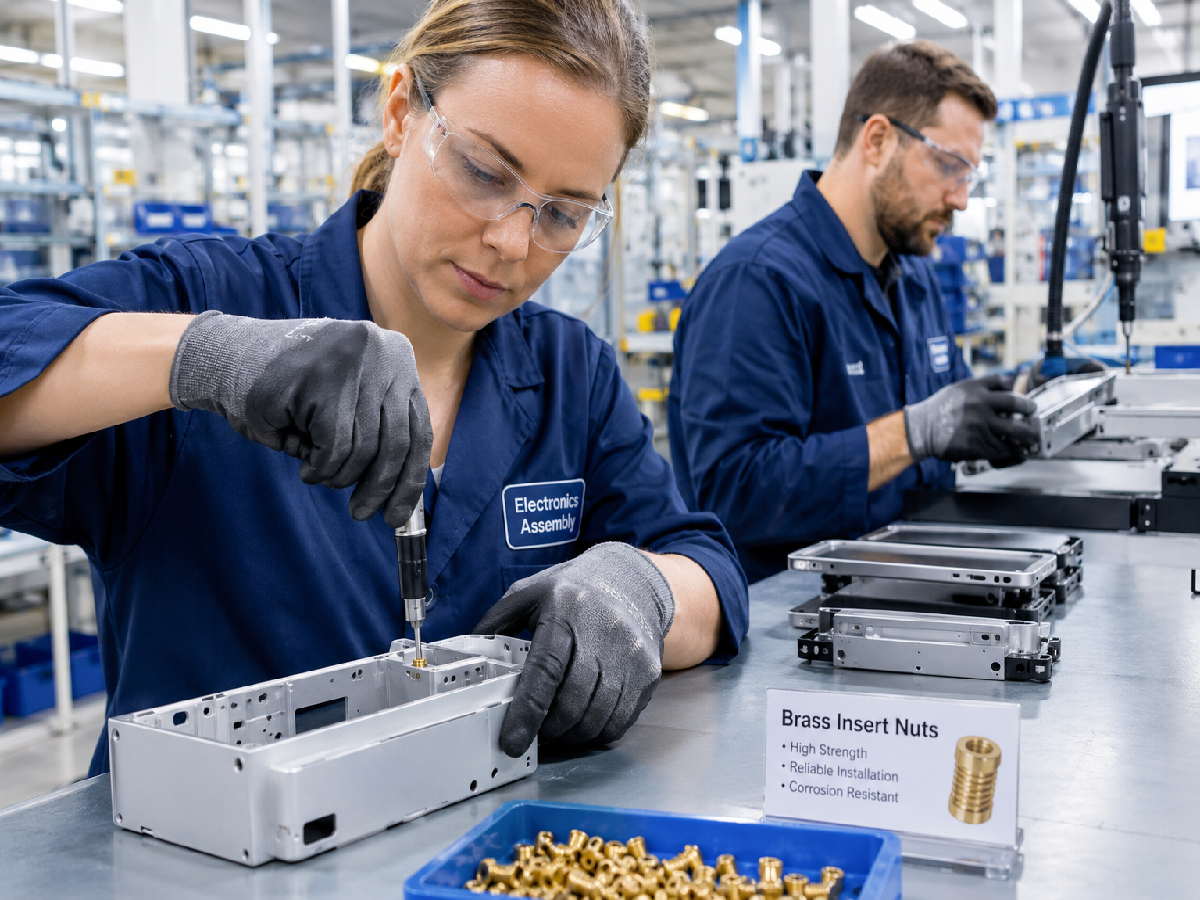
A PLC housing may contain:
PCBs
I/O modules
Communication modules
Connectors
Power components
Covers
Mounting hardware
Some joints are opened only during manufacturing.
Others may be accessed repeatedly in service.
This difference affects insert selection.
A serviceable enclosure may prioritize:
Repeated thread durability
Controlled tightening
Insert retention
Dimensional stability
An internal permanent assembly may have different priorities.
Therefore:
Same PLC Housing ≠ Same Requirement for Every Fastener.
Sensors can create particularly demanding insert-design conditions because housings may be compact.
Available boss geometry can be limited by:
PCB location
Sensor element position
Connector geometry
Sealing features
Housing wall thickness
This creates an important rule:
Small Insert ≠ Simple Joint.
A miniature insert in a thin plastic boss can be more sensitive to dimensional variation than a larger insert in a robust housing.
Industrial electronics can use engineering plastics such as:
PA6
PA66
Reinforced nylon
PC
PC/ABS
POM/acetal
PEEK
Other application-specific thermoplastics
The polymer family alone does not fully define insert performance.
Relevant variables can include:
Exact grade
Reinforcement
Filler
Moisture
Temperature
Molding condition
Chemical exposure
Aging
Therefore:
Same Polymer Name ≠ Same Finished Performance.
The insert should be validated in the actual production material where functional performance matters.
Glass-filled and other reinforced polymers can behave differently from unfilled grades.
Reinforcement can change:
Stiffness
Installation force
Polymer flow
Boss cracking behavior
Pull-out resistance
Torque resistance
Therefore:
PA66 ≠ PA66-GF Application Behavior.
An insert validated in unfilled PA66 should not automatically be transferred to glass-filled PA66.
PA6 and PA66 can absorb moisture.
Moisture can influence:
Dimensions
Stiffness
Mechanical behavior
Long-term insert retention
Therefore:
Dry Nylon Test ≠ Conditioned Nylon Performance.
Where moisture sensitivity is relevant, validation should reflect expected service conditions.
The plastic boss is not simply a holder for the insert.
It transfers load into the housing.
Important boss variables include:
Outside diameter
Receiving-hole diameter
Hole depth
Wall thickness
Distance from edges
Nearby ribs
Molded geometry
Material-flow condition
Therefore:
Correct Insert + Incorrect Boss = Unreliable Joint.
The insert supplier and enclosure designer should consider the interface together.
Adding more plastic around the insert may improve some load conditions.
But excessive local material can also influence:
Molding
Cooling
Sink
Warpage
Packaging space
The correct boss design should balance fastening performance with molding and enclosure architecture.
If the receiving hole is too small:
Installation force may increase
Boss stress may rise
Cracking may occur
Installation consistency may decline
If the hole is too large:
Pull-out resistance may decrease
Torque resistance may decrease
Polymer engagement may become insufficient
Therefore:
Insert OD Alone ≠ Correct Hole Specification.
The hole should be specified for the actual insert, polymer and installation method.
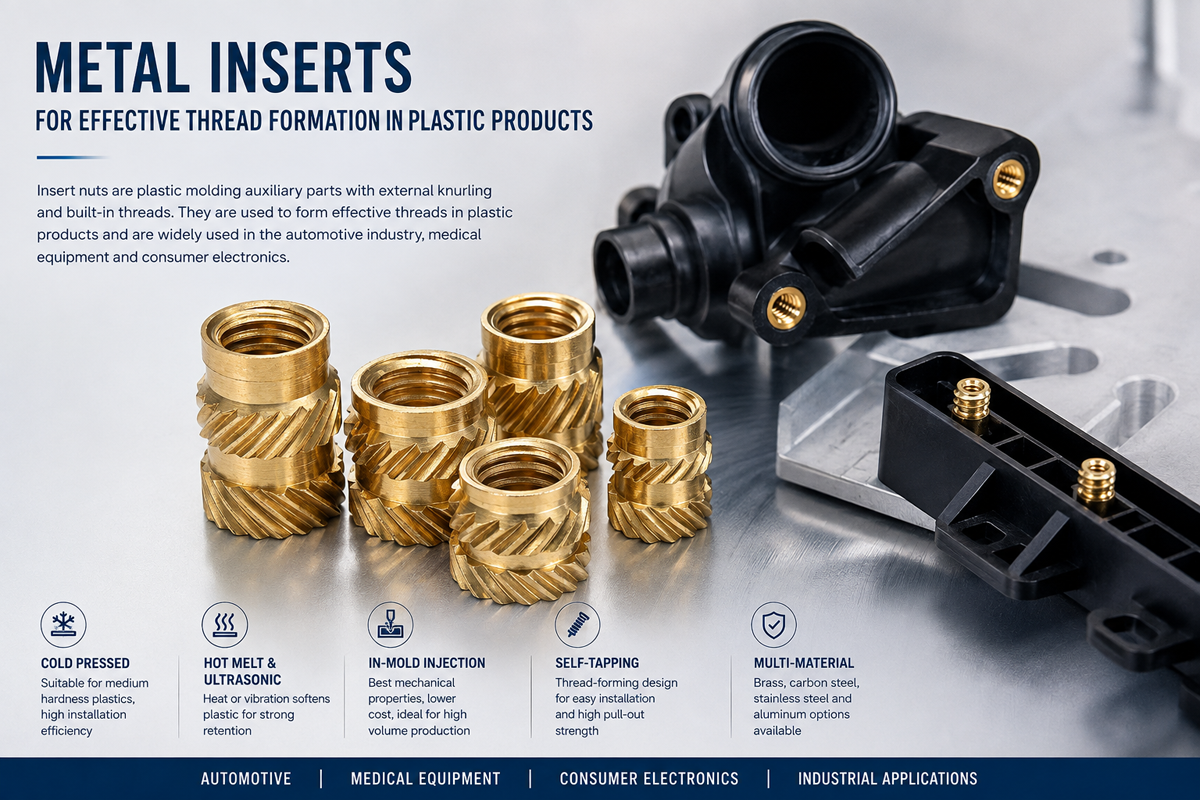
Heat-set inserts use controlled heat to soften suitable thermoplastic around the insert.
During installation, the polymer flows around external retention features.
After cooling, the plastic forms mechanical engagement around the insert.
Heat-set installation can provide:
Durable internal threads
Controlled installation
Good production repeatability
Automation potential
when the insert, boss and process are correctly matched.
Important variables can include:
Tool temperature
Insert temperature
Installation speed
Installation depth
Alignment
Polymer condition
Boss geometry
Cooling
Therefore:
Hotter Installation ≠ Better Retention.
Excessive heat can damage the polymer.
Insufficient heat can create poor flow or excessive insertion force.
The goal is a stable process window.
Ultrasonic insertion uses localized mechanical energy to generate heat at the insert/polymer interface.
Potential benefits can include:
Short installation cycles
Localized heating
Automation potential
However, performance depends on:
Polymer
Insert geometry
Ultrasonic equipment
Fixture
Energy
Pressure
Installation depth
Therefore:
Ultrasonic Installation ≠ Heat-Set Installation With Different Equipment.
Each process requires separate validation.
Press-fit inserts can be used in suitable plastic components without a thermal installation step.
However, mechanical insertion creates radial stress.
Excessive interference can cause:
Boss cracking
Local deformation
Residual stress
Installation instability
Insufficient interference can reduce retention.
Therefore:
More Interference ≠ Better Retention.
The hole, insert and boss should be matched to the actual polymer.
In-mold inserts are positioned before plastic injection.
The polymer is molded around the insert.
This can eliminate a separate post-molding installation operation.
But manufacturing must control:
Insert position
Orientation
Mold retention
Plastic flow
Flash
Thread protection
Therefore:
In-Mold Installation ≠ Automatic Performance Advantage.
The final assembly still requires functional validation.
| Engineering Factor | Heat-Set | Ultrasonic | Press-Fit | In-Mold |
|---|---|---|---|---|
| Installation stage | Post-molding | Post-molding | Post-molding | During molding |
| Thermal effect | Controlled heat | Local ultrasonic heating | Minimal process heating | Injection molding environment |
| Radial stress | Process-dependent | Process-dependent | Can be significant | Geometry-dependent |
| Automation | Possible | Possible | Possible | Integrated with molding |
| Key variables | Temperature, speed, depth | Energy, pressure, time | Interference, force | Position, mold retention, flow |
| Main risk | Incorrect thermal process | Incorrect energy/process | Boss cracking | Position/flash/control |
| Validation | Required | Required | Required | Required |
The correct choice depends on:
Polymer + Boss + Insert + Production Process + Required Performance
External knurls and retention bands transfer load between the insert and polymer.
They may help resist:
Axial pull-out
Rotation
Installation movement
Relevant characteristics can include:
Knurl angle
Knurl depth
Pitch
Direction
Retention bands
Taper
Therefore:
Same Thread + Same OD ≠ Same Insert Performance.
Visual similarity is not enough for engineering equivalence.
Pull-out testing evaluates axial retention.
Performance depends on:
Insert geometry
Insert length
Polymer
Boss
Hole
Installation
Temperature
Conditioning
Therefore:
Catalogue Pull-Out Value ≠ Finished Housing Pull-Out Performance.
Test values should always be interpreted with their polymer, geometry and test conditions.
Torque-out testing evaluates resistance to insert rotation in the plastic.
It is a different failure mode from pull-out.
Therefore:
Pull-Out ≠ Torque-Out.
A design can have good axial retention but insufficient anti-rotation performance.
The mating screw applies torque through the internal thread.
The insert must remain stable, but the plastic and clamped components must also tolerate the resulting loads.
Therefore:
Screw Tightening Torque ≠ Insert Torque-Out Requirement.
Increasing tightening torque can cause:
Insert rotation
Insert pull-out
Internal thread damage
Plastic crushing
Housing distortion
More Installation Torque ≠ Better Joint.
For joints where clamp load matters:
Torque ≠ Preload.
Thread and bearing friction influence how tightening torque becomes preload.
Changes in:
Screw coating
Insert material
Surface condition
Lubrication
can change the result.
Therefore:
Same Torque + Different Friction ≠ Same Preload.
Industrial automation equipment can experience vibration from:
Motors
Pumps
Fans
Machine frames
Production equipment
Mobile machinery
An insert may remain firmly retained while the mating screw loses preload.
Therefore:
Insert Torque-Out Resistance ≠ Screw Anti-Loosening Performance.
These are two different engineering mechanisms.
If screw loosening is the problem, increasing insert knurl aggressiveness may not solve it.

If vibration requires a locking strategy, engineers may evaluate suitable:
Prevailing-torque hardware
All-metal lock nuts where applicable
Nylon insert lock nuts where temperature permits
Other application-specific locking methods
But:
Locking Feature ≠ Correct Preload.
And:
Prevailing Torque ≠ Preload.
The correct strategy depends on the complete joint.
Industrial electronics can operate in environments with repeated temperature changes.
Metal inserts and polymers generally have different thermal expansion behavior.
Temperature cycling can influence:
Insert retention
Boss stress
Clamp load
Polymer stiffness
Therefore:
Room-Temperature Performance ≠ Full Service Performance.
Validation should represent the actual operating environment where necessary.
Plastic can deform gradually under sustained load.
This can reduce:
Local contact pressure
Clamp load
Joint stiffness
Elevated temperature can make these effects more important.
Therefore:
Initial Assembly Condition ≠ Long-Term Joint Condition.
The insert may remain in place while the clamped joint changes over time.
Industrial control equipment can be installed in:
Factories
Warehouses
Outdoor cabinets
Process equipment
HVAC environments
Depending on enclosure design, inserts may encounter humidity or condensation.
The complete material combination should be evaluated.
Corrosion-Resistant Insert ≠ Corrosion-Resistant Assembly.
Potential exposure can include:
Oils
Coolants
Cleaning chemicals
Process fluids
Industrial contaminants
The polymer can be affected even when the metal insert remains intact.
Therefore:
Chemically Resistant Insert ≠ Chemically Resistant Plastic Joint.
The insert, screw and polymer should be evaluated as a system.
Brass is commonly used for threaded inserts because it can provide:
Good machinability
Accurate internal threads
Useful corrosion behavior
Good thermal conductivity for heat installation
However:
Brass Insert ≠ Universal Industrial Insert.
The correct material depends on the environment and application.
Stainless steel inserts can be evaluated where the application requires different:
Mechanical properties
Corrosion behavior
Material compatibility
JUXIN FASTENERS supports drawing-based stainless steel threaded insert projects, including tapered heat-set insert configurations.
But:
Stainless Steel ≠ Corrosion-Proof.
And:
316 Stainless ≠ Automatically Better for Every Industrial Joint.
The actual environment, mating material and assembly should determine material selection.
Nickel plating can be specified for selected industrial insert applications.
However:
Nickel-Plated ≠ Complete Corrosion Specification.
A useful specification should identify:
Base material
Plating requirement
Thickness where required
Functional dimensions
Environmental requirement
Customer acceptance criteria
A coating can also change dimensions and surface behavior.
Therefore:
Coating Change Can Be an Engineering Change.
Where corrosion testing is specified:
Salt Spray Hours ≠ Field Service Life.
Accelerated corrosion testing can support comparative or specification-based evaluation, but it does not directly predict years of service in every industrial environment.
The actual exposure should remain part of material selection.
Aluminum can be evaluated where low mass or other application-specific properties are important.
But engineers should consider:
Thread strength
Wear
Mating screw
Galvanic interaction
Corrosion
Repeated service
Therefore:
Lower Density ≠ Better Industrial Insert.
Industrial assemblies can combine:
Brass inserts
Stainless inserts
Aluminum housings
Steel screws
Moisture
Where dissimilar metals are electrically connected in a conductive environment, galvanic interaction may need evaluation.
Therefore:
Corrosion-Resistant Insert ≠ Corrosion-Resistant Material Pair.
Automation equipment can contain:
Power electronics
PCBs
Terminal systems
Communication electronics
Grounding systems
A metal insert is electrically conductive.
But:
Conductive Insert ≠ Qualified Electrical Connection.
And:
Mechanical Fastening ≠ Electrical Safety.
If the insert participates in grounding, bonding or current-carrying functions, the electrical interface requires separate engineering validation.
The opposite assumption is also too simplistic.
Whether a metal insert affects electrical isolation depends on:
Location
Geometry
Mating screw
Adjacent conductors
Creepage
Clearance
Equipment architecture
Therefore:
Metal Insert in Plastic ≠ Automatic Electrical Failure.
Electrical design should be evaluated at system level.
Automation equipment frequently requires PCB support.
JUXIN FASTENERS supplies fastening products including:
PCB supports
PCB standoffs
Nylon spacers
Nylon screws
Nylon nuts
Nylon washers
Snap rivets
Push rivets
These can complement metal threaded inserts in electronics assemblies.
But:
Metal Standoff ≠ Electrical Insulator.
And:
Plastic Fastener ≠ System Electrical Compliance.
Material selection must follow the actual electrical and mechanical requirements.
Industrial communication equipment may operate in demanding electromagnetic environments.
But:
Metal Fastener ≠ Automatic EMI Shielding.
And:
Plastic Fastener ≠ RF Isolation.
EMI/EMC performance depends on enclosure design, conductive paths, shielding, grounding and system architecture.
The threaded insert should not be assigned electrical performance that has not been validated.
Industrial sensors and control equipment may require sealed housings.
But:
Threaded Insert ≠ Waterproof Joint.
Potential leak paths can exist around:
Insert/plastic interface
Screw
Cover
Gasket
Housing
And:
Sealed Fastener ≠ System IP Qualification.
The complete enclosure must meet the required ingress-protection performance.
Industrial automation manufacturers often use automated assembly themselves.
For automated insert installation, important characteristics can include:
Outside diameter
Length
Knurl consistency
Feeding orientation
Gripping geometry
Installation depth
Position
Thread dimensions
However:
Dimensional Compliance ≠ Stable Automated Installation.
Part geometry, polymer variation, feeding and process settings all influence production stability.
A threaded insert that performs well mechanically can still create manufacturing problems if it:
Feeds inconsistently
Flips orientation
Jams
Is difficult to grip
Has unstable presentation
Therefore:
Good Mechanical Performance ≠ Good Automation Compatibility.
For high-volume equipment, feeding should be considered during component development.
Automated installation systems may monitor variables such as:
Insertion depth
Installation force
Temperature
Time
Equipment-specific process parameters
The exact monitoring strategy depends on the process.
A useful principle is:
Process Data ≠ Product Acceptance Unless Acceptance Criteria Are Defined.
Collecting data alone does not guarantee a good insert joint.
| Observed Problem | Possible Cause | Engineering Review |
|---|---|---|
| Insert pulls out | Insufficient polymer engagement | Insert, boss, polymer, installation |
| Insert rotates | Poor anti-rotation geometry | Knurl, hole, installation |
| Boss cracks | Excessive installation stress | Hole, wall thickness, process |
| Insert sits proud | Incomplete installation | Alignment, depth, process |
| Insert installed too deep | Excess heat/force | Process control |
| Screw thread damages | Thread/torque mismatch | Insert thread, screw, torque |
| Clamp load decreases | Polymer creep | Temperature, time, preload |
| Screw loosens | Vibration/joint issue | Preload, locking strategy |
| Corrosion occurs | Material/environment mismatch | Insert, screw, coating, moisture |
| Enclosure leaks | Sealing-system issue | Insert interface, gasket, housing |
| Automated feeder jams | Geometry/feeding issue | Insert geometry, packaging |
| Second source underperforms | Functional mismatch | Geometry, material, process |
Failure analysis should identify the actual mechanism before changing the insert.
Industrial OEMs may qualify a second source for:
Supply continuity
Capacity
Regional sourcing
Cost management
Risk reduction
But alternative inserts should not be approved based only on:
Thread size
Length
Outside diameter
Material name
Appearance
Compare:
Drawing + Revision + Material + Thread + Insert Geometry + Knurl Geometry + Taper + Surface Treatment + Hole Requirement
+ Polymer + Boss Geometry + Installation Process + Pull-Out + Torque-Out + Environmental Behavior + Automation + Packaging + Documentation + Change Control
The central principle is:
Same Dimensions ≠ Functional Equivalence.
Two inserts can look similar but have different:
Knurl depth
Knurl angle
Pitch
Direction
Taper
Retention bands
These differences can change:
Polymer flow
Pull-out resistance
Torque resistance
Installation force
Automated feeding
Therefore:
Visual Similarity ≠ Functional Equivalence.
Changing:
Brass to stainless steel
One stainless grade to another
Plated to unplated material
One plating system to another
can affect:
Installation
Corrosion
Galvanic behavior
Dimensions
Electrical behavior
Cost
Therefore:
Same Geometry + Different Material ≠ Automatic Functional Equivalence.
Procurement and supplier-development teams should evaluate more than unit price.
Useful questions include:
Can the supplier control the retention geometry?
How are threads inspected?
How is material controlled?
How are coatings controlled?
Can pull-out and torque testing be defined?
How is lot identification managed?
Can packaging support automated feeding?
How are drawing revisions controlled?
How are manufacturing changes controlled?
Can the supplier support metric and inch designs?
Can custom geometry be developed from drawings?
Can supply volume remain stable?
The sourcing question is not simply:
Can This Supplier Make the Insert?
It is:
Can This Supplier Reproduce the Functional Interface Reliably Across Production Lots?
A seemingly small insert change can affect:
Installation equipment
Feeding
Hole compatibility
Pull-out
Torque resistance
Enclosure assembly
Therefore:
Small Geometry Change ≠ Small Production Change.
For established automated production, supplier process and product changes should be controlled according to the customer requirement.
Procurement should evaluate:
Total Installed Cost = Insert Price + Installation + Tooling + Cycle Time + Inspection + Scrap + Rework + Downtime + Packaging + Logistics + Warranty Risk + Supply Risk
A low-priced insert can become expensive if it causes:
Installation rejects
Boss cracking
Feeder jams
Rework
Line interruptions
Field-service failures
Therefore:
Lowest Insert Price ≠ Lowest Installed Cost.
Industrial automation equipment can remain in production for long product cycles.
Component changes may require:
Engineering review
Revalidation
Tool adjustment
Production-line changes
This makes continuity important.
Supplier-development teams should consider:
Capacity
Raw-material availability
Lead time
Production consistency
Packaging consistency
Change notification
Forecast management
Low Component Cost ≠ Low Supply Risk.
Engineers may search:
Threaded inserts for PLC housing
Threaded inserts for industrial automation
Heat-set insert for sensor housing
Threaded insert for industrial electronics
Brass inserts for plastic enclosures
Stainless steel inserts for plastic
Threaded inserts for PA66
Heat-set inserts for glass-filled nylon
Industrial insert pull-out strength
How to prevent insert rotation in plastic
Threaded inserts for control equipment
Inserts for industrial communication equipment
Threaded insert boss design
Heat-set vs ultrasonic insert
A useful engineering page should answer these selection and failure questions rather than simply display a product list.
Commercial searches may include:
Industrial threaded insert manufacturer
Automation equipment insert supplier
PLC threaded insert supplier
Sensor housing insert manufacturer
Heat-set insert manufacturer
Stainless steel threaded insert supplier
Brass insert manufacturer
Custom threaded inserts for plastic
Industrial electronics fastener supplier
Second-source threaded insert manufacturer
OEM automation fastener supplier
Procurement needs to evaluate:
Manufacturing Capability + Functional Consistency + Documentation + Supply Continuity
rather than piece price alone.
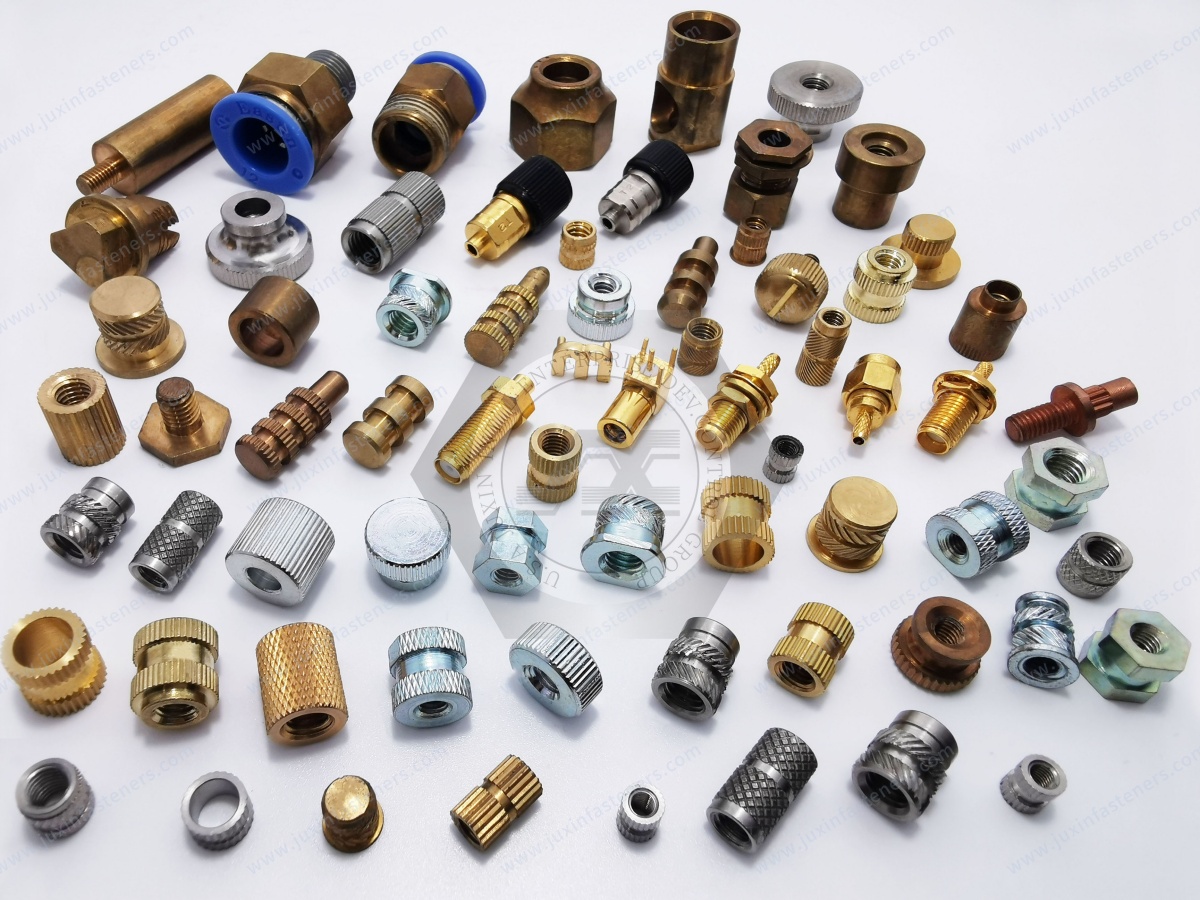
JUXIN FASTENERS supplies fastening components for engineered plastic, sheet-metal and electronic assemblies.
Relevant product families include:
Threaded inserts for controlled thermal installation into suitable thermoplastics.
Insert geometries can be evaluated for compatible ultrasonic installation processes.
Tapered configurations can support controlled installation into suitable plastic bosses.
Drawing-based stainless steel insert projects can be evaluated according to material, thread and geometry.
JUXIN FASTENERS has experience with 303 stainless steel tapered heat-set inserts for drawing-based OEM applications.
Projects can be evaluated according to:
Metric or inch thread
Length
Outside diameter
Taper
Knurl geometry
Material
Surface finish
Installation method
Customer drawing
For sheet-metal control cabinets and equipment assemblies, JUXIN FASTENERS also supplies:
Self-clinching nuts
Self-clinching studs
Self-clinching standoffs
Miniature self-clinching hardware
For one-sided installation in sheet-metal enclosures, available product families include:
Full-hex rivet nuts
Half-hex rivet nuts
Round-body rivet nuts
Knurled and ribbed rivet nuts
Countersunk rivet nuts
Open-end and closed-end rivet nuts
Floating rivet nuts
For suitable metal equipment structures, JUXIN FASTENERS supplies:
DIN 929 hex weld nuts
DIN 928 square weld nuts
Square weld nuts
Flange projection weld nuts
Round piloted projection weld nuts
Floating cage weld nuts
Weld studs
Weld pins
For electronics assemblies, JUXIN FASTENERS supplies:
Nylon screws
Nylon nuts
Nylon washers
Nylon spacers
PCB supports
PCB standoffs
Card guides
Snap rivets
Push rivets
Screw grommets
This wider product portfolio allows OEM engineers to evaluate fastening according to the actual substrate:
Plastic Housing → Threaded Insert
Sheet-Metal Enclosure → Self-Clinching Fastener or Rivet Nut
Weldable Metal Structure → Weld Nut or Weld Stud
PCB/Electronics Assembly → Standoff, Spacer or Nylon Hardware
The fastening method should follow the structure rather than forcing one product family into every application.
They provide durable reusable internal threads in suitable plastic housings used for PLCs, sensors, controllers, switches and electronic modules.
Yes, where the housing uses a compatible thermoplastic and the insert, boss and installation process are correctly designed.
There is no universal best insert. Selection depends on polymer, available boss size, thread, loads, environment and installation process.
The insert can provide mechanical retention, but insert retention and screw self-loosening are different mechanisms. Both should be evaluated.
Pull-out measures axial extraction resistance. Torque-out measures resistance to rotation in the plastic.
Nickel plating can be useful for selected environments, but the complete plating specification and service conditions must be defined.
Not automatically. The correct material depends on corrosion, chemicals, mating materials, installation and cost.
Yes where mechanically appropriate, but the insert itself does not establish enclosure sealing or an IP rating.
A metal insert is conductive, but conductivity alone does not establish a qualified grounding or bonding connection.
Heat-set, ultrasonic and other suitable installation processes can be automated, but insert geometry, feeding,
boss dimensions and process control must support stable automation.
Provide the drawing, application, polymer, boss geometry, thread, mating screw, material, installation process,
functional requirements, environment, automation requirements, packaging and annual volume.
Drawing-based projects can be evaluated according to thread, material, geometry, knurl, tolerance and installation requirements.
Metric and inch-thread drawing-based projects can be evaluated according to the required specification.
JUXIN FASTENERS can evaluate drawing-based stainless steel heat-set inserts and has experience with 303 stainless steel tapered heat-set insert projects.
A sample can support evaluation, but a controlled drawing, material specification, polymer, installation process and functional requirements provide a stronger qualification basis.
Because insert retention and installation behavior depend directly on the surrounding polymer.
Yes, especially where parts are automatically fed or where packaging changes can affect handling and production efficiency.
For controlled OEM components, change-control requirements should be defined during supplier qualification.
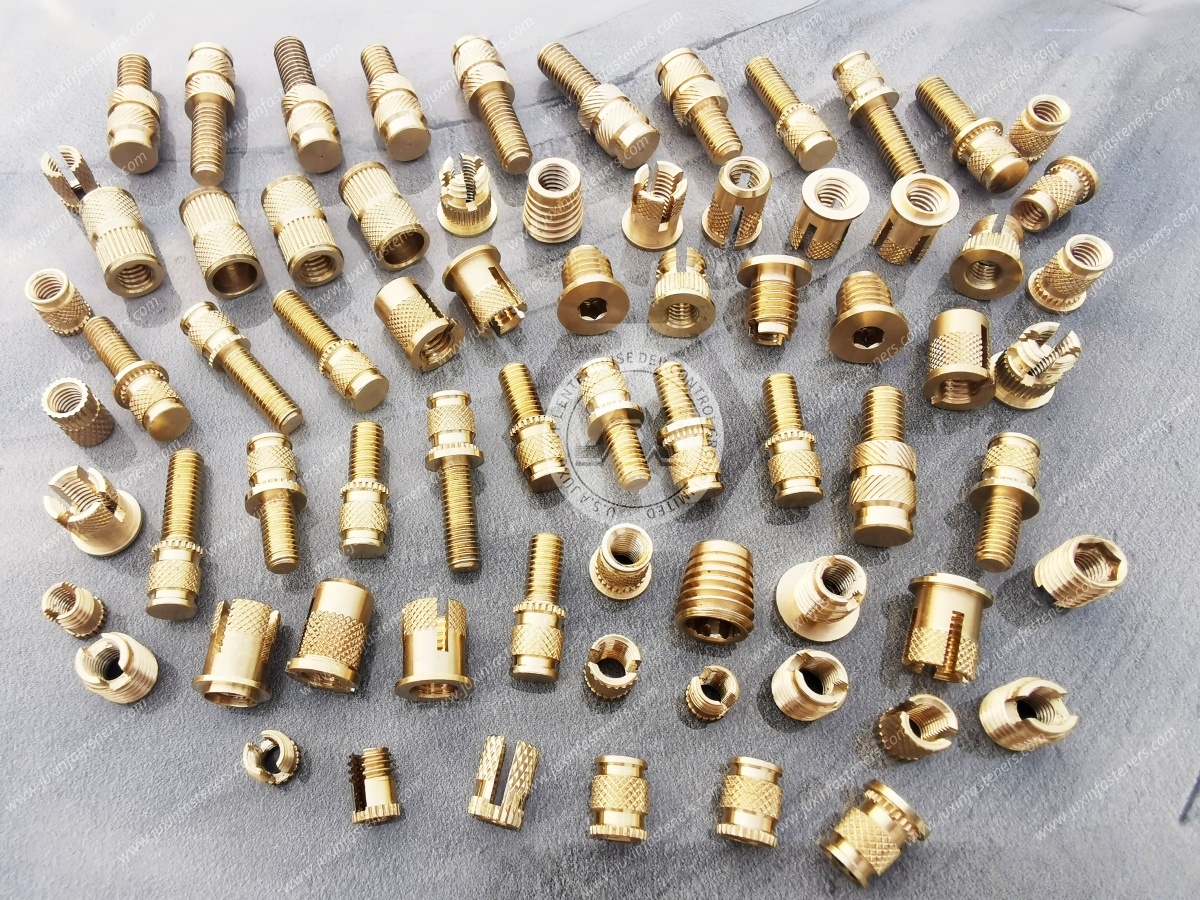
For an efficient technical and commercial review, provide:
2D drawing
3D model where available
Part number
Drawing revision
Equipment type
Component application
Joint function
Insert type
Internal thread
Metric or inch thread system
Mating screw
Insert material
Exact material grade where required
Surface treatment
Overall length
Outside diameter
Taper geometry
Knurl geometry
Flange/shoulder geometry where applicable
Polymer type
Exact polymer grade where available
Reinforcement/filler
Boss outside diameter
Receiving-hole diameter
Hole depth
Boss wall thickness
Installation method
Heat-set requirements where defined
Ultrasonic requirements where defined
Press-fit requirements where defined
In-mold requirements where applicable
Installation depth
Installation equipment
Automation requirements
Feeding method
Required pull-out performance
Required torque-out performance
Screw tightening torque
Target preload where applicable
Repeated assembly requirement
Vibration requirement
Operating temperature
Temperature cycling
Humidity
Condensation exposure
Chemical exposure
Corrosion requirement
Electrical requirement where applicable
Grounding/bonding function where applicable
Sealing/IP requirement where applicable
Dimensional tolerances
Thread inspection requirements
Functional testing
Material documentation
Surface-treatment documentation
Lot identification
Traceability requirements
First-article requirements
Customer-specific documentation
Change-control requirements
Packaging specification
Annual volume
Forecast
Production schedule
Delivery requirements
Existing approved sample for second-source projects
For second-source development, also provide the approved baseline drawing and functional acceptance criteria where available.
This enables the project to be evaluated as:
Insert + Polymer + Boss + Installation + Screw + Environment + Automation + Documentation + Supply Risk
rather than:
Thread Size + Material + Price
This article should connect internally with existing JUXIN FASTENERS resources covering:
Threaded Inserts for Plastic
Heat-Set Threaded Inserts
Ultrasonic Threaded Inserts
Stainless Steel Threaded Inserts
Industrial Automation Fastening Solutions
Communication Equipment Fastening Solutions
Electrical Equipment Fastening Solutions
PCB Supports and Standoffs
Plastic and Nylon Fasteners
Self-Clinching Fasteners
Rivet Nuts for Sheet-Metal Enclosures
Weld Nuts and Weld Studs
ISO Metric Thread Tolerances
Fastener Surface Finish Selection
Supplier Qualification and Second-Source Development
Use the existing indexed JUXIN FASTENERS URL when implementing each internal link.
The intended internal-link architecture is:
Industrial Automation → Equipment System → Housing Material → Fastener Type → Threaded Insert → Installation
→ Environment → Failure Mode → Supplier Qualification → RFQ
This page should remain focused on industrial automation threaded inserts for plastic housings,
while related pages can address sheet-metal control cabinets, PCB hardware, electrical equipment and broader industrial fastening solutions.
A threaded insert should not be selected as an isolated catalogue component.
The real system is:
Mating Screw + Insert + Retention Geometry + Polymer + Boss + Installation Process + Equipment Environment + Production Process
Remember:
Strong Insert ≠ Reliable Automation Equipment Joint.
Metal Thread ≠ Metal Joint.
Insert Strength ≠ Installed Joint Strength.
Same PLC Housing ≠ Same Requirement for Every Fastener.
Small Insert ≠ Simple Joint.
Same Polymer Name ≠ Same Finished Performance.
PA66 ≠ PA66-GF Application Behavior.
Dry Nylon Test ≠ Conditioned Nylon Performance.
Correct Insert + Incorrect Boss = Unreliable Joint.
Insert OD Alone ≠ Correct Hole Specification.
Hotter Installation ≠ Better Retention.
More Interference ≠ Better Retention.
Same Thread + Same OD ≠ Same Insert Performance.
Pull-Out ≠ Torque-Out.
Screw Tightening Torque ≠ Insert Torque-Out Requirement.
More Installation Torque ≠ Better Joint.
Torque ≠ Preload.
Same Torque + Different Friction ≠ Same Preload.
Insert Torque-Out Resistance ≠ Screw Anti-Loosening Performance.
Locking Feature ≠ Correct Preload.
Prevailing Torque ≠ Preload.
Room-Temperature Performance ≠ Full Service Performance.
Initial Assembly Condition ≠ Long-Term Joint Condition.
Corrosion-Resistant Insert ≠ Corrosion-Resistant Assembly.
Nickel-Plated ≠ Complete Corrosion Specification.
Salt Spray Hours ≠ Field Service Life.
Conductive Insert ≠ Qualified Electrical Connection.
Mechanical Fastening ≠ Electrical Safety.
Metal Fastener ≠ Automatic EMI Shielding.
Threaded Insert ≠ Waterproof Joint.
Sealed Fastener ≠ System IP Qualification.
Dimensional Compliance ≠ Stable Automated Installation.
Good Mechanical Performance ≠ Good Automation Compatibility.
Same Dimensions ≠ Functional Equivalence.
Visual Similarity ≠ Functional Equivalence.
Small Geometry Change ≠ Small Production Change.
Lowest Insert Price ≠ Lowest Installed Cost.
For design engineers, this framework connects threaded-insert selection with polymer behavior, boss geometry, vibration, temperature, corrosion and electrical-system boundaries.
For manufacturing engineers, it connects insert design with installation equipment, automation, feeding and process control.
For procurement, supplier-development and supply-chain teams, it provides a qualification path based on functional consistency,
documentation, change control and supply continuity rather than dimensions and unit price alone.
For industrial automation OEMs, the commercial development path should be:
Application → Drawing → Polymer → Boss → Insert → Installation → Environmental Validation → Production Validation → Supplier Qualification → RFQ
JUXIN FASTENERS supports industrial automation, communication equipment and electronics projects with heat-set inserts,
ultrasonic insert solutions, tapered threaded inserts, stainless steel threaded inserts, self-clinching fasteners, rivet nuts, weld nuts,
weld studs, plastic and nylon fasteners, PCB hardware and drawing-based custom fastening components.
For a new project or second-source evaluation, send the controlled drawing together with the polymer, boss geometry, mating screw,
installation process, functional requirements, operating environment, automation requirements, packaging and annual volume for technical and commercial review.
JUXIN FASTENERS
Email: info@juxinfasteners.com
Website: www.juxinfasteners.com
Contact Us
Tel.:
+86 020 8621 0320
+86 020 3121 6067
E-mail:
Technical Support:
Navigation
SEND INQUIREY



