
Call Us
+86 136 6007 9809
Call Us
+86 136 6007 9809

Oct. 01, 2026
Industrial fastener selection is not simply a choice between bolts, nuts and screws.
Modern OEM assemblies increasingly combine thin sheet metal, aluminum, stainless steel, molded plastics, electrical insulation,
blind-side installation, automated assembly, vibration, corrosion exposure and restricted installation space.
These conditions determine which fastening technology is appropriate long before a purchasing team compares unit prices.
JUXIN Fasteners supplies industrial fastening components for automotive manufacturing, motorcycle and bicycle manufacturing, racing vehicles,
AI data center cabinets, telecommunications equipment, semiconductor equipment, medical equipment, electrical power equipment,
energy systems, rail transit, marine equipment, food machinery, electronics, electrical appliances, HVAC equipment, leisure equipment and outdoor structures.
Our product scope includes weld nuts, projection weld nuts, weld studs, rivet nuts, blind rivets, self-clinching nuts, self-clinching studs,
self-clinching standoffs, locking nuts, threaded inserts for plastics, nylon and polymer fasteners, plastic rivets, CNC machined components and custom drawing-based fasteners.
The correct product depends on the joint.
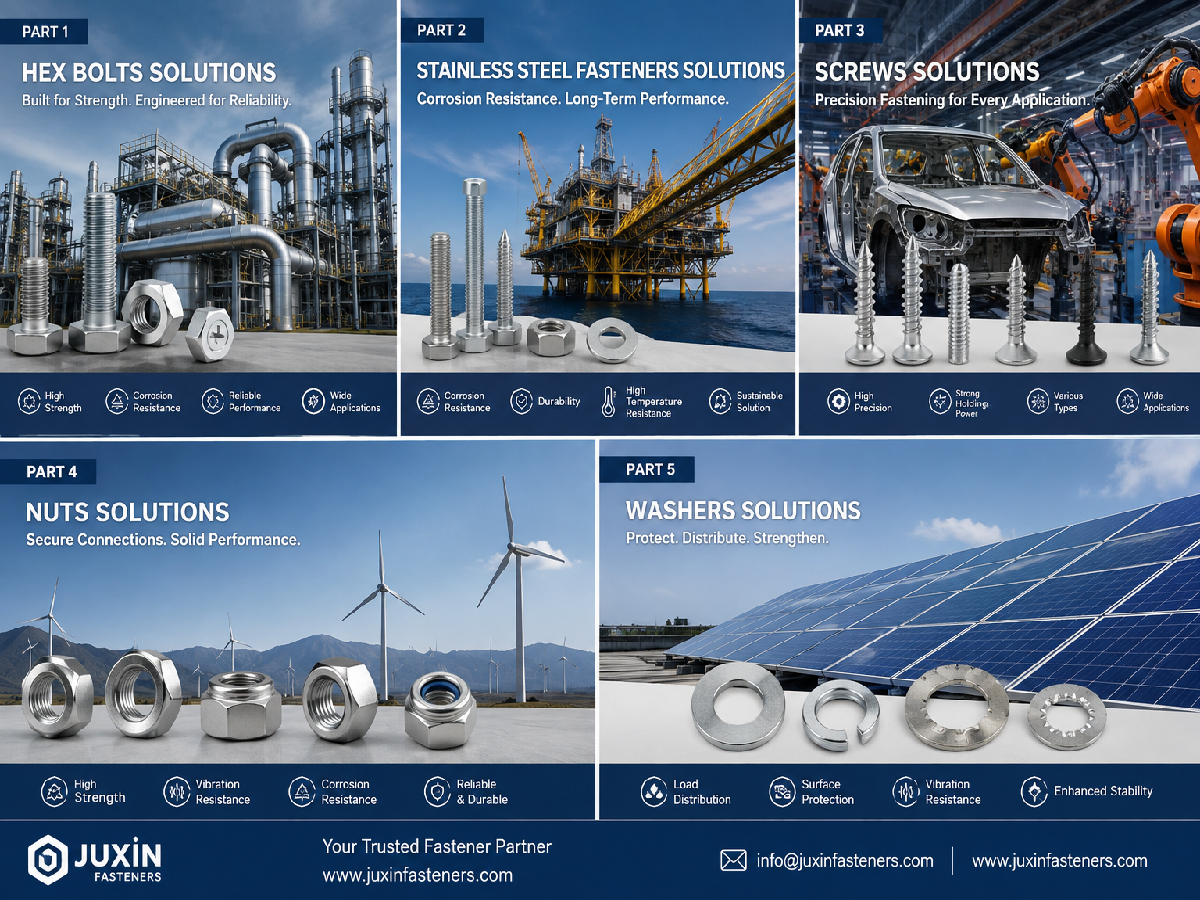
For many OEM assemblies, the fastest way to narrow the product choice is to answer four questions:
What is the substrate: sheet metal, machined metal or plastic?
Is installation access available from one side or both sides?
Does the assembly need a permanent joint or a reusable thread?
What vibration, corrosion, temperature, electrical and mechanical conditions must the joint withstand?
These questions separate fastening technologies much more effectively than thread size alone.
For example, a thin sheet-metal panel requiring an M6 reusable thread could potentially use a weld nut, rivet nut or self-clinching nut.
All three provide an M6 internal thread.
They are not interchangeable.
A weld nut depends on welding access and weld-process compatibility.
A rivet nut can create a reusable thread when installation is available from only one side.
A self-clinching nut depends on the sheet material, sheet hardness, thickness, prepared hole and press installation.
The correct specification must therefore include the installation interface, not only “M6.”
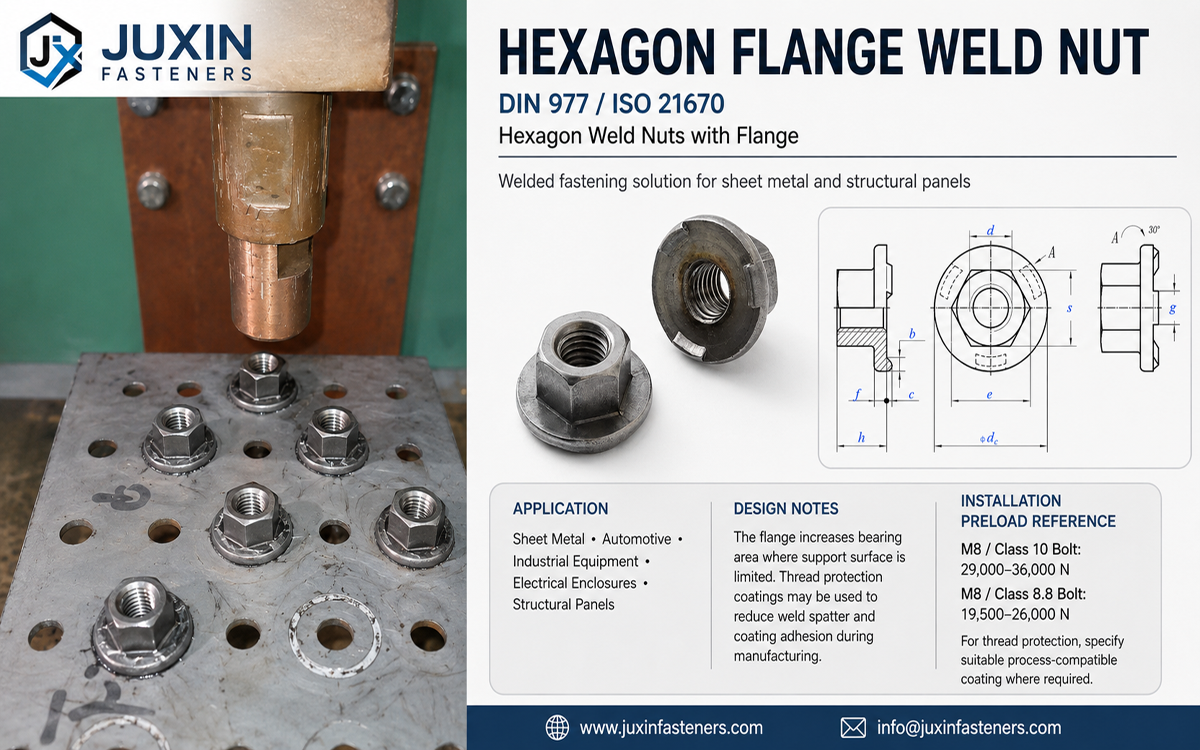
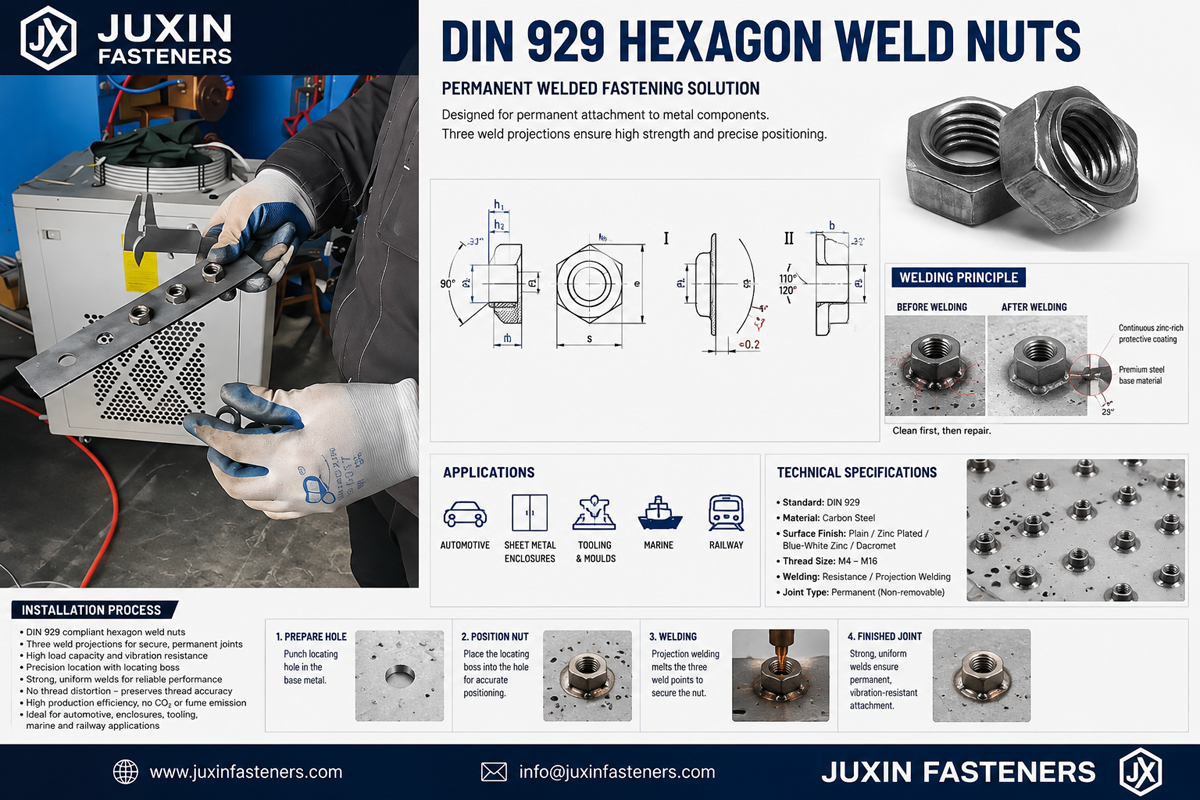
Weld nuts are designed to create a captive threaded attachment point on metal structures through welding.
JUXIN supplies weld nut configurations including:
DIN 929 hexagon weld nuts
DIN 928 square weld nuts
Projection weld nuts
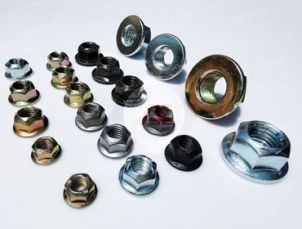
Flange-type weld nut designs
Drawing-specific weld nuts
Typical materials include low-carbon steel and stainless steel grades such as 304 and 316 where appropriate to the design and application.
Weld nuts are widely used in automotive structures, equipment frames, brackets, rail equipment, electrical cabinets and fabricated metal assemblies.
When engineers specify a weld nut, thread size is only one parameter.
Important characteristics include:
Thread diameter and pitch
Nut body geometry
Projection quantity
Projection position
Projection height and geometry
Pilot or locating feature
Mating sheet thickness
Mating sheet material
Surface condition
Welding process
Required joint performance
Projection geometry is particularly important.
The projections concentrate welding current and control local collapse during projection welding.
A weld nut that looks dimensionally similar but has different projection geometry may behave differently during the welding process.
For replacement or second-source projects, the existing welding parameters and mating sheet should therefore be considered during validation.
A weld nut is generally worth evaluating when:
A captive reusable thread is required
The assembly is metallic
Welding is already available in the fabrication process
The nut can be positioned before final assembly
Production volume supports the welding process
If welding is undesirable or the thread must be installed after enclosure fabrication, a rivet nut or another fastening method may be more suitable.
A rivet nut creates a reusable internal thread in relatively thin material and can be installed from one side of the workpiece.
JUXIN supplies rivet nut configurations including:
Flat-head rivet nuts
Countersunk rivet nuts
Reduced-head rivet nuts
Round-body rivet nuts
Knurled-body rivet nuts
Half-hex rivet nuts
Full-hex rivet nuts
Closed-end rivet nuts
Material options can include:
Carbon steel
Aluminum
Stainless steel 304
Stainless steel 316
Typical thread sizes range across common metric industrial requirements, depending on body design and customer specification.
One of the most common rivet nut specification mistakes is purchasing by thread size alone.
An M6 rivet nut is not defined only by M6.
The grip range determines the material thickness over which the rivet nut is intended to form and clamp correctly.
Procurement should therefore provide:
Thread size
Panel thickness
Required grip range
Hole diameter
Body style
Head style
Material
Surface finish
Installation method
For example, a closed-end rivet nut may also be selected where the application benefits from a closed body, but the exact sealing requirement must still be evaluated at the assembly level. A closed-end body should not automatically be described as a fully sealed joint.
Body geometry affects anti-rotation behavior and hole preparation.
A round-body rivet nut can simplify hole preparation in suitable applications.
Knurled designs can improve rotational resistance depending on substrate and installation conditions.
Half-hex and full-hex rivet nuts mechanically engage a matching hole geometry and can provide stronger anti-rotation capability where the sheet-metal design permits the required hole.
The correct body style should therefore be selected according to torque requirement, substrate and manufacturing process rather than appearance.
Self-clinching fasteners provide captive threaded or spacing features in sheet-metal assemblies.
JUXIN supplies:
Self-clinching nuts
Self-clinching studs
Self-clinching standoffs
Drawing-specific press-in hardware
These products are commonly considered for server chassis, AI data center cabinets, telecommunications equipment, electronics, electrical enclosures and industrial sheet-metal assemblies.
A self-clinching fastener cannot be specified correctly without knowing the sheet.
Engineering review should include:
Sheet material
Sheet hardness
Sheet thickness
Hole diameter
Edge distance
Installation direction
Installation force
Required push-out resistance
Required torque-out resistance
During installation, material around the prepared hole flows into the fastener retention geometry.
If the sheet is too hard, too thin, incorrectly punched or dimensionally unsuitable, the fastener may not develop the intended retention.
This is why substituting one self-clinching component for another based only on thread size can create assembly problems.
These three products are frequently compared because all can create captive internal threads.
Their manufacturing logic is different.
Weld Nut
Best evaluated when welding is already integrated into metal fabrication and a welded captive thread is appropriate.
Key information: mating sheet, weld process, projection geometry and thread requirement.
Rivet Nut
Best evaluated when a reusable thread is required and only one side of the assembly is accessible.
Key information: panel thickness, grip range, hole diameter, body style and installation tooling.
Self-Clinching Nut
Best evaluated when the fastener can be installed into compatible sheet metal before final assembly.
Key information: sheet material, hardness, thickness, hole geometry and press-installation requirements.
The best choice is therefore determined by the production architecture rather than by thread size alone.
Assemblies exposed to vibration or cyclic loading may require a locking strategy.
JUXIN product families include locking nut solutions such as:
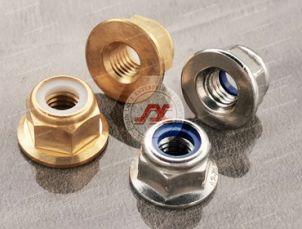
Nylon insert lock nuts
All-metal locking nut configurations
Drawing-specific locking components
DIN 985-type nylon insert lock nuts are widely used in appropriate industrial assemblies where the nylon insert provides prevailing torque.
However, nylon insert lock nuts are not suitable for every temperature or chemical environment.
Where operating conditions exceed the practical capability of the polymer locking element, an appropriate all-metal locking system or another validated locking method may be considered.
A locking nut should not be expected to compensate for a poorly designed joint.
Engineers should also consider:
Required preload
Joint stiffness
Bolt strength
Mating surfaces
Vibration amplitude
Temperature
Reuse requirements
Installation torque
The locking feature is one part of the system.
Plastic components frequently need reusable metal threads for assembly and servicing.
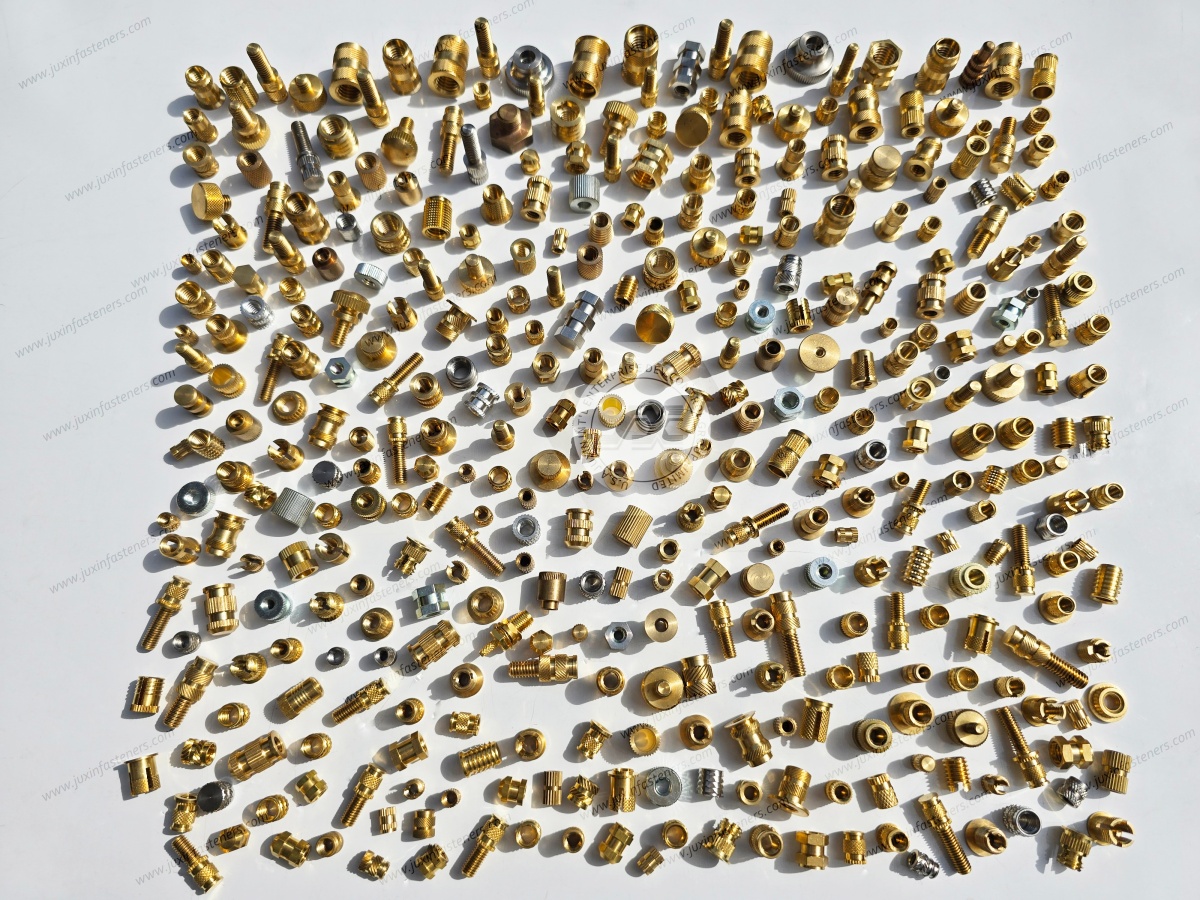
JUXIN supplies threaded inserts for suitable plastic applications, including designs used with heat insertion or ultrasonic installation processes.
Applications can include:
Electronics housings
Electrical equipment
Medical equipment housings
Telecommunications products
Automotive electronics
Industrial plastic enclosures
Consumer and commercial equipment
Important engineering parameters include:
Insert thread
Insert outside diameter
Insert length
Insert geometry
Plastic resin
Molded hole diameter
Boss diameter
Boss wall thickness
Installation method
Required pull-out resistance
Required torque-out resistance
A threaded insert that performs well in one polymer may not behave identically in another.
PA6, PA66, POM, PC and other engineering polymers differ in stiffness, thermal behavior and moisture response.
The plastic boss and insert should therefore be engineered as one assembly.
JUXIN supplies polymer fastening products including:
Nylon screws
Nylon nuts
Polymer washers
Insulating spacers
Plastic rivets
Snap rivets
Custom molded fastening components
Depending on application requirements, material families can include:
PA6
PA66
POM
PP
PC
PVDF
PEEK
Polymer fasteners are useful where an assembly requires characteristics such as:
Electrical insulation
Low weight
Corrosion resistance
Reduced surface damage
Non-metallic contact
Specific chemical resistance
However, polymer selection should account for long-term material behavior.
Metal-fastener design logic should not simply be transferred to polymer components.
For example, nylon can absorb moisture, which can change dimensions and mechanical behavior.
Polymers under continuous load can also experience creep.
Engineering review should therefore consider:
Continuous operating temperature
Peak temperature
Moisture exposure
Sustained load
Chemical environment
UV exposure
Required electrical properties
Flammability requirement where applicable
Material grade should be confirmed before assuming two visually identical plastic fasteners are equivalent.
Plastic rivets provide lightweight retention for panels, electronics, appliances and other suitable non-metallic or light-duty assemblies.
They can offer advantages such as:
Fast installation
Low weight
Electrical insulation
Corrosion resistance
Reduced surface damage
The correct design depends on:
Panel thickness
Hole diameter
Required retention
Installation method
Material
Temperature
Flammability requirement
Outdoor exposure where applicable
Where UL 94 flammability performance is required, the resin and component design should be evaluated specifically for the project.
A resin classification alone should not be used to make unsupported claims about the complete assembly.
Catalog fasteners cannot solve every assembly problem.
JUXIN also supports CNC machined components and drawing-based specialty parts where applications require:
Non-standard dimensions
Special shoulders
Unusual thread combinations
Tight interface dimensions
Custom locating features
Special material requirements
Low- or medium-volume precision components
Existing OEM legacy drawings
Possible materials depend on the drawing and can include carbon steel, stainless steel, aluminum alloys, titanium alloys and other specified materials appropriate to the component.
For drawing-based parts, RFQ review should identify which dimensions are Critical to Quality rather than treating every dimension as equally important.
Material selection should begin with application conditions.
Carbon steel is widely used where forming capability, mechanical performance and cost efficiency are important.
Appropriate surface protection can be specified according to corrosion requirements.
Alloy steels can be used for components requiring higher mechanical properties when the product design and heat-treatment route support the requirement.
Stainless steels can provide corrosion resistance for many industrial applications.
The correct grade depends on the actual environment.
Stainless steel should not automatically be specified simply because an assembly is exposed to moisture.
Aluminum can be useful where low weight and corrosion behavior are important and the required mechanical performance is compatible with the material.
Titanium alloys can be evaluated for selected drawing-based components where low weight, corrosion resistance and specific mechanical requirements justify their use.
PA6, PA66, POM, PP, PC, PVDF and PEEK provide very different combinations of mechanical, thermal, electrical and chemical performance.
The polymer must be selected according to the actual operating environment.
Surface finish can influence corrosion resistance, assembly performance and appearance.
Depending on component and customer requirements, JUXIN can evaluate finishes including:
Zinc-based coatings
Zinc-nickel coatings
Black zinc-nickel systems
Passivation for applicable stainless steel components
Other drawing-specified industrial finishes
A professional RFQ should define performance wherever possible.
Instead of specifying only “black finish,” provide information such as:
Required coating system
Corrosion requirement
Appearance
Coating thickness where critical
Thread requirements after coating
Customer-specific environmental restrictions
This reduces ambiguity during quotation and production.
Automotive manufacturing commonly uses weld nuts, projection weld nuts, weld studs, rivet nuts, locking nuts and drawing-based components.
Relevant engineering conditions include:
High-volume assembly
Sheet-metal structures
Vibration
Corrosion
Automated installation
Weight reduction
Restricted packaging space
Weld projection geometry, mechanical properties, coating and traceability may be critical depending on the component.
AI server infrastructure combines dense sheet-metal construction with power distribution, electronics and thermal-management equipment.
Relevant JUXIN product families include:
Self-clinching nuts
Self-clinching studs
Self-clinching standoffs
Rivet nuts
Nylon fasteners
Polymer washers and spacers
Threaded inserts
Custom machined components
Selection should consider sheet thickness, service access, electrical requirements, installation sequence and cabinet manufacturing process.
Telecommunications equipment can use self-clinching hardware, rivet nuts, polymer components,
threaded inserts and custom parts across cabinets, electronic assemblies and supporting structures.
Outdoor equipment should additionally consider corrosion, UV exposure for polymers and environmental sealing requirements at the assembly level.
Rail transit applications can include:
Interior panels
Equipment cabinets
Lighting assemblies
Brackets
Electrical equipment
Seating-related assemblies
Exterior equipment
Depending on the specific assembly, applicable JUXIN products can include weld nuts, rivet nuts, locking nuts, stainless components, polymer fasteners and drawing-based parts.
Rail projects may impose vibration, corrosion, fire-performance and documentation requirements that must be specified for the actual component.
Electrical and energy equipment can require both mechanical fastening and electrical isolation.
Relevant product families include:
Weld fasteners
Rivet nuts
Self-clinching hardware
Nylon fasteners
Insulating washers
Polymer spacers
Custom machined components
Material selection should consider temperature, electrical requirements, corrosion and mechanical load.
Semiconductor equipment may use precision metal components, stainless hardware, polymer fasteners, self-clinching components and drawing-based machined parts.
Where an application has cleanroom, vacuum, particle, outgassing or process-specific requirements, these must be defined explicitly.
A generic material designation alone does not establish suitability for semiconductor process equipment.
JUXIN can evaluate appropriate metal and polymer fastening components for medical equipment housings, diagnostic equipment, laboratory systems and related mechanical assemblies.
If a project requires biocompatibility, sterilization compatibility, medical-grade material or regulatory documentation, those requirements must be explicitly stated during RFQ and qualification.
Food machinery can expose fastening components to moisture, cleaning processes and chemicals.
Stainless steel and suitable engineering polymers may be evaluated according to the application.
Direct food-contact requirements must be identified separately and should not be assumed merely because a component is installed in food-processing equipment.
Marine applications require careful consideration of corrosion and material compatibility.
Stainless steel, corrosion-protected steel and suitable polymer components can be evaluated depending on the application.
When dissimilar metals are used together, galvanic corrosion should also be considered.
HVAC equipment commonly combines sheet metal, vibration, moisture, temperature cycling and repeated maintenance.
Relevant products include:
Rivet nuts
Self-clinching fasteners
Weld nuts
Stainless fasteners
Polymer components
Service access should be considered early because equipment panels and components may need repeated removal during maintenance.
Electronics and electrical appliances frequently use:
Nylon screws
Nylon nuts
Polymer washers
Spacers
Plastic rivets
Snap rivets
Threaded inserts
Self-clinching hardware
Small custom metal components
Electrical insulation, assembly speed, temperature and product service life are important selection parameters.
These applications can combine vibration, weight reduction, corrosion resistance, restricted packaging space and repeated servicing.
Depending on the design, appropriate materials may include alloy steel, stainless steel, aluminum, titanium and engineering polymers.
Material substitution should always be checked against mechanical requirements rather than selected by weight alone.
Outdoor equipment and fencing can require corrosion resistance, tamper resistance, long service life and simplified installation.
Stainless steel, coated steel, locking hardware and appropriate polymer components may be considered according to environmental exposure and load.
A practical first-stage product selection can be summarized as follows:
Need a captive thread in welded sheet metal?
Evaluate a weld nut.
Need a reusable thread with access from only one side?
Evaluate a rivet nut.
Need a captive thread, stud or standoff in compatible thin sheet?
Evaluate self-clinching hardware.
Need resistance to loosening in a vibration-prone threaded joint?
Evaluate an appropriate locking nut or validated locking system.
Need a reusable metal thread in molded plastic?
Evaluate a threaded insert.
Need electrical isolation or a non-metallic fastening interface?
Evaluate nylon or another suitable engineering polymer.
Need quick lightweight panel retention?
Evaluate a plastic rivet or snap rivet.
Cannot meet the interface with a standard product?
Evaluate a CNC machined or drawing-based custom component.
This matrix is a starting point, not a substitute for application validation.
A technically useful RFQ should contain product-specific information.
Provide:
Thread
Applicable standard or drawing
Material
Projection geometry where drawing-controlled
Mating sheet information
Surface finish
Quantity
Required inspection
Provide:
Thread
Body style
Head style
Panel thickness
Grip range
Hole size
Material
Surface finish
Quantity
Provide:
Fastener type
Thread
Sheet material
Sheet hardness where relevant
Sheet thickness
Hole diameter
Required retention performance
Quantity
Provide:
Thread
Insert dimensions
Plastic material
Boss or hole dimensions
Installation method
Pull-out or torque requirements
Quantity
Provide:
Component drawing
Resin requirement
Operating temperature
Chemical environment
UV exposure where applicable
Flammability requirement where applicable
Mechanical requirement
Quantity
Provide:
2D drawing
3D model when available
Material
Tolerances
CTQ dimensions
Heat treatment where applicable
Surface finish
Sample quantity
Production quantity
Estimated annual usage
For faster engineering review and quotation, send:
Product name or intended fastening function
2D drawing
3D CAD model when available
Thread specification
Material
Mechanical property requirement
Surface finish
Mating material
Sheet or panel thickness
Hole dimensions
Installation access
Installation method
Operating temperature
Corrosion environment
Vibration condition
Electrical requirement
Critical dimensions
Sample quantity
Production quantity
Estimated annual usage
Required inspection documents
Required material documentation
Packaging requirements
Target delivery schedule
If you are uncertain which fastening technology is appropriate, send the assembly information rather than selecting a product based only on thread size.
For example:
“M6 reusable thread required in 1.5 mm sheet; rear access unavailable after assembly.”
is more useful for technical evaluation than:
“Need M6 nut.”
JUXIN Fasteners supports OEMs, equipment manufacturers, design engineers, procurement teams and supplier-development teams with industrial fastening products and drawing-based components.
Our core product families include weld nuts, weld studs, rivet nuts, blind rivets, self-clinching hardware, locking nuts, threaded inserts, nylon and polymer fasteners,
plastic rivets, CNC machined components and custom fastening parts.
If you already know the required component, send the drawing, specification and quantity for quotation.
If the fastening method has not yet been finalized, provide the substrate, thickness, installation access, operating environment,
required joint function and expected production volume so that the requirement can be reviewed against appropriate product families.
Email: info@juxinfasteners.com
Website: www.juxinfasteners.com
JUXIN FASTENERS — Industrial Fastener Solutions for OEM and Equipment Manufacturing
 MORE NEWS
Oct. 01, 2026
Oct. 01, 2026
Contact Us
Tel.:
+86 020 8621 0320
+86 020 3121 6067
E-mail:
Technical Support:
Navigation
SEND INQUIREY