
Call Us
+86 136 6007 9809
Call Us
+86 136 6007 9809

Sep. 21, 2026
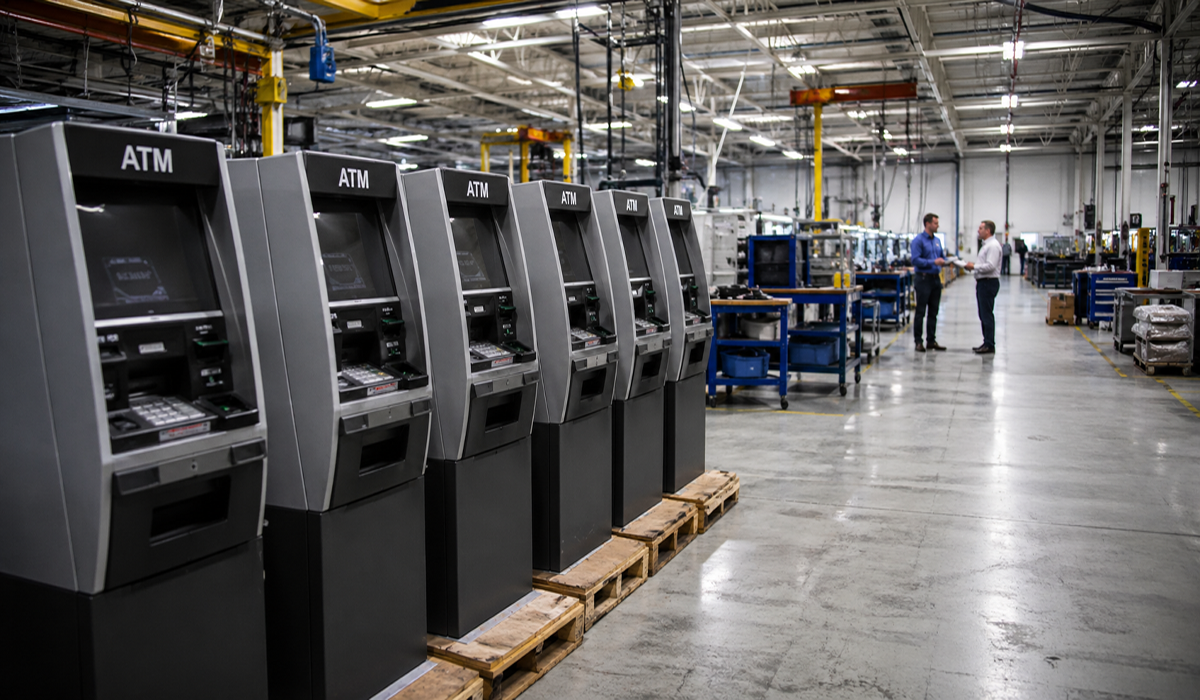
Industrial machinery, CNC machining centers, compressors, pumps, conveyors, automated production equipment and material-handling systems frequently use sheet-metal guards,
covers and service panels to separate personnel from moving equipment, protect internal components and provide maintenance access.
These assemblies create a fastening challenge.
The panel may need to remain securely attached during operation while also being removable for inspection, lubrication, tooling changes, component replacement or scheduled maintenance.
Where the attachment point is located near an accessible sheet-metal edge,
clip-on nuts for industrial machinery can provide a captive threaded fastening architecture without requiring a conventional loose nut behind the panel.
Strong-grip U-nuts, J-nuts, barrel clip-on nuts and enclosed-thread spring fasteners can be useful for appropriate machinery guards, equipment covers and maintenance panels.
However, machinery fastening requires a fundamental distinction:
A Machine Guard Is Not Always Just Another Sheet-Metal Cover
If the component performs a personnel-protection function, fastener selection becomes part of a larger machinery risk-reduction and guarding strategy.
The complete engineering problem should therefore be evaluated as:
Guard / Cover Function + Panel + Clip Nut + Screw + Joint + Vibration + Maintenance Cycle + Safety Requirement + Operating Environment
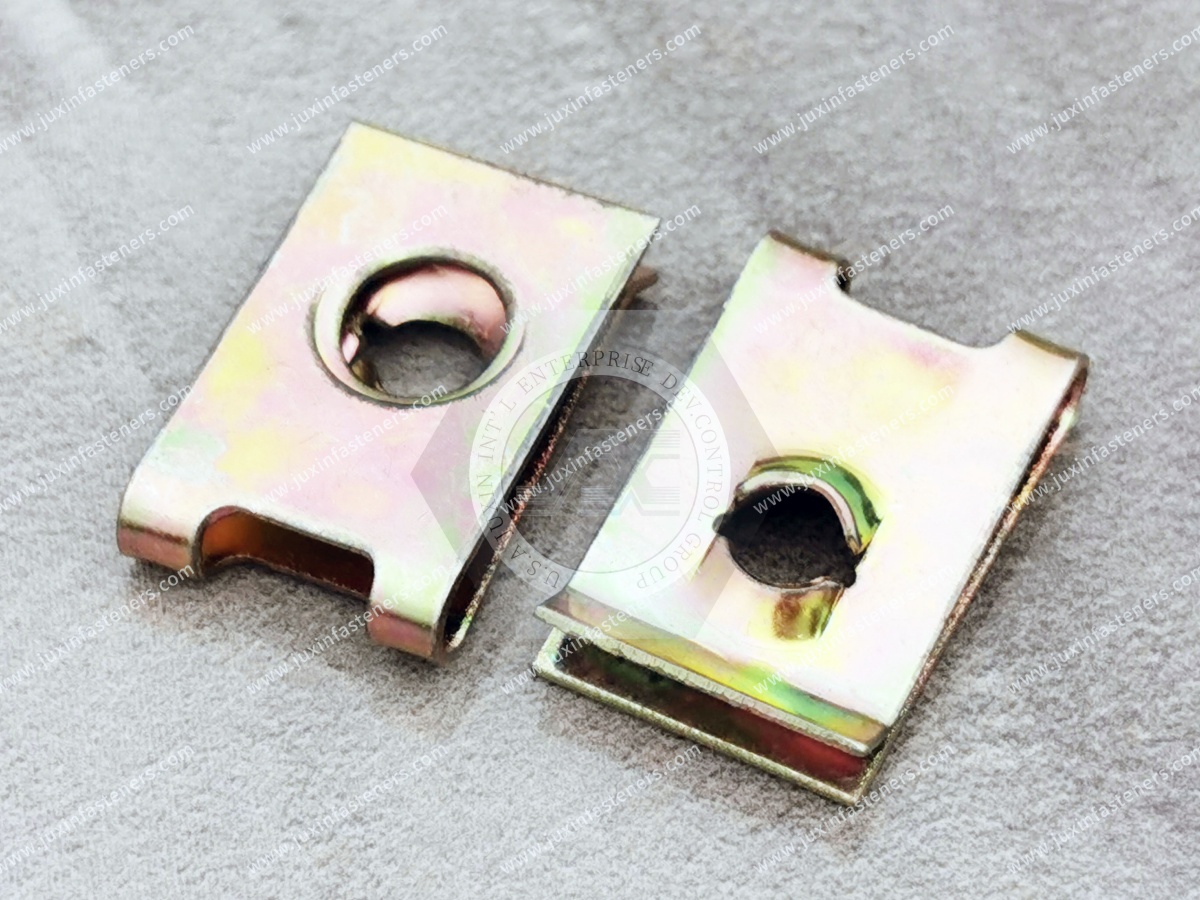
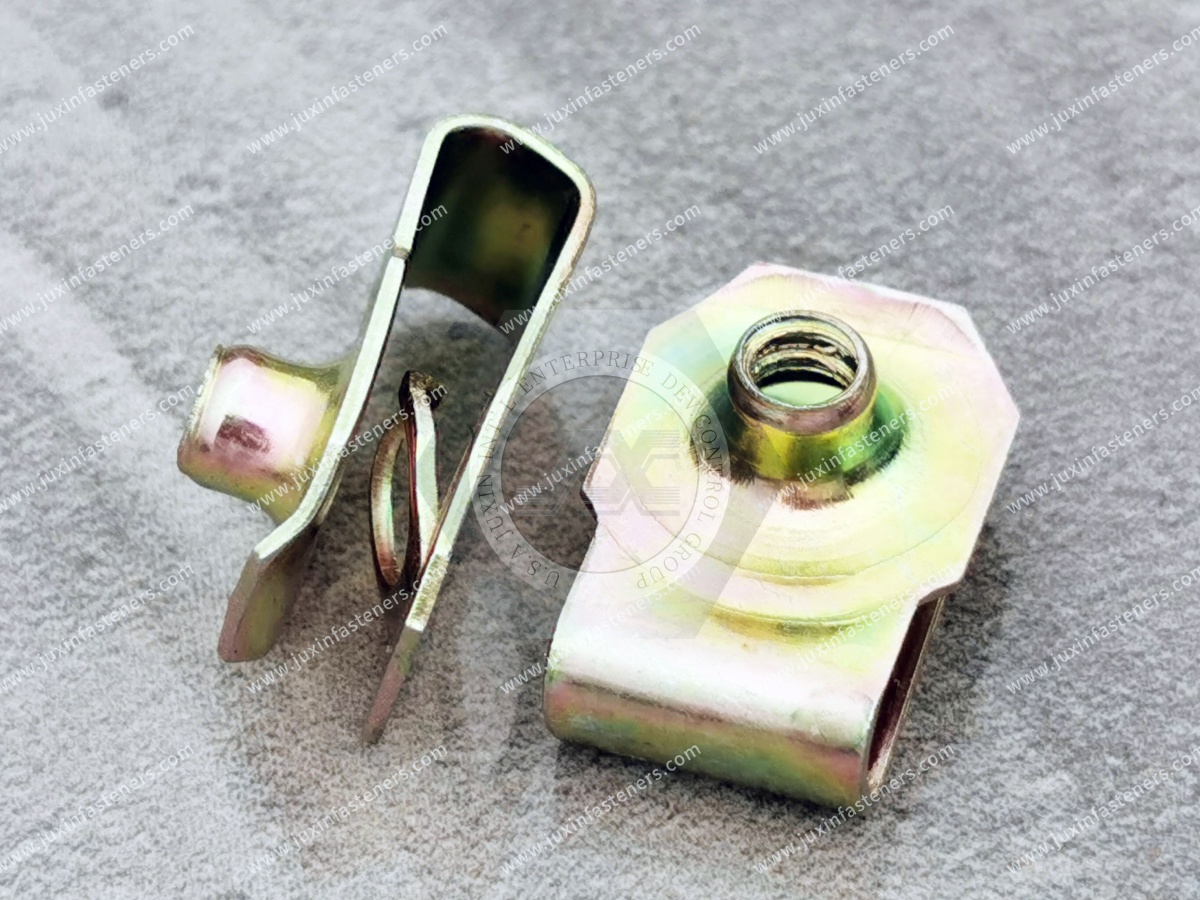
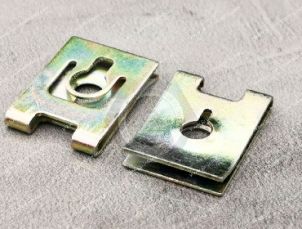
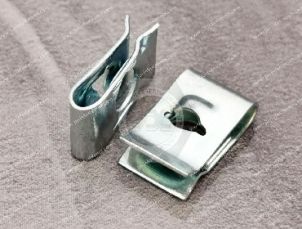
An industrial machinery clip-on nut is an edge-mounted spring fastener used to create a captive threaded or screw-engagement point on suitable sheet-metal panels, flanges and fabricated equipment housings.
Common configurations can include:
strong-grip U-nuts;
J-nuts;
barrel clip-on nuts;
enclosed-thread clip nuts;
tapping-screw spring clips;
low-profile clip-on nuts;
drawing-specific spring fasteners.
The correct design depends on the actual machinery assembly rather than the industry name alone.
Potential applications include appropriate:
CNC machine enclosures;
machine-tool access covers;
compressor guards;
pump shrouds;
conveyor service panels;
material-handling equipment covers;
automation equipment housings;
motor and drive covers;
electrical/control enclosure panels;
auxiliary machinery brackets;
maintenance inspection panels.
Not every guard or machinery joint is an appropriate clip-on nut application.
Before selecting a fastener, engineering teams should identify what the panel actually does.
These guards may form part of the machinery risk-reduction system.
Fastener selection must be evaluated together with the machine's applicable safety requirements and risk assessment.
If a guard is associated with an interlocking device, the fastening and guarding architecture should not be considered independently from the safety-control concept.
These may provide access to:
lubrication points;
filters;
belts;
tooling areas;
electrical components;
inspection locations.
Clip-on nuts can be useful where the application permits removable edge-mounted fastening.
Examples may include:
electronics covers;
acoustic covers;
cosmetic sheet-metal panels;
auxiliary equipment housings.
These can represent straightforward clip-on nut applications where geometry and mechanical requirements are suitable.
This zoning prevents a major engineering mistake:
Removable Sheet-Metal Panel ≠ Automatically Ordinary Cover
A clip-on nut can mechanically retain a panel.
It cannot independently determine whether a machine guard is safe.
Guarding performance can involve:
guard geometry;
material;
stiffness;
attachment;
access;
opening method;
interlocking;
foreseeable misuse;
machinery risk assessment.
Therefore:
Fastener Specification ≠ Guard Safety Certification
ISO 12100 provides general principles and methodology for machinery risk assessment and risk reduction.
For fastening decisions, the important engineering principle is that the fastener should be considered within the machine's complete protective strategy.
A clip-on nut itself is not an “ISO 12100 fastener.”
ISO 14120 addresses general requirements for the design, construction and selection of fixed and movable guards used to protect persons from mechanical hazards.
This makes it relevant context when a clip-on nut is being considered for an actual machinery guard.
However:
ISO 14120 Is Not a Clip-On Nut Product Standard
The machine designer remains responsible for determining whether the complete guard and its attachment method satisfy the applicable requirements.
ISO 14119 addresses principles for the design and selection of interlocking devices associated with guards.
If the panel is an interlocked guard, the clip-on nut should not be treated as the component that establishes the safety function.
The:
guard;
actuator;
interlocking device;
safety-related control system;
fastening architecture
must be evaluated according to their respective functions.
These functions must remain separate.
A clip-on nut may mechanically attach a guard.
An interlocking device may detect or control guard position according to the machine design.
Therefore:
Mechanical Attachment ≠ Safety Interlocking
If a clip-on nut is considered for a fixed guard, engineering must evaluate whether the resulting fastening method is appropriate for the guard's required removal and reinstallation behavior.
The decision cannot be based solely on convenience.
Some machinery applications may require hardware to remain associated with the guard during removal.
A clip-on nut retains the nut element on an appropriate panel edge, but this does not automatically make the entire screw-and-nut assembly captive.
If the screw must remain attached to the guard after loosening, a dedicated captive-screw architecture may be required.
Therefore:
Captive Nut ≠ Captive Screw
Industrial machinery can expose fastened assemblies to combinations of:
continuous vibration;
intermittent shock;
rotating-equipment excitation;
start-stop cycles;
thermal variation;
oils;
cutting fluids;
coolants;
humidity;
maintenance handling.
No single “heavy-duty” clip specification covers every environment.
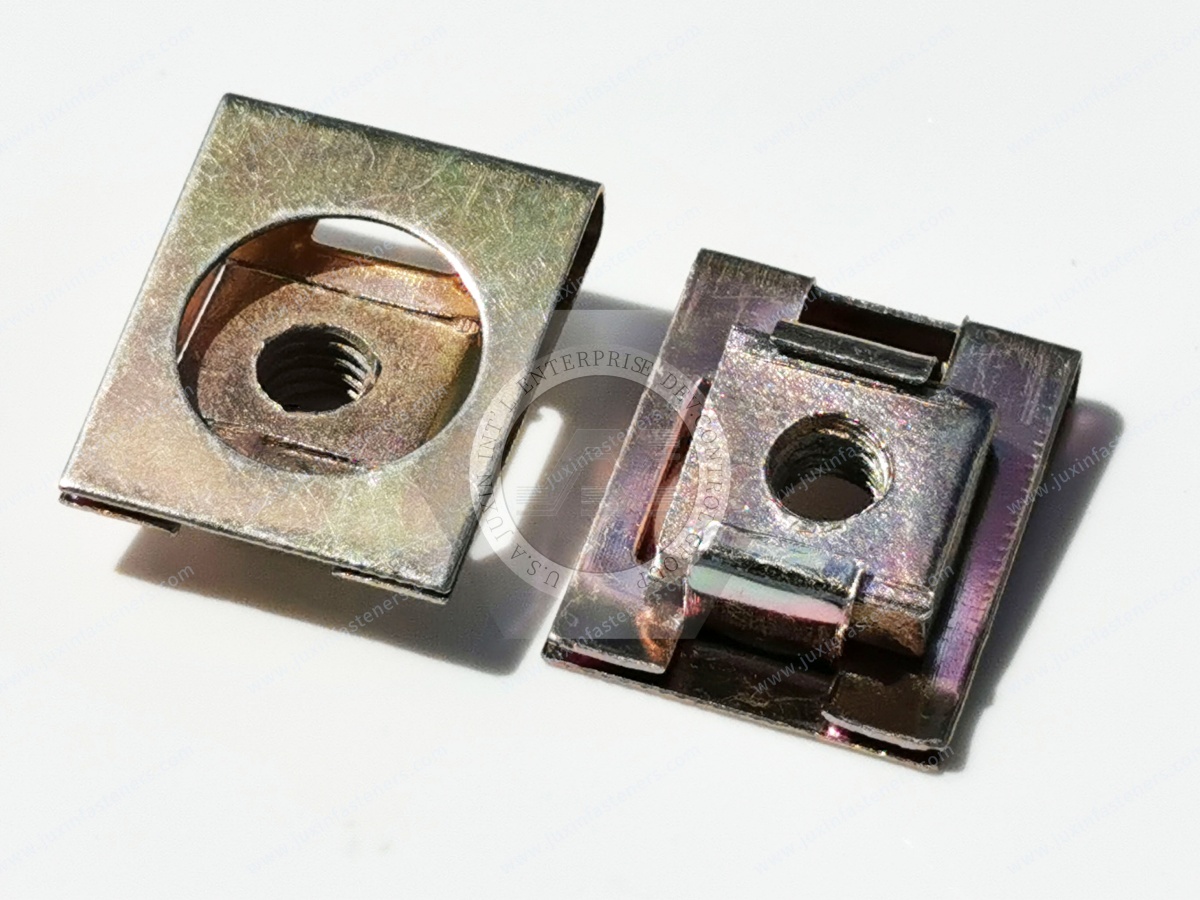
A common phrase is:
“Vibration-resistant clip nut.”
This can be useful as a product-selection concept, but engineering needs a more precise model.
The machine produces a dynamic input.
The panel and joint respond to that input.
Actual joint behavior depends on:
excitation frequency;
amplitude;
panel stiffness;
joint stiffness;
fastener spacing;
clamp;
friction;
attached mass.
Therefore:
Machine Vibration ≠ Automatic Fastener Loosening
and:
Strong Spring Clip ≠ Automatic Vibration-Proof Joint
This is one of the most important distinctions in machinery fastening.
Describes how securely the spring clip remains on the panel before and during screw installation.
Depends on factors including:
screw preload;
friction;
thread engagement;
joint stiffness;
transverse movement;
dynamic loading;
locking strategy where required.
The spring arms of the clip primarily retain the fastener on the panel.
Therefore:
Panel Grip Force ≠ Screw-Locking Torque
High clip retention does not establish final joint capacity.
The final joint is a system:
Clip Thread + Screw + Panel + Guard / Cover + Supporting Structure
Potential failure modes may include:
thread stripping;
screw failure;
clip deformation;
panel-edge deformation;
hole deformation;
attached-panel deformation.
Therefore:
Fastener Strength ≠ Joint Strength
Compressors, pumps, fans, spindles and motors can generate periodic excitation.
However, actual vibration at a guard attachment point depends on the machine structure.
A fastener should therefore not be selected merely because the equipment contains a rotating component.
A conveyor cover may experience continuous vibration.
A maintenance panel may experience occasional impact during servicing.
A compressor shroud may experience periodic excitation.
These are different mechanical environments.
The RFQ should define the relevant condition rather than simply stating:
“High vibration.”
A machine may operate reliably during production yet develop fastening problems after repeated servicing.
Maintenance cycles can create wear through:
repeated screw insertion;
repeated tightening;
thread wear;
panel-edge wear;
coating damage;
clip deformation;
incorrect screw replacement.
This means:
Operational Durability ≠ Maintenance-Cycle Durability
Machinery access panels are often removed for:
lubrication;
filter replacement;
belt inspection;
tooling changes;
coolant-system maintenance;
drive inspection;
electrical servicing.
Clip-on nuts can provide replaceable threaded points without tapping the thin sheet itself.
A clip-on nut can be removable or replaceable.
That does not establish unlimited service life.
The expected number of:
Remove → Service → Reinstall
cycles should be defined where frequent maintenance is part of normal operation.
Where repeated access is important, validation can examine:
screw-start consistency;
installation torque;
removal torque;
thread condition;
clip position;
clip retention;
panel-edge condition;
coating condition.
The required cycle count should come from the machine's service requirements.
Directly tapping thin sheet metal may provide limited thread engagement depending on:
sheet thickness;
thread size;
material.
Repeated maintenance can further increase the risk of thread damage.
A replaceable clip-on nut can shift the threaded interface into a replaceable fastener component.
However, the design still requires adequate thread engagement and validation.
Weld nuts can provide permanently located threaded points and are appropriate in many machinery applications.
However, they introduce a welding operation and may affect:
manufacturing sequence;
distortion;
coating sequence;
repair strategy.
Clip-on nuts can provide a non-welded alternative where edge geometry and joint requirements permit.
This does not mean clip-on nuts are universally superior to weld nuts.
Machine enclosures frequently contain:
folded flanges;
boxed sections;
closely spaced internal components;
inaccessible backside areas.
An edge-mounted clip can eliminate the need to hold a loose nut behind the panel during final screw installation.
But an important distinction remains:
No Backside Wrench Access ≠ No Edge Access Required
A conventional clip-on nut still requires access to the panel edge during installation.
If the threaded location is close to an accessible edge, a clip-on nut can be a candidate.
If the threaded location is far from the edge and only one side is accessible, another fastening architecture such as a suitable blind rivet nut may be more appropriate.
Clip geometry must match the actual panel thickness.
Incorrect matching can cause:
loose clip retention;
excessive installation force;
clip distortion;
panel-edge damage.
For detailed engineering guidance, see Panel Thickness Selection Guide.
Industrial panels may have:
powder coating;
wet paint;
plating;
other finishes.
The clip interacts with the finished assembly.
Therefore:
Base Sheet Thickness ≠ Automatically Final Grip Thickness
The edge-to-hole-center distance must match the selected clip geometry.
Incorrect setback can cause:
thread misalignment;
difficult screw starting;
cross-threading;
clip migration;
abnormal rundown torque.
Two clips with the same M6 or 1/4-inch thread can have different throat depths.
Therefore:
Same Thread ≠ Same Machinery Clip Nut
A clip-on nut can be mechanically adequate while the panel itself remains too flexible.
Thin guards or large covers can deflect between fasteners.
This can contribute to:
vibration;
rattling;
gasket variation where applicable;
local fatigue.
Fastener spacing should be considered together with:
panel thickness;
panel stiffness;
cover geometry;
vibration;
required retention.
Adding a stronger individual clip does not automatically compensate for poor panel support.
Panel rattle can result from:
insufficient clamp;
excessive clearance;
flexible panel geometry;
resonance;
loose components;
inappropriate spacing.
Therefore:
Higher Clip Grip ≠ Automatic Rattle Elimination
Strong-grip designs can be useful where increased panel retention is needed during:
handling;
assembly;
service.
However, “strong-grip” should not be interpreted as:
structural certification;
vibration-proof;
fatigue-proof;
safety-certified.
For related product engineering, see Strong-Grip Clip-On Nuts for Vibration-Resistant Assemblies.
Barrel-style clip-on nuts can provide a useful threaded architecture for certain industrial sheet-metal applications.
Suitability depends on:
panel thickness;
hole geometry;
throat depth;
thread;
assembly envelope.
For related geometry, see Strong-Grip Clip-On Barrel Nuts & U-Nuts.
Enclosed-thread designs can be considered where their geometry supports the required assembly and helps protect the threaded element from certain forms of handling exposure.
They should not automatically be interpreted as sealed fasteners.
For related selection, see Strong-Grip Clip-On Enclosed Hex Nuts.
Specification-controlled carbon spring steel can provide the elastic behavior required for many machinery clip-on nut designs.
Final spring performance depends on:
material condition;
thickness;
forming;
heat treatment;
clip geometry.
The material designation alone does not establish final fastener performance.
A regional material designation should not become the universal specification for an international OEM page.
For global machinery sourcing, it is more useful to control the required:
material specification;
mechanical condition;
spring behavior;
hardness where applicable;
dimensions;
functional performance.
This allows engineering teams to evaluate the actual part rather than relying on a regional material name.
Carbon spring-steel clips can use electroplated coating systems for appropriate corrosion environments.
ISO 4042 provides requirements for electroplated coating systems on fasteners and includes clips within its scope.
The required coating system should still be defined by the customer specification and operating environment.
For susceptible hardened or high-strength spring-steel components, material condition and electroplating processes can introduce hydrogen-embrittlement considerations.
Risk depends on factors including:
material;
hardness/strength;
processing;
coating route;
residual/applied stress.
Therefore:
One Universal Baking Recipe ≠ Every Spring Clip
Stainless spring materials can be considered for certain machinery environments involving:
humidity;
moisture;
selected industrial fluids;
corrosion exposure.
However:
Stainless ≠ Corrosion-Proof
and:
Stainless ≠ Automatically Better Than Coated Carbon Spring Steel
Material choice should follow the actual operating environment and mechanical requirements.
Machinery can expose fasteners to:
cutting fluids;
coolants;
lubricating oils;
hydraulic fluids;
cleaning chemicals.
Compatibility should be evaluated against the actual fluid rather than the generic phrase:
“Industrial Fluid Resistant.”
Chemical compatibility can depend on:
formulation;
concentration;
temperature;
exposure time;
contamination;
cleaning frequency.
The RFQ should identify important exposure conditions where relevant.
If laboratory corrosion testing is required, the specification should define:
test method;
exposure duration;
acceptance criteria.
A laboratory corrosion result should not automatically be translated into machinery service life.
CNC machining centers often combine:
sheet-metal guards;
viewing panels;
doors;
service covers;
electrical cabinets.
Clip-on nuts may be appropriate for selected auxiliary covers and maintenance panels.
Where the panel performs a machinery guarding function, the guard architecture and applicable safety requirements must be evaluated separately.
Some machinery enclosures combine metal framing with transparent polymer panels.
Fastening requires consideration of:
polymer properties;
hole geometry;
local bearing stress;
thermal movement;
tightening load.
A clip-on nut on the metal supporting flange does not eliminate the need to design the transparent panel correctly.
Compressors can generate significant vibration.
Potential clip-on nut applications can include appropriate:
acoustic covers;
protective shrouds;
service panels;
auxiliary housings.
The actual joint should be evaluated against the local dynamic environment.
Pump systems may expose hardware to:
vibration;
moisture;
process-area contamination.
Material and coating requirements should follow the actual equipment environment.
Conveyor and material-handling systems often require distributed maintenance access.
Clip-on nuts can support replaceable threaded attachment points for appropriate:
inspection covers;
drive covers;
service doors;
auxiliary guards.
Automation equipment can combine:
motion systems;
guarding;
electrical enclosures;
pneumatic equipment;
sensors.
Each zone can require a different fastening strategy.
The same machine does not necessarily need the same clip-on nut throughout.
An industrial machine may include an electrical cabinet next to a mechanical guard.
Their requirements differ.
Electrical cabinets can introduce:
grounding/bonding;
ingress protection;
electrical clearance
requirements.
A standard clip-on nut does not automatically provide these functions.
Metal contact alone does not establish a controlled electrical bonding path.
If grounding or bonding is required, the electrical design should specify and validate it separately.
Machinery covers may use:
gaskets;
seals;
acoustic materials.
A standard clip-on nut provides mechanical attachment.
It does not automatically provide:
oil sealing;
dust sealing;
water sealing;
IP rating.
Where a machinery cover uses a gasket, sealing performance depends on factors such as:
screw clamp;
fastener spacing;
cover stiffness;
flange stiffness;
gasket properties;
tightening sequence.
Therefore:
More Torque ≠ Automatically Better Seal
Potential failure modes include:
clip migration;
cross-threading;
thread stripping;
screw loosening;
panel-edge deformation;
clip fatigue;
coating damage;
corrosion;
maintenance-cycle wear.
For systematic troubleshooting, see Clip-On Nut Failure Analysis.
Investigate:
panel thickness;
grip range;
clip geometry;
hole setback;
screw alignment.
Do not automatically increase installation torque.
Investigate:
clamp;
friction;
joint stiffness;
transverse movement;
vibration input;
locking strategy.
Do not assume the solution is simply a stronger clip spring.
Investigate:
thread engagement;
screw material;
clip thread condition;
installation torque;
number of service cycles.
Investigate:
sheet thickness;
local stiffness;
clip geometry;
installation force;
joint load.
Investigate:
spring deflection;
material condition;
forming;
heat treatment;
surface condition;
cyclic stress.
Repeated installation or removal can affect coating at contact areas.
Evaluate:
clip geometry;
panel finish;
installation method;
service cycles;
corrosion environment.
| Engineering Requirement | Selection Consideration |
|---|---|
| Accessible sheet-metal edge | Clip-on architecture may be suitable |
| No backside wrench access | Captive clip can simplify assembly |
| Mid-panel blind thread | Consider another fastening architecture |
| Frequent service access | Define removal/reinstallation cycles |
| High vibration | Evaluate complete joint, not clip grip alone |
| Personnel-protective guard | Machinery safety evaluation required |
| Interlocked guard | Interlocking architecture evaluated separately |
| Captive screw required | Dedicated captive-screw solution may be necessary |
| Oil/coolant exposure | Define actual fluid environment |
| Painted/powder-coated panel | Include finish in grip evaluation |
| Large flexible panel | Evaluate stiffness and fastener spacing |
| Gasketed cover | Evaluate sealing system separately |
| Grounding required | Dedicated electrical bonding design required |
| Structural machine frame | Dedicated structural fastening required |
Examples include:
CNC machining center;
compressor;
pump;
conveyor;
packaging machine;
automation system;
material-handling equipment.
Is it a:
personnel-protective guard;
interlocked guard;
maintenance cover;
inspection panel;
acoustic cover;
electronics cover?
Determine whether removal or failure of the panel can expose personnel to a hazard.
If yes, evaluate the fastening architecture within the machinery risk-reduction strategy.
Determine:
edge access;
backside access;
tool access.
Specify:
material;
thickness;
tolerance;
finish;
flange geometry;
hole diameter;
hole setback.
Specify:
metric or inch;
diameter;
pitch/TPI;
screw material;
screw finish;
screw length;
head style.
Where relevant, provide:
vibration;
shock;
rotating-equipment excitation;
start-stop cycle.
Specify:
oil;
coolant;
humidity;
water;
cleaning chemicals;
temperature.
Specify:
access frequency;
expected service cycles;
replacement strategy.
Specify whether:
guard attachment is safety-related;
interlocking is involved;
screw captivity is required.
Evaluate:
Production Clip + Production Panel + Production Screw + Guard/Cover + Machine Environment + Maintenance Process
A clip that fits one prototype panel proves initial geometric compatibility.
It does not establish:
vibration durability;
maintenance-cycle durability;
corrosion performance;
guard safety;
production consistency.
These must be evaluated according to the application.
Two suppliers may both offer:
M6 Strong-Grip Machinery Clip Nut
while their parts differ in:
grip range;
throat depth;
hole setback;
spring geometry;
thread geometry;
material condition;
coating;
tolerances.
Therefore:
Same Commercial Description ≠ Same Functional Part
A sample clip should not be reproduced based only on:
overall width;
thread size;
thickness.
Functional geometry can also include:
free-state spring position;
throat geometry;
hole alignment;
formed thread geometry;
local radii;
spring-arm shape.
A controlled drawing is preferable for OEM sourcing.
Maintenance purchasing may search for a replacement based on an old:
part number;
sample;
catalogue description.
A visually similar replacement may still behave differently.
Replacement sourcing should confirm the functional dimensions before production.
Purchasing should evaluate more than fastener piece price.
A useful model is:
Fastener Cost + Assembly Cost + Maintenance Cost + Replacement Cost + Downtime Risk + Rework Risk
For industrial machinery, downtime can make a small fastening problem disproportionately expensive.
Engineers may search:
clip-on nuts for industrial machinery;
machine guard clip nuts;
CNC enclosure fasteners;
machinery access panel fasteners;
compressor guard spring nuts;
conveyor panel fasteners;
vibration-resistant machine cover fasteners.
These searches indicate engineering-selection or troubleshooting intent.
Purchasing and supplier-development teams may search:
industrial clip nut supplier;
machine guard fastener manufacturer;
machinery spring nut supplier;
custom U-nut manufacturer;
barrel clip nut supplier;
industrial equipment fastener supplier.
These searches indicate supplier-evaluation and RFQ intent.
When requesting engineering and commercial evaluation from JUXIN FASTENERS, provide where applicable:
machine type;
equipment subsystem;
panel/guard function;
safety-related function where applicable;
interlocked or non-interlocked guard;
fixed or removable panel;
2D drawing;
3D model where available;
assembly drawing;
existing fastener sample;
current supplier part number;
clip profile;
available fastener envelope;
panel material;
panel thickness;
thickness tolerance;
panel finish;
flange geometry;
hole diameter;
hole setback;
throat-depth requirement;
thread size;
metric or inch;
pitch or TPI;
mating screw specification;
screw material;
screw finish;
screw length;
screw-head style;
clip-retention requirement where defined;
joint mechanical requirement;
vibration requirement;
shock requirement;
operating speed/frequency information where relevant;
operating temperature;
humidity;
oil exposure;
coolant exposure;
cleaning-fluid exposure;
corrosion requirement;
coating specification;
corrosion-test requirement where applicable;
maintenance frequency;
expected removal/reinstallation cycles;
captive-screw requirement where applicable;
installation method;
screwdriving method;
packaging requirement;
inspection requirement;
documentation requirement;
sample quantity;
prototype quantity;
production quantity;
maintenance/spare-parts quantity;
estimated annual demand;
program timing;
customer-specific requirements.
They can create captive threaded attachment points on suitable sheet-metal edges for appropriate guards, covers, maintenance panels and auxiliary enclosures.
Potentially, but the fastener must be evaluated within the complete guard design and machinery risk-reduction strategy. A generic clip-on nut does not establish guard compliance.
No. ISO 14120 addresses machinery guards. It is not a clip-on nut product standard.
No. ISO 14119 addresses interlocking devices associated with guards.
Not automatically. Clip retention and screw-joint stability are separate engineering functions.
No generic clip-on nut should be assumed vibration-proof without application-specific validation.
In some suitable edge-access applications they can provide a replaceable threaded interface, but the correct choice depends on geometry, loads and service requirements.
In some applications, but not universally. Welding process, edge access, joint requirements, serviceability and production architecture should be compared.
Generic clip-on nuts should not automatically be used for primary structural machine-frame joints, lifting points or other high-load structural applications.
No. The nut can be retained on the panel while the screw may still be completely removable. If screw captivity is required, specify a suitable captive-screw system.
Potentially, but the clip does not itself provide sealing. Gasket compression and enclosure sealing require separate system-level design.
JUXIN FASTENERS can review available drawings, samples, panel geometry, thread requirements, environmental conditions,
maintenance requirements and production demand to identify candidate clip-on nut configurations for evaluation.
A sourcing inquiry may begin:
“Need M6 clip nut for CNC machine guard.”
That description is not enough.
Engineering should determine:
Is It a Safety Guard or an Ordinary Cover?
Is the Guard Fixed, Movable or Interlocked?
Is Screw Captivity Required?
What Is the Panel Material?
What Is the Panel Thickness?
What Is the Hole Setback?
What Is the Flange Geometry?
What Screw Is Used?
What Vibration or Shock Applies?
Is the Fastener Exposed to Oil or Coolant?
How Often Is the Panel Removed?
What Happens if the Fastener or Panel Fails?
The sourcing path becomes:
Machine → Guard / Cover Function → Safety Boundary → Access → Panel Geometry → Fastener Architecture
→ Thread / Screw → Dynamic Environment → Fluid / Corrosion Environment → Maintenance Cycle → Samples → Machine-Level Validation → Controlled Specification → Production RFQ
This converts a generic industrial fastener inquiry into an engineering-controlled sourcing process.
JUXIN FASTENERS supports OEM and industrial sourcing for appropriate machinery fastening applications, including:
strong-grip clip-on nuts;
U-nuts;
J-nuts;
barrel clip-on nuts;
enclosed-thread clip nuts;
low-profile clip-on nuts;
tapping-screw spring clips;
metric spring nuts;
inch spring nuts;
carbon spring-steel clips;
stainless spring clips where appropriate;
drawing-based spring fasteners.
Potential applications include appropriate:
CNC machine enclosures;
machine-tool covers;
compressor shrouds;
pump equipment covers;
conveyor service panels;
material-handling equipment;
automation machinery;
electrical/control equipment;
maintenance panels;
auxiliary machinery guards and covers.
For related engineering guidance, see:
Strong-Grip Clip-On Barrel Nuts & U-Nuts
Strong-Grip Clip-On Nuts for Vibration-Resistant Assemblies
Strong-Grip Clip-On Enclosed Hex Nuts
Clip-On Nuts for Flanged Edges
Panel Thickness Selection Guide
Sheet-Metal Fastener Selection Guide
Metric Clip-On Nuts Selection Guide
Inch Clip-On Nuts Selection Guide
Carbon Steel Clip-On Nuts: Material & Coating Guide
For an industrial machinery clip-on nut RFQ or existing-part review, send your drawing, machine application, guard or cover function,
panel material, panel thickness, flange geometry, hole setback, thread and mating screw specification, vibration/environmental requirements, maintenance-cycle requirements, sample quantity and estimated annual demand to:
For industrial machinery fastening, the correct sourcing question is not simply:
“Which clip nut has the strongest grip?”
It is:
“Which clip geometry, thread system, panel interface, material and surface system match the actual guard or cover function, machinery environment, maintenance cycle and safety boundary of the equipment?”
 MORE NEWS
Contact Us
Tel.:
+86 020 8621 0320
+86 020 3121 6067
E-mail:
Technical Support:
Navigation
SEND INQUIREY